
Key Takeaways
- Grant-funded detox in Oklahoma typically flows through four rails: SoonerCare Medicaid, the SUPTRS Block Grant via ODMHSAS, IHS PARD funding for tribal members, and RSAT for incarcerated individuals.
- SoonerCare covers detox and residential SUD services with prior authorization, and Medicaid expansion now makes many low-income working adults eligible who previously did not qualify 1, 13.
- Facilities must hold ODMHSAS certification, and residential providers also need national accreditation to bill SoonerCare or accept block-grant-supported slots, which explains why some detox centers cannot use certain funding 3, 6.
- Before calling an Oklahoma detox facility, gather insurance status, tribal enrollment details, and substance use history, then ask intake about prior authorization, block-grant capacity, and any room-and-board costs excluded from coverage 2, 5.
Understanding Grant-Funded Detox in Oklahoma
When searching for “grant-funded detox Oklahoma,” individuals are often seeking clarity on how to afford critical care. Withdrawal from substances like opioids, alcohol, or benzodiazepines can be medically complex and dangerous, making access to safe, affordable treatment a priority. This guide clarifies what “grant-funded” means in Oklahoma, as the term is often used broadly.
In Oklahoma, grant funding for detox typically refers to one of four main pathways: SoonerCare (Oklahoma’s Medicaid program), federal block grant dollars (specifically the SUPTRS Block Grant from SAMHSA), Indian Health Service (IHS) grants, or Residential Substance Abuse Treatment (RSAT) funds. These funding sources are distinct and apply based on an individual’s specific circumstances, such as insurance status, tribal affiliation, or involvement with the justice system. No single facility “has a grant” that applies universally; instead, funding aligns with the individual’s situation and routes them to a certified provider that can accept it.
Key Funding Pathways for Detox in Oklahoma
SoonerCare (Oklahoma Medicaid): Broad Coverage
SoonerCare, Oklahoma’s Medicaid program, is a primary pathway for accessing medical detox services. It covers detox and residential substance use disorder services for eligible individuals, including children, non-expansion adults, and expansion adults, though prior authorization is required 1. This prior authorization process involves a clinical review to confirm medical necessity, with certified providers typically managing the paperwork on behalf of the patient.
The expansion of Medicaid in Oklahoma to include low-income adults has significantly broadened access to SoonerCare, meaning many individuals who previously did not qualify may now be eligible 13. It is advisable to re-check eligibility if previous attempts were unsuccessful. While SoonerCare covers clinical services, it’s important to note that room and board are typically excluded from reimbursement 2. Facilities structure their costs to ensure clinical services are covered, and intake teams can clarify any potential out-of-pocket expenses.
The SUPTRS Block Grant: For Uninsured or Underinsured Individuals
For individuals without SoonerCare, or whose insurance does not cover substance use treatment, the Substance Use Prevention, Treatment, and Recovery Services (SUPTRS) Block Grant offers a crucial alternative. This federal funding from SAMHSA is allocated to states, including Oklahoma, to support prevention, treatment, and recovery services for those who lack insurance or whose care is not covered by existing policies 7.
In Oklahoma, these funds are administered through the Oklahoma Department of Mental Health and Substance Abuse Services (ODMHSAS), which contracts with certified providers to deliver services 6. When contacting a facility, inquire about ODMHSAS-contracted slots funded by the block grant and whether your situation aligns with the state’s priority populations for these funds. While capacity is not unlimited, these funds are specifically designed to address gaps in coverage.
IHS and PARD Funding: Support for Tribal and Native Communities
American Indian and Alaska Native community members have access to specific funding through the Indian Health Service (IHS). The Preventing Alcohol-Related Deaths (PARD) program, funded by IHS, aims to increase access to social detoxification, evaluation, stabilization, and entry into treatment for alcohol use disorders and other substance use disorders 12. These programs integrate cultural understanding into care delivery.
Facilities like the Oklahoma City Indian Clinic have received PARD funding, and similar IHS-supported behavioral health programs operate across tribal and urban Indian health settings in Oklahoma 12. These programs often collaborate with mainstream detox facilities for medical detox when necessary. Eligibility criteria for PARD and IHS-funded pathways are tribal-specific. Individuals should contact their tribal health program or an urban Indian clinic to explore available detox linkages, bringing any enrollment documentation if possible.
RSAT: For Individuals in the Justice System
The Residential Substance Abuse Treatment (RSAT) program is a federal grant administered in Oklahoma through the District Attorneys Council. Its purpose is to support the development and implementation of residential substance abuse treatment programs within state and local correctional and detention facilities 8. This funding is specifically for individuals who are currently incarcerated.
For families with a loved one in jail, awaiting sentencing, or facing charges related to substance use, RSAT-funded treatment within the facility or coordinated with reentry services can be an option. Inquire with public defenders, case managers, or jail medical staff about the availability of RSAT-supported programs. The Oklahoma District Attorneys Council notes that the RSAT application cycle re-opens periodically, affecting program availability 8. This pathway is distinct from community-based detox options.
Comparing Funding Pathways
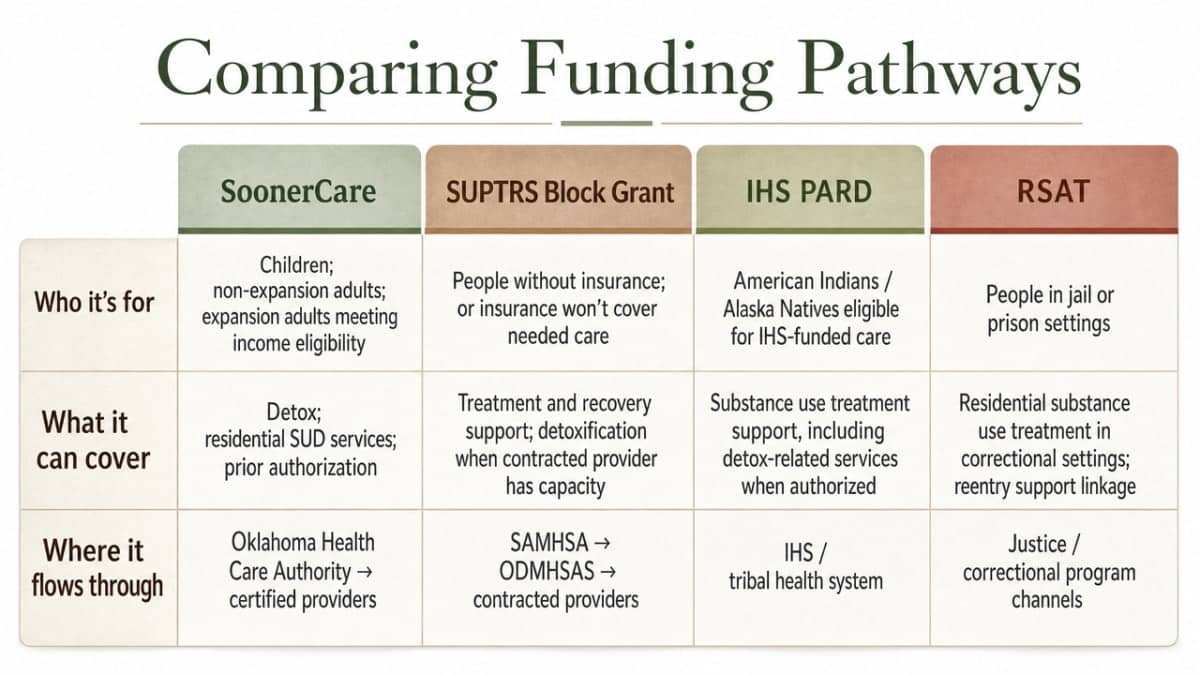
Understanding the distinctions between these funding rails is crucial for navigating detox options. The table below provides a plain comparison of who each pathway serves, what it covers, and how the funds are channeled.
| Funding rail | Who it’s for | What it can cover | Where it flows through |
|---|---|---|---|
| SoonerCare (Oklahoma Medicaid) | Children, non-expansion adults, and expansion adults who meet income eligibility—including many low-income working adults after Medicaid expansion | Detox and residential SUD services as covered benefits, with prior authorization required 1 | The Oklahoma Health Care Authority, paying certified providers directly |
| SUPTRS Block Grant | People without insurance, or with insurance that won’t cover the care they need 7 | Treatment and recovery support across the continuum, including detoxification, when a contracted provider has capacity 7 | SAMHSA to ODMHSAS to certified provider contracts |
| IHS PARD | American Indian and Alaska Native community members, including patients of urban Indian clinics like Oklahoma City Indian Clinic 12 | Social detoxification, evaluation, stabilization, and linkage into treatment 12 | Indian Health Service to tribal and urban Indian health programs |
| RSAT | People currently incarcerated in state or local correctional facilities 8 | Residential substance abuse treatment programs inside correctional and detention settings 8 | Federal award to the Oklahoma District Attorneys Council, then to correctional facilities |
SoonerCare and the SUPTRS Block Grant are the most common pathways for Oklahomans seeking detox in a community setting. PARD funding is specifically for tribal communities, while RSAT is relevant for individuals within the justice system. If multiple pathways seem applicable, certified providers can help determine the most appropriate funding source and how different options might complement each other.
Scope of Coverage: What Detox Funding Includes and Excludes
It’s important to understand that “covered” by a grant or Medicaid does not always mean all costs are eliminated. These programs are designed to cover the clinical services essential for medical detox. For instance, Oklahoma’s Medicaid rules reimburse residential substance use disorder services at per diem rates that encompass the medical and therapeutic aspects of a stay 2. A state plan amendment, effective September 2025, further specifies withdrawal management as a service under physician direction with 24/7 supervision and nursing monitoring 5. This includes physician visits, medication-assisted treatment, vital sign monitoring, and discharge planning.
Provider Eligibility: Why Some Facilities Accept Funding and Others Don’t
A common challenge in seeking detox is discovering that some facilities cannot accept certain funding types, such as SoonerCare. This is primarily due to certification requirements. In Oklahoma, alcohol and drug treatment programs, including medical detox, must hold state certification through ODMHSAS to operate legally. For residential providers, SoonerCare reimbursement additionally requires national accreditation 3. Both certifications are mandatory. The ODMHSAS certification rules, effective September 1, 2025, detail the standards for “detoxification” as a certified service 10.
Therefore, a facility lacking state certification and national accreditation cannot bill SoonerCare. Similarly, block-grant-supported slots are tied to ODMHSAS provider contracts, making certification essential for accessing these funds as well 6. When evaluating facilities, it is appropriate to ask directly about their ODMHSAS certification, national accreditation for residential care, and their ability to accept SoonerCare or block-grant-supported admissions for your specific situation.
Navigating the Initial Call for Detox Services
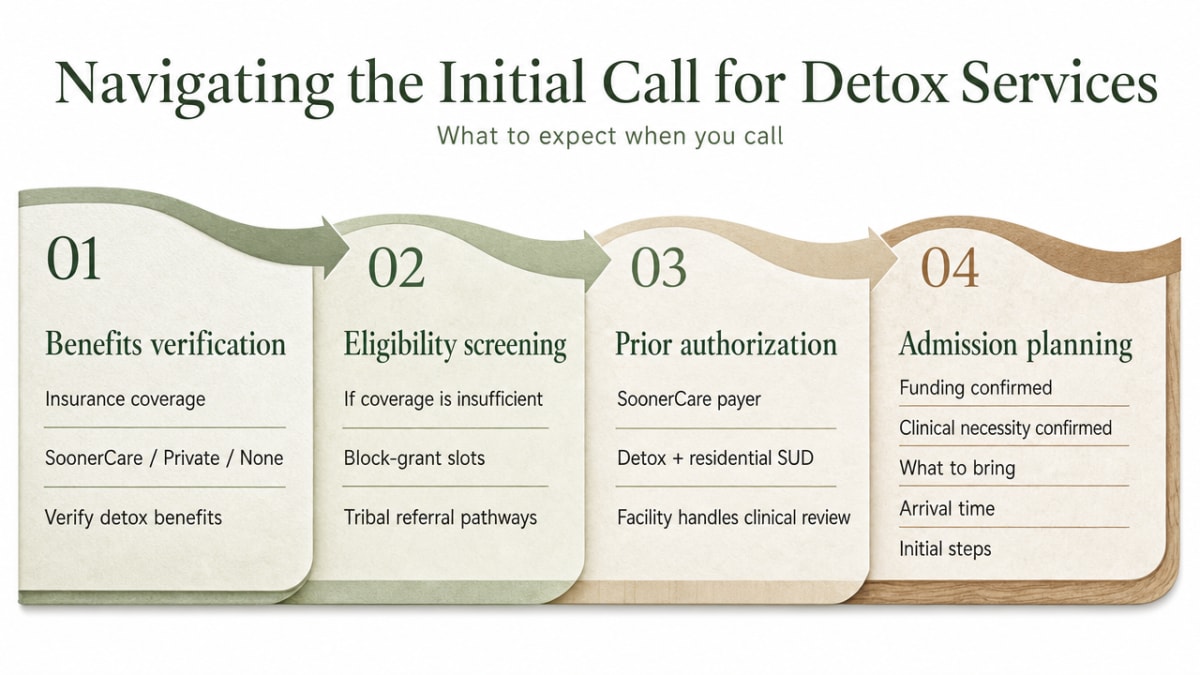
Initiating the first call for detox can be daunting, but understanding the typical process can ease the experience. The intake process usually involves four key steps.
- Benefits verification: Benefits verification: the intake team will inquire about insurance coverage (SoonerCare, private, or none) and verify what the plan covers for detox.
- Eligibility screening: if primary coverage is insufficient, they will assess eligibility for other options like block-grant-supported slots or tribal referral pathways.
- Prior authorization: if SoonerCare is the payer, detox and residential SUD services require prior authorization 1. This clinical review is handled by the facility on your behalf.
- Admission planning: once funding and clinical necessity are confirmed, the team will provide details on what to bring, arrival times, and the initial 24 hours of care, which includes physician-directed withdrawal management and 24/7 nursing monitoring, as formalized by Oklahoma’s September 2025 state plan amendment 5.
To streamline the call, have the individual’s date of birth, insurance information, and a general overview of substance use history ready. It is also helpful to ask about potential out-of-pocket costs for the clinical stay and how room and board expenses are managed, given their exclusion from SoonerCare’s per diem rates for residential SUD care 2.
Renewal Springs: Facilitating Access to Care
Renewal Springs is a medical detox facility in Oklahoma City dedicated to making care accessible. While we are not a grant-making agency, we assist individuals in understanding and navigating the various funding pathways available for detox services. Our process begins with a complimentary benefits check. If you have SoonerCare or private insurance, we verify coverage for medically supervised detox. If coverage is absent or insufficient, we explore other options, including the SUPTRS-supported network via ODMHSAS 6, 7, tribal health referrals 12, or other relevant avenues. We are committed to transparent communication, and if our facility is not the right fit for your funding situation, we will guide you toward appropriate resources.
The high standard of clinical care at Renewal Springs—including 24/7 medical supervision, medication-assisted treatment for various substances, real-time monitoring, and compassionate care—remains consistent regardless of the funding source. The primary difference lies in the pathway to admission. We encourage you to contact us, share your situation, and allow our team to help you identify the most suitable door to treatment.
Taking the Next Step: Making the Call
Understanding the complexities of detox funding in Oklahoma is a significant step toward securing help. To prepare for your call, gather three key pieces of information:
- The individual’s insurance status (SoonerCare, private, none, or unsure)
- Whether they are an enrolled tribal member
- A general overview of the substances used and last use date
With this information, you can contact a facility and inquire about funding options that may apply to your specific situation. The intake team can then guide you through the available pathways. You do not need to have all the answers before calling; simply expressing your need is the first crucial step.
Ask About Grant-Funded Detox Options Today
Connect directly to explore eligibility for grant funding and start safe, medically supervised detox without delay.
Frequently Asked Questions
Can I get detox in Oklahoma if I don’t have insurance?
Yes. The SUPTRS Block Grant from SAMHSA specifically funds treatment and recovery services for individuals without insurance or whose insurance does not cover necessary services. These funds are channeled through ODMHSAS to certified providers in Oklahoma 7, 6. While capacity may vary, this funding exists to bridge gaps in coverage. Contact a facility and openly discuss your situation.
Does SoonerCare cover medical detox?
Yes, SoonerCare covers medical detox. Oklahoma Medicaid lists detox and residential substance use disorder services as covered benefits for eligible individuals, including children and adults, with prior authorization required 1. A certified provider will manage the prior authorization process. Due to recent Medicaid expansion in Oklahoma, many working-age adults who previously did not qualify may now be eligible 13.
What is the SUPTRS block grant, and how do I access it?
The SUPTRS (Substance Use Prevention, Treatment, and Recovery Services) Block Grant is federal funding from SAMHSA provided to states to support care for individuals who cannot pay through other means 7. In Oklahoma, ODMHSAS receives these funds and contracts with certified providers who then offer block-grant-supported slots 6, 11. To access this, contact a certified detox facility and inquire about their ODMHSAS-contracted capacity that aligns with your needs.
I’m a tribal member. Are there detox funding options for me?
Yes. The Indian Health Service (IHS) funds PARD (Preventing Alcohol-Related Deaths) grants, which enhance access to social detoxification, evaluation, stabilization, and treatment linkage for American Indian and Alaska Native community members 12. The Oklahoma City Indian Clinic is one example of a site that has received this funding. Contact your tribal health program or an urban Indian clinic to learn about available detox pathways, especially for medical detox needs.
Why do some detox facilities accept SoonerCare and others don’t?
Acceptance of SoonerCare depends on facility certification. Oklahoma mandates that alcohol and drug treatment programs, including medical detox, hold ODMHSAS certification. Additionally, residential-level providers must have national accreditation to be eligible for SoonerCare reimbursement 3. The ODMHSAS rules, effective September 1, 2025, detail these standards 10. Facilities without both credentials cannot bill SoonerCare.
What costs might I still owe even with grant or Medicaid support?
While these funding streams cover the clinical aspects of detox, such as physician oversight, medications, and 24/7 nursing monitoring 5, room and board are often excluded. Oklahoma Medicaid’s per diem rates for residential SUD care and the state plan amendment for withdrawal management specifically carve out room and board 2, 5. It is important to ask the intake team how these specific costs are handled before admission.
References
- Mental Health and Substance Abuse Services – Oklahoma.gov. https://oklahoma.gov/ohca/individuals/programs/mental-health-and-substance-abuse-services.html
- 317:30-5-95.50. Residential substance use disorder (SUD) – Reimbursement. https://oklahoma.gov/ohca/policies-and-rules/xpolicy/medical-providers-fee-for-service/individual-providers-and-specialties/inpatient-psychiatric-services/residential-substance-use-disorder-reimbursement1.html
- Provider Certification – Oklahoma.gov. https://oklahoma.gov/odmhsas/policy/provider-certification.html
- Institutions for Mental Diseases Waiver for Serious Mental Illness and Substance Use Disorders Mid-Point Assessment. https://www.medicaid.gov/medicaid/section-1115-demonstrations/downloads/ok-qutrly-cms-accepted-mid-point-assessment-12132024.pdf
- Oklahoma State Plan Amendment (SPA) 25-0014. https://www.medicaid.gov/medicaid/spa/downloads/OK-25-0014.pdf
- Grants and Solicitations. https://oklahoma.gov/odmhsas/about/public-information/grant-and-solicitations.html
- Substance Use Prevention, Treatment, and Recovery Services Block Grant (SUPTRS BG). https://www.samhsa.gov/grants/block-grants/subg
- Residential Substance Abuse Treatment (RSAT). https://oklahoma.gov/dac/grants/grants-available/rsat.html
- FY 26 Budget Performance Review Oklahoma Department of Mental Health and Substance Abuse Services. https://oksenate.gov/sites/default/files/2025-01/FY%2026%20-%20DMHSAS%20-%20BPR.pdf
- CHAPTER 18 – ODMHSAS Provider Certification Rules (effective 9/1/25). https://oklahoma.gov/content/dam/ok/en/odmhsas/documents/policy/provider-certification/administrative-rules/2025/PC–Chapter-18_9-1-25.pdf
- Oklahoma Uniform Application FY 2024/2025 Combined MHBG/SUPTRS BG Application Behavioral Health Assessment and Plan. https://oklahoma.gov/content/dam/ok/en/odmhsas/documents/about/public-information/grants-and-solicitations/FFY24-25-Block-Grant-Application.pdf
- IHS Awards $16.5 Million in Grants to Support Behavioral Health Programs. https://www.ihs.gov/newsroom/pressreleases/2017pressreleases/ihs-awards-16-5-million-in-grants-to-support-behavioral-health-programs/
- Medicaid State Profile – Oklahoma. https://www.medicaid.gov/state-overviews/stateprofile.html?state=oklahoma