
Key Takeaways
- Oklahoma City families can call a detox provider like Renewal Springs to verify insurance, ask about protocols, and plan admission before their loved one has agreed to go.
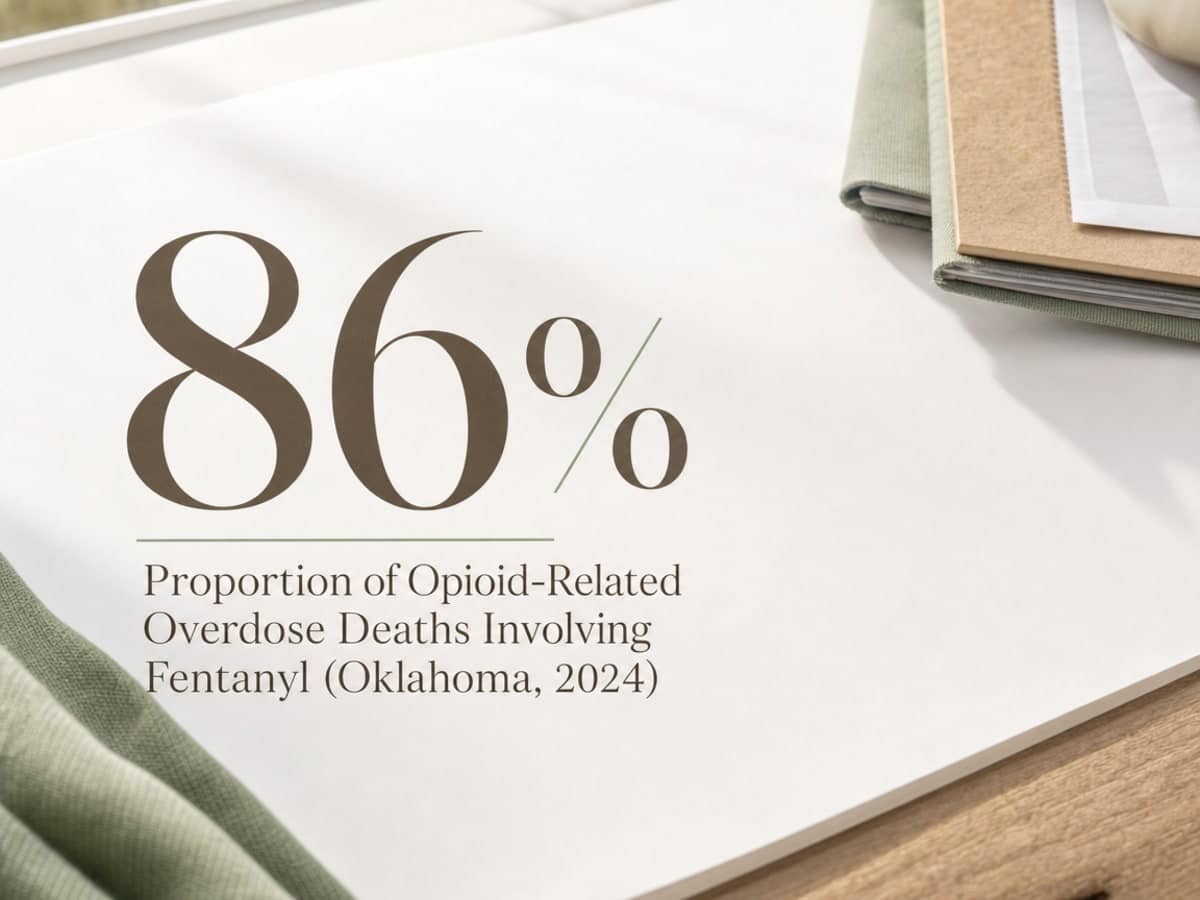
- Oklahoma’s drug supply has grown more lethal, with fentanyl involved in 86% of opioid overdose deaths and methamphetamine present in about two-thirds of overdose deaths in 2024 2, 7.
- Alcohol and benzodiazepine withdrawal can be fatal at home, making medically supervised detox with CIWA-Ar scoring and symptom-triggered benzodiazepine dosing the standard of care 12.
- Before choosing a program, compare medication protocols, monitoring practices, and the post-detox handoff, since the CDC warns that detox alone raises overdose risk once tolerance drops 14.
You Are Allowed to Make This Call First
If you are the one searching at 11 p.m. while everyone else is asleep, this is for you. Not for your son. Not for your wife. Not for the person you love who has not yet said yes. For you.
You are allowed to pick up the phone before they agree to anything. You are allowed to ask questions on someone else’s behalf. You are allowed to find out how detox in Oklahoma City actually works, what insurance would cover, and what a bed becoming available even looks like, all before your loved one has said the word yes out loud. That is not going behind their back. That is doing the quiet work that makes a yes possible when the moment comes.
Most families we hear from have already tried something. A conversation that turned into a fight. A promise that did not hold. A hospital visit that ended with a discharge paper and no plan. If that is you, you are not failing. You are learning that this is bigger than willpower, and that safe medical detox is a medical event, not a moral test.
What follows is a plain guide: what withdrawal in Oklahoma looks like right now, what medically supervised detox actually includes, how to start the conversation at home, and what your role can be before, during, and after admission. You can call Renewal Springs just to ask.
Why the Clock Matters in Oklahoma Right Now
You already know this is bad. You do not need another statistic to tell you the person you love is in trouble. But you might need one to explain to a reluctant sibling why you are not overreacting, or to steady yourself when the doubt creeps in at 2 a.m.
Here is the local picture, in plain numbers. In 2024, methamphetamine was present in about 66.7% of drug overdose deaths in Oklahoma — roughly two out of every three 2. In that same year, fentanyl was involved in 86% of opioid-related overdose deaths in the state, up from the 10 to 20% range that was typical before 2020 7. Whatever your loved one thinks they are taking, the actual chemistry in Oklahoma right now is not what it used to be. A pill that looks like a pill is often not a pill. A line that used to be one thing might be cut with something that stops breathing.
That is the part that changes the math on waiting. It is not that your loved one is weaker than they were five years ago. The supply is more lethal than it was five years ago.
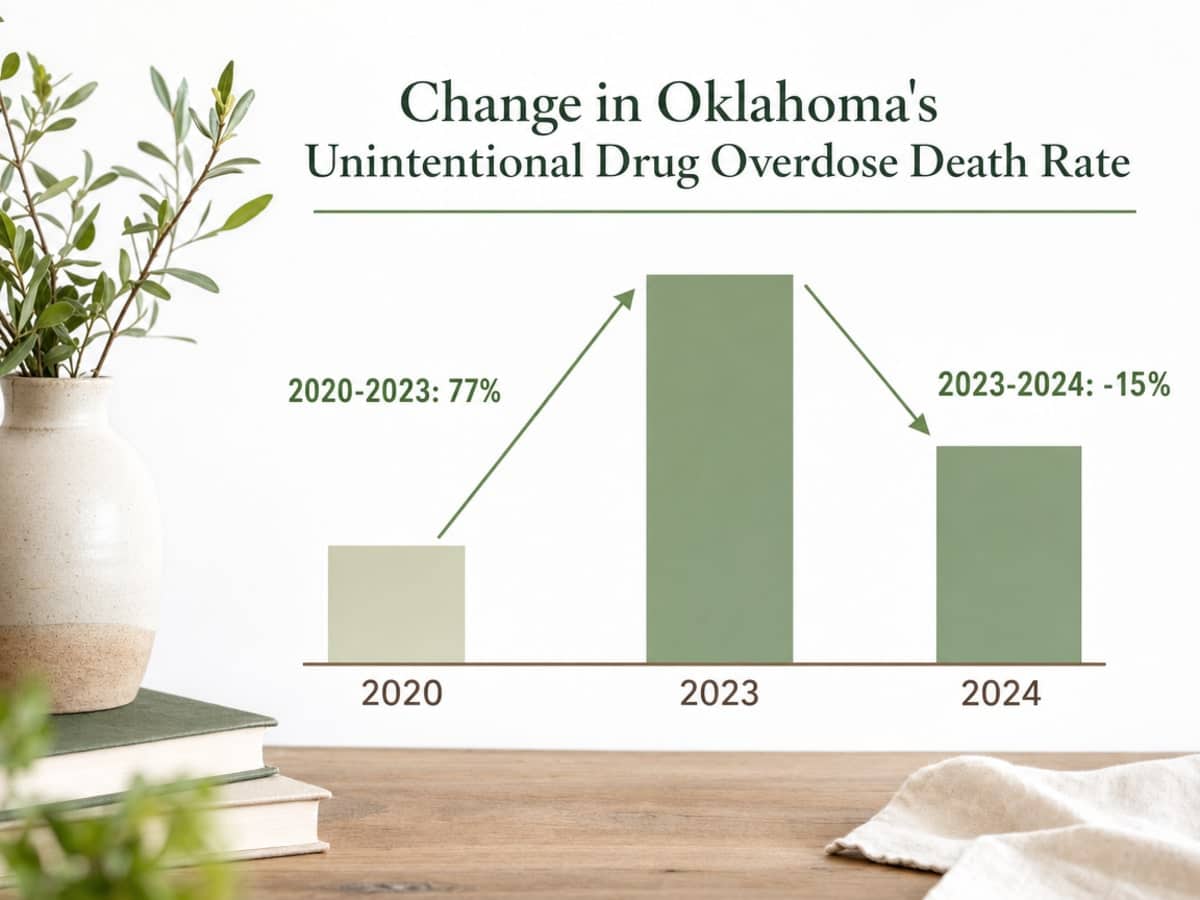
There is a little good news underneath the fear, and you are allowed to hold onto it. Oklahoma’s unintentional overdose death rate climbed 77% from 2020 to 2023, and then fell 15% from 2023 to 2024 2. Something is working — naloxone in more hands, more people getting into treatment, more families making calls like the one you are considering. The direction is not fixed. It bends when families act.
None of this means you have to panic. It does mean that “we’ll deal with it after the holidays” or “let’s see how next week goes” is a heavier bet than it used to be. If your gut has been telling you it is time, your gut is reading the same room the data is.
What Medically Supervised Detox Actually Looks Like
Alcohol Withdrawal: Why Supervision Is Not Optional
Here is what supervised alcohol detox actually involves. Medical staff run a risk assessment when your loved one arrives. They check vitals often. They use a scoring tool called the CIWA-Ar to measure withdrawal symptoms — things like tremor, sweating, agitation, nausea — and dose medication based on what the body is actually doing, not on a fixed schedule. The American Society of Addiction Medicine’s guideline names benzodiazepines as the first-line treatment for alcohol withdrawal, given based on those symptom scores rather than a preset drip 12. That guideline was built from 150 research studies and expert consensus, so this is not one clinic’s preference 13.
What that means for you: your loved one will be watched. Their heart, their breathing, their fluids, their sleep. If something starts to go sideways at 3 a.m., someone is there. That is the whole point. You do not have to be the one taking their temperature or Googling whether a shaking hand is normal.
Opioid Detox and the Question Families Forget to Ask
Opioid withdrawal is not usually life-threatening the way alcohol withdrawal is. It is, however, brutal — vomiting, diarrhea, bone-deep aches, insomnia, a level of anxiety that people describe as their skin trying to leave their body. It is the kind of misery that makes people use again just to make it stop. That is where most home detox attempts fall apart, and it is not a character flaw. It is chemistry.
Medically supervised opioid detox uses medications to blunt those symptoms so your loved one can actually get through it. But here is the question most families forget to ask, and it is the one that matters most: what happens after detox ends?
The CDC is direct about this. Detoxification on its own, without medications for opioid use disorder, is not recommended, because the risk of resuming use, overdosing, and dying from overdose actually goes up after a person’s tolerance has dropped 14. Read that again. A detox that hands your son a discharge paper and a bus token on day five, with no medication plan and no next appointment, is not a plan. It is a setup.
When you call any detox provider, including Renewal Springs, ask them directly how they connect people to medication-assisted treatment and ongoing care after detox. That is the question that separates a real recovery runway from a revolving door.
Methamphetamine and Polysubstance: Different, Not Easier
Meth withdrawal does not look like alcohol or opioid withdrawal. There is usually no seizure risk, no vomiting for days. Instead, there is a heavy crash — deep exhaustion, sleep that goes on and on, hunger, and then a stretch of depression and cravings that can last weeks. Some people become suicidal during that window. That is why supervision still matters, even without the physical drama.
Polysubstance use is more common than families expect. Your loved one may be using meth and drinking heavily, or mixing opioids with benzos, or taking pills whose contents nobody can vouch for anymore. A good detox program treats the whole picture at once, not one substance at a time. That means a medical assessment on arrival, a personalized plan, and staff who are watching for the withdrawal that shows up second, after the first one calms down.
The point is not that stimulant or polysubstance detox is easier. It is that the risks are different, and they need eyes on them.
The ER Cycle Is Not a Plan
If your loved one has already been to the emergency room once, twice, more times than you can count on one hand, you already know how that story goes. An ambulance ride. A few hours in a hallway bed. Fluids, maybe naloxone, maybe a banana bag. A social worker who hands over a printed list of phone numbers. A discharge before lunch. And then everyone goes back to the same house and the same fear, waiting for the next call.
That is not a treatment plan. That is triage. The ER is built to keep someone alive until morning, not to walk them through five to seven days of withdrawal or hand them off to a program that actually treats the reason they were in the ER in the first place.
The scale of that cycle in Oklahoma is bigger than most families realize. In 2024, the state recorded 1,137 drug overdose deaths, 4,228 inpatient hospitalizations for overdose, and 6,804 emergency department visits 4. That is thousands of families sitting in waiting rooms every year, then going home without a next step. From 2021 through 2023, nonfatal overdose hospitalizations in Oklahoma added up to $553 million in inpatient costs, with an average stay of about 4.7 days 5. Someone is paying that bill — insurance, the family, the hospital’s charity write-off — and it buys stabilization, not recovery.
A planned admission to medical detox is a different animal. Instead of a five-day inpatient stay triggered by a crisis, it is a scheduled arrival with a bed, a medical assessment, a plan for the withdrawal that is coming, and — this is the part the ER cannot give you — a warm handoff to what comes next. It is the difference between catching your loved one after they fall and giving them a way down the ladder.
You do not have to wait for the next 911 call to make the shift. If your gut has been reading the same pattern for months, the next ER visit is a fair thing to plan around, not just survive.
How to Start the Conversation at Home
What to Say Sunday Morning at the Kitchen Table
Pick a quiet moment. Not after a fight. Not in the middle of a using day. Sunday morning, or a Tuesday after work when the house is calm, or right after they’ve eaten something and the edge is off. You are looking for a window where they can hear you without their body already yelling.
Sit down. Do not stand over them. Put your phone face down. SAMHSA’s family guide puts it simply: express your concern and tell them you’re there to help, and create a judgment-free and loving environment that makes it possible to talk at all 10. That is not soft advice. That is the whole strategy.
Try something close to this: I love you. I have been scared for a while. I found a place here in Oklahoma City that does medical detox, and I called them myself to ask questions. I am not asking you to decide anything right now. I am telling you I already did some of the work, and there is a real option when you are ready.
Notice what that does. You name the fear without accusing. You name the love first. You show you have already moved, so the whole weight of the next step is not sitting on their shoulders. And you leave a door open instead of a demand on the table.
If they cry, let them cry. If they get quiet, let it be quiet. You do not have to fill the silence with more reasons. You have said the thing.
What Not to Say, Even When You Want To
Do not lead with the list. You know the list. Every job they lost, every lie, every night you sat up. Reciting it now feels like justice, and it will end the conversation before it starts. Save it for a therapist’s office, not the kitchen table.
Skip the ultimatums you cannot enforce. “If you don’t go, I’m done” only works if you actually mean it, and even then it turns a medical decision into a loyalty test. That is not the frame you want.
Do not say “clean” or “sober” or “addict” if you can help it. Say the person’s name. Say the way you’ve been feeling, or what’s been happening with the pills. Person-first language is not political correctness. It is the difference between talking to someone and talking about a category.
And please, do not stage a group ambush with cousins and coworkers reading letters. The dramatic intervention scene from television is not what current guidance recommends. A quiet, honest conversation with one or two people who love them will move further than a room full of witnesses.
If They Say No Today
They might say no. They might get angry. They might walk out the back door and not come home until Tuesday. That is not the end of anything. It is one conversation on one day.
Here is what a no actually means most of the time: I am scared, and I am not ready to say yes in front of you right now. It rarely means never. What you have done, by naming it out loud and telling them you already looked into a place, is plant a marker they will come back to. Sometimes that takes hours. Sometimes weeks.
In the meantime, keep the door open. Do not punish them with silence for saying no. A returned text, a shared meal, a ride to an appointment for something unrelated — these are the small yeses that lead to the bigger one. Celebrate them without making a scene.
Take care of yourself in the gap. Eat. Sleep if you can. Call the SAMHSA National Helpline at 1-800-662-HELP for your own support and referrals — it is free, confidential, and open around the clock for family members, not just people using 11. You are allowed to need help too.
How Admission Usually Works Once They Say Yes
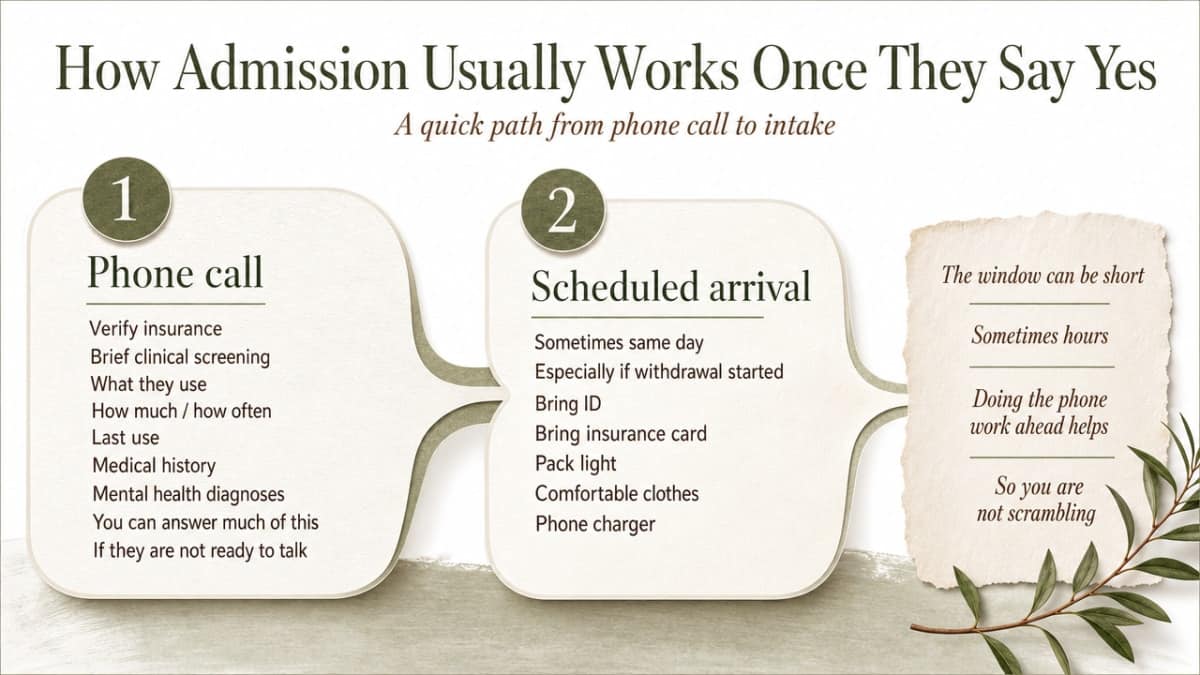
When your loved one finally says yes, the window can be short. Sometimes hours. That is why doing the phone work ahead of time matters — so when the yes lands, you are not scrambling to figure out where to drive.
Here is the shape of most medical detox admissions in Oklahoma City, so nothing feels like a surprise.
- A phone call to verify insurance and go through a brief clinical screening. Staff will ask what they are using, how much, how often, when they last used, medical history, and any mental health diagnoses. You can answer a lot of this yourself if your loved one is not ready to talk. That is a legitimate use of your time.
- A scheduled arrival. Some admissions happen the same day, especially if withdrawal has already started. Bring an ID and insurance card if you have them. Pack light — comfortable clothes, a phone charger, a toothbrush, a book. Most facilities have restrictions on what comes in, and staff will walk you through that list on the phone.
- The medical intake. A nurse and a clinician assess vitals, run labs, and build a personalized withdrawal plan based on what your loved one is actually coming off of. This is where the CIWA-Ar scoring, medication decisions, and monitoring plan get set. Then the door closes, and their body starts the work.
You are usually asked to say goodbye at the intake desk, not the bedroom. That part is harder than people expect. It is also the moment the weight comes off your shoulders and onto the medical team where it belongs.
Your Role Before, During, and After Admission
You are not a bystander in this. SAMHSA’s TIP 45 guidance for detox providers is explicit that services planning should be completed in partnership with the patient and their social support network, including family 8. That is not a courtesy. That is the standard of care. You have a job.
Before admission, you are the intelligence-gatherer. Call the detox provider yourself. Verify insurance. Ask about medication protocols, average length of stay, and what post-detox handoff looks like. Know where the building is and how long the drive takes. Pack a bag in your closet so it is ready when the yes comes. Line up childcare, pet care, the boss, the school — the logistics your loved one cannot think about while they are sick.
During admission, your job changes. Once the intake door closes, the medical team has the medical part. You do not need to text every hour. You do need to answer the phone if the clinical team calls with a question about history or medications. Send a card. Drop off a book if the facility allows it. Keep the home quiet so there is somewhere calm to come back to.
After admission is where families often go silent, and it is the moment that matters most. TIP 39 evidence is clear that involving family members in substance use disorder treatment can positively affect client engagement, retention, and outcomes 9. Show up for the family session. Learn the difference between supporting and enabling. Keep going to your own support meetings even when they are doing well. This is a long road, and your steadiness is part of the treatment.
Calling Renewal Springs Before They’ve Said Yes
Here is the part most families do not know: you can call a detox facility and ask questions for someone who has not agreed to go yet. That is a normal call. Renewal Springs takes those calls from spouses, parents, adult children, and siblings in Oklahoma City every week. You do not need your loved one’s permission to ask what a medical detox admission would look like for them, whether their insurance would cover it, or what the intake process involves.
When you call, you can ask about medication protocols for the substance they are using, how staff monitor withdrawal, what happens after the detox portion ends, and how the team connects people to ongoing care — the question the CDC says matters most for opioid use, because detox alone is not enough on its own 14. You can ask about veteran-specific care, gender-specific programs, and private options. You can walk through a free insurance benefits check with your card, or theirs if you have it. None of that requires them to be on the line.
What you are doing is building the runway. When the yes comes — Tuesday night, Sunday morning, after the next scare — the drive is already mapped, the bag is already packed, and you know the name of the person who answered the phone. That is not overstepping. That is love with a plan.
Talk with a caring expert about next steps
Get clear answers and guidance for your loved one’s safe detox journey, right now.
Frequently Asked Questions
Can I call a detox center in Oklahoma City before my loved one has agreed to go?
Yes. This is one of the most common calls detox facilities take. You can ask about admissions, verify insurance, and walk through what withdrawal management looks like without your loved one on the line. Renewal Springs talks with spouses, parents, and adult children in Oklahoma City every week who are gathering information before the yes ever comes.
Is medically supervised detox really necessary, or can they just stop at home?
For alcohol and benzodiazepines, stopping cold at home can trigger seizures or delirium tremens, both of which can be fatal. ASAM’s guideline names benzodiazepines with CIWA-Ar symptom-triggered dosing as first-line care for alcohol withdrawal for a reason 12. For opioids and stimulants, withdrawal is rarely deadly but brutal enough that most home attempts fail, and relapse after tolerance drops raises overdose risk sharply 14.
What should I ask a detox provider about what happens after detox ends?
Ask directly how they connect people to ongoing care once withdrawal is managed. For opioids specifically, the CDC states that detoxification alone, without medications for opioid use disorder, is not recommended because overdose risk rises after tolerance falls 14. Good answers include a warm handoff to residential or outpatient care, a scheduled first appointment, and a written medication plan. “They can figure it out later” is not an answer.
How do I start the conversation without pushing them further away?
Pick a calm moment, not the middle of a fight. Sit down instead of standing over them. SAMHSA’s family guide recommends expressing your concern, telling them you are there to help, and creating a judgment-free space so they can actually hear you 10. Lead with love, not the list of grievances. Show you have already made a call, so the whole weight of the next step is not on them.
What do I do if my loved one says no today?
A no on Tuesday is not a no forever. Keep the door open. Do not punish the no with silence or ultimatums you cannot enforce. Stay in their life through small yeses — a returned text, a shared meal, a ride somewhere unrelated. Take care of yourself in the meantime; SAMHSA’s guidance for families explicitly reminds caregivers to care for themselves too 10.
Are there other resources I can call alongside a local detox center?
Yes. The SAMHSA National Helpline at 1-800-662-HELP (4357) is free, confidential, and open 24/7, and it takes calls from family members, not just people who are using 11. It offers information and treatment referrals. Using it alongside a local call to Renewal Springs gives you both a national backstop and a specific bed in Oklahoma City.
References
- Drug Overdose Data Dashboard – Oklahoma.gov. https://oklahoma.gov/health/health-education/injury-prevention-service/drug-overdose/data/drug-overdose-data-dashboard.html
- Data – Oklahoma.gov. https://oklahoma.gov/health/health-education/injury-prevention-service/drug-overdose/data.html
- Drug Overdose Deaths, 2019-2023 – Oklahoma (Fact Sheet). https://oklahoma.gov/content/dam/ok/en/health/health2/aem-documents/prevention-and-preparedness/injury-prevention/drug-overdose/2025%20State%20Drug%20OD%20-%20IPS%20-%20Fact%20Sheet.pdf
- Drug Overdose Data Graphs and Maps – Oklahoma. https://oklahoma.gov/content/dam/ok/en/health/health2/aem-documents/prevention-and-preparedness/injury-prevention/drug-overdose/Drug%20Overdose%20Data%20Graphs%20and%20Maps.pdf
- Oklahoma drug overdose deaths, 2019-2023 (Digital Prairie). https://digitalprairie.ok.gov/digital/collection/stgovpub/id/729608/
- Fatal Overdose Data (Oklahoma Digital Prairie). https://digitalprairie.ok.gov/digital/api/collection/stgovpub/id/728296/download
- Gov. Signs Overdose Notification, Fentanyl Reporting. https://www.okhouse.gov/posts/news-20260515_2
- Quick Guide for Clinicians Based on TIP 45—Detoxification and Substance Abuse Treatment. https://nida.nih.gov/sites/default/files/samhsa_detoxification_and_substance_abuse_treatment.pdf
- The Importance of Family Therapy in Substance Use Disorder Treatment (Advisory). https://library.samhsa.gov/product/advisory-importance-family-therapy-substance-use-disorder-based-tip-39/pep20-02-02-016
- Helping a Loved One Dealing with Mental and/or Substance Use Disorders. https://www.samhsa.gov/sites/default/files/samhsa_families_family_support_guide_final508.pdf
- National Helpline for Mental Health, Drug, Alcohol Issues. https://www.samhsa.gov/find-help/helplines/national-helpline
- Clinical Guideline Highlights for the Hospitalist: 2020 ASAM Guideline on Alcohol Withdrawal Management. https://pubmed.ncbi.nlm.nih.gov/34910619/
- Executive Summary of the ASAM Clinical Practice Guideline on Alcohol Withdrawal Management. https://pubmed.ncbi.nlm.nih.gov/32909985/
- Opioid Use Disorder: Treating | Overdose Prevention (CDC). https://www.cdc.gov/overdose-prevention/hcp/clinical-care/opioid-use-disorder-treating.html