
Key Takeaways
- Medical safety comes down to current credentials, physician and RN supervision, guideline-based medications, and a written overdose prevention plan — not marketing language or lobby aesthetics.
- Verify four documents before admission: SAMHSA OTP certification, DEA registration, ODMHSAS state licensure, and current Joint Commission or CARF accreditation 2, 5, 7.
- Confirm a registered nurse is physically on the unit 24 hours a day and the physician can reach bedside in minutes, because withdrawal peaks overnight 6.
- Expect methadone, buprenorphine, or naltrexone dosed the way TIP 63 and ASAM describe — gradual induction, individualized to the patient, never abrupt cessation 8, 9, 10.
- End the tour if a program offers ultrarapid detox under anesthesia, forces a taper off existing MAT, or keeps no naloxone on-site 8, 9, 13.
- Insist on take-home naloxone and family training at discharge, since tolerance drops fast and the days after leaving are the highest-risk overdose window 13, 14.
- Ask what day 8, day 30, and day 90 look like — a warm handoff, continued MAT when indicated, and family involvement signal a program that treats addiction as chronic 11, 12, 15.
- Use ten specific intake questions to test the pattern of answers; defensiveness about the questions themselves is a clearer signal than any single response.
What medical safety actually means when your child is in withdrawal
If this isn’t the first program you’ve looked at, you already know the sales language starts to blur together. “State-of-the-art.” “Compassionate care.” “Fully accredited.” None of those phrases tell you whether your adult child will be safe at 3 a.m. on day two, when the sweating and vomiting peak and their heart rate climbs.
Medical safety in a heroin rehab center is not a feeling you get from a nice lobby. It is four specific things lining up at the same time.
First, the program holds current federal and state credentials for what it says it does. For any facility using methadone or buprenorphine, that means SAMHSA certification, DEA registration, and adherence to the updated 42 CFR Part 8 rules that took effect in April 2024 2. In Oklahoma, a residential medical detox also needs ODMHSAS certification plus national accreditation from a body like the Joint Commission or CARF 7.
Second, a licensed physician and a registered nurse supervise withdrawal management, not just an on-call number 6. Withdrawal from heroin or fentanyl is rarely fatal on its own, but dehydration, cardiac stress, and co-occurring conditions can turn dangerous fast. Oklahoma’s rules exist because someone has to be qualified to notice that shift and act on it.
Third, the medications match the guidelines. That means methadone, buprenorphine, or naltrexone used the way SAMHSA’s TIP 63 and ASAM’s National Practice Guideline describe, not abrupt cessation and not ultrarapid detox under anesthesia 8, 9.
Fourth, there is a written plan for overdose prevention and what happens after discharge, because the highest-risk window for a fatal overdose is the days right after someone leaves a program with a lowered tolerance 13.
The fact that you’re reading this list means you’re already doing the job well. The rest of this piece turns each of those four pillars into questions you can ask on a single phone call.
The four credentials to verify before you sign anything
SAMHSA OTP certification, DEA registration, and state licensure
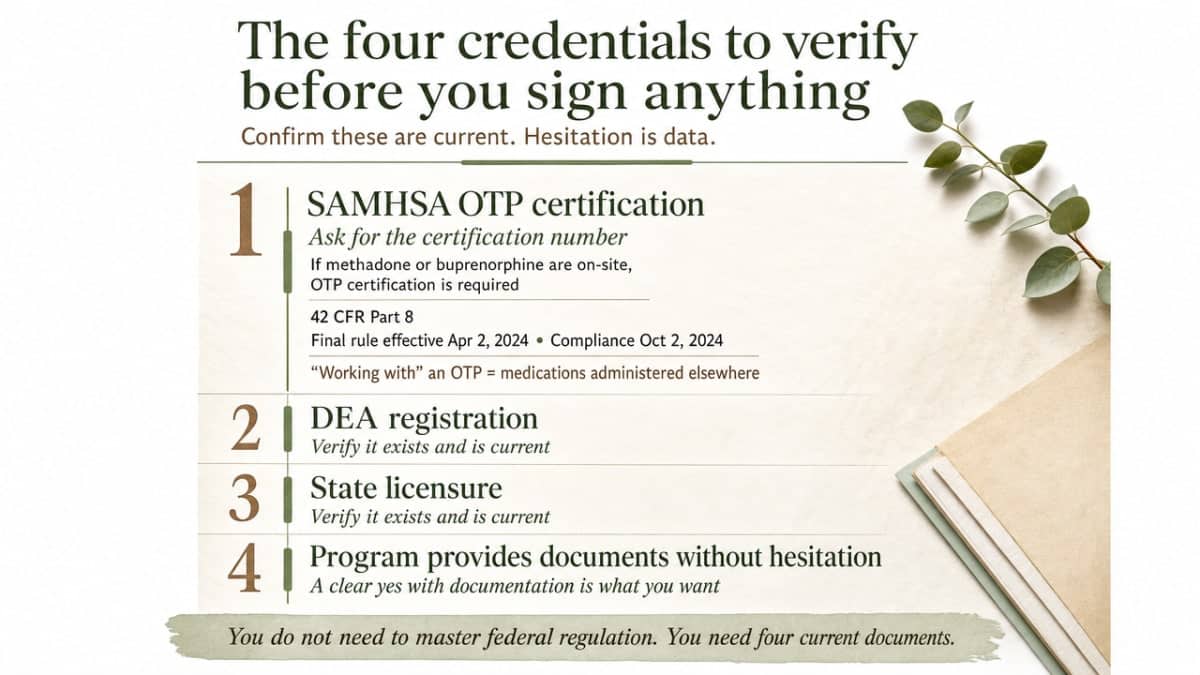
You do not need to become an expert in federal regulation. You need to confirm four documents exist and are current. Any legitimate program will hand you this information without hesitation. Hesitation itself is data.
- Start with SAMHSA certification. If a heroin rehab center uses methadone or buprenorphine on-site, it must operate as a certified opioid treatment program under 42 CFR Part 8, which was updated by final rule effective April 2, 2024, with compliance required by October 2, 2024 2. Ask directly: “Are you a SAMHSA-certified opioid treatment program, and can you send me the certification number?” A yes with a number is what you want. A vague answer about “working with” an OTP means the medications are administered somewhere else, and you need to know where and how the handoff works.
- Second, DEA registration. Methadone and buprenorphine are controlled substances, and the facility that dispenses them must be registered with the Drug Enforcement Administration 4. This is not a marketing credential. It is a legal prerequisite for having those medications on the premises at all.
- Third, state licensure. In Oklahoma, that means certification from the Department of Mental Health and Substance Abuse Services (ODMHSAS). For a residential-level provider — halfway house, residential treatment, or medical detox — ODMHSAS certification is required, and for opioid substitution treatment specifically, the program must also hold SAMHSA certification and DEA registration 7.
- Fourth, current accreditation from a recognized national body. Under 42 CFR §8.11, an OTP must hold both valid SAMHSA certification and a current, valid accreditation from an approved accrediting organization to operate lawfully 5.
Write those four items on a piece of paper before you call. Cross each one off as they answer. If a program cannot produce all four, you are not being difficult by walking away.
National accreditation and what Oklahoma requires on top of it
National accreditation is where a lot of families get lost, because facilities use the word loosely. The two accreditors that actually count for residential medical detox are the Joint Commission and CARF (the Commission on Accreditation of Rehabilitation Facilities). If a program tells you it’s “accredited” without naming one of those, ask which body, when the last survey was, and whether there were any major citations.
In Oklahoma, this is not optional. ODMHSAS requires that residential-level providers — halfway house, residential, and medical detox — hold national accreditation in addition to state certification to be eligible for SoonerCare reimbursement 7. That means a licensed Oklahoma medical detox should be able to point to both an ODMHSAS certificate and a Joint Commission or CARF accreditation. One without the other is a gap you should ask about directly.
You can verify all of this yourself in about fifteen minutes. The ODMHSAS provider certification page lists certified programs. The Joint Commission and CARF both publish searchable directories of accredited organizations. SAMHSA’s treatment locator will confirm OTP certification. You do not have to take a facility’s word for anything.
One quiet signal that a program takes this seriously: they will tell you their last accreditation date without being asked, and they will describe what changed after the survey. Programs that treat accreditation as a wall decoration usually cannot answer that second question. Programs that treat it as a working standard almost always can.
Who is actually in the building at 3 a.m.
Withdrawal doesn’t keep business hours. The sickest moments usually land somewhere between midnight and dawn, when the day-shift physician has gone home and the receptionist who gave you the warm tour is long off the clock. What matters then is who stayed.
Oklahoma’s rule on this is not soft. Medically supervised withdrawal management outside a hospital must be delivered “under the direction of a licensed physician and a licensed registered nurse supervisor” 6. That is the floor, not the ceiling. When you call, ask two specific questions: “Is there a registered nurse physically on-site 24 hours a day?” and “How quickly can the physician be at bedside if my son’s blood pressure or heart rate goes out of range?” A safe program answers the first with a flat yes and the second with a number of minutes.
SAMHSA’s 2024 federal guidelines describe what qualified staffing actually does across a day:
- patient assessment on admission,
- individualized care planning,
- medication administration under practitioner judgment,
- and continuous safety monitoring 1.
Translated into a 24-hour rhythm, a medically supervised detox day includes vital sign checks every few hours during the acute phase, MAT dosing at scheduled intervals with sedation and respiratory checks after each dose, a physician round at least daily with orders adjusted to symptoms, RN presence overnight, and a mental health screening early in the stay to catch depression, suicidal thinking, or co-occurring conditions that change the plan 1, 6.
Ask the intake coordinator to walk you through a typical day. Not the marketing version. The clinical one. If they can name the vital-sign intervals, the MAT dosing schedule, and how they document response to each dose, you are talking to a program that runs on protocol. If the answer drifts back to “our staff is amazing” without specifics, keep asking.
One more question worth its weight: “What happens if my daughter’s condition changes and she needs a hospital?” A safe facility has a written transfer agreement, a documented threshold for escalation, and a physician willing to make that call quickly. Oklahoma’s rules require assessment to rule out conditions needing hospitalization at admission 6, and a good program keeps assessing all the way through, not just at the front door.
You are not being paranoid by asking these questions at 4 in the afternoon. You are asking the questions your child cannot ask at 3 in the morning.
Medications that belong on the protocol, and the ones that shouldn’t
Methadone, buprenorphine, and naltrexone under ASAM and TIP 63
Here is the part where a lot of parents get quietly steamrolled. A program will describe its medication approach in soothing generalities, and unless you know what the guidelines actually say, it all sounds reasonable. It isn’t always.
There are three FDA-approved medications for opioid use disorder, and any medically safe heroin rehab center should be able to talk about all three without flinching.
- Methadone
- a full opioid agonist administered in a certified OTP setting.
- Buprenorphine
- a partial agonist that can be used in inpatient and outpatient settings.
- Naltrexone
- an opioid blocker used after a person is fully detoxed.
SAMHSA’s TIP 63 describes each of these as safe and effective when used appropriately, and the 2024 federal OTP guidelines expect programs to individualize the choice to the patient rather than default to one medication for everyone 1, 9.
The ASAM National Practice Guideline is even more direct on one point: using medications for opioid withdrawal management is recommended over abrupt cessation 8. In plain language, a facility that plans to “tough it out” with your child, offering only comfort meds and IV fluids, is not following the standard of care for heroin or fentanyl dependence.
When you ask about dosing, listen for the phrase “start low, go slow.” TIP 63 spells out what that looks like for inpatient methadone induction: an initial dose of 10 to 20 mg per day, increased slowly by 5 mg every few days in response to withdrawal symptoms and level of sedation 10. You do not need to memorize the numbers. You need to hear that the program treats dosing as something adjusted to your child, not something read off a chart.
Ask two more things. How does the team monitor for sedation and respiratory depression after each dose? And how do they screen for benzodiazepines or other CNS depressants that can turn a routine dose into a dangerous one? Those are the questions TIP 63 says a competent clinician should already be asking 10.
Practices that should end the tour: ultrarapid detox, forced MAT taper, no naloxone
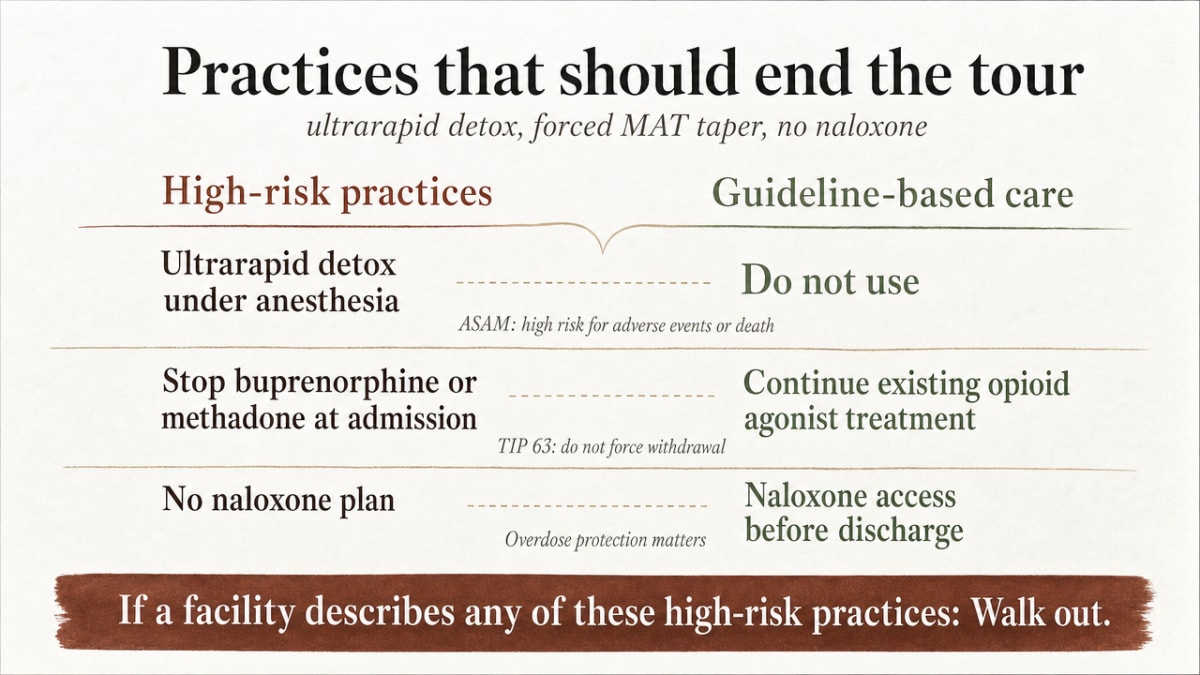
Some practices are not gray areas. If a facility describes any of the following, you have your answer.
- Ultrarapid opioid detoxification under anesthesia. ASAM’s National Practice Guideline states plainly that this approach
“is not recommended due to high risk for adverse events or death”
8. If a program offers to “reset” your child’s tolerance in a few hours under sedation, that is the sentence you need to remember. Walk out. - Forcing withdrawal from opioid agonist treatment at admission. If your adult child is already stable on buprenorphine or methadone from a previous prescriber and the facility says the first step is to stop that medication, they are working against TIP 63. The expert panel behind TIP 63 explicitly urges providers not to force patients to withdraw from opioid agonist treatment in the hospital, especially when there is acute illness, pain, or mental illness in the picture 9. Continuing MAT during admission is not a compromise. It is the standard.
- No naloxone on-site. Any facility handling opioid withdrawal should have naloxone stocked and staff trained to use it. It should also be part of the discharge plan, not just the emergency drawer 13, 14. If a program cannot tell you how many naloxone kits they dispensed to families last month, that is a real signal.
The chart below lines up what the guidelines actually recommend against what a substandard program might describe. Read it once before your next call. If a phrase from the right column comes out of an intake coordinator’s mouth, you have the citations you need to push back.
| Medically safe (ASAM, TIP 63) | High-risk practice |
|---|---|
| Gradual withdrawal management using methadone, buprenorphine, or clonidine 8 | Abrupt cessation with only comfort medications |
| Methadone induction at 10–20 mg initial dose, increased by 5 mg every few days 10 | Rapid dose escalation to “get past” withdrawal faster |
| Inpatient or certified OTP setting for methadone 8 | Ultrarapid detox under anesthesia (UROD) — not recommended, risk of death 8 |
| Continued opioid agonist treatment during admission when clinically indicated 9 | Forced taper off buprenorphine or methadone at intake 9 |
| Naloxone stocked on-site and dispensed at discharge with family training 13, 14 | No naloxone available; no take-home kit at discharge |
Overdose prevention: naloxone on the wall and in your hand at discharge
Here is the piece of the plan that nobody wants to talk about at admission, and everybody needs to talk about anyway. The days right after a person leaves a heroin detox are the highest-risk window for a fatal overdose, because tolerance drops fast and old doses become lethal ones. A medically safe program plans for that reality out loud, not in a footnote.
On-site, naloxone should be stocked where staff can reach it in seconds, and every clinical staff member should be trained to recognize an overdose and use it. Ask the intake coordinator directly: “Where is naloxone kept on the unit, and who is trained to administer it?” A specific answer — the nurses’ station, every RN and every tech, refreshed annually — is what you want to hear.
Then ask about discharge. The CDC’s evidence-based strategy is clear that treatment facilities should provide overdose response training and take-home naloxone kits to people leaving the program 13. The CDC Naloxone Toolkit goes further and encourages engaging families and caregivers in that training, not just the patient 14. That means you should expect to be handed a naloxone kit before your child walks out the door, and you should expect someone to show you how to use it.
If a program cannot answer how many kits it dispensed last month, or if naloxone is treated as an emergency-only item rather than a discharge standard, that is a gap. You are allowed to name it. Bringing your child home with a kit in your bag and the training in your head is not pessimism. It is the part of the plan that keeps the next 30 days survivable.
Continuity of care: what happens on day 8, day 30, and day 90
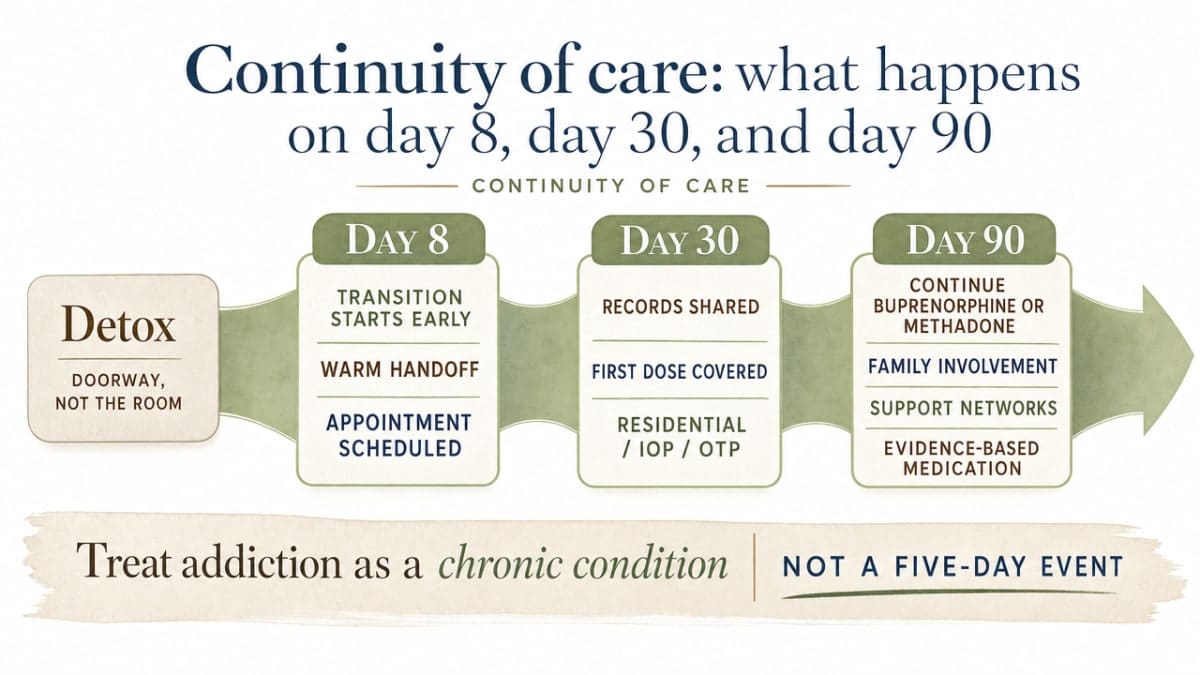
Detox is the doorway, not the room. A medically safe heroin rehab center knows that and builds the plan for what comes next before your child is even discharged. If the conversation about day 8 doesn’t start on day 2, that is a gap worth naming.
Ask what the transition looks like. A safe program treats addiction as a chronic condition with continuity of care, not a five-day event with a handshake at the end 12. That means a warm handoff to residential treatment, an intensive outpatient program, or an OTP that can continue buprenorphine or methadone maintenance — with the appointment scheduled, the records shared, and the first dose covered so nothing lapses 15.
SAMHSA’s quality-treatment guidance names family involvement and support networks as core signs of a good program, alongside evidence-based medication 11. Practically, that means you should be part of the discharge conversation. Ask who calls to check in on day 8, whether there is a case manager assigned through day 30, and what the plan is if your child misses an appointment in the first two weeks.
One more thing worth confirming: continued MAT is not a failure of recovery. If buprenorphine or methadone maintenance is part of the 90-day plan, that is the standard of care, not a compromise 9. A program that talks about MAT as something to “get off of quickly” is arguing with the guideline.
Ten questions to ask on the intake call, and the answers that should reassure you
You do not need a script. You need ten questions and a sense of what a safe answer sounds like. Read these once before you dial. Keep the list next to you and take notes.
- Are you a SAMHSA-certified opioid treatment program, and can you share the certification number? Safe answer: yes, with the number, and an offer to email documentation 2, 5.
- Do you hold current accreditation from the Joint Commission or CARF, and when was your last survey? Safe answer: a named accreditor, a specific date, and a willingness to describe what changed after the survey 11.
- Are you certified by ODMHSAS as a medical detox provider? Safe answer: yes, and they can point you to the state’s provider directory to verify 7.
- Is a registered nurse physically on the unit 24 hours a day, and how quickly can the physician get to bedside? Safe answer: RN on-site around the clock, physician response measured in minutes 6.
- Which FDA-approved medications do you use for opioid withdrawal, and how do you choose between them? Safe answer: methadone, buprenorphine, and naltrexone are all on the table, matched to the patient 9.
- If my child is already on buprenorphine or methadone, will you continue it? Safe answer: yes, unless there is a clear clinical reason not to 9.
- How do you monitor for sedation and respiratory depression after each dose? Safe answer: scheduled vital sign checks, documented response, and screening for benzodiazepines or other CNS depressants 10.
- Do you have naloxone on-site, and will you send my child home with a kit and training for me? Safe answer: yes to both, with family training built into discharge 13, 14.
- What does the day-8 and day-30 plan look like, and who arranges it? Safe answer: a case manager, a scheduled handoff to residential or outpatient care, and continued MAT if clinically indicated 15.
- How do you handle co-occurring mental health conditions during detox? Safe answer: a mental health screening early in the stay, and a plan that treats depression, anxiety, or trauma alongside withdrawal 12.
You do not need every answer to be perfect. You need the pattern to hold. If eight of ten answers land clearly and two need a follow-up call, that is a program worth a second conversation. If the coordinator gets defensive about the questions themselves, you have your answer already.
Talk Now With a Medical Detox Professional
Connect instantly for guidance on safe, medically supervised heroin detox and next steps for your loved one.
Frequently Asked Questions
How can I verify a heroin rehab center’s credentials in Oklahoma?
You can confirm most of it yourself in under twenty minutes. Check the ODMHSAS provider directory for state certification, then search the Joint Commission or CARF directory for current accreditation — Oklahoma requires both for residential medical detox 7. For any program using methadone or buprenorphine, verify SAMHSA OTP certification through the treatment locator and ask the facility to email its certification number 5. If any of the four cannot be produced, treat that gap as an answer.
Is medication-assisted treatment safer than a medication-free detox for heroin withdrawal?
Yes, and the guidelines are direct on this. ASAM’s National Practice Guideline recommends medications for opioid withdrawal management over abrupt cessation, because untreated withdrawal drives relapse and post-detox overdose risk 8. SAMHSA’s TIP 63 describes methadone, buprenorphine, and naltrexone as safe and effective when used appropriately and matched to the patient 9. A program offering only comfort meds and IV fluids for heroin or fentanyl dependence is working below the standard of care your child deserves.
What should I do if a facility says they’ll take my child off buprenorphine or methadone at admission?
Push back, with the citation in hand. The TIP 63 expert panel urges providers not to force patients to withdraw from opioid agonist treatment during admission, especially when acute illness, pain, or mental illness is present 9. Ask what the clinical reason is, in writing. If there isn’t one, that facility is arguing with the guideline. Continued MAT during admission and after discharge is the standard, not a compromise or a sign of weaker recovery.
Should the rehab center send my child home with naloxone at discharge?
Yes, and they should train you to use it. The CDC’s evidence-based strategy calls for treatment facilities to provide overdose response training and take-home naloxone kits to people exiting the program, because tolerance drops fast and the post-discharge window is the highest-risk period 13. The CDC Naloxone Toolkit specifically encourages engaging families and caregivers in that training 14. If a program treats naloxone as an emergency-drawer item only, ask them to add a discharge kit and family instruction.
What medical staffing should be on-site overnight during heroin detox?
At minimum, a registered nurse physically present around the clock, with a licensed physician directing care and reachable quickly. Oklahoma’s rules require medically supervised withdrawal management to operate under the direction of a licensed physician and a licensed RN supervisor 6. Ask two questions: is there an RN on the unit at 3 a.m., and how fast can the physician get to bedside if vital signs go out of range? A safe program answers in minutes, not hours.
Is ultrarapid detox under anesthesia a legitimate option for heroin dependence?
No. ASAM’s National Practice Guideline states plainly that ultrarapid opioid detoxification under anesthesia is not recommended due to high risk for adverse events or death 8. If a facility markets a way to “reset” tolerance in a few hours while your child is sedated, that single sentence is enough to end the conversation. A medically safe program uses gradual withdrawal management with methadone, buprenorphine, or clonidine, adjusted to your child’s symptoms — not a shortcut that the guideline explicitly warns against.
References
- Federal Guidelines for Opioid Treatment Programs (2024). https://library.samhsa.gov/product/federal-guidelines-opioid-treatment-programs-2024/pep24-02-011
- 42 CFR Part 8 Final Rule. https://www.samhsa.gov/substance-use/treatment/opioid-treatment-program/42-cfr-part-8
- Statutes, Regulations, and Guidelines. https://www.samhsa.gov/substance-use/treatment/statutes-regulations-guidelines
- Federal Guidelines for Opioid Treatment Programs (full PDF). https://library.samhsa.gov/sites/default/files/federal-guidelines-opioid-treatment-pep24-02-011.pdf
- Subpart B—Certification and Treatment Standards (42 CFR §8.11, §8.12). https://www.govinfo.gov/content/pkg/CFR-2011-title42-vol1/pdf/CFR-2011-title42-vol1-sec8-11.pdf
- CHAPTER 18. Standards and Criteria for Substance-Related and Addictive Disorder Treatment Facilities (Oklahoma). https://oklahoma.gov/content/dam/ok/en/odmhsas/documents/policy/provider-certification/administrative-rules/2021/Chapter%2018%20Final%20effective%209-15-21.pdf
- Provider Certification – Oklahoma Department of Mental Health and Substance Abuse Services. https://oklahoma.gov/odmhsas/policy/provider-certification.html
- American Society of Addiction Medicine (ASAM) National Practice Guideline for the Use of Medications in the Treatment of Addiction Involving Opioid Use. https://pmc.ncbi.nlm.nih.gov/articles/PMC4605275/
- TIP 63: Medications for Opioid Use Disorder – Full Document. https://www.samhsa.gov/resource/ebp/tip-63-medications-opioid-use-disorder
- TIP 63: Medications for Opioid Use Disorder (PDF). https://library.samhsa.gov/sites/default/files/pep21-02-01-002.pdf
- Finding Quality Treatment for Substance Use Disorders. https://library.samhsa.gov/product/finding-quality-treatment-substance-use-disorders/pep18-treatment-loc
- What to Look for in an Addiction Treatment Center. https://docs.house.gov/meetings/IF/IF02/20171212/106716/HHRG-115-IF02-20171212-SD008.pdf
- Evidence-Based Strategies for Preventing Opioid Overdose: What’s Working in the United States, 2018. https://www.cdc.gov/overdose-prevention/media/pdfs/2018-evidence-based-strategies.pdf
- Naloxone Toolkit. https://www.cdc.gov/overdose-prevention/hcp/toolkits/naloxone.html
- Medication Treatment for Opioid Use Disorder in the Inpatient Setting. https://nida.nih.gov/nidamed-medical-health-professionals/science-to-medicine/medication-treatment-opioid-use-disorder/medication-treatment-opioid-use-disorder-in-inpatient
- VHA Directive (Substance Use Care; intoxication and safety procedures). https://www.va.gov/vhapublications/ViewPublication.asp?pub_ID=10070