
Key Takeaways
- Cognitive drift shows up first in language — romanticized stories, minimized consequences, or confidence about controlled use. Note each comment; three across a weekend is a pattern worth acting on 1, 16.
- Emotional shifts like flatness, irritability, poor sleep, or HALT states precede return to use. Perceived stress raises relapse tendency, and your calm presence measurably buffers it 1, 17.
- Social warning signs include old contacts reappearing on the phone and pulling back from sponsors, meetings, or safe friends. Isolation accelerates over the holidays and predicts worse outcomes 1, 20.
- Behavioral tells — missed buprenorphine, methadone, or benzodiazepine doses, long unexplained absences, locked doors, missing cash — mean stop guessing and call the prescriber or Renewal Springs today 1, 5, 6.
- Opioid overdose signs — unresponsiveness, slow or gurgling breathing, blue lips, pinpoint pupils — require 911 and naloxone immediately. Don’t wait for certainty; waiting is what makes overdoses fatal 2, 3, 4.
- Alcohol and benzodiazepine emergencies look quieter but turn deadly fast. Confusion, seizures, clammy skin, or abrupt benzo discontinuation all warrant a 911 call, not sleeping it off 5, 8.
- Withdrawal with hallucinations, mental-status changes, severe vital-sign swings, or altered pupils needs medical evaluation tonight — not Monday — because unmanaged alcohol and benzo withdrawal can be life-threatening 6, 7, 8.
- Public confrontations, ultimatums, shame, and comparisons backfire by raising the stress that fuels relapse. Stay the safe person in the room; save the real conversation for a quiet moment 17, 19.
- Use a private check-in script that opens a door rather than interrogates — lead with love, pause through silence, and follow their request rather than fixing it for them 15, 19.
What You’re Watching For This Week
You’re not imagining it. The way they laughed off that second drink offer, the long silence in the car ride home, the phone they keep flipping face-down at the table — you’re watching, and something feels off. Trust that feeling. You don’t need a clinical degree to notice when the person you love is slipping, and you don’t need to be certain before you act.
Relapse is usually a process before it’s an event. The VA’s clinical guidance describes it as a progression you can often see first in what someone says, then how they seem, then who they’re spending time with, and finally what they’re doing — well before any substance touches their lips 1. That’s good news for you this week. It means the signs you’re already picking up on are real information, not paranoia.
This guide walks you through the specific cognitive, emotional, social, behavioral, and physical warning signs to watch for over the holidays, with a clear line between “call for support today” and “call 911 right now.” You’ll also get a check-in script for the kitchen or the porch, and a direct answer to the question underneath all of this: when do you pick up the phone? The short version — sooner than you think, and you don’t have to wait to be sure.
The Four Tiers of Warning Signs, in the Order You’ll Notice Them
Cognitive Shifts: What They’re Starting to Say
The first warning signs usually come out of their mouth, not their medicine cabinet. Listen for a shift in how they talk about their past use — a softer edge on the stories, a nostalgic lilt that wasn’t there a month ago. The VA’s relapse guidance calls this out specifically: fantasizing about past use, minimizing the consequences, and romanticizing people and places tied to using are among the earliest observable signs that a return to use is being rehearsed in someone’s head 1.
You might hear it in a half-joke at the table. “Remember that New Year’s at Danny’s? Those were the days.” Or a quiet reframing of why things fell apart: “It really wasn’t as bad as everyone made it out to be.” SAMHSA’s recovery guide names these “war stories” directly, along with daydreaming about past use and the sudden, confident idea that moderate or controlled use might be possible this time around 16. That last one — the belief that they can handle just one, or only on special occasions — is one of the loudest cognitive signals you can get.
You don’t need to challenge any of it in the moment. Just note what you heard, when you heard it, and whether it’s starting to show up more than once. A single comment is a data point. Three comments across a weekend is a pattern, and patterns are what you’re trying to see.
Emotional Shifts: How They Seem in the Room
Watching someone’s mood change under holiday lights is painful, and it’s also useful. The emotional tier is where cognitive drift starts showing on their face. You might see flatness where there used to be warmth, irritability over small things, a tightness in their shoulders when a certain relative walks in, or a sadness they’re working hard not to name.
The VA handout flags emotional deterioration — rising anxiety, depression, poor sleep, and the HALT states of being hungry, angry, lonely, or tired — as recognized precursors to a return to use 1, 14. None of these alone means relapse is coming. But a 2024 peer-reviewed study found that perceived stress had a direct positive association with relapse tendency, with social support acting as a protective moderator 17. Translation for your Thursday night: when they seem overwhelmed and pulling inward, your calm presence is doing something measurable.
Pay attention to the quieter signs too. A longer-than-usual stare at the TV. A laugh that lands a half-second late. Leaving the room when a certain song comes on. Negative mood and emotional pain show up repeatedly in relapse-model research as precursors, not just reactions 20. If something about how they’re seeming — not what they’re doing — is making the hair on your arms stand up, write it down. You’re building the picture that will make your next conversation easier, not harder.
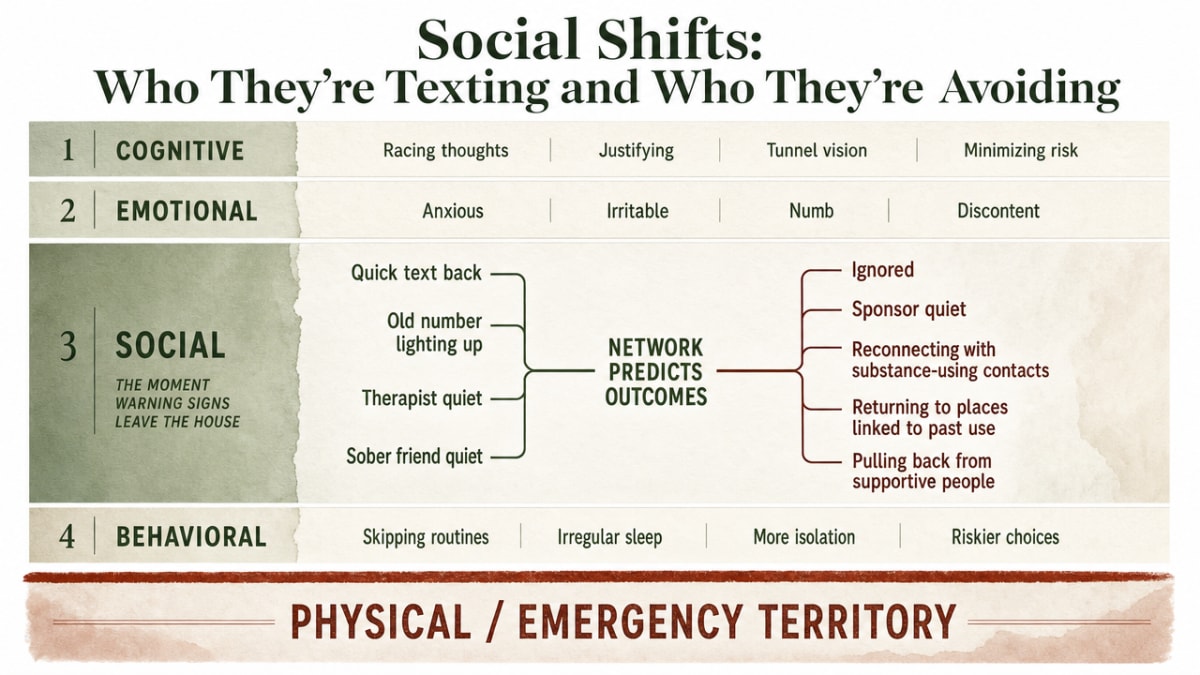
Social Shifts: Who They’re Texting and Who They’re Avoiding
By the time the social tier shows up, the warning signs are leaving the house. Watch the phone. Watch the driveway. Watch who gets a quick text back and who gets ignored.
The research here is clear and worth saying plainly: social context is central to whether recovery holds or breaks, and the composition of someone’s network — who they’re spending time with, who they’re reconnecting with — predicts outcomes 18, 20. The VA names reconnecting with substance-using contacts and returning to places linked to past use as classic early warning signs 1. If an old number you recognize is suddenly lighting up their lock screen, that matters. If they’ve gone quiet with their sponsor, their therapist, or the sober friend who usually checks in on Sundays, that matters just as much.
You’ll also see the inverse: pulling back from the people who have been safe. Skipping the meeting they’ve gone to every Tuesday for six months. Declining the group text they usually run. Isolation is one of the most consistent precursors in the relapse literature, and it tends to accelerate during the holidays when a quiet exit from the kitchen can be waved off as needing air 1, 20.
You don’t have to interrogate the phone or the schedule. Just notice who they’re moving toward and who they’re moving away from this week. That shift is often the clearest signal you’ll get before the behavioral tier starts.
Behavioral Shifts: Missed Doses, Missed Meetings, Missing Hours
The behavioral tier is where you stop guessing. You can see it. A pill organizer that still has Tuesday in it on Thursday morning. A thirty-minute errand that turned into three hours with no text. A locked bathroom door, longer than usual, twice in one evening. These are the signs that the earlier shifts have started to translate into action, and this is where the research starts asking you to pick up the phone.
Missed medication deserves its own line. If your loved one is on buprenorphine, methadone, or naltrexone for opioid use disorder and they’re skipping doses or doubling up to catch up, that’s a serious signal — SAMHSA’s protocol treats medication adherence as central to sustained recovery and overdose protection 6. If they’re on a prescribed benzodiazepine and either missing doses or taking more than prescribed, the risk cuts both directions: oversedation and interaction on one side, and seizures from abrupt discontinuation on the other, which the FDA names explicitly in its boxed warning 5. This is not a wait-and-see situation. This is a call-the-prescriber-today situation.
Also notice the small operational tells: new cash withdrawals, a car parked at an angle it never is, a familiar jacket that smells like something unfamiliar, items disappearing from a medicine cabinet, sleep schedules sliding by hours instead of minutes. The VA relapse handout groups these as “increased use-related behavior” and “changes in behavior” — and importantly, it does not require you to witness use itself before taking action 1. The pattern is the evidence. If you’re seeing three or four of these at once, that’s your signal to move to the conversation in the next section — and, if any physical warning signs join them, straight to the emergency tier.
Why ‘Just This Once’ Is More Dangerous Than It Used to Be
Here’s the part that’s hard to hear, and the part you need to hear anyway: if your loved one has been off opioids for weeks or months and returns to the dose they used to take, their body is no longer the body that could handle it. Opioid tolerance drops after any meaningful stretch of abstinence or reduced use, which means a previously “normal” amount can now shut down their breathing. The VA names this explicitly as one of the most dangerous moments in recovery, and the holidays — with their stress, access, and old social cues — are exactly when it tends to happen 14.
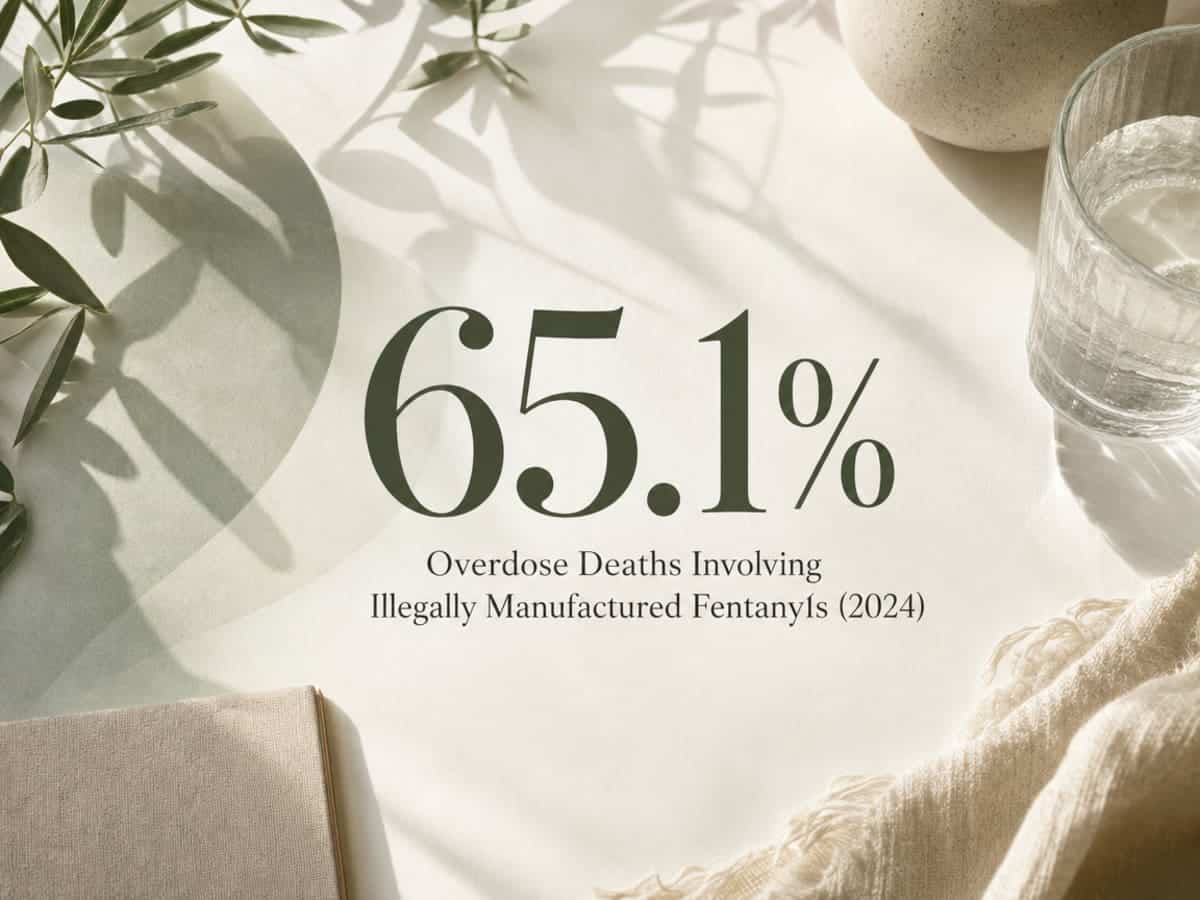
The supply itself has also changed, and it keeps changing. CDC’s SUDORS dashboard reported that across 43 jurisdictions in 2024, illegally manufactured fentanyls were involved in 65.1% of overdose deaths, and 67.5% of those deaths had at least one potential opportunity for intervention beforehand 13. Said plainly: a pill that looks like something they used to take, a bag that looks like what they used to buy, is now more likely than not to contain fentanyl. There is no such thing as a familiar dose from an unregulated supply anymore.
Physical Signs That Cross Into Medical Emergency
Opioid Overdose: Call 911, Give Naloxone, Don’t Wait to Be Sure
This is the section you may need to read twice and then forget you read, until you don’t. If your loved one cannot be woken up, is breathing slowly or not at all, is making a gurgling or snoring sound you can’t rouse them from, has lips or fingernails turning blue, gray, or purple, has gone limp, or has pinpoint pupils with pale, clammy skin — that is an opioid overdose until proven otherwise. Call 911 first. Give naloxone if you have it. Do not wait to confirm what they took or whether they “really” relapsed 2, 3, 4.
The scripts in your head right now — he’s just tired, she had a long day, let him sleep it off — are exactly the scripts that cost lives. SAMHSA and CDC both lead with the same instruction: a suspected overdose is treated as an overdose, because waiting for certainty is what makes it fatal 3, 4. Shake their shoulder, call their name loudly, rub your knuckles hard on their breastbone. If they don’t respond, you are in an emergency.
Give naloxone if you have it, place them on their side in the recovery position, and stay with them until paramedics arrive — naloxone can wear off before the opioid does, and a second dose or repeat overdose is possible 2. One honest note: naloxone reverses opioid overdose only. It won’t help a pure alcohol or benzodiazepine emergency, but it also won’t hurt to try. 911 is still the call either way.
Alcohol and Benzodiazepine Red Flags: Seizures, Confusion, Clammy Skin
Not every holiday emergency looks like an opioid overdose, and some of the most dangerous ones don’t. Alcohol poisoning and benzodiazepine crises can look quieter at first — a family member slumped on the couch who seems “off” in a way you can’t name — and then move fast.
For alcohol, the signs to act on are confusion, difficulty staying awake or being roused, vomiting (especially while unconscious), seizures, slow or irregular breathing, a slow heart rate, pale or bluish skin, clammy skin, and a low body temperature 8. Any one of those is a 911 call. Do not try to walk them around, feed them coffee, or let them “sleep it off” in another room. Lay them on their side so they don’t aspirate, and stay with them.
Benzodiazepines carry a different danger pattern, and the holidays can set it up without anyone meaning to. If your loved one has been taking a prescribed benzodiazepine — alprazolam, clonazepam, lorazepam, diazepam — and either doubled up with alcohol or opioids, or abruptly stopped taking it, you are watching two separate emergencies. Oversedation with another depressant looks like extreme drowsiness, slurred speech, and shallow breathing. Abrupt discontinuation can produce tremors, severe anxiety, hallucinations, and seizures, which the FDA names explicitly in its boxed warning 5, 8. Seizures are not a wait-and-see. Call 911.
Withdrawal That Needs Medical Supervision Tonight
Not every red flag is an overdose. Some are withdrawal, and some withdrawal needs medical hands on it tonight — not in the morning, not after the weekend. The TIP 45 clinician guide names the specific signals that mean someone needs immediate medical evaluation: changes in mental status, hallucinations, significant swings in blood pressure or heart rate, and altered pupil responsiveness 7.
Translate that to your kitchen. If your loved one is sweating through their shirt, shaking, vomiting, and can’t keep water down, that’s a call. If they’re seeing or hearing things that aren’t there, becoming paranoid, or losing track of where they are, that’s a call. Severe alcohol and benzodiazepine withdrawal can cause seizures and delirium tremens and is genuinely life-threatening when unmanaged 6, 8. Opioid withdrawal is rarely fatal by itself, but it is miserable enough to drive a return to use at a dose their body can no longer handle — which is how withdrawal becomes an overdose by Sunday 14.
You are not asking them to tough it out. You are getting them somewhere safe. That’s what 24/7 medical detox exists for.
A Supportive Check-In Script for the Kitchen or the Porch
Pick a quiet moment. Not the dinner table. Not the car ride with three other people in it. The porch after everyone’s gone outside to look at the lights, or the kitchen while you’re drying a dish they handed you — somewhere the two of you can be alone for five minutes without an audience. The VA family brochure is clear that the goal is to support, not to interrogate, and that recovery is a process in which lapses can happen without erasing progress 15. Walk in with that framing and you’ve already done the hardest part.
Try something close to this:“Hey. I’ve been thinking about you tonight. The holidays are a lot, and I just wanted to check in — how are you really doing?”Pause. Let the silence sit longer than feels comfortable. If they say “I’m fine,” you can go one step further:
“I love you, and I’m not going anywhere. If today’s harder than you’re letting on, I’d rather know.”You’re not accusing. You’re opening a door.If they share something — a craving, a hard call with an old friend, a missed dose — resist the urge to fix it in that moment. The research on supportive family involvement is consistent: stable relationships and nonjudgmental support are associated with sustained recovery, while criticism and hostility push the other direction 19. So you say,
“Thank you for telling me. What would help right now?”and you follow their lead. If they ask for a ride to a meeting, you drive. If they ask you to call Renewal Springs with them, you dial.
“I’m here. Any hour. No lecture.”Then keep watching, keep writing things down, and let the next section help you decide what backfires if you push harder than this.
What Backfires at the Holiday Table
You already know not to do it, and you may do it anyway because you’re scared. The confrontation in front of the whole family. The ultimatum between the stuffing and the pie. The pointed comment about last Christmas. These land as attacks, not as help, and the research is unkind to them: criticism, hostility, and alienation from relatives are associated with higher relapse likelihood, while stable, supportive relationships track with sustained recovery 19.
Shame doesn’t motivate recovery either. The 2024 stress study found that higher perceived stress was directly associated with greater relapse tendency, with social support acting as a buffer, not an accelerant 17. Translation: a tense public callout raises exactly the thing you’re trying to lower.
So skip the group confrontation. Skip the “if you ever do this again” speech. Skip searching their bag or their car in front of cousins. Skip comparing them to the family member who “got it together.” Skip framing a lapse as the end of recovery — the VA family brochure is explicit that recovery is a process in which lapses can happen without erasing progress 15. Your job tonight is to stay the safe person in the room, not the loudest one.
When to Call Renewal Springs Tonight
Here’s the simplest version of this whole article: you don’t have to be certain to call. If you’ve been reading this and nodding, if three or four of the warning signs in Section 2 are showing up at once, if a missed buprenorphine or benzodiazepine dose is sitting in your stomach like a stone, that’s the call. Renewal Springs’ admissions line in Oklahoma City is answered 24/7 by people who have had this exact conversation with families on Thanksgiving night and the morning of New Year’s Day. You can call before you’ve decided anything. You can call just to ask what happens next.
Don’t let the quiet statistics convince you that help is already in motion. In 2024, only 19.3% of people classified as needing substance-use treatment actually received it, according to the national survey SAMHSA released in July 2025 11. Said another way, roughly four out of five families in your position are waiting for a moment that doesn’t come on its own. The phone call is the moment.
If what you’re watching has crossed into the physical tier — unresponsiveness, slow or gurgling breathing, blue lips, a seizure, hallucinations, severe confusion — stop reading and dial 911 first, give naloxone if you have it, and call Renewal Springs after the paramedics arrive 2, 3. If what you’re watching is earlier than that — the war stories, the old number lighting up the phone, the missed dose, the long bathroom door — call Renewal Springs tonight. Medically supervised detox with 24/7 monitoring, MAT protocols, and Huml Health vital-sign tracking is a safe place for your person to land while you both figure out what comes next. You’ve been the watchful one all weekend. Let someone else take the next shift.
Worried About Relapse Signs? Reach Out Now
Get answers and real-time support if you’re seeing warning signs over the holidays.
Frequently Asked Questions
How can I tell the difference between normal holiday stress and an actual relapse warning sign?
Stress is a feeling. A warning sign is a pattern. If they’re tense before dinner but still showing up to their meeting, calling their sponsor, and taking their medication, that’s holiday stress. If you’re seeing clusters — romanticizing past use, pulling away from support, missed doses, old contacts lighting up the phone — that’s the progression the VA relapse handout describes 1. Trust the pattern, not any single moment.
What should I do if my loved one missed a dose of their buprenorphine, methadone, or benzodiazepine over the holidays?
Call their prescriber today, not Monday. Missed opioid-treatment doses raise overdose risk and can destabilize recovery 6. Missed benzodiazepine doses carry a separate danger — the FDA warns that abrupt discontinuation can trigger seizures and requires a patient-specific taper 5. If their prescriber isn’t reachable, call Renewal Springs. Do not let them “catch up” by doubling the next dose on their own.
When is slow breathing or heavy sedation an emergency versus just someone sleeping off a long day?
If you cannot wake them with a loud voice, a hard shoulder shake, or a knuckle rub on the breastbone, that’s an emergency. If their breathing is slow, shallow, snoring in a way you can’t rouse them from, or their lips or fingernails look blue, gray, or purple, call 911 and give naloxone if you have it 2, 3, 4. Don’t wait to be sure.
Should I confront them at the dinner table if I think they’ve already used?
No. A public confrontation raises stress and shame, which the research links to higher relapse likelihood, not lower 17, 19. Wait for a quiet moment — the porch, the kitchen, the drive home — and use the check-in script. Lead with love, not accusation. If their safety is at risk right now, that’s a different call: get them somewhere safe, and if their body is in crisis, dial 911.
If they only used ‘a little,’ do I still need to worry about overdose?
Yes. Opioid tolerance drops after any meaningful stretch of abstinence, so a previously familiar dose can shut down breathing 14. The supply has also shifted — CDC’s SUDORS dashboard reported illegally manufactured fentanyls in 65.1% of 2024 overdose deaths across 43 jurisdictions 13. Mixing with alcohol or a prescribed benzodiazepine makes it worse 2. Stay with them, watch their breathing, and keep naloxone within reach.
When should I call Renewal Springs instead of waiting to see if things settle down?
Call tonight. You don’t have to be certain, and you don’t have to wait for a crisis — the admissions line in Oklahoma City is answered 24/7, and you can call just to ask questions. Only 19.3% of people needing substance-use treatment in 2024 actually received it 11. The call is how that changes. If their body is already in crisis, dial 911 first, then call us.
References
- Reducing Relapse Risk. https://www.va.gov/WHOLEHEALTHLIBRARY/docs/Reducing-Relapse-Risk.pdf
- SAMHSA Overdose Prevention and Response Toolkit. https://www.cdc.gov/overdose-prevention/media/pdfs/2024/04/SAMHSA-overdose-prevention-response-toolkit.pdf
- Opioid Overdose Prevention and Reversal – SAMHSA. https://www.samhsa.gov/substance-use/treatment/overdose-prevention
- Risks and How to Reduce Them | Overdose Prevention – CDC. https://www.cdc.gov/overdose-prevention/manage-treat-pain/reduce-risks.html
- FDA requiring Boxed Warning updated to improve safe use of benzodiazepine drug class. https://www.fda.gov/drugs/drug-safety-and-availability/fda-requiring-boxed-warning-updated-improve-safe-use-benzodiazepine-drug-class
- TIP 63: Medications for Opioid Use Disorder. https://library.samhsa.gov/sites/default/files/pep21-02-01-002.pdf
- Quick Guide For Clinicians Based on TIP 45 Detoxification and Substance Abuse Treatment. https://nida.nih.gov/sites/default/files/samhsa_detoxification_and_substance_abuse_treatment.pdf
- Chapter 14 Substance Use Disorders. https://www.ncbi.nlm.nih.gov/books/NBK590030/
- 3 Patient Assessment. https://www.ncbi.nlm.nih.gov/books/NBK64237/
- SAMHSA Releases Annual National Survey on Drug Use and Health. https://www.samhsa.gov/newsroom/press-announcements/20250728/samhsa-releases-annual-national-survey-on-drug-use-and-health
- Highlights for the 2024 National Survey on Drug Use and Health. https://www.samhsa.gov/data/sites/default/files/NSDUH%202024%20Annual%20Release/2024-nsduh-nnr-highlights.pdf
- U.S. Overdose Deaths Decrease Almost 27% in 2024. https://www.cdc.gov/nchs/pressroom/releases/20250514.html
- SUDORS Dashboard: Fatal Drug Overdose Data – Accessible Version. https://www.cdc.gov/overdose-prevention/data-research/facts-stats/sudors-dashboard-fatal-overdose-data-accessible.html
- Substance Use Disorders. https://www.va.gov/WHOLEHEALTHLIBRARY/docs/Substance-Use-Disorders.pdf
- Substance Use Disorder Affects Families. https://www.healthquality.va.gov/HEALTHQUALITY/guidelines/MH/sud/SUD-family-brochurev-20220314508.pdf
- The Next Steps…Towards A Better Life. https://library.samhsa.gov/sites/default/files/sma14-4474.pdf
- Self-control as mediator and social support as moderator in the relationship between perceived stress and relapse tendency among individuals with substance use disorders. https://pmc.ncbi.nlm.nih.gov/articles/PMC11349877/
- Role of Social Context in Addiction Etiology and Recovery. https://pmc.ncbi.nlm.nih.gov/articles/PMC10528354/
- Theory-Based Processes that Promote the Remission of Substance Use Disorders. https://pmc.ncbi.nlm.nih.gov/articles/PMC1940243/
- An extension of the Witkiewitz and Marlatt relapse model. https://pmc.ncbi.nlm.nih.gov/articles/PMC2714871/
- Determinants of Relapse and Opportunities for Growth: Perspectives on Substance Use Among American Indian Community Members. https://pmc.ncbi.nlm.nih.gov/articles/PMC8692388/