
Key Takeaways
- Medical detox typically runs a few days to a few weeks, with some substances requiring longer tapering, and no honest day count can be given before a clinical assessment 9.
- Detox is a clinical range built around three phases — evaluation, stabilization, and readiness for treatment — not a fixed calendar, per federal TIP 45 guidance 7.
- Timelines vary sharply by substance: alcohol usually fits within two weeks, opioids run one to two weeks after buprenorphine timing, and benzodiazepine tapers may take a year or more 3.
- Acute physical symptoms often ease within 7–10 days, but protracted withdrawal can start weeks later and last 6–12 months, making the outpatient plan as important as the inpatient days 2.
The honest answer to “how many days will this take?”
You want a number. That makes sense. If you’re sitting with the shakes, or watching someone you love count down the hours since their last dose, “how long” is not an abstract question. It’s about work, kids, court dates, whether you can survive the middle of it. So here is the honest answer, before anything else: medical detox usually takes somewhere between a few days and a few weeks, and for some substances the safe tapering process stretches longer than that 9. That’s the range clinicians actually work inside.
What it will take for you depends on which substance is in your system, how much and how long you’ve used it, your physical and mental health, and how your body responds hour by hour once care begins 9. There is no reputable clinic that can promise you a specific day count before they’ve assessed you. Anyone who does is guessing.
That uncertainty is uncomfortable. It’s also the reason medical detox exists. A supervised setting can move faster when your symptoms allow it and slow down when your body needs more time, without you having to make that call alone. The rest of this article walks through what shapes that range, substance by substance, so when you talk to the clinical team at Renewal Springs, you can ask the right questions and get an answer that actually applies to you.
Why detox is a clinical range, not a calendar
When you picture detox, you probably picture a countdown. Day one, day two, day five, done. The problem with that mental model is that detox isn’t a timer. It’s a set of clinical goals, and you’re finished when the goals are met, not when a clock runs out.
The federal Treatment Improvement Protocol for detoxification (TIP 45) describes the process as three overlapping steps: evaluation, stabilization, and fostering patient readiness for and entry into treatment 7. Decisions about setting and intensity are based on individualized assessment, not fixed timelines 7. That single sentence is why no one can promise you a day count over the phone.
Here’s what those three phases actually mean for your days:
- Evaluation
- The first hours. A clinician screens what’s in your system, how much, how long, what other conditions are in play, and what your withdrawal risk looks like. This is the piece that shapes everything after it. A 55-year-old drinking a fifth a day for ten years and a 25-year-old using fentanyl for six months need very different plans, even if both walk in the same door.
- Stabilization
- The medical work. Managing symptoms, adjusting medication, keeping you safe as your body clears the substance. For alcohol, that might mean benzodiazepines given every one to two hours until symptoms ease 8. For opioids, it might mean waiting the right number of hours before starting buprenorphine. This phase ends when your vitals are steady and the acute danger has passed — which for some people is a few days, and for others is longer.
- Fostering readiness
- The handoff. Detox is not treatment. It’s the door you walk through before treatment. This phase makes sure you don’t leave stabilized but stranded.
When the clinical team at Renewal Springs quotes you a window, they’re estimating how long these three phases will take for your body, your history, and your response to care — not reading a standard schedule off a wall.
How long acute withdrawal usually lasts, by substance
Alcohol: the two-week boundary
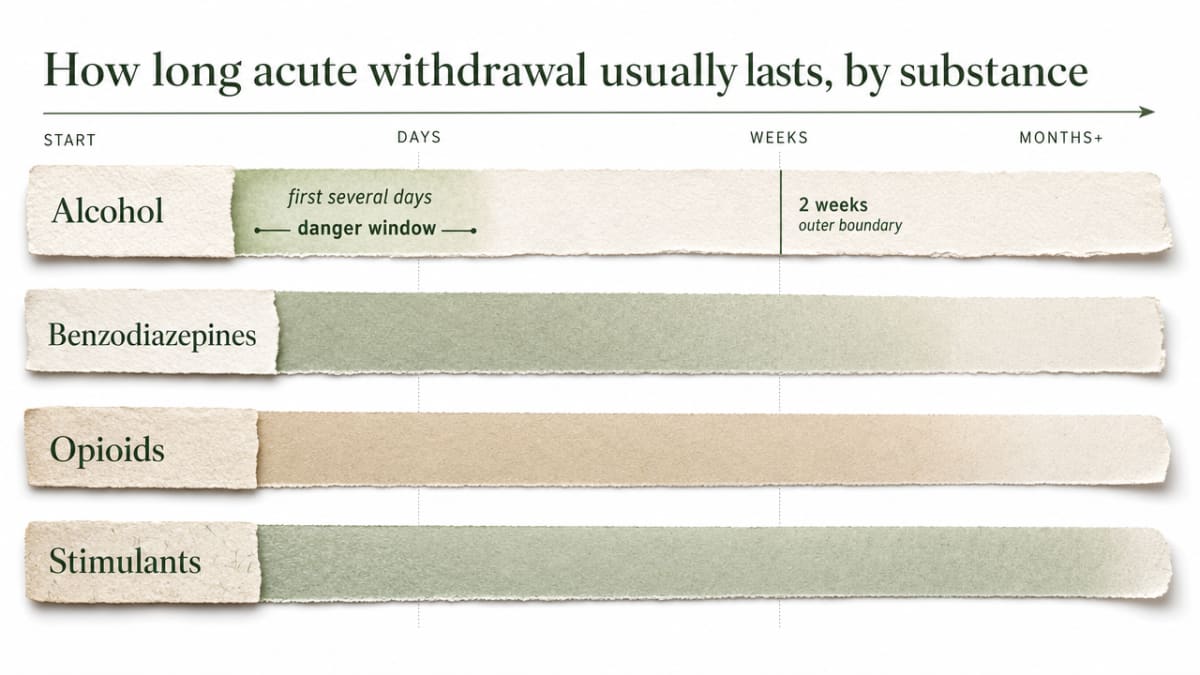
If you’re detoxing from alcohol, most of the acute physical symptoms — the tremors, sweating, elevated heart rate, and the risk of seizures or delirium tremens — happen inside the first several days after your last drink. Clinicians treat this as the dangerous window. It’s also the window where symptom-triggered medication makes the biggest difference: for alcohol withdrawal, guidance describes benzodiazepines given every 1 to 2 hours until significant clinical improvement occurs or the patient becomes sedated, which is why your dose isn’t set in advance 8. Your body tells the clinician what you need next.
A useful outer boundary: a systematic review of alcohol withdrawal management notes that when withdrawal-like symptoms or delirium appear after 2 weeks of complete cessation of alcohol, the diagnosis of alcohol withdrawal syndrome or delirium tremens becomes untenable 1. In other words, if something is still hitting you three or four weeks in, it’s likely something else — depression, anxiety, sleep disruption, or another condition — and it needs its own care plan.
What that means for you: the medically supervised piece of alcohol detox usually fits inside a couple of weeks, and often less. What comes after is real too, and it’s why detox alone isn’t the whole answer.
Opioids (fentanyl, heroin, prescription painkillers): the buprenorphine timing decision
If opioids are what brought you here, the first big timeline decision isn’t how many days detox will take. It’s how many hours to wait before the first dose of buprenorphine. Start too early and you can trigger precipitated withdrawal — a sudden, severe crash of symptoms that is worse than what you walked in with. Wait too long and you’re suffering unnecessarily. The clinical team’s job is to hit that window.
Federal prescribing guidance is specific here. Clinicians and patients should wait at least 8–12 hours after the last dose of short-acting opioids and longer (e.g., 12–24 hours or more) after long-acting opioids before the first buprenorphine dose 6. For fentanyl, which lingers differently in the body than heroin or oxycodone, the waiting piece can be trickier, and newer low-dose induction strategies are still emerging in practice 6. This is exactly the kind of judgment call that belongs to a licensed clinician who is looking at you, not a schedule on a wall.
Once induction is done, acute opioid withdrawal typically runs through the worst of it over roughly one to two weeks, though the range varies with the specific opioid, your dose, and how long you’ve used 2. Fatigue, poor sleep, cravings, and low mood can outlast the physical symptoms, which is why the plan after detox matters as much as the days inside it.
The takeaway: your first day is about timing the medication safely, not rushing to the finish. The Renewal Springs clinical team can walk you through what your specific last-use timeline means for induction before you arrive.
Benzodiazepines: why this one can take a year
Benzodiazepine detox is the piece of this article that most breaks the “detox is a week” expectation. If you’ve been taking Xanax, Klonopin, Valium, Ativan, or a similar medication for months or years, stopping abruptly isn’t just uncomfortable — it can be medically dangerous, and a slow taper is the standard of care.
The scale is worth seeing plainly. The 2025 Joint Clinical Practice Guideline on Benzodiazepine Tapering, from ASAM/AAAP and partners, notes that evaluated tapering schedules range from 10–25% reductions every 1–2 weeks to 5–10% every 2–4 weeks, and that the tapering process may take a year or more for patients who have been taking benzodiazepines for a long period of time 3. Any patient who has taken a benzodiazepine for longer than three to four weeks is likely to have withdrawal symptoms if it’s stopped abruptly, which is why gradual reduction — sometimes over ten weeks or much longer — is used to reach lasting abstinence 4.
What this means for you: the medically supervised inpatient portion of your care may still be measured in days to a couple of weeks — enough to stabilize you, adjust your medication, and get you onto a safe reduction schedule. The full taper, though, may continue in an outpatient setting for months. The clinical team’s job at intake is to tell you which part happens where.
Stimulants and cannabis: supportive care, not a fixed protocol
Stimulants — methamphetamine, cocaine, prescription amphetamines like Adderall — and cannabis sit in a different category. There aren’t established pharmacologic detox protocols for these substances the way there are for alcohol, opioids, and benzos 9. The ASAM/AAAP stimulant guideline frames withdrawal management as supportive care, and stresses that patients with stimulant use disorder should receive ongoing recovery management well beyond the acute phase 11.
What that looks like in practice: the acute stretch is usually days to a couple of weeks of crushing fatigue, heavy sleep, low mood, and intense cravings. There isn’t a medication that shortens it. What medical detox provides is a safe place to move through the worst of it — hydration, nutrition, sleep, monitoring for suicidal thoughts and cardiovascular strain, and a plan for what happens next.
If you’ve been using stimulants heavily, the mental piece often outlasts the physical crash. Sleep-wake cycles can stay off for weeks. Motivation and pleasure can feel flattened for longer. That’s not a sign detox failed. It’s part of why continuing care after the medically supervised days is the real work of recovery, not an add-on.
Acute withdrawal vs. protracted withdrawal: the second timeline nobody explains
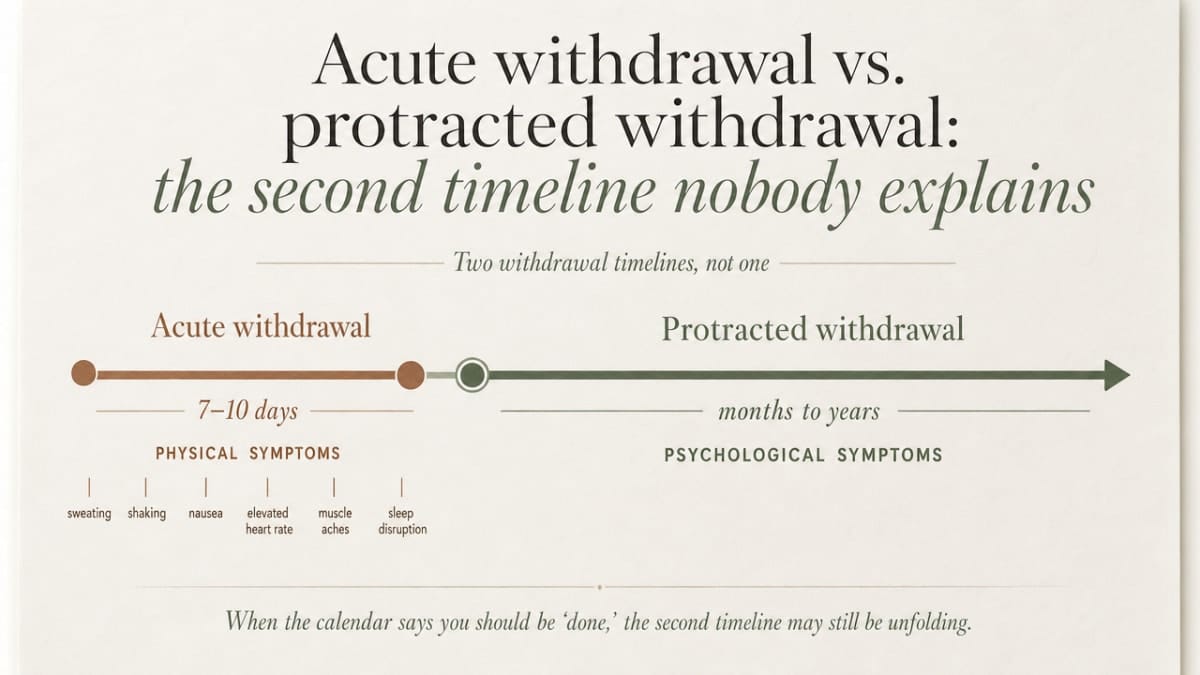
Here’s the piece most articles skip, and it’s the piece that will change how you plan the next few months of your life: there are actually two withdrawal timelines, not one. The first is acute. The second is protracted. Knowing the difference is how you stop feeling like something is wrong with you when the calendar says you should be “done.”
Acute withdrawal is what most people picture when they hear the word detox. It’s the physical piece — the sweating, shaking, nausea, elevated heart rate, muscle aches, sleep disruption, the raw discomfort of your body clearing the substance and adjusting. Educational guidance summarizes it this way: physical symptoms tend to subside after 7–10 days, but psychological symptoms may last months to years 10. That first line is the number you came looking for. The second line is the one nobody warned you about.
Protracted withdrawal is what happens after the acute phase ends. Reviews of dependence and withdrawal across CNS drug classes note that the symptoms of protracted withdrawal start ~4–6 weeks after drug discontinuation and may last 6–12 months, but some symptoms, such as anxiety, may persist for up to 2 years 2. This is not a sign that detox failed. It’s a documented pattern seen across benzodiazepines, opioids, stimulants, and other substances, and it’s part of why the field has moved away from thinking of detox as a finished event.
What protracted withdrawal usually looks like:
- Sleep that still isn’t right.
- Anxiety that shows up without a trigger.
- Low mood, low motivation, blunted pleasure.
- Cravings that come in waves weeks after the physical stuff cleared.
If you’ve been through detox before and felt blindsided by any of this in month two or month three, this is what was happening. You weren’t relapsing in your head. Your nervous system was still recalibrating.
Why this matters for the question you actually came here to answer: when you ask “how long does medical detox take,” the acute answer is usually days to a couple of weeks. The protracted answer is months, and it doesn’t require an inpatient stay — it requires the outpatient plan, the medication adjustments, the therapy, and the people you check in with after you leave. The medically supervised days are the beginning. The rest is real, and it’s manageable, and it’s what the Renewal Springs clinical team will help you set up before you’re discharged so you’re not walking into month two alone.
The variables clinicians actually weigh in your case
Substance, dose, and how long you’ve used
The three questions that shape your timeline more than any others: what have you been using, how much, and for how long. A person who has been on a prescribed benzodiazepine for eight years is not in the same clinical situation as someone who’s been using it for six weeks, even if the drug on the label is identical. The length of use directly shapes how gradually the reduction has to happen 4.
The same principle applies to alcohol and opioids. Higher daily doses and longer histories generally mean a longer stabilization phase and more careful medication management. The published range clinicians work inside — a few days to a few weeks inpatient, up to twelve weeks in community settings — exists precisely because dose and duration of use vary so widely from one person to the next 9. When intake asks you detailed questions about your last use, the amount, and the years behind it, that’s what those answers are for.
Polysubstance use and medical or mental health conditions
If more than one substance is in the picture — say, opioids and benzodiazepines, or alcohol and stimulants — your detox plan has to account for each one separately, and for how they interact. Withdrawal onset and duration already vary widely by drug class, with acute symptoms ranging from around six hours to several days to start, and lasting anywhere from ten days to six weeks depending on the drug 2. Layer two of those on top of each other and the sequencing matters. A benzodiazepine taper that would normally happen over weeks may have to be woven around opioid stabilization that’s happening in days.
Your medical and mental health history reshapes the plan too. Liver function, cardiovascular strain, seizure history, pregnancy, chronic pain, depression, PTSD, prior withdrawal complications — each one can extend the stabilization phase or change which medications are safe. This is exactly why TIP 45 frames detox around individualized assessment rather than fixed schedules 7. The clinical team at Renewal Springs asks about all of it at intake because that’s where a realistic window actually comes from.
Real-time monitoring and symptom-triggered dosing
Here’s the part that surprises people: even after intake, your timeline keeps updating. Modern detox isn’t a schedule you receive on day one and follow to the hour. It’s a plan that adjusts based on what your body is doing right now.
For alcohol withdrawal, the TIP 45 quick guide describes a symptom-triggered benzodiazepine loading strategy where doses are given every 1 to 2 hours until significant clinical improvement occurs or the patient becomes sedated 8. Notice what that means. The medication isn’t on a clock. It’s on your symptoms. Two people admitted the same morning with similar histories can finish the acute stabilization phase a day or two apart because one responded faster than the other. Neither one is doing detox wrong.
Renewal Springs uses wearable monitoring from Huml Health to track vital signs, sleep quality, and stress signals continuously through your stay. That real-time data feeds into the same symptom-triggered logic. When your heart rate settles overnight, when your sleep starts consolidating, when the tremor readings drop — those are the signals that tell the clinical team when to step medication down, when to hold steady, and when you’re actually ready for the next phase, rather than guessing from spot checks every few hours.
Your timeline, in other words, is a conversation between your body and the people watching over it. When you ask the clinical team what to expect for your situation, this is the framework they’re working from — not a fixed number, but a plan that has room to move with you.
What your specific fear is really asking
The search box says “how long does medical detox take.” What you’re actually asking is usually more specific than that. It’s worth naming, because the honest answer changes depending on which fear is driving the question.
“Will I be out in time to keep my job?” For alcohol and opioids, the medically supervised piece often fits inside a couple of weeks, sometimes less 9. Short-term disability, FMLA, and a letter from the clinical team are usually the practical path. Ask about documentation at intake, not on discharge day.
“Will I be there when my kids get home from school next week?” Maybe, maybe not. Pushing to leave before stabilization is finished is how people end up back in the emergency room. A few extra days now buys you the version of yourself your kids actually need.
“Will I feel normal when I walk out?” Physically, mostly. Emotionally, not entirely. Physical symptoms tend to subside within about 7–10 days, but psychological symptoms can last months 10. That’s not failure. That’s the shape of recovery, and it’s what the outpatient plan is built for.
“Can I handle this?” You don’t have to handle it alone. That’s the whole point of medical supervision. The days you’re most afraid of are the days someone is watching over you.
Turning “it depends” into your answer at Renewal Springs
“It depends” is a frustrating answer when you’re sitting with the question. Here’s how it becomes a real one.
When you call Renewal Springs, the clinical team will ask about the substance or substances involved, your most recent use, your daily amounts, how long you’ve been using, prior withdrawal experiences, and your medical and mental health history. Those questions aren’t a formality. They’re the individualized assessment that federal guidance says every detox plan should start from 7. That’s where a vague range starts to become a specific window for you.
Once you’re admitted, the licensed medical team in Oklahoma City manages your care around the clock, with wearable monitoring from Huml Health tracking vitals, sleep, and stress signals continuously. That data is what lets stabilization move at your body’s pace instead of a rigid schedule. When you’re steady, the plan shifts. When you’re not, the plan holds. Before discharge, the team walks you through what protracted symptoms may look like over the coming weeks and helps arrange the next step — residential, outpatient, or ongoing recovery support — so month two doesn’t catch you unprepared.
You called or clicked to read this because you wanted a number. Ask the clinical team what to expect for your situation. That’s the honest place a real timeline comes from.
Talk to Someone Now About Your Detox Timeline
Get real answers about what medical detox might look like for you, right now.

Frequently Asked Questions
How long does medical detox usually take for opioids like fentanyl or heroin?
For most people, the acute stretch of opioid withdrawal runs through the worst of it over roughly one to two weeks, though the exact range depends on the specific opioid, your dose, and how long you’ve used 2. The first-day decision that shapes your timeline is buprenorphine induction timing, which requires waiting at least 8–12 hours after short-acting opioids and 12–24 hours or more after long-acting ones 6.
Why can benzodiazepine detox take so much longer than alcohol or opioid detox?
Stopping a benzodiazepine abruptly after long-term use can be medically dangerous, so the standard of care is a gradual taper rather than a fast clear-out. The 2025 ASAM/AAAP tapering guideline notes the process may take a year or more for patients who’ve used benzodiazepines for a long period, with dose reductions typically pacing at 5–25% every one to four weeks 3. The inpatient piece is shorter; the taper often continues in outpatient care.
What’s the difference between acute withdrawal and protracted withdrawal?
Acute withdrawal is the physical piece — tremors, nausea, sweating, elevated heart rate — and physical symptoms tend to subside after 7–10 days 10. Protracted withdrawal is what can follow: symptoms like anxiety, sleep disruption, and low mood that generally start around 4–6 weeks after discontinuation and may last 6–12 months, with some symptoms persisting up to 2 years 2. This isn’t relapse. It’s your nervous system recalibrating, and it’s manageable with outpatient care.
Will I feel back to normal by the time I leave medical detox?
Physically, mostly. Emotionally, not entirely, and that’s normal. Physical symptoms typically ease within 7–10 days, but psychological symptoms — sleep issues, low mood, cravings, anxiety — can last months 10. Leaving detox means the acute medical danger has passed and your vitals are steady. It doesn’t mean every trace of withdrawal is gone. That’s exactly why the plan after detox matters, and why your discharge plan is built before you walk out.
How does using more than one substance change the detox timeline?
Each substance has its own withdrawal pattern — acute onset can range from around 6 hours to several days, with duration from 10 days to 6 weeks depending on the drug 2. When two are in play, the sequencing matters. A benzodiazepine taper that normally spans weeks may need to be woven around opioid stabilization happening in days. Your intake assessment sorts through this, which is why federal guidance frames detox around individualized evaluation 7.
How does Renewal Springs decide how long my detox will last?
Your window comes from the individualized assessment TIP 45 describes — the substance, dose, duration of use, medical and mental health history, and prior withdrawal experiences 7. Once you’re admitted, wearable monitoring from Huml Health tracks vitals, sleep, and stress signals continuously, so medication decisions follow your body’s response rather than a fixed clock. Ask the clinical team what to expect for your situation. That’s where a vague range becomes a real answer.
References
- Clinical management of alcohol withdrawal: A systematic review. https://pmc.ncbi.nlm.nih.gov/articles/PMC4085800/
- Dependence, withdrawal and rebound of CNS drugs. https://pmc.ncbi.nlm.nih.gov/articles/PMC7425303/
- Joint Clinical Practice Guideline on Benzodiazepine Tapering. https://pmc.ncbi.nlm.nih.gov/articles/PMC12463801/
- Management of benzodiazepine misuse and dependence. https://pmc.ncbi.nlm.nih.gov/articles/PMC4657308/
- Helping Patients Taper from Benzodiazepines. https://www.va.gov/painmanagement/docs/OSI_6_Toolkit_Taper_Benzodiazepines_Clinicians.pdf
- CDC Clinical Practice Guideline for Prescribing Opioids for Pain. https://www.cdc.gov/mmwr/volumes/71/rr/rr7103a1.htm
- Detoxification and Substance Abuse Treatment (NCBI Bookshelf, TIP 45). https://www.ncbi.nlm.nih.gov/books/NBK64115/
- Quick Guide for Clinicians Based on TIP 45: Detoxification and Substance Abuse Treatment. https://nida.nih.gov/sites/default/files/samhsa_detoxification_and_substance_abuse_treatment.pdf
- Pharmacological strategies for detoxification. https://pmc.ncbi.nlm.nih.gov/articles/PMC4014033/
- Managing Substance-Related Withdrawal (Module 7). https://www.marshall.edu/pharmacy/files/Module-7-Managing-Substance-Related-Withdrawal.pdf
- The ASAM/AAAP Clinical Practice Guideline on the Management of Stimulant Use Disorder. https://stacks.cdc.gov/view/cdc/156927/cdc_156927_DS1.pdf