
Key Takeaways
- Detox centers in Oklahoma City vary by ASAM level, and most opioid, alcohol, or benzodiazepine withdrawal calls for Level III.7-D medically monitored inpatient care with bedside nursing 1.
- Ask directly whether the program can safely manage your specific withdrawal on site, names buprenorphine for opioids, and uses CIWA-guided benzo tapers for alcohol and sedatives 2, 7.
- Verify Joint Commission or CARF accreditation alongside ODMHSAS state certification, and confirm the facility handles SoonerCare prior authorization in-house before admission 9, 6.
- Compare programs on their discharge handoff — named residential, PHP, or IOP placements, scheduled medication follow-up, and family involvement — since detox alone is not sufficient treatment 8.
What a Safe Detox Actually Looks Like at 2 A.M.
If you are reading this at 2 a.m., sweating through a shirt, or scrolling on behalf of someone you love who is curled up in the next room, you are already doing something hard. You are trying to make a smart decision inside a body or a household that feels like it is running out of time. That counts. Take one breath. Then keep reading.
Here is the truth nobody says out loud on a facility website: choosing a detox center in Oklahoma City is not about picking the prettiest lobby or the softest bathrobe. It is about whether the people answering the phone at 2 a.m. can keep you alive, keep you comfortable, and hand you off well to whatever comes next. Opioid, alcohol, and benzodiazepine withdrawal can turn medically dangerous fast, which is why national clinical guidance treats detox as the management of acute intoxication and withdrawal under medical supervision, not a willpower exercise 3.
This guide gives you the exact questions to ask any facility, grounded in the frameworks clinicians actually use. Read it once, then call. Ask us. Ask anyone you are considering. The answers should sound the same.
What Medical Supervision Actually Means
The Five ASAM Levels of Withdrawal Management
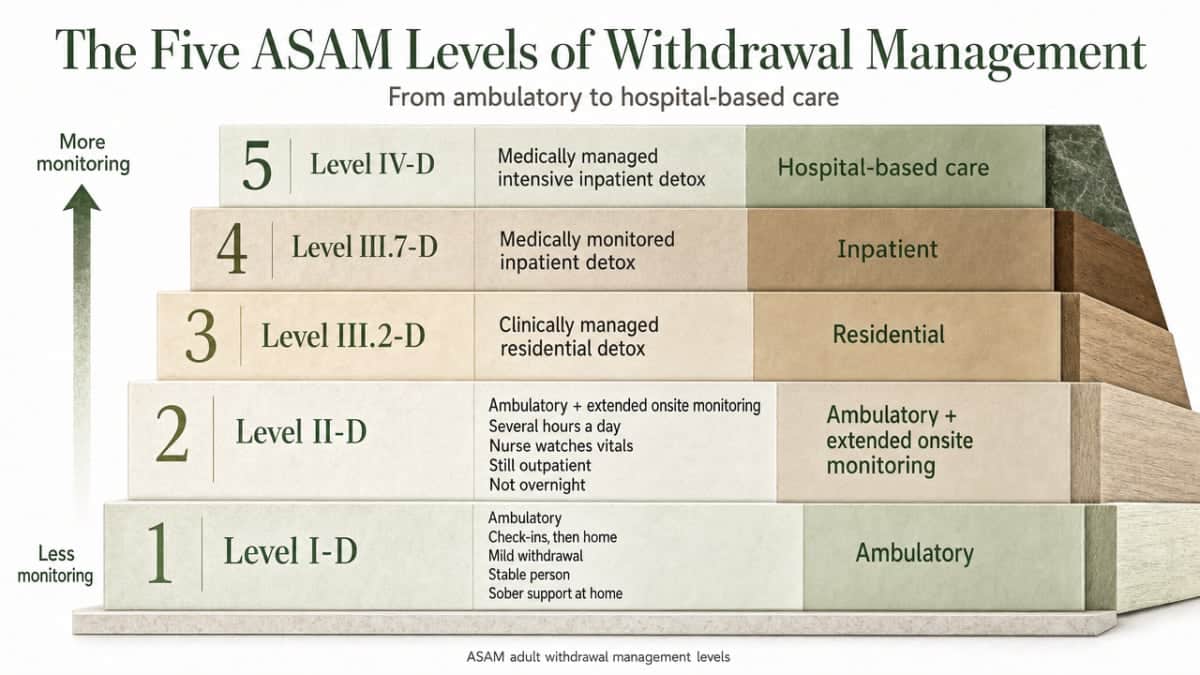
When you hear “medical detox,” it can sound like one thing. It is not. The American Society of Addiction Medicine sorts adult withdrawal management into five distinct levels of care, and the level a facility offers tells you almost everything about the kind of safety net you will have around you 1.
Here is the plain-language version of the ladder:
- Level I-D — Ambulatory detox without extended onsite monitoring. You come in for check-ins, then go home. Fine for mild withdrawal in a stable person with a sober support at home. Not built for opioid, alcohol, or benzo withdrawal that could turn serious.
- Level II-D — Ambulatory detox with extended onsite monitoring. Still outpatient, but you stay for several hours a day so a nurse can watch your vitals. A step up, still not overnight.
- Level III.2-D — Clinically managed residential detox. A live-in setting with 24-hour support, but the emphasis is social, not medical. Physician access is on call, not at the bedside.
- Level III.7-D — Medically monitored inpatient detox. A freestanding detox center that “provides 24-hour medically supervised detoxification services,” with nursing at the bedside and a physician available around the clock 1. This is the benchmark for most opioid, alcohol, and benzodiazepine withdrawal.
- Level IV-D — Medically managed intensive inpatient detox. Hospital-based, for people who are medically unstable or have severe co-occurring conditions like uncontrolled heart disease or active psychiatric emergencies.
Most people calling about heroin, fentanyl, prescription opioids, alcohol, or benzos land at Level III.7-D. It is the sweet spot: enough medical firepower to keep you safe, without the sterile intensity of a hospital ward. If a facility describes itself in words that sound softer than 24-hour medically supervised detox and you are withdrawing from opioids, alcohol, or benzos, that mismatch matters. Ask them to place their program on this ladder, out loud.
The Question to Ask: ‘Can You Safely Manage My Withdrawal Here?’
Write this one down. When you call any Oklahoma City detox center, ask: “Given what I am withdrawing from, can you safely manage my intoxication, withdrawal, and any medical problems I have here, at your level of care?”
That phrasing is not random. Medicaid’s own clinical guidance says intoxication, withdrawal, and biomedical concerns must be “safely manageable” at whatever level of care a program offers 2. If the person on the phone hesitates, redirects to marketing language, or cannot name their ASAM level, that is data. A good answer sounds like: “Yes. We are a medically monitored inpatient program, Level 3.7. We can manage opioid, alcohol, and benzodiazepine withdrawal on site. Here is how we handle someone with your history.”
You should also share what you actually have going on — daily use amount, last dose, other medications, medical conditions, prior seizures, prior withdrawal complications. The right facility will use that to say yes, or to tell you honestly that a hospital-based Level IV-D setting is the safer first stop. Honesty at intake is the first sign of a program that will keep you safe.
24/7 Physician Availability and Bedside Nursing
“Around the clock” gets used loosely. Push on it. There is a real difference between a nurse in the building at 3 a.m. and a nurse on call from home who might arrive in forty minutes. Withdrawal does not keep business hours. Blood pressure spikes at 2 a.m. Seizure risk climbs somewhere between hours 24 and 72 of alcohol withdrawal. Opioid withdrawal peaks at times the front desk is quiet.
SAMHSA’s TIP 45 administrator guidance is clear on what a residential detox program should look like: staff who are credentialed and trained to run physician-approved protocols for patient observation and supervision, with medical evaluation and consultation available 24 hours a day 9. That is the standard. So ask directly:
- Is there a nurse physically in the building, on the unit, all night?
- Is a physician on site, or on call — and how fast can they get there or issue orders?
- Who checks my vitals overnight, and how often during the first 72 hours?
- What happens if I get worse at 4 a.m. — do you transfer, or can you escalate care here?
You are not being difficult by asking. You are being the exact kind of patient — or family member — who ends up safer.
Staffing, Ratios, and What ‘Around the Clock’ Should Sound Like
Staffing is where a facility’s brochure meets its actual capacity to keep you safe. “Around the clock” should not be a marketing phrase. It should be a schedule you can picture.
SAMHSA’s administrator guidance for residential detox is specific: staff must be credentialed, trained to run physician-approved observation and supervision protocols, and backed by medical evaluation and consultation available 24 hours a day 9. That is the floor, not the ceiling. Ask the facility to describe their shift structure in plain sentences. Who is on the unit from 11 p.m. to 7 a.m.? How many nurses per patient during peak withdrawal, when someone is 36 hours into alcohol detox or 48 hours off fentanyl? Are techs and behavioral health aides counted in the nurse ratio, or reported separately?
Also ask what the team looks like across a full week. A modern detox draws on an interdisciplinary group — physicians, nurses, licensed counselors, a case manager who handles insurance and aftercare, and often a peer support specialist who has been where you are. If the answer sounds like one nurse doing everything, that is a red flag.
You are allowed to write down what they tell you. Compare it, out loud, to the next call you make. The differences will be obvious.
Medications That Belong in a Modern Detox
Buprenorphine, Methadone, and Opioid Withdrawal
If you are coming off heroin, fentanyl, or prescription painkillers, the single most important question you can ask a detox center is what medications they use, and when they start them. “We keep you comfortable” is not an answer. The names you want to hear are buprenorphine and, in some settings, methadone.
Buprenorphine is the medication most modern detox programs reach for first. It quiets the worst of opioid withdrawal — the bone pain, the vomiting, the sleeplessness — and it stabilizes your brain chemistry enough that you can actually think about what comes next. The 2021 VA/DoD clinical practice guideline for substance use disorders specifically highlights buprenorphine for opioid use disorder as a preferred approach 7. This is not experimental. This is the standard.
Ask when they start it, who prescribes it, and what happens if you are still in early withdrawal versus deep into it. A program that shrugs at the question, or steers you toward a “medication-free” detox for opioids, is not offering current care. You deserve a specific answer, in medication names, on the phone.
Benzodiazepine Protocols for Alcohol and Sedative Withdrawal
Alcohol and benzodiazepine withdrawal work differently, and they can kill you if handled poorly. Seizures, delirium tremens, and dangerous blood pressure swings are real risks somewhere between 24 and 72 hours after your last drink or dose. This is why TIP 45 frames detox as the medical management of acute withdrawal, not a waiting game 3.
The workhorse medications here are long-acting benzodiazepines, given on a symptom-triggered or scheduled taper. For someone coming off Xanax, Klonopin, Valium, or Ativan, the taper itself is the treatment — abrupt stops are dangerous. Ask the facility: “How do you dose during alcohol withdrawal? Do you use CIWA scoring? What is your benzo taper protocol for someone with my history?” A clear, specific answer is a good sign. Vague reassurance is not.
Trauma-Informed Care as an Operational Practice, Not a Slogan
Almost every facility website in Oklahoma City uses the phrase “trauma-informed.” Very few can tell you what they actually do differently because of it. That gap is the thing to listen for on the phone.
SAMHSA’s TIP 57 defines trauma-informed care as an agency-wide commitment: leadership, policies, physical environment, and staff training all reflect an understanding that many patients arrive carrying histories of abuse, combat, assault, or medical trauma 4. It also flags a specific operational rule that separates real practice from marketing language — The right time is after stabilization, using validated instruments, in a setting where the patient feels safe enough to answer honestly.
So ask concrete questions. When does trauma screening happen — day one, or after you are medically stable? What training do the overnight techs have on de-escalation and consent? Are there private rooms, gender-specific units, and doors that lock from the inside? Can you request a same-gender nurse for vitals checks? Are restraints avoided except in true medical emergencies, and how is that documented?
These are not soft questions. They are how you tell a program that treats dignity as a protocol from one that treats it as a tagline. If the answers come quickly and specifically, you have found people who have thought this through before you called.
Accreditation, Licensing, and How to Verify It From Your Phone
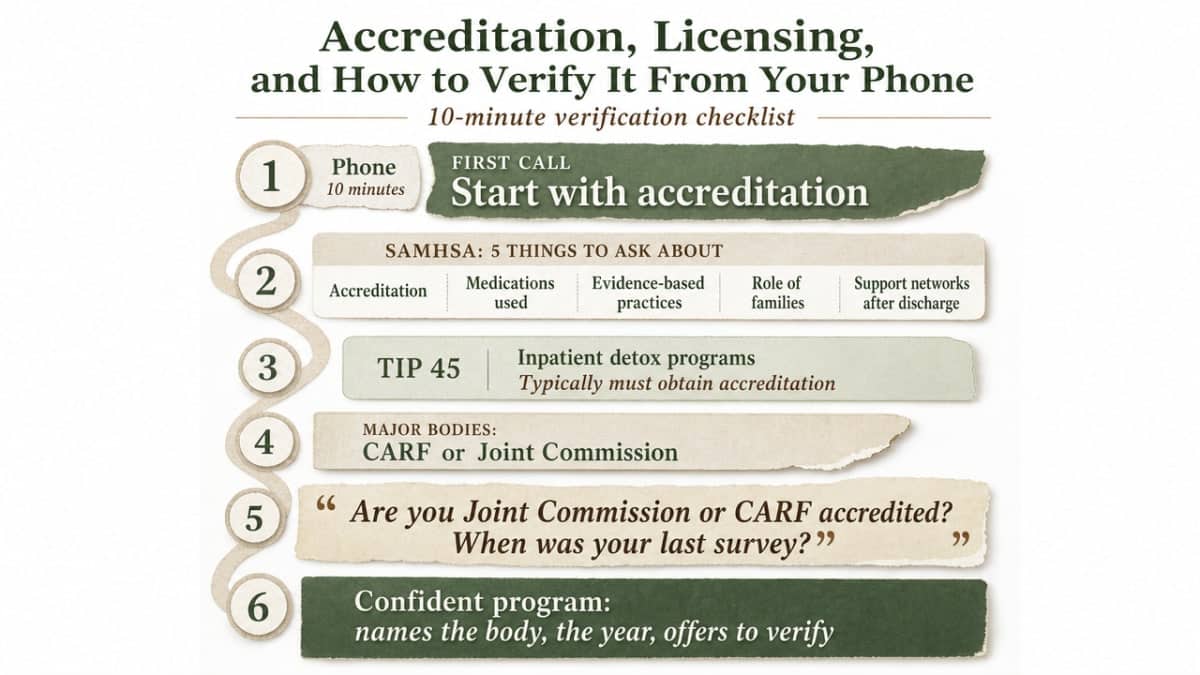
You do not need a clinical degree to check a facility’s credentials. You need a phone, ten minutes, and a short list of things to look up. SAMHSA’s consumer guidance for finding quality treatment names five things that separate a solid program from a shaky one: accreditation, the medications used, evidence-based practices, the program’s position on the role of families, and support networks for after discharge 8. Every one of those is something you can ask about in a first call.
Start with accreditation. TIP 45’s administrator guidance notes that inpatient detoxification programs typically must obtain accreditation from major bodies such as CARF or the Joint Commission 9. So ask: “Are you Joint Commission or CARF accredited? When was your last survey?” A confident program will name the body, the year, and offer to send documentation. You can also look up the facility on the accreditor’s public directory while you are still on the call.
Then check state licensing. In Oklahoma, the Department of Mental Health and Substance Abuse Services (ODMHSAS) is the certification authority for programs providing medication-assisted treatment and related services 12. Ask which ODMHSAS certifications the facility holds, and cross-check on the state’s provider list.
Insurance, SoonerCare, and the Prior Authorization Question
Money worry does not have to be the reason someone waits another week to get help. It is worth spending five minutes on the phone to find out what your coverage actually does.
Start with what Oklahoma Medicaid says out loud. SoonerCare lists mental health treatment benefits that include “inpatient acute care, crisis stabilization and medical detoxification” 5. That language matters — medical detox is a named, covered service, not a gray-area extra. On the substance use side, the state’s benefit table shows that detox and residential SUD services are covered for children, non-expansion adults, and expansion adults alike, with one shared string attached: prior authorization is required 6.
Prior authorization is not a rejection. It is a paperwork step where the facility submits your clinical information to the payer and gets a yes before or shortly after you are admitted. The question you want to ask any Oklahoma City detox center is direct: “Do you handle SoonerCare prior authorization in-house, and how fast do you usually get a decision?” A program that does this every day will have a case manager who can talk you through it in specifics — who submits, what documentation they need from you, what happens if the first submission is denied.
If you carry commercial insurance instead, ask for a free benefits verification before you commit to anything. A good intake team will call your plan, confirm your detox coverage, tell you what your out-of-pocket looks like, and put it in writing. If you are uninsured, ask about self-pay rates and whether they can help you apply for SoonerCare on the spot. The answer should be a real plan, not a shrug.
For Veterans and Service Members Near Tinker
If you served, or you are calling on behalf of someone who did, the questions shift a little. Not because the ASAM levels change — they do not — but because what a good detox looks like for a veteran includes things a civilian intake sometimes misses.
Start with the medication conversation. The 2021 VA/DoD clinical practice guideline for substance use disorders names buprenorphine as a preferred medication for opioid use disorder and points to telehealth as a real tool for keeping people connected to care after they leave the unit 7. So ask the facility: “Do you start buprenorphine here? Who manages my prescription after discharge? Can you set up telehealth follow-up with a provider who understands veterans?”
Then ask about the room around you. Are there other veterans in the program, or will you be the only one? Is there staff — a peer, a counselor, a case manager — who has worked with service members before? Can they coordinate with the Oklahoma City VA or your unit’s behavioral health contact when you are ready? Trauma-informed practice matters here specifically, and the timing rule still holds: real trauma screening waits until you are medically stable, not while you are in acute withdrawal 4. A program that understands that is a program worth calling first.
If You’re the One Making the Call for Someone Else
Quick audience shift: this section is for the person on the other end of the situation — the spouse who found the empty bottle, the mom who has not slept in three days, the adult kid trying to keep it together while a parent shakes on the couch. You are not the patient. You are still doing something that matters.
You are allowed to ask the clinical questions on their behalf. Facilities are used to it. When you call, say plainly: “I’m calling for my [husband, son, dad]. Here is what he is withdrawing from, here is how much, here is when he last used, and here are the other medications and health problems I know about.” Then ask the same questions the rest of this guide teaches — ASAM level of care 1, whether they can safely manage this specific withdrawal on site 2, what medications they start and when, how prior authorization works with SoonerCare or commercial insurance 6, and what the handoff looks like after detox 8.
Write the answers down. Ask if you can be involved in the aftercare conversation. And breathe — making one clear phone call is a real step forward, not a small one.
Handoff to What Comes After Detox
Here is the part that separates a program you will thank later from one you will regret: what happens on day five, when your vitals are stable and your bag is packed. Detox is the start, not the finish. SAMHSA says this plainly in its consumer guidance — detoxification alone is not sufficient treatment for a substance use disorder, and quality programs link you to continuing care before you walk out the door 8.
So while you are still on the intake call, ask what the handoff looks like. Not in general — for you. Do they have residential beds, a partial hospitalization program, or intensive outpatient slots ready, or do they refer out? If they refer, to whom, and have they already called to check availability? Who prescribes your buprenorphine on day six, and is that appointment on the calendar before discharge 7? Is there a peer support specialist or case manager who follows up in the first week, when relapse risk is highest?
Ask about family too. A good program will offer to include the people helping you — with your consent — in the aftercare plan 8. That is what a real handoff sounds like: names, dates, and a phone number you can call on day seven.
A Short Phone Script You Can Read Out Loud
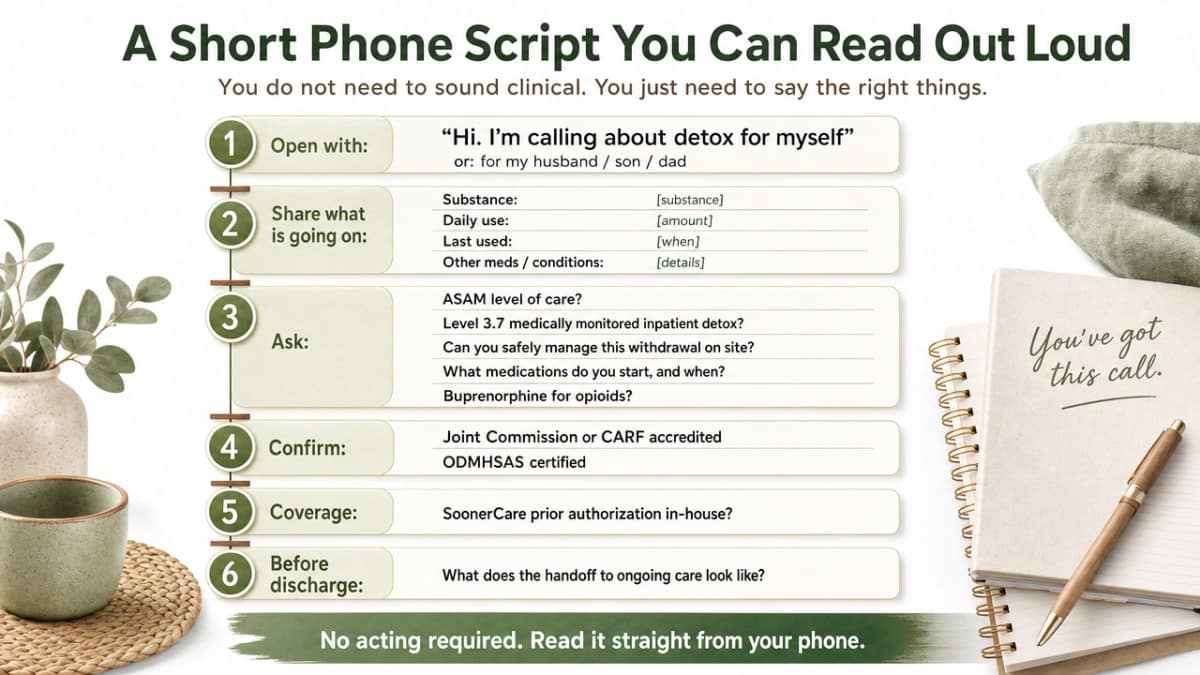
You do not need to sound clinical. You just need to say the right things. Here is a script you can read straight off your phone screen, no acting required.
“Hi. I’m calling about detox for myself [or: for my husband/son/dad]. Here is what is going on: I’ve been using [substance] daily, about [amount], last used [when]. I also take [other medications] and have [medical conditions]. A few questions.
- What ASAM level of care is your program — are you a Level 3.7 medically monitored inpatient detox? 1
- Can you safely manage this withdrawal on site? 2
- What medications do you start, and when — do you use buprenorphine for opioids? 7
- Are you Joint Commission or CARF accredited, and ODMHSAS certified? 9
- Do you handle SoonerCare prior authorization in-house? 6
- What does the handoff to ongoing care look like on discharge day? 8“
Read it. Write down the answers. Then call us and ask the same things.
Talk With a Real Nurse About Detox Now
Get your questions answered and discuss next steps with a compassionate medical professional right away.
Frequently Asked Questions
What ASAM level of care do I need for opioid, alcohol, or benzo withdrawal?
For most opioid, alcohol, or benzodiazepine withdrawal, the benchmark is ASAM Level III.7-D — medically monitored inpatient detox, which offers 24-hour medically supervised detoxification in a freestanding center 1. If you have severe medical or psychiatric issues, a hospital-based Level IV-D may be safer. Ask the facility to name their level out loud.
Does SoonerCare cover medical detox in Oklahoma City?
Yes. SoonerCare’s mental health benefits include inpatient acute care, crisis stabilization, and medical detoxification 5. Detox and residential SUD services are covered for children, non-expansion adults, and expansion adults, with prior authorization required 6. Ask any facility if they handle that prior authorization paperwork in-house and how quickly they usually get a decision back.
How do I verify a detox center’s accreditation and state licensing?
Ask if they are accredited by the Joint Commission or CARF — TIP 45’s administrator guidance names these as the typical accrediting bodies for inpatient detox 9. Then check state certification through the Oklahoma Department of Mental Health and Substance Abuse Services, which is the certification authority for programs providing MAT and related services in Oklahoma 12.
What medications should a modern detox program offer?
For opioid withdrawal, buprenorphine is the medication you should hear named — the 2021 VA/DoD clinical practice guideline highlights it as a preferred approach for opioid use disorder 7. For alcohol and benzodiazepine withdrawal, expect long-acting benzodiazepines on a symptom-triggered or scheduled taper, delivered under medical supervision as TIP 45 outlines 3. “Medication-free” is not modern care.
What should I ask about care for veterans or people with trauma histories?
Ask if they start buprenorphine on site and can arrange telehealth follow-up, both emphasized in the 2021 VA/DoD guideline 7. For trauma-informed care, ask when screening happens — TIP 57 is clear that trauma screening should not occur while a patient is under the influence or in acute withdrawal, but after stabilization using validated instruments 4.
Is detox alone enough, or do I need more treatment afterward?
Detox alone is not sufficient treatment for a substance use disorder — SAMHSA is direct about this, and quality programs link you to continuing care before discharge 8. Ask what happens on day five: residential, partial hospitalization, or intensive outpatient placement, who prescribes your ongoing medication, and whether family can be included in the aftercare plan.
References
- 2 Settings, Levels of Care, and Patient Placement. https://www.ncbi.nlm.nih.gov/books/NBK64109/
- Overview of Substance Use Disorder Care Clinical Guidelines. https://www.medicaid.gov/state-resource-center/innovation-accelerator-program/iap-downloads/reducing-substance-use-disorders/asam-resource-guide.pdf
- Quick Guide for Clinicians Based on TIP 45: Detoxification and Substance Abuse Treatment. https://nida.nih.gov/sites/default/files/samhsa_detoxification_and_substance_abuse_treatment.pdf
- TIP 57: Trauma-Informed Care in Behavioral Health Services. https://library.samhsa.gov/sites/default/files/sma14-4816.pdf
- Behavioral Health and Substance Abuse Services (SoonerCare Benefits). https://oklahoma.gov/ohca/individuals/mysoonercare/soonercare-benefits/behavioral-health-and-substance-abuse-services.html
- Mental Health and Substance Abuse Services – Oklahoma Medicaid. https://oklahoma.gov/ohca/individuals/programs/mental-health-and-substance-abuse-services.html
- Synopsis of the 2021 U.S. Department of Veterans Affairs and Department of Defense Clinical Practice Guideline for the Management of Substance Use Disorders. https://pubmed.ncbi.nlm.nih.gov/35313113/
- Finding Quality Treatment for Substance Use Disorders. https://library.samhsa.gov/product/finding-quality-treatment-substance-use-disorders/pep18-treatment-loc
- Quick Guide for Administrators Based on TIP 45. https://radarcart.boisestate.edu/library/files/2017/07/TIP-45-QuickGuideAdmin_SMA06-4226.pdf
- Chapter 70. Standards and Criteria for Opioid Treatment Programs (Effective 9-15-22). https://oklahoma.gov/content/dam/ok/en/odmhsas/documents/policy/provider-certification/administrative-rules/2022/Chapter%2070%20Final%20effective%209-15-22%20w%20History.pdf
- Chapter 70. Standards and Criteria for Opioid Treatment Programs (Effective 9-15-23). https://oklahoma.gov/content/dam/ok/en/odmhsas/documents/policy/provider-certification/administrative-rules/2023/PC–Chapter-70-Final-effective-9-15-23.pdf
- Chapter 70. Standards and Criteria for Opioid Treatment Programs (Effective 9-15-25). https://oklahoma.gov/content/dam/ok/en/odmhsas/documents/policy/provider-certification/administrative-rules/2025/PC–Chapter-70_9_15_2025.pdf