Key Takeaways
- Hydrocodone dependence rewires the nervous system, so late doses trigger physical withdrawal that reflects biology, not weakness or a lack of willpower.
- Detox alone is not treatment—federal guidance warns that stopping without ongoing care raises relapse and overdose death risk 3.
- The strongest path pairs medically supervised withdrawal with one of three FDA-approved medications: buprenorphine, methadone, or extended-release naltrexone 7, 16.
- Induction timing decides whether medication works—starting buprenorphine or naltrexone too early triggers precipitated withdrawal, so plan the wait with a clinician 1, 8.
Why Stopping Hydrocodone Is a Medical Event, Not a Willpower Test
If you’ve been taking hydrocodone long enough for your body to notice when a dose is late, you already know something most people don’t: the shakiness, the sweat between your shoulder blades, the way your skin feels wrong. That’s not weakness. That’s your nervous system doing exactly what it learned to do while the medication was in your bloodstream every few hours. Stopping is a physical event, and it deserves the same seriousness you’d give any other medical situation.
The fact that you’re reading this counts. Really. Most people who develop hydrocodone dependence didn’t go looking for it. A surgery, a back injury, a dental procedure, a prescription that kept getting refilled because the pain was real and the pills worked. Somewhere along the way, the medication started running your day instead of the other way around. That’s a common story, and it doesn’t say anything about your character.
What Withdrawal Actually Feels Like—and Why It Peaks When It Does
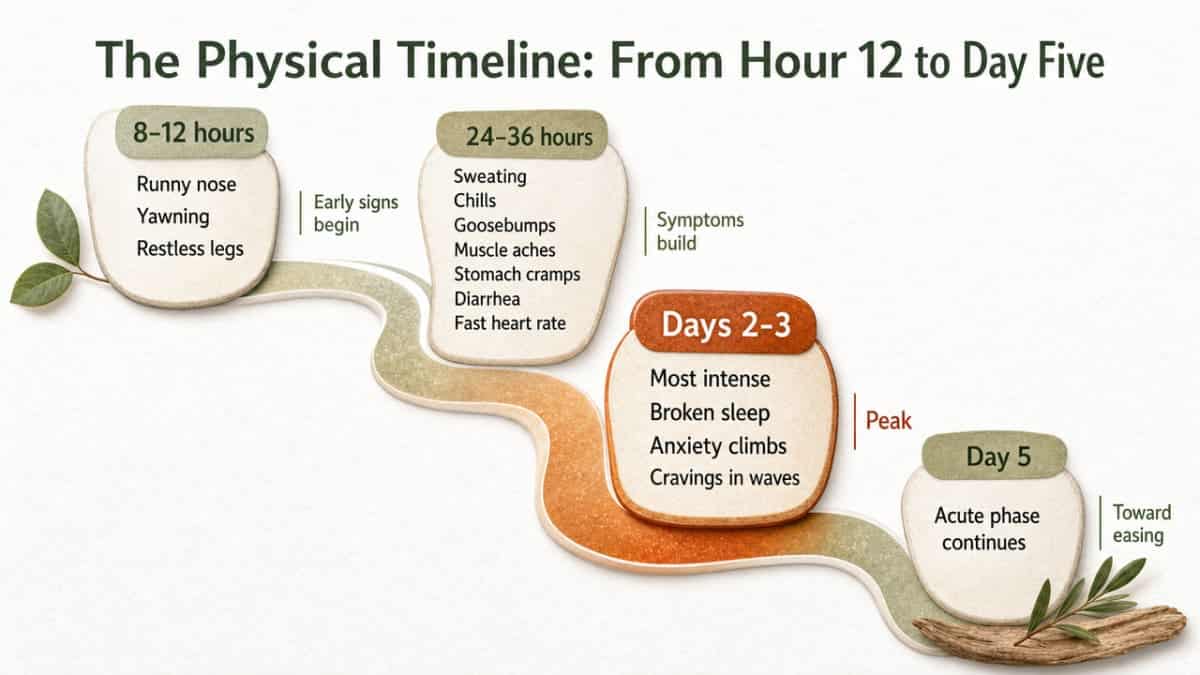
The Physical Timeline: From Hour 12 to Day Five
Withdrawal from hydrocodone doesn’t hit all at once. It builds. For most people who’ve been taking a short-acting formulation like NORCO or Vicodin, the first uneasy signs show up somewhere between 8 and 12 hours after the last dose. Your nose starts running. You yawn even though you’re not tired. A restless feeling settles into your legs. This is the body noticing the absence of a chemical it had learned to expect on a schedule.
By hours 24 to 36, things get louder. Sweating, chills, goosebumps, muscle aches deep in the back and thighs, stomach cramps, diarrhea, a heart rate that feels too fast for what you’re doing. Sleep breaks apart. Anxiety climbs. Cravings arrive in waves that feel less like temptation and more like alarm.
The peak generally lands on days two and three. That’s when the physical symptoms are the most intense and when the risk of giving up on the process is highest. In a supervised setting, this is also where medication does the most visible work: μ-opioid receptor agonists like methadone, partial agonists like buprenorphine, and α2-adrenergic agonists like clonidine or lofexidine are the medication classes used to reduce the severity of these symptoms during medically supervised withdrawal 16, 1.
By days four and five, the worst of the acute physical symptoms usually starts to ease. Sleep is still rough. Energy is still low. But your body is beginning to remember how to run itself again. That’s the doorway into the next phase of care, not the finish line.
Why ‘Just Quitting’ Backfires
There’s a version of this story that a lot of people try first: flush the pills, tough it out on the couch for a week, come out the other side. Sometimes it seems to work for a few days. Then something breaks. The muscle pain gets unbearable. Sleep won’t come. The anxiety turns into something you can’t sit still inside of. And the fastest way to make all of it stop is exactly what your body has been asking for since hour 12.
That’s the mechanical reason cold-turkey attempts so often end in a return to use. It isn’t a moral failure. It’s what happens when you leave the most difficult 72 hours of a medical event unmedicated and unsupervised. Federal treatment guidance is direct on this: detoxification on its own is not recommended, because stopping without ongoing treatment raises the risk of relapse, overdose, and overdose death 3.
The overdose piece is worth pausing on. When someone stops using and then relapses, their tolerance has dropped. The dose that felt normal two weeks ago can now cause dangerous respiratory depression. That’s not a lecture. It’s the reason supervised withdrawal exists as a category of care, and why the medications discussed later in this guide matter so much. You’re not choosing between suffering and comfort. You’re choosing between an unmonitored crash and a monitored transition.
The Detox Trap: Why Short-Term Withdrawal Care Isn’t Treatment
Here’s a distinction that gets blurred in almost every conversation about getting off opioids: detox and treatment are not the same thing. Detox is a short medical process that helps your body clear a substance and manage the acute withdrawal that follows. Treatment is what keeps you from ending up right back where you started. A lot of programs sell the first as if it were the second, and that mismatch is where people get hurt.
The CDC is unusually direct on this point. Detoxification on its own is not recommended for opioid use disorder, because stopping without ongoing treatment raises the risk of relapse, overdose, and overdose death 3. Read that twice if you need to. The problem isn’t that a five-day medical stay is useless. The problem is that finishing one and walking out with no medication, no follow-up, and no plan is one of the more dangerous configurations in modern addiction care. Tolerance drops fast during those days. If use resumes at anything close to the old amount, the body can’t handle it.
That’s why the standard of care for opioid use disorder includes buprenorphine, methadone, or extended-release naltrexone as ongoing medication, not just something used briefly and then dropped 16. When you’re evaluating a program, the question isn’t whether they can get you through the first week. It’s what happens on day eight.
Tapering: What Safe Dose Reduction Looks Like
Reading Your Own Prescription Label
Pick up the bottle. Whether it’s NORCO, Vicodin, Norco generic, or ZOHYDRO ER, the FDA-approved label inside that pharmacy printout says something worth reading before you make any decisions about stopping. The NORCO label is explicit: do not abruptly discontinue in a patient who is physically dependent, and gradually taper the dosage instead. Rapid tapering, the label warns, can lead to serious withdrawal symptoms, uncontrolled pain, and suicide 11.
The extended-release version carries the same warning with more detail. The ZOHYDRO ER label says not to stop the medication suddenly and provides example taper schedules organized by the dose you’ve stabilized on, with instructions to slow the reduction if withdrawal shows up 12. These aren’t cautious footnotes. They’re the manufacturer telling your prescriber, in plain regulatory language, that stopping too fast can hurt you.
If you’ve been reducing your own dose to stretch a prescription, or skipping days because you’re trying to quit on your own, this is the piece to sit with. Your body has been reading a different label than you have. The taper the FDA describes isn’t a suggestion for careful patients. It’s the safety floor, and it exists because people got hurt when doses were cut too fast.
How Slow Is Slow Enough
Two federal documents give you the numbers to anchor a real conversation with a prescriber. The CDC’s 2022 clinical practice guideline offers an example taper rate of roughly 10% of the original dose per month for people who’ve been on long-term opioid therapy, with slower reductions for those who’ve taken opioids for years 4. The HHS clinician guide describes a common range of 5% to 20% every 4 weeks, individualized to the person in front of you 10. Neither number is a rule. Both exist because rapid tapers caused real harm, and federal guidance shifted to explicitly warn against them.
Look at what those figures actually mean if you’re taking hydrocodone. A 10-milligram-per-dose regimen, tapered at 10% of the original dose per month, is a schedule measured in many months, not weeks. That can feel discouraging when you want to be done. But the pace is doing something for you: it lets your nervous system recalibrate a little at a time instead of crashing all at once, and it keeps the withdrawal symptoms in a range that medication and monitoring can manage.
Here’s the honest part. A slow outpatient taper is one path. It works well when pain is stable, the prescribing relationship is solid, and the goal is dose reduction rather than a diagnosis of opioid use disorder. When cravings, loss of control, or unsafe use are part of the picture, tapering alone isn’t the right tool. That’s the point where medically supervised withdrawal paired with buprenorphine, methadone, or naltrexone becomes the safer plan. Bring both taper ranges to your prescriber and ask which one fits where you actually are.

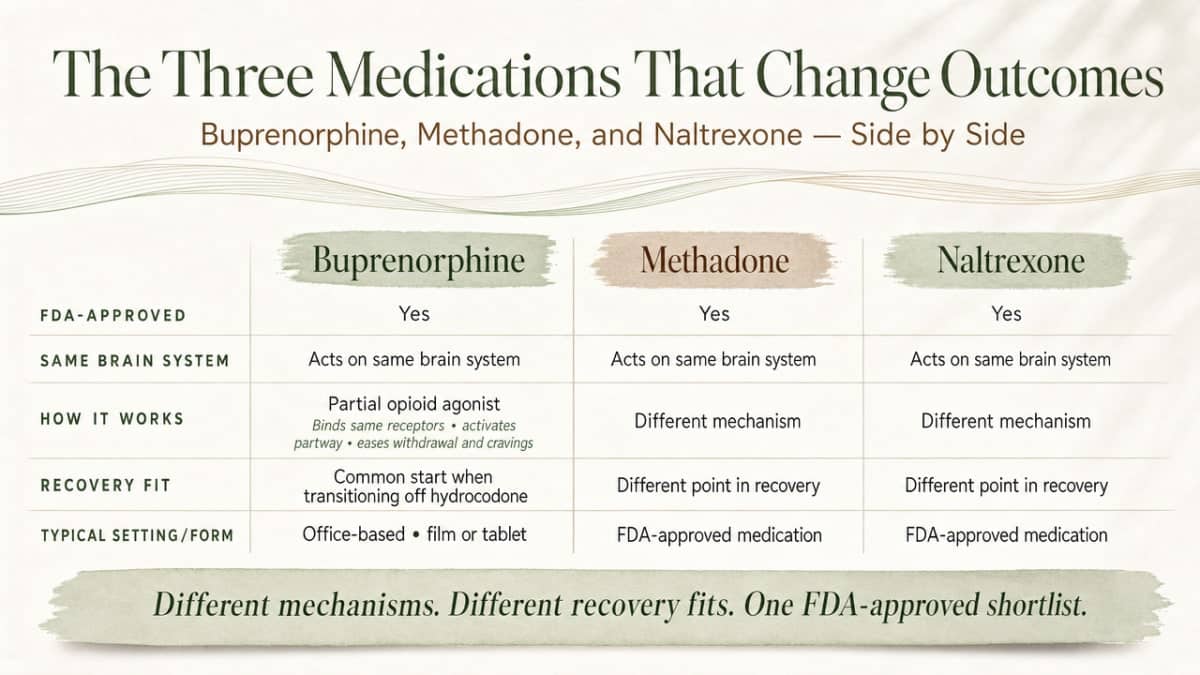
The Three Medications That Change Outcomes
Buprenorphine, Methadone, and Naltrexone—Side by Side
The FDA has approved three medications for opioid use disorder: buprenorphine, methadone, and naltrexone 7. That’s the whole shortlist. Each one works on the same brain system hydrocodone acts on, but in a different way, and each one fits a different point in your recovery. Understanding what they actually do makes the choice feel less like a coin flip and more like a match.
- Buprenorphine
- A partial opioid agonist. It binds to the same receptors hydrocodone binds to, but it activates them only partway. That’s enough to quiet withdrawal and cravings without producing the strong euphoria full opioids create 8. It’s typically prescribed in an office-based setting, often as a film or tablet, and it’s the medication most people start with when transitioning off hydrocodone. Critically, it can only be started once withdrawal has already begun 1.
- Methadone
- A full opioid agonist, taken as a daily oral dose. It works well for people with longer or higher-dose opioid histories, and it can be started while opioids are still in your system. The trade-off is access: methadone for OUD is dispensed only through federally regulated opioid treatment programs, which means daily visits at first, then gradually earned take-home doses 2.
- Naltrexone
- The outlier. It’s not an opioid at all—it’s an opioid blocker, available as a monthly extended-release injection. Because it occupies the receptors without activating them, taking it while opioids are still in your body triggers immediate, severe withdrawal. That’s why it can only be started after a full opioid-free interval, usually 7 to 10 days 8. It’s often the right medication for someone who has already made it through detox and wants a non-opioid option going forward.
For withdrawal management specifically, the evidence favors buprenorphine over non-opioid options like clonidine or lofexidine—it reduces symptom severity more effectively and helps more people complete the process 15. Between buprenorphine and methadone, completion rates are similar, and the choice comes down to your history, your access, and what you and your clinician think will hold.
Why Induction Timing Decides Whether the Medication Works
Here’s where a lot of hydrocodone recoveries stumble. Not because the wrong medication was chosen, but because the right one was started at the wrong moment. Timing is not a detail. It’s the difference between relief and a withdrawal so sudden it sends you back to using within hours.
With buprenorphine, the rule is counterintuitive: you have to already be in withdrawal before your first dose. SAMHSA’s federal guidance is explicit that clinicians should not start buprenorphine until opioid withdrawal is present 1. The reason has to do with how partial agonists work. If hydrocodone is still occupying your opioid receptors and buprenorphine arrives, it pushes the hydrocodone off but doesn’t replace it with the same level of activation. The result is called precipitated withdrawal—symptoms that come on fast, hit hard, and feel worse than what you’d have had if you’d just waited a few more hours.
For short-acting hydrocodone, that usually means waiting somewhere in the 12-to-24-hour range after your last dose, until the early withdrawal signs your body is already giving you—runny nose, restlessness, sweating, wide pupils—reach a level your clinician can measure. It feels backwards to intentionally wait for symptoms. It’s also what makes the medication work.
Naltrexone flips the timing in the other direction. Because it’s a full blocker, it can’t be started until opioids have completely cleared your system, which typically takes 7 to 10 days for short-acting opioids like hydrocodone 8. Starting sooner triggers the same precipitated withdrawal buprenorphine can cause, only more severe. This is exactly why supervised programs matter: the timing math is not something to run alone.
Naloxone Belongs in the Plan, Not the Panic
Somewhere along the way, naloxone got tangled up with shame. People hear the word and think of the worst-case scene: an ambulance, a stranger, a headline. That framing is doing real damage, because it keeps naloxone out of the medicine cabinets where it belongs. Federal guidance treats it as a normal part of opioid treatment planning, not an emergency confession. The CDC recommends that clinicians offer naloxone and education to patients with opioid use disorder and to the people they live with 3, 4.
Here’s what naloxone actually is: a medication that reverses opioid-related respiratory depression during an overdose. NARCAN, the nasal spray version, is FDA-approved for emergency use in known or suspected opioid overdose with respiratory or central nervous system depression 14. You spray it. It buys time for help to arrive. That’s the whole job.
One detail matters specifically for hydrocodone. Naloxone can wear off before hydrocodone does, so repeated doses may be needed while waiting for emergency responders 13. Keeping two doses on hand, and making sure the people you live with know where they are, is standard practice—not a signal that anyone expects you to fail 6.
What a Safe Supervised Program Actually Includes
Not every program that uses the word “detox” is doing the same thing. Some are five-day stays with a bed and a blood pressure cuff. Others are structured medical settings with continuous monitoring, medication protocols, and a real handoff into ongoing care. The difference matters, because you’re the one whose body will be inside whichever version you choose.
A few markers separate the two.
- First, around-the-clock medical supervision—not a nurse who checks in twice a day, but staff who can actually see how your vital signs, sleep, and symptoms are moving through the peak of withdrawal on days two and three.
- Second, a medication protocol grounded in the three FDA-approved options for opioid use disorder: buprenorphine, methadone, or extended-release naltrexone, with a clinician who knows the induction timing rules for each 7, 1. If a program tells you they don’t use medication, they’re offering something federal guidance no longer considers standard care 16.
- Third, naloxone education for you and the people you live with, written into the discharge plan rather than mentioned as an afterthought. The CDC’s guidance is that clinicians should offer naloxone and education to patients with opioid use disorder and to household members—it belongs in the plan from day one 3.
- Fourth, and this is the one most short-term programs skip: a concrete transition into ongoing MOUD before you walk out the door. That means an appointment already on the calendar, the first prescription in hand or arranged, and a clinician who will still know your name in week three. If you can’t get a clear answer about what day eight looks like, that’s the answer.
Moving From Withdrawal Care Into Ongoing Recovery
The week you finish supervised withdrawal isn’t the finish line. It’s the point where a different, quieter kind of work begins—and it’s the part that decides whether the past several days hold. Federal reviews are clear that the standard of care for opioid use disorder includes buprenorphine, methadone, or extended-release naltrexone as ongoing medication, not just something used briefly during the acute phase 16. What that means for you is practical: the medication you started (or the one you’re moving to) should still be part of your life on day 30, day 90, and often well beyond.
For most people leaving hydrocodone withdrawal on buprenorphine, the next stretch is about finding a stable dose, keeping regular appointments with a prescribing clinician, and letting the medication do what it’s designed to do—reduce cravings without producing strong euphoria 8. Some people stay on buprenorphine long-term. Others make a planned transition to extended-release naltrexone once they’ve been opioid-free long enough for that switch to be safe, using a low-dose buprenorphine strategy their clinician can walk them through 17. Methadone patients settle into a rhythm at an opioid treatment program, with doses and visit frequency that adjust over time 2.
One more thing worth naming. If pain was the reason hydrocodone entered your life, it doesn’t disappear because the medication did. Federal guidance is direct that MOUD and pain treatment can be delivered at the same time, with dose adjustments and supportive services when cravings or discomfort persist 2. You’re allowed to keep addressing both.
Finding Supervised Care Locally
If you’re in Oklahoma City and looking for supervised detox, a few practical questions will tell you more than any brochure.
- Ask whether a physician is on-site or on-call around the clock during the first 72 hours.
- Ask which of the three FDA-approved medications—buprenorphine, methadone, or extended-release naltrexone—the program uses, and who handles induction timing 7.
- Ask what the transition to ongoing MOUD looks like on day eight, whether that means an in-house prescriber or a warm handoff to an opioid treatment program or office-based clinician 16.
Insurance verification should be free and quick. Naloxone education for you and someone in your household should be part of discharge, not an upsell 3. If a facility can answer those questions plainly, you’re in the right kind of conversation. Renewal Springs Detox is one Oklahoma City option that works within this framework, but the questions matter more than the name on the door.
Talk Now About Starting Hydrocodone Detox Safely
Get real answers and support for your next step in hydrocodone withdrawal care.
Frequently Asked Questions
Can I stop taking hydrocodone cold turkey at home?
It’s not the safest way, and federal guidance is direct that detoxification alone raises the risk of relapse, overdose, and overdose death 3. The FDA label for NORCO also warns against abrupt discontinuation in physically dependent patients 11. A supervised setting with medication support gives your body a monitored transition instead of an unmanaged crash.
How long does hydrocodone withdrawal last?
For a short-acting hydrocodone product, early symptoms usually appear 8 to 12 hours after your last dose, peak around days two and three, and start easing by days four to five. Sleep and energy can lag for another week or two. Medications used during supervised withdrawal are designed to reduce symptom severity across that window 16, 1.
Which medication is best for hydrocodone addiction—buprenorphine, methadone, or naltrexone?
All three are FDA-approved for opioid use disorder, and the right fit depends on your history and access 7. Buprenorphine is often the starting point for people leaving hydrocodone and outperforms clonidine or lofexidine on symptom severity and completion 15. Methadone suits longer or higher-dose histories. Naltrexone is a non-opioid blocker started only after a full opioid-free interval 8.
Do I have to be in withdrawal before starting buprenorphine?
Yes, and it feels backwards until you know why. SAMHSA instructs clinicians not to start buprenorphine until opioid withdrawal is present 1. If hydrocodone is still on your receptors, buprenorphine can push it off and trigger precipitated withdrawal—symptoms that come on fast and hit harder than waiting would have. Your clinician measures early signs before the first dose.
Is medically supervised detox enough, or do I need more treatment after?
Detox on its own is not treatment. CDC guidance is explicit that stopping without ongoing care raises the risk of relapse and overdose death 3. The standard of care includes continuing on buprenorphine, methadone, or extended-release naltrexone after the acute phase 16. When you evaluate a program, ask what day eight looks like, not just what the first week covers.
Should my family keep naloxone at home if I’m being treated for hydrocodone dependence?
Yes. CDC recommends offering naloxone and education to patients with opioid use disorder and their household members 3. NARCAN nasal spray is indicated for known or suspected opioid overdose with respiratory depression 14. One hydrocodone-specific detail: naloxone can wear off before hydrocodone does, so repeat doses may be needed while waiting for emergency responders 13.
References
- TIP 63: Medications for Opioid Use Disorder. https://library.samhsa.gov/product/tip-63-medications-opioid-use-disorder/pep21-02-01-002
- Federal Guidelines for Opioid Treatment Programs. https://library.samhsa.gov/sites/default/files/federal-guidelines-opioid-treatment-pep24-02-011.pdf
- Opioid Use Disorder: Treating | Overdose Prevention. https://www.cdc.gov/overdose-prevention/hcp/clinical-care/opioid-use-disorder-treating.html
- CDC Clinical Practice Guideline for Prescribing Opioids for Pain — United States, 2022. https://www.cdc.gov/mmwr/volumes/71/rr/rr7103a1.htm
- Guideline Recommendations and Guiding Principles. https://www.cdc.gov/overdose-prevention/hcp/clinical-guidance/recommendations-and-principles.html
- Naloxone Toolkit. https://www.cdc.gov/overdose-prevention/hcp/toolkits/naloxone.html
- Information about Medications for Opioid Use Disorder (MOUD). https://www.fda.gov/drugs/food-and-drug-administration-overdose-prevention-framework/information-about-medications-opioid-use-disorder-moud
- Medications for Opioid Use Disorder. https://www.nida.nih.gov/research-topics/medications-opioid-use-disorder
- Recovery is Possible: Know the Options | Rx Awareness. https://www.cdc.gov/rx-awareness/treatment/index.html
- HHS Guide for Clinicians on the Appropriate Dosage Reduction or Discontinuation of Long-Term Opioid Analgesics. https://www.hhs.gov/system/files/Dosage_Reduction_Discontinuation.pdf
- NORCO® (Hydrocodone Bitartrate and Acetaminophen Tablets) Label. https://www.accessdata.fda.gov/drugsatfda_docs/label/2019/040148s073lbl.pdf
- ZOHYDRO ER (Hydrocodone Bitartrate) Label. https://www.accessdata.fda.gov/drugsatfda_docs/label/2016/202880s009s010lbl.pdf
- Vicodin – Accessdata FDA Label. https://www.accessdata.fda.gov/drugsatfda_docs/label/2006/088058s027lbl.pdf
- NARCAN Nasal Spray Label. https://www.accessdata.fda.gov/drugsatfda_docs/label/2023/208411s007lbl.pdf
- Buprenorphine for managing opioid withdrawal. https://pmc.ncbi.nlm.nih.gov/articles/PMC6464315/
- New directions in the treatment of opioid withdrawal. https://pmc.ncbi.nlm.nih.gov/articles/PMC7385662/
- Buprenorphine Treatment for Opioid Use Disorder: An Overview. https://pmc.ncbi.nlm.nih.gov/articles/PMC6585403/