
Key Takeaways
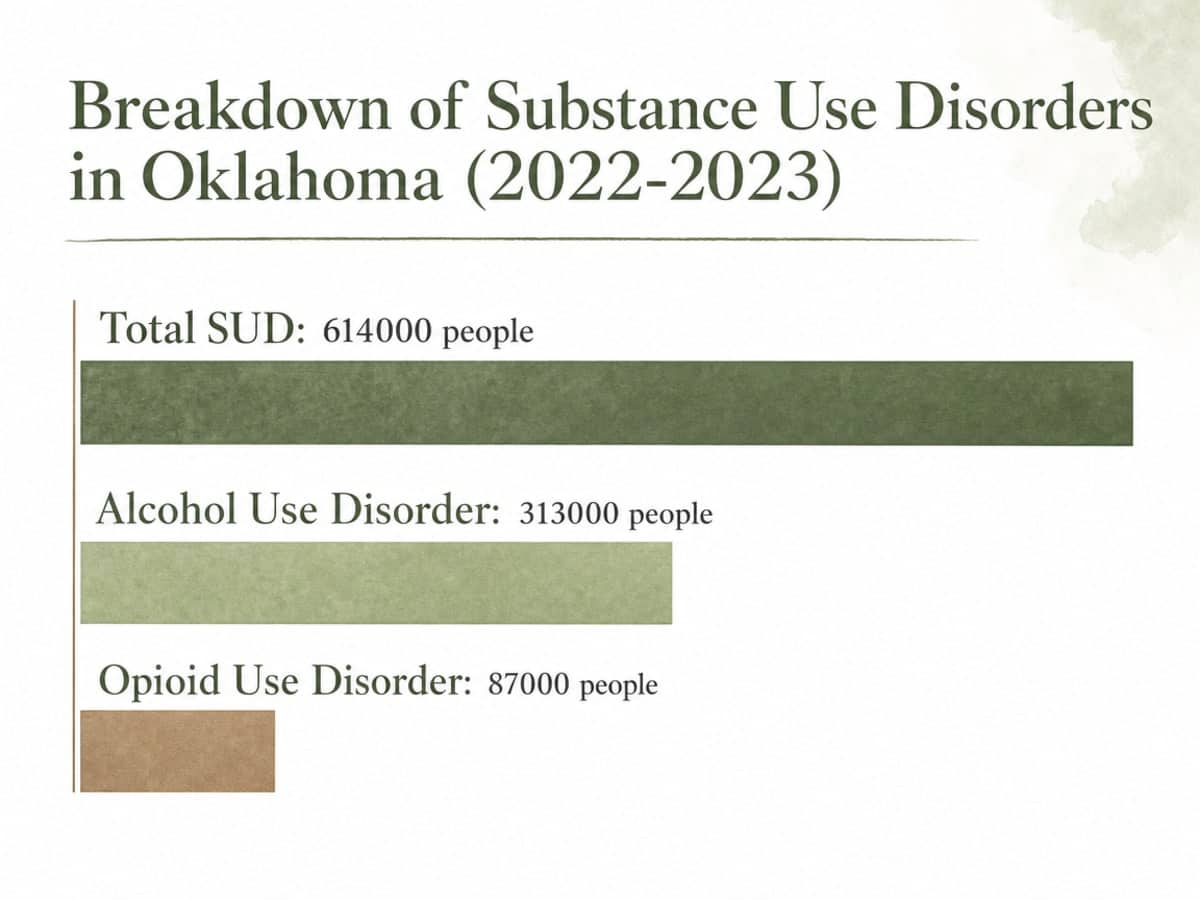
- Oklahoma City sits inside a state where roughly 614,000 residents live with substance use disorder, spanning alcohol, opioid, and stimulant patterns that each demand different withdrawal care 1.
- Alcohol, opioid, and stimulant withdrawal carry different medical risks and medication needs, so a template protocol will over-treat one person and under-serve another 9.
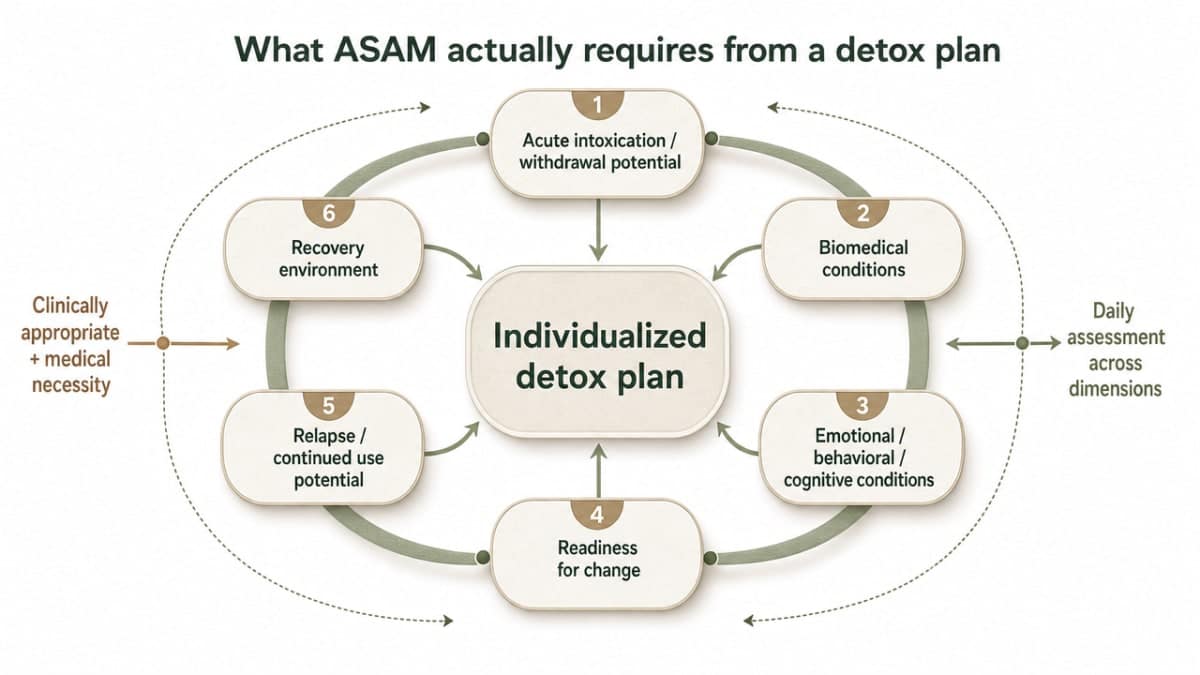
- ASAM-aligned detox requires an individualized plan built across six assessment dimensions with daily reassessment, not a fixed timeline you graduate from on schedule 10.
- Before choosing a program, compare medical supervision structure, how the plan adapts to veterans, women, or co-occurring conditions, and how insurance coverage and Oklahoma licensing are handled 11.
The moment you decide to make the call
You already know what withdrawal feels like, or you’ve watched someone you love go through it. That’s why you’re here. Maybe you’re the one holding the phone. Maybe you’re a partner, a parent, a sibling reading this at 2 a.m. because sleep isn’t coming. Either way, the fact that you’re this far into the page is not nothing. It’s a step.
Reaching out for detox in Oklahoma City is a heavy decision, and it’s fair to want to understand what you’re actually signing up for before you make the call. You’ve probably heard detox described like a checklist: come in, get through the worst of it, go home. That framing misses what good care actually looks like. Withdrawal from fentanyl is not withdrawal from alcohol. A 26-year-old with an opioid dependence and a history of anxiety needs a different plan than a 55-year-old veteran managing chronic pain and heavy drinking.
The honest question isn’t whether detox works. It’s whether the detox in front of you was built around you, or around a template. That distinction matters more than any brochure language, and it’s the through-line of everything below. Past attempts don’t disqualify you. Not knowing exactly what you need doesn’t disqualify you. Being unsure is a starting point, not a failure.
What Oklahoma’s substance use picture actually looks like
Before you can judge whether a detox plan is right for you, it helps to see the room you’re standing in. Oklahoma is not a small corner of this crisis. Combined 2022–2023 federal survey estimates put roughly 614,000 Oklahomans aged 12 or older as living with a substance use disorder in the past year, including about 313,000 with an alcohol use disorder and about 87,000 with an opioid use disorder 1. That’s more than half a million people, each with their own history, medications, family situation, and reason for reading something like this tonight.
Sit with that for a second. Alcohol use disorder alone accounts for a much larger share of the state’s clinical picture than opioid use disorder does, and opioid dependence still touches roughly 87,000 lives 1. Those aren’t the same withdrawal syndrome. They don’t carry the same seizure risk, the same craving arc, the same medication toolkit. A protocol built to shepherd someone through alcohol withdrawal is not a protocol built to stabilize someone coming off fentanyl, and neither of those looks like a stimulant taper.
Add the overdose layer. The Oklahoma State Department of Health tracks fatal and nonfatal overdoses across the state, with methamphetamine, opioids, and fentanyl called out as key substance categories in its ongoing dashboard 2. Recent state fact-sheet data through 2023 shows drug-induced deaths rising, with alcohol-involved overdose deaths numbering in the hundreds 3. Whatever brought you to this page, the risk that it could go badly at home, without medical eyes on it, is not theoretical.
So when you hear the phrase “individualized detox plan,” it isn’t marketing polish. It’s the honest response to a population where hundreds of thousands of clinical pictures share almost nothing except the courage it takes to ask for help. One protocol cannot hold that many stories. Your story needs its own plan, and understanding the scale of what’s happening around you is the first reason why.
Why a template protocol fails when the substance changes
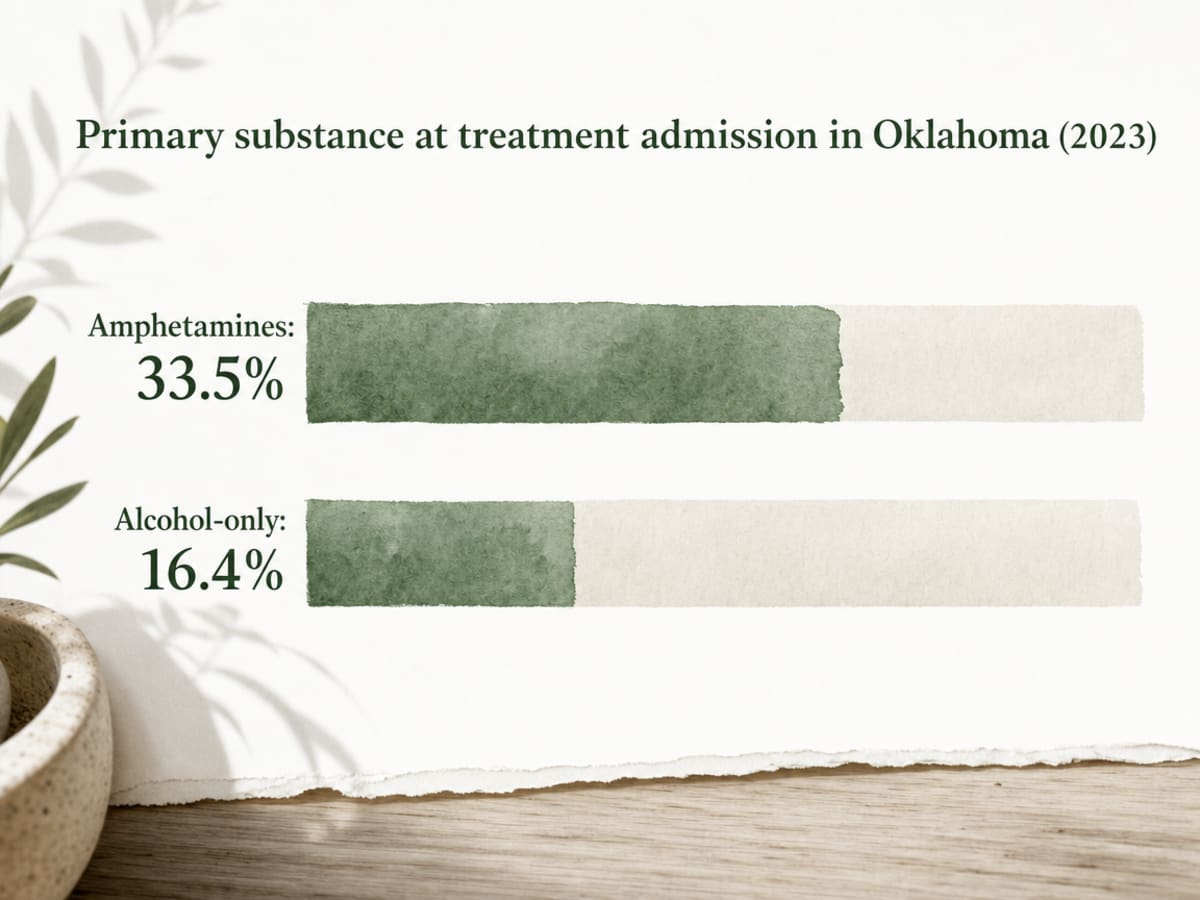
Look at who is actually walking into treatment across Oklahoma, and the case for individualized detox stops being philosophical. In 2023, the state recorded 14,559 treatment admissions. Amphetamines were the primary substance for 33.5% of them. Alcohol-only accounted for 16.4% 4. Those two groups alone represent thousands of people whose bodies are doing very different things when the substance stops.
A stimulant coming down is not an alcohol withdrawal. Someone stepping off methamphetamine can crash into deep fatigue, heavy sleep, dark mood, and cravings that arrive in waves — with medical concerns that lean toward cardiovascular strain, psychiatric stabilization, and suicide risk screening. Alcohol withdrawal is a different clinical animal. It can escalate into tremor, autonomic instability, seizures, and delirium tremens, and ASAM guidance treats it as a syndrome that has to be risk-stratified and matched to the right level of care in adults with varying degrees of severity 9. The medications, the monitoring cadence, the danger windows — none of them line up.
Now put an opioid patient in the same room. Fentanyl withdrawal moves fast and hits hard: bone-deep aches, GI symptoms, agitation, and a craving pull that is its own kind of medical emergency. The pharmacologic toolkit that helps here is not the toolkit that helps the alcohol patient down the hall.
What you should hear when a program talks about its detox: which substance you used, how much, how long, what else is going on in your body and mind — and how the plan changes because of your answers, not despite them.
What ASAM actually requires from a detox plan
If you’ve ever wondered whether “personalized detox” is a real clinical standard or a marketing phrase, here’s the plain answer: the American Society of Addiction Medicine writes the criteria most reputable programs work from, and those criteria explicitly require care to be built around you.
State-level implementation guidance on the ASAM Criteria, 3rd Edition, spells it out directly. Withdrawal management is described as“not just a set of services: it is a level of care that must be clinically appropriate and based on medical necessity,”and it calls for an individualized treatment plan with problem identification across ASAM’s assessment dimensions and daily assessment of client progress 10. Read that again. Daily. Across dimensions. Not a fixed timeline you graduate from on schedule.
Those dimensions cover:
- your intoxication and withdrawal risk,
- your biomedical conditions,
- your emotional and behavioral state,
- your readiness to change,
- your relapse and continued-use risk,
- and your recovery environment — the home you’d walk back into.
A plan that only addresses the first dimension is not an ASAM-aligned plan. It’s a symptom protocol.
For alcohol specifically, ASAM’s clinical practice guideline emphasizes identifying and managing withdrawal“in adults with varying degrees of syndrome severity”and matching each person to the right setting — ambulatory or inpatient — based on that severity 9. The pocket guide version reinforces the same idea in shorthand: match the level of care to the clinical picture in front of you 16.
What this means in practice: if a program’s answer to “what will my detox look like?” sounds identical to what they’d tell the next caller, something is missing. Ask how the plan gets reassessed each day. That’s the standard.
The four modalities inside a person-centered plan
Cognitive Behavioral Therapy: rewriting the response to a craving
Cravings aren’t just physical. They’re a loop — a trigger, a thought, a familiar reach for the substance that has always answered the question. Cognitive Behavioral Therapy works on that loop. It helps you notice what set the craving off, what story your brain told you about it, and what you actually did next. Then it helps you rehearse a different next move.
SAMHSA’s counseling guidance describes CBT as“one of the most common, evidence-based treatments”for problematic substance use, and reports that combining CBT with medication produces greater improvements than usual care plus medication 5. A 2023 systematic review adds that CBT shows both short-term and longer-term impact in handling cognitive and behavioral setbacks that come with recovery 6.
In a detox setting, CBT doesn’t try to solve your whole history in three days. It gives you a few concrete tools — naming a trigger, questioning a thought, planning the next hour — that travel with you into whatever comes after discharge.
Motivational Interviewing: meeting ambivalence honestly
Nobody walks into detox feeling only one thing. Part of you wants out. Part of you is grieving what you’re leaving behind, even if what you’re leaving behind was hurting you. That mixed feeling has a clinical name — ambivalence — and Motivational Interviewing is built to sit with it instead of arguing with it.
MI is a conversation style, not a lecture. A clinician asks open questions, reflects what you say, and helps you hear your own reasons for change in your own voice. It’s the opposite of being talked into something.
Be honest with yourself about what the research says here. A 2023 meta-analysis found a small to moderate benefit of MI compared to no intervention, but little to no difference compared to treatment as usual or other active interventions 7. A broader review of reviews reached a similar conclusion: MI is generally more effective than no treatment and comparable to other active treatments, with strong support for alcohol and tobacco and less evidence for methamphetamine or opioid use 8. So MI is not a cure. It’s a way of starting the conversation that keeps you in the room. During detox, staying in the room matters.
Reality Therapy: choices you can make today
Reality Therapy is grounded in a simple, uncomfortable, honest idea: you can’t change what already happened, and you can’t change other people, but you can look at what you’re doing right now and ask whether it’s getting you closer to the life you want.
Inside detox, that translates into short, practical questions. What do you want your week after discharge to look like? What are you doing today that moves toward it? What are you doing that moves away? No blame, no long excavation of the past — just a steady focus on choices you still have.
For someone who has been drowning in shame about how they got here, that pivot toward what’s still in your hands is often the first time in a long time that recovery feels like something you’re doing rather than something being done to you.
Person-centered care: the plan bends to the person
Person-centered care is less a technique than a stance. The plan gets built around you — your history, your body, your goals, your fears about what happens after this — instead of you being fit into the plan.
That stance is what ties CBT, MI, and Reality Therapy together during detox. The clinician isn’t picking a modality off a shelf. They’re listening for which tool helps you today, and which one might help you tomorrow when the picture has shifted. State-level ASAM implementation guidance backs this up directly, calling for an individualized treatment plan with problem identification across ASAM’s dimensions and daily reassessment of your progress 10.
What that feels like from your side: you get asked, not told. Your answers change the plan. The person sitting across from you actually remembers what you said yesterday. That is what person-centered means when it’s real and not just a phrase on a website.
Medical supervision, monitoring, and the safety layer
The talking modalities matter, and so does the body you’re bringing into detox. Withdrawal is a medical event. Blood pressure climbs. Heart rate spikes. Sleep collapses. Seizures can arrive without a polite warning, especially with alcohol and benzodiazepines. That’s why medical supervision isn’t a nice-to-have layered on top of counseling — it’s the floor everything else stands on.
Oklahoma’s own regulatory language treats it that way. State code defines medical withdrawal management as diagnostic and treatment services for acute alcohol or drug intoxication and complications, delivered under physician and registered nurse direction 11. That is the baseline. What good programs add on top is the ASAM structure: an individualized treatment plan with problem identification across six assessment dimensions — intoxication and withdrawal risk, biomedical conditions, emotional and behavioral state, readiness to change, relapse risk, and recovery environment — with daily reassessment of progress across those dimensions 10.
Daily reassessment is the part that matters most for you. Day one is not day three. A patient who looked stable at intake can decompensate at hour 30. So the monitoring cadence has to keep up. At Renewal Springs, 24/7 medical staffing is paired with Huml Health wearable biotech that tracks vital signs, sleep quality, and stress signals in real time — so a shift in your body doesn’t have to wait for the next scheduled check-in to be noticed.
That’s what the safety layer is actually doing: catching the change before it becomes an emergency, and letting the plan bend with the picture instead of running ahead of it.
When your situation needs a specific fit
Veterans and the group treatment evidence
If you’ve served, you already know the culture inside a treatment room matters. Sitting in a group where nobody understands the deployment, the pain management history, or the specific weight of what you’re carrying isn’t neutral — it’s an obstacle.
There’s clinical data to back up why matching veterans to the right group approach matters. A meta-analysis of group treatments for veterans with substance use disorders found that CBT groups produced the greatest increase in percentage of days abstinent, while Twelve Step Facilitation groups produced the greatest relief from family and social problems 13. Two different tools, two different wins. That’s the whole argument for individualization in one finding: the best modality depends on what you actually need to change.
A veteran-aware detox plan asks about service history, chronic pain, TBI, and prior VA care before it picks a psychosocial layer. It also flags what medications have been tried and what didn’t stick. Renewal Springs offers a veteran-focused track for exactly that reason — so the plan starts with your context, not around it.
Women in residential detox
Detox for women is not detox for men in a different room. Trauma histories, caregiving pressures, pregnancy considerations, and the specific way shame gets internalized all shape how someone tolerates withdrawal and what she’ll say out loud when a clinician asks how she’s doing.
Research is beginning to reflect that. A 2022 trial evaluated a CBT-based intervention specifically in women receiving residential substance use treatment, with a sample of 63 participants — one of a growing set of studies focused on gender-specific application of CBT rather than assuming general findings transfer cleanly 14. It’s a small trial, not a definitive answer, and that’s the point. The evidence is still being built, and thoughtful programs treat that as a reason for careful individualization, not a reason to default to a mixed-gender template.
Renewal Springs offers a women’s detox track so the environment, the pacing, and the conversations are built with those realities in view from day one.
Co-occurring conditions and polysubstance use
Very few people arrive at detox with only one thing going on. You might be dependent on opioids and also drinking heavily to sleep. You might be tapering off benzodiazepines while managing depression that predates the substance use by a decade. Polysubstance patterns and co-occurring mental health conditions are the norm, not the exception.
That’s exactly the picture ASAM’s framework is built for. State-level implementation guidance calls for an individualized treatment plan with problem identification across dimensions covering biomedical conditions, emotional and behavioral state, and relapse risk — not just the substance in front of the clinician 10. A plan that treats the alcohol withdrawal but ignores the untreated PTSD is going to stall the first week after discharge.
What you should hear at intake: questions about every substance, every prescription, every mental health diagnosis, and every past attempt. The more complete the picture, the more the plan can actually hold you.
What the first honest assessment sounds like
Picture the actual conversation. You call, or someone calls with you. On the other end is a person whose job is to listen before they suggest anything. That’s it. That’s the whole first move.
An honest intake sounds like specific questions, asked without judgment:
- What substance, or substances, and how much on a typical day?
- When was your last use?
- Have you gone through withdrawal before, and what happened?
- Any seizures, any DTs, any overdoses?
- What medications are you on?
- What mental health diagnoses have you carried, treated or untreated?
- Are you a veteran?
- Is there a partner, a kid, a parent whose situation shapes when you can come in?
- What are you afraid of about this call?
Those questions aren’t a script. They’re the raw material for the individualized plan that ASAM-aligned guidance actually requires — problem identification across your withdrawal risk, biomedical state, emotional and behavioral picture, readiness, relapse risk, and recovery environment 10.
You don’t have to have clean answers. “I don’t know” is a real answer. “I’m scared” is a real answer. Making the call is the step. The plan gets built from there, with you.
Access, insurance, and the Oklahoma City regulatory frame
The financial piece is real, and it’s often the thing that keeps the call from happening. Renewal Springs accepts most major insurance providers and offers free benefits verification, so you can find out what your plan actually covers before you commit to anything. That verification call is a fact-finding conversation, not a decision point.
Oklahoma’s regulatory frame sits underneath all of this. State code defines medical withdrawal management as diagnostic and treatment services for acute alcohol or drug intoxication and complications, delivered under physician and registered nurse direction 11. Some detox-specific provisions in the older subchapter have been revoked as the state reorganized its oversight of these services 12. What that means for you as a patient: ask any Oklahoma City program how their medical direction is structured today, and expect a clear answer about the licensed clinicians responsible for your care.
Cost, coverage, and licensing are questions that deserve straight answers before you walk in. Getting those answers is part of the same first conversation, not a separate hurdle you have to clear alone.
Speak with a real person about your needs
Get immediate answers about individualized detox plans and next steps for safe withdrawal support.
Frequently Asked Questions
How is an individualized detox plan different from a standard withdrawal protocol?
A standard protocol treats withdrawal like a fixed timeline. An individualized plan treats it as a clinical picture that shifts. ASAM-aligned guidance calls for problem identification across six assessment dimensions and daily reassessment of your progress, not a schedule you graduate from on autopilot 10. Your substance, your history, and what changes overnight all move the plan.
What actually happens during the first intake assessment?
Someone listens before they suggest anything. Expect specific, non-judgmental questions: what you’ve used, how much, when you last used, prior withdrawal experiences, current medications, mental health history, and what you’re afraid of. Those answers become the raw material for a plan built across ASAM’s assessment dimensions 10. “I don’t know” is a real answer. Making the call is the step that matters.
Is medically supervised detox necessary, or can someone safely withdraw at home?
Withdrawal is a medical event. Alcohol withdrawal can escalate to seizures and delirium tremens, and ASAM guidance emphasizes risk stratification for adults with varying severity 9. Oklahoma continues to see rising drug-induced deaths through 2023, including hundreds involving alcohol 3. Home withdrawal skips the monitoring that catches a change before it becomes an emergency. That’s a real risk to weigh honestly.
What do CBT, motivational interviewing, and Reality Therapy look like during detox?
CBT gives you tools to notice a trigger and rehearse a different response, and SAMHSA describes it as one of the most common evidence-based treatments for problematic substance use 5. MI is a conversation style that sits with mixed feelings; research shows small-to-moderate benefit versus no treatment 7. Reality Therapy focuses on choices still in your hands right now — no blame, no long excavation.
Can a detox plan account for veteran status, gender-specific needs, or co-occurring mental health conditions?
Yes. A veteran meta-analysis found CBT groups produced the greatest gains in days abstinent, while Twelve Step Facilitation groups offered more relief from family and social strain — different tools for different needs 13. Renewal Springs offers veteran-focused and gender-specific tracks. Co-occurring conditions are built into ASAM’s assessment dimensions covering biomedical, emotional, and behavioral state — not treated as afterthoughts 10.
Will insurance cover detox at Renewal Springs in Oklahoma City?
Renewal Springs accepts most major insurance providers and offers free benefits verification, so you can find out what your specific plan covers before committing to anything. That verification is a fact-finding conversation, not a decision. Ask about medical direction too — Oklahoma code defines medical withdrawal management as services delivered under physician and registered nurse direction, and a program should answer that clearly 11.
References
- OKLAHOMA – National Survey on Drug Use and Health, 2022–2023 State Tables. https://www.samhsa.gov/data/sites/default/files/reports/rpt56188/2023-nsduh-sae-state-tables_0/2023-nsduh-sae-state-tabs-oklahoma.pdf
- Drug Overdose Data Dashboard. https://oklahoma.gov/health/health-education/injury-prevention-service/drug-overdose/data/drug-overdose-data-dashboard.html
- Drug Overdose Deaths, 2019–2023 – Oklahoma. https://oklahoma.gov/content/dam/ok/en/health/health2/aem-documents/prevention-and-preparedness/injury-prevention/drug-overdose/2025%20State%20Drug%20OD%20-%20IPS%20-%20Fact%20Sheet.pdf
- 2023 TEDS-A Oklahoma | CBHSQ Data. https://www.samhsa.gov/data/node/51076
- Chapter 3—Counseling Approaches for Promoting Harm Reduction and Recovery. https://www.ncbi.nlm.nih.gov/books/NBK601490/
- The Leading Role Of Evidence-Based Practices In The Treatment Of Patients With Substance Use Disorders: A Systematic Review. https://pubmed.ncbi.nlm.nih.gov/37697761/
- Motivational interviewing for substance use reduction. https://pmc.ncbi.nlm.nih.gov/articles/PMC10714668/
- Motivational interviewing, enhancement, and brief interventions over the last decade: A review of reviews and meta-analyses. https://pubmed.ncbi.nlm.nih.gov/29199843/
- Executive Summary of the American Society of Addiction Medicine Clinical Practice Guideline on Alcohol Withdrawal Management. https://pubmed.ncbi.nlm.nih.gov/32909985/
- Guidance for implementing ASAM Criteria, 3rd Edition, for Withdrawal Management (WM). https://mn.gov/dhs/assets/WDM%20Guidance_9.8.2025_tcm1053-706303.pdf
- Oklahoma Administrative Code Title 450, Chapter 18 – Provider Certification (Effective September 15, 2023). https://oklahoma.gov/content/dam/ok/en/odmhsas/documents/policy/provider-certification/administrative-rules/2023/PC–Chapter-18-Final-effective-9-15-23.pdf
- Okla. Admin. Code tit. 450, ch. 18, subch. 3 – Substance Abuse Treatment Services [REVOKED]. https://www.law.cornell.edu/regulations/oklahoma/title-450/chapter-18/subchapter-3
- A Meta-Analysis of Group Treatment Outcomes for Veterans with Substance Use Disorders. https://digitalcommons.odu.edu/cgi/viewcontent.cgi?article=1124&context=chs_etds
- CBT4CBT trials table (including women in residential SUD treatment). https://pmc.ncbi.nlm.nih.gov/articles/PMC12778349/table/t1-5996/
- Evidence for optimism: behavior therapies and motivational interviewing in adolescent substance abuse treatment. https://pubmed.ncbi.nlm.nih.gov/20682219/
- The ASAM Clinical Practice Guideline on Alcohol Withdrawal Management – Pocket Guide. https://www.samhsa.gov/resource/ebp/asam-clinical-practice-guideline-alcohol-withdrawal-management-pocket-guide
- NSDUH Behavioral Health Barometer: Oklahoma, Volume 8. https://www.samhsa.gov/data/report/nsduh-behavioral-health-barometer-oklahoma-volume-8