Key Takeaways
- Home detox can suit a narrow group with mild alcohol dependence, daily medical check-ins, and a sober person present; anyone with prior seizures, delirium, polysubstance use, unstable housing, suicidal thoughts, or serious medical conditions needs supervised care from the start 6.
- Alcohol withdrawal turns dangerous between 24 and 72 hours in, and delirium tremens carries a 1–5% mortality risk in hospitalized patients 3; whole-body tremor, hallucinations, racing heart with fever, or a past severe withdrawal mean call for medical help now.
- Abruptly stopping daily benzodiazepines can trigger seizures, delirium, and psychotic reactions 8, 9; a slow, doctor-run taper with someone watching the seizure threshold is the version of quitting that actually works, not tossing the bottle on a Sunday night.
- Opioid withdrawal rarely kills, but stand-alone detox raises the risk of relapse and fatal overdose because tolerance drops fast 11; ask any program specifically about buprenorphine, methadone, or naltrexone before you start.
- If you’re the sober one in the house, watch for worsening shaking, confusion, seizures, slow breathing, suicidal talk, or sweating with a racing heart and fever 1, 2, 4— your job is to notice and call, not to diagnose.
- Supervised detox means 24/7 nursing, vitals checked three to four times daily 5, and medications matched to your symptoms so seizures, delirium, or overdose risk don’t get a foothold — a setup a loving partner at home cannot reproduce.
- Making the call before the first bad night is easier than during it; asking about beds, medications, and insurance coverage commits you to nothing but replaces guessing at 2 a.m. with a plan.
The 2 a.m. Question: Is What You’re Feeling Normal or an Emergency?
It’s 2 a.m. Your sheets are damp. Your hands won’t stop shaking, and you’re not sure if it’s the anxiety, the last drink wearing off, or something worse. Maybe you’re the one going through it. Maybe you’re the one sitting up in the next room, watching the clock, trying to decide if you should wake someone else in the house.
If you’ve made it this far into an article about at-home detox, you already know something feels off. That instinct is worth listening to.
Here’s the honest answer most pages won’t give you: at-home detox isn’t automatically dangerous, and it isn’t automatically safe. It depends on which substance you’re coming off of, how long you’ve been using, whether you’ve had a bad withdrawal before, and who is actually in the house with you. For some people with mild alcohol dependence and a doctor checking in daily, a home detox can go fine 6. For others — especially anyone coming off alcohol or benzodiazepines with a history of seizures or delirium — trying to ride it out at home is the kind of decision that turns into a 3 a.m. ambulance ride 2.
This article is going to walk you through the specific red flags for alcohol, benzodiazepines, and opioids — the three substances where unsupervised withdrawal causes the most harm. You’ll see what those warning signs actually look like at 2 a.m., not in a textbook. And you’ll know what to do next.
Take a breath. You’re already doing the right thing by asking the question.
When Home Detox Can Work — And When It Can’t
Let’s start with the truth: for a specific slice of people with mild alcohol dependence, home detox can be a reasonable path. A structured home withdrawal, delivered through primary care with daily check-ins and a trusted person in the house, works for many carefully selected patients 6. That’s the honest starting point. Nobody who has felt shame around drinking or pill use needs another article yelling at them.
But that same body of research is just as clear about who should not attempt it. There are specific conditions that turn a home attempt from “manageable” into “unsafe” — and if any one of them describes your situation, the safer move is medically supervised care from the start.
Here’s the checklist clinicians actually use. If you can say yes to any of these, home detox is off the table 6:
- You’ve had a withdrawal seizure or delirium before. Once your brain has done that once, it’s more likely to do it again — often faster and harder than the first time.
- There’s no sober, reliable person in the house. Someone has to be there to notice if your speech slurs, if you can’t be woken up, or if you start seeing things that aren’t there. A roommate who works nights doesn’t count.
- Your housing isn’t safe or stable. Withdrawal in a couch-surfing situation, an unheated apartment, or a house where using is happening around you is not the same setup the research is talking about.
- You’re using more than one substance. Alcohol plus benzos, opioids plus alcohol, benzos plus anything — polysubstance withdrawal is unpredictable in ways home care can’t catch in time.
- You’ve had thoughts of hurting yourself. Withdrawal can make those thoughts louder, especially in the first 72 hours. You deserve someone in the room.
- You have a serious medical condition. Heart problems, liver disease, uncontrolled diabetes, pregnancy — these change every calculation about what your body can tolerate.
If none of the items above apply to you, a conversation with a doctor about a supported home taper is a fair thing to ask for. If even one does, keep reading. The next sections show you exactly what those red flags look like when the sun goes down.
Alcohol: The Red Flags That Change Everything
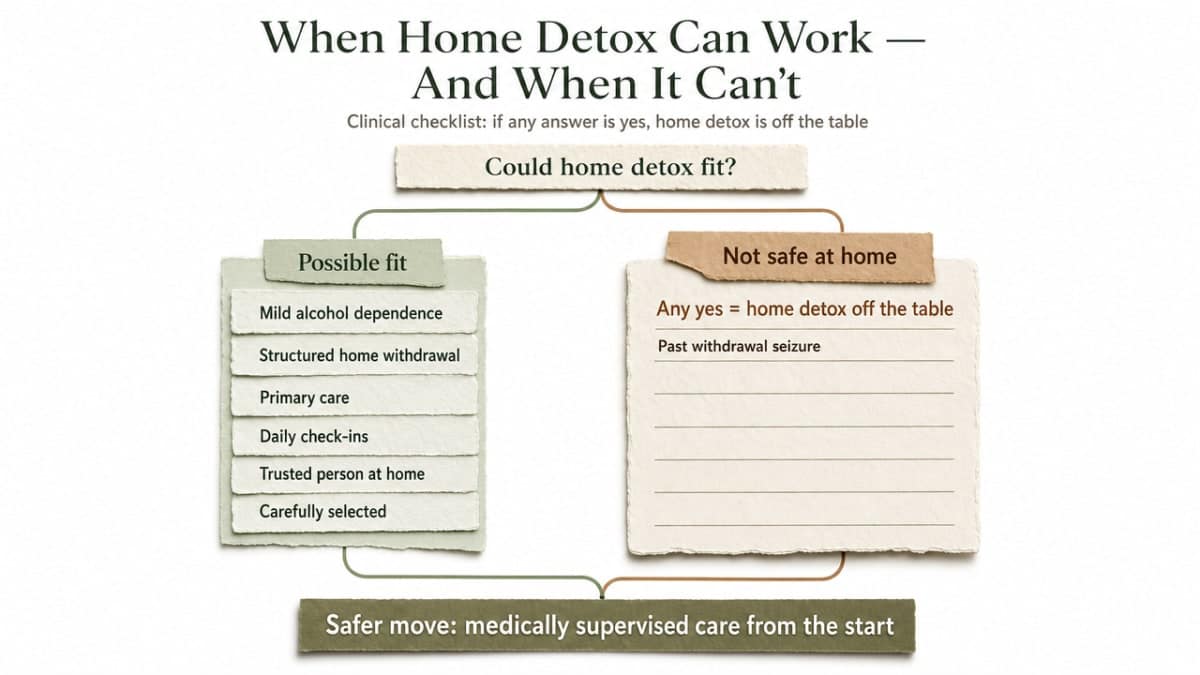
Alcohol is the substance most people underestimate. It’s legal, it’s in the fridge, and the first day or two of stopping often feels manageable — a headache, some nausea, a rough night’s sleep. That’s the trap. The dangerous part of alcohol withdrawal usually shows up between 24 and 72 hours in, right when you might be telling yourself the worst is over.
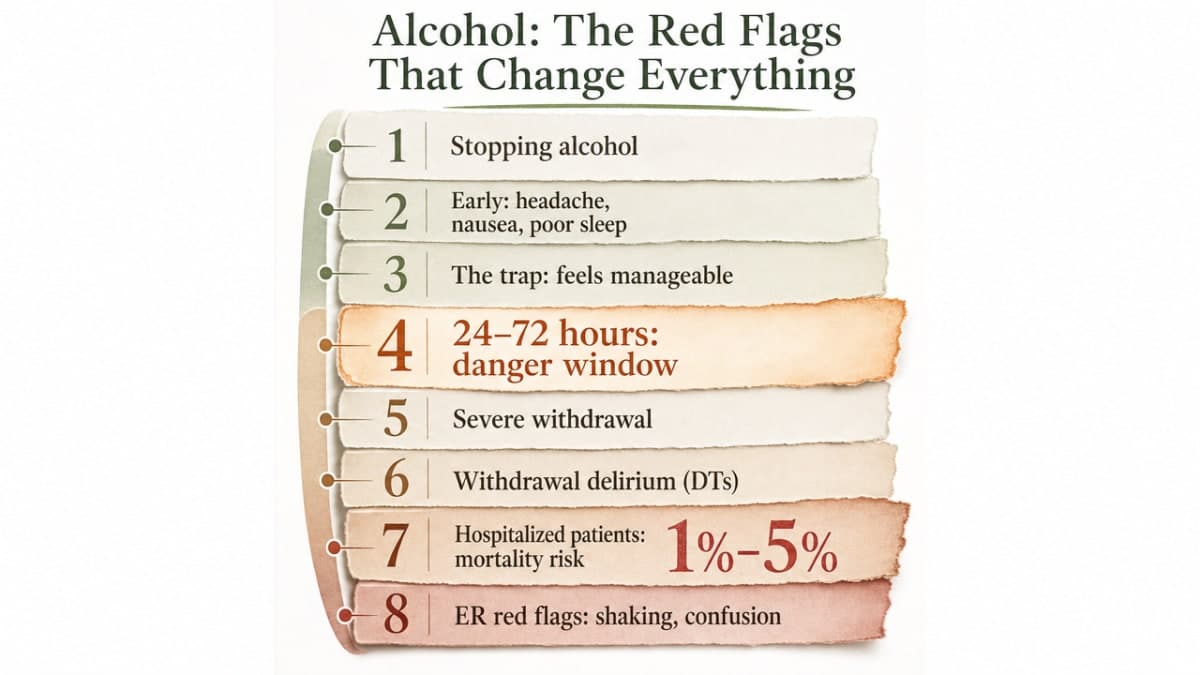
Here’s the part clinicians want you to know without dressing it up: severe alcohol withdrawal can be fatal. Alcohol withdrawal delirium — what most people call the DTs — carries a mortality risk of roughly 1% to 5% in hospitalized patients with alcohol withdrawal syndrome, according to StatPearls 3. That number is specifically about people already sick enough to be in a hospital bed, not everyone who ever stops drinking. But it’s the reason emergency rooms take shaking, confused patients seriously the moment they walk in.
So what does the danger actually look like at your kitchen table? These are the red flags that mean home is no longer the right place:
You’ve had a withdrawal seizure or the DTs before. This one sits at the top of every guideline. NICE recommends hospital admission for anyone in acute withdrawal who is at high risk of seizures or delirium tremens — and the strongest predictor of future severe withdrawal is a past one 2. If you’ve ever come to on the bathroom floor after a night of quitting, your brain has already shown you what it’s capable of. StatPearls is direct with patients in this group: don’t reduce your intake without talking to your care team first 4.
Your hands shake so hard you can’t hold a glass of water. Mild tremor is common. Coarse, whole-body shaking that makes buttoning a shirt impossible is a different category. It usually means your nervous system is already in overdrive, and the next 24 hours are the window when seizures are most likely.
You’re seeing or hearing things that aren’t there. Shadows moving in the corner of the room. A voice in the hallway. Bugs on your arm. This is early alcohol hallucinosis, and it can slide into full delirium within hours. If it’s happening, home is over.
Your heart is pounding, you’re drenched in sweat, and you can’t tell what day it is. Racing heart rate, high blood pressure, fever, and confusion together — sometimes called autonomic instability — are the fingerprints of severe withdrawal. This is a 911 call, not a wait-and-see.
You’ve been drinking heavily every day for months or years. Duration and volume both raise the risk. SAMHSA’s clinician guide flags patients with prior severe withdrawal or current moderate symptoms as the groups who need medication started as quickly as possible 1. “I’ll just power through this weekend” is not a plan that respects what your body has adapted to.
If any of these describe your last attempt, or where you are right now, please don’t try to ride it out alone. Call a doctor, call a detox line, or head to the ER. You’re not overreacting. You’re reading the signs correctly.
Benzodiazepines: Why ‘Just Stopping’ Is the Most Dangerous Move
If you’re on Xanax, Klonopin, Ativan, or Valium — daily, for months or longer — please read this section before you do anything else. Benzodiazepines are the substance where the gap between “I’ll just stop” and “I’m in the ER” is the shortest, and the one where good intentions cause the most harm.
Here’s why. Benzos work on the same brain chemistry as alcohol. So when you stop them, your body reacts in the same category of ways — including the two that scare clinicians the most: seizures and psychosis. The classic research on benzodiazepine withdrawal documented cases of seizures and psychotic reactions, especially with higher doses or when someone stopped abruptly 8. StatPearls puts benzo withdrawal complications in the same bucket as alcohol, including seizures and, in serious cases, death 3.
That’s not fear-mongering. That’s the reason your prescriber told you not to run out of your bottle.
The most dangerous move is the one people make when they’ve decided they’re done — throwing the pills in the trash on a Sunday night. The 2025 Joint Clinical Practice Guideline on Benzodiazepine Tapering is direct: rapid dose reduction or abrupt discontinuation can cause life-threatening withdrawal symptoms including seizures and delirium 9. That guideline also says most tapers can be handled outpatient, but people with severe acute withdrawal, high seizure risk, or complex medical instability belong in inpatient or medically managed residential care 9. Home is not a taper. Home is the environment where a taper might happen if a doctor is running it.
What the red flags look like in real life:
- You’ve been on a benzo daily for more than a few weeks, at a moderate or high dose. The longer and higher, the worse the rebound. This includes prescriptions you’ve taken exactly as directed — dependence is a physical adaptation, not a moral failing.
- You’ve tried to stop before and it went badly. A seizure, a hospital visit, a stretch of days where you couldn’t tell what was real. Your brain remembers. The next attempt won’t be gentler.
- You’re mixing benzos with alcohol or opioids. This is the combination where home withdrawal fails most predictably. The nervous system doesn’t know which substance is missing; it just knows it’s missing something, and the response can escalate fast.
- You’re getting them from more than one source, or the supply is unreliable. Missed doses that feel like missed doses — restlessness, panic, a metallic feeling behind the eyes — are your body telling you a supervised taper is the safer path.
- You feel like you’re going to lose your mind if you don’t stop. That feeling is real, and it’s a reason to call someone tonight — not a reason to quit alone tomorrow.
If any of that sounds like you, the safest next step is a phone call to a doctor or a detox program before you change your dose. A slow, monitored taper — with someone watching for the seizure threshold — is the version of quitting that actually works.
Opioids: The Danger Isn’t the Withdrawal — It’s What Happens After
Here’s the part about opioids that most articles get wrong. Withdrawal from heroin, fentanyl, oxycodone, hydrocodone, or methadone usually isn’t going to kill you the way alcohol or benzo withdrawal can. There’s no equivalent of DTs waiting for you at hour 48. What you’ll feel is closer to the worst flu of your life stacked on top of a panic attack: bone aches, sweating, chills, cramping, diarrhea, restless legs that won’t let you sleep, and a mental noise that makes 20 minutes feel like four hours.
That’s real suffering. It’s just not usually the thing that kills people. What kills people is what happens on day four, or day ten, or the first Friday after you thought you were through it.
The reason is biological, not moral. When you stop using opioids, your tolerance drops fast. The dose that felt normal two weeks ago — the amount your body was used to on the day you quit — is now a dose your body can’t handle. If a rough night pushes you back to using, and you reach for what you were taking before, that’s the overdose. It’s not because you’re weak. It’s because your lungs and your brain forgot what they used to tolerate, and no one told you.
This is what makes at-home opioid detox uniquely dangerous in a way that’s easy to miss. You can white-knuckle through the sweats. You can survive the diarrhea and the shaking. And you can still die three days after you thought you’d won, because the taper didn’t come with buprenorphine, methadone, or naltrexone attached to it 11. Detox by itself isn’t treatment. It’s the front door. Walking through the door and then closing it behind you — with no medication, no follow-up, no plan for the fentanyl still available on your street — is the setup the CDC is trying to warn you away from.
If you’re reading this the morning after a hard night, or you’re the person who found the empty bottle in the drawer, please don’t treat opioid withdrawal like a weekend project. Call a doctor or a detox program before you start. Ask specifically about medication-assisted treatment. The version of quitting that actually keeps people alive isn’t the one where you tough it out alone — it’s the one where somebody hands you buprenorphine on day one and stays in touch on day 30.
If You’re the Sober One in the House: What to Watch For
Maybe you’re not the one detoxing. You’re the spouse, the adult child, the parent, the roommate who noticed the empty bottles or the pill count that didn’t add up. You’re the one who’s going to be awake when things get hard, and you’re reading this because you want to know what to actually look for.
Thank you for being there. That matters more than you know.
Here’s what to watch for, in the language of a real night in a real house:
- Shaking that gets worse, not better, as hours pass. Some tremor is expected. Shaking that spreads from the hands to the whole body, or that keeps them from holding a cup, is a change in direction. Call for help.
- Confusion about where they are or what day it is. If they don’t recognize the room, think it’s a different year, or talk to people who aren’t there, that’s alcohol withdrawal delirium territory 2. This is a 911 call.
- A seizure — even a brief one. Any seizure during withdrawal means the next one is more likely and could be worse 4. Don’t wait to see if it happens again. Call for an ambulance.
- You can’t wake them up, or their breathing is slow and shallow. This matters especially if opioids or benzos are involved. Slow breathing is the sign that comes before an overdose becomes fatal.
- Talk of not wanting to be here anymore. Withdrawal turns the volume up on dark thoughts. Take it seriously the first time you hear it, not the third.
- Heavy sweating with a racing heart and a fever. Together, those three signal severe withdrawal, and they need a medical setting tonight 1.
You don’t have to diagnose anything. You just have to notice, and pick up the phone. Keep a detox line or an ER number on the fridge before day one, not after. And give yourself permission to sleep in shifts if someone else can trade off with you — you can’t watch anyone at 4 a.m. if you’ve been up since Tuesday.
What Supervised Detox Actually Looks Like in Oklahoma City
If everything you’ve read so far describes your situation, here’s what the alternative actually is — not in brochure language, but in real terms.
Medically supervised detox means you’re in a bed with a nurse down the hall, not a partner Googling symptoms at 3 a.m. Vitals get checked several times a day — the standard clinical guidelines call for symptom monitoring three to four times daily with staff available around the clock 5. If your blood pressure spikes or your tremor gets worse, someone catches it in the hour it happens, not the morning after.
Medication is part of it, not an afterthought. For alcohol withdrawal, that usually means benzodiazepines dosed against your symptoms so seizures and delirium don’t get a foothold 2. For a benzo taper, it means a slow, mapped-out reduction with someone watching the seizure threshold 9. For opioids, it means starting buprenorphine, methadone, or naltrexone on day one — the medications the CDC says have to be part of the plan if you want the odds on your side after you leave 11.
At Renewal Springs Detox in Oklahoma City, that’s the shape of the care: 24/7 medical staffing, personalized medication protocols, and wearable monitoring from Huml Health that tracks your vitals, sleep, and stress in real time so nothing gets missed between check-ins. There are separate tracks for men, for women, for veterans, and for people who want a more private setting. Most major insurance plans are accepted, and benefits verification is free — so cost doesn’t have to be the reason you don’t call.
You don’t have to be at your worst to reach out. You just have to be tired of guessing whether tonight is the night things get scary.
Making the Call Before the First Bad Night
Here’s the truth about the phone call you’re thinking about making: it’s easier before the first bad night than during it. When you’re already shaking, already scared, already trying to remember which pill bottle is in which drawer, dialing feels impossible. When you make the call now — at 4 p.m. on a Tuesday, before anything has gone wrong — it’s just a conversation.
You don’t have to commit to anything on that first call. You can ask what a bed looks like, what medications are on the table, whether your insurance covers it, what happens if you change your mind Wednesday morning. You’ll get an answer. If it’s Renewal Springs in Oklahoma City, someone will pick up any hour, walk you through benefits verification for free, and tell you plainly what the next 24 hours could look like.
Whatever you decide after that call is still yours. But you’ll know what you’re walking into — and you won’t be guessing alone at 2 a.m.
Talk With a Medical Detox Expert Now
Get answers and support before you attempt detox alone.
Frequently Asked Questions
Is at-home detox ever safe?
Sometimes, yes — but only for a specific group. Research on structured home alcohol detox shows it can work for carefully selected patients with mild dependence, daily doctor check-ins, a sober support person, and safe housing 6. If you have a history of withdrawal seizures or delirium, are using multiple substances, live alone, or have serious medical or mental health conditions, home is not the right setting 6. When in doubt, call before you start.
Which substances are the most dangerous to detox from at home?
Alcohol and benzodiazepines like Xanax, Klonopin, Ativan, and Valium top the list. Both can cause seizures, delirium, and in serious cases, death when stopped abruptly 3. Opioids feel brutal but rarely cause fatal withdrawal on their own — the danger comes after, when lowered tolerance meets a relapse and turns into an overdose 11. Stimulants and marijuana are usually less physically dangerous to stop, but the mental health piece still deserves professional support.
What withdrawal symptoms mean I should call 911 or go to the ER?
Any seizure, even a short one. Confusion about where you are, what day it is, or seeing and hearing things that aren’t there 2. A racing heart, heavy sweating, and fever together. Slow or shallow breathing, especially if opioids or benzos are involved. Thoughts of hurting yourself. Shaking so severe you can’t hold a cup. Don’t try to decide if it’s “bad enough” — if any of these show up, get medical help now 4.
Why is quitting opioids cold turkey risky even though withdrawal usually isn’t fatal?
Because your tolerance drops within days. The dose your body handled last week can stop your breathing this week. The CDC is clear that detox alone, without medications like buprenorphine, methadone, or naltrexone, increases the risk of resuming use, overdose, and overdose death 11. Getting through the sweats and cramps at home doesn’t mean you’re safe — the first Friday after usually is when the danger lives. Ask any detox program specifically about medication-assisted treatment.
Can I just taper benzodiazepines on my own at home?
Not without a doctor running it. Rapid dose reduction or abruptly stopping benzos can cause life-threatening withdrawal, including seizures and delirium 9. The classic research also documents psychotic reactions with abrupt or high-dose withdrawal 8. Most tapers can be done outpatient, but they need to be slow, mapped out, and medically supervised — with someone watching for the seizure threshold 9. If you’ve been on a daily benzo for weeks or longer, call your prescriber before changing anything.
What does supervised detox look like, and will insurance help cover it?
You’ll have a bed, a nurse nearby, and vitals checked several times a day — clinical guidelines call for symptom monitoring three to four times daily with staff available around the clock 5. Medications are matched to your symptoms so seizures, delirium, or severe cravings don’t get a foothold. At Renewal Springs in Oklahoma City, most major insurance plans are accepted and benefits verification is free. One phone call tells you what your plan covers before you commit to anything.
References
- Quick Guide for Clinicians Based on TIP 45 Detoxification and Substance Abuse Treatment. https://nida.nih.gov/sites/default/files/samhsa_detoxification_and_substance_abuse_treatment.pdf
- Acute Alcohol Withdrawal (NICE evidence review). https://www.ncbi.nlm.nih.gov/books/NBK65581/
- Withdrawal Syndromes (StatPearls – NCBI Bookshelf). https://www.ncbi.nlm.nih.gov/books/NBK459239/
- Alcohol Withdrawal Syndrome (StatPearls – NCBI Bookshelf). https://www.ncbi.nlm.nih.gov/books/NBK441882/
- Withdrawal Management (WHO/NICE-linked guidance – NCBI Bookshelf). https://www.ncbi.nlm.nih.gov/books/NBK310652/
- Home detox – supporting patients to overcome alcohol addiction. https://pmc.ncbi.nlm.nih.gov/articles/PMC6299173/
- Management of Acute Withdrawal and Detoxification for Adults who misuse alcohol (NICE-linked monograph). https://www.ncbi.nlm.nih.gov/books/NBK545066/
- The benzodiazepine withdrawal syndrome. https://pubmed.ncbi.nlm.nih.gov/7841856/
- Joint Clinical Practice Guideline on Benzodiazepine Tapering. https://pmc.ncbi.nlm.nih.gov/articles/PMC12463801/
- CDC Clinical Practice Guideline for Prescribing Opioids for Pain — United States, 2022. https://www.cdc.gov/mmwr/volumes/71/rr/rr7103a1.htm
- Opioid Use Disorder: Treating | Overdose Prevention (CDC). https://www.cdc.gov/overdose-prevention/hcp/clinical-care/opioid-use-disorder-treating.html