
Key Takeaways
- A 1:3 staff-to-client ratio in Oklahoma City detox means one nurse or tech is responsible for three patients, shortening response time during the 24-to-72-hour fentanyl withdrawal peak 2.
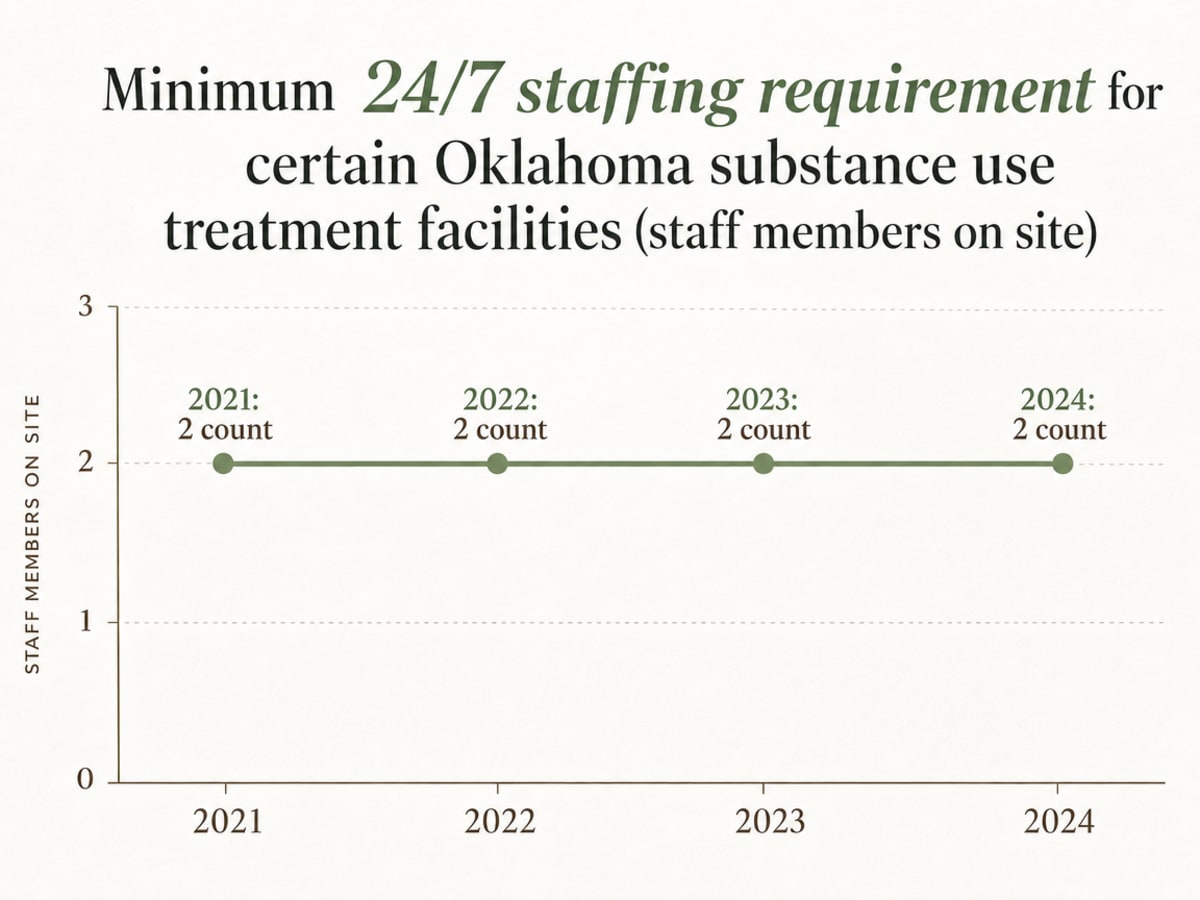
- Oklahoma requires only two awake staff on-site around the clock for medically supervised withdrawal management, with no cap on how many patients they cover — a floor, not a ceiling 9.
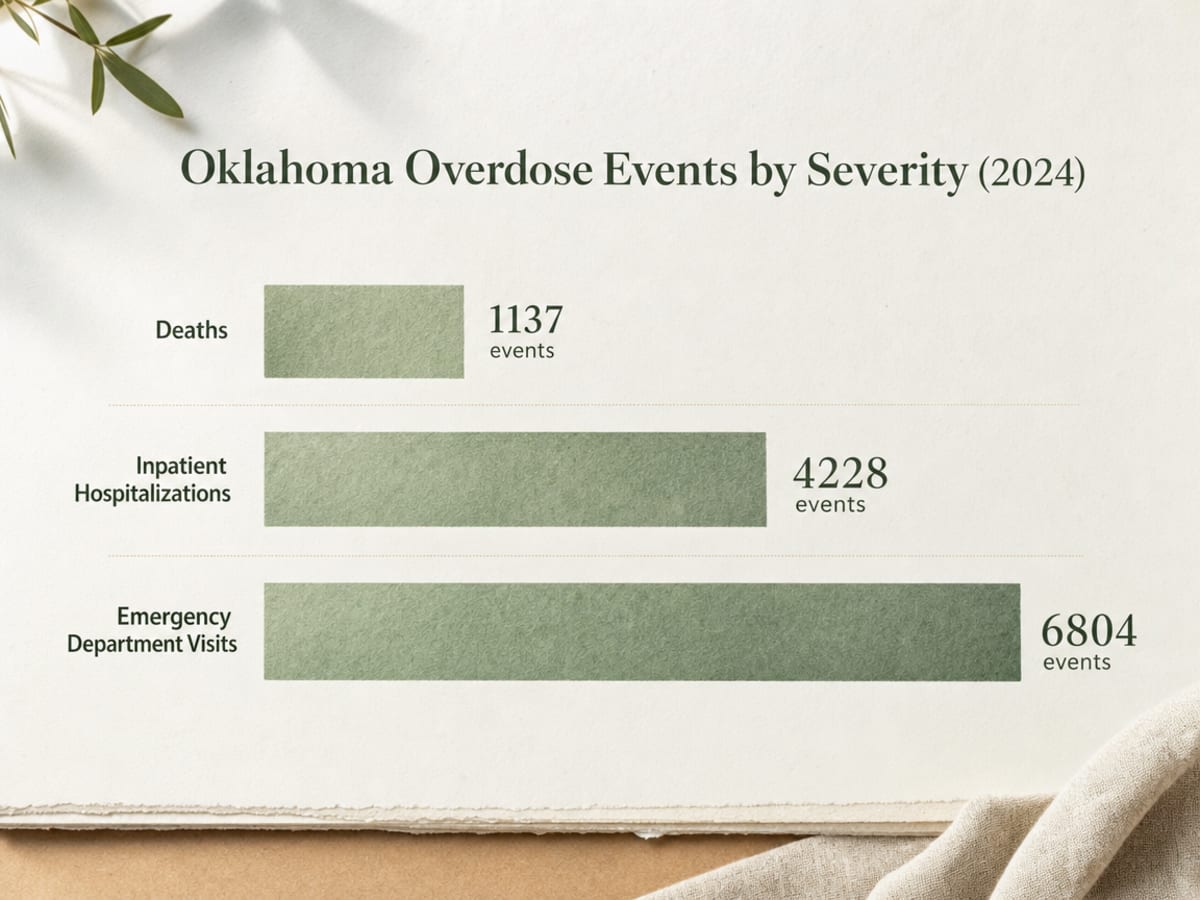
- With 1,137 overdose deaths and 4,228 overdose hospitalizations recorded in Oklahoma in 2024, local detox capacity and continuous nurse monitoring at ASAM Level 3.7 shape real outcomes 8, 2.
- Before committing, ask any Oklahoma City facility about overnight staff-to-client ratio, whether a registered nurse is on-site 24/7, and how vitals are monitored between scheduled checks.
What a 1:3 ratio actually changes at 3 a.m.
Picture it. You wake up soaked through your shirt, legs kicking like they belong to someone else, stomach turning over. The clock says 3:14 a.m. This is hour 22 of opioid withdrawal, and it is the hour you were dreading.
What happens in the next ten minutes is not decided by luck. It is decided by how many people are on shift and how far away they are from your room.
A staff-to-client ratio of 1:3 means one staff member is responsible for you and two other people. Not eight. Not twelve. Three. When your heart rate climbs or you press the call button or the wearable on your wrist flags a spike, there is a person close enough to reach you before things escalate. That is the entire point.
Oklahoma rules require a minimum of two awake staff on site around the clock at medically supervised withdrawal management facilities 9. That is a floor, not a ceiling. A 1:3 ratio sits well above that floor by design, so the middle-of-the-night moments, the ones that scare you most, are met with a response instead of a wait.
You are not being dramatic for wanting that. Opioid withdrawal is one of the hardest things a body goes through. Reading this article, thinking about the call, is already a step. The rest of this piece walks you through what a 1:3 ratio changes, hour by hour.
The staffing floor Oklahoma sets — and what it doesn’t say
Two awake staff, 24/7: the minimum on paper
Here is the rule, in plain terms. In Oklahoma, a medically supervised withdrawal management program has to keep at least two staff members awake and on site, twenty-four hours a day, seven days a week 9. A licensed physician has to be reachable, and a registered nurse has to be on-site running things 9.
That is the floor. That is what a facility has to clear to be allowed to open its doors.
Read it again, though, because what it doesn’t say matters just as much. It doesn’t say how many patients those two staff can be responsible for. It doesn’t set a maximum. On a busy night, those two awake staff could be covering six people. Or ten. Or more, depending on the facility’s licensed bed count and how the state’s Medicaid rule breaks down group ratios, which allow up to fourteen adults to one qualified provider in certain residential rehabilitation settings 10.
You are not looking for a place that meets the minimum. You are looking for a place where the person walking down the hallway at 3 a.m. has the time to actually stop at your door. That is a different question than “is this facility licensed?” — and it is the question worth asking on the phone.
How 1:3 compares to codified ratios elsewhere
Most states do not put a number on it. Oklahoma’s rules describe roles — a nurse here, a physician on call, two awake staff — without saying how many patients each of those people should be responsible for during medical detox 9. That silence is the reason two facilities on the same block can look identical on their license and feel completely different at 4 a.m.
A few states have written the number down. Pennsylvania is one of them. Its psychosocial staffing rule requires one full-time-equivalent primary care staff person for every five patients in inpatient hospital detoxification, and one for every seven patients in inpatient nonhospital detoxification 1. That is a codified benchmark, and it is one of the tighter ones you will find in any state’s regulations.
Now line them up. Oklahoma’s floor for medically supervised withdrawal management is two awake staff on site, with adult residential rehabilitation groups permitted at up to fourteen patients to one qualified provider 9, 10. Pennsylvania’s inpatient hospital detox floor sits at one staff member per five patients 1. A 1:3 medical detox ratio is a step below both — meaning one staff member is watching fewer people, not more.
What does that gap feel like on the floor? At 14:1, a group setting is more about coverage than presence. At 1:5, a single nurse has five sets of vitals to track, five call buttons to answer, five stories to know. At 1:3, that same nurse has room to sit down with you when the shakes are at their worst, to notice that your color is off before you notice it yourself, to keep working the medication schedule instead of triaging who needs help most.
None of this makes the higher ratios wrong or illegal. They meet the standards their states set. But when you are the person whose heart is pounding at hour 30, the difference between one staff member for three people and one staff member for fourteen is not academic. It is the difference between being seen and being on a list.
Why opioid withdrawal is a staffing problem, not a scheduling one
The fentanyl withdrawal timeline in plain language
Opioid withdrawal does not spread its symptoms evenly across the week. It clusters. It piles up in specific hours, and those hours are when you need someone next to you.
Here is roughly how it moves for short-acting opioids like fentanyl, heroin, and most prescription painkillers. Somewhere around hour 8 to 12, you start to feel it — yawning, watery eyes, a runny nose, an anxious edge that won’t settle. By hour 12 to 24, the muscle aches show up. Your legs feel wrong. You cannot get comfortable in any chair, any bed, any position. Sleep is not coming.
Then comes the peak. For most people using fentanyl, the worst window sits somewhere between hour 24 and hour 72. That is when the vomiting, the diarrhea, the sweats, the goosebumps, the racing heart, and the blood pressure spikes tend to arrive together. That is when cravings feel loudest. That is when people leave detox against medical advice, if there is no one there to talk them through it.
Oklahoma’s Medicaid rule ties medical detox to ASAM Level 3.7, which is defined as medically monitored intensive inpatient withdrawal management with a registered nurse on-site around the clock for supervision and medication availability 2. That standard exists because opioid withdrawal peaks at hours when a scheduled check-in is not enough. You need eyes that are already in the room, or close to it.
A 1:3 ratio is what makes those eyes possible during the peak. When one nurse is responsible for three people instead of ten, the hour-30 vomiting episode gets a comfort medication in minutes, not on the next rounds. The 2 a.m. panic gets a person sitting with you until it eases. The wearable spike gets a check before it becomes an emergency. The timeline does not slow down for you. The staffing has to speed up to meet it.
Why ambulatory detox is usually the wrong door for opioids
There is a version of detox that happens without extended on-site monitoring. Oklahoma’s administrative code calls it ambulatory withdrawal management without extended on-site monitoring — outpatient detox, essentially, where you come in for visits and go home in between 4. For some people and some substances, it is a reasonable path.
Opioids, and especially fentanyl, are usually not that story.
The reason is the peak you just read about. When your worst symptoms hit at hour 30, you are not at the clinic. You are at home, or in a car, or on a friend’s couch, and the medication that would take the edge off is somewhere you cannot get to. Cravings are strongest exactly when supervision is thinnest. Most people who try to detox from opioids on their own return to use, not because they lack willpower, but because the setup gives withdrawal every advantage.
Inpatient medical detox at ASAM Level 3.7 flips that math. A nurse is on-site the whole time 2. Comfort medications are in the building. And with a 1:3 ratio, someone is close enough to notice the moment your symptoms turn, not the moment you finally reach a phone.
The Oklahoma City overdose picture behind the phone call
You are not the only one making this call today. That is not meant to make you feel small. It is meant to help you understand why the person on the other end of the line already knows what you are going through.
In 2024, Oklahoma recorded 1,137 overdose deaths, 4,228 inpatient hospitalizations for overdose, and 6,804 emergency department visits for nonfatal overdoses 8. Read that middle number again. More than four thousand people made it to a hospital bed alive last year, which means more than four thousand people at some point faced the question you are facing now: what happens after the hospital, when the medical crisis is over but the withdrawal is just starting?
Oklahoma City sits at the center of a lot of that volume. In 2023, one ODMHSAS partner alone counted 839 opioid overdose reversals in the metro 5. Each of those is a person who survived a moment that could have gone the other way. Each of those is also a person who, in the hours and days after, needed somewhere safe to come down.
The state’s overdose burden runs high by national measure too. Oklahoma’s age-adjusted drug overdose death rate was about 30.7 per 100,000 in 2022, above the national average 7. That number is not here to scare you. It is here to explain why detox capacity in this city matters, and why the difference between a facility staffed to the floor and a facility staffed to a 1:3 ratio is not a marketing distinction. It is a response-time distinction, multiplied across thousands of people who need it every year.
You are one of those people right now. What you are feeling — the fear, the exhaustion, the wondering whether it is worth picking up the phone — is not weakness. It is the weight of a crisis that a whole city is carrying alongside you. And it is exactly why a detox program built to see you, not just admit you, was designed the way it was.
How the ratio translates into response time
Wearable vitals, staffed eyes, faster hands
Numbers on a policy page do not help you at 2 a.m. What helps you is the loop between a signal and a person. That loop has three parts, and the ratio shapes all of them.
At Renewal Springs, the first part is a Huml Health wearable on your wrist. It tracks your heart rate, sleep patterns, and stress markers in real time. When your heart rate climbs into a range that suggests withdrawal is escalating, or your breathing pattern shifts, the device flags it. That signal does not go into a chart nobody reads until morning. It goes to the nurse on shift.
The second part is the nurse. Oklahoma’s Medicaid rule for ASAM Level 3.7 puts a registered nurse on-site around the clock for supervision and medication availability 2. That is a requirement everywhere at this level of care. What changes with a 1:3 ratio is not whether a nurse exists. It is how quickly that nurse can leave what she is doing and get to your room.
The third part is the hands. When one staff member is responsible for three people, an alert on a wearable does not have to wait behind seven other alerts. It gets a check within minutes. A blood pressure cuff, a cool cloth, a comfort medication pulled from the med room — the physical response arrives while the symptom is still small.
Higher ratios break that loop. A wearable can flag every spike in the building, but if the person on shift is triaging a dozen people, the signal becomes noise. What you feel, in your bed, is that nobody is coming. The technology is only as fast as the staffing behind it.
MAT titration decisions happen in minutes, not hours
Medication-assisted treatment during opioid detox is not a one-time dose. It is a moving target. Your first dose of buprenorphine or another comfort medication is a starting point, and from there the clinical team is watching how your body responds — whether the shakes ease, whether your pulse settles, whether you can finally close your eyes. If the dose is not enough, they adjust. If side effects show up, they adjust again.
Those adjustments depend entirely on someone being close enough to see what your body is doing between scheduled checks. At a 1:3 ratio, a nurse can sit with you for the twenty minutes after a dose and watch whether it lands. She can catch the moment your sweating slows or your restless legs settle, and she can flag the physician if it doesn’t. The next titration decision gets made on that observation, not on a note written six hours later.
Under Oklahoma’s rules, a licensed independent practitioner has to be reachable and a registered nurse has to be on-site for medically supervised withdrawal management 2. The rules do not say how fast that conversation between nurse and practitioner has to happen. A tighter ratio compresses it. The nurse who has been watching you can pick up the phone with a specific observation, and your dose changes before the next wave of symptoms hits — not after you have already ridden them out.
What a typical day in detox looks like
You will not remember every hour of your first few days. That is normal. What you will remember are the moments someone was there — the nurse who noticed you were cold before you did, the tech who brought you a second blanket, the quiet check at 4 a.m. that told you you were not alone.
Here is what those hours actually contain.
Morning starts early, but gently. A nurse takes your vitals — blood pressure, pulse, temperature — and asks you how the night went. She has time to hear the answer because she has two other people to look after, not ten. If your Huml Health wearable flagged anything overnight, she already knows and wants your side of it. Breakfast is available whenever your stomach can handle it. If it can’t, that is fine too.
Mid-morning is when the physician or licensed independent practitioner checks in, on-site or by call as Oklahoma’s ASAM 3.7 rule requires 2. Your medication plan gets reviewed against what your body did in the last twelve hours. If your dose needs to shift, it shifts now, not tomorrow.
Afternoons soften. You might sleep. You might sit with a counselor for a short conversation, not a therapy marathon. You might just watch the light change through the window. Withdrawal is exhausting, and the day is built around letting your body do the hard work it needs to do.
Evening brings another vitals check, another medication window, another chance to say what hurts. Overnight, two awake staff are on the floor at minimum — Oklahoma’s floor for medically supervised withdrawal management 9— and at a 1:3 ratio, one of them is close enough that a call button gets answered while the feeling that prompted it is still fresh.
The day is not exciting. That is the point. What you want from detox is a stretch of hours where the biggest thing that happens is that you got through them, and someone was there while you did.
Questions to ask any Oklahoma City detox before you commit
If you have the energy to ask three questions on the phone, ask these. You do not need clinical training to hear the difference in the answers.
- What is your staff-to-client ratio overnight?
- Not “do you meet Oklahoma’s minimum,” which is two awake staff on site 9. The question is how many patients each of those staff is responsible for at 3 a.m. A facility that has thought about this will tell you a number. A facility that hasn’t will pivot to something else.
- What level of care are you licensed for, and is a registered nurse on-site around the clock?
- Opioid detox belongs at ASAM Level 3.7, which requires a registered nurse on-site 24 hours a day for supervision and medication availability 2. If the answer is “a nurse is on call” or “we do ambulatory withdrawal management,” that is a different level of care with less continuous monitoring 4.
- How do you monitor vitals between scheduled checks?
- You are listening for whether the facility has a plan for the hours you are alone in your room. Wearable technology, more frequent rounds, a lower ratio — any of these is a real answer. Silence, or a vague answer about “experienced staff,” is also an answer.
Write the responses down. When you compare two facilities, the difference will be on the page.
Making the call: what admissions can walk you through
The hardest part of the phone call is picking up the phone. Once it is in your hand, you do not need a script. You can say, “I think I need help, and I don’t know what to ask.” That is enough. The person on the other end has heard it before.
If you want a way in, try this: ask admissions to walk you through a day in detox, hour by hour. What time is the first vitals check. How the Huml wearable gets set up. Who is on the floor overnight and how many people they are watching. What happens if your symptoms turn at 3 a.m. What the ratio actually looks like on your worst day.
They can also verify your insurance while you are still on the line, talk through what you can bring, and tell you how soon a bed is open. You are not signing anything by calling. You are gathering information. That, right now, is a real step forward — and you have already started.
Talk With a Team Member About Detox Support
Connect directly for details about daily support and how our low staff-to-client ratio benefits you.
Frequently Asked Questions
What does a 1:3 staff-to-client ratio actually mean during opioid detox?
It means one staff member is responsible for you and two other people, not a hallway full. In practice, that shortens the distance between a symptom and a response. When your wearable flags a heart rate spike or you press a call button at 2 a.m., someone has the time to get to your room while the moment is still small.
How is a 1:3 detox ratio different from Oklahoma’s minimum staffing rules?
Oklahoma requires at least two awake staff on site around the clock for medically supervised withdrawal management, with a registered nurse present and a physician reachable 9. The rules do not cap how many patients those staff can cover. A 1:3 ratio deliberately staffs above that floor, so one nurse’s attention is split three ways instead of across a full unit.
Can I detox from fentanyl or other opioids at home or in an outpatient setting instead?
For most people, no. Oklahoma recognizes ambulatory withdrawal management without extended on-site monitoring, but it does not provide continuous supervision 4. Fentanyl withdrawal peaks between hour 24 and 72, exactly when you would be alone. Inpatient care at ASAM Level 3.7 keeps a registered nurse on-site around the clock so medication and monitoring are there when symptoms turn 2.
How long does opioid withdrawal last in medical detox?
For short-acting opioids like fentanyl, heroin, and most prescription painkillers, acute withdrawal usually runs about 5 to 7 days, with the worst symptoms between hours 24 and 72. Medical detox does not stop the timeline, but medication-assisted treatment and continuous nursing under ASAM 3.7 standards make it far more tolerable 2. Your specific plan depends on what you used, how long, and how much.
What should I ask when I call an Oklahoma City detox facility?
Ask three things. What is your staff-to-client ratio overnight, not just whether you meet Oklahoma’s two-awake-staff minimum 9. Is a registered nurse on-site 24/7, meaning you are licensed at ASAM Level 3.7 2. How do you monitor vitals between scheduled checks? Clear answers tell you the facility has thought about the hours you will be most afraid.
Will someone be with me at night during the worst of withdrawal?
Yes. Under Oklahoma’s rules, medically supervised withdrawal management keeps at least two staff awake and on-site through the night, every night 9. At a 1:3 ratio, one of them is close enough to answer a call button while you still feel the symptom that made you press it. You do not have to ride out the worst hours alone. That is the whole point of this level of care.
References
- 28 Pa. Code § 715.8 – Psychosocial staffing. https://www.law.cornell.edu/regulations/pennsylvania/28-Pa-Code-SS-715-8
- SECTION 95.43. Residential substance use disorder treatment. https://oklahoma.gov/ohca/policies-and-rules/xpolicy/medical-providers-fee-for-service/individual-providers-and-specialties/inpatient-psychiatric-services/residential-substance-use-disorder-treatment.html
- SECTION 95.44. Residential substance use disorder (SUD) – Eligible providers and requirements. https://oklahoma.gov/ohca/policies-and-rules/xpolicy/medical-providers-fee-for-service/individual-providers-and-specialties/inpatient-psychiatric-services/residential-substance-use-disorder-eligible-providers-and-requirements.html
- Okla. Admin. Code § 450:24-3-64 – Ambulatory withdrawal management without extended on-site monitoring environment. https://www.law.cornell.edu/regulations/oklahoma/OAC-450-24-3-64
- National Overdose Awareness Day: Over 80,000 Narcan Kits have been distributed by ODMHSAS in 2023. https://oklahoma.gov/odmhsas/about/public-information/press-releases-and-other-news/2023/national-overdose-awareness-day–over-80-000-narcan-kits-have-be.html
- Drug Overdose Deaths, 2019–2023 – Oklahoma (Fact Sheet). https://oklahoma.gov/content/dam/ok/en/health/health2/aem-documents/prevention-and-preparedness/injury-prevention/drug-overdose/2025%20State%20Drug%20OD%20-%20IPS%20-%20Fact%20Sheet.pdf
- Changes in Drug Overdose Mortality and Selected Characteristics of Drug Overdose Deaths in the United States, 2022–2023. https://www.cdc.gov/nchs/data/hestat/drug-overdose/drug-overdose-2022-2023.htm
- Drug Overdose Data: Graphs and Maps – Oklahoma. https://oklahoma.gov/content/dam/ok/en/health/health2/aem-documents/prevention-and-preparedness/injury-prevention/drug-overdose/Drug%20Overdose%20Data%20Graphs%20and%20Maps.pdf
- CHAPTER 18. Standards and Criteria for Substance Related and Addictive Disorder Treatment Services. https://oklahoma.gov/content/dam/ok/en/odmhsas/documents/policy/provider-certification/administrative-rules/2021/Chapter%2018%20Final%20effective%209-15-21.pdf
- 317:30-5-95.46. Residential substance use disorder (SUD) – Covered services and medical necessity criteria. https://oklahoma.gov/ohca/policies-and-rules/xpolicy/medical-providers-fee-for-service/individual-providers-and-specialties/inpatient-psychiatric-services/residential-substance-use-disorder-covered-services-and-medical-necessity-criteria.html
- Drug Overdose Data – Injury Prevention Service. https://oklahoma.gov/health/health-education/injury-prevention-service/drug-overdose/data.html
- Drug Overdose Data Dashboard – Oklahoma. https://oklahoma.gov/health/health-education/injury-prevention-service/drug-overdose/data/drug-overdose-data-dashboard.html