
Key Takeaways
- Look past veteran-friendly branding and verify three clinical anchors: medically supervised detox following VA/DoD 2021 guidelines, integrated PTSD and SUD treatment, and clinicians fluent in military culture 3, 4, 5.
- Untreated SUD affects 16% of veterans and 18% of young veterans, so acting on the decision to seek private care already puts you ahead of the largest group that never gets there 11.
- Alcohol drives most veteran detox planning at a five-to-one ratio over illicit drugs, so choose a program whose medical protocols and MAT options are built around alcohol first 8.
- Treat the VA/DoD 2021 SUD Clinical Practice Guideline as the minimum floor for any private program, covering assessment, psychosocial therapy, pharmacotherapy, and integrated co-occurring care 3.
- PTSD and SUD should be treated concurrently using Prolonged Exposure, CPT, or EMDR from week one, because sequential models that delay trauma work fall behind current VA standards 5, 7.
- Confirm the facility prescribes naltrexone, acamprosate, or buprenorphine on staff and sends you out with a prescription, since the guideline treats MAT as first-line rather than optional 3.
- Residential care carries real weight: a 2024 propensity-matched study found a 66% reduction in all-cause mortality, and the I-ACT model retained 74.6% of veterans through completion 1, 6.
- Reframe luxury as engagement infrastructure: private rooms and lower census protect your ability to stay through trauma work, while chefs and views are decoration that won’t hold you in treatment.
What actually separates veteran-specialized care from a nicely furnished rehab
You’ve probably already noticed how many programs advertise “veteran-friendly” care. A flag in the lobby, a page on the website, maybe a former service member on staff. That’s marketing. It isn’t the same thing as a facility built to treat you.
Three things separate the real from the decorated. First, medically supervised detox that follows the VA/DoD 2021 Clinical Practice Guideline for substance use disorder, including medication-assisted treatment for alcohol and opioid dependence 3. Second, the capacity to treat PTSD and SUD as one problem rather than two, using trauma-focused therapies like Prolonged Exposure, Cognitive Processing Therapy, or EMDR alongside addiction care 5. Third, clinicians who understand military culture without you having to translate it for them, which the VA’s own practice recommendations for comorbid SUD and PTSD treat as a baseline expectation, not a specialty 4.
Everything else, including the private room, the quiet hallways, the food that doesn’t taste like a mess hall, matters only if those three anchors are in place. This guide walks you through how to test for them, what the research actually shows about residential care, and how coverage works when you use a private program instead of the VA.
The scale of the problem you’re already inside
How common substance use disorder actually is among veterans
If you’re reading this, you already know something is wrong. What you may not know is how much company you have.
A systematic review of studies sampling U.S. veterans pooled the prevalence of any substance use disorder at roughly 11%, with 10% meeting criteria for alcohol use disorder and 5% for drug use disorder 12. That’s not a fringe. That’s one in nine people who served, walking around with the same weight you’re carrying right now.
The gap between having the problem and getting help is where this gets harder to look at. A national survey using NSDUH data found that untreated SUD among veterans runs at 16%, twice the rate of untreated serious psychological distress at 8%. Among young veterans specifically, SUD prevalence hits 18% 11. More veterans are walking around with an untreated substance use disorder than with untreated serious mental illness, and the younger cohort carries the heaviest load.
So the fact that you’re actively looking at private care, comparing programs, reading past the marketing, puts you ahead of a very large group who never gets there. That matters. The system leaks people at every stage between recognition and admission, and choosing to close that gap yourself is the first thing a good program can’t do for you.
Why alcohol drives most veteran detox planning
Here’s the thing most rehab brochures don’t say plainly: for veterans, this is usually an alcohol problem first, and something else second.
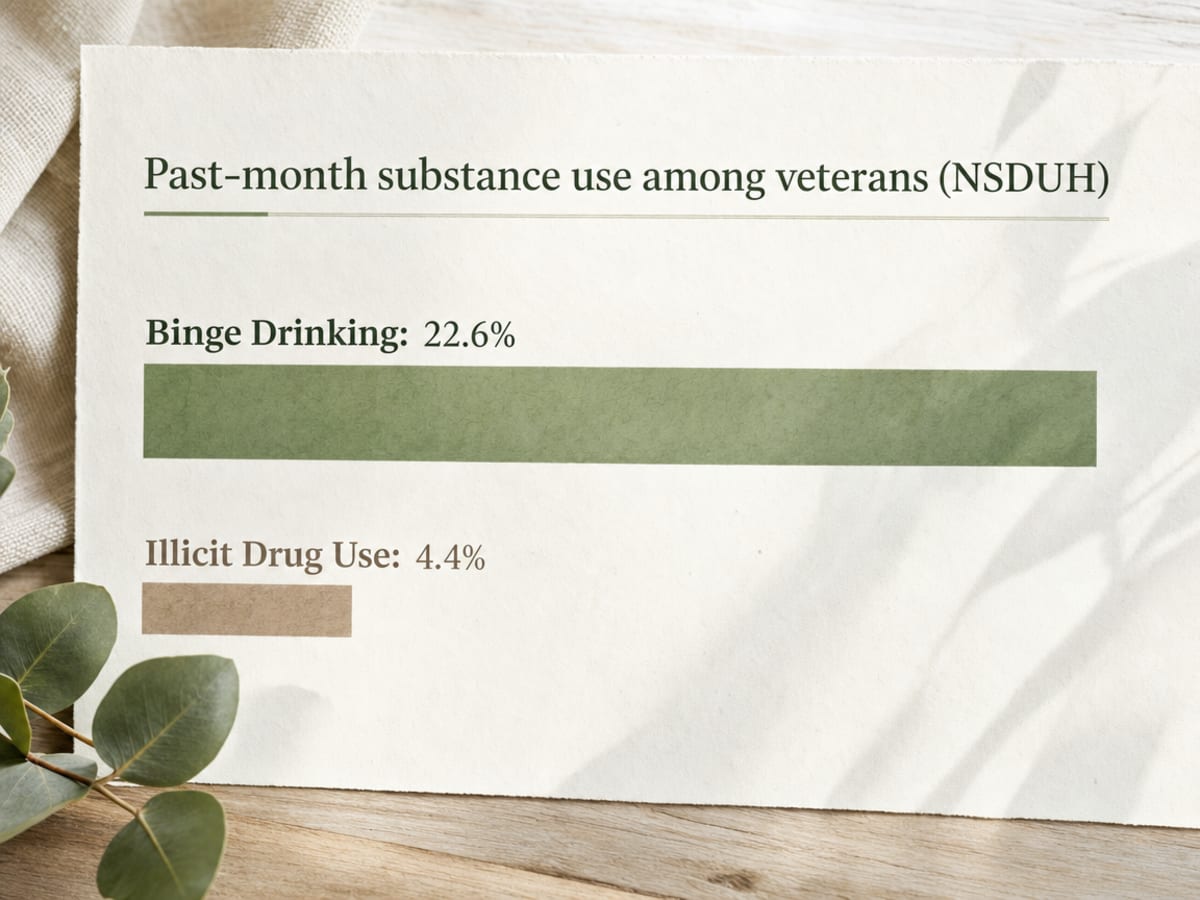
NSDUH data shows that 22.6% of veterans reported past-month binge drinking, compared with 4.4% who reported any past-month illicit drug use 8. That’s a five-to-one ratio. Alcohol isn’t one problem in a lineup of equals. It’s the dominant substance shaping what a veteran-focused detox actually has to be prepared to manage.
That has real clinical consequences for the program you choose. Alcohol withdrawal is not opioid withdrawal. Untreated, it can escalate into seizures and delirium tremens, which is why the medical side of your detox needs to be built around it rather than bolted on. A facility that primarily runs opioid detox and treats alcohol as a secondary track is not the same operation as one whose medical protocols, MAT options like naltrexone and acamprosate, and nursing observation schedules are built for alcohol first.
When you ask a program what they treat, listen for the order. If alcohol comes up third, after fentanyl and benzos, you’re probably looking at a facility that treats veterans occasionally rather than by design. The prevalence data tells you which answer should come first.
The clinical spine: what evidence-based veteran care actually looks like
The VA/DoD 2021 SUD guideline as your minimum floor
You don’t need to memorize a clinical guideline to choose a program. You do need to know one exists, and use it as the minimum bar a private facility has to clear.
The VA/DoD 2021 Clinical Practice Guideline for the Management of Substance Use Disorder is the document VA and Defense Department clinicians work from. It lays out what evidence-based SUD care actually includes:
- structured assessment
- psychosocial treatments like CBT and motivational enhancement
- pharmacotherapy for alcohol and opioid use disorders
- a stepped model of care that runs from outpatient to intensive outpatient to residential to inpatient 3
It also treats integrated care for co-occurring conditions, including PTSD, as a standard expectation rather than a bonus feature 3.
When you’re talking with an admissions team, you have permission to say the words. Ask whether their clinical protocols align with the VA/DoD 2021 SUD CPG. Ask which parts of it drive their assessment tools, their medication protocols, and their level-of-care decisions. If the answer is vague, or if the person on the phone has never heard of the document, that tells you where the program’s clinical center of gravity actually sits. A facility that treats veterans by design will treat that question like a normal Tuesday.
PTSD and SUD are one problem, not two
For most veterans walking into detox, PTSD isn’t a side condition. It’s the reason the drinking or the pills started making sense in the first place. Treating one without the other is like changing the oil while the engine is on fire.
The VA’s own guidance is explicit about this. Individuals with PTSD and SUD can safely engage in and benefit from trauma-focused cognitive behavioral therapies, and Prolonged Exposure (PE), Cognitive Processing Therapy (CPT), and EMDR should be accessible to veterans with PTSD and co-occurring SUD 5. Co-occurring substance use should not be used as a reason to delay or block PTSD treatment. That principle is reinforced in the 2023 VA/DoD PTSD Clinical Practice Guideline, which frames integrated care as the standard rather than the exception 7.
The VA’s practice recommendations for comorbid SUD and PTSD go further, endorsing concurrent treatment planning, motivational interviewing, and structured programs like Seeking Safety within residential and outpatient settings 4. In plain terms: the same treatment plan, running at the same time, coordinated by clinicians who talk to each other.
Here’s the practical test. When you ask a private facility how they handle PTSD, listen for whether trauma work waits until “stabilization” is complete, or whether it’s built into the residential schedule from the first week. A program that quarantines trauma therapy for later is running a sequential model the VA guidance moved past. A program that names PE, CPT, or EMDR by acronym, and can tell you which of their clinicians deliver each one, is operating on the current standard 5, 7. That difference is the whole ballgame for a veteran carrying service-related trauma into detox.
Medication-assisted treatment for alcohol and opioid use disorders
Medication is not a moral compromise. The VA/DoD 2021 guideline strongly supports pharmacotherapy for alcohol use disorder and opioid use disorder as first-line elements of care, not backup plans 3.
For alcohol, that means naltrexone and acamprosate, and in some cases disulfiram, prescribed and monitored during and after detox. For opioids, that means buprenorphine or methadone maintenance, or extended-release naltrexone once detox is complete. These aren’t experimental. They’re the medications the VA uses because the evidence for them is deeper than for most of what happens in a therapy room.
Some private facilities, especially those built around an abstinence-only philosophy, will offer detox without offering ongoing MAT. That’s a real gap. Ask directly: does a physician on staff prescribe naltrexone, acamprosate, or buprenorphine, and will you leave with a prescription and a plan? If the answer is that medication ends at discharge, or that MAT is available only through an outside referral, you’re looking at a program that treats pharmacotherapy as optional. The guideline doesn’t 3.
Why residential care earns its price tag
Before you weigh the price of a private program, you have to answer a simpler question: does residential care actually do more than intensive outpatient? The evidence says yes, and by a margin that changes how you should think about the decision.
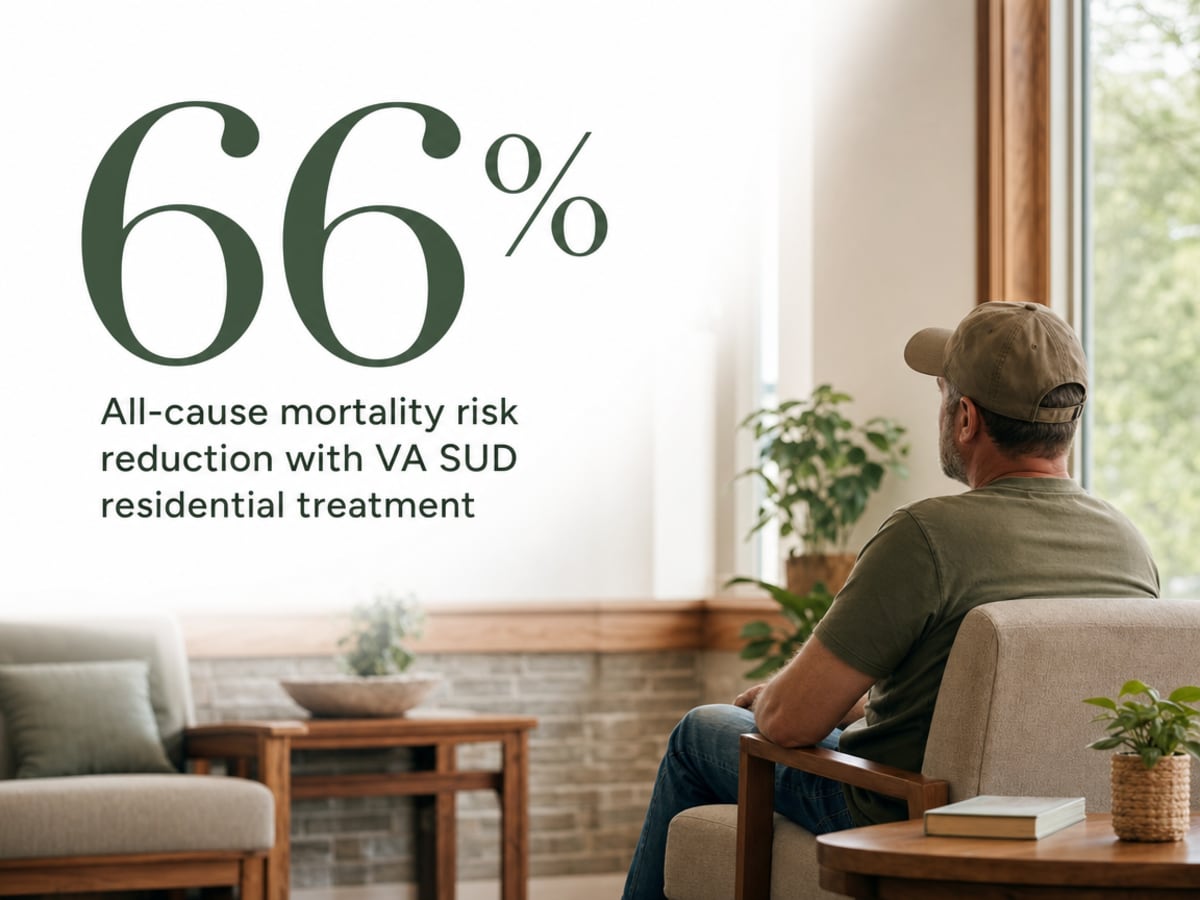
A 2024 propensity-matched study of VA residential SUD treatment found a 66% reduction in all-cause mortality risk among veterans who received residential care compared with a modeled counterfactual group, along with medium-to-large improvements in SUD and mental health symptoms that were sustained at one year post-screening 1. Scope matters here. These were VA residential patients, matched against a comparable non-residential group, followed for a year. It’s not a claim about luxury settings specifically. It’s a claim about the residential level of care itself, delivered inside a program that follows VA/DoD standards.
Hold that finding next to the completion data. The VA’s Individualized Addictions Consultation Team residential program, which tailors care for veterans who haven’t done well in traditional tracks, kept 74.6% of participants through to completion 6. Individualized, veteran-aware residential models can hold people in care long enough for the treatment to work.
That’s the argument for residential. What a well-run private program adds on top is not better medicine. It’s better conditions for the medicine to land. Fewer people on the unit, private space to sleep and process, and a schedule that has room for trauma-focused therapy alongside detox rather than after it. You’re not paying for the outcome to be different. You’re paying for the odds of finishing to be higher and the week-two therapy hour to be usable when you get to it.
Reframing luxury as engagement infrastructure
The word “luxury” does most of the damage in this category. It suggests you’re paying for comfort, and comfort feels like a soft thing to spend serious money on when what you actually need is medical care. So let’s rename it. In a program built around the clinical spine already described, luxury is engagement infrastructure. It’s the set of conditions that make it more likely you’ll still be in treatment on day fourteen, still doing the trauma work on day twenty-one, and still returning phone calls to your discharge planner on day forty-five.
Think about what makes people leave residential care early:
- A crowded unit where the same television is on for sixteen hours.
- A shared room with someone whose withdrawal is louder than yours.
- A group therapy circle of thirty where nobody knows your name by Friday.
None of those things are clinical failures on paper. All of them are reasons a veteran with hypervigilance, poor sleep, and unfinished trauma work decides at 2 a.m. that this isn’t going to work and books a car home.
A private room, a lower census, and a quieter physical environment change that math. They don’t do the therapy for you. They protect your capacity to receive it. That matters especially when trauma-focused work like Prolonged Exposure or CPT is running alongside detox, because those therapies require you to be regulated enough to stay in the session and safe enough to sleep after it 5. The I-ACT residential model held 74.6% of veterans through completion in part because it was designed around individualized, veteran-aware conditions rather than a one-size unit 6.
So when you look at amenities, ask what each one is doing for your ability to stay. A private room is engagement infrastructure. A chef is decoration. Judge accordingly.
The questions to ask before you admit
Pressure-testing MAT, trauma therapy, and cultural fluency
Admissions calls are performances on both sides. You’re nervous, they’re friendly, and forty minutes disappear before you’ve asked anything that actually matters. Slow it down. Bring three lines of questioning, and don’t get off the phone until you have real answers on each.
Start with medication. Ask which physician on staff prescribes naltrexone, acamprosate, and buprenorphine, and whether you’ll leave with a prescription and a follow-up plan or a referral card. The VA/DoD 2021 guideline treats pharmacotherapy for alcohol and opioid use disorders as first-line care, not an add-on 3. If the program hedges on MAT or frames it as philosophically optional, you’ve learned something important about their clinical center of gravity.
Move to trauma next. Ask which clinicians on the residential team deliver Prolonged Exposure, Cognitive Processing Therapy, or EMDR, and when those sessions start relative to admission. A program aligned with VA guidance runs trauma-focused therapy alongside SUD care, not after some undefined stabilization window 5, 7. If they can name the therapist, the modality, and week one on the schedule, that’s real. If trauma work sounds like a group called “processing,” it isn’t.
Then test cultural fluency. Ask how many veterans they admitted last quarter, whether clinicians have specific training on military culture and service-related trauma, and whether they use structured programs like Seeking Safety inside residential care 4. You’re not looking for a former sergeant on payroll. You’re looking for a team that doesn’t need you to explain what a deployment cycle did to your sleep.
Write the answers down while you’re on the call. If you’re comparing two facilities a week later, the difference between “yes, of course” and a specific clinician’s name will be the whole decision.
Reading the staff, not the brochure
The brochure is written by marketing. The staff is who you’ll actually be in a room with at three in the morning when the withdrawal is loud and the memory you don’t talk about shows up uninvited. Learn to read them directly.
Ask to speak with a clinician, not just admissions, before you commit. Five minutes with the medical director or lead therapist tells you more than an hour with an intake coordinator. Listen for whether they ask about your service, your deployments, and your prior treatment history in a way that suggests they’ve heard those answers before. Listen for whether they treat your PTSD as central to the plan or as something to “address” later.
Watch tenure and turnover. A residential program where the same clinicians have been on the unit for three or four years is running something different than one where the therapist you meet at admission won’t be there in week two. Ask directly how long the core clinical team has been together.
One more test: how they talk about the VA. A serious program treats the VA as a partner in your continuity of care, not a competitor to disparage. If someone on the phone runs down VA care to sell you theirs, that’s the brochure talking.
Coverage mechanics: VA Community Care, TRICARE, and private insurance
Most veteran-focused rehab pages dodge this part. You shouldn’t have to.
There are three doors into a private residential program.
The first is the VA Community Care Network, which lets the VA pay a non-VA provider when eligibility criteria are met, usually around distance, wait times, or specific clinical need. If you’re already enrolled in VA care, the conversation starts with your VA primary care team or SUD provider, not with the private facility’s admissions line. Ask the facility whether they’re an in-network Community Care provider and how often they actually bill through it. “We can help you figure it out” is not the same answer as “we billed twenty Community Care admissions last quarter.”
The second door is TRICARE, if you’re a retiree, still eligible through service connection, or covered as a dependent. TRICARE covers medically necessary detox and residential SUD treatment at authorized facilities, but prior authorization rules and network status vary by plan. Get the facility’s TRICARE contract confirmed in writing before admission, not verbally at intake.
The third door is a private PPO through an employer or a spouse, which usually offers the widest facility choice and the least friction, but the highest out-of-pocket exposure. Ask for a written verification of benefits with the deductible, coinsurance, out-of-pocket max, and any per-day residential caps spelled out.
Whatever door you use, insist that the facility coordinate directly with VA for records and continuity, so nothing you build in residential care disappears the day you discharge 2.
Discharge planning that starts on day one
The single biggest predictor of whether a residential stay holds is what waits for you on the other side of it. A program that treats discharge as a Friday afternoon task is running a different operation than one where the aftercare plan opens on the admission chart.
Ask on day one who owns your discharge. It should be a named person, not a role. Ask what the plan will include:
- a MAT prescription in hand
- a scheduled outpatient appointment before you leave campus
- a records release already signed for your VA primary care team or Community Care coordinator
- a named contact for the first 72 hours after you walk out 2
VA guidance treats integrated, coordinated care across settings as standard, not concierge 4.
One more thing. Ask what happens if you relapse in month two. A serious program answers that question without flinching, because they’ve answered it before. That answer, more than the room or the view, is what you’re actually buying.
Speak Confidentially With a Veteran-Focused Intake Specialist
Get prompt answers and guidance from someone who understands veterans’ unique rehab needs.

Frequently Asked Questions
Does TRICARE or VA Community Care pay for private luxury rehab?
Sometimes, yes. VA Community Care can pay a private residential provider when eligibility criteria are met, and TRICARE covers medically necessary detox and residential SUD care at authorized facilities. Get network status and prior authorization confirmed in writing before admission. Luxury amenities themselves aren’t reimbursed, so any premium above the covered rate becomes your out-of-pocket cost.
Can I get PTSD treatment during detox, or do I have to finish detox first?
You can start trauma work during residential care. VA guidance is explicit that co-occurring SUD should not block or delay PTSD treatment, and that Prolonged Exposure, Cognitive Processing Therapy, and EMDR should be accessible alongside SUD care 5, 7. If a facility tells you trauma work waits until stabilization is complete, they’re running a sequential model the current standard moved past.
How do I know a facility is genuinely veteran-specialized and not just marketing to veterans?
Ask three things. How many veterans they admitted last quarter. Whether clinicians have specific training in military culture and use structured programs like Seeking Safety inside residential care 4. Whether their protocols align with the VA/DoD 2021 SUD guideline 3. Specific answers, named clinicians, and case volume mean design. Vague reassurance means a flag in the lobby.
Is residential care actually better than intensive outpatient for a veteran with a job and family?
The evidence favors residential when it’s clinically warranted. A 2024 propensity-matched study of VA residential SUD care found a 66% reduction in all-cause mortality risk with medium-to-large symptom improvements sustained at one year 1. That’s not a claim about luxury settings. It’s about the level of care. Talk with a clinician about which level fits your situation.
Will a private facility prescribe medications like naltrexone, buprenorphine, or acamprosate?
A serious one will. The VA/DoD 2021 guideline treats pharmacotherapy for alcohol and opioid use disorders as first-line care, not an add-on 3. Ask directly whether a physician on staff prescribes these medications and whether you’ll leave with a prescription and a follow-up plan. If MAT is available only through an outside referral, that tells you where the program sits.
What happens after discharge if I want to return to VA care?
A well-run private program coordinates with the VA before you leave. That means a signed records release, a scheduled handoff to your VA primary care team or SUD provider, and a MAT prescription bridged until the VA continues it 2. Ask on day one who owns your discharge by name. VA care as your continuity plan is normal, not awkward.
References
- Effectiveness of residential treatment services for veterans with substance use disorders: A propensity score matching evaluation. https://pubmed.ncbi.nlm.nih.gov/38211367/
- Alcohol & Drug Addiction Treatment for Veterans. https://www.mentalhealth.va.gov/substance-use/treatment.asp
- Management of Substance Use Disorder (SUD) (2021) – VA/DoD Clinical Practice Guideline. https://www.healthquality.va.gov/guidelines/mh/sud/
- Practice Recommendations for Treatment of Veterans with Comorbid Substance Use Disorder and Posttraumatic Stress Disorder. https://www.mentalhealth.va.gov/providers/sud/docs/SUD_PTSD_Practice_Recommendations.pdf
- Treatment of Co-Occurring PTSD and Substance Use Disorders in VA. https://www.ptsd.va.gov/professional/treat/cooccurring/tx_sud_va.asp
- The Individualized Addictions Consultation Team Residential Program. https://pubmed.ncbi.nlm.nih.gov/33583351/
- VA/DoD 2023 Clinical Practice Guideline for the Management of Posttraumatic Stress Disorder and Acute Stress Disorder. https://www.ptsd.va.gov/professional/treat/txessentials/cpg_ptsd_management.asp
- Prevalence of substance use disorders among veterans and comparable nonveterans from the National Survey on Drug Use and Health. https://bearworks.missouristate.edu/articles-chhs/508/
- Substance Use and Military Life DrugFacts. https://nida.nih.gov/publications/drugfacts/substance-use-military-life
- Substance use disorders in military veterans: prevalence and treatment challenges. https://pmc.ncbi.nlm.nih.gov/articles/PMC5587184/
- Unmet Need for Treatment of Substance Use Disorders and Serious Mental Illness among Veterans: A National Survey. https://pmc.ncbi.nlm.nih.gov/articles/PMC3743427/
- The Epidemiology of Substance Use Disorders in US Veterans: A Systematic Review and Analysis of Assessment Methods. https://pmc.ncbi.nlm.nih.gov/articles/PMC5123305/
- Substance Use Disorders Among Veterans in a Nationally Representative Sample: Prevalence and Association with Functioning. https://pubmed.ncbi.nlm.nih.gov/30573015/