Key Takeaways
- Medical detox in Oklahoma City provides 24/7 monitoring, withdrawal medications, and licensed clinical care that safely manages the medical risks of stopping alcohol, opioids, or benzodiazepines.
- Alcohol and benzodiazepine withdrawal can trigger seizures and delirium tremens, while opioid withdrawal drives relapse into overdose once tolerance drops.9,10,13
- Self-tapering rarely works because safe benzodiazepine reductions must stay under 25% per week, and home alcohol or opioid tapers usually collapse before the danger window closes.3,1
- Before choosing a facility, compare whether detox is the core service or an add-on, how CIWA and COWS scoring drive medication timing, and how the handoff to ongoing care is arranged.
If you’re reading this at 2 a.m., start here
You didn’t plan to be awake right now. Maybe your hands are shaking. Maybe your stomach is turning, or your heart is racing, or someone you love is asleep in the next room and you don’t want them to see this tab open. Whatever brought you to this page, take a breath. You’re in the right place to figure out what’s next with medical detox Oklahoma city.
Here’s what you probably already suspect: quitting on your own is not working, or the last time you tried, it hurt worse than you expected. That’s not a character flaw. Alcohol, opioids, and benzodiazepines change how your brain and body function, and pulling those substances out suddenly can trigger complications that range from miserable to genuinely dangerous, including seizures and delirium tremens for heavy drinkers and life-threatening overdose after opioid tolerance drops.9,10
Medical detox in Oklahoma City exists so you don’t have to white-knuckle this alone. It’s a licensed level of care with 24/7 monitoring, medications that actually blunt withdrawal, and clinicians who have seen every version of what you’re feeling right now. Renewal Springs is one of those places, a 30-bed facility that treats detox as the medical event it is, not a three-day inconvenience.
The rest of this article walks you through what happens to your body, what supervision looks like, and what it feels like to make the call. Keep reading. You already did the hardest part by opening the page.
What withdrawal actually does to your body
Alcohol: seizures, delirium tremens, and why some drinkers die detoxing at home
If you’ve been drinking heavily every day for months or years, your brain has adapted. Alcohol slows down your nervous system, and your body compensates by revving that system up. When you suddenly stop, the brakes come off, but the engine is still floored. That’s withdrawal.
For a lot of people, it starts within six to twelve hours after the last drink. Shakes, sweating, a racing heart, nausea, anxiety that feels like your skin is trying to crawl off. Uncomfortable, but not the part that kills people. The part that kills people comes later.
Somewhere between 24 and 48 hours in, some drinkers develop withdrawal seizures. Between 48 and 72 hours, a smaller group develop delirium tremens, sometimes called DTs, which brings severe confusion, hallucinations, dangerously high heart rate and blood pressure, and a real risk of death without treatment. This isn’t rare in heavy drinkers, and there’s no reliable way to predict at home who will get it and who won’t.9,11
Here’s what makes home detox especially cruel: the first day feels survivable. You white-knuckle through the shakes, tell yourself the worst is over, and then day two or three arrives and you’re alone when the seizure hits. Nobody’s checking your blood pressure. Nobody’s watching for the confusion that means DTs are starting.
In a medical detox setting, long-acting benzodiazepines like chlordiazepoxide or diazepam are given on a schedule that blunts withdrawal severity and dramatically reduces seizure and DT risk. That’s not comfort care. That’s the difference between a rough week and a hospital admission you don’t wake up from.1,3
Opioids (fentanyl, heroin, painkillers): dehydration, aspiration, and the overdose that comes after
People will tell you opioid withdrawal won’t kill you. That’s mostly true, and it’s also missing the point.
Opioid withdrawal feels like the worst flu of your life stacked on top of a panic attack. Muscle and bone pain, cramping, vomiting, diarrhea that doesn’t stop, cold sweats, restless legs, insomnia, and a psychological desperation that is hard to describe if you haven’t felt it. The medical danger isn’t the withdrawal itself. It’s what the withdrawal does to you.12
Vomiting and diarrhea for two or three days straight causes dehydration and electrolyte imbalances that can trigger dangerous heart rhythms. If you vomit while sedated or asleep, you can aspirate. And the misery is so intense that most people who try to detox alone reach for the drug again within 24 to 48 hours, just to make it stop.10
That relapse is where opioids actually kill you. Once your tolerance drops, even a few days off, the dose you used to take is now an overdose dose. The CDC has been explicit about this: stopping opioids suddenly is dangerous, and the risk of fatal overdose spikes after a period of abstinence. Fentanyl makes this worse, because the street supply is unpredictable and even small amounts can stop your breathing.10
Medically supervised opioid detox uses buprenorphine or methadone to blunt withdrawal, manages the vomiting and dehydration with IV fluids and anti-nausea medications, and, critically, keeps you in a place where relapse isn’t an option during the highest-risk window.12
Benzodiazepines: the withdrawal people underestimate the most
Xanax, Klonopin, Ativan, Valium. If you’ve been taking a prescribed benzodiazepine daily for more than a few months, or using them non-medically, your brain has changed the way alcohol does. And benzodiazepine withdrawal is arguably the most dangerous of any drug class to attempt alone.
Stopping abruptly, or tapering too fast, can trigger seizures, severe anxiety, insomnia that lasts weeks, and a phenomenon called withdrawal-induced psychosis. People die from benzo seizures. People end up in emergency rooms after their friend told them to just cut the dose in half.13
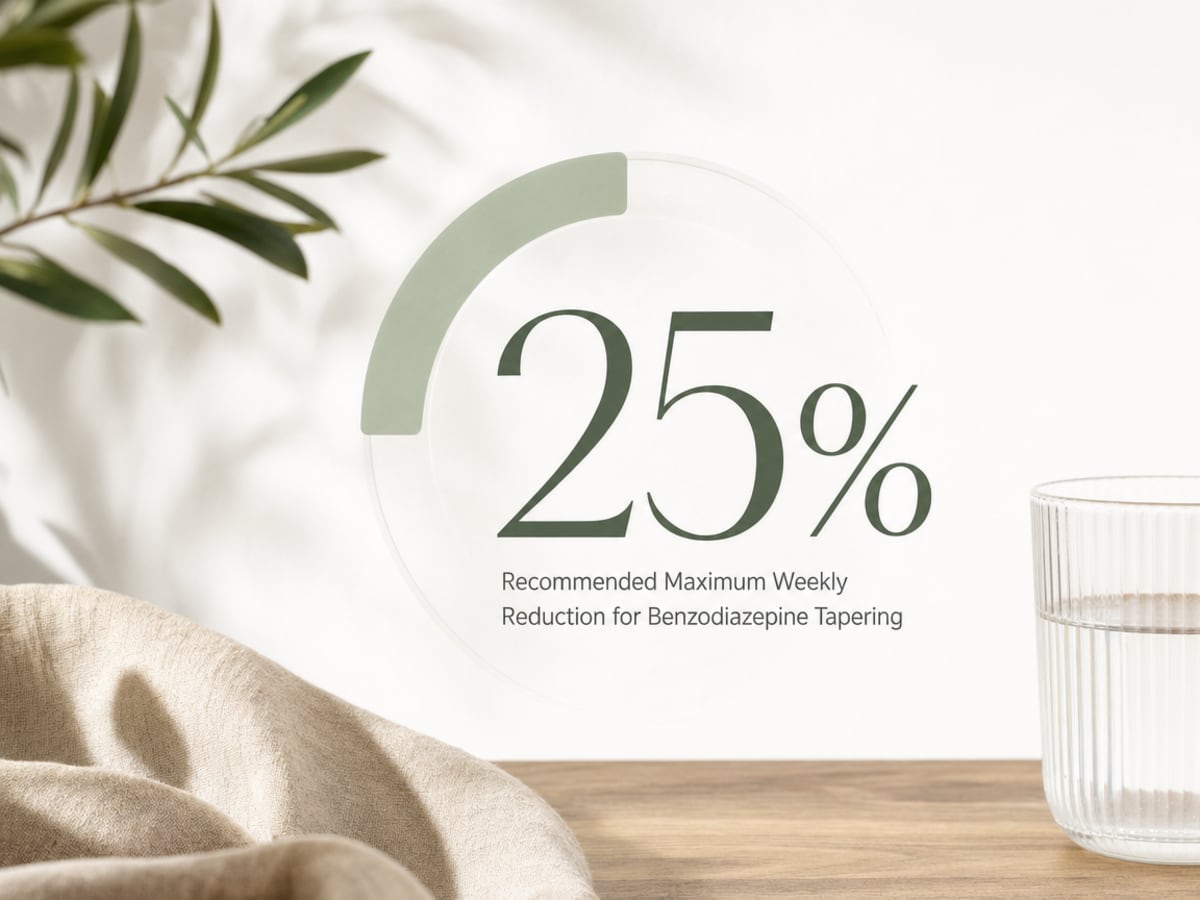
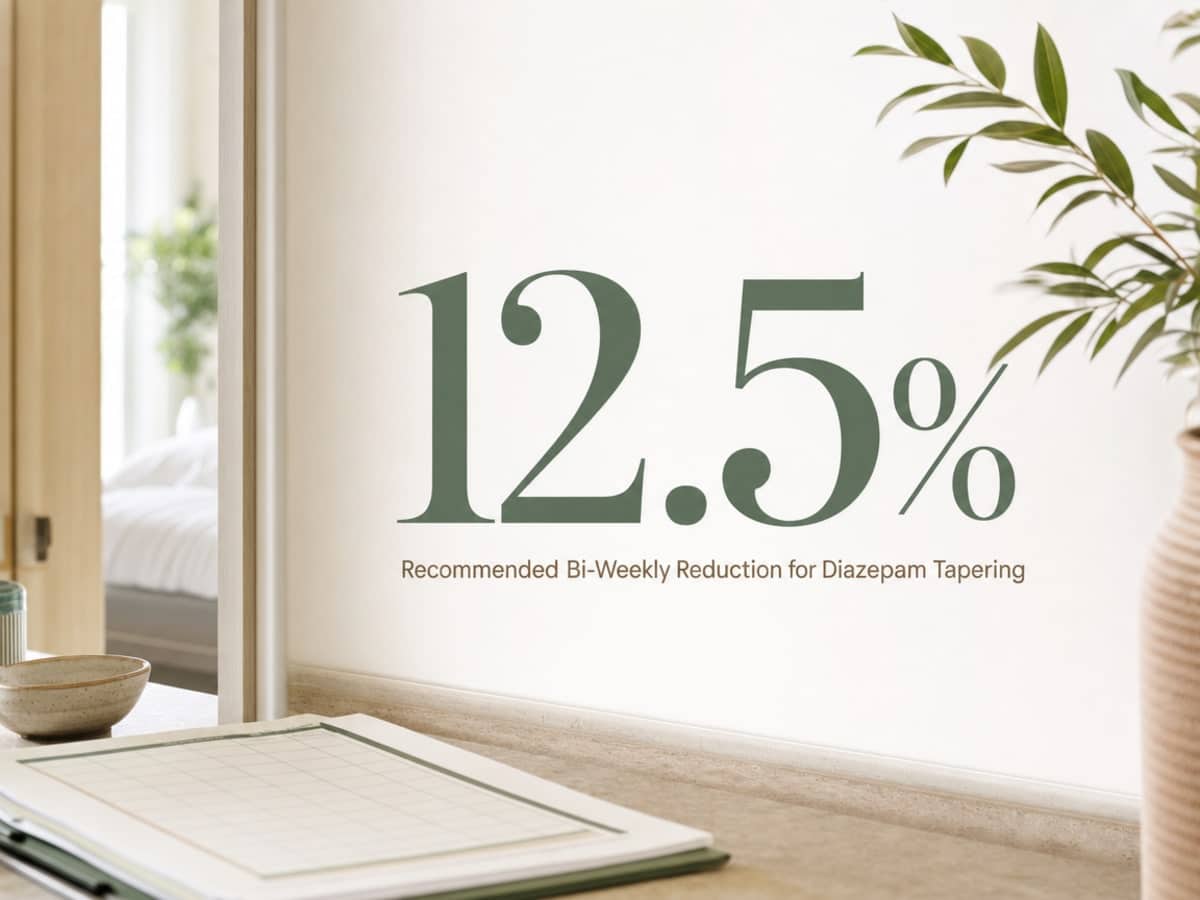
Here’s what a safe taper actually looks like, and this is where the numbers matter. Federal guidance from the US Bureau of Justice Assistance sets a ceiling: benzodiazepine tapers should be no more rapid than 25% per week. A commonly cited clinical protocol goes even slower, converting the patient to diazepam and reducing the dose by roughly 12.5% every two weeks.1,3
Read those two numbers again. The federal ceiling for a monitored medical setting is 25% per week. The gentler clinical example is 12.5% every two weeks, which works out to about 3% per week. If you’re at home cutting your dose in half, you’re moving three to sixteen times faster than what clinicians consider safe. That’s not caution talking. That’s the seizure risk.
Medical detox for benzos means a slow, structured taper with monitoring, often using a long-acting agent to smooth the ride.
Stimulants and mixed use: the risks people don’t talk about
Meth, cocaine, and prescription stimulants don’t cause the same kind of physical withdrawal that alcohol or opioids do. There’s no classic seizure pattern. What comes instead is a crash: heavy sleep, ravenous hunger, a depression that can turn suicidal, paranoia, and sometimes psychosis that outlasts the drug itself. The medical risk during heavy use is also real, mostly cardiac and psychiatric, and coming down after a long binge can expose problems that were masked while you were high.14
Then there’s the reality most people won’t tell their doctor about: mixed use. Alcohol plus opioids. Benzos plus fentanyl. Meth plus almost anything. Concurrent withdrawal from more than one substance is more dangerous than either alone, and clinical consensus is that these cases should be managed inpatient with close monitoring and the simultaneous use of benzodiazepines and opioid agonists when needed.2
If you’ve been using more than one substance, that’s not a reason to hide from care. It’s exactly why supervised detox exists. You don’t have to sort out which drug is causing which symptom. That’s the clinician’s job.
You’re not the only one in Oklahoma doing this
If shame is part of what’s kept you from picking up the phone, this part matters. You are not the only person in this state waking up sick, or hiding a bottle, or counting pills. You are one of thousands.
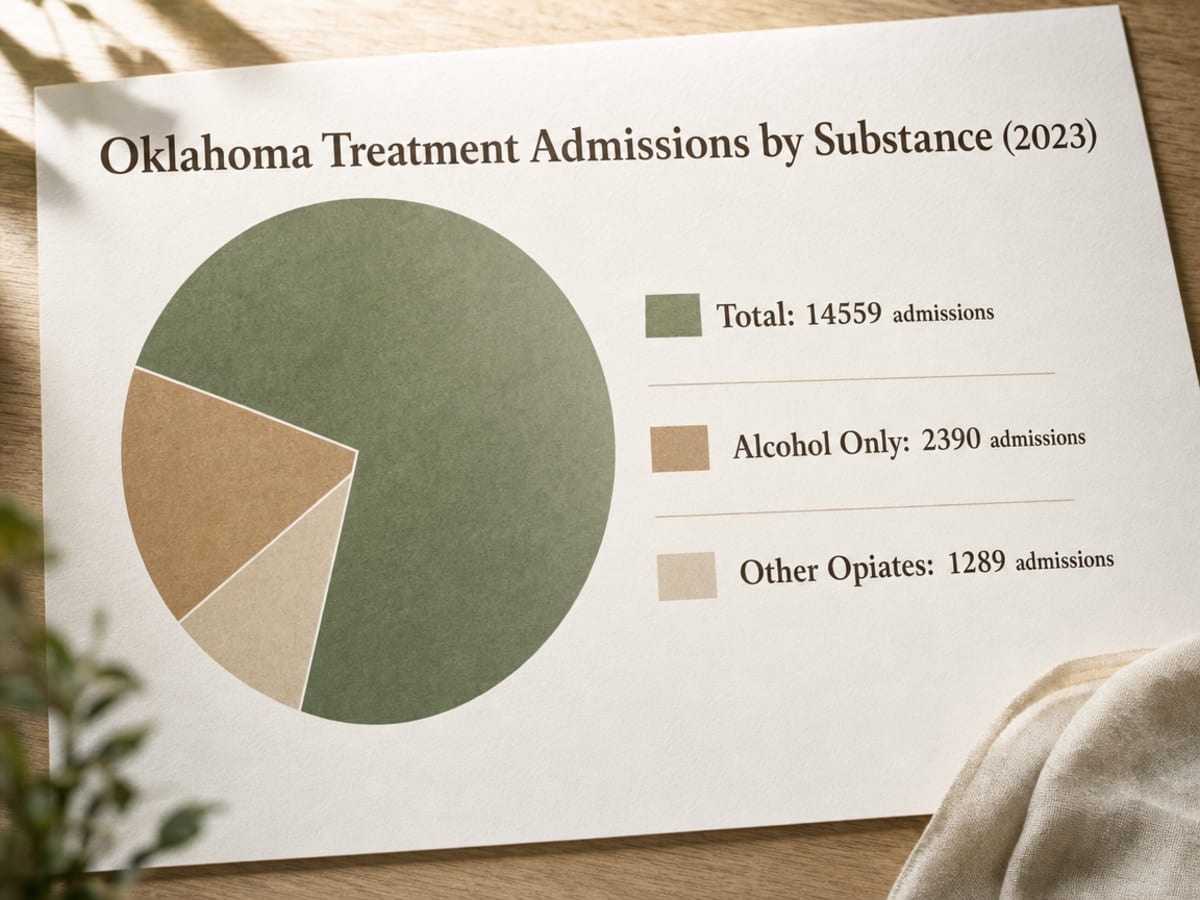
In 2023, Oklahoma recorded 14,559 treatment admissions across the state. Of those, 2,390 were for alcohol only and 1,289 were for other opiates, with the rest spread across stimulants, marijuana, multiple substances, and other drugs. Those are just the people who made it into treatment. The real number of Oklahomans struggling is larger, because most people who need care don’t get it in any given year.5
Read that back. Fourteen thousand five hundred and fifty-nine of your neighbors walked into an admissions office last year. Teachers. Nurses. Roofers. Grandparents. Veterans. The person who bagged your groceries. They sat down, gave their information, and started. Some of them were more scared than you are right now. Some of them were sicker.
You are not the exception. You are not the worst case. And you are not the first person in Oklahoma City to sit up at an odd hour and wonder if a detox facility would actually let you in the door. They would. That’s what the door is for.
Why self-tapering and ‘toughing it out’ keep failing
You’ve probably already tried. Maybe more than once. You poured out the bottle on a Sunday night, or you skipped a dose, or you told yourself Monday morning would be different. By Tuesday afternoon, your hands were shaking and your brain was screaming, and you drank or used again just to feel like a person. That’s not weakness. That’s your nervous system doing exactly what a physically dependent nervous system does.
Here’s the piece nobody explains clearly enough: willpower and tapering strategy are two different skills, and even the tapering strategy is genuinely hard to execute alone. Cutting your alcohol intake in half, or halving your Xanax dose, or spacing your painkillers out further sounds like a reasonable middle path. Clinically, it usually isn’t. For benzodiazepines, moving faster than roughly 25% per week is considered too aggressive by federal withdrawal guidelines, and many clinicians go far slower than that. For alcohol, once you’re physically dependent enough to shake in the morning, tapering with more alcohol tends to spiral because your dose window is unstable and your judgment is the thing withdrawing.1,3
What 24/7 medical supervision actually looks like on the floor
Vitals, CIWA and COWS scoring, and the medication window
When you hear “24/7 medical supervision,” it can sound like a marketing phrase. On a detox floor, it’s a schedule. Nurses take your vitals on a set rotation, often every one to four hours in the early days depending on how you’re presenting. Blood pressure, heart rate, temperature, oxygen. Those numbers tell the team whether your withdrawal is tracking normally or heading somewhere that needs a faster response.
Alongside the vitals, staff use two structured scoring tools you’ll hear referenced by name. CIWA-Ar is used for alcohol withdrawal. It scores things like tremor, sweating, anxiety, nausea, and orientation, and the total number decides whether you get more medication now or wait. COWS does the same job for opioid withdrawal, scoring pupil size, gooseflesh, restlessness, gastrointestinal symptoms, and more. These aren’t checkbox exercises. They exist because withdrawal changes hour by hour, and the score at 3 a.m. can be very different from the score at noon.
The scores drive the medication window. Long-acting benzodiazepines are the preferred first-line agents for alcohol withdrawal, dosed on the CIWA rhythm rather than a flat schedule. When someone is withdrawing from both alcohol and opioids at once, clinical consensus supports inpatient management with benzodiazepines and opioid agonists used together under close monitoring. That combination is not something you attempt at home. It’s the whole reason the floor exists.2,3
The medications that make withdrawal survivable
You are not supposed to muscle through this. The medications used in a licensed detox aren’t a shortcut or a crutch. They are how clinicians keep your nervous system from doing something dangerous while your body relearns how to function without the substance.
For alcohol, the workhorses are long-acting benzodiazepines like chlordiazepoxide and diazepam. Decades of guidelines and Cochrane reviews back their use because they meaningfully reduce withdrawal severity and cut the risk of seizures and delirium tremens. You don’t get a bottle to take home. You get scheduled doses adjusted by your CIWA score, tapered down as your symptoms settle.1,3
For opioids, the two agents you’ll hear most are buprenorphine and methadone. Both are full or partial opioid agonists, and both are used to blunt the withdrawal curve so your body isn’t in crisis for seventy-two hours straight. Buprenorphine in particular has changed what opioid detox looks like. Instead of the classic image of someone shaking and vomiting in a bed for days, you get something closer to a bad flu that the medication actually reaches.12
Around those primary medications sit the supportive ones: IV fluids for dehydration, anti-nausea medications, clonidine for the autonomic symptoms of opioid withdrawal, sleep support, and non-narcotic options for muscle pain. When alcohol and opioids are both in play, these agents can be used together in an inpatient setting with close monitoring for respiratory depression.2
Why a detox-focused campus works differently than a rehab with a detox wing
A lot of treatment centers in this state offer detox because they have to. It’s the front door to their thirty-day program, and they’d rather you not have to leave the building between the two. That’s not automatically bad, but it changes how detox gets treated internally. When detox is the runway to another product, the pressure is to move you through it. When detox is the product, the pressure is to get it right.
Renewal Springs is built around thirty detox beds. Not thirty rehab beds with a few detox rooms carved out. Thirty beds staffed and equipped for the acute medical work of getting you through withdrawal safely. That number matters because it sets the tempo of the whole facility. Nursing ratios, medication protocols, physician availability, and the physical layout are all sized for people in their first three to seven days, not people six weeks into a residential stay.
Practically, that means the person checking on you at 4 a.m. is a clinician whose entire shift is withdrawal management. The medication timing is built around CIWA and COWS scores, not the group therapy schedule down the hall. And when detox ends, you’re handed off to residential or outpatient care as a deliberate transition rather than a hallway walk. That’s what focus looks like in practice.
What happens when you call admissions at Renewal Springs
The call is one conversation. Not a commitment, not a contract, not a plane ticket you can’t refund. Someone answers the phone, and you talk. That’s it.
You’ll be asked a few things because the person on the other end needs to know how to help you safely. What substances, how much, how long, when your last use was. Any medical conditions, any medications, any prior withdrawal seizures. If you’re currently withdrawing, they want to know your symptoms right now. None of this is a test. It’s how the admitting clinician builds the plan before you arrive, so the medications you’ll need are ready and the risks are already mapped.
They’ll also ask about insurance. Most major plans are accepted, and the benefits check is free. If cost is the thing that’s kept you frozen, say so on the call. Get the actual number instead of the imagined one.
If Renewal Springs isn’t the right fit, they’ll say so and help you find what is. If it is a fit, the next step is arranging your arrival at the Oklahoma City facility, sometimes the same day. SAMHSA’s National Helpline is also a 24/7 confidential option if you want a second door to knock on first.4
Pick up the phone.
For families reading this on someone else’s behalf
If you’re the spouse, parent, sibling, or adult child holding this tab open, you already know the shape of the fear. You’ve watched them try. You’ve counted bottles or pills. You’ve googled seizure symptoms at a stoplight. You are exhausted, and you are still here. That counts for something.
Two things you can do tonight. First, you can call admissions yourself. You don’t need your loved one on the line to ask questions, describe what you’re seeing, and understand what a safe admission would look like. If they’re using multiple substances or drinking heavily, inpatient management with close monitoring is the clinical consensus, not an overreaction. Second, do not push them to quit cold turkey at home while you wait for a better moment. Abrupt alcohol or benzodiazepine cessation can trigger seizures, and abrupt opioid cessation raises the overdose risk the moment they use again.2,9,10,13
You can’t decide for them. You can hand them a phone number, sit next to them while they dial, and know the door opens either way. That’s not small. That’s the work.
Speak with a Medical Detox Specialist Now
Get answers and next steps for starting safe, medically supervised detox in Oklahoma City.
Frequently Asked Questions
Is medical detox actually safer than quitting at home?
For alcohol, opioids, and benzodiazepines, yes. Heavy alcohol withdrawal can cause seizures and delirium tremens, both of which have a real mortality rate without treatment 9, 11. Benzodiazepine withdrawal carries a similar seizure risk. Opioid withdrawal itself rarely kills you, but the relapse it drives often does, because tolerance drops within days 10. A supervised setting interrupts all three patterns.13
How long does medical detox usually take?
Most people stay somewhere between three and seven days, though it varies by substance and severity. Alcohol withdrawal typically peaks within 24 to 72 hours and settles over the following days 11. Opioid withdrawal from short-acting drugs like heroin often runs four to seven days, longer for methadone. Benzodiazepine tapers can extend longer because they must move slowly. Your admitting clinician will estimate your specific range.12
What medications are used during detox for alcohol or opioids?
For alcohol, long-acting benzodiazepines like chlordiazepoxide and diazepam are first-line, dosed by CIWA score to reduce withdrawal severity and lower seizure and delirium tremens risk. For opioids, buprenorphine and methadone blunt the withdrawal curve so your body isn’t in crisis for days. Supportive medications handle nausea, dehydration, sleep, and autonomic symptoms. When both substances are involved, agents can be used together with close monitoring.1,2,3,12
Can I detox from benzodiazepines by slowly cutting my dose on my own?
It’s the riskiest DIY detox of any drug class. Federal guidance sets a ceiling of no more than a 25% reduction per week, and many clinicians go slower, closer to 12.5% every two weeks after converting to diazepam. Moving faster raises seizure risk sharply. If you’re already on a daily benzodiazepine, call a detox facility or your prescriber before adjusting anything yourself.1,3,13
What happens after detox ends?
Detox stabilizes your body. It doesn’t rewire the habits or brain chemistry that brought you in. Most people step down into residential treatment, an intensive outpatient program, or ongoing outpatient care with medications for opioid or alcohol use disorder. Clinical consensus increasingly favors continuing medication rather than stopping at detox. Renewal Springs coordinates that handoff before you leave, so you’re not searching for the next step alone.2
What should I bring, and what does the first call to admissions involve?
Bring photo ID, your insurance card, a list of current medications, and comfortable clothes for a few days. Leave anything sharp, alcohol-containing, or unprescribed at home. The call itself is a conversation, not a commitment. Expect questions about substances used, amounts, last use, medical history, and insurance. Benefits verification is free. If you’d rather start with a second door, SAMHSA’s National Helpline is also 24/7.4
References
- Pharmacological strategies for detoxification. https://pmc.ncbi.nlm.nih.gov/articles/PMC4014033/
- Concurrent opioid and alcohol withdrawal management. https://pmc.ncbi.nlm.nih.gov/articles/PMC10696169/
- Guidelines for Managing Substance Withdrawal in Jails. https://bja.ojp.gov/doc/guidelines-managing-substance-withdrawal-jails.pdf
- National Helpline. https://www.samhsa.gov/find-help/helplines/national-helpline
- 2023 TEDS-A Oklahoma | CBHSQ Data. https://www.samhsa.gov/data/node/51076
- 2023 NSDUH State Tables: Oklahoma. https://www.samhsa.gov/data/sites/default/files/reports/rpt56188/2023-nsduh-sae-state-tables_0/2023-nsduh-sae-state-tabs-oklahoma.pdf
- Behavioral Health Barometer: Oklahoma, Volume 4. https://www.samhsa.gov/data/sites/default/files/Oklahoma_BHBarometer_Volume_4.pdf
- NSDUH Behavioral Health Barometer: Oklahoma, Volume 8. https://www.samhsa.gov/data/report/nsduh-behavioral-health-barometer-oklahoma-volume-8
- Alcohol Use and Your Health. https://www.cdc.gov/alcohol/fact-sheets/alcohol-use.htm
- CDC Guideline for Prescribing Opioids for Chronic Pain (Patient Brochure). https://www.cdc.gov/drugoverdose/pdf/patients/Opioid-Prescribing.pdf
- Alcohol Withdrawal Syndrome (StatPearls). https://www.ncbi.nlm.nih.gov/books/NBK441882/
- Opioid Withdrawal (StatPearls). https://www.ncbi.nlm.nih.gov/books/NBK310654/
- Benzodiazepine Withdrawal (StatPearls). https://www.ncbi.nlm.nih.gov/books/NBK538174/
- Stimulant Toxicity (StatPearls). https://www.ncbi.nlm.nih.gov/books/NBK310652/