
Key Takeaways
- MAT-based detox in Oklahoma City uses methadone or buprenorphine under supervision to quiet opioid receptors, replacing the peak of withdrawal with a controlled, medically managed taper.
- Oklahoma’s fentanyl overdose deaths jumped from 50 in 2019 to 730 in 2023 1, making unmedicated detox riskier because tolerance drops fast and post-detox relapse can be fatal.
- When comparing local programs, weigh cold-turkey, supportive-only, and MAT pathways — MAT-assisted detox shows higher completion and lower early relapse than non-medicated approaches 10.
- Before choosing a facility, ask which agonist medication they use, how they handle fentanyl induction, what the taper schedule looks like, and what ongoing treatment linkage happens on discharge day.
What MAT actually does at the bedside during opioid withdrawal
If you are reading this while shaking, sweating, or watching someone you love do both, take a breath. You are already doing something that matters. Medically assisted treatment for detox in OKC is not a philosophy or a poster on a wall — it is a specific set of medications given on a specific schedule, by clinicians who stay with you while your body resets.
Here is what MAT actually looks like when the door closes behind you. A nurse or physician evaluates your history, your last use, and your withdrawal severity. Then, if you are opioid-dependent, they give you a starting dose of an opioid agonist — most often methadone or buprenorphine — that binds to the same receptors the fentanyl, heroin, or oxycodone was hitting. An agonist, in plain language, is a medication that speaks the same chemical language as the drug your body is missing. It does not get you high. It stops the receptors from screaming.
That single act changes the next 72 hours. Instead of the bone-deep aching, vomiting, diarrhea, and racing heart that unmedicated withdrawal delivers, symptoms are dialed down to something you can rest through. Clinical trials show buprenorphine produces faster relief of withdrawal symptoms and better retention in treatment than non-opioid approaches like clonidine alone 9. A comparative outcomes study of MAT-assisted versus non-medicated detox found significantly higher completion rates and lower early relapse in the MAT group 10. Translation: more people finish. More people walk out the other side.
MAT-based detox is not just about comfort. It is about survival. Your tolerance drops fast during withdrawal, and if you leave a non-medicated detox and use again at your old dose, the overdose risk is severe. Medication smooths the descent so you never have to make that panicked choice. Around the clock, someone checks your vitals, adjusts the dose, and treats the smaller symptoms — nausea, insomnia, anxiety — with additional supportive medications. That is the bedside reality. Not white-knuckling. Not toughing it out. Steady, medicated stabilization while your nervous system learns how to be still again.
Why medically assisted detox matters right now in Oklahoma City
You are not imagining the fear. What is happening in Oklahoma right now is different than it was even five years ago, and your body knows it. The drug supply changed. The margin for error shrank. And the reason MAT-based detox exists as a distinct clinical option — not just a nicer version of quitting — is because unmedicated withdrawal in the fentanyl era is a different level of dangerous than it used to be.
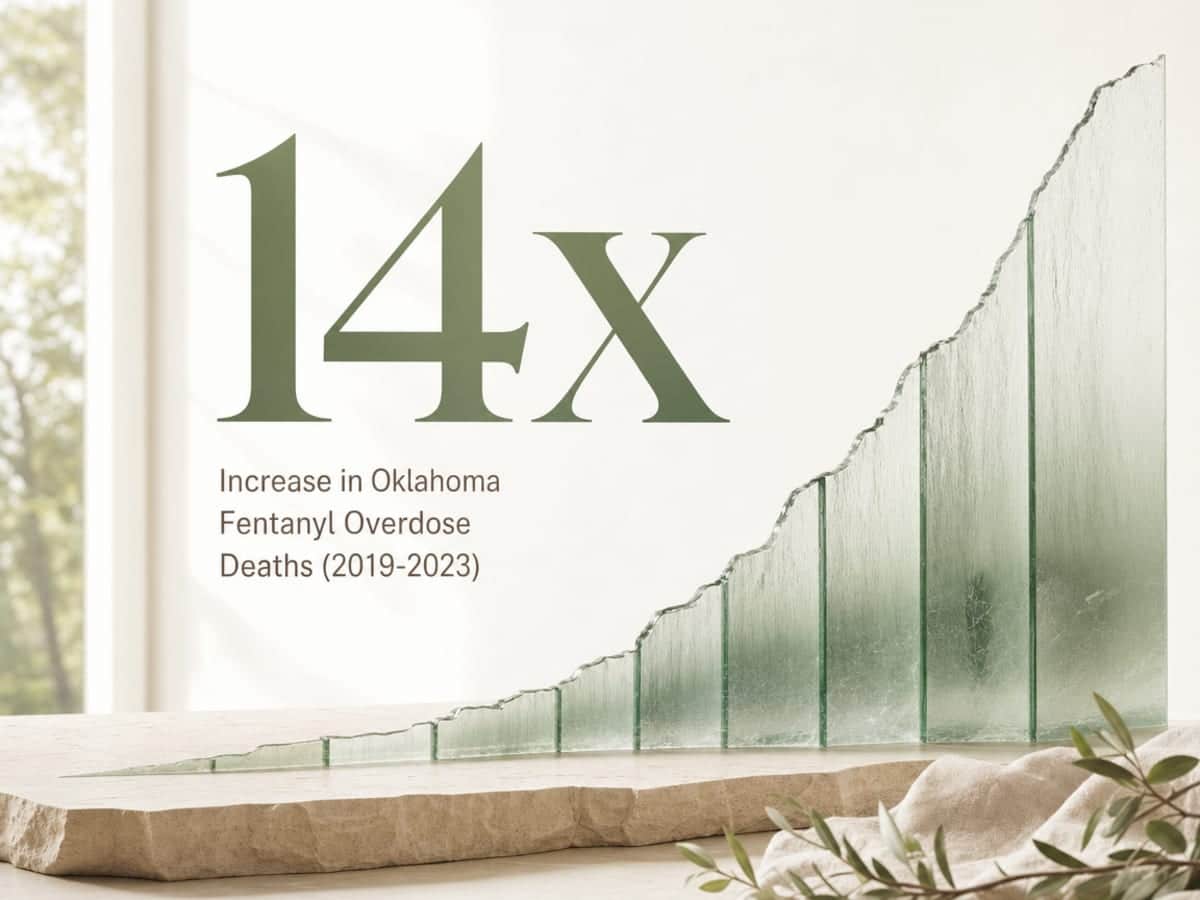
Here is the local picture, and then we will move on. Fentanyl overdose deaths in Oklahoma rose from 50 in 2019 to 730 in 2023 — a more than 14-fold increase in four years 1. That is not a statistic about someone else. That is the drug supply you or your loved one has been surviving. Whatever you were using a year ago is not what you are using now, even if the pill looks the same, even if the powder looks the same, even if the dealer swears it is the same.
What that means for detox is simple and important. Tolerance drops within days of stopping. If you white-knuckle it at home, decide the aching is unbearable at hour 40, and use again at the dose your body handled last week, the odds of a fatal overdose are higher than they have ever been. This is one of the core reasons federal guidance now states plainly that short-term supervised withdrawal alone is not recommended because of the high rate of return to illicit opioid use 11.
The two agonist medications that carry MAT-based detox
Two medications do most of the work in MAT-based opioid detox: methadone and buprenorphine. Both are opioid agonists, meaning they occupy the same receptors that fentanyl, heroin, or oxycodone were binding to — but they do it in a controlled, measured way that lets your nervous system settle instead of spiral. The choice between them, and the dose your clinician picks, is not arbitrary. It follows dosing windows written into the FDA label and taper schedules refined over decades of clinical practice. Here is what each one actually looks like in a detox setting.
Methadone: dose windows, day-one caps, and taper mechanics
Methadone is a full opioid agonist, which means it activates the receptors the same way heroin or fentanyl does — just longer, steadier, and without the peaks and crashes that drive craving. In a detox setting, it is dosed once a day, watched closely, and adjusted based on how your body responds.
The first day is where the guardrails are strictest. The FDA-approved label for methadone specifies that an initial single dose of 20 to 30 mg is often sufficient to suppress withdrawal, that the single initial dose should not exceed 30 mg, and that the total dose given on the first day should not ordinarily exceed 40 mg 8. Those numbers exist for a reason. Methadone has a long half-life. It keeps accumulating in your system for hours after you feel the first dose working. Push too hard on day one, and the same medication that was supposed to steady you can slow your breathing overnight. So the clinician starts low, watches, and adds a small supplemental dose later if withdrawal breaks through.
Once you are stabilized, the taper begins. For short-term detox, SAMHSA’s clinical guidance describes methadone being given once daily and generally tapered over 3 to 5 days in 5 to 10 mg daily reductions after dose requirements are established 12. That is the compressed version — useful when you have a shorter treatment window and a clear plan for what comes next. If you are coming down from a longer maintenance dose instead, the pace is much slower. The FDA label advises reductions of less than 10% of the established maintenance dose at 10- to 14-day intervals, and it acknowledges considerable variability in what the right pace looks like from patient to patient 8.
What that means for you, practically, is this. On the first day, you get a dose in the 20 to 30 mg range, no single dose above 30 mg, and no more than about 40 mg total before the calendar flips. On the days that follow, the dose steps down in small, planned reductions — 5 to 10 mg a day if you are on a short-term taper 12, or under 10% every couple of weeks if you are coming off a longer-term maintenance dose 8. You are not being weaned by feel. You are being weaned by a number your clinician can defend and adjust. That is what makes methadone-based detox different from any version of quitting on your own.
Buprenorphine: faster symptom relief and the fentanyl induction problem
Buprenorphine works a little differently. It is a partial opioid agonist, which means it binds to the same receptors as methadone or fentanyl but only activates them part of the way. In plain terms, it turns the dial down without turning it off. That partial activation is what gives buprenorphine its safety profile — there is a ceiling on how much respiratory depression it can cause — and it is also what makes it a strong first-line MAT medication for withdrawal. Clinical trials show buprenorphine produces more rapid relief of withdrawal symptoms and better treatment retention than clonidine, a non-opioid supportive medication that was standard in older detox protocols 9. Translation: you feel better faster, and you are more likely to still be in treatment a week from now.
Here is the honest complication, and the one most local pages skip. Buprenorphine has to be started at the right moment. Because it is a partial agonist that binds tightly to opioid receptors, it will actually kick a full agonist like fentanyl or heroin off those receptors when you take your first dose. If there is still enough full-agonist opioid in your system when that happens, buprenorphine can trigger precipitated withdrawal — a sudden, severe wave of the exact symptoms you came in to escape. That is not a rare quirk. It is a real clinical risk, and it is more complicated in the fentanyl era than it used to be.
Fentanyl behaves differently than the shorter-acting opioids the old induction protocols were built around. It stores in fatty tissue, releases slowly, and can linger in your body for days after your last use. That means the standard “wait until you’re in moderate withdrawal, then dose” rule is harder to time cleanly. A clinician managing your induction is looking at your last use, your withdrawal scores, and sometimes lengthening the window before that first buprenorphine dose — or using a low-dose start — to reduce the chance of precipitating a bad hour.
None of this makes buprenorphine the wrong choice. It makes the clinician the point. In a supervised setting, the timing gets managed for you. If precipitated withdrawal starts anyway, there are medications and adjustments ready to bring it back down. What you should not do is try to induct yourself at home with a strip a friend gave you. That is the scenario where the fentanyl induction problem becomes a crisis instead of a hurdle.
Three pathways compared: cold-turkey, supportive-only, and MAT
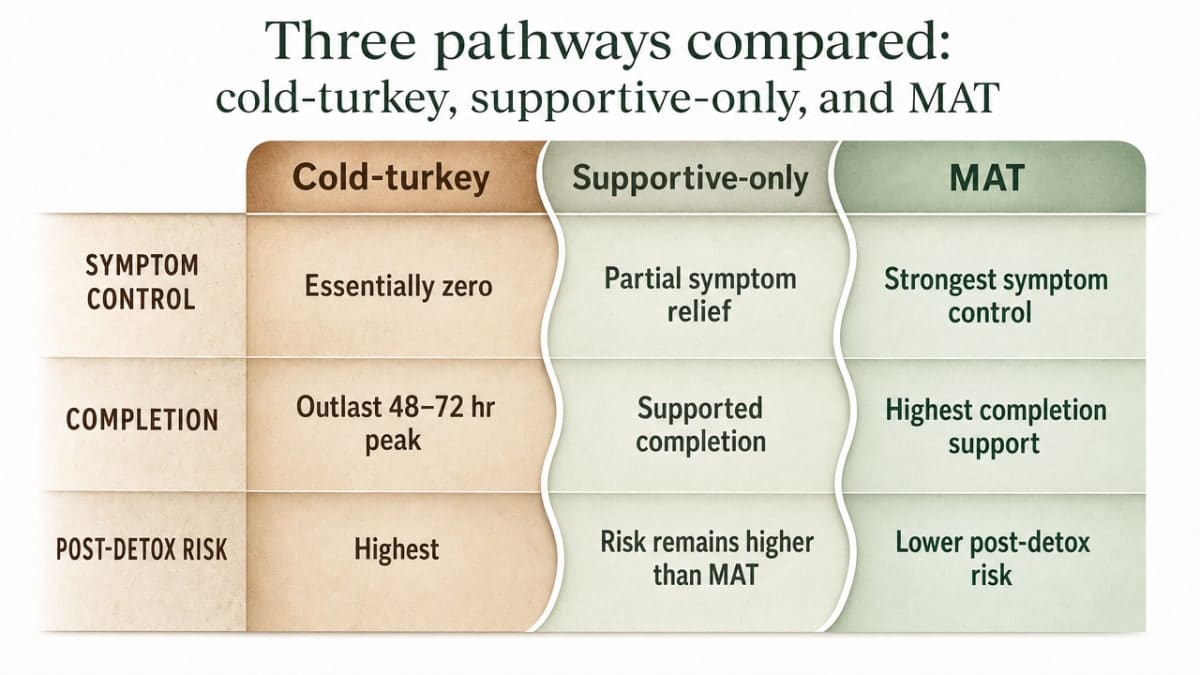
When someone is in withdrawal, there are really only three doors people walk through. It helps to see them next to each other, because they are not equivalent choices with different price tags. They are different levels of medical risk.
The first door is cold-turkey at home. No medications, no monitoring, just willpower against a nervous system that has been rewired around opioids. Symptom control is essentially zero — you feel every hour of it. The medications used are whatever is in the cabinet, which usually means nothing that touches the actual withdrawal. Completion is defined by whether you can outlast the peak, which for most people is 48 to 72 hours of the worst physical distress they have ever felt. And the post-detox overdose risk is the highest of any pathway, because your tolerance has dropped while your access to the same drug supply has not. Federal guidance is explicit that short-term supervised withdrawal alone is not recommended because of its high rate of return to illicit opioid use 11 — and cold-turkey at home is a version of that with even less protection.
The second door is non-medicated supportive detox. You are in a facility. Someone is watching. You might get something for nausea, something for sleep, maybe clonidine to blunt the adrenaline surge. What you do not get is an opioid agonist to actually occupy the receptors that are firing. Symptom control is better than cold-turkey but still limited — clonidine helps with some autonomic symptoms but does not stop the craving or the aching. A comparative outcomes study found that patients undergoing MAT-assisted detox had significantly higher treatment completion and lower early relapse rates than patients in non-medicated detox 10. Buprenorphine specifically produces more rapid relief of withdrawal symptoms and better treatment retention than clonidine-only approaches 9. In plain language: more people leave supportive-only detox early, and more of them use again soon after.
The third door is MAT-based detox. Methadone or buprenorphine at a controlled starting dose, given under supervision, with the receptors that were driving withdrawal quieted instead of empty. Symptom control is the highest of the three. Medications used include an opioid agonist plus targeted supportive care for the smaller symptoms. Completion rates are the highest of the three 10. And post-detox overdose risk, while never zero, is lowered when detox is linked directly into ongoing medication treatment — which is why federal guidance treats withdrawal management as one step inside a longer continuum rather than a stand-alone fix 11.
The takeaway is not that MAT is a comfort upgrade. It is that the other two pathways carry medical risk that a supervised MAT protocol removes. If you are choosing between them, you are choosing between different odds of finishing and different odds of the next 30 days.
Why anesthesia-based ultra-rapid detox is not on the table
You may have seen ads for it, or heard someone mention a clinic that promises to fast-forward withdrawal while you sleep. The idea sounds merciful. Put the patient under general anesthesia, dose them with an opioid blocker like naltrexone to strip the receptors clean in hours instead of days, then wake them up on the other side. No aching. No sweating. No memory of the worst part.
Here is why no reputable MAT program in Oklahoma City offers it. The American Society of Addiction Medicine’s national practice guideline states directly that opioid withdrawal management using anesthesia — ultra-rapid opioid detoxification — is not recommended due to high risk for adverse events or death 13. That is not a soft caution. That is a formal recommendation against, from the body that writes the clinical playbook for addiction medicine in the United States.
The problem is not that the withdrawal gets compressed. It is what happens to a sedated body when a blocker floods the system at once. Sudden autonomic surges, cardiac stress, vomiting under anesthesia, and post-procedure relapses have all been documented, and the payoff — a few hours of unconsciousness — does nothing to address the craving, the tolerance drop, or the linkage to ongoing treatment that determines whether you are still safe a month from now.
MAT does the opposite. It stretches the receptors gently, over days, with medications that are dosed while you are awake and can tell the clinician how you feel. It is slower. It is also the version that keeps you alive.
Detox is a doorway, not a destination
Here is the part most people do not want to hear when they are three days into withdrawal and just want to feel human again: finishing detox is not the same as finishing treatment. It is the front door. Walking through it is a real accomplishment. Stopping there is where the danger comes back.
Federal guidance is unusually direct on this point. SAMHSA’s 2024 guidelines for opioid treatment programs state that short-term medically supervised withdrawal alone is not recommended because of its high rate of return to illicit opioid use 11. The ASAM national practice guideline reinforces the same principle: withdrawal management is a step, not a stand-alone treatment, and it needs to connect to ongoing medication for opioid use disorder to actually protect the patient 13. This is not a marketing angle. It is the consensus of the two bodies that write the clinical rules.
The reason is biological, not motivational. During those three to five days of MAT-based detox, your tolerance drops. Your receptors quiet down. If you leave the facility with no bridge to what comes next — no buprenorphine or methadone maintenance, no counseling, no naltrexone plan, no residential or outpatient placement — you are walking back into the same drug supply with a body that can no longer handle what it used to. That is the window where post-detox overdoses happen, and it is why SAMHSA’s TIP 63 frames medications for opioid use disorder as first-line treatment integrated with counseling and recovery support, not as something you graduate from after a week 15.
So think of the taper differently. The methadone or buprenorphine you receive in detox is not the finish line — it is the handoff. A good program is already asking, on day one, what happens on day six. Residential care. Outpatient MAT. A buprenorphine prescription and a follow-up appointment on the calendar before you leave the building. That is what turns a detox into a doorway.
What to ask when you call Renewal Springs
Picking up the phone is often the hardest part. Your hands might shake. You might not know what to say first. That is okay. You do not need a script — you need a few specific questions that will tell you whether a facility is running an actual MAT protocol or something softer wearing the same name. Here is what to ask when you call Renewal Springs, and why each question matters.
“Do you use methadone or buprenorphine for opioid detox, and how do you decide which one?” A MAT-based program should be able to answer this directly. If the answer is only clonidine and comfort medications, that is a supportive-only detox, not MAT — and the outcomes literature is clear that MAT-assisted detox produces higher completion and lower early relapse than non-medicated approaches 10.
“I’ve been using fentanyl. How do you handle buprenorphine induction to avoid precipitated withdrawal?” A clinician who works with fentanyl-dependent patients regularly will have a real answer — extended waiting windows, low-dose starts, or a methadone-first approach. If the person on the phone does not understand the question, keep calling.
“What does the taper actually look like?” You want to hear specifics — a methadone start in the 20 to 30 mg range with day-one dosing that stays inside the FDA-labeled window 8, and a taper plan measured in daily reductions, not vibes 12.
“What happens on the day I leave?” This is the question that separates a detox from a doorway. A program following federal guidance should already be planning your linkage to ongoing medication for opioid use disorder before you finish, because short-term withdrawal alone is not recommended as a stand-alone treatment 11. Ask about buprenorphine bridge prescriptions, residential placement, outpatient MAT, and follow-up appointments.
One more thing. If you are the person in withdrawal and the questions feel like too much, ask this instead: “Is MAT the right fit for my situation?” Then let the clinician on the other end of the line do the work of walking you through it. That is what they are there for.
Talk with a MAT Specialist About Your Options
Connect now for real answers on safe, supervised medication-assisted detox tailored to your needs.
Frequently Asked Questions
How is medically assisted detox different from quitting opioids cold turkey?
Cold turkey means your receptors go empty and your nervous system fires without any brake. MAT gives you an opioid agonist — methadone or buprenorphine — that occupies those same receptors in a controlled, measured way, so the peak of withdrawal is dialed down instead of endured. A comparative outcomes study found significantly higher treatment completion and lower early relapse rates among patients in MAT-assisted detox compared with non-medicated detox 10. More people finish, and fewer use again in the days right after.
Which medication will I be given — methadone or buprenorphine?
That decision belongs to the clinician who evaluates you, based on your last use, dependence severity, medical history, and what your ongoing treatment plan looks like. Methadone is a full agonist dosed once daily, often started at 20 to 30 mg with a day-one cap around 40 mg 8. Buprenorphine is a partial agonist that tends to produce faster symptom relief and better retention than non-opioid options like clonidine 9. Both are first-line MAT medications — neither is automatically the right one for you.
I’ve been using fentanyl. Can I still start buprenorphine safely?
Yes, but the timing matters more than it used to. Because buprenorphine is a partial agonist that binds tightly, it can trigger precipitated withdrawal if a full agonist is still on the receptors. Fentanyl stores in fatty tissue and releases slowly, which makes the standard induction window harder to time. In a supervised setting, clinicians manage this with extended waiting periods, low-dose starts, or a methadone-first approach. What you should not do is try to induct yourself at home with a strip from a friend.
How long does a MAT-based opioid detox usually take?
For short-term detox, SAMHSA’s clinical guidance describes methadone being given once daily and generally tapered over 3 to 5 days in 5 to 10 mg daily reductions after your dose requirements are established 12. If you are coming off a longer maintenance dose instead, the pace slows considerably — the FDA label advises reductions of less than 10% at 10- to 14-day intervals 8. Your actual timeline depends on the drug you were using, how much, how long, and what your ongoing treatment plan looks like.
What happens after detox ends — am I done with treatment?
No, and this is the part that matters most for staying safe. Federal guidance states directly that short-term medically supervised withdrawal alone is not recommended because of its high rate of return to illicit opioid use 11. SAMHSA’s TIP 63 frames medications for opioid use disorder as first-line treatment integrated with counseling and recovery support, not as something you finish after a week 15. Detox is the doorway. What comes through it — residential care, outpatient MAT, a buprenorphine bridge, counseling — is where the actual protection lives.
Is rapid or anesthesia-assisted detox a faster option?
It is faster on the clock, and it is also riskier in ways that matter. The American Society of Addiction Medicine’s national practice guideline states directly that opioid withdrawal management using anesthesia — ultra-rapid opioid detoxification — is not recommended due to high risk for adverse events or death 13. Compressing withdrawal into a few sedated hours does not lower craving, restore tolerance safely, or connect you to ongoing treatment. A supervised MAT taper is slower on purpose. It is the version built to keep you alive.
References
- Drug Overdose Deaths, 2019–2023 – Oklahoma (Fact Sheet). https://oklahoma.gov/content/dam/ok/en/health/health2/aem-documents/prevention-and-preparedness/injury-prevention/drug-overdose/2025%20State%20Drug%20OD%20-%20IPS%20-%20Fact%20Sheet.pdf
- Drug Overdose Data – Oklahoma State Department of Health. https://oklahoma.gov/health/health-education/injury-prevention-service/drug-overdose/data.html
- Drug Overdose Data Graphs and Maps – Oklahoma. https://oklahoma.gov/content/dam/ok/en/health/health2/aem-documents/prevention-and-preparedness/injury-prevention/drug-overdose/Drug%20Overdose%20Data%20Graphs%20and%20Maps.pdf
- Changes in Drug Overdose Mortality and Selected Characteristics: United States, 2022–2023. https://www.cdc.gov/nchs/data/hestat/drug-overdose/drug-overdose-2022-2023.htm
- U.S. Overdose Deaths Decrease in 2023, First Time Since 2018. https://www.cdc.gov/nchs/pressroom/releases/20240515.html
- Understanding the Opioid Overdose Epidemic. https://www.cdc.gov/overdose-prevention/about/understanding-the-opioid-overdose-epidemic.html
- TIP 45: Detoxification and Substance Abuse Treatment (Archived PDF). https://www.govinfo.gov/content/pkg/GOVPUB-HE20_400-PURL-gpo124442/pdf/GOVPUB-HE20_400-PURL-gpo124442.pdf
- Methadose (Methadone Hydrochloride) Oral Concentrate – FDA Prescribing Information (2023 Label). https://www.accessdata.fda.gov/drugsatfda_docs/label/2023/017116s045lbl.pdf
- Buprenorphine for the Management of Opioid Withdrawal. https://pubmed.ncbi.nlm.nih.gov/29999993/
- Comparative Outcomes of Medication-Assisted Detoxification vs Non-medicated Detoxification in Opioid Dependence. https://pubmed.ncbi.nlm.nih.gov/25569172/
- Federal Guidelines for Opioid Treatment Programs (2024) – PDF. https://library.samhsa.gov/sites/default/files/federal-guidelines-opioid-treatment-pep24-02-011.pdf
- Quick Guide for Clinicians Based on TIP 45—Detoxification and Substance Abuse Treatment. https://nida.nih.gov/sites/default/files/samhsa_detoxification_and_substance_abuse_treatment.pdf
- American Society of Addiction Medicine (ASAM) National Practice Guideline for the Use of Medications in the Treatment of Addiction Involving Opioid Use. https://pmc.ncbi.nlm.nih.gov/articles/PMC4605275/
- Executive Summary of the American Society of Addiction Medicine (ASAM) Clinical Practice Guideline on Alcohol Withdrawal Management. https://pubmed.ncbi.nlm.nih.gov/32909985/
- TIP 63: Medications for Opioid Use Disorder – Full Document. https://library.samhsa.gov/product/tip-63-medications-opioid-use-disorder/pep21-02-01-002
- Medication-Assisted Treatment for Opioid Addiction in Opioid Treatment Programs. https://library.samhsa.gov/product/medication-assisted-treatment-opioid-addiction-opioid-treatment-programs/sma12-4108