Key Takeaways
- Medically supervised detox in Oklahoma City means ASAM 3.7-WM or 4-WM care, with 24-hour nursing, physician oversight, and medications ready when withdrawal symptoms peak 19.
- Fentanyl drove 86% of Oklahoma opioid overdose deaths in 2024, which changes the risk math on home detox and any pause-and-restart attempt 23.
- Before choosing a facility, ask about ASAM level, ODMHSAS certification, overnight staffing, and how they connect you to buprenorphine, methadone, or naltrexone at discharge 7, 6.
- SoonerCare covers detox and residential SUD services with prior authorization the facility handles, and most commercial plans cover medically supervised detox after a benefits check 8.
What you’re actually deciding when you look up detox at 2 a.m.
If you’re reading this in the middle of the night, sweating through a shirt, counting hours since the last dose, you already know what withdrawal feels like coming. You’ve probably tried to stop before. Maybe you made it eighteen hours. Maybe you made it three days and then the muscle pain and the vomiting and the certainty that you were going to die pushed you back to using. That’s not a character flaw. That’s what opioid withdrawal does to a body that has learned to depend on the drug.
So the question you’re really asking isn’t should I quit. You’ve decided that part. The question is whether you try to white-knuckle it alone again, or whether you let people who do this every day handle the dangerous part for you.
Medically supervised detox is the second option. It means a licensed medical team watches your vitals around the clock, uses medications to blunt the worst symptoms, and keeps you safe from the complications that make home detox risky, especially with fentanyl now driving most opioid deaths in Oklahoma 23. It’s a regulated level of care in Oklahoma, not a wellness retreat 7.
You don’t have to decide the rest of your life tonight. You just have to decide the next 24 hours. The rest of this guide walks you through what that actually looks like.
What “medically supervised” means in clinical terms
ASAM 3.7-WM and 4-WM: the levels that define real supervision
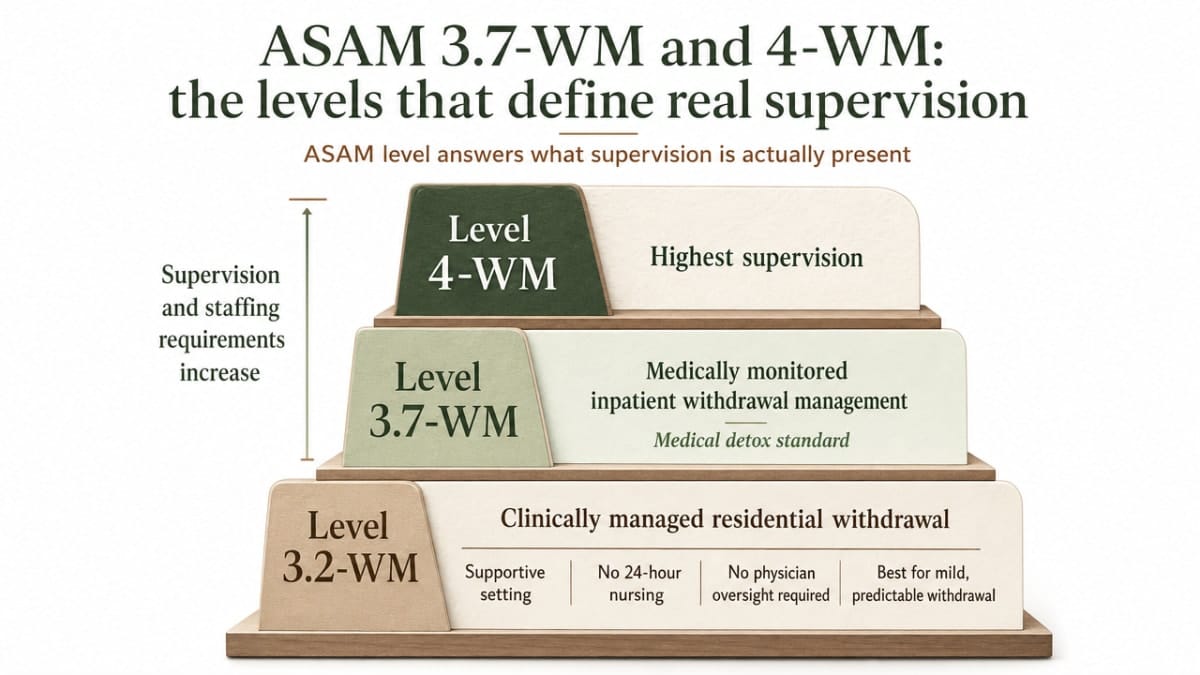
“Medically supervised” isn’t marketing language. It maps to specific levels of care defined by the American Society of Addiction Medicine (ASAM), and those levels have staffing rules attached to them. If a facility says it offers medical detox, you can ask which ASAM level it operates at. That answer tells you almost everything.
At the lower end sits Level 3.2-WM, clinically managed residential withdrawal. It’s a supportive setting with trained staff, but it does not require 24-hour nursing or physician oversight. It works for people whose withdrawal is expected to be mild and predictable. It is not built for someone coming off high-dose fentanyl or mixing opioids with benzodiazepines.
Level 3.7-WM, medically monitored inpatient withdrawal management, is the standard most people picture when they hear “medical detox.” It requires 24-hour nursing care and physician visits, and it’s designed for patients with severe withdrawal who are “unlikely to complete withdrawal management without medical monitoring” 19. Nurses handle vitals, medications, and complications in real time. A physician is available and involved, not just on paper. State regulations codifying this level spell out prompt access to medical evaluations and delivery of services under physician monitoring in residential settings licensed to handle controlled substances 22.
Level 4-WM, medically managed intensive inpatient withdrawal, is the most intensive setting: 24-hour nursing plus daily physician visits, typically for patients with medical instability or serious co-occurring conditions 19. It looks more like a hospital unit than a residential facility.
The distinction matters because withdrawal management isn’t a mood or a philosophy. As the ASAM technical guidance puts it, the liver detoxifies; clinicians manage withdrawal 20. What separates a supervised bed from a lower-acuity bed is who is standing next to you when the symptoms peak, how quickly they can act, and what medications they are authorized to give. When you call a facility, ask what level of care they operate. If the answer is 3.7-WM with medication-assisted treatment protocols, you’re talking to the kind of place this article is describing.
Why 24-hour nursing changes what withdrawal looks like
Opioid withdrawal follows a rough arc, but the details don’t. Two people using the same amount of fentanyl for the same length of time can look very different at hour twelve. One is uncomfortable but stable. The other has a resting heart rate of 130, hasn’t kept water down in eight hours, and is edging toward the kind of dehydration that lands people in an ER.
That variability is why 24-hour nursing matters. When a nurse is checking your vitals every few hours, they catch the shift before it becomes a crisis. Blood pressure climbing? Add a medication. Vomiting won’t stop? Start IV fluids and an antiemetic. Anxiety and muscle pain making sleep impossible? Adjust comfort meds. The clinical framework for acute withdrawal treats these as expected events to be managed, not surprises to be endured 14.
There’s also the piece nobody prepares you for: the psychological weight. Around hour eighteen to thirty-six, most people using opioids hit a wall where the certainty that this will never end feels absolute. That’s when people leave against medical advice and use again. A nurse who has walked hundreds of patients through that same wall knows what it is, tells you what it is, and gives you something to help you through it. That’s not a hotel amenity. That’s the reason supervised detox exists.
The Oklahoma City context: what the local overdose data actually shows
You don’t need a graph to know Oklahoma has an opioid problem. You’ve probably lost someone. But the numbers matter here because they explain why the calculus of quitting has changed, and why the plan that almost worked in 2015 can kill you in 2024.
In 2024, Oklahoma recorded 1,137 drug overdose deaths, 4,228 nonfatal inpatient hospitalizations for overdose, and 6,804 nonfatal emergency department visits for overdose 26. More than eleven thousand times last year, someone in this state went to a hospital because a drug event was serious enough to require acute care and they lived. That is the shape of the crisis around you. It is not just the funerals. It is the near misses.
The reason the near misses have multiplied is fentanyl. Between 2020 and 2023, fentanyl overdose deaths in Oklahoma jumped roughly six-fold, from 127 to 730 23. In 2024, fentanyl was involved in 86% of opioid-related overdose deaths in the state 23. When almost nine out of ten opioid deaths involve a substance that is measured in micrograms, the old script for quitting on your own falls apart. You don’t know exactly what your tolerance is. You don’t know what’s in the last bag. Any pause and restart, including a failed home taper, is a relapse-with-fentanyl risk, not a fresh start.
This is the part where the shame voice gets loud. You have tried before. You have relapsed before. You have watched friends do the same. That pattern is not proof that you can’t stop. It is proof that fentanyl-era withdrawal is a medical event, and that trying to muscle through it at home in Oklahoma City in 2024 is a different problem than it was five years ago. The state’s safety-net system and its detox providers exist because those numbers are what they are 5. Getting into a monitored bed doesn’t mean you’ve failed at willpower. It means you’ve read the room.
The first 24 hours in medically supervised opioid detox
The unknown is part of what makes the first call so hard. You can picture the withdrawal because you’ve been through pieces of it. You can’t picture the room, the people, the paperwork, or what actually happens when the door closes behind you. Here’s what the arc looks like when it’s done right.
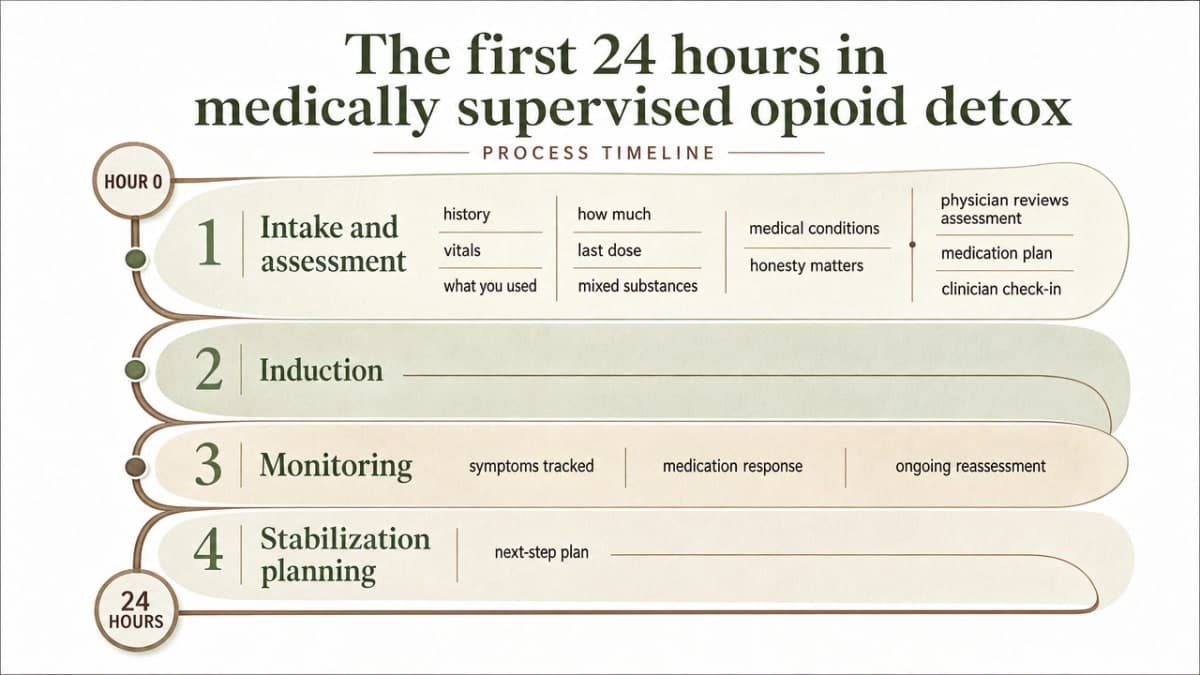
Hour 0: Intake and assessment. A nurse takes your history and your vitals. You’re asked what you used, how much, when the last dose was, whether you’ve been mixing anything with the opioids, and whether you have any medical conditions the team needs to know about. Honesty here matters more than pride. If you used two hours ago instead of twelve, say two. If there’s fentanyl and Xanax and alcohol in the picture, say all three. A physician or physician’s designee reviews the assessment and sets your medication plan. This is also when a clinician scores your withdrawal using COWS, the Clinical Opiate Withdrawal Scale, which tracks things like pulse, sweating, pupil size, tremor, and gooseflesh to gauge where you are on the arc.
Hours 2 to 6: Induction and comfort meds. Once you’re in moderate withdrawal by COWS, the team can start buprenorphine induction if that’s the plan. Comfort medications come alongside: something for nausea, something for muscle aches and bone pain, something for the crawling anxiety, something to help you sleep. You are not expected to be brave. The clinical framework for acute withdrawal treats symptom control as the standard of care, not a favor 14.
Hours 6 to 24: Vitals cadence and sleep monitoring. Nurses check on you regularly through the night. Blood pressure, heart rate, temperature, hydration. If anything drifts, they adjust. If you can’t keep water down, they start IV fluids. If your anxiety spikes at 3 a.a.m., someone is awake and available. At Renewal Springs, wearable biotech from Huml Health adds a continuous layer to the manual checks, tracking vitals, sleep quality, and stress signals in real time so shifts in your body register before they become emergencies.
Day 2 and forward: Stabilization and MAT planning. Once the acute peak passes, the conversation turns toward what holds the ground you just gained. That’s when the team starts talking with you about medication-assisted treatment, aftercare, and what stepping down from a monitored bed looks like. You’re not asked to make a five-year plan on day two. You’re asked what the next step is, and you’re helped to make it.
Twenty-four hours from now, you will still be uncomfortable. But you will be safe, hydrated, medicated, and no longer alone with it. That is the whole point of the setting.
Why quitting opioids at home rarely works — and what the evidence says
You’ve probably tried. Maybe more than once. A weekend cleared. A friend to sit with you. A bottle of Imodium, some gas station Gatorade, a plan to sleep through the worst of it. Then hour twenty rolls in and the plan falls apart.
That’s not a story about your willpower. It’s a story about what happens when opioid dependence meets an unmonitored bedroom.
The research on home-based detox is thinner than most people assume. A recent systematic review of the literature on home detoxification for alcohol or drug dependence found only 11 publications meeting inclusion criteria, and the authors could not reach a firm conclusion about whether home detox is as effective as other settings 15. Outcomes looked acceptable in some carefully selected cases — usually mild alcohol withdrawal in stable patients with a sober support person present — but the evidence base for home opioid detox in particular is limited and does not carry the weight of a standard of care 15.
There are practical reasons for that gap. Home detox doesn’t have a nurse checking your pulse at 3 a.m. It doesn’t have IV fluids when you can’t keep water down. It doesn’t have buprenorphine on hand for the moment your COWS score hits moderate. What it usually has is a person alone with the exact cue — the phone, the number, the memory of relief — that made quitting hard in the first place. When the wall hits, the drug is easier to reach than a hospital.
The clinical framework for acute withdrawal treats symptom control, hydration, and monitoring as core to the setting, not extras 14. Strip those out and you haven’t chosen a gentler path. You’ve chosen a harder one with fewer tools. If you have tried this at home and it didn’t hold, that is data, not a verdict on you.
Where detox connects: MAT, insurance, and what comes after stabilization
Buprenorphine, methadone, naltrexone: the medications that hold the gains
Detox gets you through the acute peak. It does not, by itself, undo the neurological changes that made opioids feel necessary in the first place. That’s why the conversation on day two turns to medication for opioid use disorder — MOUD — and why the medically supervised setting is often the right place to start it.
Three medications carry most of the weight.
- Buprenorphine
- A partial opioid agonist. It occupies the same receptors fentanyl or heroin were hitting, quiets the craving, and blocks the euphoria if you use on top of it. It’s frequently started during detox itself, once you’re in moderate withdrawal by COWS.
- Methadone
- A full agonist dispensed through licensed opioid treatment programs, and it’s the option many people do best on when tolerance has been very high or buprenorphine hasn’t held.
- Naltrexone
- Usually the long-acting injectable form, blocks opioid effects entirely; it’s started only after you’re fully clear of opioids, which is one of the reasons a supervised bed makes the timing possible.
Oklahoma’s MOUD services — office-based buprenorphine, methadone through OTP clinics, and injectable naltrexone — are available statewide under state opioid treatment authority oversight 6. A supervised detox that’s paying attention will not discharge you with a handshake and a phone number. It will start the medication conversation while you’re still inpatient and set the first appointment before you walk out the door.
How coverage works in Oklahoma: Medicaid, commercial insurance, verification
The money question is usually the second thing families ask, right after “is a bed open.” Here’s the short version of how it actually works in Oklahoma.
If you’re on SoonerCare (Oklahoma Medicaid), detox and residential substance use disorder services are covered benefits, along with medication-assisted treatment and outpatient care. Prior authorization is required, which sounds like a wall but in practice means the facility submits clinical documentation showing the level of care is medically necessary 8. That paperwork happens on their end while you’re being assessed. You are not the person chasing it down at 4 a.m.
If you have commercial insurance through a job or a spouse’s plan, most major carriers cover medically supervised detox at Renewal Springs, and the facility runs a free benefits verification before admission — the call that tells you what your deductible looks like, whether prior authorization is needed, and what a realistic out-of-pocket range is for your specific plan.
What you don’t need to do right now is memorize a formulary or argue with a claims department. You need to make one call, hand over your insurance card details, and let intake tell you what’s covered before you commit to anything. If you don’t have insurance at all, ask about that on the same call. Oklahoma’s safety-net system exists for a reason 5, and a good intake team knows how to route you.
Choosing a detox facility in the OKC metro without getting oversold
Search results for detox in Oklahoma City will bury you in stock photos of lakes, mountains, and hands clasped in soft light. None of that tells you whether the place is safe. Here are the questions that actually do.
What ASAM level of care do you operate? A supervised opioid detox should be 3.7-WM or 4-WM. If the person on the phone can’t answer that or reroutes you into a pitch, keep dialing. The level of care determines who is in the building at 3 a.m. 19.
Are you ODMHSAS-certified? Certification is required for alcohol and drug treatment programs in Oklahoma before they can provide services 7. This is not a bonus credential. It is the baseline. A facility that dodges the question is telling you something.
Who is on staff overnight? You want to hear a specific answer: registered nurses on shift around the clock, a physician available and involved, protocols in place for buprenorphine induction and comfort medications. Vague answers about “caring staff” are not answers.
What happens on day four? Detox that ends with a taxi voucher and a printed list of phone numbers is not really detox. Ask how they connect you to medication for opioid use disorder — buprenorphine, methadone through an OTP, or naltrexone — before you’re discharged 6. The good ones set the first appointment while you’re still in the bed.
Will you verify my insurance before I commit? Detox and residential SUD services are covered benefits under SoonerCare with prior authorization 8, and most commercial plans cover medically supervised detox. Renewal Springs runs a free benefits check before admission. If a facility pressures you toward a payment plan without running your coverage first, that’s a red flag.
You are not shopping for a resort. You are hiring a medical team to keep you safe through the hardest 72 hours of the year. Ask the boring questions. The right facility will answer them plainly.
How to start today: the phone call, the intake, the ride there
The distance between reading this and being safe is one phone call. Not a form. Not an intake portal. A call, where a person picks up and starts asking the questions that route you to a bed.
Here’s what that call actually sounds like at Renewal Springs. Someone answers. You tell them what you’ve been using and roughly how much. They ask when your last dose was, whether you have insurance, and whether you’re in withdrawal right now or trying to get in before it starts. If you have your insurance card, they run a free benefits verification while you’re on the line — SoonerCare, commercial plan, or self-pay 8. If you don’t have your card, they work with what you can tell them. You are not being screened out. You are being sorted toward the right level of care.
The ride there does not have to be complicated. A family member, a friend, a rideshare, EMBARK if that’s what you have. If you’re too sick to travel safely on your own and no one can drive you, say that on the call. Intake teams have handled it before.
Bring an ID and your insurance card if you have them, a phone charger, comfortable clothes, and any prescription medications in their original bottles. That’s it. Everything else can wait.
Talk With a Medical Detox Specialist Now
Connect directly for support, answers, or to begin safe, supervised detox in Oklahoma City.
Frequently Asked Questions
Is medically supervised detox safer than quitting opioids at home?
For opioid dependence, yes — and the evidence for home-based detox is thinner than most people expect. A systematic review of home detoxification found only 11 qualifying studies and could not reach a firm conclusion about effectiveness compared with other settings 15. Supervised detox gives you 24-hour nursing, physician oversight, and medications for the moment symptoms peak 19. If you’ve tried at home and it didn’t hold, that’s data about the setting, not you.
How long does opioid detox take in a medically supervised setting?
Most people spend roughly five to seven days in medically supervised opioid detox, though your clinical team sets the exact length based on your substance, dose, and how your body responds. Acute withdrawal usually peaks in the first 48 to 72 hours 14. From there, the focus shifts to stabilization and setting up medication for opioid use disorder — buprenorphine, methadone through an OTP, or naltrexone — before discharge 6.
Will insurance or Oklahoma Medicaid (SoonerCare) cover detox in Oklahoma City?
SoonerCare covers detox and residential substance use disorder services as behavioral health benefits, though prior authorization is required and the facility handles that paperwork 8. Most major commercial plans also cover medically supervised detox. Renewal Springs runs a free benefits verification before admission — one call gives you your deductible, prior-auth status, and realistic out-of-pocket range. If you’re uninsured, ask on the same call about safety-net routing 5.
What medications are used during medically supervised opioid withdrawal?
Buprenorphine is the workhorse — a partial opioid agonist started once you’re in moderate withdrawal by COWS score, which quiets cravings and blocks euphoria 6. Comfort medications run alongside it: something for nausea, muscle pain, anxiety, and sleep 14. Some patients transition to methadone through a licensed opioid treatment program or to long-acting injectable naltrexone once fully clear of opioids 6. Your clinical team matches the medication to your history and tolerance.
What happens in the first few hours after I arrive for detox?
A nurse takes your vitals and history, asking what you used, how much, and when the last dose was. A physician or designee reviews the assessment and sets your medication plan. A clinician scores your withdrawal using COWS — pulse, sweating, pupil size, tremor, gooseflesh. Once you reach moderate withdrawal, induction begins along with comfort medications 14. From there, nurses monitor vitals through the night and adjust as your symptoms shift.
What should I bring, and can someone drive me to the facility?
Bring an ID, your insurance card if you have one, a phone charger, comfortable clothes, and any prescription medications in their original bottles. That’s it. A family member, friend, or rideshare can drive you; EMBARK works too if that’s what you have. If you’re too sick to travel safely alone and no one can drive you, say that on the intake call — the team has handled it before. If you’re in crisis, dial 988 or 1-800-662-HELP 16.
References
- Oklahoma Funding Priorities. https://www.cdc.gov/injury/budget-funding/oklahoma.html
- Changes in Drug Overdose Mortality and Selected Drug Type by State: United States, 2022 to 2023. https://www.cdc.gov/nchs/data/hestat/drug-overdose/drug-overdose-2022-2023.htm
- DOSE-DIS Dashboard: Nonfatal Overdose Emergency Department and Inpatient Hospitalization Discharge Data. https://www.cdc.gov/overdose-prevention/data-research/facts-stats/dose-dashboard-nonfatal-discharge-data.html
- SUDORS Dashboard: Fatal Drug Overdose Data. https://www.cdc.gov/overdose-prevention/data-research/facts-stats/sudors-dashboard-fatal-overdose-data.html
- Agency Overview – Oklahoma.gov. https://oklahoma.gov/odmhsas/about/agency-overview.html
- Medications for Opioid Use Disorder – Oklahoma.gov. https://oklahoma.gov/odmhsas/treatment/adult-family-treatment-services/moud.html
- Provider Certification – Oklahoma.gov. https://oklahoma.gov/odmhsas/policy/provider-certification.html
- Mental Health and Substance Abuse Services – Oklahoma.gov. https://oklahoma.gov/ohca/individuals/programs/mental-health-and-substance-abuse-services.html
- MAPS 4 | City of OKC. https://www.okc.gov/Infrastructure-Development/Current-Infrastructure-Projects/MAPS-4
- Timeline | City of OKC. https://www.okc.gov/Infrastructure-Development/Current-Infrastructure-Projects/MAPS-4/Timeline
- City Council adopts MAPS 4 EMBARK Bus Rapid Transit route. https://www.okc.gov/News-articles/City-Council-adopts-MAPS-4-EMBARK-Bus-Rapid-Transit-route
- Public Transportation and Parking | City of OKC. https://www.okc.gov/Community-Recreation/Public-Transportation-and-Parking
- MAPS 4 Bus Rapid Transit Corridor Project Profile | FTA. https://www.transit.dot.gov/funding/grants/grant-programs/capital-investments/maps-4-bus-rapid-transit-corridor-project-profile
- Management of Acute Withdrawal and Detoxification for Adults with Substance Use Disorders. https://www.ncbi.nlm.nih.gov/books/NBK545066/
- Home‐based detoxification for individuals with alcohol or drug dependence: A systematic review of the recent literature. https://pmc.ncbi.nlm.nih.gov/articles/PMC11814356/
- National Helpline for Mental Health, Drug, Alcohol Issues. https://www.samhsa.gov/find-help/helplines/national-helpline
- Drug Overdose Deaths, 2019–2023 – Oklahoma Injury Prevention Service Fact Sheet. https://oklahoma.gov/content/dam/ok/en/health/health2/aem-documents/prevention-and-preparedness/injury-prevention/drug-overdose/2025%20State%20Drug%20OD%20-%20IPS%20-%20Fact%20Sheet.pdf
- Oklahoma.gov. https://oklahoma.gov/content/dam/ok/en/health/health2/aem-documents/prevention-and-preparedness/injury-prevention/drug-overdose/DrugOverdoseStateFactSheet1023.pdf
- Overview of Substance Use Disorder (SUD) Care Clinical Guidelines: A Resource Guide. https://www.medicaid.gov/state-resource-center/innovation-accelerator-program/iap-downloads/reducing-substance-use-disorders/asam-resource-guide.pdf
- ASAM Monthly Technical Assistance Series: Withdrawal Management. https://www.pa.gov/content/dam/copapwp-pagov/en/ddap/documents/professionals/documents/asam-page/asam-update/9.12.2022%20asam%20monthly%20ta%20wm.pdf
- Guidance for Implementing ASAM Criteria, 3rd Edition, for Withdrawal Management. https://mn.gov/dhs/assets/WDM%20Guidance_9.8.2025_tcm1053-706303.pdf
- 2 CCR 502-1-5.11 – Medically Monitored Inpatient Withdrawal Management. https://www.law.cornell.edu/regulations/colorado/2-CCR-502-1-5.11
- Drug Overdose Data – Oklahoma State Department of Health. https://oklahoma.gov/health/health-education/injury-prevention-service/drug-overdose/data.html
- Drug Overdose Data Dashboard – Oklahoma State Department of Health. https://oklahoma.gov/health/health-education/injury-prevention-service/drug-overdose/data/drug-overdose-data-dashboard.html
- 2021 Oklahoma Opioid Overdose Fatality Review Board Chairman’s Report. https://oklahoma.gov/content/dam/ok/en/oag/resources/meetings/opioid-overdose-fatality-review-board/annual-reports/2021_oklahoma_opioid_overdose_fatality_review_board_charimans_report_final.pdf
- Drug Overdose Data Graphs and Maps – Oklahoma Injury Prevention Service. https://oklahoma.gov/content/dam/ok/en/health/health2/aem-documents/prevention-and-preparedness/injury-prevention/drug-overdose/Drug%20Overdose%20Data%20Graphs%20and%20Maps.pdf