
Key Takeaways
- Medication-assisted treatment in Oklahoma City combines methadone, buprenorphine, or naltrexone with counseling, and is endorsed by the CDC, SAMHSA, and ASAM as the standard of care for opioid use disorder 3, 23, 8.
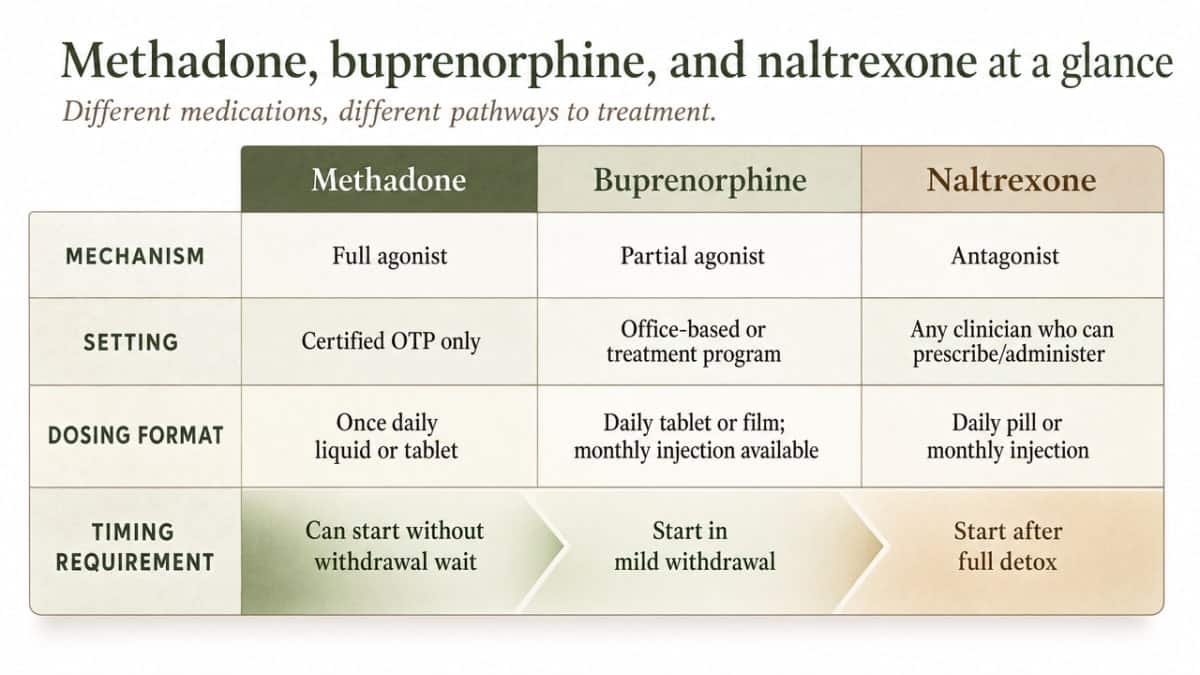
- The three medications aren’t interchangeable—methadone requires a certified OTP with daily dosing, buprenorphine works office-based or through an OTP, and naltrexone needs 7–14 opioid-free days before starting 8.
- Fentanyl has made self-directed starts riskier, since precipitated withdrawal and the naltrexone gap are harder to time without medical supervision tracking vital signs and withdrawal thresholds 8.
- Before choosing a setting, compare SoonerCare coverage, commercial parity protections under SB1718, and self-pay options, and weigh whether office-based or supervised detox initiation fits your current stability 10, 13.
The question you’re actually holding at 2 a.m.
You didn’t come here for a definition. You came here because something happened, or almost happened, or keeps almost happening. Maybe the last dose was hours ago and your skin is starting to crawl. Maybe you’re a parent scrolling on your phone in the hallway while someone you love sleeps in the next room. Maybe you’ve done this before, and the word relapse is sitting in your chest like a stone.
The question underneath the search bar isn’t really what is medication-assisted treatment. It’s closer to: Is there a way through this that doesn’t feel like white-knuckling it alone? Is there something that actually works? And if I ask for help, will the help make sense?
Those are fair questions. They deserve straight answers.
Here’s what you can hold onto while you read: MAT is not a shortcut, and it’s not a moral compromise. It’s the current standard of care for opioid use disorder, endorsed by the CDC, SAMHSA, and the American Society of Addiction Medicine 3, 23, 8. In Oklahoma, it’s covered by SoonerCare and, under state parity law, by most commercial insurance plans 9, 13. And starting it under medical supervision, especially in the fentanyl era, is different than trying to start it on your own or in a rushed office visit.
This piece will walk through what MAT actually is, the three medications you’ll hear named, the honest trade-offs between them, what coverage looks like in Oklahoma City, and where a medically supervised detox stay fits in the picture. You don’t have to decide anything tonight. Reading this is a step. It counts.
What Oklahoma’s overdose numbers mean for someone deciding right now
You don’t need a lecture on the opioid crisis. You’re living inside it, or watching someone you love live inside it. But there’s one set of numbers worth sitting with for a minute, because they tell you something honest about the ground underneath your feet in Oklahoma right now.
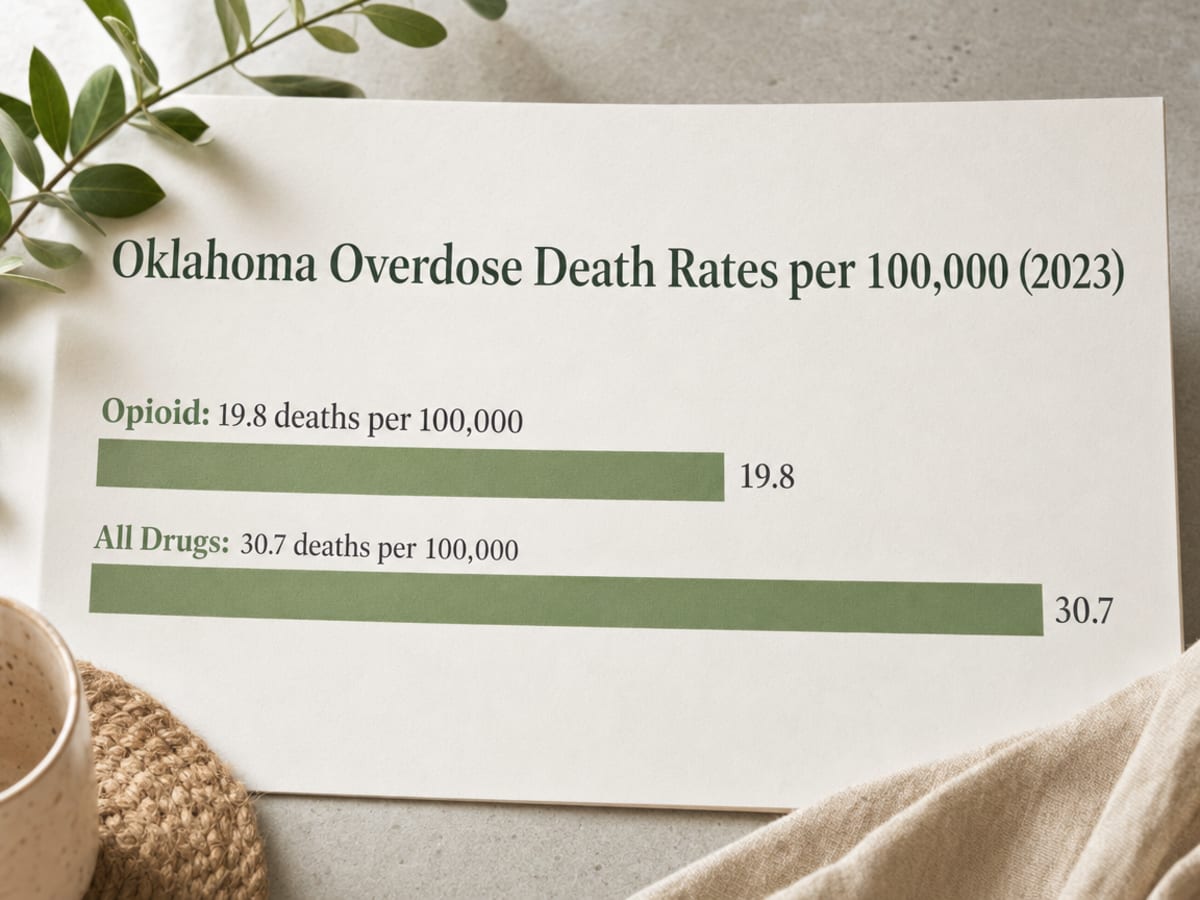
In 2023, Oklahoma’s age-adjusted opioid overdose death rate was 19.8 per 100,000 people. The all-drug overdose rate was 30.7 per 100,000 1. That gap between the two numbers matters. It says opioids are driving most of the loss, but not all of it—stimulants, benzodiazepines, and mixed-substance overdoses fill in the rest. If you use more than one thing, or if what you thought was one thing turned out to be laced with another, you’re not an outlier. You’re the pattern.
Here’s a local number that puts the state figure at eye level: ODMHSAS reported 839 opioid overdose reversals in the Oklahoma City metro in 2023 alone 21. Eight hundred and thirty-nine times, someone got a second chance in this city. Some of those people are still here because a stranger had Narcan in a glove box. Some of them are reading something like this right now.
What the numbers don’t tell you is which side of them you’ll be on. What they do tell you is that fentanyl has changed the arithmetic of “I’ll try to taper on my own this weekend.” The drug supply isn’t what it was five years ago, and neither is the risk of a single relapse. That’s not meant to scare you. It’s meant to say the decision you’re weighing tonight is worth taking seriously enough to make it under medical supervision, not alone in a bathroom.
‘Trading one drug for another’—the worry that deserves a real answer
You may have heard it from a family member, a sponsor, a coworker, or a voice in your own head: MAT is just trading one drug for another. That worry deserves a real answer, not a dismissal.
Here’s the honest version. Methadone and buprenorphine both act on the same opioid receptors that heroin, fentanyl, and prescription painkillers do. That much is true. What’s different is what happens next. At a steady, prescribed dose, these medications quiet the withdrawal, quiet the craving, and don’t produce the rolling highs and crashes that define active use. Your brain gets a floor to stand on instead of a cliff to fall off. SAMHSA describes this as a“whole-patient approach”—medication plus counseling and behavioral support, aimed at recovery rather than intoxication23.
The evidence isn’t subtle. The CDC concludes that MAT with methadone, buprenorphine, or naltrexone is associated with fewer deaths, less opioid use, and better day-to-day functioning 3. NIDA puts it plainly: these are FDA-approved medications that help people stop or reduce opioid use 4. In its 2016 guideline, the CDC found that methadone and buprenorphine maintenance therapy prevent relapse more effectively than detoxification alone 7.
Naltrexone sits in a different category entirely. It’s not an opioid at all—it blocks the receptors rather than activating them 4. If the concern is “another opioid,” naltrexone answers that concern directly. It’s also harder to start, which we’ll get to.
None of this makes the worry silly. It just means the answer is bigger than the worry. Taking a medication that lets you sleep through the night, hold a job, stay alive, and show up for the people who love you is not a compromise. It’s medicine doing what medicine does.
The three medications, and why the choice isn’t interchangeable
Methadone, buprenorphine, and naltrexone at a glance
Three FDA-approved medications treat opioid use disorder, and they don’t do the same job in the same way 4. The differences matter because they shape where you get the medication, how you take it, and when in your recovery you can start.
- Methadone
- A full opioid agonist. It occupies the same receptors that heroin, fentanyl, and painkillers do, but at a steady, long-acting dose that doesn’t produce a high. You take it once a day, usually as a liquid or tablet, and by federal rule it can only be dispensed through a certified opioid treatment program (OTP)—the licensed clinics you may have heard called “methadone clinics” 10, 17. In the early weeks, that means showing up daily. Take-homes are earned over time.
- Buprenorphine
- A partial agonist. It activates the same receptors but with a built-in ceiling, so higher doses don’t produce proportionally stronger effects 4. It comes as a daily film or tablet that dissolves under the tongue (often combined with naloxone as Suboxone), or as a monthly injection. Unlike methadone, buprenorphine can be prescribed in an office-based setting or through an OTP, which usually means fewer daily visits once you’re stable.
- Naltrexone
- Different from both. It’s an opioid antagonist—it blocks the receptors instead of activating them, so it produces no opioid effect at all 4. The extended-release version (Vivitrol) is a monthly injection; there’s also a daily tablet. Because it blocks receptors, it can only be started after you’re fully through withdrawal, typically 7 to 14 days opioid-free 8. That waiting period is the catch.
None of these is a lesser or greater choice. Which one fits you depends on how much opioid is in your system now, how stable your housing and schedule are, whether daily clinic visits are workable, and what your medical team sees when they evaluate you.
Timing traps: precipitated withdrawal, the naltrexone gap, and fentanyl
Here’s where the fentanyl era has changed the rules, and where trying to figure this out on your own gets dangerous.
Buprenorphine can trigger something called precipitated withdrawal if you take it too soon after your last dose of a full opioid. Because buprenorphine binds tightly to the receptors but only partially activates them, it can shove a stronger opioid off those receptors and throw you into sudden, severe withdrawal—worse than what you were already feeling. With heroin or short-acting pills, the timing window was more predictable. With fentanyl, which lingers in body tissue longer than people expect, the old rules of thumb don’t always hold. This is one of the main reasons medical supervision matters when starting buprenorphine now.
Naltrexone has the opposite timing problem. Because it blocks receptors entirely, starting it while any opioid is still active in your system will pull you straight into withdrawal. ASAM’s guideline is clear that 7 to 14 days should elapse between stopping opioids and starting naltrexone 8. For someone dependent on fentanyl, getting through those days without relapse is exactly what a supervised detox setting is built to do. Trying to bridge that gap alone is where a lot of good intentions collapse.
The takeaway isn’t that MAT is complicated. It’s that the sequencing—when you stop, when you start, which medication first—is a clinical decision that benefits from someone watching your vital signs and adjusting in real time.
Why starting MAT during supervised detox is different from starting it in an office
MAT gets started in two very different settings, and the difference isn’t a technicality. It shapes how safe the first 72 hours feel and how likely you are to still be in treatment two weeks later.
In an office-based visit, you show up, get evaluated, get a prescription, and go home. That works for a lot of people. But it depends on you being able to time your last dose correctly, ride out enough withdrawal to avoid precipitated withdrawal when the buprenorphine starts, sleep in your own bed with the same triggers around you, and drive yourself back for follow-up. In the fentanyl era, that first step is the one that trips a lot of people. Fentanyl hangs on in body tissue longer than short-acting opioids, and the point where it’s safe to start buprenorphine is harder to pin down without someone monitoring you 8.
In a supervised detox setting, the sequencing isn’t your job. Licensed medical staff track your vital signs around the clock, use non-opioid medications to soften the worst of the withdrawal, and time the first buprenorphine dose based on what they’re seeing in your body, not on what you’re guessing from the clock. If naltrexone ends up being the right choice, the 7-to-14-day opioid-free window ASAM calls for happens inside a place where relapse isn’t one text message away 8. SAMHSA describes MAT as a whole-patient approach that combines medication with counseling and behavioral support 23. During a supervised stay, that combination starts on day one instead of getting scheduled for later.
None of this makes office-based MAT wrong. It’s a good fit for many people, especially those who are past the acute withdrawal phase. But if you’re still using, or you’ve tried to start on your own and gotten thrown back into withdrawal, the supervised setting exists because that first stretch is the hardest part to do alone.
Detox alone doesn’t hold. Here’s what the evidence actually says.
There’s a version of recovery that a lot of people try first, sometimes more than once. You get clean. You white-knuckle the withdrawal, maybe in a detox bed, maybe on a friend’s couch, maybe in a hospital after something scary. Then you go home. Nothing in your body is asking for the drug anymore, at least not the way it was. And within days, or weeks, you’re back where you started, or worse.
That isn’t a character flaw. It’s what the research predicts.
The CDC’s 2016 clinical guideline reached a straightforward conclusion on this point: methadone and buprenorphine maintenance therapy increase retention in treatment and decrease illicit opioid use more effectively than detoxification alone 7. NIDA’s policy brief on effective treatments says the same thing in different words—medications keep people in care and out of active use in a way that a clean break, by itself, does not 6. ASAM’s guideline reinforces it and adds the safety piece: after detox alone, tolerance drops fast, and a return to a previous dose is exactly the arithmetic that produces fatal overdoses 8.
This is why the question worth asking isn’t can I get through withdrawal. It’s what’s holding me the week after. Detox is the doorway. MAT is what’s on the other side of it.
Coverage in Oklahoma: SoonerCare, commercial parity, and self-pay
One of the quiet reasons people put off asking for help is a fear that the answer will end at the front desk: we don’t take your insurance. In Oklahoma, that fear is mostly out of date. Here’s how the three coverage lanes actually work.
SoonerCare (Oklahoma Medicaid). If you’re on SoonerCare, all three FDA-approved MAT medications are covered. The state’s plan amendment is explicit: SoonerCare covers naltrexone, buprenorphine, and methadone, and all approved forms of these drugs used for MAT 10. Methadone is dispensed through certified opioid treatment programs, which is a federal requirement, not an Oklahoma quirk 10. Buprenorphine and naltrexone can be provided through OTPs or office-based settings. Oklahoma was actually the first Medicaid agency in the country to get federal approval to cover all FDA-approved MAT prescriptions across both OTP and office-based delivery, effective October 1, 2020 9. The catch worth naming: some MAT drugs and OTP services require prior authorization, which can add a step but shouldn’t stop you 11.
Commercial insurance under Oklahoma parity. If you have private coverage through work or the marketplace, state law is on your side. Oklahoma passed SB1718 in 2020, which requires carriers to offer mental health and substance use disorder coverage in parity with medical care 13. The Oklahoma Insurance Department puts it directly: health insurance companies must cover benefits for mental health and substance use disorders on equal terms with coverage for other physical diseases 12. That parity extends to SoonerCare and CHIP as well 14. In plain terms: your plan cannot slap tighter limits on MAT or detox than it does on treatment for diabetes or a heart condition. If a denial says otherwise, that denial is worth appealing.
Self-pay and private options. Some people are between jobs, between plans, or don’t want a claim on file. Self-pay is a real lane, and most detox facilities in Oklahoma City will walk you through what a stay actually costs before you commit. Ask for a benefits verification either way—it’s usually free and takes a phone call. Knowing what your plan covers is not the same as knowing what you’ll owe out of pocket, and the two conversations happen best before admission, not after.
What the first days actually look like
If you’ve never been through a supervised detox, the unknown is part of what makes it hard to say yes to. So here’s a plain sketch of what the first stretch tends to involve—not a promise about your specific case, but enough shape to make the decision less abstract.
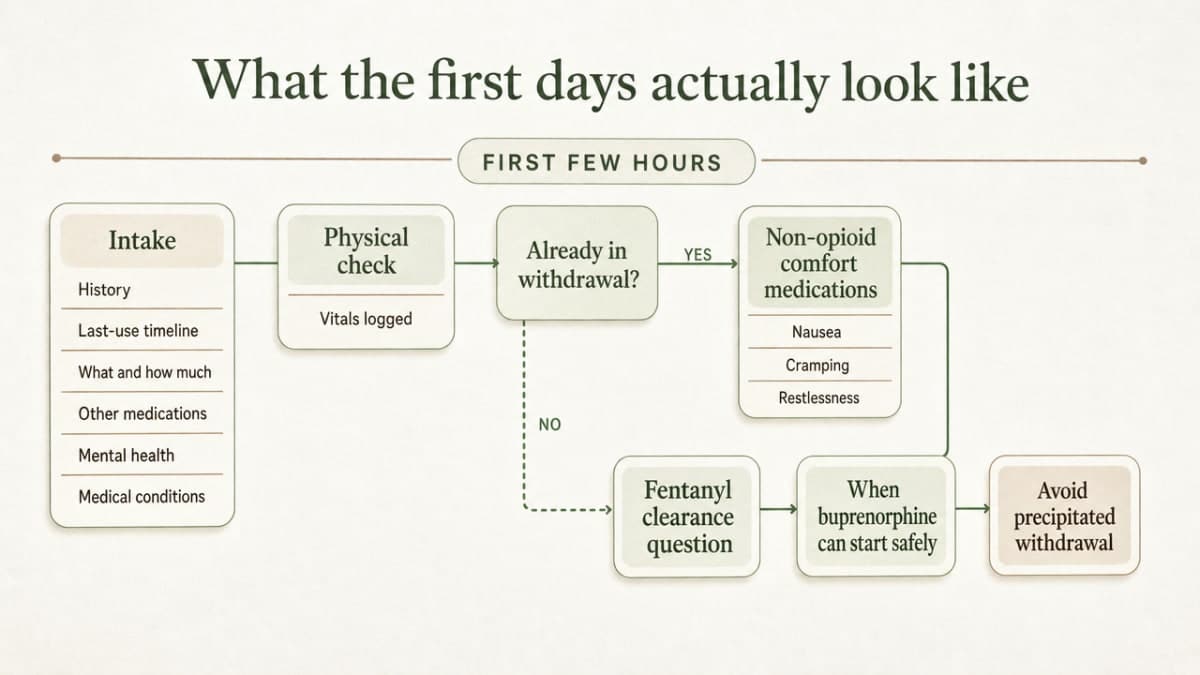
The first few hours are mostly intake. Someone takes your history, your last-use timeline, what you’ve been using and how much, other medications, mental health, medical conditions. You’ll be checked physically. Vital signs get logged. If you’re already in withdrawal, non-opioid comfort medications can start almost immediately to take the edge off nausea, cramping, and the crawling restlessness. This is also when the team figures out where you are on the fentanyl clearance question, which shapes when buprenorphine can be started safely without triggering precipitated withdrawal 8.
Days one and two are usually the roughest physically. Sleep is broken. You may feel worse before you feel steadier. Staff check on you around the clock, adjust medications as symptoms shift, and keep you hydrated. If the plan is buprenorphine, initiation typically happens once withdrawal has reached a defined threshold—clinical judgment, not a stopwatch. If methadone is the plan, dosing starts low and adjusts based on response. If naltrexone is the goal, the opioid-free window has to be completed first, which is exactly why the supervised setting exists 8.
By days three to five, most people are sleeping longer stretches, eating again, and starting to think past the next hour. Counseling and behavioral support fold in during this window—SAMHSA’s whole-patient framing put into practice 23. This is when conversations about what comes after detox get real.
Where Renewal Springs fits—and where it doesn’t
Renewal Springs is a medical detox facility in Oklahoma City. That’s the honest scope of what we do. Around-the-clock monitoring by licensed medical staff, MAT protocols started under supervision when they fit your clinical picture, wearable biotech from Huml Health tracking your vital signs and sleep in real time, and specialized tracks for veterans, men, women, and people who want a more private setting. Most major insurance is accepted, and benefits verification is free.
Here’s what we’re not. We’re not a methadone maintenance clinic—those are certified OTPs, and methadone dispensing lives there 17. We’re not a long-term residential program. We’re not the last stop. Detox is the doorway the CDC and NIDA describe 7, 6, and MAT started here is meant to hand off cleanly to what comes next: outpatient buprenorphine, a monthly naltrexone injection, residential care, or an OTP for methadone.
If you’re not sure whether MAT fits your situation, that’s the conversation to have. Ask. It’s a phone call, not a commitment.
Talk To a Medical Detox Specialist Now
Get immediate answers about medication-assisted treatment and next steps for your situation today.
Frequently Asked Questions
Is medication-assisted treatment just replacing one drug with another?
No. At a steady, prescribed dose, methadone and buprenorphine quiet withdrawal and cravings without producing the highs and crashes of active use, and naltrexone isn’t an opioid at all—it blocks the receptors 4. SAMHSA describes MAT as a whole-patient approach combining medication with counseling 23, and the CDC finds it reduces death and opioid use 3.
Does SoonerCare cover MAT in Oklahoma City?
Yes. SoonerCare covers naltrexone, buprenorphine, and methadone and all approved forms of these drugs for MAT 10. Oklahoma was the first Medicaid agency in the country to secure federal approval for MAT coverage across both opioid treatment programs and office-based settings, effective October 2020 9. Some drugs and OTP services require prior authorization, which adds a step but shouldn’t stop you 11.
Which medication is right for me—methadone, buprenorphine, or naltrexone?
That’s a clinical decision, not a preference you have to figure out alone. It depends on what you’ve been using, how much is in your system, your medical history, and your daily life. Methadone is OTP-only with daily dosing, buprenorphine can be office-based or OTP, and naltrexone requires 7–14 days opioid-free before starting 8. A medical evaluation matches the medication to your situation 4.
Do I have to finish detox before I can start MAT?
Not for methadone or buprenorphine—both are often started during supervised detox, once withdrawal reaches a clinical threshold that avoids precipitated withdrawal 8. Naltrexone is different: it requires a full 7–14 day opioid-free window before the first dose 8. That gap is exactly what a supervised setting is built to hold, since starting naltrexone too early pulls you straight back into withdrawal.
Will my commercial insurance cover MAT the same way it covers other medical care?
It should. Oklahoma law requires health insurance companies to cover mental health and substance use benefits on equal terms with other physical conditions 12. SB1718, passed in 2020, requires carriers to offer parity coverage for fully insured individual and group plans 13. If your plan puts tighter limits on MAT than on other medical care, that denial is worth appealing.
What if I’ve tried detox before and relapsed?
That’s not a failure of will—it’s what the research predicts when detox happens without medication to hold the other side. The CDC concluded that methadone and buprenorphine maintenance therapy prevent relapse more effectively than detoxification alone 7, and NIDA reports the same 6. If a previous attempt didn’t include MAT, the setup wasn’t the same one you’d be considering now. That matters.
References
- Changes in Drug Overdose Mortality and Selected Characteristics, 2022–2023. https://www.cdc.gov/nchs/data/hestat/drug-overdose/drug-overdose-2022-2023.htm
- Understanding the Opioid Overdose Epidemic. https://www.cdc.gov/overdose-prevention/about/understanding-the-opioid-overdose-epidemic.html
- Medication-Assisted Treatment for Opioid Use Disorder. https://www.cdc.gov/overdose-resources/files/medication-assisted-treatment-for-opioid-use-disorder.html
- Medications for Opioid Use Disorder. https://nida.nih.gov/research-topics/medications-opioid-use-disorder
- Medications to Treat Opioid Use Disorder. https://nida.nih.gov/sites/default/files/21349-medications-to-treat-opioid-use-disorder.pdf
- Effective Treatments for Opioid Addiction. https://irp.nida.nih.gov/wp-content/uploads/2019/12/NIDA_Policybrief-effectivetreatments_2016.pdf
- CDC Guideline for Prescribing Opioids for Chronic Pain — United States, 2016. https://www.cdc.gov/mmwr/volumes/65/rr/rr6501e1.htm
- American Society of Addiction Medicine (ASAM) National Practice Guideline for the Use of Medications in the Treatment of Addiction Involving Opioid Use. https://pmc.ncbi.nlm.nih.gov/articles/PMC4605275/
- Oklahoma Health Care Authority to Increase Coverage for Opioid Treatment Programs. https://oklahoma.gov/ohca/about/newsroom/2021/march/ohca-to-increase-coverage-for-opioid-treatment-programs.html
- Oklahoma State Plan Amendment (SPA) 25-0017 – Medicaid. https://www.medicaid.gov/medicaid/spa/downloads/OK-25-0017.pdf
- Mental Health and Substance Abuse Services – Oklahoma.gov. https://oklahoma.gov/ohca/individuals/programs/mental-health-and-substance-abuse-services.html
- LH BULLETIN NO. 2020-05. https://www.oid.ok.gov/lh-bulletin-no-2020-05/
- Understanding Mental Health Parity and Your Insurance Coverage. https://www.oid.ok.gov/getready12_2023/
- Mental/Behavioral Health and Insurance. https://www.oid.ok.gov/mental-behavioral-health-and-insurance/
- Drug Overdose Data Dashboard – Oklahoma. https://oklahoma.gov/health/health-education/injury-prevention-service/drug-overdose/data/drug-overdose-data-dashboard.html
- Oklahoma State Plan Amendment (SPA) 20-0036. https://www.medicaid.gov/Medicaid/spa/downloads/OK-20-0036.pdf
- 317:30-5-241.7. Medication-assisted treatment (MAT) services for eligible individuals with opioid use disorder (OUD). https://oklahoma.gov/ohca/policies-and-rules/xpolicy/medical-providers-fee-for-service/individual-providers-and-specialties/outpatient-behavioral-health-services/medication-assisted-treatment-services-for-eligible-individuals-with-opioid-use-disorder.html
- TIP 63: Medications for Opioid Use Disorder. https://library.samhsa.gov/product/tip-63-medications-opioid-use-disorder/pep21-02-01-002
- State Medicaid Director Letter #20-005: Medication-Assisted Treatment (MAT). https://www.medicaid.gov/federal-policy-guidance/downloads/sho20005.pdf
- Medication Assisted Treatment for Opioid Use Disorder (Federal Bureau of Prisons Clinical Guidance). https://www.bop.gov/resources/pdfs/opioid_use_disorder_cg.pdf
- National Overdose Awareness Day: Over 80,000 Narcan Kits have been distributed by ODMHSAS in 2023. https://oklahoma.gov/odmhsas/about/public-information/press-releases-and-other-news/2023/national-overdose-awareness-day–over-80-000-narcan-kits-have-be.html
- Drug Overdose Deaths, 2019-2023 – Oklahoma Injury Prevention Service Fact Sheet. https://oklahoma.gov/content/dam/ok/en/health/health2/aem-documents/prevention-and-preparedness/injury-prevention/drug-overdose/2025%20State%20Drug%20OD%20-%20IPS%20-%20Fact%20Sheet.pdf
- Medication-Assisted Treatment (MAT) – SAMHSA. https://www.samhsa.gov/medication-assisted-treatment