
Key Takeaways
- The meth crash has predictable symptoms and a clear ending, with peak withdrawal hitting around days 2 to 3 and easing by the end of week one 1.
- Acute withdrawal moves through distinct phases: a brutal first 72 hours, a flat gray middle around days 4 to 7, and protracted symptoms that can linger up to five weeks 11.
- Supervised detox becomes necessary when suicidal thoughts, hallucinations, cardiac symptoms, seizure history, mixed substance use, pregnancy, or an unsafe home environment are in play.
- Inside a detox center, a low-stimulation environment paired with hydration and rest is itself the clinical intervention, since noise and chaos worsen a raw nervous system 5.
- No medication cures a meth crash, but clinicians can treat agitation with benzodiazepines, support sleep, and manage dangerous vital sign changes as they arise 3, 9.
- Suicidal thoughts during the crash are expected, and good staff should respond immediately with direct questions, removal of means, and constant presence rather than dismissal.
- Contingency management is the strongest evidence-based next step after detox and should be arranged as a warm handoff before discharge, not left to chance 4, 7.
- In Oklahoma, verify ODMHSAS certification and national accreditation, ask specific questions about staffing and aftercare, and pack only essentials before making the call 12, 13.
What the Crash Actually Feels Like Right Now
If you’re reading this while the walls feel too bright and your body feels like it belongs to someone else, you are not broken. You are in a meth crash, and what you’re feeling has a name, a shape, and an ending. That last part matters. This will end.
Right now your brain is running on empty. The dopamine your system flooded itself with over the last hours or days is gone, and what’s left is the opposite of a high: heavy fatigue, a mood that feels flattened into concrete, hunger that came out of nowhere, sleep that either won’t come or won’t quit. Some people feel a scraped-raw anxiety. Some people feel nothing at all, which is somehow worse. Cravings will come in waves. So might thoughts about not wanting to be here anymore. If that last one is happening, tell someone out loud, or call or text 988. Do not sit alone with it.
The clinical shorthand for what you’re feeling is stimulant withdrawal, and the symptoms your body is producing right now — depression, anxiety, fatigue, intense craving, trouble sleeping, trouble concentrating — are the ones every major research review lists first 1, 9. You are not making this up. You are not weaker than other people. Your nervous system is doing a predictable thing.
The rest of this guide walks you through what happens next, what a meth detox center actually does during these days, and how to decide whether you need one.
The Meth Crash, Hour by Hour and Day by Day
Days 1 to 3: When Your Body Shutters
The first 72 hours are the hardest, and they are also the shortest part of what’s ahead. Knowing that helps.
In the first few hours after your last use, your body starts pulling back everything it borrowed. Sleep comes in heavy, uneven waves — sometimes 12 or 14 hours of it, sometimes 30 minutes at a stretch punctuated by racing thoughts. Hunger returns with a vengeance after days of forgetting food existed. Your muscles ache in a dull, whole-body way. Your mood drops through the floor.
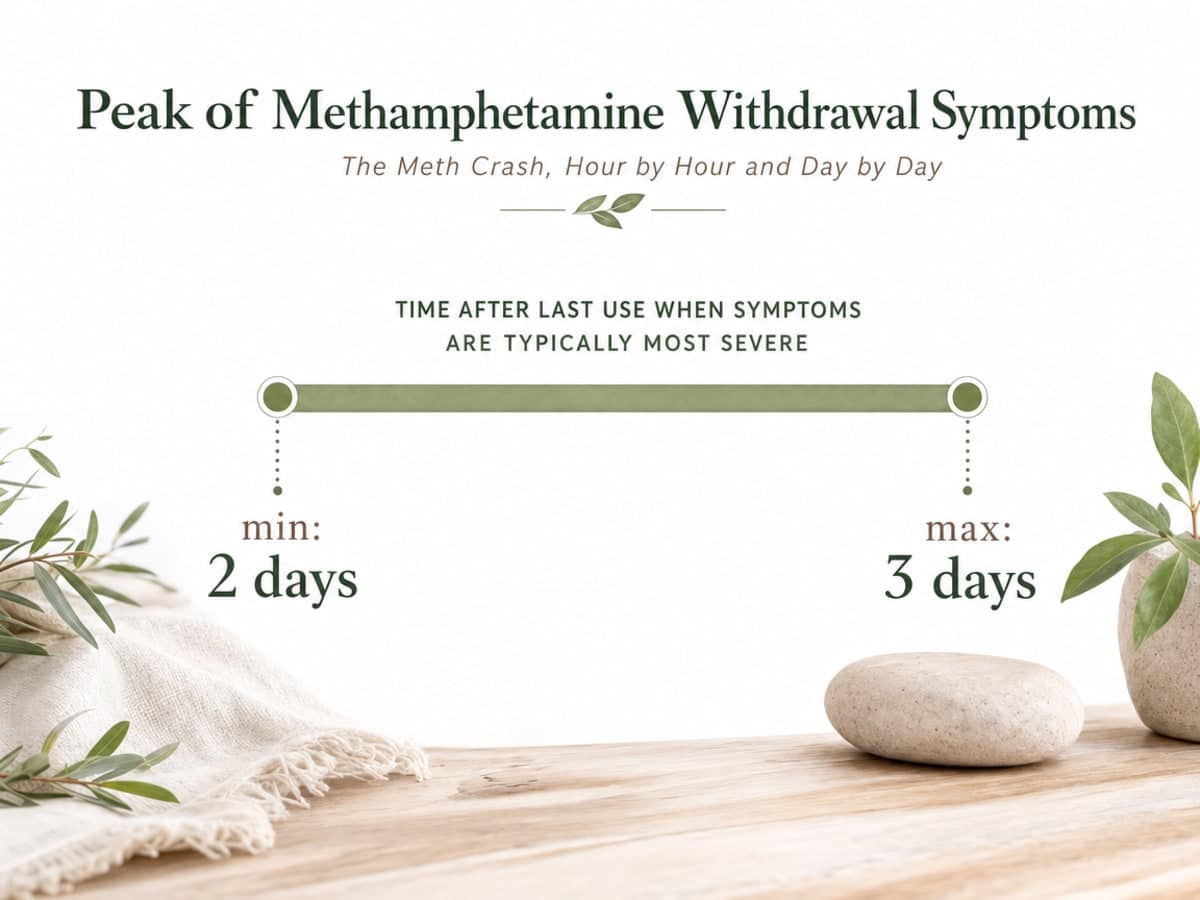
By day 2 or day 3, the acute withdrawal is at its worst. NIDA describes this window plainly: methamphetamine withdrawal symptoms peak 2 to 3 days after last use and last about a week 1. That peak is not a metaphor. Depression thickens. Anxiety sharpens. Cravings arrive in loud, physical waves that feel like they will never end. They do end. Each wave, on average, lasts minutes, not hours, even when it doesn’t feel that way from inside it.
Some people also feel a somnolent heaviness — a pull toward sleep that competes with agitation — along with irritability and a hollow, dysphoric mood 11. If suicidal thoughts show up here, that is a known feature of the crash, not a sign of weakness. Tell someone. Call or text 988. This is the part where you are not supposed to be alone.
Days 4 to 7: The Flat, Gray Middle
Something shifts around day 4. It doesn’t feel like relief yet. It feels like fog.
The sharpest edges of the crash start to soften, but what replaces them is a strange, colorless flatness. You might sleep more normally, or at least in longer stretches. Appetite returns in an uneven way — a full meal one hour, no interest in food the next. The physical exhaustion is still there, deeper than tired, the kind of tired that a nap doesn’t touch.
Emotionally, this is the stretch where people get ambushed. The acute symptoms are easing, so a small voice starts whispering that maybe you don’t need help after all, maybe you can handle this on your own, maybe just this once wouldn’t hurt. That voice is the withdrawal talking, not you. Cravings often stay strong through the end of the first week even when the other symptoms fade 1, 9.
Depression and anhedonia — the flat inability to feel pleasure — can dominate these days. Concentration is still shot. Small tasks feel large. This is a normal part of the timeline. If you slept four hours in a row, ate one real meal, and drank enough water today, that is a genuine win. Say it out loud to yourself or to someone else. Those small things are how the middle of the week gets crossed.
Week 2 Through Week 5: Protracted Withdrawal and Why It Sneaks Up
Here is the part most people don’t get warned about: the acute crash ends, and something quieter takes its place. Protracted withdrawal can stretch out for up to five weeks after your last use 11. It is not as loud as the first week. It is trickier.
In this stretch, the mood problems can linger — a low-grade depression, blunted feelings, sleep that still isn’t quite right, cravings that show up unannounced when you drive past a familiar street or hear a certain song. Fatigue can hang on. Concentration comes back in pieces. Some days you feel almost normal, then a random Tuesday afternoon flattens you again.
There isn’t a lab test or a numeric score that tells you where you are in this phase. Meth withdrawal doesn’t have an objective severity scale the way alcohol or opioid withdrawal does 11, which is part of why people underestimate it. You feel better than you did on day 3, so you assume you’re done. Then week 3 hits with a craving that feels like week 1 all over again, and you wonder if something is wrong with you.
Nothing is wrong with you. Your brain is still rebuilding its dopamine baseline. That takes weeks, not days. This is exactly why what happens after detox — the ongoing treatment, the structure, the human support — matters as much as the first week.
When Home Isn’t Safe Enough: Signs You Need Supervised Detox
Not everyone who comes off meth needs a hospital bed. But some situations turn a home crash into something dangerous, and it helps to know which ones.
Consider a detox center if any of these are true right now: you’ve been having thoughts of hurting yourself or ending your life, you’re seeing or hearing things other people aren’t, your heart is racing or your chest hurts, you can’t stop shaking, you have a history of seizures, or you’re using meth alongside alcohol, benzodiazepines, or opioids. Mixed use is a big one. If opioids might be in the picture, someone in the house should have naloxone on hand — but know that naloxone does not reverse a stimulant overdose on its own 2. It only helps if opioids are also involved.
Other signs it’s time to make the call: you live alone and don’t have someone who can sit with you through the worst 72 hours, you’re pregnant, you have a serious medical condition like heart disease or uncontrolled diabetes, or you’ve been using heavily for weeks or months without a real break. Supervised detox gives you monitored vital signs, someone trained watching for the psychiatric shifts that can happen fast, and medications available for agitation, sleep, or safety if a clinician decides you need them 3. You don’t have to be at rock bottom to deserve that. You just have to be in the crash.
What Happens Inside a Meth Detox Center
The Room, the Rest, the Quiet: Why the Environment Matters
The first thing a good detox center takes away is noise. Not just sound — all of it. The overhead fluorescents get swapped for softer lighting. The TV in the hallway stays off. Your phone gets set aside for a while, not as punishment but as protection from the group chat, the ex, the dealer, the argument you were in the middle of when everything fell apart.
This isn’t decor. The ASAM/AAAP clinical practice guideline is explicit that supportive treatment for stimulant withdrawal should not be delayed and that clinicians should provide a low-stimulation environment along with adequate hydration 5. Your nervous system is raw right now. Every buzz, flicker, and raised voice lands harder than it would on a normal day. Reducing that input isn’t coddling you — it’s clinical care.
What you’ll actually notice: a quiet room, a bed that’s yours, water and electrolyte drinks within reach, meals that show up whether you feel like eating or not, and staff who check on you without a lot of small talk. Sleep will come in strange shapes for the first few days. That’s fine. The point of the room isn’t to make you sleep perfectly. The point is to let your body do the heavy work of resetting without having to also brace against the world.
The Medication Question: What Detox Can and Cannot Give You
Here is the honest answer nobody wants to give you: there is no pill that stops a meth crash. NIDA states plainly that no medication currently counteracts methamphetamine’s specific effects or reliably prolongs abstinence 9, and a broad peer-reviewed review of psychostimulant withdrawal confirms there are no FDA-approved pharmacological treatments for people recently abstinent from amphetamines 6. If a facility promises otherwise, that’s a red flag.
What a good detox center can do is treat what’s happening in front of them. If you’re agitated to the point of danger, a clinician can give a benzodiazepine to bring you down — CDC’s stimulant guide names benzodiazepines as first-line for acute stimulant crises administered by a health professional 3. If you can’t sleep for three nights running, there are sleep supports. If you’re dehydrated, that gets fixed. If your blood pressure or heart rate spikes into a dangerous range, that gets managed.
Some clinicians also explore off-label options during protracted withdrawal — mirtazapine for mood and sleep, bupropion, naltrexone, or rTMS have shown signals in research but not clean, replicated results 6. None of these is a cure. They’re tools a doctor might reach for based on your specific picture.
The takeaway isn’t discouraging. It’s clarifying. Detox for meth isn’t about finding the right molecule to end the crash. It’s about being somewhere safe while your brain does the work, with people who can respond fast if something goes wrong. That’s what you’re paying for. That’s what actually helps.
Suicidal Thoughts During the Crash: How Staff Should Respond
Suicidal thoughts during a meth crash are common enough that any detox center worth its certification treats them as an expected part of the work, not a surprise. If you have them, you are not the exception. You are inside the most predictable part of this timeline.
What good staff should do when you tell them:
- listen without flinching,
- ask direct questions about a plan and access to means,
- remove anything you could use to hurt yourself,
- and stay with you or check on you at short intervals.
You should not have to prove you’re in crisis. Saying the words should be enough to change what happens in the next hour.
If a staff member brushes off suicidal thoughts, delays a response, or tells you to sleep it off, that is not adequate care. Ask for the charge nurse or the medical director. If you’re supporting someone in the crash and staff won’t escalate, call 988 or take them to an emergency room. The window when the crash is deepest is also the window when these thoughts get loudest. Tell someone every time. Not just the first time.
After Detox: Why Contingency Management Is the Real Turning Point
Detox is the door. It is not the room. If you walk out of a detox center on day 7 and go home to the same phone, the same couch, the same Friday night, the crash you just survived is going to feel like it was for nothing. This is the part where a lot of people relapse, and it is not because they didn’t want it enough.
Here is what the strongest evidence actually says works next. A 2024 Cochrane review pooled the research on psychosocial treatments for stimulant use disorder and found that, compared with no intervention, these treatments reduce dropout and likely increase abstinence — and contingency management was the most studied and most effective approach 7, 8. The ASAM/AAAP clinical practice guideline names contingency management the current standard of care for stimulant use disorder 4. CDC’s stimulant surveillance work echoes the same point: contingency management is the most effective treatment, and it is underused 10.
Contingency management is simpler than the name makes it sound. You provide a clean urine sample, you get a small tangible reward — a gift card, a voucher, sometimes cash equivalent. Provide another one, the reward grows. Miss one, it resets. Your brain, which has spent months or years learning that meth equals reward, starts learning that not using also equals reward. That sounds too basic to matter. It isn’t. It is the intervention with the cleanest data behind it.
Some centers pair contingency management with cognitive behavioral therapy, the Matrix Model, or peer support. Ask any detox center you’re considering what happens on day 8. If the answer is vague, or if it’s just “we’ll refer you somewhere,” push harder. A warm handoff — where someone from detox actually places you into a specific outpatient program with a specific start date before you leave the building — is what closes the gap between surviving the crash and staying out of it.
Choosing a Meth Detox Center in Oklahoma
The Certification Checklist That Separates Real Care from Marketing
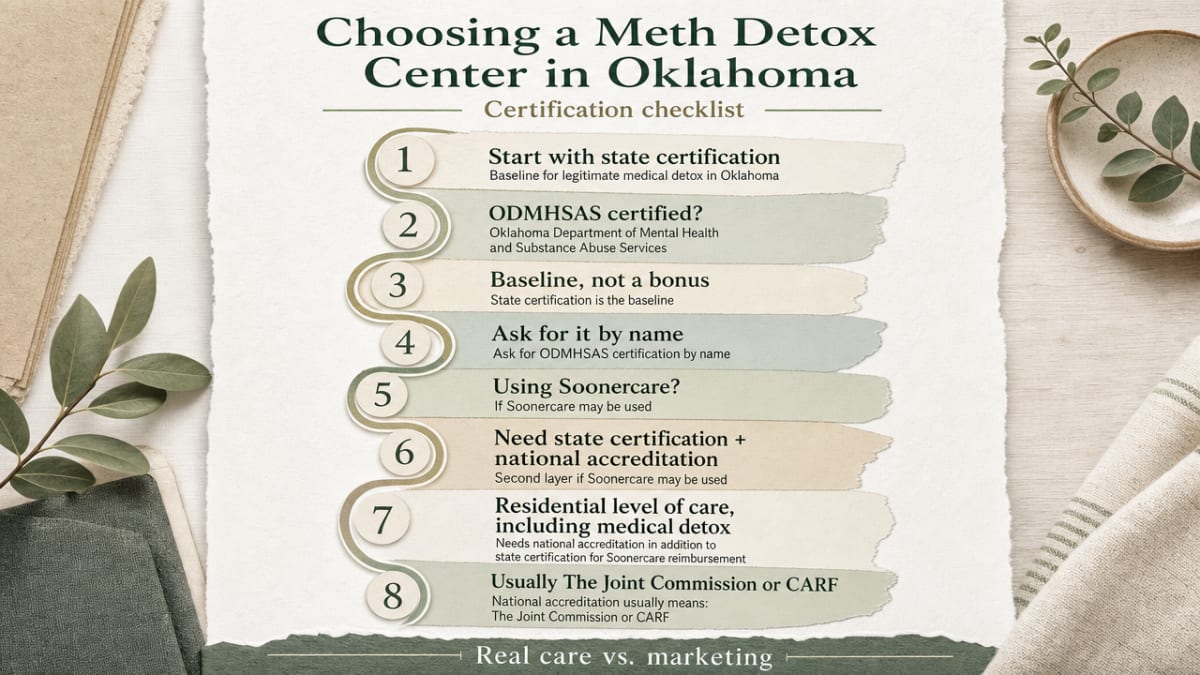
A polished website is not a credential. Anywhere in Oklahoma, the actual floor for a legitimate medical detox is state certification through the Oklahoma Department of Mental Health and Substance Abuse Services. Substance-related and addictive disorder treatment facilities are required to be certified by ODMHSAS under the state’s administrative rules for these services 13. That certification is a baseline, not a bonus. Ask for it by name.
The second layer matters just as much if you or your family may use Soonercare. Oklahoma requires residential level-of-care providers, including medical detox, to carry national accreditation in addition to state certification to be eligible for Soonercare reimbursement 12. National accreditation usually means The Joint Commission or CARF. If a facility is vague about which one they hold, that’s information.
From there, a short list of things a real meth detox should be able to answer without hesitation:
- 24/7 licensed medical staff on-site, not on-call from home
- A written suicide risk protocol, since suicidal thoughts during the crash are common enough to plan for 1
- A low-stimulation environment and supportive care available from admission, not delayed 5
- Access to a clinician who can order benzodiazepines or other symptomatic care if acute agitation escalates 3
- A named plan for what happens on day 8, not a vague promise to “connect you with resources”
If any of those come back as a shrug, keep dialing. This is your life. You get to be picky.
Questions to Ask on the Phone Before You Pack a Bag
You don’t have to sound clinical. You just have to ask, and listen for how they answer.
Try these, in whatever order feels natural:
- “Are you certified by ODMHSAS, and are you nationally accredited?” A real facility will answer in one sentence.
- “Is a doctor or nurse on-site 24 hours a day?” On-call is not the same as on-site during a crash.
- “How do you handle it if I have suicidal thoughts while I’m there?” Listen for a specific protocol, not reassurance.
- “Do you take my insurance, or Soonercare, or offer help figuring out coverage?” Cost should not be a mystery.
- “What happens on day 7 or day 8 when I’m ready to leave? Do you place me into a specific outpatient program before discharge?” A warm handoff is the difference between finishing detox and staying out of the crash.
- “Do you offer or refer to contingency management or cognitive behavioral therapy after detox?”
You can also ask how quickly they can take you today. If you’re in the middle of a crash right now, waiting three days for an intake appointment is not the answer. A good intake line hears the urgency and moves.
How to Make the Call Today
You do not have to feel ready. Ready is a feeling that shows up later, after the phone is already in your hand. Right now, all you need is the next small motion.
Pick up the phone. Dial one Oklahoma detox center from your list and ask if they have a bed today. If the first line is busy or the answer is no, call the next one. If you are the person supporting someone in the crash, you make the call while they sit next to you. That counts. That is help.
Before you dial, put a few things in one spot: your ID, your insurance card if you have one, a phone charger, a change of clothes, and any medications you take. That is enough. You do not need a suitcase. You do not need to clean the kitchen. You do not need to tell anyone you are not ready to tell.
If suicidal thoughts are loud right now, call or text 988 first, then call the detox line. If you think opioids might also be in your system, get to an emergency room — naloxone does not reverse a stimulant overdose on its own 2.
One call. That is the whole task. Renewal Springs Detox and other certified Oklahoma programs answer their intake lines around the clock. You survived the hardest part already, which was deciding this had to change. The rest is a phone number.
Talk to Someone Who Understands Meth Recovery
Get immediate support and answers about safe, medically monitored meth detox whenever you need help.
Frequently Asked Questions
Is there a medication that stops meth withdrawal?
No. There is no FDA-approved medication for methamphetamine withdrawal or methamphetamine use disorder 6. What a detox clinician can do is treat specific symptoms as they show up — a benzodiazepine for dangerous agitation, sleep support for insomnia, IV fluids for dehydration. Those are targeted tools, not a cure for the crash itself.
How long does someone usually stay in a meth detox center?
Most stays run about 5 to 7 days, which lines up with how long acute withdrawal typically lasts 1. Some people leave sooner if symptoms are mild, and some stay longer if depression, sleep, or suicidal thoughts haven’t stabilized. The right length is whatever gets you through the sharpest part safely and into the next level of care.
Can I detox from meth safely at home instead?
Sometimes, if the use has been light, you have someone with you, and no suicidal thoughts, hallucinations, or mixed opioid or alcohol use are in the picture. Home isn’t safe if you’re alone, if you’ve relapsed at this stage before, or if a low-stimulation environment isn’t possible — and ASAM guidance says that environment matters clinically 5. When in doubt, call an intake line and let them help you decide.
What should I do if I’m having suicidal thoughts during the crash?
Tell someone right now. Call or text 988 to reach the Suicide and Crisis Lifeline. If you’re already in a detox center, tell any staff member — nurse, tech, anyone — and ask them to stay with you. If you’re at home and no one is there, go to an emergency room. These thoughts are a known feature of the crash, and they get quieter with sleep, time, and human presence.
Does Soonercare cover meth detox in Oklahoma?
Soonercare can cover medical detox when the facility meets Oklahoma’s requirements. Residential level-of-care providers, including medical detox, must carry national accreditation in addition to state ODMHSAS certification to be eligible for Soonercare reimbursement 12. Ask any center you call whether they are ODMHSAS-certified, nationally accredited, and in-network with Soonercare. Their benefits team should verify coverage for you before you arrive.
What happens after I leave detox?
The strongest evidence points to psychosocial treatment, especially contingency management, which the ASAM/AAAP guideline names the standard of care for stimulant use disorder 4. That usually means outpatient sessions, group therapy, and often a rewards-based program for verified abstinence. A good detox center places you into a specific program with a specific start date before you walk out the door.
References
- Methamphetamine | National Institute on Drug Abuse (NIDA). https://nida.nih.gov/research-topics/methamphetamine
- Stimulants | Overdose Prevention. https://www.cdc.gov/overdose-prevention/about/stimulant-overdose.html
- STIMULANT GUIDE. https://www.cdc.gov/overdose-prevention/media/pdfs/2024/03/CDC-Stimulant-Guide.pdf
- The ASAM/AAAP Clinical Practice Guideline on the Management of Stimulant Use Disorder. https://pubmed.ncbi.nlm.nih.gov/38669101/
- The ASAM/AAAP Clinical Practice Guideline on the Management …. https://stacks.cdc.gov/view/cdc/156927/cdc_156927_DS1.pdf
- Clinical Management of Psychostimulant Withdrawal. https://pmc.ncbi.nlm.nih.gov/articles/PMC10069411/
- Psychosocial interventions for stimulant use disorder. https://pubmed.ncbi.nlm.nih.gov/38357958/
- Psychosocial interventions for stimulant use disorder. https://pmc.ncbi.nlm.nih.gov/articles/PMC10867898/
- Methamphetamine – National Institute on Drug Abuse (NIDA). https://nida.nih.gov/sites/default/files/methrrs.pdf
- Drug Overdose Deaths Involving Stimulants. https://www.cdc.gov/mmwr/volumes/74/wr/mm7432a1.htm
- Methamphetamine dependence in Australia–why is ‘ice’ so hard to quit?. https://pmc.ncbi.nlm.nih.gov/articles/PMC11305059/
- Provider Certification – Oklahoma.gov. https://oklahoma.gov/odmhsas/policy/provider-certification.html
- CHAPTER 18. STANDARDS AND CRITERIA FOR SUBSTANCE …. https://oklahoma.gov/content/dam/ok/en/odmhsas/documents/policy/provider-certification/administrative-rules/2021/Chapter%2018%20Final%20effective%209-15-21.pdf