
Key Takeaways
- Meth withdrawal rarely kills, but the crash brings cardiac strain, severe depression, and cravings that make week one the highest-risk window for relapse without supervision.
- Oklahoma recorded 1,137 drug overdose deaths and over 11,000 nonfatal overdose hospital contacts in 2024, and the state’s licensed detox network and ODMHSAS referral pathways are built to receive people making this call 2, 1.
- No FDA-approved medication treats meth use disorder, so contingency management, CBT, and the Matrix Model — not pills — carry the recovery work after detox 11, 3, 4.
- Call a licensed Oklahoma detox facility for a same-day benefits check, and have insurance, transportation, and a next-step outpatient plan lined up before the crash hits.
Do You Actually Need Medical Detox for Meth?
Here is the honest answer up front: meth withdrawal is unlikely to kill you the way alcohol or benzo withdrawal can. If you are looking for permission to skip detox and tough it out at home, that is the sentence people usually grab.
But that is only half the truth.
The other half is that meth intoxication and the days that follow can put real strain on your heart and your mind. Acute meth use is linked to tachycardia, high blood pressure, hyperthermia, agitation, and in some cases psychosis — the kind of complications that need medical eyes on you, not a friend on the couch 8. If you have been using heavily, using with fentanyl-contaminated supply, or you already have a heart condition or a psychiatric history, the risk profile changes.
Then there is the part nobody talks about enough. The crash. The sleeplessness that flips into 20-hour sleep binges. The depression that lands so hard you cannot remember why you wanted to quit in the first place. Meth withdrawal commonly brings anhedonia, fatigue, sleep disturbance, and depressed mood, and those symptoms can push people back to use within days 9.
That is the real reason medical detox exists for meth. Not because you will seize. Because week one is when most people relapse, and doing it alone in the same apartment where you used is stacking the deck against yourself.
So do you need medical detox? You probably do if any of this fits:
- you have tried to quit before and could not get past day three,
- you have a heart or mental health condition,
- you are using with other substances, or
- you simply do not have a safe, sober place to land for the next ten days.
That is not weakness. That is math.
What the First 72 Hours Really Feel Like
The Crash: Hours 0 to 24
The crash starts when the last dose wears off. Not gradually. It falls on you.
For most people, the first thing you notice is that you cannot keep your eyes open. Your body has been running on borrowed energy, sometimes for days, and now it is calling in the debt. You may sleep for 12, 16, even 20 hours. When you wake up, you sleep again. That part is normal. Your brain is trying to reset the systems meth has been overriding.
Alongside the exhaustion, you may feel hungry in a way that surprises you, or nauseous, or both in the same hour. Your heart rate and blood pressure are still coming down from stimulant levels, and if you have been using heavily, that ride down can bring chest tightness, headaches, or a heavy, drained feeling in your limbs 8. This is the window where medical monitoring matters most, especially if you have any cardiac history.
Emotionally, the first 24 hours are usually flat. Not sad yet. Just empty. The dopamine flood is gone and your brain has not figured out how to make its own again.
If you are going through this at a detox facility, staff will let you sleep, check your vitals often, and start gentle hydration and nutrition. You do not have to perform. You just have to be there.
Peak Acute Withdrawal: Days 2 Through 10
This is the window competitor articles collapse into a vague “five to seven days.” It deserves more honesty than that.
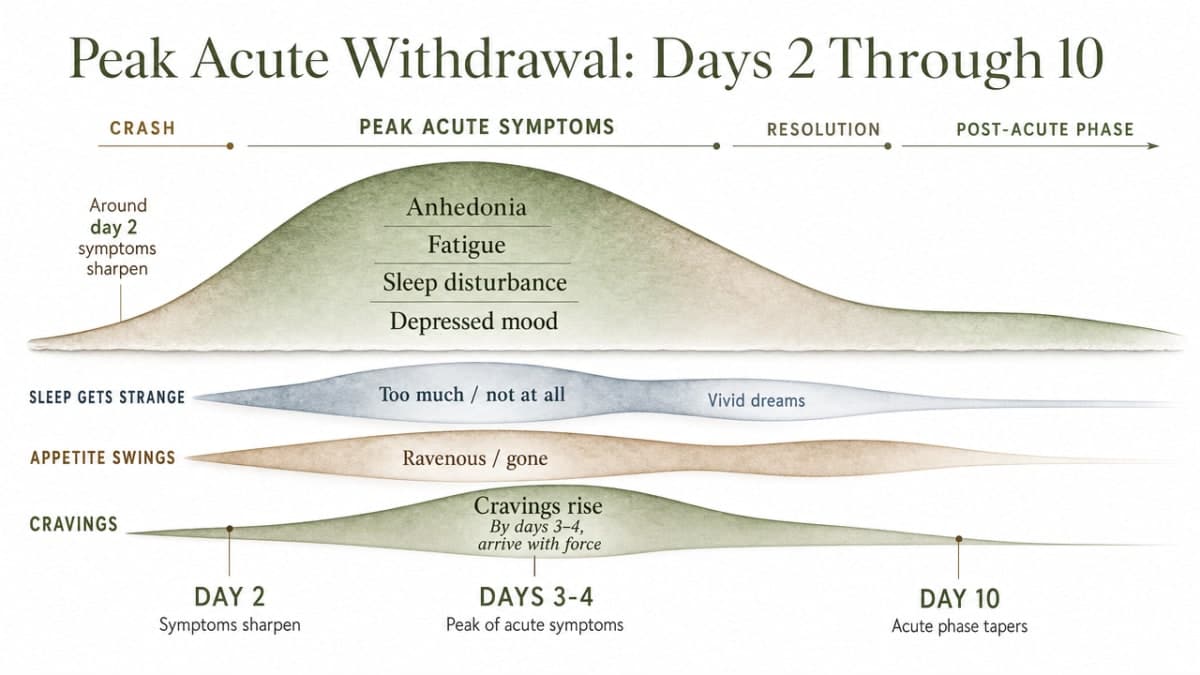
Around day two, the flatness turns into something sharper. Meth withdrawal commonly brings anhedonia, fatigue, sleep disturbance, and depressed mood, and days two through four are typically when those symptoms hit their peak 9. Anhedonia is the clinical word for the fact that nothing feels good. Food tastes like nothing. Music sounds like noise. A hug from someone you love registers as pressure on your skin, not comfort. That is your dopamine system, empty and recalibrating.
Sleep gets strange. You may sleep too much one night and not at all the next. Vivid dreams, sometimes about using, are common. Your appetite swings the same way — ravenous, then gone.
By days three and four, cravings usually arrive with force. Not a passing thought. A physical pull, often triggered by a specific sound, smell, or place. This is the point where people trying to detox alone almost always use again. Not because they are weak. Because the craving landed while they were exhausted, depressed, and unsupervised.
Days five through ten are the slow climb out of the acute phase. Sleep begins to organize itself. You can hold a short conversation without your mind sliding sideways. The depression lifts a little most days, though it can still crash back down in the evenings.
Medically, staff are watching for the things acute intoxication and withdrawal actually cause — lingering blood pressure issues, agitation, and any signs of psychosis or severe depression that need psychiatric attention 8. Sleep support, hydration, nutrition, and something to steady the anxiety are the main tools. There is no magic drug that shortcuts this window (more on that in the next section), but a supervised setting can take the edge off enough that you do not run.
The chart above shows the arc: crash in the first 24 hours, peak acute symptoms on days two through four, gradual resolution by day ten, and post-acute symptoms that stretch into weeks and months 9. Knowing the shape of it helps. When day four feels unbearable, it helps to know day four is supposed to feel unbearable, and that day seven usually does not.
The Weeks After: Post-Acute Symptoms Nobody Warns You About
Here is what most detox brochures leave out. The acute stuff clears in about a week. What comes after can last months.
Anhedonia — that flat, gray feeling where nothing lands right — often continues well past the 10-day mark. Sleep can stay uneven for weeks. Cravings show up in waves, sometimes triggered by something as small as a lighter clicking or a certain song. Mood dips and cognitive fog, especially trouble with focus and short-term memory, are documented in the neuropsychiatric literature as part of the extended withdrawal picture 9. This is not a sign you are failing. It is the timeline.
This is also why detox alone is not the finish line. Two weeks after your last use, your body has cleared the drug and your acute symptoms are mostly gone, but your brain is still rebuilding its ability to feel normal pleasure. If you leave detox with no plan for those next 8 to 12 weeks, the post-acute crash catches you at home, in the same environment, with the same triggers, and often without the sleep you need to think clearly.
The good news buried in this: it does get better. Sleep tends to normalize first, usually within a few weeks. Mood follows. Cognitive sharpness returns more slowly, often over months, and it returns more fully when you are not fighting it alone.
What helps in this stretch is structure. Regular sleep and meal times. Something to look forward to, even something small. And behavioral treatment that keeps you engaged when your brain is still telling you nothing is worth doing — which is the piece we get to next.
What Medical Detox Can and Cannot Do
It helps to be honest about what a detox facility actually delivers, because the meth treatment world has a bad habit of overpromising.
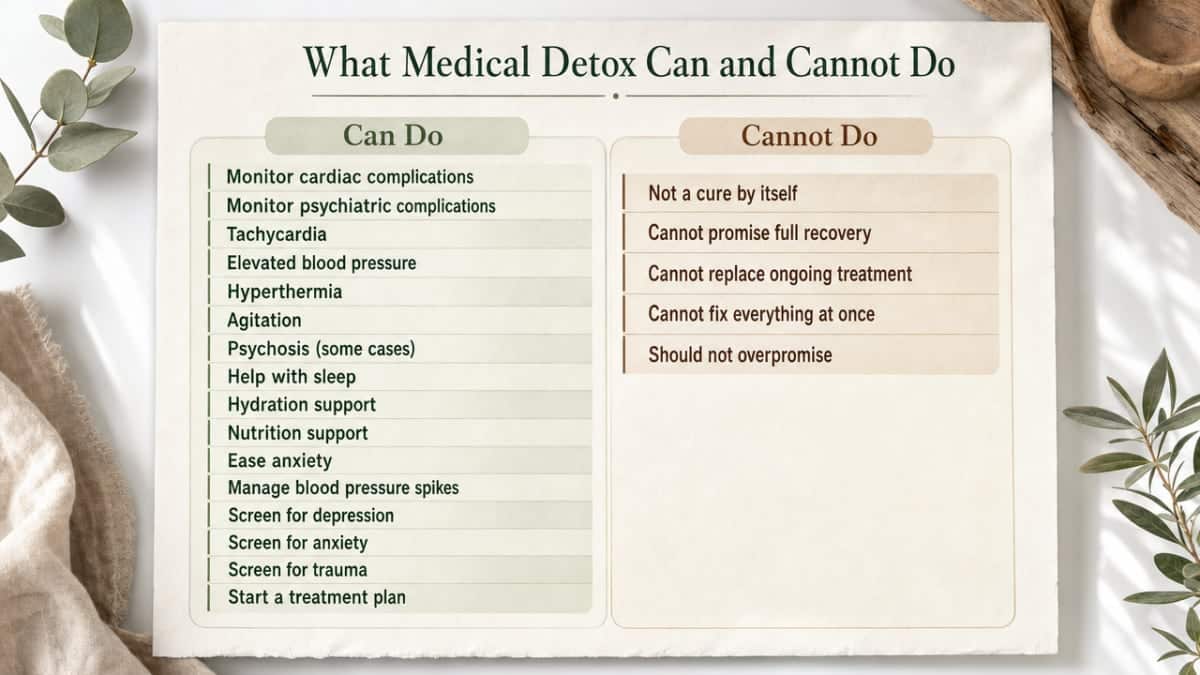
Here is what medical detox can do for you. Staff can monitor the cardiac and psychiatric complications that acute meth use actually causes — the tachycardia, elevated blood pressure, hyperthermia, agitation, and in some cases psychosis that the clinical literature describes as the real medical risks of this drug 8. They can treat symptoms as they come up: something to help you sleep when your body cannot settle, hydration and nutrition support when your appetite is scrambled, and medication to take the edge off anxiety or dangerous blood pressure spikes. They can screen you for the depression, anxiety, and trauma that so often ride alongside meth use, and start a plan for those conditions instead of leaving them for you to figure out at home 12. And they can hold you through the specific week when relapse is most likely, in a place where using is not an option.
Here is what medical detox cannot do, and this is the part most facilities will not tell you plainly.
Detox also cannot fix cravings permanently in five to seven days. It cannot rewire the parts of your brain that meth has been overriding. And it cannot replace the behavioral treatment that the evidence actually supports 3.
What detox can do is get you to day ten alive, medically stable, and connected to the next step. That is the honest offer. It is not small — it is the difference between another failed attempt and a real starting line — but it is not the whole answer either.
Why Oklahoma Is Different
You are not doing this in a vacuum. You are doing it in a state that has been carrying a heavy load for a long time.
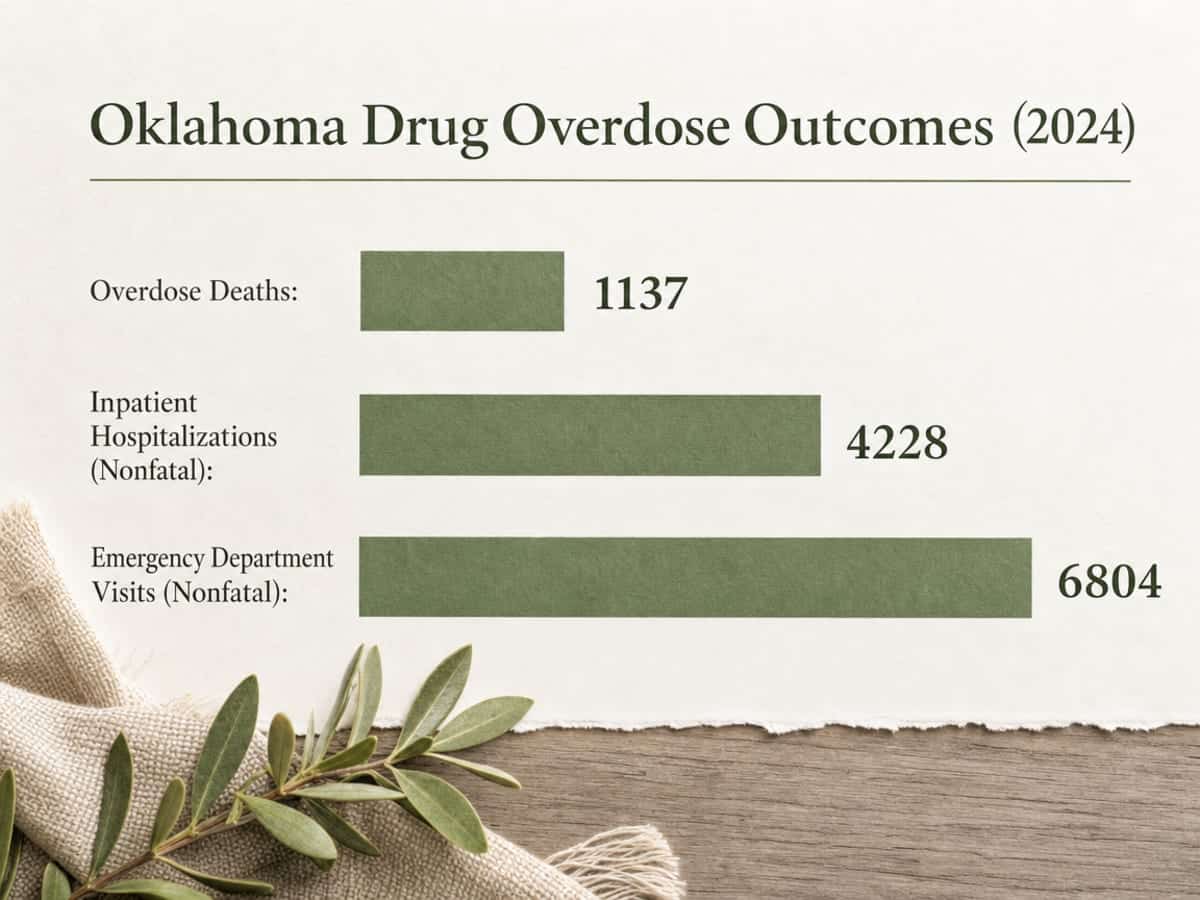
In 2024, Oklahoma recorded 1,137 drug overdose deaths, 4,228 nonfatal inpatient hospitalizations, and 6,804 nonfatal emergency department visits related to drug overdose — statewide, across all drug categories, in a single year 2. Methamphetamine is a large piece of that picture. It shows up in overdose deaths, in ER visits for chest pain and psychosis, and in the treatment admissions the Oklahoma Department of Mental Health and Substance Abuse Services tracks year over year 1.
Numbers like that can feel abstract, or they can feel like a weight. Try to hear them a different way: every one of those hospital visits was a person who reached a point where their body or mind could not keep going. A lot of them are still here. A lot of them started with a detox admission that looked exactly like the one you are considering right now.
Oklahoma is also different in ways that shape what your care actually looks like. Rural counties often have longer drives to a licensed detox bed, which is why arriving stabilized matters — arranging transportation and a same-day admission call beats showing up in crisis at an ER 90 miles from home. The state has a large veteran population, and meth use among veterans frequently sits on top of PTSD, chronic pain, and service-connected mental health conditions that need to be part of the treatment plan from day one, not tacked on later 12.
ODMHSAS maintains referral pathways for people without private insurance, and most licensed detox facilities in the state — including in Oklahoma City — accept the major commercial plans 1. You do not have to figure that piece out alone before you call. Benefits verification is something the facility can do for you, usually the same day.
The point of the state data is not to scare you. It is to tell you that what you are dealing with is common enough here that the system knows how to receive you. You are not the first person in Oklahoma to make this call this week.
Co-Occurring Depression, Psychosis, and Trauma
If you have been using meth for a while, chances are something else is riding along with it. Depression. Anxiety that never quite shuts off. Old trauma that meth was quieting, at least for a little while. Maybe episodes of paranoia or hearing things that other people did not hear. This is not a moral failing and it is not rare. The clinical literature on meth users shows high rates of mood disorders, anxiety disorders, and psychotic symptoms, and treating those conditions alongside the substance use — not after — produces better outcomes than sequencing them one at a time 12.
The hard part during detox is that meth itself mimics and worsens all of these things. The depression you feel on day three may be withdrawal, may be a depression that was there before meth ever entered the picture, or may be both. Paranoia and hallucinations that showed up during heavy use can linger into the first days of withdrawal and then fade — or they can be signs of something that needs its own treatment plan 9. A good detox program will not try to diagnose everything in the first 48 hours. It will assess you, keep you safe, and start distinguishing what is drug-related from what is not as the fog clears.
Trauma deserves its own sentence here. For many Oklahomans, especially veterans, meth started as a way to outrun PTSD, chronic pain, or grief. Detox is not the place to open all of that up. It is the place to name it, note it, and make sure the therapist you see next knows it is part of the picture 12.
Tell the intake nurse the truth about your mental health history. All of it. That one conversation shapes everything that follows.
What Actually Works After Detox
Contingency Management and Why It Matters
If you take one thing from this whole article, take this: the treatment with the strongest evidence for meth is not a medication. It is a behavioral approach called contingency management, and it works better than most people expect.
Contingency management, or CM, is simple on paper. You show up for treatment and provide a clean urine sample, and you earn a small reward — a gift card, a voucher, a prize draw. Miss a session or test positive, and the reward resets. That is it. No lectures. No confrontation. Just a structured way of paying your brain back for the dopamine it is not getting from meth right now.
The clinical trial evidence shows CM significantly increases abstinence rates and keeps people in treatment longer compared to standard care 10. The ASAM/AAAP clinical practice guideline goes further and names contingency management as the current standard of care for stimulant use disorder 3. That is unusual language for a guideline. It means the evidence is strong enough that not offering CM is falling short.
If a program you are considering does not offer CM or something like it, ask why. This is the question worth pushing on.
CBT, the Matrix Model, and Community Reinforcement
CM works best when it sits alongside talk therapy that helps you understand what pulls you back to use. That is where cognitive behavioral therapy, the Matrix Model, and community reinforcement come in.
Cognitive behavioral therapy for stimulant use focuses on the specific thoughts, situations, and feelings that lead to using, and gives you concrete tools to interrupt that chain. It is not about digging into your childhood in week one. It is practical. What happened right before you used last time? What could you do instead? What do you say when a friend offers?
The Matrix Model is a 16-week outpatient program designed specifically for stimulant users. It combines CBT, family education, relapse prevention, and drug testing in a structured schedule, and SAMHSA lists it among the evidence-based approaches for stimulant use disorders 4. Community reinforcement approaches take a similar idea further — rebuilding a daily life where sober activities become more rewarding than using.
None of these are quick. All of them work better than doing nothing, and all of them work better when you start them within a week or two of leaving detox 5.
Paying for Detox in Oklahoma
Money is one of the biggest reasons Oklahomans put off calling. It should not be the reason you keep waiting.
Most licensed detox facilities in Oklahoma accept the major commercial insurance plans, and many will run a benefits check for you the same day you call, at no cost. That check tells you what your plan covers, what your out-of-pocket portion might look like, and whether the facility is in-network. You do not need to have those answers before you dial. That is what the intake team does.
If you do not have private insurance, the state has a pathway. The Oklahoma Department of Mental Health and Substance Abuse Services funds and coordinates substance use treatment across the state, including referrals for people without coverage 1. It is not instant, and beds are not always available in your county the day you ask, but the door exists.
One practical note: call before you talk yourself out of it. The financial conversation is shorter than the one you are having in your head right now.
If You’re the Family Member Reading This
You are exhausted. You have been Googling at 2 a.m. You have watched someone you love disappear a little more each month, and you are scared of the phone ringing.
A few things worth knowing.
You cannot make someone go to detox. What you can do is have the information ready for the moment they say yes — the phone number, the insurance card, a bag packed, a ride. That moment is usually short. Preparation is the difference between it passing and it landing.
When they are in the crash, do not expect conversation. Days one and two are mostly sleep, and days three and four are when the depression hits hardest 9. If they seem flat, hopeless, or say nothing feels good, that is withdrawal talking, not a verdict on treatment. Sit with it. Do not try to fix it.
Take care of yourself too. Al-Anon and Nar-Anon meetings exist across Oklahoma for exactly this reason. You are allowed to need support of your own.
Talk With Someone About Meth Detox Support Now
Get answers and immediate guidance for safe, supervised methamphetamine detox in Oklahoma.
Frequently Asked Questions
Can meth withdrawal kill you?
Meth withdrawal itself is very unlikely to kill you in the way alcohol or benzo withdrawal can. The bigger risks come from what meth was doing to your body before you stopped — cardiac strain, dangerously high blood pressure, hyperthermia, and psychiatric complications like severe agitation or psychosis 8. Suicidal thoughts during the depression phase are also a real risk 9. Medical monitoring is about catching those things early, not about surviving withdrawal itself.
How long does meth detox take?
Most medical detox stays for meth run five to ten days. The crash takes up the first 24 hours, acute symptoms peak around days two through four, and things ease by day seven or ten for most people 9. That said, detox is not the finish line. Post-acute symptoms like anhedonia, sleep problems, and cravings can stretch weeks to months, which is why linking to ongoing treatment right after detox matters more than the length of the stay 9.
Is there a medication that treats meth withdrawal?
Not the way methadone or buprenorphine treats opioids. There is no FDA-approved medication for methamphetamine use disorder, and the systematic review of trials on bupropion, naltrexone, mirtazapine, and others found no drug with consistent, robust efficacy 11. What detox staff can do is treat symptoms — something to help you sleep, something for anxiety, something for dangerous blood pressure spikes. That is real help, but it is symptom management, not a cure. Behavioral treatment carries most of the recovery work 3.
Will insurance cover meth detox in Oklahoma?
Usually, yes. Most licensed detox facilities in Oklahoma accept the major commercial plans, and intake teams will run a free benefits check the same day you call to tell you what your plan covers and what your out-of-pocket portion looks like. If you do not have private insurance, the Oklahoma Department of Mental Health and Substance Abuse Services coordinates publicly funded pathways and referrals across the state 1. Do not let the money question keep you from making the first call.
Can I detox from meth at home?
Some people do. But home detox is where most meth relapses happen in week one, because the crash, sleeplessness, and depression hit hardest right where the triggers live 9. Home detox is riskier if you have a heart condition, a psychiatric history, are using other substances, or do not have a fully sober environment. If you go that route, at minimum have someone with you who can call for help if chest pain, severe agitation, or suicidal thoughts show up 8.
What happens after detox ends?
Detox hands you off to the treatment that actually rewires long-term use. That usually means contingency management, which the ASAM/AAAP guideline names as the standard of care for stimulant use disorder, alongside CBT and structured outpatient programs like the Matrix Model 3, 4. Some people step down to residential care first, others go straight to intensive outpatient. Ask the detox team to set up your next appointment before you discharge — the first two weeks after detox are when engagement matters most 6.
References
- Statistics and Data – Oklahoma Department of Mental Health and Substance Abuse Services. https://oklahoma.gov/odmhsas/research/statistics-and-data.html
- Drug Overdose Data Graphs and Maps (Oklahoma State Department of Health). https://oklahoma.gov/content/dam/ok/en/health/health2/aem-documents/prevention-and-preparedness/injury-prevention/drug-overdose/Drug%20Overdose%20Data%20Graphs%20and%20Maps.pdf
- The ASAM/AAAP Clinical Practice Guideline on the Management of Stimulant Use Disorder. https://pubmed.ncbi.nlm.nih.gov/38669101/
- Treatment for Stimulant Use Disorders (NCBI Bookshelf). https://www.ncbi.nlm.nih.gov/sites/books/NBK576541/
- Treatment for Stimulant Use Disorders. https://pubmed.ncbi.nlm.nih.gov/22514839/
- TIP 35: Enhancing Motivation for Change in Substance Use Disorder Treatment. https://library.samhsa.gov/product/tip-35-enhancing-motivation-change-substance-use-disorder-treatment/pep19-02-01-003
- Drug Overdose Deaths by Drug. https://www.cdc.gov/drugoverdose/deaths/drug-specific.html
- Management of Acute Methamphetamine Intoxication and Withdrawal. https://pubmed.ncbi.nlm.nih.gov/30852873/
- Methamphetamine Use and Withdrawal: Neuropsychiatric and Clinical Considerations. https://www.ncbi.nlm.nih.gov/pmc/articles/PMC5027896/
- Contingency Management for the Treatment of Methamphetamine Use Disorder. https://www.ncbi.nlm.nih.gov/pmc/articles/PMC4350465/
- Pharmacologic Treatments for Methamphetamine Use Disorder: A Systematic Review. https://www.ncbi.nlm.nih.gov/pmc/articles/PMC6425823/
- Co-occurring Mental Health Disorders in Methamphetamine Users: Implications for Treatment. https://www.ncbi.nlm.nih.gov/pmc/articles/PMC5145652/
- Research Report: Methamphetamine. https://www.drugabuse.gov/publications/research-reports/methamphetamine