
How to Find Military Alcohol Rehab That Understands You
Key Takeaways
- A program that truly understands veterans holds two truths at once: alcohol use disorder needs medical care, and service history shapes how you cope, sleep, and trust.
- Expect clinicians who follow VA/DoD Clinical Practice Guidelines and can name the four recommended AUD medications — acamprosate, disulfiram, naltrexone, topiramate — plus specific behavioral therapies like CBT and motivational enhancement 2, 5, 8.
- PTSD and alcohol care belong in the same plan; if a program tells you to get sober before trauma work starts, that contradicts current guidelines 3, 7.
- Trauma-informed care shows up in procedure — how a urine screen is explained, whether intake gathers alcohol and trauma history together, and how choice is offered back to you 4, 9.
- Test any admissions line with specific questions about guideline medications, concurrent PTSD treatment, named trauma therapies, and how the first 48 hours of detox are medically managed.
- VA primary care already screens every new patient for alcohol misuse, so a prior screen or referral can speed re-entry into specialty substance use care whenever you’re ready 6.
- In Oklahoma, the Oklahoma City VA substance abuse clinic accepts walk-ins without a referral and offers both outpatient and 24-hour residential programs 10, 11.
- TRICARE and community programs are legitimate alternatives when held to the same clinical standard, and licensed medical detox can bridge you safely into longer treatment 2, 3, 9.
What “understands you” actually means in a rehab program
Every rehab website claims it understands veterans. Very few can tell you how.
The phrase should mean something specific. A program that understands you can hold two truths at once: you have an alcohol problem that needs medical care, and you have a service history that shaped how you cope, sleep, drink, and trust. Neither cancels the other out. Both belong in your treatment plan.
On the clinical side, that means the staff follows VA/DoD Clinical Practice Guidelines for alcohol use disorder and PTSD, and they can name the medications and therapies those guidelines recommend without hesitation 2, 8. It means if you show up with PTSD symptoms and a drinking problem, they treat both at the same time instead of asking you to “get sober first” before trauma work begins 3, 7.
On the human side, it means the intake counselor doesn’t flinch at rank, deployment, MST, or a less-than-honorable discharge. It means small things — how a urine screen is explained, whether groups mix combat veterans with people who have no shared frame of reference, whether the person across the desk knows what a redeployment cycle actually looks like 9.
You’ve earned care that meets you where you are. The rest of this guide gives you a concrete way to test any program against that standard — the questions to ask, the treatments to expect, and the local doors in Oklahoma that are open to you right now 1, 10.
The clinical standard veterans should expect: VA/DoD guidelines
Guideline-recommended AUD medications and when each fits
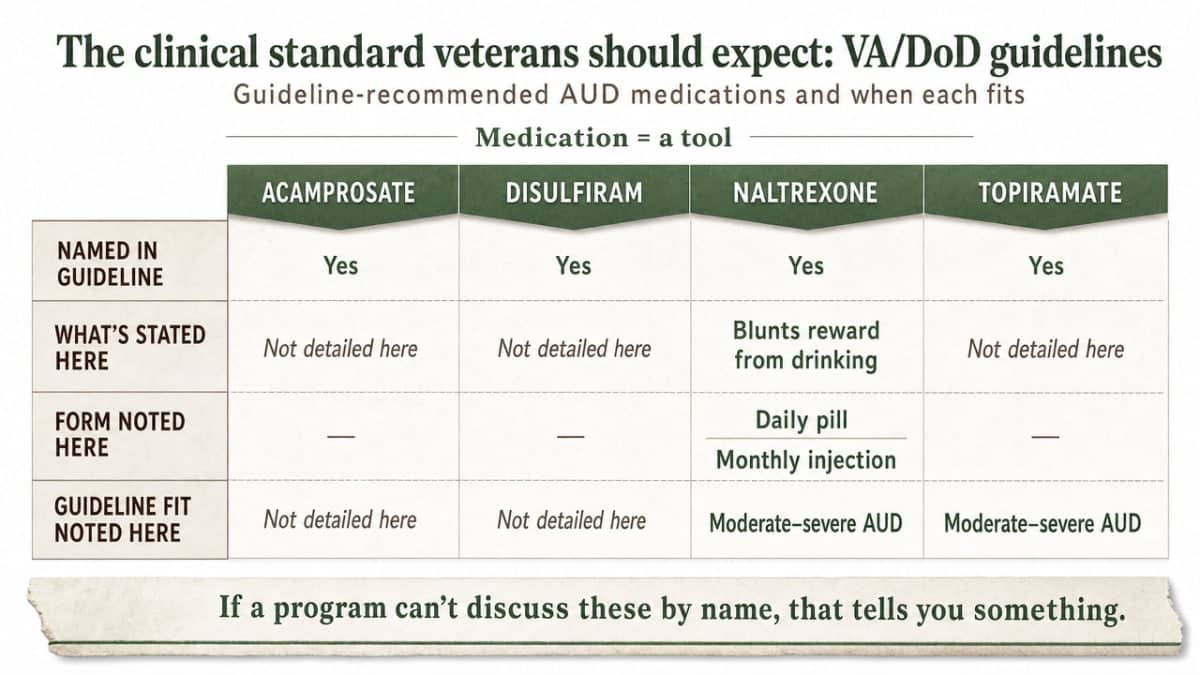
Medication is not a moral question. It’s a tool. And the VA/DoD Clinical Practice Guidelines name four specific medications for alcohol use disorder that any serious program should be able to discuss with you by name: acamprosate, disulfiram, naltrexone, and topiramate 2. If an admissions counselor can’t tell you which of these they offer, that tells you something.
Here’s what each one actually does:
- Naltrexone
- Blunts the reward you get from drinking. It comes as a daily pill or a monthly injection. For a lot of veterans, the injection matters — one shot a month is easier to keep up with than remembering a pill on a rough morning. RAND’s 2025 review notes that naltrexone and topiramate are the medications the VA/DoD guidelines recommend for moderate-to-severe AUD, especially when paired with behavioral treatment 8.
- Topiramate
- Was originally a seizure medication. It reduces heavy drinking days and cravings, and it can help if naltrexone doesn’t fit — for example, if you’re also managing chronic pain on opioids.
- Acamprosate
- Works differently. It helps steady the brain after you’ve already stopped drinking, easing the restlessness and sleep problems that can pull you back in during the first weeks. It’s a maintenance tool, not a starter.
- Disulfiram
- Makes you sick if you drink on it. It’s a deterrent, not a craving reducer. It works best when someone at home is helping you take it and you’ve already committed to abstinence.
None of these are a cure. All four are meant to be paired with counseling — the guidelines are clear about that pairing 8. When you call a program, ask which of the four they prescribe on-site, who manages the prescription after discharge, and whether the injectable form of naltrexone is available. A program that only offers one option, or that treats medication as optional, is not operating at the standard you should expect.
Behavioral therapies the guidelines actually name
Medication is half the picture. The other half is what you do in the room with a counselor. And again, the VA/DoD guideline is specific — this isn’t a case of “any talk therapy will do.”
The guideline-recommended psychotherapies for alcohol use disorder are cognitive behavioral therapy, behavioral couples therapy, community reinforcement, motivational enhancement therapy, and 12-step facilitation 5. Each has a job.
Cognitive behavioral therapy teaches you to spot the thought patterns and situations that lead to drinking, and to build a different response. It’s the workhorse. Motivational enhancement therapy is shorter and useful early on, when part of you still isn’t sure you want to stop. Community reinforcement rebuilds the parts of your life — work, relationships, routine — that drinking hollowed out. Twelve-step facilitation isn’t the same as AA itself; it’s a structured way of connecting you to peer support that continues after treatment ends.
Behavioral couples therapy is the one most programs skip. If you’re married or in a serious relationship, ask about it directly. Drinking rarely happens in isolation, and neither does recovery.
When you’re on the phone with a program, you don’t need to quote the guideline. Just ask: which of these therapies do your counselors actually deliver, and how often? If the answer is vague — “we do individual and group” — press for names. A program that trains its clinicians in these specific modalities will tell you so without hesitation. That’s the standard the guidelines set, and it’s the standard you should hold them to.
PTSD and alcohol belong in the same treatment plan
Why concurrent, integrated care is the standard
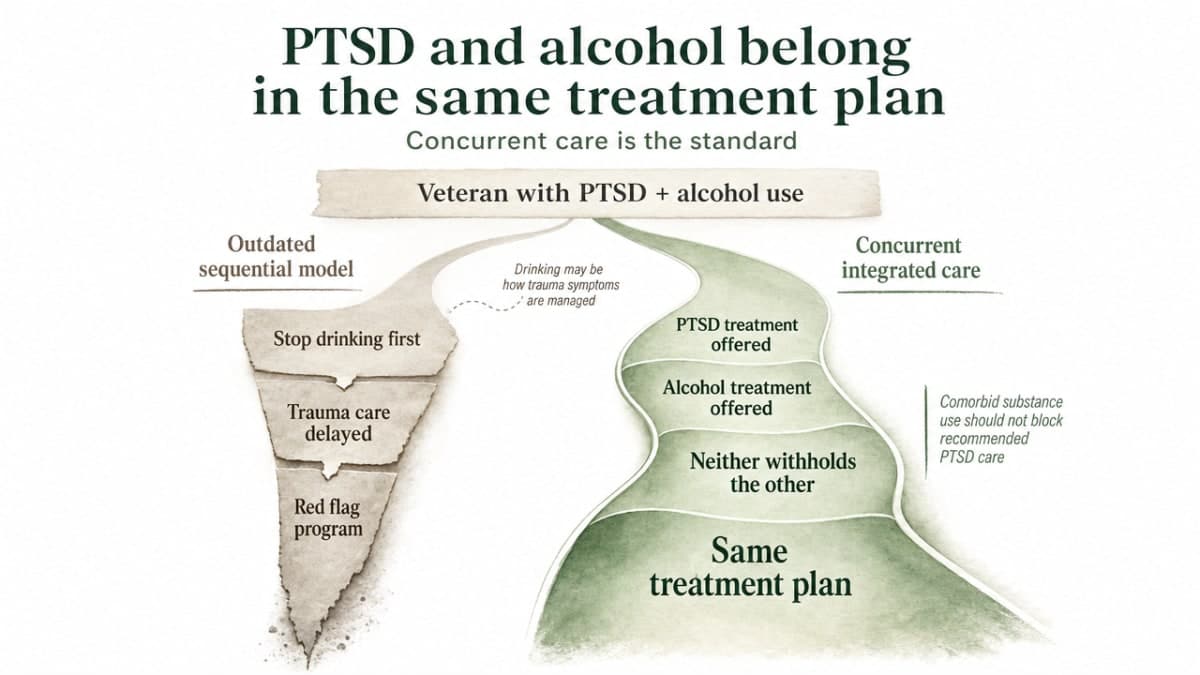
For a long time, veterans were told some version of the same thing: get the drinking under control first, and then we’ll talk about the trauma. That advice is out of date, and if you hear it from a program today, walk.
There’s a reason the guidance changed. For many veterans, drinking is not a separate problem sitting next to PTSD. It’s how you’ve been managing the nightmares, the hypervigilance, the anger that shows up in the wrong places. Treat only the alcohol and the trauma keeps driving you back to it. Treat only the trauma and the drinking keeps you from doing the work. The VA practice recommendations for clinicians put it plainly: treatments for patients with both PTSD and SUD can be effectively delivered concurrently 4.
When you’re asking a program about their approach, listen for this. If they describe PTSD care and alcohol care as one plan with one team, that’s the standard. If they describe a waiting period, that’s a red flag.
What trauma-focused therapy looks like alongside AUD treatment
Trauma-focused therapy has specific names. The three the VA relies on for PTSD are prolonged exposure, cognitive processing therapy, and EMDR 3. All three are structured, time-limited, and built to help you process the memories that keep intruding — not to have you retell your story week after week with no shape to it.
Prolonged exposure walks you, gradually, back toward the memories and situations you’ve been avoiding, so they lose their grip. Cognitive processing therapy focuses on the beliefs that got wired in — about guilt, safety, trust, control — and helps you examine them. EMDR uses guided eye movements or other bilateral stimulation while you hold a memory in mind; it sounds odd until you’ve done it.
Alongside these, your AUD treatment continues — the medication conversation, the CBT or motivational work, the group. A well-run program schedules them together rather than making you choose. Some clinicians use early stabilization tools like Seeking Safety in the first weeks, though later guideline updates have questioned whether non-trauma-focused approaches move PTSD symptoms enough on their own 4.
Ask any program: which of the three trauma-focused therapies do your clinicians deliver, and when in treatment does that work start? If the answer is “after you’re stable,” ask what stable means and how long that takes. You deserve a real timeline, not a shrug.
Signs a program is trauma-informed, not just trauma-aware
Trauma-aware is a poster in the lobby. Trauma-informed is how the intake actually runs.
The difference shows up in small, procedural moments. A case series on veterans with co-occurring PTSD and substance use disorder found that adapting one routine procedure — urine drug screening — with an approach called GLAPE (guidelines, language, atmosphere, procedure, environment) helped engage and retain military veterans in a trauma-informed outpatient program 9. That’s the tell. If a program has thought carefully about how it explains a drug screen to someone with a trauma history, it has probably thought carefully about the rest of the day too.
Here’s what to listen for on the phone or watch for at intake:
- The person doing your intake explains why each step happens — the screen, the questionnaire, the room they’re taking you to — before it happens. They ask, not tell.
- You’re offered choices about small things: which chair, whether the door stays open, whether a family member can stay for the first part.
- Questions about deployment, MST, or combat exposure are asked once, by someone trained to ask them, not repeated by three different staff members across the same afternoon.
- Assessment is integrated. One clinician, or a coordinated team, gathers your alcohol history and your trauma history together — not two separate departments handing you two separate clipboards 4.
- Motivational interviewing shows up in how counselors talk to you. You’re asked what you want, not lectured on what you should want 4.
- Group composition is considered. Veterans are placed with other veterans when possible, or at minimum, groups are led by clinicians who understand military language and hierarchy.
Contrast that with a generic intake: a clipboard shoved across a counter, a cup handed to you with no explanation, the same intrusive questions asked twice by strangers, groups that mix everyone regardless of background.
You don’t need every one of these details to be perfect. You do need to see the pattern. When a program has built its procedures around the possibility that the person walking in has been through something, that shows up everywhere — in the language, the pacing, the way choice gets offered back to you. Ask an admissions counselor to walk you through the first two hours of intake, minute by minute. Their answer tells you almost everything.
Questions to ask an admissions line before you commit
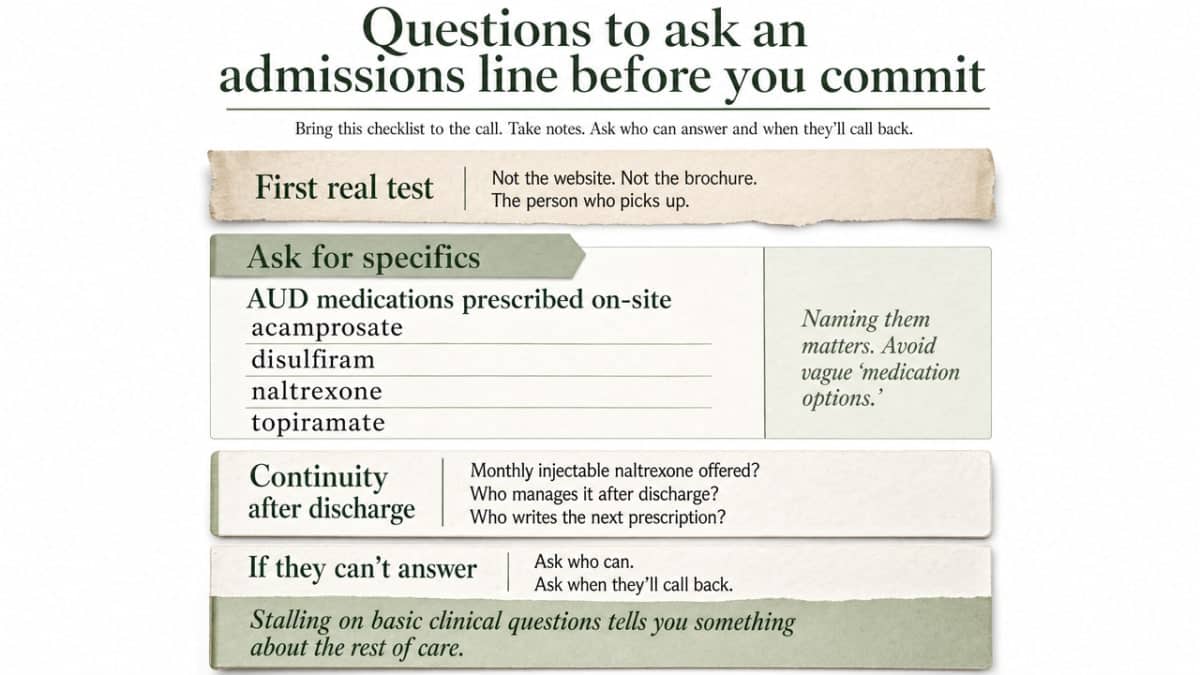
The phone call is your first real test of a program. Not the website, not the brochure — the person who picks up. Have a short list ready and take notes. If they can’t answer, ask who can, and when they’ll call you back. A program that stalls on basic clinical questions is telling you something about how the rest of your care will go.
Here’s what to ask, and why each question matters:
- Which of the four VA/DoD guideline AUD medications do you prescribe on-site — acamprosate, disulfiram, naltrexone, or topiramate? Naming them by name is the point. You want to hear specifics, not “we have medication options” 2, 8.
- Do you offer the monthly injectable form of naltrexone, and who manages it after I discharge? Continuity is where a lot of veterans lose ground. Ask who writes the next prescription.
- If I screen positive for PTSD, when does trauma-focused therapy start — and do I have to be sober first? The right answer is that PTSD and alcohol treatment run concurrently. If they tell you to get sober first, that’s out of step with current guidelines 3, 7.
- Which trauma-focused therapies do your clinicians actually deliver — prolonged exposure, cognitive processing therapy, or EMDR? Ask for names, not “trauma work” 3.
- How is intake structured for veterans? Listen for whether one clinician gathers your alcohol and trauma history together, and whether motivational interviewing is part of how counselors are trained 4.
- How do you explain a urine drug screen to a veteran with a trauma history? This is the small, telling question. A program that has thought about this has thought about the rest 9.
- Do your groups place veterans with other veterans, and are group leaders familiar with military culture?
- Do you take VA community care referrals or TRICARE, and can you verify my benefits before I commit?
- What does the first 48 hours look like — medically supervised detox, monitoring, medications for withdrawal? Alcohol withdrawal can be dangerous. You want a clear medical answer.
You don’t have to get through all of these in one call. Pick the four that matter most to you and start there. How the person on the other end handles the questions — patient, specific, willing to slow down — tells you more than any brochure will.
How the VA screens for alcohol misuse and what happens next
If you’ve been to a VA appointment in the last few years, you’ve probably already been screened for alcohol misuse — even if you didn’t realize that’s what was happening. VA policy requires that all new patients in the VA health system be screened for PTSD, major depression, and alcohol misuse 6. That short questionnaire about how often you drink and how much? That’s the screen.
Here’s what usually happens next. If your answers suggest unhealthy drinking, your primary care provider is expected to do a brief intervention right there in the room — a short conversation about your use, the risks, and what you’d want to change. If the pattern looks more serious, you get referred to specialty substance use care 6.
That referral is where a lot of veterans stall. Maybe you nodded along in the appointment and never called. Maybe the referral came through and the timing felt wrong. That’s a common place to be, and it doesn’t close any doors.
You can restart the process at any point. Call your primary care team and ask to be re-screened or re-referred, walk into a Vet Center, or contact the SUD program directly 1. If a screen already flagged you, your record likely has notes that can speed up the next intake. You’re not starting from zero, even if it feels that way.
Oklahoma access points: where a veteran can start today
If you’re in Oklahoma and reading this, there are doors open to you right now. You don’t have to know exactly what you need before you use them.
The most direct one is the substance abuse clinic at the Oklahoma City VA Medical Center. You can walk in without an appointment and without a referral. Their guidance is explicit: visit the office, with or without an appointment, and a referral is not required 10. That matters. A lot of veterans have run into gatekeeping at other systems and given up. This one is built to let you start the same day you decide to try.
The center offers outpatient care, and it also runs 24-hour therapeutic and educational residential programs for substance use — the level of care most people picture when they hear the word rehab 10. Which track fits you depends on how much your drinking has taken hold, whether you’re safe to detox at home, and what your responsibilities look like right now. That gets sorted at intake, not by you in advance.
If you want to call first, the main number for the Oklahoma City VA Health Care System is 405-456-1000. The Substance Abuse Treatment Program has its own direct line at 405-456-1000, extension 63218 11. Ask for the substance abuse clinic and say you’re a veteran calling about alcohol. That’s enough of a sentence to get you to the right person.
A few other paths are worth knowing:
- 988, then press 1. The Veterans Crisis Line. Use it if tonight feels dangerous, if you’re thinking about drinking to cope with something you can’t sit with, or if you just need a voice on the other end while you decide what to do next 1.
- Vet Centers. Lower-key than a medical center, staffed with people who often served themselves. They can connect you to SUD care without you having to walk into a hospital first 1.
- The state VA SUD directory. If Oklahoma City isn’t where you live, the directory lists other VA-affiliated substance use programs across the state 11.
- Community medical detox. If alcohol withdrawal is your immediate concern — shakes, elevated heart rate, seizure risk — a licensed medical detox facility can stabilize you first and then hand you off to a longer program. This is a bridge, not a substitute for the treatment that comes after.
Pick one door. You can use another tomorrow if the first one isn’t right.
If the VA is not your first choice: TRICARE and community programs
Some veterans don’t want to start at the VA. Maybe the last visit didn’t go well. Maybe you’re still on active duty or covered under TRICARE through a family member. Maybe you just want a smaller setting where nobody asks about your file. That’s a legitimate choice, not a failure of will.
TRICARE-authorized programs are held to their own clinical standards, and the questions you’d ask a VA program still apply here: which of the four guideline-recommended AUD medications do they prescribe, do they treat PTSD and alcohol concurrently, are their clinicians trained in prolonged exposure, cognitive processing therapy, or EMDR 2, 3, 7. Ask up front whether they’re in-network, and get benefits verified in writing before you admit.
Community medical detox fits a different need. If you’ve been drinking daily and heavily, stopping cold is a medical event — heart rate, blood pressure, and seizure risk all belong under a clinician’s watch, not managed on a couch. A licensed detox facility can stabilize you in the first days and then hand you off to a longer program, VA or otherwise. Ask whether they’ve worked with veterans, whether their intake is trauma-informed, and how they coordinate the step after discharge 9. The right community program acts as a bridge, not a substitute.
Making the call and what to bring with you
The hardest part is often the ten seconds before you dial. That’s fair. Give yourself a small setup so the call goes somewhere.
Before you pick up the phone, gather what you can: your DD-214 if it’s within reach, insurance card or TRICARE information, a rough list of medications you take, and the phone number of your VA primary care team if you have one. None of this is required to start — the Oklahoma City VA substance abuse clinic will see you without an appointment or a referral 10— but having it nearby cuts the friction.
Write down two or three questions from earlier in this guide. Ask about guideline-based medications by name and whether PTSD care can start alongside alcohol treatment 2, 3. If your hands shake or your voice does, that’s information too — say so. It helps them route you to the right level of care.
If tonight is the wrong night for a clinic call, dial 988 and press 1. Someone will pick up 1.
You already did the hard thinking. The call is just the next small step.
Talk Now With Someone Who Gets Military Life
Connect instantly to discuss next steps and get answers from a team that understands your experience.
Frequently Asked Questions
Will a bad discharge status keep me from getting VA alcohol treatment?
Not automatically. VA guidance is that veterans can seek help for substance use problems regardless of discharge status, and the first step is to apply for VA health care so eligibility can be reviewed 1. If you’re unsure where you stand, call the VA and ask — don’t assume the answer is no. Vet Centers can also connect you to care while any eligibility question is being sorted out.
Do I have to be sober before I can start PTSD treatment?
No. The VA/DoD Clinical Practice Guidelines say veterans with both PTSD and a substance use disorder should be offered evidence-based treatment for both, and having one is not a barrier to receiving care for the other 3. The 2023 PTSD guideline repeats this point: comorbidities, including substance use disorders, should not stop you from getting a recommended PTSD treatment 7. Concurrent care is the standard.
Which alcohol use disorder medications should a veteran-focused program offer?
The four the VA/DoD guidelines name are acamprosate, disulfiram, naltrexone, and topiramate 2. RAND’s 2025 review highlights naltrexone and topiramate for moderate-to-severe AUD, especially paired with behavioral treatment 8. A serious program can tell you which of the four they prescribe on-site, whether the monthly injectable form of naltrexone is available, and who manages the prescription after discharge. Vague answers are a warning sign.
Can I walk into the Oklahoma City VA Medical Center without a referral?
Yes. The Oklahoma City VA Medical Center’s guidance on its substance abuse clinic is explicit: visit the office, with or without an appointment, and a referral is not required 10. If you’d rather call ahead, the main number for the Oklahoma City VA Health Care System is 405-456-1000, and the Substance Abuse Treatment Program has a direct extension at 405-456-1000 x 63218 11.
What if I have TRICARE or prefer a community program over the VA?
That’s a valid path. Hold any TRICARE-authorized or community program to the same standard: ask which of the four guideline-recommended AUD medications they prescribe 2, whether PTSD and alcohol treatment run concurrently 3, 7, and how their intake is adapted for veterans with trauma histories 9. Get benefits verified in writing before you admit. A community medical detox can also serve as a short bridge into longer care.
What should I do right now if I’m in crisis or thinking about drinking to cope?
Dial 988 and press 1. That’s the Veterans Crisis Line, and someone will pick up 1. Use it if tonight feels dangerous, if you’re thinking about drinking to get through something you can’t sit with, or if you just need a voice on the other end while you figure out the next step. It doesn’t cost anything, and it doesn’t go on any record that limits your care.
References
- Substance Use Treatment For Veterans. https://www.va.gov/health-care/health-needs-conditions/substance-use-problems/
- Alcohol & Drug Addiction Treatment for Veterans – Mental Health. https://www.mentalhealth.va.gov/substance-use/treatment.asp
- Treatment of Co-Occurring PTSD and Substance Use Disorders in VA. https://www.ptsd.va.gov/professional/treat/cooccurring/tx_sud_va.asp
- Practice Recommendations for Treatment of Veterans with Comorbid Substance Use Disorder and Posttraumatic Stress Disorder. https://www.mentalhealth.va.gov/providers/sud/docs/SUD_PTSD_Practice_Recommendations.pdf
- Co-Occurring Post-Traumatic Stress Disorder and Alcohol Use Disorder in U.S. Military and Veteran Populations. https://pmc.ncbi.nlm.nih.gov/articles/PMC6561402/
- Clinical Management of Mental Health Conditions at the Veterans Health Administration. https://www.ncbi.nlm.nih.gov/books/NBK499504/
- A clinician’s guide to the 2023 VA/DoD Clinical Practice Guideline for Management of Posttraumatic Stress Disorder and Acute Stress Disorder. https://www.ptsd.va.gov/professional/articles/article-pdf/id1629192.pdf
- Alcohol Use Disorder Among U.S. Veterans. https://www.rand.org/pubs/perspectives/PEA1363-14.html
- Trauma-informed Drug Screens for Veterans with Co-occurring Disorders: A Case Series. https://pubmed.ncbi.nlm.nih.gov/32286200/
- Oklahoma City VA Medical Center. https://www.va.gov/oklahoma-city-health-care/locations/oklahoma-city-va-medical-center/
- Oklahoma – VA Substance Use Disorder Program Locations. https://www.va.gov/directory/guide/state_SUD.cfm?STATE=OK