
Key Takeaways
- Motivational interviewing is the counseling backbone of current Oklahoma detox care, replacing confrontation and rock-bottom thinking with open questions, reflective listening, and rolling with ambivalence 1, 5.
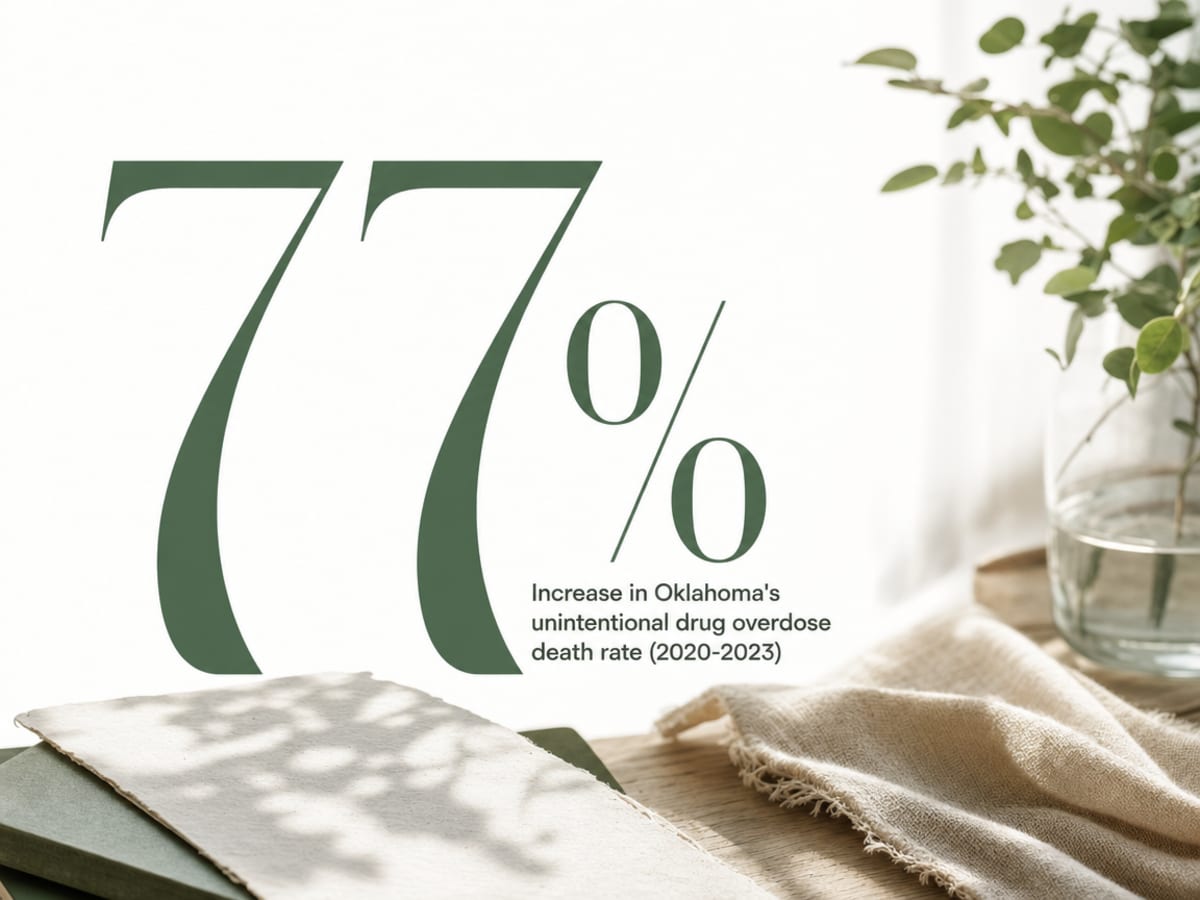
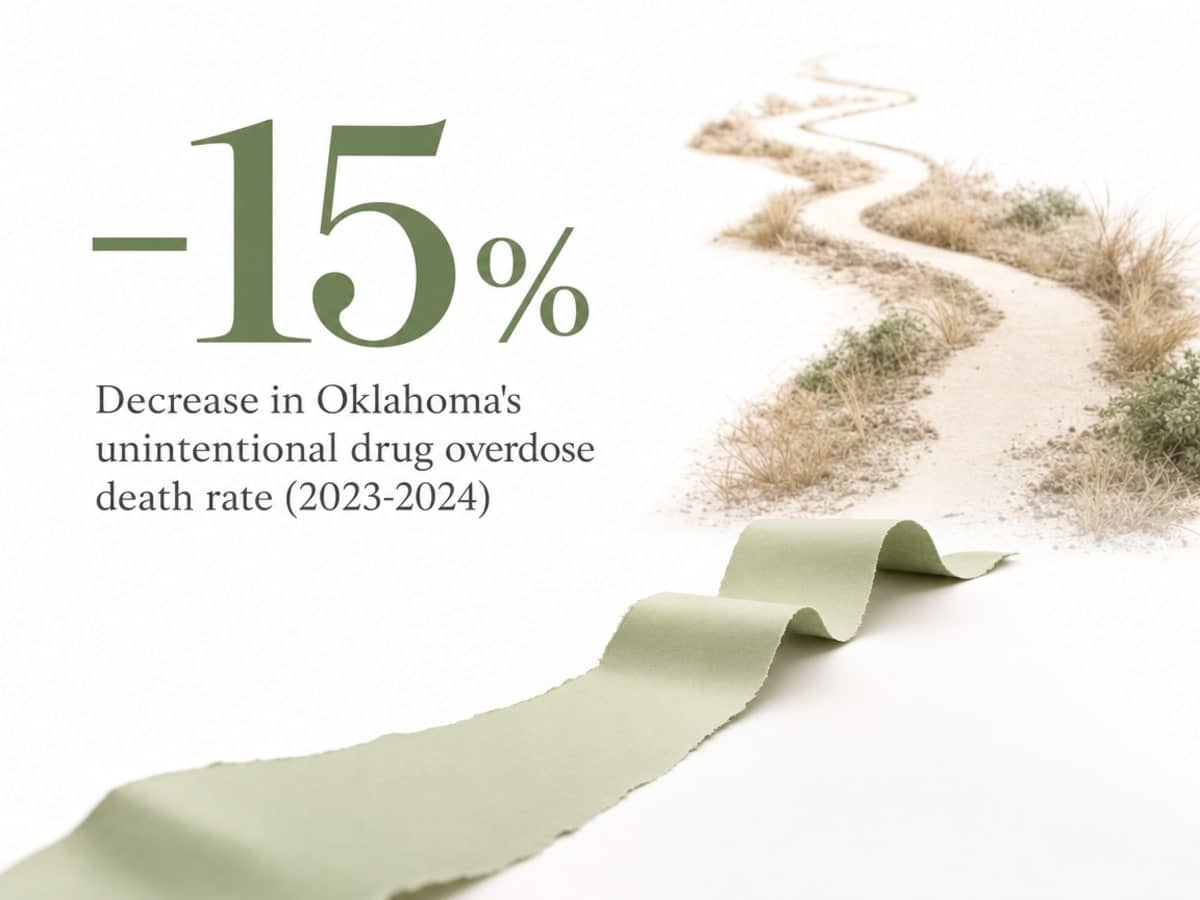
- Oklahoma’s unintentional overdose death rate rose 77% from 2020 to 2023 before dropping 15% into 2024, with methamphetamine involved in about two-thirds of 2024 deaths 10.
- MI works alongside medication, not against it — comfort meds and buprenorphine stabilize the body while MI helps you decide, hour by hour, to stay through withdrawal 9.
- Legitimate Oklahoma detox facilities are certified by ODMHSAS under Chapter 18 rules; call a certified provider like Renewal Springs and ask how counselors respond when someone wants to leave 13.
If you’re scared of being judged at intake, read this first
You have probably rehearsed this moment more times than you can count. The walk from the parking lot. The clipboard. The stranger who might look at you the way people have looked at you before.
If you are in opioid dependence right now, or you love someone who is, that fear is not paranoia. It is memory. Somewhere along the way, a doctor, a family member, or a treatment program made you feel like the problem was your character instead of a condition your body has learned to survive. That fear is one of the biggest reasons people delay picking up the phone for detox, even when withdrawal is closing in.
Here is what you deserve to know before you walk into any Oklahoma detox door: the current standard of care does not look like the interventions you have seen on TV. There is no circle of family members ambushing you at the kitchen table. There is no counselor waiting to tell you that you have to hit rock bottom before anyone can help.
What good detox actually uses is a counseling style called motivational interviewing, or MI. Federal agencies including SAMHSA and the CDC now train clinicians in this approach specifically because it works better than confrontation for people who are scared, ambivalent, or worn down by past treatment 14.
You are already doing something hard by reading this. That counts. The rest of this guide walks you through what MI actually sounds like, what the evidence really says, and what to expect at a certified Oklahoma facility that uses it.
What motivational interviewing actually is (in plain language)
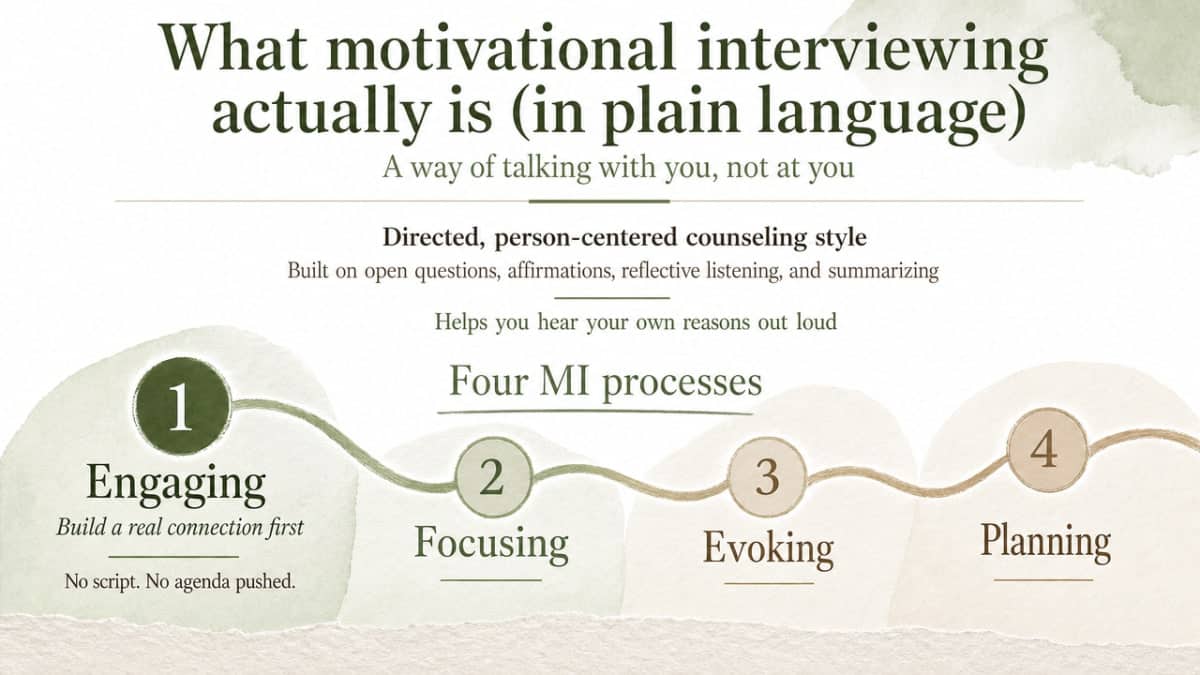
Motivational interviewing is a way of talking with you, not at you. That is really the whole idea. It is a counseling style developed to help people who feel stuck between wanting to change and not being sure they can, which is exactly where opioid dependence tends to leave you.
SAMHSA describes MI as a directed, person-centered counseling style
built on open questions, affirmations, reflective listening, and summarizing what you have said 8. A trained clinician is not there to argue you into treatment. They are there to help you hear your own reasons out loud.
The framework has four processes, and once you know them, you can spot them in any good conversation about your care 1:
- Engaging — the counselor builds a real connection with you first. No script, no agenda pushed at you in the first five minutes. Just: who are you, what brought you here today, what does this feel like?
- Focusing — together, you narrow in on what actually matters to you right now. Maybe it is getting through withdrawal without a heart episode. Maybe it is being able to see your kids again. You name the direction.
- Evoking — this is where the counselor draws out your own reasons for change instead of listing theirs. They might ask what you would miss about using, and what you would not. Both answers are welcome.
- Planning — only when you are ready, you build the next step together. Not a lecture on the twelve-step calendar. A plan you helped write.
There is one more phrase worth knowing: “roll with resistance” 1. If you push back — if you say you are not sure detox will work, or you have tried before and failed — an MI-trained clinician does not argue. They lean in and get curious. Your doubt is information, not defiance.
Federal agencies including SAMHSA and the CDC now use this framework as the standard way to talk with people about substance use 2. That matters because it means MI is not a soft add-on to “real” treatment. It is the counseling backbone of current, evidence-based care.
What MI sounds like at 3 a.m. during opioid withdrawal
Opioid withdrawal does not respect business hours. The worst of it — the sweating, the crawling skin, the gut cramps, the certainty that leaving is the only way to stop feeling this — tends to peak in the middle of the night. That is when the story you tell yourself about detox gets tested.
Here is what MI sounds like when a nurse or counselor walks into your room at 3 a.m. and you have just said you want to leave.
They do not block the door. They do not remind you what you promised your family. They pull up a chair.
They ask an open question first. Not “why are you doing this to yourself,” but something like: “What’s happening for you right now?” 8 You get to answer without being interrupted or corrected.
They reflect what they hear. If you say, “I can’t do this, it’s too much,” they might say, “This is harder than you thought it would be, and part of you is wondering if it’s worth staying.” That is not agreement. That is showing you they actually heard you 3. It is also a small trick your nervous system responds to — being understood lowers the volume on panic.
They affirm something real. Not a compliment out of a card. Something like, “You walked in here yesterday even though you were scared. That took something.” Affirmations in MI are specific, and they are true 8.
They might use a readiness ruler. The CDC’s MI guidance suggests asking, on a scale of one to ten, how ready you are to keep going right now 3. If you say a four, the counselor does not argue you up to a nine. They ask what makes it a four instead of a two. Your own answer — “I don’t want my mom to bury me” — is more powerful than anything they could tell you.
They summarize. Before they leave the room, they might say, “So the pain is real, you’re not sure you can finish, and there’s still a piece of you that wants to see what life looks like on the other side of this week.” Both truths get to exist 2.
Nowhere in that conversation did anyone say the word “quit” as a demand. Nowhere did anyone threaten you with what happens if you walk. That is not because the clinician does not care whether you stay. It is because they know that pressure at 3 a.m. usually pushes people out the door — and curiosity keeps them in the bed long enough for the medication to work and the next hour to arrive.
‘Tough love’ vs. MI: dismantling the rock-bottom myth
You have probably heard some version of it your whole life. “They have to want it.” “They have to hit bottom.” “Sometimes you just have to let them fall.” It sounds like wisdom. It is not.
The rock-bottom myth grew out of a specific era of treatment culture — one that treated addiction as a moral failure and confrontation as the cure. Family members were coached to line up and read letters. Counselors argued with patients until they “broke through” denial. The theory was that shame, applied hard enough, would flip a switch.
Here is the problem: for people with opioid dependence, that switch does not exist. What actually flips is the exit. Shame at intake is one of the fastest ways to send someone back out the door and into a much more dangerous next hour. The CDC now explicitly directs clinicians to use person-first language and to demonstrate empathy and understanding
in every conversation about substance use, precisely because stigma-based approaches drive people away from care 5.
MI turns the old model inside out. Instead of arguing you out of your ambivalence, an MI-trained clinician assumes ambivalence is normal — of course part of you wants to leave, and of course part of you wants to stop. Both feelings live in the same body. The counselor’s job is to help the part that wants to stop get louder, using your words, not theirs 1.
Notice what MI does not do. It does not require you to admit you are powerless before you get help. It does not require your family to stage anything. It does not require you to be “ready” on someone else’s timeline. Picking up the phone counts. Sitting in the intake chair counts. Saying “I’m not sure” counts — because “not sure” is exactly the doorway MI is designed to walk through with you 2.
If someone has told you that you have to want it more before treatment can work, they were repeating a story, not the science. You do not have to arrive at detox already convinced. You just have to arrive.
Oklahoma’s overdose picture and why MI belongs in the response
If you live in Oklahoma, you already know this crisis is not abstract. It is a coworker who did not come back after lunch. It is a cousin’s obituary. It is the neighbor whose porch light stayed on all night.
The state data tells the same story your community does. According to the Oklahoma State Department of Health, the unintentional drug overdose death rate rose 77% from 2020 to 2023, then fell 15% from 2023 to 2024 10. That drop matters. It is real progress, and it is fragile. It reflects the combined work of naloxone distribution, medication-assisted treatment expansion, and — quietly, in thousands of intake rooms — the shift toward engagement-based conversations instead of confrontational ones 4.
The substances behind those numbers have changed too. Methamphetamine was involved in roughly two out of three Oklahoma overdose deaths in 2024, often alongside fentanyl 10. That combination is unforgiving. It also means the person walking into detox today is often carrying a longer, more complicated dependence history than the classic “one drug” story treatment programs were built around a generation ago.
Here is why MI fits this moment. When someone is using both an opioid and a stimulant, the ambivalence is layered. Part of you might be ready to stop the fentanyl but not the meth. Part of you might have tried detox before and left on day two. A confrontational intake — the one that demands you commit to total sobriety before you have even had your first dose of comfort medication — collides with that layered reality and loses. An MI conversation meets it 1.
The Oklahoma Department of Mental Health and Substance Abuse Services has folded engagement-focused practice into its prevention and treatment work, and the CDC is actively training clinicians in MI as part of overdose response 124. This is not a fringe idea. It is what current state and federal systems are asking detox facilities to actually do at the bedside.
The 15% drop is not a finish line. It is a signal that when people get met with medicine and a real conversation instead of a lecture, more of them stay long enough for the next hour to arrive.
How strong is the evidence for MI, honestly
You deserve a straight answer here, not a sales pitch dressed up as science.
The largest systematic review of MI for substance use pulled together 59 studies and 13,342 participants. At the point right after the intervention ended, MI showed a standardized mean difference of 0.79 in substance use outcomes compared with people who got no treatment at all — a meaningful effect by clinical research standards 7. This effect shrinks at medium-term follow-up, down to roughly 0.15 7. In plain language, MI is very good at helping people engage and reduce use in the short window that matters most for detox — the moment you are deciding whether to stay — and less powerful on its own months later, when what you really need is ongoing treatment carrying the load.
The 2023 Cochrane review, the most recent high-level synthesis, concluded that MI may reduce substance use compared with no intervention, and probably reduces it slightly compared with just being assessed and given feedback 6. Effects on treatment retention and readiness to change were less clear.
So MI is not a miracle. It is a real, measurable tool that helps people show up, stay through the first hard days, and hand off to the next level of care. That is exactly what detox needs it to do.
How MI works alongside medication for opioid withdrawal
Here is a myth that needs to go: the idea that talk therapy and medication are competitors. In opioid detox, they are not two paths. They are two hands doing the same work.
Medication for opioid withdrawal — buprenorphine, comfort medications for nausea, sleep, muscle pain, blood pressure — does the physical job your body cannot do on its own right now. It quiets the receptors that are screaming. It gives your nervous system a floor to stand on. Without it, most people cannot stay long enough for anything else to matter. The VA/DoD clinical practice guideline for substance use disorder is direct about this sequence: acute stabilization first, then engagement and referral into ongoing care 9.
MI does the other job. It works on the part of you that is deciding, hour by hour, whether to stay in the bed and let the medication do its work.
Think about what actually happens during a taper. A dose lands. You feel a little better. Twenty minutes later, a wave of doubt hits — maybe you should not have come, maybe you can manage this at home, maybe your family is wrong about how bad it got. That is not weakness. That is opioid dependence talking through a temporarily calmer body. If no one is trained to meet that moment with anything except “you signed the paperwork,” the medication cannot hold you by itself.
An MI-trained clinician meets the doubt with a question, not a rebuttal. What is coming up right now? What would leaving today cost you? What would staying through tonight make possible tomorrow? Your answers — not theirs — become the reason the next dose gets taken 13.
This is why the CDC promotes MI training specifically inside overdose-prevention practice, not as a separate wellness track 4. The conversation and the medicine are meant to arrive together. One keeps your body in the room. The other keeps you in the room.
At Renewal Springs, that pairing is the whole design of the day. Medication-assisted protocols manage the physical withdrawal, wearable monitoring from Huml Health tracks your vitals, sleep, and stress in real time, and the counseling style around all of it is built to match — no ultimatums, no shame if you waver, just a partner asking the next honest question until the next hour arrives.
Walking into a certified Oklahoma detox: what to expect
Here is what the first few hours actually look like, so nothing catches you off guard.
You will be met at the door, not processed at it. A licensed nurse or admissions clinician will sit with you, take your history, and ask about what you have been using, how much, and when you last used. Answer honestly. This is not a legal proceeding. It is how they figure out which medications will make you comfortable and which vital signs need close watching in the first 24 hours.
The paperwork exists. It is real. But at a facility trained in MI, the paperwork does not lead the conversation — you do. Expect open questions before checkboxes. Expect the counselor to ask what you are most worried about and to actually pause for the answer 3.
Within the first day, you should expect an initial medical assessment, comfort medications started as needed, a room that is quiet enough to sleep in, and a counselor who introduces themselves before they introduce a plan. If any of that is missing, ask about it. You are allowed to.
MI in practice at Renewal Springs in Oklahoma City
Here is what MI looks like when it is not a training slide but the actual rhythm of your day.
At Renewal Springs in Oklahoma City, the counseling style meets you where the medicine does — in the same room, at the same hour. Licensed medical staff run the withdrawal side of your care around the clock, using medication-assisted protocols matched to whatever brought you in: fentanyl, prescription painkillers, heroin, alcohol, benzos, meth, kratom, or the combinations most Oklahomans are actually carrying today. Huml Health wearables track your vitals, sleep, and stress in real time, so the team can see when a rough patch is coming before you have to explain it.
The MI layer sits on top of all of that. Counselors are trained to ask before they tell, to reflect what you say back to you, and to roll with it when you waver instead of arguing you back into compliance 13. If you are a veteran, that engagement style is not a bonus — it is the same patient-centered approach federal SUD guidelines have asked veteran care to lead with for years 9. Gender-specific tracks for men and women exist because the conversations that matter in detox are not one-size-fits-all, and private care options give you the quiet room that makes an honest conversation possible in the first place.
If you want to hear what this actually sounds like before you commit to anything, call. Ask how their counselors handle the moment you want to leave. Ask about insurance — most major plans are accepted and benefits verification is free. You do not have to be sure. You just have to make the call.
Talk to a supportive detox specialist now
Get real answers and immediate guidance for medication-assisted detox and motivational interviewing support.
Frequently Asked Questions
Will I be lectured or shamed when I walk into detox?
Not at a facility trained in motivational interviewing. The CDC now directs clinicians to use person-first language and to demonstrate empathy and understanding in every substance use conversation 5. Expect open questions, reflective listening, and a counselor who pauses for your answer instead of loading you up with warnings. If you feel judged at intake anywhere, that is a red flag about the facility, not about you.
How is motivational interviewing different from a traditional intervention?
A traditional intervention corners you with an ultimatum. MI does the opposite. It is a collaborative counseling style built on four processes — engaging, focusing, evoking, and planning — where the clinician helps you find your own reasons for change rather than supplying theirs 1. No family ambush, no reading of letters, no demand that you admit powerlessness before help begins. Your ambivalence is treated as normal information, not as denial to break through.
Can motivational interviewing work if I’m not sure I want to quit?
Yes — that uncertainty is exactly what MI was built for. Being ambivalent does not disqualify you from care. An MI-trained counselor rolls with resistance instead of arguing you into commitment, drawing out the part of you that is curious about change 1. You do not have to arrive certain. Picking up the phone and sitting in the intake chair while unsure counts as a real start, not a failed one.
Does MI replace medication for opioid withdrawal?
No. MI and medication do different jobs and belong together. Comfort medications and buprenorphine settle the physical withdrawal so your body can stay in the room. MI works on the part of you deciding, hour by hour, whether to keep letting the medicine work. The VA/DoD substance use disorder guideline is direct about the sequence — acute stabilization first, then engagement and referral into ongoing care 9. You need both hands doing the work.
Is motivational interviewing actually backed by research?
Yes, with an honest caveat. The 2023 Cochrane review concluded that MI may reduce substance use compared with no intervention and probably reduces it slightly compared with assessment and feedback alone 6. Effects on treatment retention and readiness to change were less clear. So MI is not a miracle — it is a real, measurable tool that helps people engage and stay through the first hard days, then hand off to ongoing treatment.
What should I expect on the first day at an Oklahoma detox that uses MI?
You will be met by a licensed nurse or admissions clinician who asks about what you have used and when, so they can choose the right comfort medications. Expect open questions before checkboxes and a counselor who introduces themselves before a plan 3. Any legitimate Oklahoma detox is certified by ODMHSAS under Chapter 18 rules 13. Call Renewal Springs to ask how their counselors handle the moment you want to leave.
References
- SAMHSA TIP 35 Enhancing Motivation for Change in Substance Use Disorder Treatment. https://library.samhsa.gov/sites/default/files/tip-35-pep19-02-01-003.pdf
- Using Motivational Interviewing in Substance Use Disorder Treatment. https://library.samhsa.gov/sites/default/files/PEP20-02-02-014.pdf
- Motivational Interviewing to Help Your Patients Seek Treatment. https://www.cdc.gov/overdose-prevention/media/pdfs/2024/07/Conversation-Starter-Motivational-Interviewing.pdf
- Training: Motivational Interviewing | Overdose Prevention. https://www.cdc.gov/overdose-prevention/hcp/trainings/motivational-interviewing.html
- Remove Stigma: Talk with Your Patients About Substance Use Disorder. https://www.cdc.gov/overdose-prevention/media/pdfs/2024/04/Conversation-Starter-Remove-Stigma.pdf
- Motivational interviewing for substance use reduction. https://pubmed.ncbi.nlm.nih.gov/38084817/
- Motivational interviewing for substance abuse. https://pmc.ncbi.nlm.nih.gov/articles/PMC8939890/
- Chapter 3—Motivational Interviewing as a Counseling Style. https://www.ncbi.nlm.nih.gov/books/NBK571068/
- VA-DoD SUD Clinical Practice Guideline. https://www.healthquality.va.gov/guidelines/MH/sud/VA-DoD-SUD-CPG_Final_for-508_v3.pdf
- Data – Oklahoma.gov. https://oklahoma.gov/health/health-education/injury-prevention-service/drug-overdose/data.html
- Drug Overdose Data Dashboard – Oklahoma.gov. https://aem-prod.oklahoma.gov/health/health-education/injury-prevention-service/drug-overdose/data/drug-overdose-data-dashboard.html
- Executive Summary – EOY 25 – Oklahoma.gov. https://oklahoma.gov/content/dam/ok/en/odmhsas/documents/prevention/data/Executive%20Summary%20-%20EOY%20Evaluation%20FY%2025.pdf
- CHAPTER 18 – Oklahoma.gov. https://oklahoma.gov/content/dam/ok/en/odmhsas/documents/policy/provider-certification/administrative-rules/2023/PC–Chapter-18-Final-effective-9-15-23.pdf
- SECTION 95.44. Residential substance use disorder (SUD). https://oklahoma.gov/ohca/policies-and-rules/xpolicy/medical-providers-fee-for-service/individual-providers-and-specialties/inpatient-psychiatric-services/residential-substance-use-disorder-eligible-providers-and-requirements.html