
Key Takeaways
- Recovery works best as a layered stack: medical detox first, then formal treatment and medication when appropriate, with mutual-help meetings sustaining progress rather than replacing clinical care 9.
- Non-12-step programs like SMART, LifeRing, Women for Sobriety, Refuge Recovery, and SOS produce outcomes comparable to AA, with active involvement predicting success more than the specific group chosen 3.
- Match the program to your thinking style and circumstances: cognitive tools in SMART, open conversation in LifeRing, gender-specific support in WFS, or contemplative practice in Refuge Recovery 17.
- If earlier attempts stalled, focus on completing supervised withdrawal, connecting with a peer specialist, and committing to at least three meetings of a program that fits before switching 1.
When Quitting on Your Own Stops Working
Many individuals attempting to stop substance use on their own experience a cycle of brief success followed by relapse. This isn’t a personal failing but a common outcome of physical dependence. Trying to overcome alcohol, opioid, or benzodiazepine withdrawal without support is not only uncomfortable but can be medically dangerous. Federal treatment guidelines emphasize that medical detox is merely the initial stage of care and, by itself, has limited impact on long-term substance use patterns 9. Therefore, attempting to quit without any form of detox or support is even less likely to lead to lasting change.
If previous attempts to find help felt unsuitable, or if a particular program didn’t resonate, it doesn’t mean recovery is unattainable. It simply indicates that a specific path wasn’t the right fit. There are numerous alternative approaches available, which this article will explore.
Why the 12-Step Path Isn’t the Only Path
For much of the last century, the primary recommendation for substance use issues was participation in 12-step programs like Alcoholics Anonymous. This prevalence stemmed from their accessibility and widespread availability, rather than exclusive scientific validation as the single best approach. This historical context has shaped public perception of what recovery entails, potentially deterring individuals who found certain aspects of 12-step programs unappealing.
Some individuals may find the language of powerlessness, the emphasis on a higher power, or the confessional format of 12-step meetings incongruent with their beliefs or experiences. If an honest attempt at a 12-step program didn’t feel right, it doesn’t negate the possibility of recovery; it merely suggests that a different tradition might be more suitable.
Over the past three decades, a variety of other mutual-help programs have emerged. SMART Recovery utilizes cognitive-behavioral tools, while LifeRing emphasizes individual empowerment. Women for Sobriety focuses on emotional growth, and Refuge Recovery incorporates Buddhist practices. Secular Organizations for Sobriety offers a non-religious framework. A longitudinal study comparing Women for Sobriety, LifeRing, SMART, and 12-step groups found that all four were similarly effective for individuals with abstinence goals, with participant involvement being the most significant predictor of success 3. This demonstrates that the path to recovery is diverse and not limited to a single model.
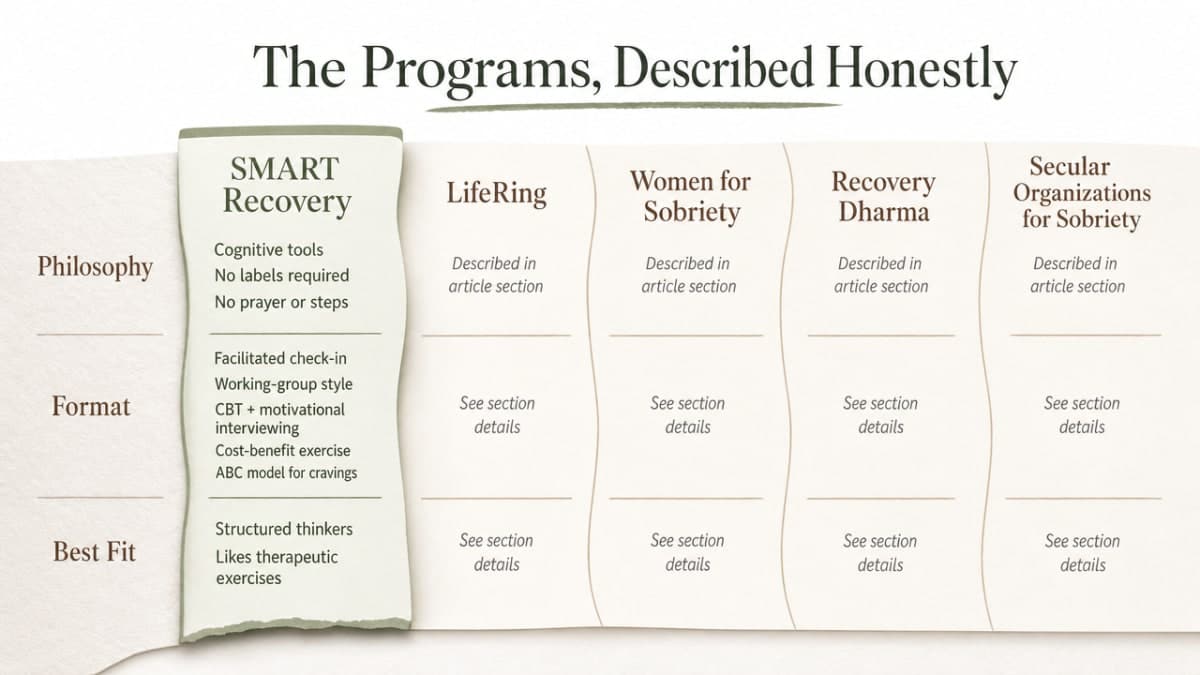
The Programs, Described Honestly
SMART Recovery: Cognitive Tools, Not Confessions
SMART Recovery meetings are structured around practical, cognitive tools. A facilitator, often trained but not a clinician, leads a check-in where participants share their progress. Unlike some other programs, there is no requirement to label oneself an “alcoholic” or “addict,” no prayer, and no reading of steps.
The sessions function more like a working group, applying techniques from cognitive-behavioral therapy and motivational interviewing. Participants might engage in exercises such as a cost-benefit analysis of continued substance use versus abstinence, or utilize the ABC model to manage cravings by examining the beliefs between an urge and their reaction. This format is particularly appealing to individuals who prefer structured thinking and respond well to therapeutic exercises.
Evidence supporting SMART Recovery is developing. A systematic review of twelve studies indicated generally positive effects on alcohol outcomes, though researchers noted the need for more robust studies due to small sample sizes and varied methodologies 2. A randomized trial found that higher attendance in SMART-only settings correlated with improved alcohol outcomes, suggesting that active engagement with the program’s tools is crucial 1. Ongoing research, such as a 24-month prospective cohort study of 368 adults, aims to provide higher-quality longitudinal data on SMART’s effectiveness 5.
LifeRing Secular Recovery: Your Sober Self, Talking
LifeRing meetings offer a distinct approach compared to SMART. They are less structured, without worksheets or a fixed curriculum. The format, known as a Congress of Sober Selves, is primarily conversational. Participants sit in a circle, sharing their experiences, discussing what helped them maintain sobriety, and what challenges they faced during the week.
The core principle of LifeRing is the belief in an internal “sober self” and a “using self.” The meeting’s purpose is to strengthen the sober voice. There are no sponsors, steps, or higher power, and no prescribed program to follow. Instead, individuals develop a “Personal Recovery Program” tailored to their specific needs, incorporating tools, routines, and supports that promote their well-being.
For those who found 12-step meetings too rigid or disliked the concept of powerlessness, LifeRing’s flexible format can be a welcome alternative. Comparative evidence, including the PAL Study, suggests that LifeRing, Women for Sobriety, and SMART are roughly as effective as 12-step groups for individuals seeking abstinence, with engagement being a stronger predictor of success than the specific group chosen 3.
Women for Sobriety and Refuge Recovery
Women for Sobriety (WFS) was established in the 1970s, recognizing that the traditional AA framework often did not fully address the unique experiences of women in recovery. WFS meetings are exclusively for women and center around thirteen Acceptance Statements designed to foster emotional and cognitive growth, emphasizing personal responsibility, positive thinking, self-worth, and joy. This program is particularly relevant for women whose substance use is intertwined with issues of shame, trauma, or gender-specific experiences.
The effectiveness of gender-responsive care is well-supported in research. A study comparing women-only and mixed-gender treatment programs found that women in the women-only setting reported significantly reduced substance use and criminal activity one year post-treatment 17. Another trial, the Women’s Recovery Group, showed sustained improvement in substance use outcomes for participants in a 12-session women-focused group six months after treatment, compared to mixed-gender Group Drug Counseling 16. While not every woman may prefer a single-gender environment, the evidence underscores the validity of this approach.
Refuge Recovery is a program rooted in Buddhist practices. Meetings typically begin with a short meditation, followed by readings and discussions that apply the Four Noble Truths to the context of addiction. This approach does not involve a deity but offers a contemplative framework for understanding craving, suffering, and habitual thought patterns. It appeals to individuals seeking introspective work without religious dogma.
Secular Organizations for Sobriety and Online Options
Secular Organizations for Sobriety (SOS), also known as Save Our Selves, provides a straightforward non-religious path to recovery. Its core premise is that sobriety is a distinct priority, separate from any belief system, and is maintained through daily personal commitment. Meeting formats vary, from structured discussions to open forums, all intentionally excluding spiritual or religious content.
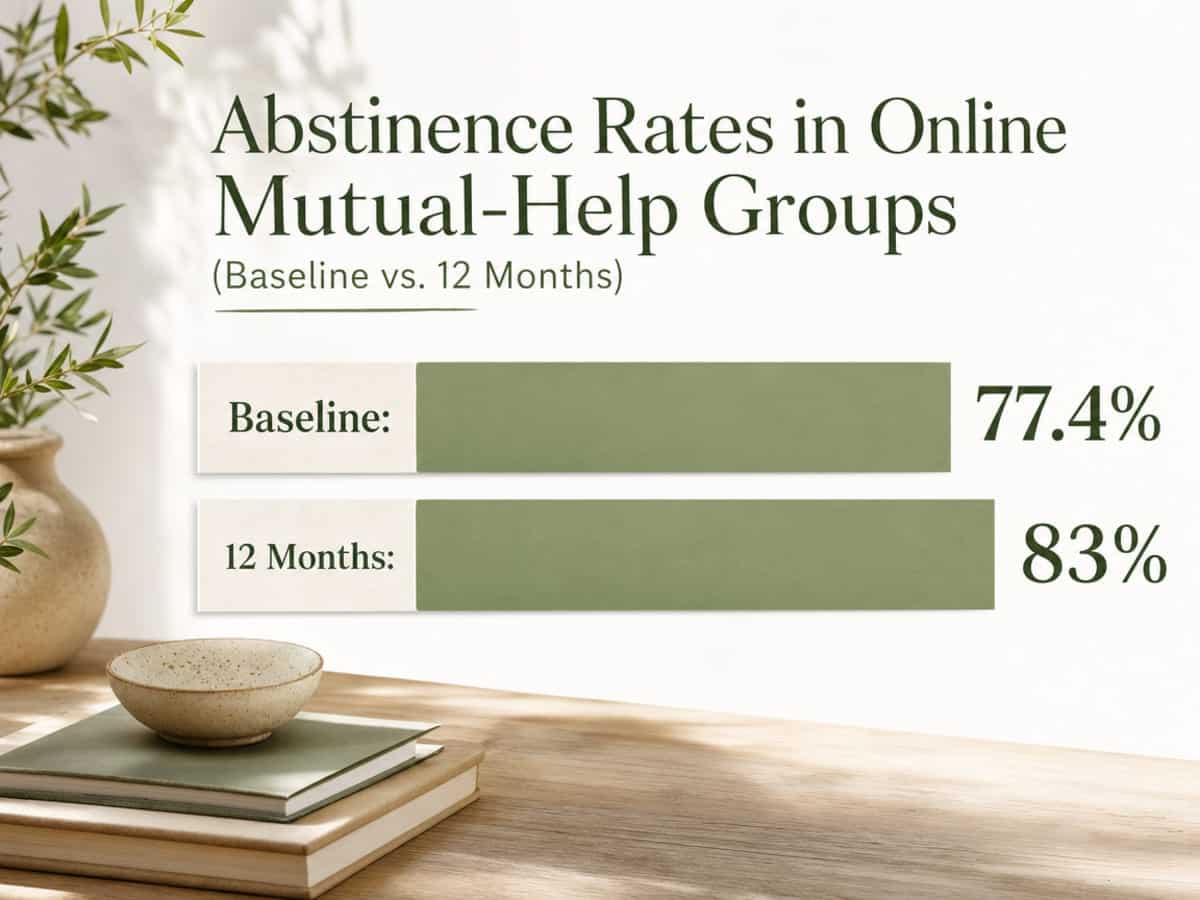
The advent of online platforms has significantly expanded access to mutual-help programs. SMART, LifeRing, Women for Sobriety, and Refuge Recovery all offer video meetings, allowing individuals to participate remotely or combine in-person and online attendance. Research on online mutual-help is encouraging. An analysis of PAL Study data revealed that while online attendees initially had lower abstinence rates, they achieved similar rates to in-person attendees by the 12-month mark, indicating that online formats can effectively support recovery when participants remain engaged 6. For those facing barriers to physical attendance, online options provide a viable and effective alternative.
Does the Evidence Actually Support Non-12-Step Programs?
Yes, with important considerations. The most robust comparative data comes from the Project on Addiction and Life-Course (PAL) Study, which tracked adults participating in Women for Sobriety, LifeRing, SMART Recovery, and 12-step groups over 6 to 12 months. This study found no single program consistently outperformed the others in terms of abstinence, drinking days, or alcohol-related problems. Instead, the key predictor of positive outcomes was the individual’s involvement in their chosen primary group, regardless of which group it was 3. A 2025 systematic review of SMART, LifeRing, and Women for Sobriety reached a similar conclusion, while also noting that the number of randomized trials for these programs is smaller than for AA 4. This suggests that non-12-step programs are comparable in effectiveness, and engagement is the crucial factor.
The importance of engagement is also evident in online data. An analysis of PAL Study participants utilizing online mutual-help meetings (across various programs) showed that alcohol abstinence increased from 77.4% at baseline to 83.0% at 12-month follow-up, and total substance abstinence rose from 72.6% to 79.1% over the same period 6. Although online attendees initially had lower abstinence rates, they closed this gap within a year, highlighting the efficacy of online formats for those who commit to them.
However, some caveats exist. The systematic review of SMART Recovery studies, while generally positive, noted that small sample sizes and varied methodologies in some studies warrant cautious interpretation of strong efficacy claims 2. Evidence for non-12-step groups treating illicit drug use, particularly stimulants and opioids, is less extensive than for alcohol, though a 2025 review indicated that mutual-help attendance generally predicted better outcomes across different substance types 7. The evidence consistently supports that choosing a program that aligns with one’s preferences and actively participating significantly increases the likelihood of success. It does not, however, endorse any single program as universally superior.
Where Mutual-Help Actually Fits: The Recovery Stack
Mutual-help meetings, whether 12-step or alternative, are not a standalone treatment but rather one component within a comprehensive recovery framework. When individuals bypass other essential layers of care, meetings may seem ineffective because they are being asked to fulfill a role they were not designed to handle alone.
This framework can be conceptualized as a “recovery stack.” The foundational layer is medical detox. For individuals physically dependent on alcohol, opioids, or benzodiazepines, safe withdrawal typically requires clinical supervision to manage symptoms like blood pressure fluctuations, seizures, and other physical complications. The National Institute on Drug Abuse (NIDA) explicitly states that medical detoxification is only the initial phase of addiction treatment and has limited impact on long-term drug use if not followed by further care 9. Thus, detox is necessary but not sufficient.
The middle layer involves formal treatment. For opioid use disorder, the American Society of Addiction Medicine (ASAM) recommends psychosocial treatment in conjunction with medication for all patients on Medication-Assisted Treatment (MAT). This includes counseling, family support, and community referrals, which complement medications like buprenorphine or naltrexone 8. Similarly, the VA/DoD guideline for substance use disorders advocates for integrated pharmacotherapy, psychosocial interventions, and linkage to mutual-help programs based on patient preference, all within a recovery-oriented system 18. Group therapy led by trained clinicians, encompassing cognitive-behavioral, skills-based, or support-focused approaches, constitutes a distinct layer of care, separate from peer-led meetings 15.
Mutual-help programs form the top layer of this stack. This includes SMART meetings, LifeRing circles, Women for Sobriety gatherings, Refuge Recovery sessions, or 12-step meetings, depending on individual preference. This layer sustains recovery efforts after formal treatment concludes, serving as a crucial link between short-term programs and long-term sobriety.
Choosing Your Program: A Practical Decision Frame
The goal is not to find a “perfect” program, but one that you will consistently attend, as consistent attendance is strongly linked to positive outcomes 1. Here’s a practical approach to making that choice:
First, consider the language and philosophy. If the concept of a higher power is genuinely problematic for you, programs like SMART, LifeRing, Women for Sobriety, Refuge Recovery, and Secular Organizations for Sobriety are designed without this framing. Even if it’s not a strong aversion, but other aspects of 12-step programs didn’t resonate, exploring alternatives is a valid step.
Next, reflect on your preferred way of processing challenges. If you appreciate structured tools, worksheets, and a cognitive approach to managing cravings, SMART’s cognitive-behavioral format may be a good fit. If you prefer open discussion and hearing others’ experiences, LifeRing’s conversational style might be more appealing. For those whose substance use is connected to shame, trauma, or gender-specific issues, a women-only environment, such as Women for Sobriety, has strong evidence supporting its effectiveness 17. If you seek introspective, contemplative work without religious doctrine, Refuge Recovery offers such an approach.
Finally, evaluate accessibility. Consider whether you can attend in-person meetings or if online participation is necessary. Online engagement has been shown to achieve similar 12-month outcomes as in-person attendance for those who remain committed 6.
It’s recommended to try a program and attend at least three meetings before making a decision. If it still doesn’t feel right, explore another option. The key is finding a setting where you feel comfortable and motivated to return.
Populations With Specific Needs
Veterans and Co-Occurring PTSD
For veterans whose substance use is intertwined with post-traumatic stress disorder (PTSD), a specialized recovery plan is often necessary. Substance use and PTSD frequently exacerbate each other; for example, using substances to cope with nightmares can lead to increased dependence. Addressing the underlying trauma is crucial for effective recovery.
VA practice recommendations for veterans with co-occurring SUD and PTSD emphasize initiating addiction-focused psychosocial care, including cognitive-behavioral therapy, contingency management, and motivational enhancement. These interventions should be combined with strategies to promote active involvement in mutual-help programs chosen based on individual history and preference 11. This guideline underscores the importance of selecting a program that the veteran will genuinely engage with, rather than forcing a particular model. SMART Recovery’s cognitive-behavioral tools often align directly with trauma-informed therapeutic approaches used by VA clinicians, creating a cohesive treatment experience.
Opioids, Stimulants, and Polysubstance Use
While the evidence base for non-12-step groups is most robust for alcohol use, research on their effectiveness for opioid, stimulant, and polysubstance use is growing. A 2025 review of mutual-help groups for illicit drug use found that attendance correlated with improved drug and alcohol outcomes and higher rates of complete abstinence. Non-12-step formats like SMART show promise, though more controlled trials are needed 7.
For opioid use disorder specifically, the comprehensive “recovery stack” is particularly vital. ASAM recommends psychosocial treatment in conjunction with medication for all patients on MAT, viewing mutual-help (whether 12-step or alternative) as an ancillary support rather than a replacement for medications like buprenorphine, methadone, or naltrexone 8. Some 12-step environments may express discomfort with MAT. In contrast, SMART and LifeRing are generally accepting of medication, making them potentially more suitable for individuals undergoing MAT. The recommendation is to integrate medication with mutual-help support, rather than choosing one over the other.
Oklahoma’s Peer Recovery Network
Oklahoma’s public health system incorporates a valuable component of the recovery stack: the Peer Recovery Network. The Oklahoma Department of Mental Health and Substance Abuse Services trains and certifies Peer Recovery Support Specialists (PRSS). These are individuals with lived experience in recovery who provide support to others on similar journeys 13. A PRSS is distinct from a therapist or sponsor; their role is to listen, share their own experiences, and help individuals connect with necessary resources, whether that’s a mutual-help meeting, a counselor, housing assistance, or transportation to appointments 14.
For someone transitioning out of detox who may not feel ready for a 12-step meeting but also doesn’t want to navigate recovery alone, a peer specialist can provide crucial support. They are not tied to a single mutual-help philosophy and can help individuals find programs like SMART or LifeRing if those are a better fit. Oklahoma also certifies Family Peer Recovery Support Specialists to assist family members in supporting their loved ones effectively 13.
Oklahoma’s administrative rules mandate that licensed substance use disorder programs coordinate these recovery support services alongside clinical care, making peer services an integral part of the state’s treatment model 12. It is advisable to request a connection with a peer specialist before leaving detox, as this handoff can be a critical step in ongoing recovery.
Starting Where Recovery Actually Starts
It’s important to recognize that no mutual-help meeting, secular or otherwise, will be effective if the body is still in the throes of withdrawal. The correct sequence of care, often overlooked in failed quit attempts, begins with safe, medically supervised detox to manage the physical aspects of withdrawal. Following detox, the subsequent layers of care include counseling, medication (if appropriate), and engagement with a mutual-help program that resonates with the individual. NIDA clearly states that detox alone has limited long-term impact without subsequent treatment 9, and major guidelines consistently position mutual-help as one component of a broader, patient-preferred recovery plan, rather than a prescribed tradition 18.
Therefore, if you’ve been caught between struggling alone and finding a program that didn’t fit, a different starting point exists. A medically supervised detox, such as those offered in Oklahoma City, is designed to safely guide you through the most challenging initial days, then facilitate a transition to the comprehensive treatment and peer support necessary for sustained recovery. The choice of path is yours, but the essential first step is safely navigating withdrawal.
Talk with a Recovery Specialist Right Now
Get real answers about non-12-step recovery options and next steps for lasting change.
Frequently Asked Questions
Do non-12-step recovery programs actually work as well as AA?
For adults with abstinence-oriented goals, comparative evidence suggests they are similarly effective. A longitudinal study involving Women for Sobriety, LifeRing, SMART Recovery, and 12-step groups found that no single program was definitively superior. The most significant factor predicting positive outcomes was the individual’s active involvement in their chosen group, rather than the specific program’s label 3.
Can I go through recovery without believing in a higher power?
Yes. Programs such as SMART Recovery, LifeRing, Women for Sobriety, Refuge Recovery, and Secular Organizations for Sobriety are designed without a higher-power framework. Major clinical guidelines emphasize that mutual-help should be chosen based on patient preference, not dictated by tradition 18. If the concept of powerlessness or a higher power was a barrier to 12-step programs, there are many alternatives available.
What actually happens in a SMART Recovery or LifeRing meeting?
SMART meetings are interactive working sessions led by a facilitator. Participants check in and then utilize cognitive-behavioral tools, such as cost-benefit analyses or the ABC model for managing cravings. LifeRing meetings are conversational, where participants share their weekly experiences and strategies for maintaining sobriety. Neither program involves steps, sponsors, or prayer, focusing instead on practical tools or shared discussion 2.
Do I need medical detox before joining a mutual-help group?
If you are physically dependent on substances like alcohol, opioids, or benzodiazepines, medical detox is crucial. Withdrawal from these substances can be medically dangerous, and NIDA clearly states that detox is the essential first stage of care 9. Mutual-help meetings cannot manage severe withdrawal symptoms like seizures or blood pressure instability. It is vital to complete a safe, clinically supervised detox before engaging in mutual-help as part of your ongoing recovery plan.
Can I combine a non-12-step program with medication for opioid or alcohol use disorder?
Yes, and current clinical guidelines strongly recommend this integrated approach. ASAM advises psychosocial treatment in conjunction with medication for all patients on MAT, with mutual-help serving as an additional support 8. Programs like SMART and LifeRing are generally supportive of medication-assisted treatment, making them potentially more compatible than some 12-step environments that may express reservations about MAT. The recommendation is to continue medication while also participating in a suitable mutual-help program.
What if I try a program and it doesn’t fit?
It’s advisable to attend at least three meetings of any program before deciding if it’s the right fit, as a single session may not be representative. If after three meetings it still doesn’t feel right, explore a different program. Various options like LifeRing, SMART, Women for Sobriety, and Refuge Recovery cater to different preferences. Research indicates that consistent attendance is a primary driver of success 1, so the objective is to find a program you are comfortable and willing to return to regularly.
References
- Comparison of 12-step Groups to Mutual Help Alternatives for Alcohol Use Disorder. https://pmc.ncbi.nlm.nih.gov/articles/PMC5193234/
- Systematic review of SMART Recovery: Outcomes, process variables, and participant profiles. https://pubmed.ncbi.nlm.nih.gov/28165272/
- A Longitudinal Study of the Comparative Efficacy of Women for Sobriety, LifeRing, SMART Recovery, and 12-step groups. https://pmc.ncbi.nlm.nih.gov/articles/PMC5884451/
- A Systematic Review of SMART Recovery, LifeRing, and Women for Sobriety for Alcohol Use Disorder. https://minds.wisc.edu/items/eec4f7a4-4c15-4224-8d8a-4654682a4788
- An Investigation of SMART Recovery: A Prospective Longitudinal Cohort Study. https://pmc.ncbi.nlm.nih.gov/articles/PMC9900056/
- Predictors and Outcomes of Online Mutual-help Group Participation in Adults with Alcohol Use Disorders. https://pmc.ncbi.nlm.nih.gov/articles/PMC9167158/
- Effectiveness of Mutual Help Groups for Illicit Drug Use Disorders: A Review. https://pmc.ncbi.nlm.nih.gov/articles/PMC12360454/
- ASAM National Practice Guideline for the Use of Medications in the Treatment of Addiction Involving Opioid Use. https://medicine.hsc.wvu.edu/media/367154/asam_mat_national_practice_guidelines.pdf
- Principles of Drug Addiction Treatment: A Research-Based Guide. https://nida.nih.gov/sites/default/files/podat_1.pdf
- NIDA Treatment Guidelines: Effective Substance Use Disorder Treatments. https://webcampus.med.drexel.edu/nida/module_1/content/5_0_Treatment.htm
- Practice Recommendations for Treatment of Veterans with Comorbid Substance Use Disorder and PTSD. https://www.mentalhealth.va.gov/providers/sud/docs/SUD_PTSD_Practice_Recommendations.pdf
- Oklahoma Administrative Code: Standards and Criteria for Substance Use Disorders Treatment Programs (Chapter 18). https://oklahoma.gov/content/dam/ok/en/odmhsas/documents/policy/provider-certification/administrative-rules/2021/Chapter%2018%20Final%20effective%209-15-21.pdf
- Certified Peer Recovery Support Specialist – Oklahoma ODMHSAS. https://oklahoma.gov/odmhsas/trainings/workforce-certification/certified-peer-recovery-support-specialist.html
- Peer Services – Recovery – Oklahoma Department of Mental Health and Substance Abuse Services. https://oklahoma.gov/odmhsas/recovery/peer-services.html
- Substance Abuse Treatment: Group Therapy (SAMHSA Treatment Improvement Protocol). https://library.samhsa.gov/product/substance-abuse-treatment-group-therapy/sma15-4024
- The Women’s Recovery Group Study: A Stage I trial of women-focused group therapy for substance use disorders. https://pmc.ncbi.nlm.nih.gov/articles/PMC3679366/
- The Relative Effectiveness of Women-Only and Mixed-Gender Substance Abuse Treatment Programs. https://pmc.ncbi.nlm.nih.gov/articles/PMC3081899/
- VA/DoD Clinical Practice Guideline for the Management of Substance Use Disorders (Summary Resource). https://integrationacademy.ahrq.gov/resources/17256