
Key Takeaways
- Oscar plans sold on the Oklahoma City marketplace must cover medical detox as an ACA essential health benefit, with parity rules preventing stricter limits than comparable medical stays 11.
- Coverage itself is settled, but deductible, coinsurance, and out-of-pocket max vary by plan tier — those specific numbers are what determine your actual admission cost.
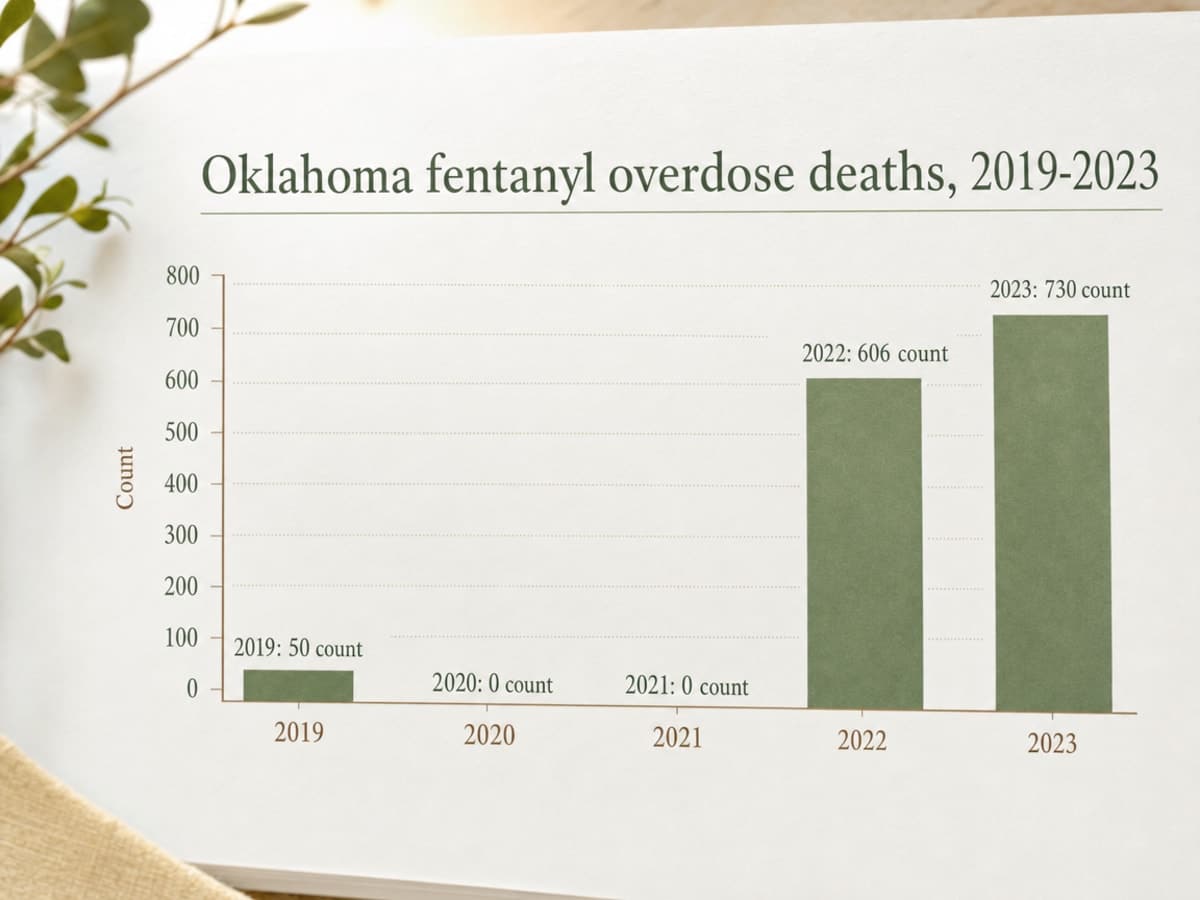
- Oklahoma’s fentanyl overdose deaths jumped from 50 in 2019 to 730 in 2023, and local facilities operate under state-recognized protocols for inpatient withdrawal management 7, 12.
- Before calling, gather your member ID, plan name, group number, primary substance, last use, current medications, and medical conditions so admissions can document medical necessity to Oscar quickly.
What Oscar Actually Has to Cover When You Call About Detox
If you’re reading this on your phone at 6 a.m., insurance card in one hand, wondering whether Oscar will actually pay for detox — take a breath. The answer to the biggest question is already settled by federal law, not by whoever picks up the phone at the member line.
Every plan Oscar sells on the Oklahoma City marketplace is an Affordable Care Act plan. That means it has to cover substance use disorder treatment as one of the ten essential health benefits — the same short list that includes hospital stays, emergency care, and prescription drugs 2, 3. Medical detox and inpatient behavioral health both live inside that category. So the starting point isn’t whether your plan covers detox. It’s what your plan looks like when it does.
The second protection matters just as much. Under the Mental Health Parity and Addiction Equity Act, Oscar can’t make it harder to get detox than it would be to get a comparable medical or surgical hospital stay 11. That applies to the dollars — your copay, your deductible, your out-of-pocket max — and to the rules, like visit limits or approval requirements 4. If Oscar covers a week in the hospital for pneumonia without a mountain of paperwork, it can’t turn around and make opioid withdrawal management a bureaucratic maze.
Here’s what that means for you, sitting there this morning: you don’t have to argue for the concept of coverage. You’re not asking Oscar to make an exception. You’re asking a plan that is legally required to include this benefit to tell you the specific numbers on your specific policy — which, by the way, is exactly what a facility like Renewal Springs, which works with Oscar as an in-network detox provider in Oklahoma City, does for you at no cost when you call for a benefits check.
The Real Question Isn’t Coverage — It’s Your Specific Plan
Once you know detox has to be covered, the honest next question is smaller and more useful: what does your Oscar plan look like when it pays for it?
Oscar sells several plan tiers in Oklahoma — bronze, silver, gold, and their EPO variants — and the federal rules that require coverage don’t dictate every service line inside it. Peer-reviewed analysis of the ACA’s effect on substance use disorder treatment makes this plain: federal law requires SUD coverage, but it doesn’t spell out which exact services a plan must include, which is where variation between carriers and tiers creeps in 5. Two people with Oscar cards in the same Oklahoma City ZIP code can walk into detox with meaningfully different deductibles, coinsurance percentages, and out-of-pocket maximums.
So the questions worth asking are the specific ones:
- What is your deductible — the amount you pay before Oscar starts sharing costs? How much have you already met this year?
- After the deductible, what percentage does Oscar pay for an in-network inpatient stay, and what percentage falls to you (that’s coinsurance)?
- What’s your out-of-pocket max — the ceiling on what you can spend before Oscar pays everything?
- Is inpatient detox a covered level of care on your specific plan, or would Oscar want you to try outpatient first?
That last one matters. Federal parity rules mean Oscar can’t hide behind arbitrary limits, but it can still apply medical necessity criteria and utilization review — the same kind of rules a hospital stay for anything else would face 10. That’s not a denial waiting to happen. It’s a conversation, usually a fast one, between the facility’s admissions team and Oscar’s clinical reviewer.
You don’t have to translate any of this yourself. When you call Renewal Springs for a free benefits check, the team pulls your plan details from Oscar directly and tells you — in dollars, not jargon — what admission this week would actually cost you. That’s the answer you’re really after.
What Oklahoma City Looks Like Right Now for Someone in Withdrawal
Here’s the part that matters, and then we’ll set it down: you’re not alone in this, and the numbers say the same thing.
Oklahoma’s fentanyl-involved overdose deaths went from 50 in 2019 to 730 in 2023 — a roughly fourteenfold jump in five years 7. That’s not a statistic for a policy paper. That’s neighbors, coworkers, someone’s kid, someone’s dad. If you’re the person reading this with a bottle of pills that’s dwindling faster than you meant, or you’re the mother refreshing a screen at 2 a.m. because your son didn’t come home, that curve is the room you’re standing in. It’s also the reason detox capacity in Oklahoma City is not some optional service line — it’s the frontline of an ongoing emergency.
The state has responded, at least on the structural level. Oklahoma’s CMS-approved waiver treats medically necessary residential treatment, facility-based crisis stabilization, and inpatient withdrawal management as legitimate, monitored levels of care 12. That matters even if you’re on Oscar and not on SoonerCare, because it shapes the clinical standards local facilities operate under — the same standards Renewal Springs applies whether your card says Oscar, another commercial carrier, or something else entirely.
What this means for the phone call you’re thinking about making: the local system knows what medical detox is. It has protocols for opioid withdrawal, for MAT induction with buprenorphine or methadone bridges, for the fever-and-shakes stretch that keeps people using because stopping feels impossible alone. You are not going to be the strange case. You are going to be Tuesday.
And if what’s stopping you right now is just the weight of the last few years — everything the fentanyl chart above represents, and everything it’s cost you personally — that’s fair. Put the phone down for five minutes if you need to. Then pick it back up. The next step is smaller than the whole picture.
Before You Call: What to Have in Front of You
The call itself takes about ten minutes. What eats the time — and what makes people give up halfway through — is scrambling for information mid-conversation. So let’s get the pile in front of you first, while your hands are still steady.
Pull out your Oscar insurance card. If you can’t find it, the Oscar app has a digital version under the ID Card tab; that counts. From the card, you want five things:
- your member ID number (usually the longest string, sometimes prefixed with letters),
- the group number if there is one,
- the plan name printed on the front (something like “Oscar Silver EPO” or “Oscar Gold Classic”),
- the RxBIN or pharmacy identifier,
- and the customer service phone number on the back.
Take a photo of the front and back with your phone. That single step saves ten minutes and a lot of squinting.
Next, get honest with a piece of paper. Write down the primary substance you’re using or that your loved one is using — the one causing the withdrawal risk. If it’s more than one, list them in order of use. Write the last time of use, as best you can remember, and roughly how much. Note whether there’s been a prior detox or treatment episode, when, and how it ended. Add any current medications, including prescriptions for anxiety, blood pressure, seizures, or MAT like buprenorphine or methadone. And write down any medical conditions the admissions team should know about — pregnancy, heart issues, seizure history, diabetes.
None of this is going into a permanent file the world sees. It’s clinical intake, protected by HIPAA, and it lets Renewal Springs’ team tell Oscar exactly why this admission meets medical necessity — the same criteria Oscar applies to any inpatient stay under federal parity rules 11. Vague answers slow the prior authorization down. Specific answers move it.
One more small thing that matters more than it sounds like it should: a quiet room, or at least a door you can close. You may need to say things out loud that you haven’t said to anyone. That’s easier when nobody’s listening over your shoulder. If you’re the family member making the call for someone else, be ready with that person’s date of birth and, if possible, their verbal permission — the admissions team can walk you through consent on the line.
You gathered the card. You wrote the list. That’s the hardest part of the paperwork already behind you.
The Four Steps a Benefits Check Actually Follows
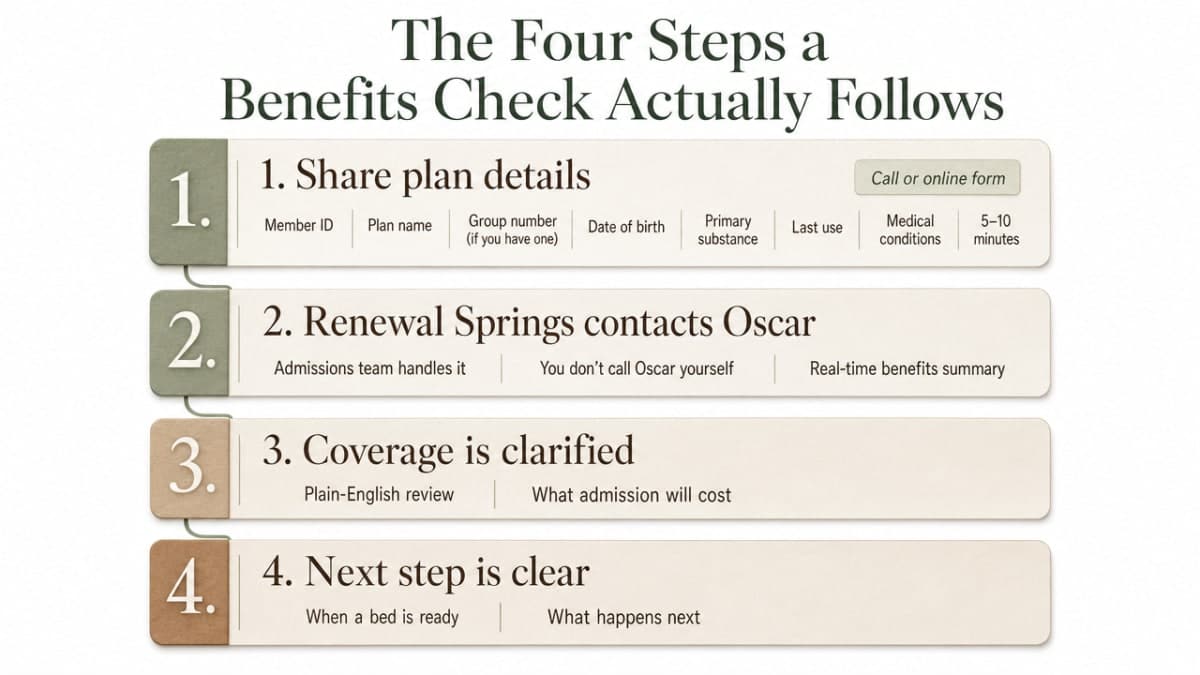
You have your card, your notes, and a quiet room. Here’s what actually happens between the moment you dial and the moment someone tells you, in plain English, what admission will cost you and when a bed is ready.
Step one: you share your Oscar plan details. When you call Renewal Springs or fill out the online benefits form, the admissions team asks for the member ID, the plan name, the group number if you have one, and your date of birth. That’s it for the insurance side. On the clinical side, they’ll ask about the primary substance, last use, and any medical conditions from the list you already wrote down. Five to ten minutes, tops.
Step two: Renewal Springs contacts Oscar directly. This is the part you don’t have to do yourself, which is a relief when you’re already running on fumes. The team pulls a real-time benefits summary from Oscar — deductible, how much of it you’ve already met, coinsurance, out-of-pocket max, and whether inpatient detox is covered at the in-network rate. Because Renewal Springs is in-network with Oscar in Oklahoma City, the numbers that come back reflect the lower in-network cost share, not the surprise bills that come with going outside the network.
Step three: Oscar reviews prior authorization. This is the step that scares people, and it’s the one worth understanding calmly. Prior authorization is what regulators call a non-quantitative treatment limit — a rule about how you access care rather than how much of it you get 10. Oklahoma treats detox and residential SUD services as prior-authorization-required levels of care across public and commercial plans 13, and Oscar is no different. The admissions team submits the clinical picture — your withdrawal risk, your substance, your co-occurring conditions — and Oscar’s clinical reviewer says yes, asks for more information, or (rarely, for a clear medical necessity case) says no. Under parity rules, that review has to move at the same speed and follow the same kind of medical necessity criteria Oscar would use for any inpatient stay. For opioid withdrawal, decisions typically come back within hours, not days.
Step four: you get a clear picture. Renewal Springs comes back to you with three specific things — what admission will actually cost you out of pocket, whether prior auth is approved or pending, and when a bed is available. No jargon, no maybe. If something in the middle stalls, you hear about it in real time, not three days later in the mail.
Four steps. One phone call on your end. The rest happens behind the scenes while you go take a shower or sit with the person you love.
Why Opioid Detox Meets Medical Necessity Differently Than Alcohol or Benzo Detox
If you’re the person on the opioid side of this — fentanyl, heroin, oxycodone, tramadol, whatever the primary substance is — it helps to know that Oscar’s clinical reviewer isn’t looking at your case with the same checklist they’d use for someone coming off alcohol or Xanax. The medical necessity picture is genuinely different, and that difference usually works in your favor for getting inpatient detox approved quickly.
Alcohol and benzodiazepine withdrawal are the two syndromes where not being in a medical setting can kill you. Seizures, delirium tremens, cardiovascular collapse — those are the reasons alcohol and benzo detox almost always sail through prior auth for inpatient care. Opioid withdrawal is different. It is rarely fatal on its own, and Oscar’s reviewer knows that. On paper, that could make the medical necessity argument harder — except for what opioid withdrawal actually looks like in 2024 and what happens when someone tries to ride it out at home.
The clinical case for inpatient opioid detox rests on three things a facility like Renewal Springs documents for Oscar during prior auth:
- MAT induction — starting buprenorphine or a methadone bridge safely requires timing withdrawal precisely, and a botched induction sends people back to using within hours.
- Relapse risk during withdrawal is a mortality risk in the fentanyl era; tolerance drops fast, and a return-to-use dose that felt normal a week ago can be fatal now.
- Co-occurring conditions. Oklahoma’s state behavioral health data shows how common it is for substance use to travel with mental health diagnoses that complicate detox — depression, anxiety, PTSD, trauma histories that don’t pause because you stopped using 9. Any one of those alone can push an outpatient plan into inpatient territory.
Under federal parity rules, Oscar has to evaluate that clinical picture with medical necessity criteria comparable to what it would use for any inpatient medical stay 11. So when Renewal Springs submits your case, it’s not pleading for an exception — it’s documenting a standard opioid detox admission the way the criteria expect. That’s the difference between a fast yes and a stalled maybe.
Oscar’s Digital Tools — and Where They Stop Being Enough
One reason you may have picked Oscar in the first place: the tech actually works. The app shows your deductible progress, your ID card, your claims, and your Virtual Primary Care visits without a fax machine anywhere in sight. For most of what a healthy 34-year-old needs from an insurer in a year, that’s genuinely enough.
Detox is the place where those tools quietly hit their edge. The app will tell you that substance use disorder services are covered — which they have to be under the ACA’s essential health benefits 2— and it may show a searchable in-network directory. What it won’t do is submit a prior authorization for inpatient withdrawal management, argue medical necessity for a same-day admission, or tell you at 11 p.m. on a Thursday whether the bed you need tomorrow morning is authorized. Those decisions live in a clinical review process the app doesn’t touch.
Virtual Primary Care has the same limit. A telehealth visit is a fine place to talk about tapering plans or a referral, but it isn’t a substitute for a medically supervised detox admission when withdrawal is already turning physical. Oscar’s own coverage structure recognizes that — inpatient detox is a different level of care, subject to its own utilization review rules 10.
So use the app for what it’s good at: confirming your plan is active, finding your member ID, checking your deductible progress before you call. Then hand the harder part — the prior auth, the medical necessity documentation, the timing of admission — to an in-network facility like Renewal Springs that does this every day. The digital tools got you this far. A person takes it from here.
If Something Feels Off: Appeals and the Oklahoma Parity Route
Most of the time, the benefits check comes back clean and admission moves forward. Sometimes it doesn’t. If Oscar denies your detox admission, delays prior authorization past what the clinical picture warrants, or approves a level of care that feels wrong for what you’re actually going through — you have real options, and you don’t have to use them alone.
Start with the appeal on your Oscar plan. Every denial letter has to spell out the reason, the clinical criteria used, and the deadline for internal appeal. Renewal Springs’ admissions team writes these appeals routinely and can attach peer-to-peer review — a doctor at the facility talking directly to Oscar’s medical reviewer. That call resolves a surprising number of soft denials within a day.
If the internal appeal fails and something still smells like a parity problem — say, Oscar approving a five-day inpatient medical stay easily but insisting opioid detox happen outpatient — that’s when the Oklahoma Insurance Department becomes your leverage. OID handles parity complaints for fully insured individual and marketplace plans sold in the state, which includes Oscar’s ACA offerings 1. You can file directly. The department can require Oscar to show its work — the medical necessity criteria, the utilization data, the comparability analysis parity law now demands 10.
You are not being difficult by asking. Parity exists because plans have historically treated substance use differently, and the whole point of the complaint route is that you don’t have to prove the pattern — the regulator does. Save the denial letter, save the call notes, and make the next phone call.
If You’re Not on Oscar After All: A Quick Sanity Check
A quick note for the reader who pulled out the card and realized it doesn’t actually say Oscar — or who isn’t sure what they’re holding. This happens more than you’d think at 3 a.m.
If your card says SoonerCare, you’re on Oklahoma Medicaid, and medical detox is a covered benefit there too — inpatient acute care, crisis stabilization, and medical detoxification are all named services 8, with prior authorization required for detox and residential SUD care 13. Different phone tree, same destination. Renewal Springs works with SoonerCare members and can run that verification the same way.
If you don’t have any coverage right now, don’t stop reading. Oklahoma treats residential and inpatient withdrawal management as a legitimate, monitored level of care regardless of payer 12, and the admissions team can talk through same-day options, sliding arrangements, or a fast marketplace enrollment if you qualify for a special enrollment period. Uninsured is not a closed door. It’s a slightly longer intake conversation.
Whatever the card says — Oscar, another commercial carrier, SoonerCare, or nothing — the next move is the same one. Make the call. Let someone else sort the paperwork.
Talk to a Detox Admissions Specialist Now
Get answers about Oscar coverage and start your detox admission process right away.
Frequently Asked Questions
Does Oscar cover medical detox in Oklahoma City?
Yes. Every Oscar plan sold on the Oklahoma marketplace has to cover substance use disorder services, including medical detox, as one of the ten essential health benefits under the ACA 2. Federal parity rules also require those benefits to be treated no more restrictively than a comparable medical or surgical hospital stay 11. What varies is your specific deductible, coinsurance, and out-of-pocket max — which is what a free benefits check confirms.
Will calling to verify my benefits put a mark on my record or alert my employer?
No. A benefits check is a confidential clinical intake protected by HIPAA. It doesn’t generate a public record, and if you’re on an individual Oscar marketplace plan, your employer isn’t involved at all. Even on employer-sponsored coverage, the employer sees premiums and enrollment — not the reason you called a provider. You can ask a question about coverage without committing to admission and without anyone being notified.
What information do I need before I call for a benefits check?
Have your Oscar member ID, the plan name printed on the card, the group number if there is one, and your date of birth. On the clinical side, write down the primary substance, the last time of use, roughly how much, any current medications (including MAT like buprenorphine), and any relevant medical conditions — pregnancy, seizure history, heart issues. That short list is what lets admissions document medical necessity to Oscar quickly.
What is prior authorization, and will it delay my admission?
Prior authorization is Oscar’s clinical review of whether inpatient detox is medically necessary — what regulators call a non-quantitative treatment limit 10. Oklahoma treats detox as a prior-auth-required level of care 13, so this step is standard, not a red flag. For opioid withdrawal cases with clear documentation, decisions typically come back within hours. If Oscar asks for more information, Renewal Springs’ admissions team handles the back-and-forth while you focus on getting through the day.
What if Oscar denies coverage for detox?
Denials aren’t the end of the road. The first move is an internal appeal, often paired with a peer-to-peer review where a facility doctor speaks directly with Oscar’s medical reviewer — that resolves many soft denials within a day. If the pattern looks like a parity problem — Oscar approving comparable medical inpatient stays but blocking detox — you can file a complaint with the Oklahoma Insurance Department, which oversees marketplace plans sold in the state 1.
What if I’m on SoonerCare or uninsured instead of Oscar?
You still have a path. SoonerCare covers medical detoxification, inpatient acute care, and crisis stabilization as core behavioral health benefits 8, with prior authorization required for detox and residential SUD services 13. If you’re uninsured, Oklahoma treats inpatient withdrawal management as a legitimate level of care regardless of payer 12, and admissions can walk you through same-day options or a special enrollment period if you qualify. Make the call — the paperwork sorts itself from there.
References
- Understanding Mental Health Parity and Your Insurance. https://www.oid.ok.gov/getready12_2023/
- Mental health & substance abuse coverage. https://www.healthcare.gov/coverage/mental-health-substance-abuse-coverage/
- Essential Health Benefits Bulletin – CMS. https://www.cms.gov/cciio/resources/files/downloads/essential_health_benefits_bulletin.pdf
- Understanding Your Mental Health and Substance Use Disorder Benefits. https://www.dol.gov/agencies/ebsa/about-ebsa/our-activities/resource-center/publications/understanding-your-mental-health-and-substance-use-disorder-benefits
- The Affordable Care Act Transformation of Substance Use Disorder Treatment. https://pmc.ncbi.nlm.nih.gov/articles/PMC5308192/
- Drug Overdose Data – Oklahoma State Department of Health. https://oklahoma.gov/health/health-education/injury-prevention-service/drug-overdose/data.html
- Drug Overdose Deaths, 2019–2023 – Oklahoma Fact Sheet. https://oklahoma.gov/content/dam/ok/en/health/health2/aem-documents/prevention-and-preparedness/injury-prevention/drug-overdose/2025%20State%20Drug%20OD%20-%20IPS%20-%20Fact%20Sheet.pdf
- Behavioral Health and Substance Abuse Services – SoonerCare. https://oklahoma.gov/ohca/individuals/mysoonercare/soonercare-benefits/behavioral-health-and-substance-abuse-services.html
- Co-Occurring Substance Use (Oklahoma Department of Mental Health and Substance Abuse Services). https://oklahoma.gov/content/dam/ok/en/odmhsas/documents/research/reports/Substance-Use-Report.pdf
- New Mental Health and Substance Use Disorder Parity Rules: What They Mean for Plans and Issuers. https://www.dol.gov/agencies/ebsa/laws-and-regulations/laws/mental-health-parity/new-mhpaea-rules-what-they-mean-for-plans-and-issuers
- Mental Health Parity and Addiction Equity Act (MHPAEA) – CMS. https://www.cms.gov/marketplace/about/oversight/other-insurance-protections/mental-health-parity-and-addiction-equity-act-mhpaea
- December 22, 2020 Melody Anthony Chief State Medicaid Director… Approval Letter and Special Terms and Conditions. https://www.medicaid.gov/medicaid/section-1115-demonstrations/downloads/ok-imd-waiver-smi-sud-cms-appvl-12222020.pdf
- Mental Health and Substance Abuse Services – Oklahoma.gov. https://oklahoma.gov/ohca/individuals/programs/mental-health-and-substance-abuse-services.html