
What to Know About Outpatient Detox Programs
Key Takeaways
- Outpatient detox is real medical care with three jobs: evaluation, stabilization, and preparing you for ongoing treatment — not a stand-alone cure for substance use disorder 3.
- ASAM Level 1-WM fits mild withdrawal with brief daily visits, while Level 2-WM covers moderate withdrawal with extended on-site monitoring and a supportive home at night 5, 6.
- Prior withdrawal seizures, delirium tremens, failed detox attempts, unstable medical or psychiatric conditions, or an unsafe home mean inpatient stabilization is the safer starting point 9, 10.
- Ask what week two looks like before saying yes to week one — especially for opioids, where detox without ongoing maintenance therapy carries very high relapse risk 12.
You Already Tried to Quit. Here’s What Changes With Medical Supervision.
You made the decision. You poured it out, flushed the pills, or picked a Monday and told yourself this was it. And then your body pushed back harder than you expected — the sweats, the shaking, the sleepless nights, the pull that felt bigger than your willpower. Maybe you white-knuckled it for a few days. Maybe you didn’t make it past the first afternoon.
That’s not a character flaw. Withdrawal is a medical event, and for alcohol, opioids, and benzodiazepines especially, it can be dangerous to ride out alone 9. The fact that you’re reading this instead of trying the same thing again is already a shift worth noticing.
Outpatient detox — sometimes called ambulatory withdrawal management — is a real level of medical care. You sleep at home. You show up for scheduled visits with clinicians who monitor your vitals, adjust medications, and track your withdrawal symptoms with validated tools 2. It sits between quitting alone and checking into a hospital bed, and for the right person, it can be safe and effective 10.
The rest of this guide walks you through what outpatient detox involves, who it fits, who it doesn’t, and how to tell the difference honestly.
What Outpatient Detox Actually Is (Ambulatory Withdrawal Management)
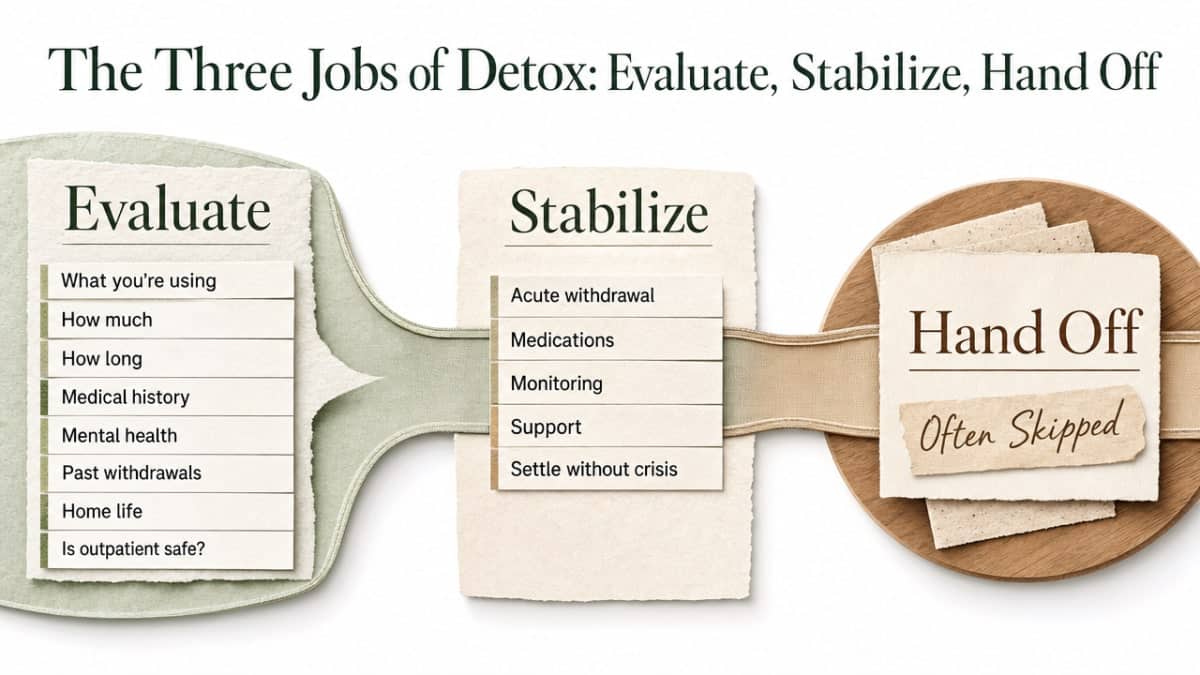
The Three Jobs of Detox: Evaluate, Stabilize, Hand Off
Detox isn’t one thing. It’s three jobs stitched together, and understanding that changes what you should expect from a good outpatient program.
- The first job is evaluation. Before anyone hands you a prescription, a clinician needs a full picture: what you’re using, how much, how long, your medical history, your mental health, what withdrawals have looked like for you in the past, and what your home life actually looks like on a Tuesday night. This isn’t a formality. It’s how they decide whether outpatient care is safe for you at all 3.
- The second job is stabilization. This is the part most people picture when they hear “detox” — getting through the acute withdrawal window with medications, monitoring, and support so your body can settle without a crisis 3.
- The third job is the one that gets skipped most often, and it’s the one that decides whether all of this holds: fostering your readiness for ongoing treatment 3. A good program starts planning your next step before you finish your first week. Detox alone doesn’t fix a substance use disorder. It gets you to a starting line where the real work can begin.
Where It Happens and Who’s in the Room With You
Outpatient detox happens in a few different places depending on your risk level: a physician’s office, a specialty addiction clinic, a day-hospital program, or sometimes a home-health arrangement with visiting nurses 1. You don’t sleep there. You come in for scheduled visits, get evaluated, receive medications if they’re indicated, and go home with a clear plan for the hours in between.
Who you actually see varies, but a real program has medical eyes on you. Expect some combination of a physician or nurse practitioner overseeing your care, nurses handling vitals and withdrawal scale assessments, and counselors or case managers helping you think about what comes after stabilization 1. Programs designed for patients who can’t be in a hospital setting are backed up by medical and nursing coverage around the clock, so if something shifts overnight, there’s a number to call and a plan already in place 2.
ASAM Level 1-WM vs Level 2-WM: The Decision Framework That Matters
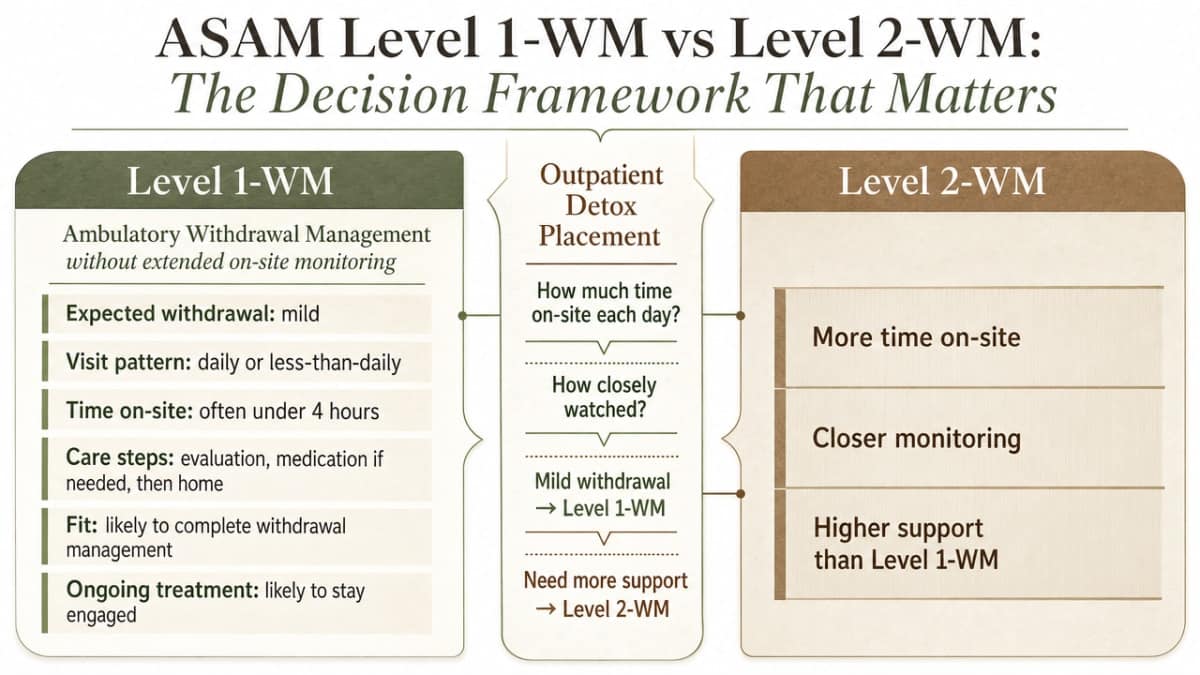
Here’s where the language gets specific, and specific is your friend right now. The American Society of Addiction Medicine (ASAM) splits outpatient detox into two levels, and the difference between them is not marketing. It’s how clinicians decide how much time you need on-site each day and how closely you’ll be watched.
Level 1-WM (Ambulatory Withdrawal Management without extended on-site monitoring) is for people expected to have mild withdrawal. You come in for daily or less-than-daily visits — often under four hours on-site — get evaluated, receive medications if needed, and head home 5. ASAM describes this level as fitting someone with “mild withdrawal with daily or less-than-daily outpatient supervision” who is likely to complete withdrawal management and stay engaged in ongoing treatment 6.
Level 2-WM (Ambulatory Withdrawal Management with extended on-site monitoring) steps up the intensity. You’re on-site more than four hours but fewer than 24, sometimes most of the day, with clinical staff watching you through the peak symptom window 5. The ASAM criteria describe Level 2-WM patients as having “moderate withdrawal with all-day withdrawal management support and supervision” who then go home at night to a supportive family or living situation 6. That last part is not optional.
Above both of these sits inpatient or residential withdrawal management, where you sleep on-site and clinical staff are available every hour of the night. That level is for severe expected withdrawal, unstable medical or psychiatric conditions, or a home situation that can’t support recovery.
Why does this matter to you? Because when you call a program, you should hear language that matches this framework. If a program can’t tell you which level you’d start at and why, that’s a signal. Your withdrawal history, what you’ve been using and how much, whether you live alone, and how you’d get to daily visits all feed into which level fits — or whether outpatient is the right call at all.
Are You a Candidate? Honest Eligibility Criteria
The Green-Light Profile
Let’s do this honestly. Outpatient detox is a good fit for a real, specific profile of person — not everyone, and that’s not a judgment. It’s biology and logistics.
You’re generally a candidate when five things line up:
- Your expected withdrawal is mild to moderate. Based on what you’ve been using, how much, and how long, a clinician can reasonably predict you won’t hit the severe end of the withdrawal curve 1.
- You don’t have a history of withdrawal seizures or delirium tremens. If you’ve never had a seizure coming off alcohol and never hallucinated or lost track of where you were, that’s a meaningful data point 9.
- Your home is stable and someone helpful is in it. A calm place to sleep, a person who can check on you, and no active chaos around your recovery 1.
- You don’t have acute medical or psychiatric instability. No uncontrolled heart problems, no active suicidal crisis, no untreated serious mental illness making the next 72 hours unpredictable 10.
- You can actually get to your appointments. Reliable transportation to daily visits isn’t a small detail. Missing days breaks the safety net.
If most of that describes you, take a breath. You’re in the range where outpatient care is designed to work.
When Outpatient Detox Is Not Safe for You
This part matters more than the green-light list, so read it slowly.
Outpatient detox is not the right level of care for you if any of the following are true. This isn’t about gatekeeping. It’s about not dying from something that a higher level of care could have caught in the next room.
- You’ve had a withdrawal seizure before, or delirium tremens. Once your nervous system has gone there, it’s more likely to go there again. Inpatient monitoring exists for exactly this 9.
- Your last few quit attempts ended in severe withdrawal, medical emergencies, or the ER. Prior failed detox attempts are one of the clearest signals in the literature that a higher level of care is warranted 10.
- You have significant untreated medical conditions. Uncontrolled heart disease, liver disease, pregnancy, or serious co-occurring illness change the risk calculation completely 9.
- You’re in acute psychiatric distress. Active suicidal thinking, psychosis, or a severe untreated mental health condition needs a setting where someone is with you continuously.
- You don’t have a safe, supportive place to sleep. If home is where the using happens, where the person who hurts you lives, or where you’d be alone through the worst nights, outpatient care can’t protect you from that gap 1.
None of this means you’re beyond help. It means the right first step is a higher level of care — inpatient or residential withdrawal management — and then, often, stepping down to outpatient once you’re stable. Being honest about which door to walk through first is the whole point.
What Happens Medically, by Substance
Alcohol: Symptom-Triggered Protocols and the CIWA-Ar
If alcohol is what you’ve been trying to stop, here’s what a real outpatient program looks like from the inside.
You’ll come in, and someone will run through a validated withdrawal scale with you — most commonly the CIWA-Ar. It scores things like tremor, sweating, anxiety, nausea, and how alert you are. That number, not a guess, is what drives the medication decisions 4. If your score is low, you may not need medication that visit. If it climbs, they treat it.
The medication piece is usually a symptom-triggered benzodiazepine protocol. Instead of a fixed dose you take on a schedule whether you need it or not, you get medication based on what your body is actually doing that day 11. Adjunctive medications may be added for sleep, blood pressure, or nausea. You’ll be given clear instructions for what to take at home, what warning signs mean you call, and when to come back — typically daily at first.
Structured ambulatory programs like this achieve high rates of completion and low complication rates when patients are carefully selected 11. That last phrase matters. The protocol works because the screening in front of it works. If your withdrawal starts outrunning the plan, the plan changes — and sometimes that means moving you to a higher level of care the same day.
Opioids: Why Detox Alone Isn’t the Goal
Opioid withdrawal is miserable. It’s rarely medically dangerous the way alcohol withdrawal can be, but it’s the kind of miserable that sends people back to using within hours of trying to stop. That’s the part outpatient care is built to interrupt.
In an outpatient setting, opioid withdrawal is typically managed with buprenorphine, sometimes clonidine, and adjunctive medications for the physical symptoms — the cramping, the nausea, the restlessness that won’t let you sit still 12. Your clinician tracks your symptoms with a scale called the COWS and adjusts as you go.
Here’s the honest part, and it’s the one you need to hear before you start: patients detoxified from opioids without subsequent maintenance therapy relapse at very high rates 12. That’s not a scare tactic. It’s the reason a good outpatient program doesn’t treat detox as the finish line for opioid use. Instead, the goal is to move you through the acute withdrawal window and directly into ongoing medication-assisted treatment — buprenorphine or methadone maintenance — that keeps working after the initial symptoms fade.
If a program offers you opioid detox with no clear plan for what happens on day eight, ask why. The evidence is on your side to push for a real handoff.
Benzodiazepines: Slow Tapers, Careful Selection
Benzodiazepines — Xanax, Klonopin, Ativan, Valium — are the substance where outpatient detox requires the most caution and the slowest hand.
Stopping benzos abruptly, especially after long-term or high-dose use, can trigger seizures. That’s why outpatient management of benzodiazepine dependence is built around a gradual taper: your clinician works with you to reduce your dose in small steps over weeks, sometimes months, while monitoring for withdrawal symptoms along the way 13. There is no reasonable version of “outpatient benzo detox in five days.”
Structured outpatient tapering has achieved successful discontinuation in a majority of patients without major complications, but only with appropriate monitoring and careful case selection 13. If you’ve been on high doses, using them for a long time, mixing them with alcohol or opioids, or if you’ve had a withdrawal seizure before, outpatient care may not be the right starting point.
Looking across substances, the picture that emerges is not a blanket yes or no. Ambulatory detox works for many people with mild-to-moderate alcohol or opioid withdrawal when they’re linked to ongoing care 2, 11, 12. It works for benzodiazepines only with slow tapers and tight selection 13. And TIP 45 consensus originally recommended hospital-level detox for alcohol, opioids, and sedative-hypnotics — a reminder that outpatient care for these substances requires disciplined screening, not marketing enthusiasm 2.
Stimulants and Other Substances: A Brief Note
Stimulants — cocaine, methamphetamine, high-dose prescription stimulants — don’t produce the kind of physically dangerous acute withdrawal that alcohol and benzos can. What you’ll face instead is a crash: deep fatigue, heavy sleep, low mood, and intense cravings that can last weeks.
That doesn’t mean you shouldn’t get help. It means the medical piece looks different. Outpatient care for stimulant use often focuses less on medication for withdrawal itself and more on stabilization, mental health support, and rapid engagement in ongoing treatment 7. The same is generally true for kratom and cannabis — outpatient support with a strong emphasis on what comes next.
How Outpatient Compares to Inpatient and Residential
You may already be running the math in your head: if outpatient works, why would anyone choose a hospital bed? The answer isn’t that one is better and one is worse. They’re built for different bodies and different situations.
Outpatient keeps you at home. You keep your job, your kids’ school routine, your own bed. The trade-off is that the safety net has gaps between visits — hours where no one is watching you, and where a support person at home is the first line if something shifts. This is why ambulatory detox is only considered appropriate when you have a positive, helpful social support network in place 1.
Inpatient or residential withdrawal management takes those gaps away. You sleep on-site. Nurses check on you overnight. If your blood pressure spikes at 3 a.m. or a seizure comes out of nowhere, someone is already in the room. That level of coverage is what TIP 45 originally recommended as the default for withdrawal from alcohol, opioids, and sedative-hypnotics — a reminder of how seriously the risk was taken before ambulatory options expanded 2.
The clinical question isn’t which setting is nicer. It’s which one matches your risk. Outpatient care is described in the literature as safe and effective for carefully selected patients, but not suitable for people with a history of complicated withdrawal or serious medical or psychiatric illness 10. If that describes you, starting inpatient and stepping down to outpatient after stabilization is often the smarter path — and a common one.
The Handoff: Why Detox Isn’t the Finish Line
Here’s the part that gets glossed over in a lot of brochures, and it’s the part you can’t afford to gloss over.
Detox gets your body through the acute withdrawal window. It does not, by itself, treat a substance use disorder. TIP 45 is explicit about this: detoxification is a process with three parts — evaluation, stabilization, and fostering your readiness for entry into treatment — not a stand-alone cure 3. The third part is where outpatient programs either earn their keep or quietly set you up to end up right back where you started.
What a real handoff looks like in practice: your program starts talking with you about what comes next in the first few days, not the last. For alcohol, that might mean stepping into an intensive outpatient program, individual counseling, medications like naltrexone or acamprosate, and a peer support community that fits you 7. For opioids, it means a direct bridge into buprenorphine or methadone maintenance — because detox without ongoing medication-assisted treatment leaves you at very high risk of relapse and overdose 12. For benzodiazepines, it means continued mental health care for whatever the medication was originally treating.
How to Take the Next Step in Oklahoma City
You’ve read this far, which means you’re closer to a decision than you were an hour ago. That counts.
A practical next step looks like this: call a local medical detox program and ask for an evaluation. Bring your honest answers to the eligibility questions in this guide — what you’ve been using, how much, how long, what past withdrawals looked like, who’s at home with you. A good clinician will place you at the level of care that fits, whether that’s Level 1-WM, Level 2-WM, or inpatient stabilization first with an outpatient step-down after 5, 6.
If you’re not ready to call a facility directly, SAMHSA’s National Helpline is free, confidential, and available 24/7 for treatment referrals across the country, including Oklahoma 8.
Whatever door you walk through, ask what week two looks like. Detox is evaluation, stabilization, and the handoff into ongoing care 3. The programs worth your time already have that third part planned. Renewal Springs Detox in Oklahoma City is one option built around that full arc.
Ready to Talk About Your Detox Options?
Connect directly with a team member for guidance on safe, effective detox pathways tailored to your situation.
Frequently Asked Questions
How long does outpatient detox usually take?
It depends on the substance and your withdrawal severity. Alcohol withdrawal is typically most intense over three to seven days, with tapering visits after. Opioid withdrawal peaks in the first several days but blends into ongoing maintenance treatment. Benzodiazepine tapers stretch over weeks or months by design 13. A clinician sets the timeline based on your evaluation, not a fixed program length.
Can I keep working or caring for my family during outpatient detox?
Sometimes yes, sometimes no. Level 1-WM may only need a few hours of on-site time per visit, which some people fit around a schedule. Level 2-WM can take most of your day for several days running 5. Expect fatigue, poor sleep, and difficulty concentrating regardless of level. Plan for reduced responsibilities during the first week, even if you technically could push through.
What medications might I be given during outpatient withdrawal?
For alcohol, expect a symptom-triggered benzodiazepine protocol dosed to your CIWA-Ar score, plus adjuncts for sleep, blood pressure, or nausea 4, 11. For opioids, buprenorphine is common, sometimes with clonidine and comfort medications, then transition into ongoing maintenance 12. For benzodiazepines, you slowly taper the medication itself over weeks 13. Your clinician chooses based on your substance, history, and daily assessments.
What happens if my withdrawal symptoms get worse than expected?
Good programs plan for this before it happens. You’ll have a number to call around the clock and clear instructions for warning signs — worsening tremor, confusion, chest pain, hallucinations 2. If your symptoms outrun the outpatient plan, your clinician can escalate care the same day, which sometimes means moving you to inpatient stabilization. Escalation isn’t failure. It’s the safety net working correctly.
Do I need someone to stay with me at home during detox?
Yes, and this isn’t a soft recommendation. Ambulatory detox is considered appropriate only when you have a positive, helpful social support network at home 1. A trusted person needs to be present through the peak withdrawal days to check on you, help with medications, and call for help if something shifts. If you can’t line that up, tell the intake clinician honestly — it changes the plan.
What if I’ve already failed outpatient detox before?
That history matters, and it’s not held against you — it’s clinical information. Prior failed detox attempts are one of the clearest signals in the research that a higher level of care may be needed this time 10. Bring it up during your evaluation. Starting with inpatient stabilization and stepping down to outpatient once you’re stable is a common and reasonable path, not a setback.
References
- 2 Settings, Levels of Care, and Patient Placement. https://www.ncbi.nlm.nih.gov/books/NBK64109/
- Ambulatory detoxification in alcohol use disorder and opioid use disorder. https://pmc.ncbi.nlm.nih.gov/articles/PMC7653729/
- Quick Guide for Clinicians Based on TIP 45 — Detoxification and Substance Abuse Treatment. https://nida.nih.gov/sites/default/files/samhsa_detoxification_and_substance_abuse_treatment.pdf
- The ASAM Clinical Practice Guideline on Alcohol Withdrawal Management Pocket Guide. https://www.samhsa.gov/resource/ebp/asam-clinical-practice-guideline-alcohol-withdrawal-management-pocket-guide
- Substance Use Disorders Services Policy and Clinical Assumptions – Ambulatory Withdrawal Management. https://portal.ct.gov/-/media/Departments-and-Agencies/DSS/Health-and-Home-Care/CT-Outpatient-SUD-Assumptions-Grid-Ambulatory-Withdrawal-Management-FINAL.pdf/1000
- The ASAM Criteria® – Level of Withdrawal Management for Adults. https://www.azahcccs.gov/PlansProviders/Downloads/CurrentProviders/ASAMCriteriaBrochure.pdf
- TIP 47: Substance Abuse: Clinical Issues in Intensive Outpatient Treatment. https://library.samhsa.gov/product/tip-47-substance-abuse-clinical-issues-intensive-outpatient-treatment/sma13-4182
- National Helpline for Mental Health, Drug, Alcohol Issues. https://www.samhsa.gov/find-help/helplines/national-helpline
- Chapter: Alcohol Withdrawal Syndrome – StatPearls (NCBI Bookshelf). https://www.ncbi.nlm.nih.gov/books/NBK310652/
- Alcohol detoxification: inpatient vs outpatient management – clinical considerations. https://pubmed.ncbi.nlm.nih.gov/17850115/
- Medically assisted alcohol withdrawal: ambulatory strategies. https://pubmed.ncbi.nlm.nih.gov/26919224/
- Outpatient opioid withdrawal management and transition to maintenance treatment. https://pubmed.ncbi.nlm.nih.gov/25449026/
- Ambulatory detoxification for benzodiazepine dependence. https://pubmed.ncbi.nlm.nih.gov/22109368/