
Is PHP Rehab for Veterans the Right Choice?
Key Takeaways
- PHP bridges the vulnerable gap after detox, offering intensive weekday clinical care while veterans return home at night, filling the space between residential treatment and standard outpatient therapy.
- Current VA guidelines call for treating PTSD and substance use disorders concurrently from the start, so any program that defers trauma work until later sobriety falls short of best practice 6.
- Fit depends on five lenses: withdrawal stability, functional impairment, home safety at night, PTSD symptom load, and realistic daily availability for 15 or more program hours weekly 1.
- Judge program quality by verifying required staffing, integrated trauma care, coordinated handoffs from detox, and concrete case management for housing, benefits, VA referrals, and vocational support.
The Fragile Weeks After Detox
The days immediately following detox are a critical period. While physical withdrawal symptoms may subside, the emotional and psychological challenges of early recovery often intensify. This phase demands careful consideration for the next steps in treatment.
The Substance Abuse and Mental Health Services Administration (SAMHSA) emphasizes that detox alone is not a complete treatment for a substance use disorder. It is merely the initial step in a broader continuum of care, and successful long-term recovery hinges on transitioning into ongoing support 2. For veterans, this period can be particularly challenging, as sleep disturbances and resurfacing traumatic memories are common, and the structured environment of detox is replaced by the complexities of daily life.
A Partial Hospitalization Program (PHP) is specifically designed to address the needs of individuals in this vulnerable stage. It acts as a bridge for the weeks when physical stability has been achieved, but the nervous system, daily routines, and support networks are still developing. Considering a PHP at this juncture demonstrates a proactive approach to sustained recovery.
What a Partial Hospitalization Program Actually Is
A Partial Hospitalization Program (PHP) provides intensive treatment during the day, allowing participants to return home at night. This model offers a structured clinical environment typically found in inpatient settings, while maintaining some connection to one’s regular life.
In Oklahoma, PHPs are regulated as an alternative or step-down from inpatient care, with the goal of improving a patient’s condition and preventing relapse or re-hospitalization 1. Clinically, a PHP involves a multidisciplinary team, including a psychiatrist as medical director, a registered nurse, and licensed behavioral health professionals. Services encompass individual and group therapy, skills training, medication support, case management, and 24/7 crisis coverage 1.
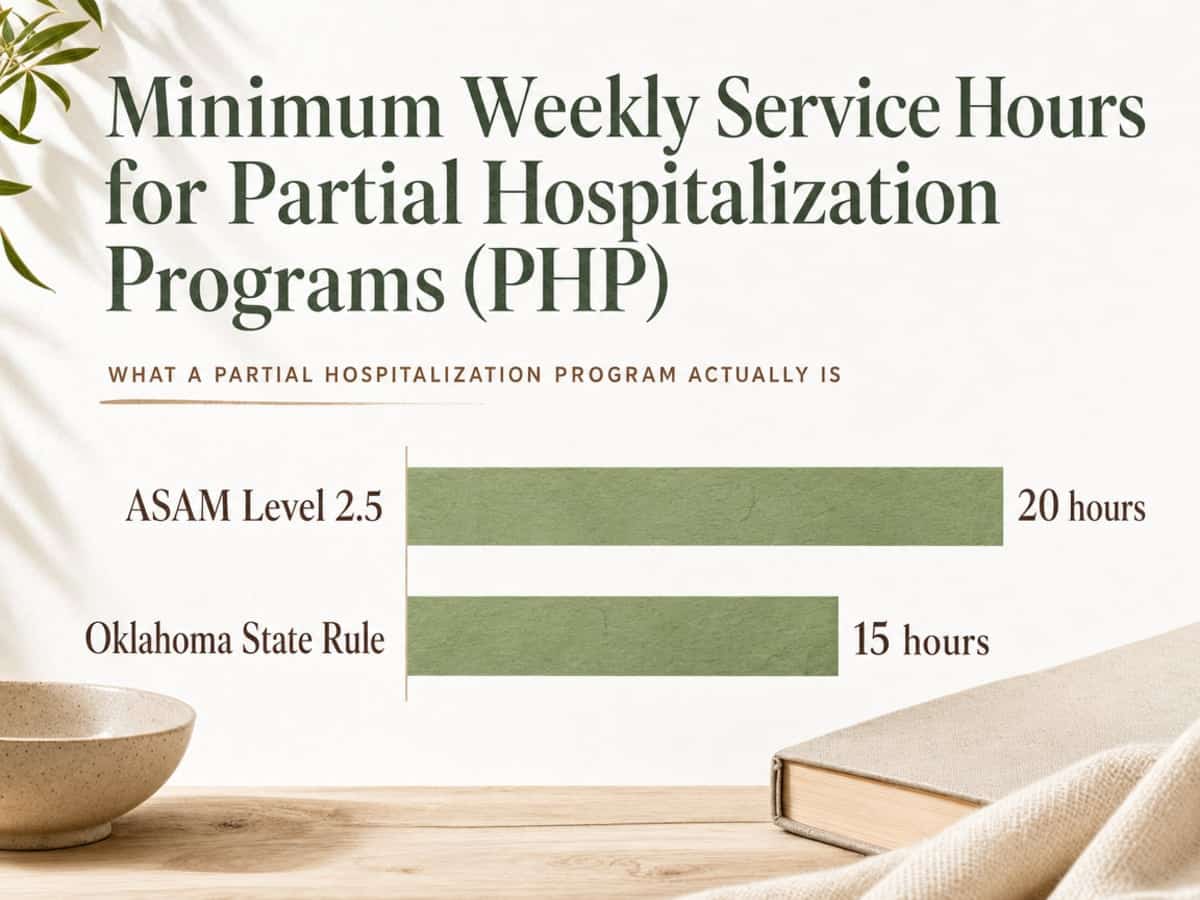
Regarding time commitment, national ASAM Level 2.5 criteria recommend 20 or more service hours per week. Oklahoma’s regulations specify approximately 15 hours per week, typically three hours a day, five days a week 1.
It is important to clarify what PHP is not. It is distinct from detox, residential rehab, or standard outpatient care. PHP cannot be billed concurrently with inpatient SUD treatment, targeted case management, PACT, CCBHC, or peer recovery services in Oklahoma 1. Additionally, room, board, education, and childcare are not covered by PHP services 1. Essentially, PHP serves as a weekday clinical anchor for individuals who require more support than traditional outpatient therapy but are medically stable enough to reside at home.
Where PHP Sits on the Continuum of Care
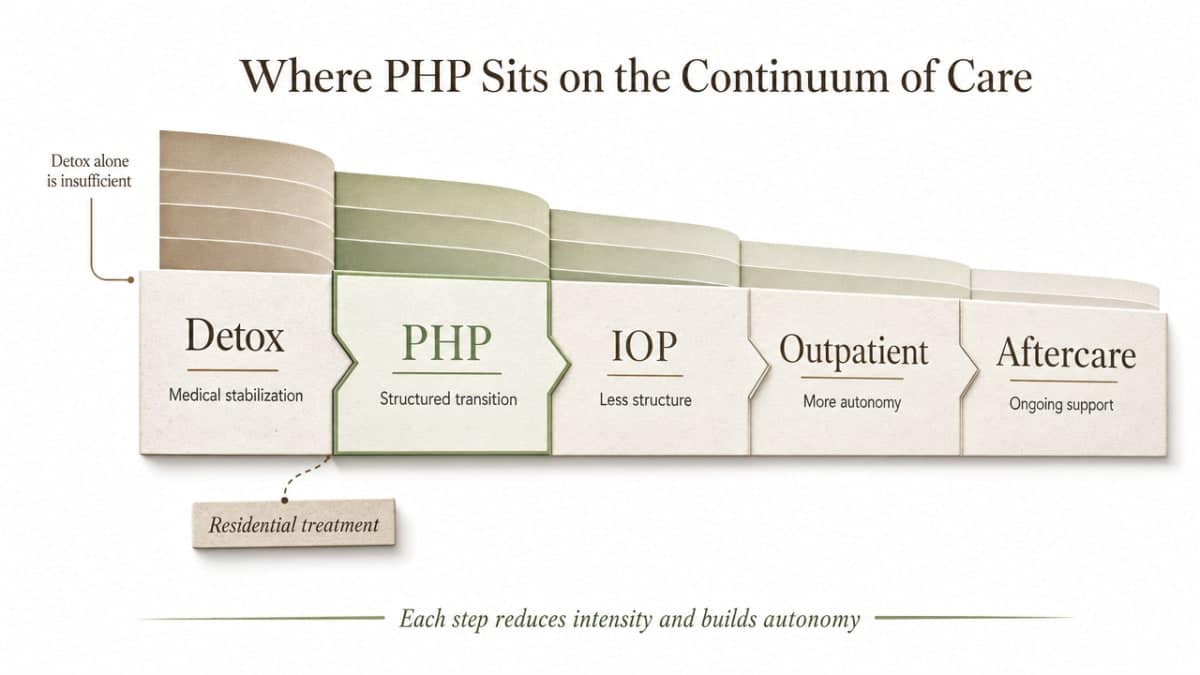
The journey from active substance use to stable recovery involves a continuum of care, with each step offering a different level of support. Detox is the initial medical stabilization phase. PHP often follows, providing a structured transition before moving to Intensive Outpatient Programs (IOP), and then standard outpatient care and aftercare. Each subsequent step reduces the intensity of structure, aiming to equip individuals with increasing autonomy and coping mechanisms.
Detox focuses solely on safely removing substances from the body. SAMHSA explicitly states that detox alone is insufficient for treating substance dependence and must be integrated into a broader continuum of care 2. A lack of a post-detox plan is a common factor in relapse, particularly for veterans managing co-occurring PTSD and SUD.
Residential treatment, which involves living at a facility with round-the-clock clinical care, represents a higher level of intensity than PHP. PHP, while offering similar daily clinical hours to residential programs, allows patients to return home overnight. The VA describes day treatment, a model akin to PHP, as involving several days per week of group and individual therapy for multiple hours daily 5.
IOP is a step down from PHP, typically involving fewer weekly hours, often three sessions instead of five, promoting greater independence. Standard outpatient and aftercare represent the least intensive levels, focusing on weekly or bi-weekly sessions, medication management, and peer support, as individuals build a life independent of intensive program structures.
PHP is often referred to as a “bridge” because it fills a crucial gap. Many veterans exiting detox are not yet ready for the limited support of weekly therapy, nor do they necessarily require or have access to residential care. PHP provides the daily clinical engagement of residential treatment without requiring an overnight stay, and offers more support than outpatient services, preventing premature independence. Oklahoma’s regulations specifically authorize PHP as a step-down from inpatient or residential treatment, or as an alternative for those who need more than standard outpatient care but not 24-hour supervision 1.
Understanding one’s position on this continuum is vital. The most effective next step is one that aligns with current stability and needs, rather than perceived convenience or program labels.
PTSD and SUD as Co-Primary, Not Sequential
Historically, treatment for trauma and substance use disorders (SUD) often followed a sequential model: address sobriety first, then trauma. This approach frequently led to relapse, as substances often served as a coping mechanism for traumatic memories, and removing them without providing alternative coping tools proved unsustainable.
Current VA guidance has shifted away from this model. The 2023 PTSD and 2021 SUD clinical practice guidelines advocate for concurrent treatment of both disorders, ensuring that a diagnosis of one does not impede treatment for the other 6. The VA explicitly states that veterans with co-occurring PTSD and SUD often require more intensive services than standard outpatient settings can provide 4. The Agency for Healthcare Research and Quality (AHRQ) further supports this, emphasizing that level-of-care decisions should be guided by individual patient needs 11.
This integrated approach is particularly relevant for PHP. Co-occurring PTSD and alcohol use disorder can lead to more severe symptoms and functional impairment than either condition alone 8. This combination often necessitates a higher level of care than weekly therapy. Evidence supports trauma-focused psychotherapy delivered simultaneously with SUD treatment, rather than sequentially 7. A PHP that delays trauma work or treats it as secondary is not aligned with current best practices.
While direct comparative evidence for PHP specifically for dual-diagnosis veterans is still developing, exploratory studies indicate that integrated treatment can reduce symptom severity 10. The prevailing guidelines underscore the importance of treating both conditions concurrently, at an intensity level that addresses the impact on daily functioning.
A Week Inside PHP: What the Rhythm Looks Like
Understanding the daily rhythm of a PHP can clarify its benefits. A typical PHP week runs Monday through Friday, with clinical sessions scheduled during morning and early afternoon hours. Participants attend sessions at the facility and return home before the evening rush.
The VA’s description of day treatment aligns with this structure, involving attendance several days a week with multiple hours of group and individual therapy daily 5. In Oklahoma, this typically translates to about three hours a day, five days a week, incorporating various services mandated by state regulations. These services include:
- assessment
- individual and group therapy
- family sessions (when appropriate)
- skills training
- medication management
- case management
- access to 24/7 crisis support 1
A typical morning might begin with a check-in group, allowing participants to share their experiences from the previous night, including sleep quality, cravings, or emotional states. This is often followed by a process group, where clinicians facilitate discussions on underlying factors contributing to substance use. Mid-morning sessions frequently focus on skills development, such as grounding techniques for flashbacks, urge-surfing strategies for cravings, or communication skills for challenging personal interactions. Individual therapy sessions are scheduled several times a week, and a psychiatrist or prescriber monitors medications for withdrawal recovery, sleep, or PTSD symptoms.
Afternoons typically involve tapering activities. Case management might address practical needs like benefits, housing, or communication with probation officers. Participants usually conclude their day by lunch or early afternoon, returning home. Evenings are then available for family time, support meetings, rest, or practicing the skills learned during the day, preparing for the next day’s sessions.
A Five-Lens Framework for Judging Fit
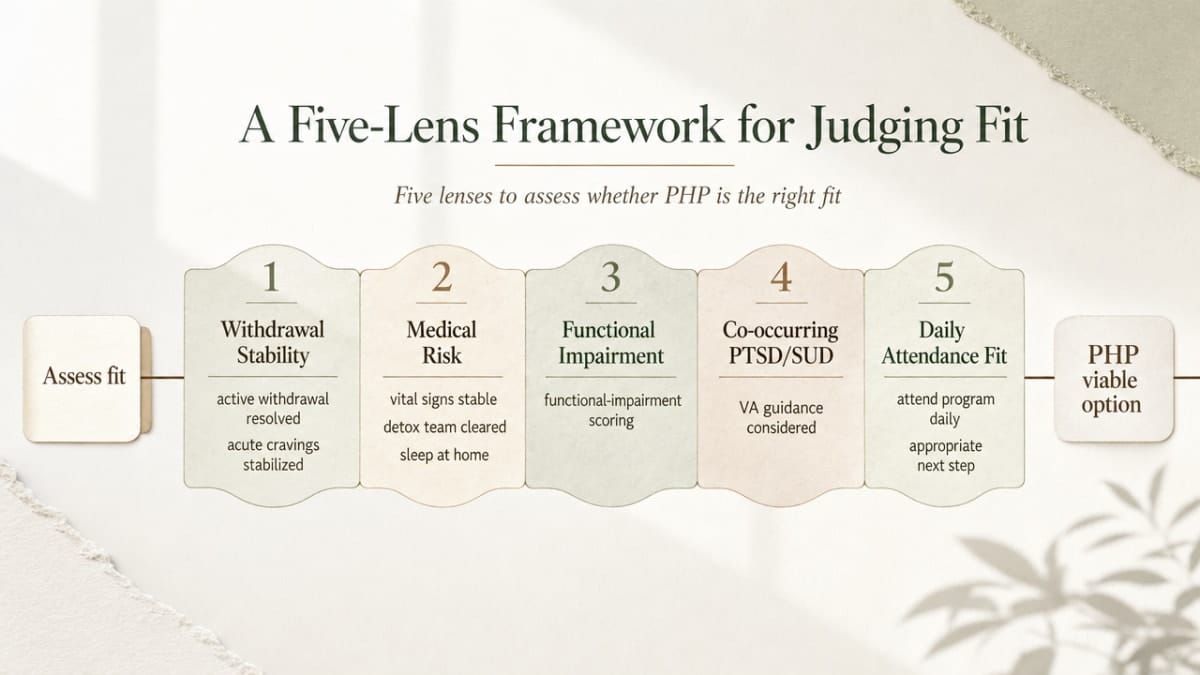
Determining if PHP is the appropriate next step involves a comprehensive assessment using several key criteria. These lenses align with Oklahoma’s PHP rule 1, SoonerCare’s functional-impairment scoring 3, and VA guidance on co-occurring PTSD and SUD 4. By evaluating these factors, individuals can make an informed decision about the most suitable level of care.
Withdrawal Stability and Medical Risk
PHP is not designed for managing active withdrawal symptoms. The Oklahoma rule presumes medical stability, meaning individuals are stable enough to sleep at home and attend the program daily 1. It’s crucial to assess if tremors, seizure risks, vital sign fluctuations, and acute cravings are resolved. If the detox team has cleared the individual and vital signs have remained stable for several days, PHP becomes a viable option. However, if withdrawal symptoms persist or a medication taper is ongoing, a higher level of care is necessary.
Functional Impairment Level
SoonerCare’s framework categorizes adult functional impairment into four levels, with the higher levels indicating severe impairment that necessitates intensive services to prevent hospitalization 3. PHP is suitable for individuals at the upper end of this range—those who can manage basic self-care and attend appointments but experience significant challenges with work, parenting, and self-regulation. If impairment is less severe (levels one or two), IOP or standard outpatient care may be sufficient. Conversely, if daily life has become largely unmanageable, residential care should be considered.
Home Environment and Safety at Night
Since PHP involves returning home each evening, the home environment must be conducive to recovery. It’s important to honestly assess if others in the household are actively using substances, if alcohol is present, or if cohabitants are triggers rather than sources of support. Ensuring a secure place for medications and functional locks on doors is also critical. If the home environment poses significant risks, the overnight autonomy of PHP could be detrimental, making residential care, which provides 24-hour supervision, a safer alternative.
PTSD Symptom Load
The severity of trauma symptoms directly impacts the need for intensive care. VA guidance clearly states that PTSD and SUD should be treated concurrently, and veterans with both conditions often require more intensive services than standard outpatient care can provide 4. If flashbacks, nightmares, or hypervigilance are significantly affecting daily life, PHP offers five mornings a week of structured clinical contact, allowing clinicians to address both diagnoses simultaneously. If PTSD symptoms are mild and stable, IOP might be sufficient.
Daily Availability and Transportation
PHP demands a significant time commitment, typically 15 to 20+ hours per week during business hours 1. Practical considerations such as reliable transportation (e.g., a ride, bus route, or program van) and arrangements for childcare or work shifts are essential. If logistical challenges prevent consistent attendance, the effectiveness of PHP will be compromised. However, if these logistics can be managed, PHP offers a feasible alternative to residential care.
Work, Purpose, and Reintegration
Recovery extends beyond abstinence; it involves rebuilding a meaningful life. For many veterans, the void left by substance use can be a relapse trigger. Engaging in work, pursuing personal goals, and maintaining social roles are crucial for sustained recovery.
PHP facilitates this reintegration in a way that residential care often cannot. By allowing participants to return home in the evenings and on weekends, PHP enables them to maintain part-time employment, attend classes, participate in family activities, or engage with VA vocational counselors while actively receiving treatment. The weekday structure provides accountability, while the remaining time allows for connection to the life being rebuilt.
An older VA study highlighted the benefits of combining structured day treatment with vocational support. Veterans transitioning from an addictions PHP to a Veterans Industries work therapy model showed improvements in employment, abstinence, and housing stability 9. While this study is dated and specific, it suggests that PHP is most effective when integrated with comprehensive case management that connects individuals to resources for work, housing, benefits, and other practical support systems.
When evaluating a PHP, inquire about its approach to vocational support and reintegration. A program that offers specific referrals, coordinators, and clear next steps demonstrates a commitment to holistic recovery, rather than just therapy.
Oklahoma’s PHP Rules in Plain English
Oklahoma’s regulations for adult Partial Hospitalization Programs, though detailed, contain key provisions that are crucial for understanding and comparing programs within the state.
PHP is defined as a step-down or alternative to inpatient care. The rule characterizes PHP as intensive, nonresidential, structured treatment for substance use, mental health, or co-occurring disorders. Its purpose is to facilitate transition from inpatient settings or to prevent hospitalization when 24-hour care is not required 1. Any program presenting PHP as a less intensive form of residential care misrepresents its regulatory definition.
Staffing requirements are mandatory. A compliant PHP must have a psychiatrist serving as medical director, a registered nurse on-site during clinical hours, and licensed behavioral health professionals delivering therapy and skills training 1. Prospective participants should verify these roles before committing to a program.
Specific services are covered. The core services include assessment and reassessment, individual and group therapy, family therapy (when appropriate), skills training, medication management, and case management, along with 24/7 crisis coverage 1. These components define the scope of treatment provided.
Certain services are not covered by Oklahoma’s PHP. Room and board, education, and childcare are explicitly excluded from PHP coverage 1. These are the responsibility of the participant to arrange.
Concurrent billing is prohibited. PHP services cannot be billed simultaneously with inpatient or residential SUD treatment, targeted case management, PACT, CCBHC services, or peer recovery support 1. This regulation underscores the importance of a clear transition from one level of care to the next, rather than overlapping services.
How to Judge a PHP Program’s Quality
Once PHP is identified as the appropriate level of care, evaluating program quality becomes paramount. Beyond marketing claims, specific inquiries can reveal the effectiveness of a program.
Begin by verifying the clinical team. Confirm the presence of a psychiatrist as medical director, a registered nurse on-site during clinical hours, and licensed behavioral health professionals conducting therapy 1. Any ambiguity regarding these roles indicates a potential deviation from Oklahoma’s regulatory standards.
Inquire about the program’s approach to PTSD treatment. A high-quality program for veterans will integrate trauma-focused therapy with SUD treatment from the initial weeks, rather than deferring it until later stages of sobriety 6. If intake staff suggest delaying trauma work, it may be advisable to seek other options.
Ask about the transition process from detox. An effective program will coordinate with the detox team, review medication plans, and have a clear step-down pathway to IOP, aligning with SAMHSA’s emphasis on a continuous continuum of care 2. Programs that initiate treatment without reviewing prior records may indicate a lack of integrated care.
Finally, assess the scope of case management services. Comprehensive case management should include assistance with housing letters, benefits paperwork, VA referrals, vocational contacts, and family sessions. If a program offers concrete support in these areas, it demonstrates a commitment to addressing the broader aspects of a veteran’s life, beyond just therapy sessions.
Making the Call and What Comes Next
After successfully completing detox, which requires significant effort, the decision regarding the next step in treatment is crucial. Utilizing the five-lens framework—withdrawal stability, functional impairment, home safety, PTSD load, and daily availability—provides an objective method for assessing whether PHP is the right choice, free from external pressures.
If the assessment points towards PHP, the next step should be a coordinated transition rather than a fresh start. Follow these steps:
- Request that your detox team forward your records directly to the PHP.
- Confirm with the PHP intake coordinator how PTSD will be addressed from the first week, in line with current guidelines 6.
- Verify the presence of a psychiatrist, an on-site registered nurse, and licensed clinicians before your first day 1.
- Proactively arrange logistics such as transportation, childcare, or work coverage to ensure consistent attendance.
Conversely, if the assessment suggests a different level of care, it is important to heed that guidance. Residential treatment and IOP exist for specific reasons. Choosing the level of care that accurately matches your current needs is a proactive and effective decision, not a setback. When you are ready for this transition, Renewal Springs Detox can assist in coordinating the next steps in your recovery journey.
Talk to Someone Who Understands Veteran Needs
Connect now for real answers about veteran-focused detox and next steps—no judgment, just support.
Frequently Asked Questions
Is PHP the same as detox?
No. Detox focuses on the medical process of safely removing substances from the body. PHP begins after medical stabilization, providing daily clinical structure for individuals who are medically stable but still require intensive support. SAMHSA’s guidance clarifies that detox alone is insufficient for treating substance dependence and is only one part of a comprehensive continuum of care 2. PHP represents a subsequent step in this continuum.
How is PHP different from residential rehab and IOP?
Residential rehab involves living at a facility with 24-hour clinical supervision. PHP offers similar intensive daytime therapy hours but allows participants to return home at night. IOP (Intensive Outpatient Program) is a step below PHP, typically involving fewer weekly sessions, often three instead of five. Oklahoma’s regulations specifically define PHP as a step-down from inpatient or residential care, or an alternative for those who need more than standard outpatient but not round-the-clock supervision 1.
Can PTSD and substance use be treated at the same time in PHP?
Yes, and current VA guidelines recommend concurrent treatment. The 2023 PTSD and 2021 SUD clinical practice guidelines state that evidence-based treatments for both disorders should be available to veterans, and one diagnosis should not preclude treatment for the other 6. The outdated approach of treating sobriety first and trauma later is not supported by current evidence. A quality PHP will address both conditions from the initial weeks of treatment.
How many hours per week does a PHP require in Oklahoma?
Oklahoma’s adult PHP rule specifies approximately 15 hours per week, typically structured as about three hours a day across five days 1. National ASAM Level 2.5 criteria, however, set a higher minimum of 20 or more service hours per week. The actual weekly schedule can vary between programs in Oklahoma, with some adhering closer to the state minimum and others to the ASAM guidelines. It is advisable to inquire about the specific weekly schedule from each program under consideration.
Can a veteran keep working or care for family while in PHP?
Maintaining work or family responsibilities during PHP may require adjustments. Clinical hours typically occur during the workday, often necessitating a pause or shift in full-time employment. However, part-time work, evening classes, and family responsibilities outside of clinical hours are often manageable. An older study involving veterans transitioning from an addictions PHP to a work therapy model demonstrated improvements in employment and housing stability when treatment was combined with vocational support 9. It is recommended to ask programs how they coordinate with employers and VA vocational services.
How do I know if PHP is the right next step after detox?
To determine if PHP is the appropriate next step after detox, consider five key questions: Is withdrawal complete? What is the level of daily functional impairment? Is the home environment safe at night? How severe is the PTSD symptom load? Can you consistently attend the program five mornings a week? Both Oklahoma’s PHP rule and SoonerCare’s functional-impairment framework suggest PHP when an individual is medically stable but remains at significant risk without intensive services 1, 3. If most of these factors align, PHP is likely a suitable option.
References
- 317:30-5-241.10. Partial hospitalization program (PHP) – Adults. https://oklahoma.gov/ohca/policies-and-rules/xpolicy/medical-providers-fee-for-service/individual-providers-and-specialties/outpatient-behavioral-health-services/partial-hospitalization-program-adults.html
- Quick Guide for Clinicians Based on TIP 45 – Detoxification and Substance Abuse Treatment. https://nida.nih.gov/sites/default/files/samhsa_detoxification_and_substance_abuse_treatment.pdf
- SoonerCare Behavioral Health Provider Manual (August 2010). https://digitalprairie.ok.gov/digital/api/collection/stgovpub/id/17842/download
- Treatment of Co-Occurring PTSD and Substance Use Disorders. https://www.ptsd.va.gov/professional/treat/cooccurring/sud_tx.asp
- Substance Use Disorders – VA Whole Health Library. https://www.va.gov/WHOLEHEALTHLIBRARY/docs/Substance-Use-Disorders.pdf
- Treatment of Co-Occurring PTSD and Substance Use Disorders in VA. https://www.ptsd.va.gov/professional/treat/cooccurring/tx_sud_va.asp
- Treatment of Comorbid Posttraumatic Stress Disorder and Substance Use Disorder. https://www.ptsd.va.gov/professional/articles/article-pdf/id1635224.pdf
- Co-occurring Posttraumatic Stress Disorder and Alcohol Use Disorders in U.S. Veterans. https://pmc.ncbi.nlm.nih.gov/articles/PMC3474251/
- Vocational Rehabilitation Outcomes of Veterans with Substance Use Disorders in a Partial Hospitalization Program. https://pubmed.ncbi.nlm.nih.gov/11097656/
- Substance Use Disorders and PTSD: An Exploratory Study of Treatment Outcomes in Veterans. https://pmc.ncbi.nlm.nih.gov/articles/PMC3855915/
- VA/DoD Clinical Practice Guideline for the Management of Substance Use Disorders (AHRQ Integration Academy Summary). https://integrationacademy.ahrq.gov/resources/17256