
Key Takeaways
- The 72 hours after detox are the highest-risk window, and stepping directly into structured care like PHP protects against fast relapse 7, 10.
- Oklahoma defines PHP as intensive nonresidential care of at least three hours per day, five days per week, distinguishing it from lower-intensity day programs 15.
- PHP admission hinges on ASAM Level 2.5 criteria and low withdrawal risk, so confirm the assessment process and stability projection before scheduling an intake 3, 4.
- A focused ten-minute call screening for ODMHSAS certification, ASAM assessment, on-site MAT, integrated mental health, and same-week capacity quickly narrows your shortlist 15, 13, 14.
- Verify licensure by requesting the ODMHSAS certification number and national accreditation, and use ASAM Level 2.5 language on insurance calls to speed prior authorization 16, 5.
- A warm handoff requires four documents traveling with the patient — discharge summary, ASAM assessment, medication list, and prior authorization number — plus a clinician-to-clinician call 7, 10.
- On-site MAT and integrated psychiatric care are the two features local PHPs most often lack, and both shape outcomes for opioid, alcohol, and co-occurring conditions 13, 14, 8.
- Realistic PHP outcomes include roughly 40% abstinence at one month and reduced use among the rest, with results comparable to residential when continuing care follows 11, 9.
When detox ends and the next 72 hours decide everything
Your husband, wife, or partner is a day or two from finishing detox. The discharge planner keeps saying “next level of care.” You’ve been Googling PHP treatment near me between hospital visits, and every result blurs together. Take a breath. What you’re doing right now matters more than you know.
Here’s the part no one says clearly enough: detox by itself is not treatment. Federal guidance from SAMHSA has been explicit about this for years — detoxification “is not in itself sufficient to treat substance use disorders” and must be followed by ongoing care to hold 7. Peer-reviewed research on the detox-to-treatment transition shows that when people leave withdrawal management without stepping directly into structured care, relapse rates climb sharply 10. The window between discharge and the next admission is short, and it’s fragile.
That’s why the next 72 hours carry so much weight. A partial hospitalization program — usually called PHP — is often the right catch. It’s the most intensive form of outpatient care, and in Oklahoma it has a specific legal definition, specific admission rules, and specific insurance mechanics you can actually verify by phone 15.
This guide walks you through it in the order the decisions actually arrive: what PHP is, whether your loved one clinically fits, how to pre-screen programs quickly, how to confirm licensure and coverage, and how to arrange the handoff so no one falls through a gap. You’re not shopping. You’re coordinating care.
What PHP actually is (and what it isn’t) in Oklahoma
The Oklahoma definition that governs your search
When you type PHP treatment near me into a search bar, you’re not looking for a category of general “day programs.” You’re looking for a specific level of care that Oklahoma defines in rule, pays for through SoonerCare, and regulates through state certification. Knowing the definition changes the questions you ask.
Under Oklahoma Administrative Code 317:30-5-241.10, a partial hospitalization program is intensive, nonresidential, structured therapeutic treatment for adults with substance use disorders, mental health diagnoses, or both. State rule requires a minimum service intensity of at least three hours per day, five days per week, and the program must be accredited and meet documentation and medical-necessity standards to bill SoonerCare 15. Oklahoma’s State Plan Amendment reinforces the same framing: PHP is an alternative to inpatient or residential treatment, or a step-down from it, reimbursed on a per-encounter basis 5.
Two things matter about that language for you right now. First, “nonresidential” means your loved one comes home or stays in supportive housing at night — this is not a lockdown setting. Second, “medical necessity” is not a formality; a licensed clinician has to document why this level of care fits, or the admission stalls before it starts.
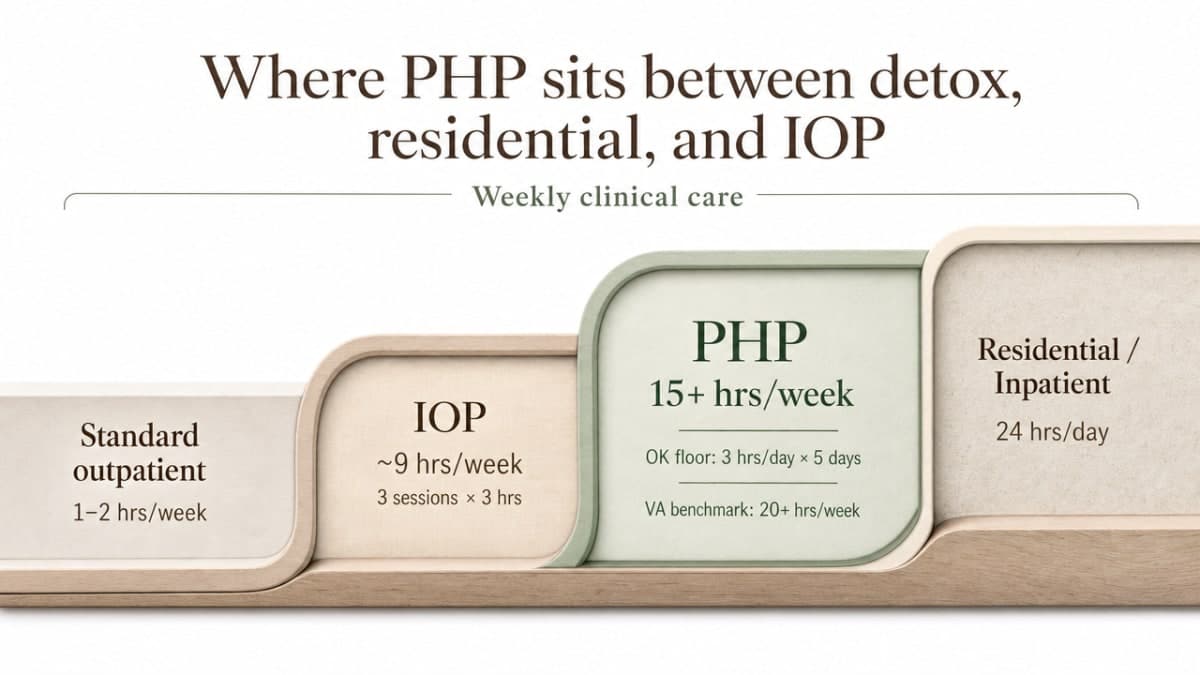
Where PHP sits between detox, residential, and IOP
The clearest way to picture PHP is by how many hours of clinical care your loved one gets each week. That number is what separates the levels of care — and it’s the number insurance reviewers use to decide what they’ll approve.
Standard outpatient therapy usually means one or two clinical hours a week: a therapy appointment, maybe a group. Intensive outpatient (IOP) sits around nine hours a week, typically three sessions of three hours each. PHP is a real step up. Under Oklahoma’s floor of three hours per day, five days per week, you’re looking at 15 or more clinical hours weekly 15, and many programs run longer days. Virginia’s regulation, often used as a national benchmark, requires PHPs to “offer no fewer than 20 hours of skilled treatment services per week” 2. Residential and inpatient care is the ceiling — 24 hours a day, seven days a week, with staff on site around the clock.
So where does PHP fit for your husband, wife, or partner? It’s the right catch when someone needs structure that feels almost like a hospital day — clinical groups, individual therapy, medication management, psychiatric check-ins — but is medically stable enough to sleep at home. It’s a step down from residential when 24/7 supervision is no longer needed, and a step up from IOP when nine hours a week won’t hold the early weeks of recovery.
You don’t have to memorize the hour counts. You just have to know that if a program calls itself PHP but only offers three clinical hours a week, it isn’t PHP. That’s a real thing families run into, and now you can name it.
Is PHP the right level of care right now?
Reading ASAM Level 2.5 criteria the way a reviewer does
Insurance reviewers and admissions clinicians don’t guess whether someone belongs in PHP. They work through a framework called ASAM Level 2.5, which is the addiction medicine standard for partial hospitalization. You don’t have to be a clinician to understand it. You just have to know what the reviewer is looking for, because those are the same details that will decide whether your loved one gets admitted this week or bounced to a longer waitlist.
ASAM Level 2.5 rests on six dimensions the assessor scores together:
- acute intoxication and withdrawal potential
- biomedical conditions
- emotional and behavioral conditions
- readiness to change
- relapse potential
- the recovery environment
Virginia’s admission rule captures the threshold plainly — before admission, the person must “meet diagnostic criteria for a substance use disorder or addictive disorder as defined by the DSM” and “meet the admission criteria of Level 2.5 of ASAM” 3. Oklahoma programs use the same clinical language when documenting medical necessity for SoonerCare and commercial payers 15.
What does this look like in practice for your husband, wife, or partner? A reviewer wants to see that the diagnosis is documented, that withdrawal has been managed or is manageable in a day setting, that there’s enough emotional or psychiatric complexity to justify daily care, and that the home environment is safe enough to sleep in but not stable enough for a lower level. When you call a program, ask directly: “Do you complete a full ASAM 2.5 assessment before admission, and who signs off on medical necessity?” If the answer is vague, that program will struggle to get authorized — and your loved one will feel the delay.
Why withdrawal risk has to be settled first
So if your partner is still on a tapering benzodiazepine protocol, still needing IV fluids, still having vital-sign spikes, PHP admission will either be delayed or denied at intake. That’s not a failure. That’s the system doing what it’s supposed to — keeping someone in medical detox until the acute risk clears, then handing them to PHP.
The practical move here is to ask the detox team two things before you commit to a PHP admission date: what does their discharge note say about withdrawal severity today, and when do they project the person will be medically stable enough for an outpatient day setting? That projection — usually 24 to 72 hours out — is the window you’re actually scheduling against.
Pre-screening programs in a ten-minute phone call
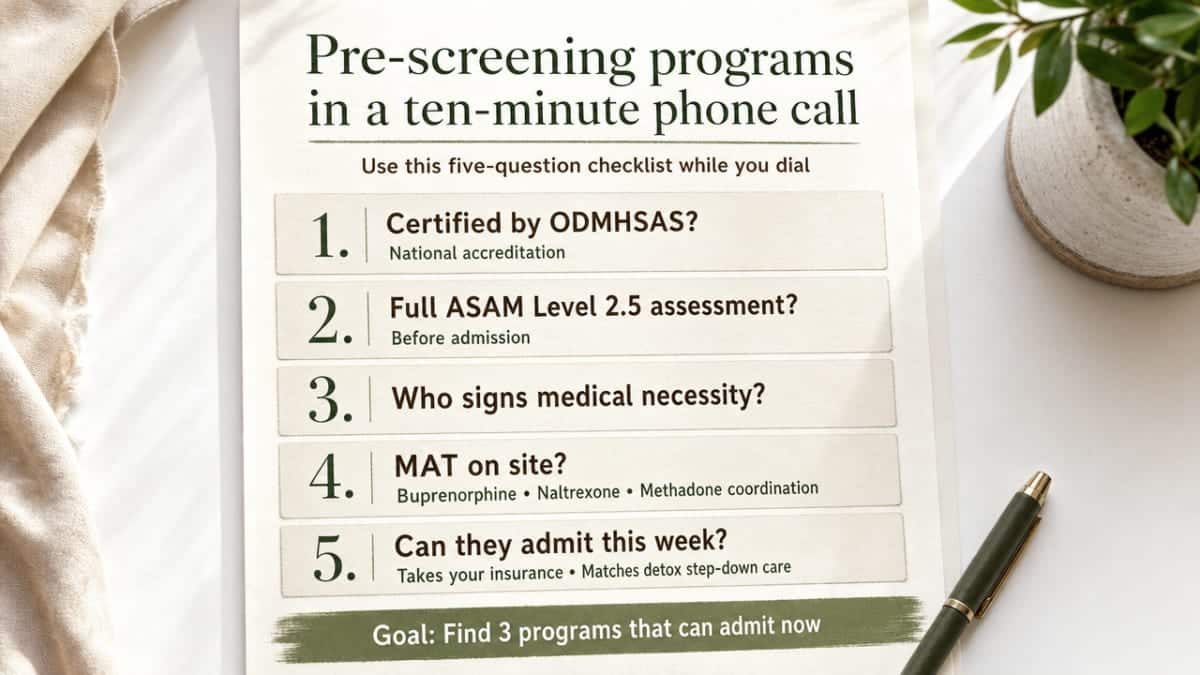
You do not need a shortlist of twenty programs. You need three that can actually admit your loved one this week, take your insurance, and deliver the level of care detox is discharging into. A focused phone call gets you there faster than another hour of searching.
Here is the call, in the order that works:
- Ask the person who answers whether they are certified by the Oklahoma Department of Mental Health and Substance Abuse Services and accredited by a national body — that is the baseline Oklahoma rule requires for PHP billing and operation 15, 16.
- Ask whether they complete a full ASAM Level 2.5 assessment before admission and who signs the medical-necessity documentation.
- Ask whether they offer medication-assisted treatment on site for opioid use disorder and alcohol use disorder — buprenorphine, naltrexone, methadone coordination — because SAMHSA is clear that MAT reduces relapse and hospitalization when paired with counseling 13.
- Ask whether mental health care is integrated into the same treatment team, not referred out, since SAMHSA’s evidence-based guidance for co-occurring disorders points to one team treating both conditions together 14.
- Then ask the question that ends most calls quickly: what is your earliest admission date, and do you have capacity this week?
A program that hesitates on any of these — that cannot name their accreditation, that outsources psychiatric care, that says MAT is “case by case” without explaining — is not disqualified, but it moves down your list. A program that answers each question crisply and offers a same-week intake slot moves to the top. You are not being picky. You are matching your husband, wife, or partner to a program that can actually do what its name says.
Write the answers down. When you finish three calls, you will know which program to send the discharge summary to first.
Verifying licensure, accreditation, and insurance without losing a day
What ‘licensed’ means when you check an Oklahoma program
When a website says a program is “licensed,” that word is doing a lot of work — and not all of it is the work you need. In Oklahoma, the meaningful credential for a PHP is certification by the Oklahoma Department of Mental Health and Substance Abuse Services (ODMHSAS) under the state’s facility standards, plus national accreditation from a body like The Joint Commission or CARF. Both are required for a program to legally operate at this level of care and to bill SoonerCare 15, 16.
You can verify certification yourself in about five minutes. Ask the program for their ODMHSAS certification number and the name of their national accrediting body. Then check the ODMHSAS provider certification listings — the rules chapter that governs this process is publicly posted, and the department maintains oversight of every certified behavioral health facility in the state 17. If a program cannot produce a certification number on request, that is your answer. A legitimate PHP has this information ready because they use it every day in their billing.
One more thing to listen for: the person who does the ASAM Level 2.5 assessment and signs medical necessity must be a licensed clinician credentialed through the program. “Licensed” as a phrase means nothing without a name and a credential behind it.
The insurance verification call: words that speed prior authorization
The insurance call is where families lose the most time — and where the right vocabulary buys hours back. You have two calls to make, and the order matters. Call the PHP’s admissions or utilization team first, then your insurer. The program does this every day; you do not. Let their language lead yours.
When you call the PHP, give them the subscriber name, member ID, group number, date of birth, and the name of the discharging detox facility. Then use these words: “We need a benefits verification and a prior authorization request for partial hospitalization at ASAM Level 2.5, stepping down from medically managed withdrawal.” That sentence tells the intake coordinator exactly which CPT and revenue codes to run and which clinical criteria to attach. If your loved one has opioid use disorder, add: “He’ll need MAT continuation” — SAMHSA is explicit that MAT reduces relapse and inpatient readmission when paired with counseling 13, and payers know it.
When you call your insurer directly, ask three questions in this order:
- What is the in-network status of this specific facility and tax ID?
- What is the daily copay or coinsurance for PHP, and does the deductible reset apply?
- How many days are authorized initially, and what clinical documentation triggers a concurrent review?
If you have SoonerCare, PHP is reimbursed on a per-encounter basis under Oklahoma’s State Plan Amendment, which the program’s billing team will already know how to code 5.
Write down the reference number for every call. That number is what a program uses to fight a denial three days from now.
The warm handoff from detox to PHP
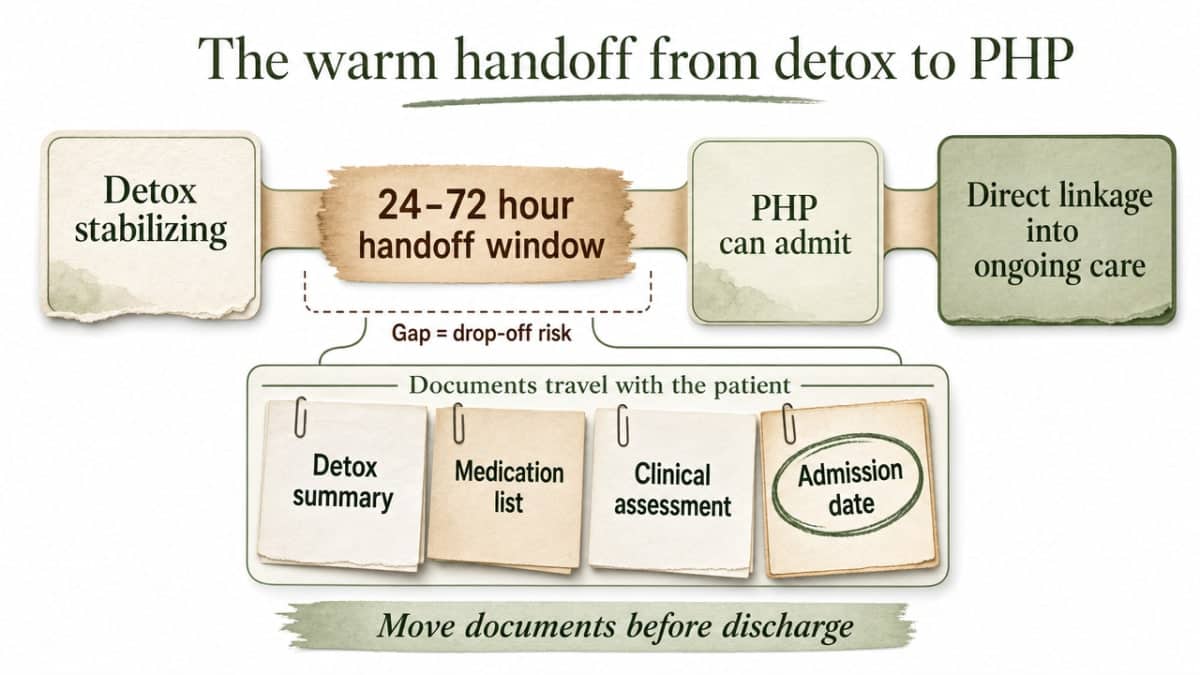
This is the part that either works or unravels. The detox team knows your loved one is stabilizing. The PHP has said they can admit. Somewhere between those two facts, families lose people — sometimes for a day, sometimes for good. A warm handoff is what closes that gap.
SAMHSA has said it plainly for years: detoxification “is not in itself sufficient to treat substance use disorders” and outcomes depend on direct linkage into ongoing care 7. The peer-reviewed literature on this transition is unambiguous — when people leave withdrawal management without stepping into a structured program, drop-off is high and relapse follows fast 10. The fix is boring and specific: get the right documents moving, and get an admission date on the calendar before your loved one walks out of detox.
Four documents need to travel with your husband, wife, or partner. Ask the detox social worker or discharge planner for each one by name:
- The discharge summary — signed by the attending physician, dated, with withdrawal severity and current stability documented.
- The ASAM assessment — the multidimensional score that supports Level 2.5 placement.
- The current medication list — every dose, every taper schedule, every PRN, including any MAT started in detox.
- The insurance prior authorization number — the reference the PHP’s utilization team can call on if a payer questions the admission.
Then ask for one more thing: a direct clinician-to-clinician call between the detox physician or nurse and the PHP intake clinician before discharge. That call is the handoff. It takes ten minutes and it prevents the second-day gap where nobody quite owns the case.
If the PHP admission date is 48 hours after detox discharge, ask the detox team what bridge support is possible — an extra observation day, a same-evening outpatient check-in, sober housing coordination. You are not being demanding. You are asking the system to do what it was designed to do.
Two questions most local PHPs quietly fail
Does the program actually offer MAT on site?
This is the question that separates a modern PHP from one that hasn’t caught up. If your husband, wife, or partner has an opioid use disorder or an alcohol use disorder, medication-assisted treatment is not a nice-to-have. SAMHSA is direct: MAT “is clinically effective and significantly reduces the need for inpatient detoxification services” when combined with counseling and behavioral therapies 13. Programs that skip it or refer it out are asking your loved one to do the hardest part of recovery with one hand tied.
Ask the question this specifically: “Is buprenorphine prescribed on site by a clinician on your team? Is naltrexone available for alcohol use disorder? If methadone is needed, do you coordinate directly with an opioid treatment program, or does the family have to arrange that separately?” You are listening for names of medications and names of clinicians. If the answer is “we can talk about that after admission” or “our medical director handles that case by case,” MAT is not built into the program. That doesn’t disqualify the PHP, but it tells you the medication your loved one may need most could arrive late — or not at all.
Is mental health care integrated or bolted on?
Most people entering PHP for substance use have a co-occurring mental health condition — depression, anxiety, trauma, bipolar disorder — whether or not it has been formally diagnosed. SAMHSA’s evidence-based guidance for co-occurring disorders is clear that the model with the best outcomes is integrated: one treatment team addressing both conditions in the same plan, at the same time, in the same building 14. NIMH describes the standard the same way — “the same health care providers or team of providers treat both the substance use disorder and the mental health condition” 8.
Here is how to test it on the phone. Ask: “Who prescribes psychiatric medication for your PHP clients, and are they part of the PHP treatment team or an outside referral? Does the same clinician review both the substance use and mental health treatment plans each week?” A program with integrated care will name a psychiatrist or psychiatric nurse practitioner who sits in on team meetings. A program that has bolted mental health on will describe a referral to an outside provider your loved one sees on their own time. The difference shows up in week two, when the depression that was masked by drinking surfaces and nobody on the team is prepared to treat it.
What good PHP outcomes look like, and what they don’t promise
Before your husband, wife, or partner walks into a program, it helps to know what recovery at this level of care actually looks like on the other side — because the picture is more honest than either the brochures or your worst fears suggest.
A study of adults one month after brief intensive treatment for opioid use disorder — either inpatient detox or partial hospitalization — found that about 40% remained completely abstinent, and those who did use opioids reported significantly fewer days of use than before treatment 11. This indicates that a meaningful share of people who complete this level of care are not using at 30 days, and most of the rest are using less. That is progress a hospital chart can measure.
The broader evidence review from the NCBI Bookshelf reaches a similar conclusion: for many patients, intensive outpatient and partial hospitalization programs can achieve outcomes comparable to inpatient or residential treatment, particularly when paired with continuing care afterward 9. PHP is not a lesser option because it lets someone sleep at home. For the right person, matched to the right level, it works.
What PHP does not promise is a finish line. Six weeks of daily groups will not resolve a decade of use, and no reputable program will tell you it does. What it can do is stabilize the first fragile stretch after detox, put integrated treatment in place, and hand your loved one to the next level of care — usually IOP, then standard outpatient with recovery support — with momentum instead of a gap. Your job right now is to get them through the door. The program’s job, and theirs, is what happens after.
Ready to Talk About Local PHP Options?
Connect directly with a caring team member for immediate answers and next steps in your recovery journey.
Frequently Asked Questions
How quickly can my spouse move from detox into a PHP in Oklahoma?
Most warm handoffs happen within 24 to 72 hours of detox discharge, once withdrawal is stable and insurance authorization is in hand. The pace depends on three things: the detox team completing the discharge summary and ASAM assessment, the PHP confirming a same-week intake slot, and the prior authorization coming back from your payer. If you have all three lined up before discharge day, admission the next morning is realistic 7, 10.
Will insurance or SoonerCare cover partial hospitalization?
Yes, in most cases. SoonerCare reimburses PHP on a per-encounter basis under Oklahoma’s State Plan Amendment when medical necessity and ASAM criteria are documented 5. Commercial insurers typically cover PHP too, but they require prior authorization and clinical review. Ask the program to run a benefits verification before admission, and ask your insurer for the initial number of authorized days and what triggers concurrent review. Coverage details vary by plan.
What’s the difference between PHP and IOP, and how do I know which one my loved one needs?
PHP delivers 15 or more clinical hours per week under Oklahoma’s floor of three hours a day, five days a week 15. IOP runs about nine hours a week. The choice usually comes down to how much structure your husband, wife, or partner needs right after detox. If they need daily contact, psychiatric oversight, and MAT management, PHP is the right catch. IOP fits better as a step-down later.
Do Oklahoma PHPs offer medication-assisted treatment (MAT) on site?
Some do, some don’t — and that’s the part you have to verify by phone. SAMHSA is clear that MAT is clinically effective and reduces the need for inpatient detoxification when combined with counseling 13. Ask specifically whether buprenorphine is prescribed on site, whether naltrexone is available for alcohol use disorder, and whether methadone coordination happens through the program or falls to your family to arrange separately.
How do I verify a PHP is actually licensed in Oklahoma?
Ask the program for their Oklahoma Department of Mental Health and Substance Abuse Services (ODMHSAS) certification number and the name of their national accrediting body — typically The Joint Commission or CARF. Both are required for a PHP to operate at this level of care and bill SoonerCare 15, 16. ODMHSAS oversees provider certification statewide 17. A legitimate program has this information ready. Hesitation is your answer.
What happens if my loved one still has withdrawal symptoms when detox ends?
Then PHP admission waits. PHP requires low withdrawal risk or minimal remaining symptoms — that’s a clinical bar, not a technicality 4. Ask the detox team when they project medical stability, usually a 24 to 72 hour window. If withdrawal is dragging, the answer is more detox time, not a rushed step-down. Pushing into PHP too early means denied authorization or a return to a higher level of care 15.
References
- 510.2 PARTIAL HospitalIZATION Program (West Virginia Medicaid). https://bms.wv.gov/media/40004/download?inline
- 12VAC35-105-1680 et seq. Substance Abuse Partial Hospitalization Program. https://law.lis.virginia.gov/admincodefull/title12/agency35/chapter105/partVII/article6/
- 12VAC35-105-1700. Admission criteria for substance abuse partial hospitalization. https://law.lis.virginia.gov/admincode/title12/agency35/chapter105/section1700/
- 2 CCR 502-1-4.7 – Partial Hospitalization Program (PHP) Services. https://www.law.cornell.edu/regulations/colorado/2-CCR-502-1-4.7
- Oklahoma State Plan Amendment 22-0016 – Partial Hospitalization Program. https://www.medicaid.gov/medicaid/spa/downloads/OK-22-0016.pdf
- Behavioral Health Provider Manual (Oklahoma Health Care Authority, August 2010). https://digitalprairie.ok.gov/digital/api/collection/stgovpub/id/17842/download
- Treatment Improvement Protocol (TIP) 45: Detoxification and Substance Abuse Treatment. https://www.govinfo.gov/content/pkg/GOVPUB-HE20_400-PURL-gpo124442/pdf/GOVPUB-HE20_400-PURL-gpo124442.pdf
- Substance Use and Mental Health (NIMH). https://www.nimh.nih.gov/health/topics/substance-use-and-mental-health
- Inpatient and Outpatient Treatment for Substance Use Disorder: Comparative Effectiveness (Summary of Evidence). https://www.ncbi.nlm.nih.gov/books/NBK507689/
- Transitioning from Detoxification to Substance Use Disorder Treatment. https://pmc.ncbi.nlm.nih.gov/articles/PMC6448765/
- Quality of Life and Well-being following Inpatient and Partial Hospitalization Treatment for Opioid Use Disorder. https://pmc.ncbi.nlm.nih.gov/articles/PMC5968820/
- Stability of Outcomes Following Residential Drug Treatment: Comparison of 3-Month and 12-Month Follow-Up. https://pmc.ncbi.nlm.nih.gov/articles/PMC3146302/
- Medication-Assisted Treatment (MAT) for Opioid Use Disorder. https://www.samhsa.gov/medication-assisted-treatment
- Integrated Treatment for Co-Occurring Disorders Evidence-Based Practices (SAMHSA Toolkit). https://store.samhsa.gov/sites/default/files/SAMHSA_Digital_Download/PEP20-06-02-001.pdf
- 317:30-5-241.10. Partial hospitalization program (PHP). https://oklahoma.gov/ohca/policies-and-rules/xpolicy/medical-providers-fee-for-service/individual-providers-and-specialties/outpatient-behavioral-health-services/partial-hospitalization-program-adults.html
- CHAPTER 18. Standards for Facilities and Services (Oklahoma Board of Mental Health and Substance Abuse Services). https://aem-prod.oklahoma.gov/content/dam/ok/en/odmhsas/documents/policy/provider-certification/administrative-rules/2025/PC–Chapter-18_9-1-25.pdf
- CHAPTER 1. Administration (Oklahoma Department of Mental Health and Substance Abuse Services). https://aem-prod.oklahoma.gov/content/dam/ok/en/odmhsas/documents/policy/provider-certification/administrative-rules/2023/PC–Chapter-1-Final-Effective-9-15-23.pdf
- Okla. Admin. Code § 450:18-13-101 – Residential treatment for adults. https://www.law.cornell.edu/regulations/oklahoma/OAC-450-18-13-101