
Key Takeaways
- Oklahoma’s SB 1718 requires fully insured plans to cover detox at parity with medical care, so deductibles and copays cannot exceed what comparable medical admissions would trigger 4.
- Self-funded employer plans follow federal rather than state rules, so confirming plan type with HR or intake changes which parity protections apply to your admission 3.
- Facilities focused on commercial insurance run verification, prior authorization, and bed prep on parallel tracks, often returning a clear coverage answer within thirty to sixty minutes.
- Gather your insurance card, deductible estimate, and substance use details, then call to request a written benefits verification with reference number and quoted coverage.
The cost fear that keeps insured Oklahomans out of detox
You’ve probably done the math in your head a dozen times already. Rehab, in your mind, costs somewhere between a used car and a small house, and the number is high enough that you keep putting off the call. That fear is the reason a lot of insured Oklahomans stay sick longer than they need to.
Here’s the thing worth sitting with for a minute: if you have private health insurance through your job or the marketplace, medical detox in Oklahoma is closer to a covered medical procedure than a cash expense. Since 2020, state law has required fully insured individual, small-group, and large-group plans sold in Oklahoma to include mental health and substance use disorder benefits at parity with medical and surgical coverage 4. Parity is a legal word that translates simply. Your plan cannot make detox harder to get, or more expensive out of pocket, than it would make a knee surgery or a cardiac workup 12.
That does not mean every call ends in a yes with no paperwork. Prior authorization exists. Deductibles exist. Network status matters. But the starting assumption most people carry, that they’ll be handed a five-figure bill before anyone will even talk to them, is usually wrong.
What follows is a plain walk-through of what your plan actually has to cover, what a private-insurance-focused detox facility does differently than one juggling five payer types at once, and how to make the benefits verification call so you get a real answer within an hour instead of a runaround. You do not need to have this figured out before you pick up the phone. You just need to know the ground is more solid under you than it feels right now.
What your plan is actually required to cover
Oklahoma’s parity law in plain English
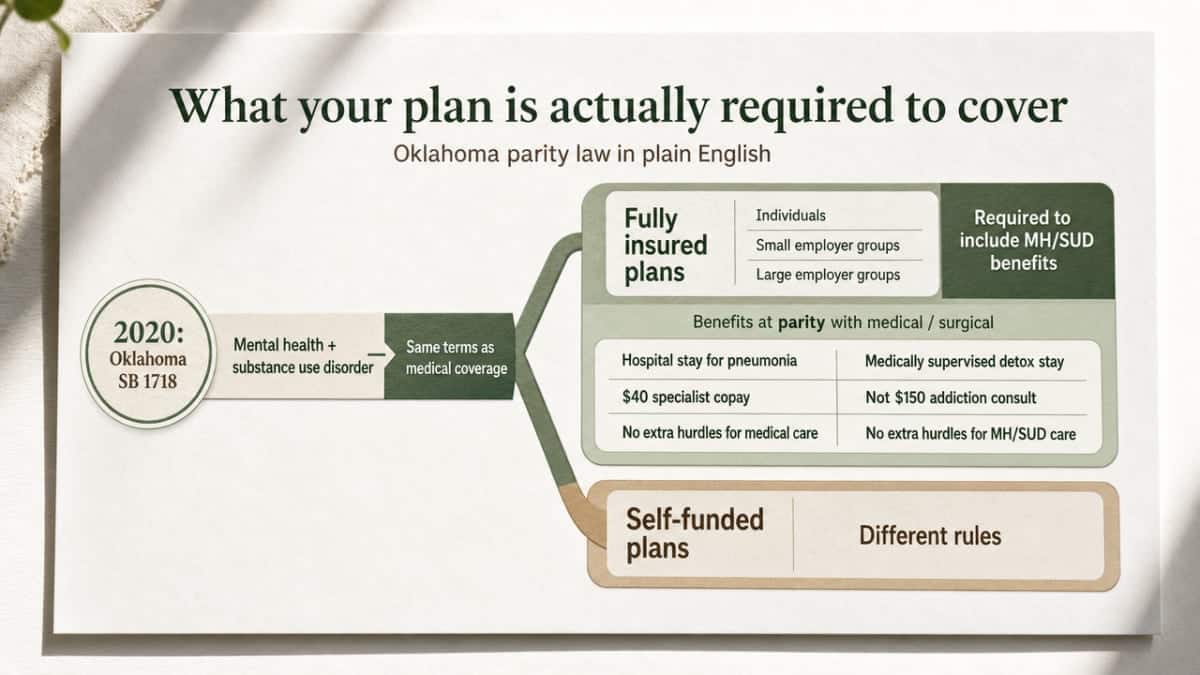
Parity is the word that changes the math on that first phone call. In 2020, Oklahoma passed SB 1718, which requires carriers in the state to offer mental health and substance use disorder coverage on the same terms as medical coverage. Every fully insured plan sold to individuals, small employer groups, and large employer groups has to include benefits for MH/SUD services, and those benefits have to sit at parity with the medical and surgical side of the plan 4.
Here is what that means when you strip out the legal language. If your plan covers a hospital stay for pneumonia, it has to cover a medically supervised detox stay on comparable terms. If your copay for a specialist visit is $40, your copay for an addiction medicine consult cannot suddenly be $150. If your plan does not require you to jump through a stack of paperwork before a cardiologist can admit you, it cannot invent a taller stack for a detox admission 12.
Parity does not mean everything is free. You still have a deductible. You still have a coinsurance percentage. You may still need prior authorization. But the ceiling and the friction have to look like the rest of your medical coverage, not a separate, harsher rulebook written just for addiction.
That single shift, from “specialty expense” to “covered medical care,” is the reframe most insured Oklahomans have never been told about.
The self-funded plan wrinkle most articles skip
There is one distinction worth understanding before you call, because it is the place most insured Oklahomans get quietly stuck. Not every employer plan is regulated the same way, and that changes which rules apply to your detox coverage.
A fully insured plan is one where your employer pays a premium to a carrier like Blue Cross Blue Shield of Oklahoma, Aetna, Cigna, or UnitedHealthcare, and the carrier takes on the financial risk of your claims. Those plans are regulated by the Oklahoma Insurance Department and are bound by SB 1718 and the state parity rules 3.
A self-funded plan looks almost identical from the outside. It might even have a familiar carrier’s name on the ID card, because that carrier is administering the claims. But the employer, not the insurance company, is actually paying the bills. Self-funded plans are governed by federal law, not Oklahoma law, and they are not required to cover mental health or substance use services at all. If they do cover those services, they must follow federal parity rules 4.
In practice, most large-employer self-funded plans in Oklahoma do cover detox, because the federal Mental Health Parity and Addiction Equity Act pulls them in as soon as MH/SUD benefits are offered 12. You are not usually shut out. But it is worth asking your HR department, or the intake team when you call, which type of plan you actually have.
Why 2024 and 2025 changed the pressure on insurers
You are calling at a better moment than you might realize. Federal regulators just tightened the screws on how insurers handle addiction treatment, and the timing works in your favor.
In September 2024, the Departments of Labor, Health and Human Services, and Treasury finalized new rules under the Mental Health Parity and Addiction Equity Act. The final rule became effective November 22, 2024, with most group plan provisions applying to plan years beginning on or after January 1, 2025, and certain individual-market provisions applying in 2026 6. The rollout is staggered, but the direction is clear.
What the rule actually requires matters for you. Plans now have to run a formal analysis of the nonquantitative treatment limitations they impose on mental health and substance use benefits, things like prior authorization requirements, medical necessity criteria, network standards, and step-therapy rules, and prove those limits are no more restrictive than what they apply to medical and surgical care 7. If a carrier requires three phone calls and a written appeal before approving a detox admission but rubber-stamps a hospital stay for the flu, that gap is now a documented compliance problem the carrier has to fix 1.
Oklahoma carriers already file annual parity compliance reports with the state Insurance Department, and those reports are publicly posted 2. Between state reporting and the 2024 federal rule, an insurer denying a medically appropriate detox admission is taking on more risk than it was two years ago. That does not guarantee a yes on your claim. It does mean the person on the other end of the phone is working inside a system that is actively being watched.
What ‘private-insurance detox’ actually means as an operating model
Single-payer focus vs. mixed-payer facilities
When you hear “private-insurance detox,” it sounds like a marketing label. It is actually a description of how a facility organizes its intake desk, its billing team, and its beds.
Every residential SUD program in Oklahoma has to meet the same clinical floor. Facilities must maintain certification through the Oklahoma Department of Mental Health and Substance Abuse Services, hold accreditation from The Joint Commission, CARF, or COA, and provide 24/7 professionally directed care with a physician available at least by telephone around the clock 13. Residential treatment specifically must offer a planned regimen of twenty-four hours a day, seven days a week of professionally directed evaluation, care, and treatment 15. That standard applies whether the person in the bed is on Medicaid, on a commercial plan, or paying cash.
The difference sits behind the clinical floor, in the back office. A mixed-payer facility runs three or four billing tracks at once. The intake nurse who takes your call is also fielding SoonerCare referrals with different prior authorization forms, self-pay conversations that require deposit paperwork, and out-of-network commercial claims that trigger single-case agreement negotiations. Each track has its own timeline, its own required documentation, and its own denial appeal process.
A private-insurance-focused facility runs one primary track. The staff know the utilization review contacts at the major commercial carriers by name. The prior authorization forms live in a shared folder, already partially filled out. When your name and member ID come through, the workflow that opens on the intake coordinator’s screen is one they run several times a day, not a form they have to hunt down.
That operational focus does not make the medicine different. It changes how quickly the paperwork clears so the medicine can start.
How intake actually moves faster on a commercial claim
Speed on the day you call comes down to three things, and a facility built around commercial plans is set up to move on all three at once.
The first is benefits verification. Your plan’s member services line has to confirm active coverage, in-network status, deductible balance, and any prior authorization requirement before a facility can commit to admitting you at a covered rate. A team that runs commercial verifications every hour can usually get a clear read back to you within thirty to sixty minutes. A team that verifies commercial claims occasionally, between Medicaid and self-pay conversations, may take a full business day or push the call to the next morning.
The second is prior authorization. Under the 2024 federal parity final rule, carriers now have to document that their prior authorization criteria for detox are no more restrictive than what they apply to comparable medical admissions 1. A facility that submits these requests daily knows which clinical language and which ASAM criteria the reviewer at your carrier expects to see. That familiarity shortens the review, which is often the longest step between your phone call and a bed.
The third is the bed itself. When intake, verification, and authorization are running on parallel tracks instead of a single queue, the room can be prepared while the paperwork is still moving. You are not waiting for one person to finish billing before another person unlocks a door.
The regulatory floor every Oklahoma detox facility should meet
Before you compare facilities, it helps to know what the state already requires of all of them. This is the baseline. Anything a facility markets on top of it, private rooms, wearable monitoring, veteran-specific tracks, is layered onto a floor that was set by Oklahoma regulators, not by the facility itself.
Any residential SUD program in the state has to hold current certification from the Oklahoma Department of Mental Health and Substance Abuse Services, and facilities enrolling with the state Medicaid agency also go through a Certificate of Need review before opening or expanding 14. On top of that, residential providers are required to carry accreditation from The Joint Commission, CARF, or COA 13. Those three bodies audit clinical protocols, safety practices, and patient rights on their own schedules, which means the facility is being watched by more than one set of eyes.
The clinical minimums are written into Oklahoma’s administrative code. Residential treatment for adults has to provide a planned regimen of twenty-four hours a day, seven days a week of professionally directed evaluation, care, and treatment, with a licensed physician available at least by telephone around the clock and therapy delivered by qualified behavioral health professionals 15.
Making the benefits verification call
What to have in front of you before you dial
You do not need much, and none of it is hard to find. Take five minutes at the kitchen table and gather these things in front of you before you make the call.
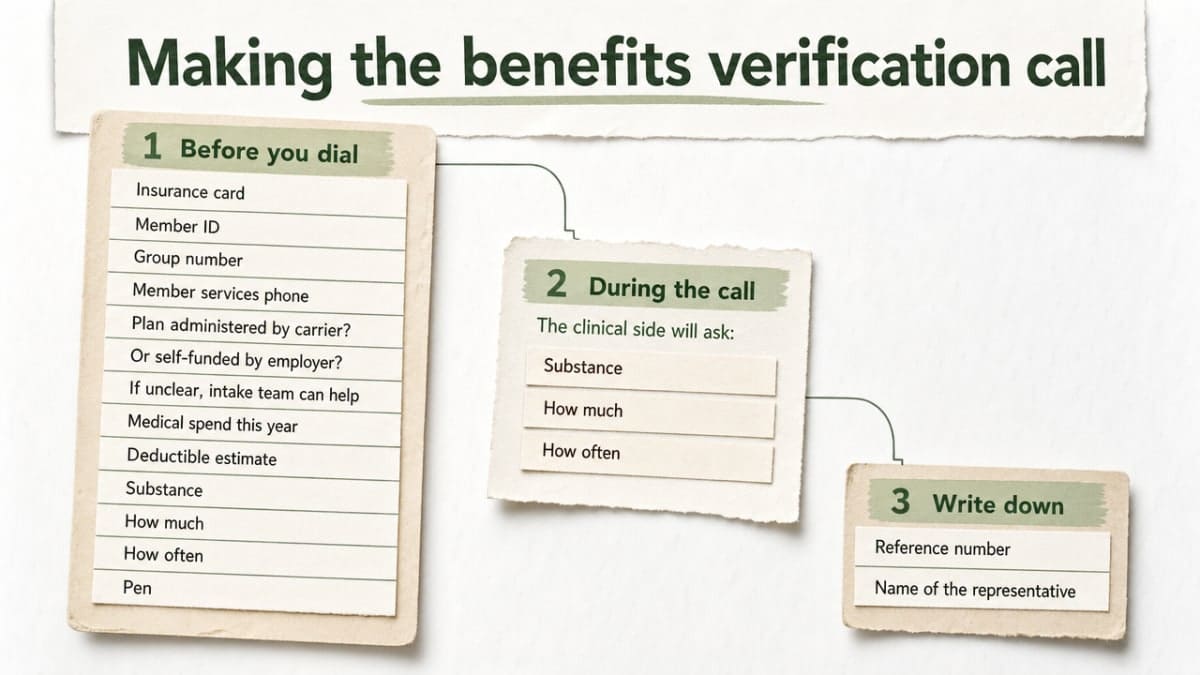
Pull out your insurance card. The front has your member ID and group number. The back usually lists a member services phone line and, in smaller print, whether the plan is administered by the carrier or self-funded by your employer. If you cannot tell, that is fine. The intake team can help you figure it out 3.
Have a rough sense of what you have already spent on medical care this year, so you can guess where you are against your deductible. Know the substance and roughly how much and how often, because the clinical side of the call will ask. And have a pen. You will want to write down the reference number for the verification, the name of the person you spoke with, and whatever they quote you on coverage.
That is the whole kit. You are ready.
The questions that get you a real answer within an hour
When a facility’s intake team runs commercial verifications every day, they can usually give you a straight answer inside an hour. To get that clean read, the questions below are the ones worth asking, either directly to your carrier’s member services line or to the intake coordinator who will call on your behalf.
- Ask whether the facility is in-network with your plan. In-network means the negotiated rate applies and your out-of-pocket exposure is predictable. Out-of-network is not always a dead end, but it changes the math.
- Ask what your remaining deductible is, and what your out-of-pocket maximum is for the year. Detox often lands inside a single plan year, and if you are close to your out-of-pocket max already, the covered portion can be substantially higher than you expect.
- Ask whether prior authorization is required for inpatient detox, and if so, what clinical criteria the reviewer applies. Under the 2024 federal parity final rule, carriers now have to document that these criteria are no more restrictive than what they apply to comparable medical admissions, and intake teams that submit these requests daily know what the reviewer expects to see 1.
- Ask about the covered length of stay and how continued-stay reviews work. Ask whether medication-assisted treatment during detox is a covered benefit under your plan.
- Finally, ask for a written summary of the verification. Not a promise of payment, which no facility can give you before claims process, but a documented summary of what was quoted, by whom, and on what date. That paper is worth more than any verbal reassurance.
What a ‘no’ actually means and what to do next
A denial on the first call is rarely the end of the conversation. It usually means one of a few specific things, and each has a next step.
Sometimes the answer is that the facility is out-of-network. Ask whether a single-case agreement is possible. Carriers sometimes agree to treat an out-of-network facility as in-network for one admission when the clinical need is documented and in-network capacity is thin.
Sometimes the answer is that prior authorization was denied on medical necessity. That is a clinical disagreement, not a final decision. The facility’s medical team can submit a peer-to-peer review, where their physician talks directly to the carrier’s reviewing physician. Many denials get overturned at this step.
Sometimes the answer is that your plan is self-funded and does not include MH/SUD benefits at all. That is rarer than it sounds, but it happens. If it does, Oklahoma insurers still file annual parity compliance reports with the state Insurance Department, and the department takes consumer complaints if a fully insured plan is not following the law 2.
A no is a data point. It is not a verdict on whether you get help. Keep the reference number, ask what the next step is, and let the intake team carry the appeal work for you.
Carriers commonly seen on Oklahoma commercial plans
When people call about detox in Oklahoma, the ID cards on the kitchen table tend to come from a familiar set of carriers. Blue Cross Blue Shield of Oklahoma is the one that shows up most often, because it dominates the employer market in this state. Aetna, Cigna, and UnitedHealthcare show up next, usually through large employers or marketplace plans. HealthChoice is common for state employees, teachers, and their families. A handful of smaller regional and marketplace carriers round out the rest.
Facilities focused on private-insurance detox tend to hold in-network agreements with several of these major commercial carriers, though the specific list changes as contracts are renewed. That is why an honest answer to “do you take my insurance?” always ends with a verification call rather than a promise made on a website. Your plan number, your group number, and whether the plan is fully insured or self-funded all change the answer for you specifically 3.
What matters more than the logo on your card is what sits behind it. Under Oklahoma law, fully insured plans from any of these carriers must cover MH/SUD services at parity with medical care 12. That is true whether the letters on your card spell BCBS, Aetna, Cigna, or UHC. The reframe holds. The next step is finding out exactly how it applies to your plan.
The next call, and what happens after you make it
The hardest part of this whole thing is not the paperwork. It is the ten seconds between picking up the phone and hearing someone answer. You have already done the heavy lifting by reading this far. The rest is a conversation.
When you call Renewal Springs, the intake team will run a free benefits verification against your plan. You will hear back, usually within an hour, on in-network status, what your plan is quoting for the admission, and whether prior authorization is needed. If it is, they submit it. If a peer-to-peer review is needed, the medical team handles that too. You are not chasing your carrier alone.
Under Oklahoma law, fully insured plans have to treat your detox admission on parity terms with any other medical admission 12. You are not asking for a favor. You are using a benefit you already pay for.
Make the call. Get the numbers on paper. The next few days will look different than the last few have.
Talk to Someone Who Understands Right Now
Get immediate answers about private insurance detox and your next steps—no judgment, just real support.
Frequently Asked Questions
Will my private insurance actually cover medical detox in Oklahoma?
In most cases, yes. Oklahoma law requires fully insured individual, small group, and large group plans sold in the state to include mental health and substance use disorder benefits, and to cover them at parity with medical and surgical care 4. That means detox is a covered medical service, not an out-of-pocket luxury. Your deductible and coinsurance still apply, but the ceiling looks like the rest of your plan.
How do I know if my plan is fully insured or self-funded, and why does it matter?
Ask your HR department, or look at the back of your insurance card for language about the plan sponsor. Fully insured plans are regulated by Oklahoma and bound by SB 1718 3. Self-funded plans follow federal law and are not required to offer MH/SUD benefits, but most do, and when they do, federal parity rules apply 12. The intake team can help you sort this out on the call.
How quickly can I get admitted if I use private insurance instead of paying cash?
A facility that runs commercial verifications daily can usually confirm benefits within thirty to sixty minutes and submit prior authorization the same day. Cash admissions can move faster because there is no carrier to check with, but they cost you thousands out of pocket. With insurance, the wait is usually hours, not days, and you keep the money in your account. Timelines vary by carrier and clinical review.
What should I ask when I call to verify my detox benefits?
Ask five things. Is the facility in-network with your plan. What is your remaining deductible and out-of-pocket maximum for the year. Is prior authorization required for inpatient detox. What is the covered length of stay and how do continued-stay reviews work. Is medication-assisted treatment covered during detox. Then ask for a written summary of the verification, including the reference number and the name of who quoted it.
What happens if my insurance denies coverage for detox?
A denial is rarely final. If it is a medical necessity denial, the facility’s physician can request a peer-to-peer review with the carrier’s reviewing doctor, and many denials get overturned there. If the facility is out-of-network, a single-case agreement may still be possible. If a fully insured plan appears to be violating parity, the Oklahoma Insurance Department accepts consumer complaints and reviews carrier compliance reports annually 2.
Will my employer or family find out if I use my insurance for detox?
Your employer does not see your specific claims. They see aggregate plan costs, not individual diagnoses. Federal privacy law protects your medical records, and SUD treatment records carry an extra layer of protection under 42 CFR Part 2. If you are on a family plan, the policyholder may see an explanation of benefits statement showing a claim was paid, but not clinical detail. Ask intake about privacy specifics.
References
- Requirements Related to the Mental Health Parity and Addiction Equity Act. https://www.federalregister.gov/documents/2024/09/23/2024-20612/requirements-related-to-the-mental-health-parity-and-addiction-equity-act
- LH BULLETIN NO. 2020-05 – Oklahoma Insurance Department. https://www.oid.ok.gov/lh-bulletin-no-2020-05/
- Mental/Behavioral Health and Insurance. https://www.oid.ok.gov/mental-behavioral-health-and-insurance/
- Understanding Mental Health Parity and Your Insurance Coverage. https://www.oid.ok.gov/getready12_2023/
- 2024 MHPAEA Report to Congress. https://www.dol.gov/sites/dolgov/files/ebsa/laws-and-regulations/laws/mental-health-parity/report-to-congress-2024.pdf
- Statement Regarding Enforcement of the Final Rule Requirements Related to MHPAEA. https://www.cms.gov/files/document/statement-regarding-enforcement-final-rule-requirements-related-mhpaea.pdf
- Departments of Labor, Health and Human Services, Treasury issue final rules strengthening access to mental health and substance use disorder care. https://www.cms.gov/newsroom/press-releases/departments-labor-health-and-human-services-treasury-issue-final-rules-strengthening-access-mental
- Parity. https://www.medicaid.gov/medicaid/benefits/behavioral-health-services/parity
- HB 2049 (2025) – Medicaid Managed Care Parity Requirements (Oklahoma Legislature). https://www.oklegislature.gov/cf_pdf/2025-26%20int/hb/HB2049%20int.pdf
- SoonerSelect 2025 Mental Health Parity Review. https://oklahoma.gov/content/dam/ok/en/okhca/docs/research/data-and-reports/studies-and-evaluations/2025/SoonerSelect%20Mental%20Health%20Parity%202025%20Report%2012.19.25.pdf
- Mental Health and Substance Abuse Services – Oklahoma.gov. https://oklahoma.gov/ohca/individuals/programs/mental-health-and-substance-abuse-services.html
- Mental Health Parity and Addiction Equity Act. https://www.oid.ok.gov/regulated-entities/financial/financial-regulation-forms/mentalhealthparity/
- SECTION 95.44. Residential substance use disorder (SUD) – Eligible providers and requirements. https://oklahoma.gov/ohca/policies-and-rules/xpolicy/medical-providers-fee-for-service/individual-providers-and-specialties/inpatient-psychiatric-services/residential-substance-use-disorder-eligible-providers-and-requirements.html
- Administrative Rules – Chapter 18 Effective 11-16-20 (ODMHSAS). https://oklahoma.gov/content/dam/ok/en/odmhsas/documents/policy/provider-certification/administrative-rules/2020/AdminRules-Chapter18–11-16-20.pdf
- Okla. Admin. Code § 450:18-13-101 – Residential treatment for adults. https://www.law.cornell.edu/regulations/oklahoma/OAC-450-18-13-101