
Key Takeaways
- Psychoeducational groups in Oklahoma detox function as structured classes about addiction, brain chemistry, and coping tools rather than emotional disclosure circles, with facilitators carrying most of the talking.
- Oklahoma’s provider standards require medically supervised withdrawal to happen inside a broader treatment program with counseling and education attached, not as a stand-alone medical event 17, 24.
- With opioids, benzodiazepines, stimulants, and amphetamines driving Oklahoma hospitalizations and admissions, curriculum topics need to match the substances people are actually detoxing from 9, 16.
- When calling a program like Renewal Springs in Oklahoma City, ask how group topics, medical monitoring, and discharge planning fit together across a typical day.
The Part of Detox Nobody Warns You About
When you picture detox, you probably picture a bed, an IV, and someone checking your blood pressure at 3 a.m. That part is real. But it’s not the whole day.
Somewhere between the vitals checks and the meals, most detox programs in Oklahoma also run something called psychoeducational groups. If the word group makes your shoulders tense up, that’s fair. You’ve probably heard stories about people crying in a circle, forced to share the worst thing they ever did. That’s not what this is.
A psychoeducational group is closer to a class than a confession. It’s structured learning about what addiction actually does to your brain, what your triggers really are, and what tools other people have used to stay steady in early recovery 1, 3. National treatment guidelines put these groups right alongside medical care as a standard part of detox, not an extra 24.
This guide walks you through what those sessions look like, what topics tend to help most in the first week, and how they fit into a day at a place like Renewal Springs in Oklahoma City. No brochure language. Just plain answers so the unknown gets smaller before you walk in.
What a Psychoeducational Group Actually Is (and Isn’t)
The Plain-English Definition
A psychoeducational group is a short, structured class about addiction. That’s really it. A counselor or trained facilitator walks a small group of people through a specific topic — how withdrawal affects your body, why cravings hit at weird times, what a relapse warning sign looks like — usually with a handout, a whiteboard, and a set curriculum 1, 2.
National treatment guidelines describe these groups as “highly structured” and “curriculum-based,” designed to help people in early recovery learn about their disorder in plain language 2. The goal isn’t to dig into your childhood or get you to cry it out. It’s to expand what you know about the behavioral, medical, and psychological consequences of substance use so the fog starts to lift 1.
Think of it like driver’s ed for early recovery. Someone teaches the rules of the road — how your brain reacts to a trigger, what your first 30 days might feel like, what tools actually help at 3 a.m. — before you’re expected to drive on your own. You listen, you ask questions if you want, and you leave with information you didn’t have that morning 3.
Psychoeducational Group vs. Process Group vs. 12-Step Meeting
People use “group” as a catch-all word, but in a detox setting there are usually three different things happening under that label. Knowing the difference takes a lot of the dread out of the day.
- Psychoeducational group
- The class. Structured content, a facilitator with a curriculum, a topic like “what opioids do to the brain” or “how to spot an early relapse warning sign.” The focus is teaching and awareness, not personal disclosure 1, 2. Guidelines specifically note these groups are not designed for deep emotional processing — that’s a different tool 1.
- Process group
- The therapy circle you might be picturing. People talk about what they’re feeling, a therapist helps the group work through it together, and the point is emotional insight and change. Useful, but usually a later step, not a first-week detox activity.
- 12-step meeting
- Peer-led. Someone in recovery shares their story, others share if they want, and the structure comes from the 12 steps themselves rather than a clinical curriculum. Some detox programs bring these in as an option so you can see what community-based support looks like after discharge 6.
Same room, sometimes. Very different jobs. If the word “group” has been making you tense for weeks, it’s worth knowing that the class version — the one you’ll probably see most in a detox day — is the least confrontational of the three 3.
Do You Have to Talk? The Honest Answer
No. Not on day one, and usually not at all if you don’t want to.
Because psychoeducational groups are built around teaching, not disclosure, the facilitator carries most of the talking. You’re there to learn — take in the topic, look at the handout, maybe answer a yes/no question if one gets tossed your way 1, 2. Nobody is going to pass you a mic and ask you to explain how you ended up in detox.
Most people find that by day three or four, they want to say something. A question comes up, or somebody else describes a craving pattern that sounds exactly like theirs, and it slips out. That’s fine. It’s also fine if it doesn’t. Sitting in the back and just listening is a legitimate way to start 3.
If the fear of being called on has been the reason you’ve put this off, you can let that one go.
What a 60-Minute Session Looks Like in a Detox Day
The Shape of a Single Session
An hour goes faster than you’d think when someone else is steering it. Most psychoeducational sessions in a detox setting follow a similar rhythm because the curriculum-based structure is baked into the model national guidelines recommend 2, 4.
Here’s a version you’ll recognize if you’ve ever sat in one:
- The first five minutes are a quick check-in — the facilitator asks how everyone slept, whether anyone needs water or a break, and reminds the room what today’s topic is.
- Then about 20 minutes of teaching. A whiteboard, a handout, plain language. Maybe the topic is “what cravings actually are” or “why sleep gets weird in week one.” No trick questions.
- Next comes roughly 15 minutes of open discussion. The facilitator asks something like, “Did anything on the handout match what you’re feeling this week?” You can nod. You can say a sentence. You can stay quiet.
- Then about 15 minutes of skill practice — writing down two personal triggers, sketching a coping plan on a worksheet, or role-playing a phone call to a support person.
- The last five minutes wrap it: one thing to try before tomorrow’s session.
That shape isn’t unique to one program. A randomized trial of alcohol detox patients described an inpatient day that included twice-daily one-hour groups covering abstinence, treatment options, nutrition, relaxation, and relapse prevention 6. Same bones, different topics rotating through the week.
Where Groups Sit in a Day of 24/7 Medical Care
Groups don’t replace the medical part of detox. They fit around it.
A day at a facility like Renewal Springs is built on 24/7 medically supervised withdrawal management — vitals, medication support, nursing checks, physician oversight. Oklahoma’s provider standards specifically require that detox happen inside a broader treatment program with clinical direction, not as a stand-alone medical service 17. That means psychoeducational groups aren’t extras tacked onto a hospital stay. They’re part of what the program is expected to provide.
National detox guidance says the same thing more plainly: withdrawal care should come with counseling and education about addiction and recovery, delivered through individual and group sessions 24. So a typical day usually threads together medical checks in the morning, breakfast, a group session, more monitoring, lunch, another group or one-on-one time, quiet hours, dinner, and often a shorter evening session or peer meeting 6.
The point of putting groups next to the medical care — instead of after — is timing. Your body is stabilizing and your head is starting to clear. That’s exactly the window where new information tends to stick. You’re learning what your cravings are while you’re feeling them, not six weeks later trying to remember what the nurse said.
The Topics That Actually Help in Week One
What Your Brain Is Doing Right Now
If nobody has ever explained withdrawal to you in plain words, the first session on brain chemistry can feel like someone finally turned the lights on.
The topic usually goes something like this: your brain got used to a substance being around. It adjusted. Now the substance is gone, and your brain is scrambling to rebalance — which is why you’re sweating, why your sleep is wrecked, why your mood swings from flat to furious in an hour. It’s not a character flaw. It’s chemistry catching up. National treatment guidelines describe this exact kind of session as core psychoeducational content — teaching people what’s happening in their bodies and minds so the experience stops feeling random 1, 3.
A 2025 randomized study tested a brain-awareness psychoeducation program with people in substance use treatment. The people who got the education showed better metacognition, stronger motivation to stay in treatment, and — this is the part that matters — lower relapse rates than the group that didn’t 5. Understanding what your brain is doing isn’t a nice-to-have. It’s a lever.
You don’t have to memorize any of it. You just have to sit through the class once and let it start rewiring how you interpret what you’re feeling at 7 p.m. tonight.
Triggers, Cravings, and the 3 A.M. Problem
Cravings don’t show up on a schedule, but they do have patterns. That’s the whole point of the second big topic in most detox curriculums.
A trigger is anything that sets off the urge to use. Some are obvious — a person, a place, a specific song. Some are quieter and harder to spot, like being hungry, angry, lonely, or tired. The NIAAA’s cognitive-behavioral coping manual, which a lot of detox curriculums borrow from, puts it directly: some triggers are hard to recognize, and the easiest way to handle a craving is often to see it coming before it lands 8. The manual walks through how to name your personal triggers, how to plan around the ones you can avoid, and how to sit through the ones you can’t 8.
That last part is the 3 a.m. problem. Cravings often spike when your defenses are down — bad sleep, low blood sugar, an empty house. A group session might spend fifteen minutes just on this: what happens in your body when a craving hits, how long it usually lasts if you don’t act on it, and what two or three concrete things you can do instead. Call someone. Drink water. Get outside. Not magic. Just a plan.
Learning why 3 a.m. cravings hit hardest is a real thing you can use tomorrow. Or tonight.
Relapse Warning Signs and a Basic Coping Plan
The third topic that tends to stick in week one is the one nobody wants to think about: what a relapse actually looks like before it happens.
Relapse rarely starts with a drink or a pill. It usually starts weeks earlier with small shifts — skipping meals, isolating from people you trust, romanticizing old use, dropping the routines that were holding you steady. Psychoeducational curriculums teach you to spot those early relapse warning signs in yourself, so you can flag them before they turn into a decision you didn’t mean to make 1, 4. Guidelines specifically list relapse prevention as one of the standard content areas for these groups, and it’s built into detox days that follow the model — a real inpatient study documented daily group sessions covering exactly this material 6.
By the end of the week, most people leave with something simple written down: a short list of personal warning signs, two or three coping moves that actually fit their life, and the names and phone numbers of people they’ll call. It’s not a masterpiece. It’s a plan you can read at 2 a.m. when your judgment is thin.
That piece of paper does more work than it looks like it does.
Why This Matters in Oklahoma Specifically
The Substances Filling Oklahoma Hospital Beds
National guidelines are one thing. What’s actually landing people in Oklahoma emergency rooms is another. And the mix here shapes what topics need to be on the whiteboard when you sit down for that first psychoeducational session.
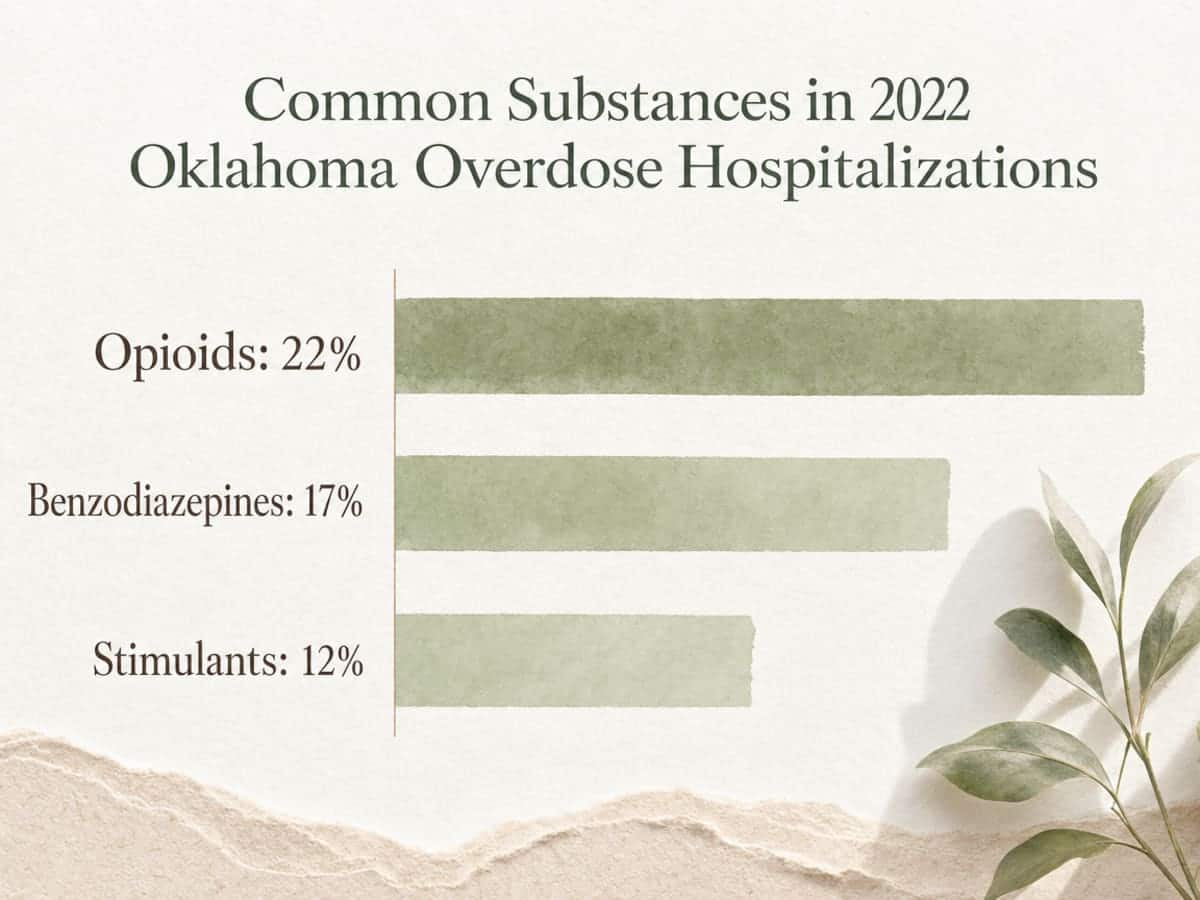
The Oklahoma State Department of Health tracks what shows up in nonfatal overdose hospitalizations. In 2022, the most common substances involved were opioids at 22%, benzodiazepines at 17%, and stimulants at 12% — and about 94 Oklahomans were hospitalized for a drug overdose every single week 9. That’s not a national average filtered down to your state. That’s your neighbors, your coworkers, the person two beds over.
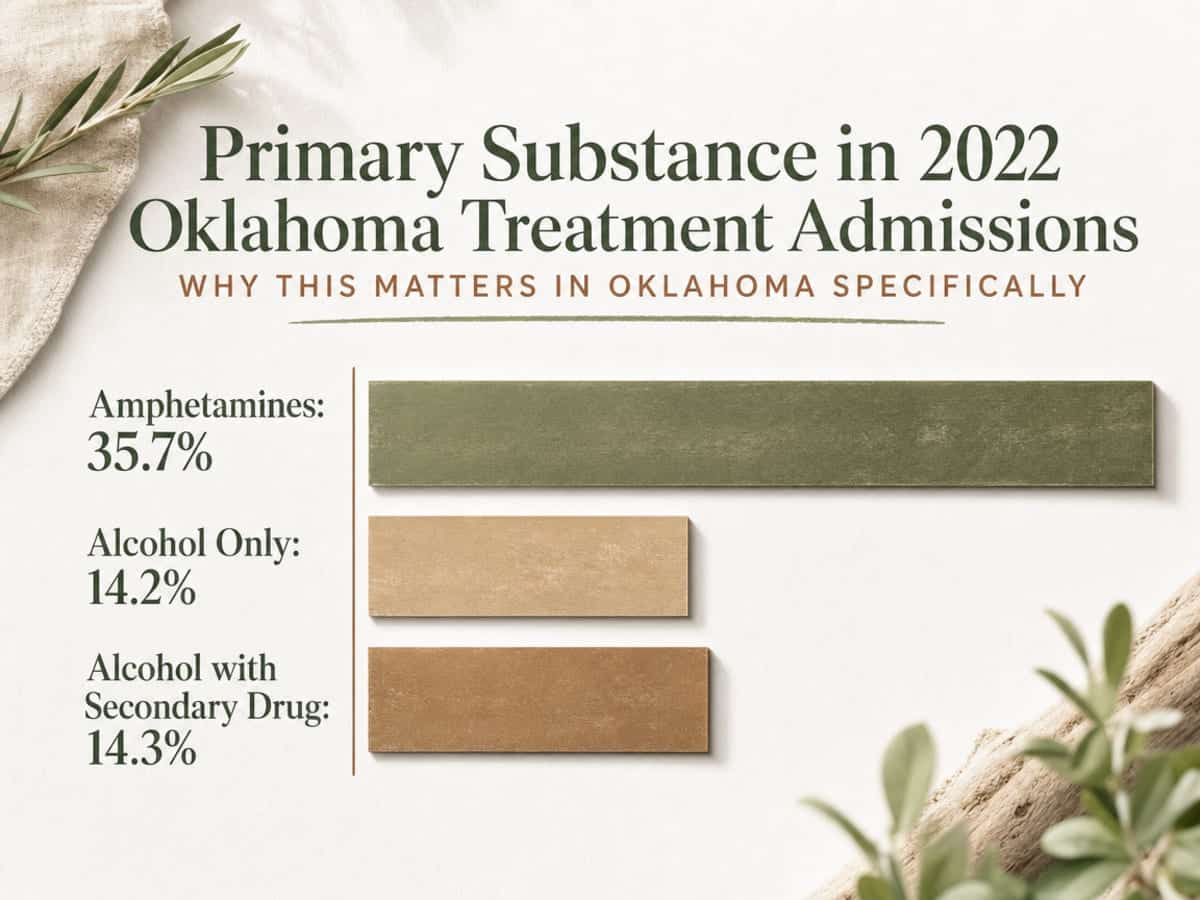
Treatment admissions tell a related story. In 2022, amphetamines were the primary substance for 35.7% of Oklahoma treatment admissions, with alcohol only close behind 16. So a psychoeducational curriculum built for this state can’t lean only on the classic alcohol-and-opioid script. It has to make room for what meth does to sleep, what fentanyl contamination has done to the opioid supply, and how benzodiazepines interact with everything else people are trying to stop.
When the topic on the wall matches the substance in your history, the hour lands differently. You’re not sitting through a generic lesson. You’re getting information written for the exact fight you’re in.
The Treatment Gap and Why Entry Points Matter
That gap isn’t a moral failure. It’s a logistics problem — insurance, transportation, shame, work schedules, not knowing where to start, being told the wait is six weeks. Detox is one of the few doors that opens quickly, and once you’re through it, the psychoeducational hours embedded in the day are often the first structured recovery education a person has ever had.
Oklahoma’s own rules recognize this. The state’s provider standards require that medically supervised withdrawal happen inside a broader treatment program, not as an isolated medical event 17. That framework exists because walking someone through withdrawal without teaching them anything about what comes next tends not to hold. National detox guidance says the same: withdrawal care should come paired with counseling and education about addiction and recovery 24.
So the classroom hour in your detox day isn’t a nice extra. In a state with this much unmet need, it’s often the education you were never going to get anywhere else.
Does It Actually Work? An Honest Read of the Evidence
Where the Research Is Strong
Fair question. You’re being asked to sit through classes while your body is still shaking. It’s reasonable to want to know if the hour pays off.
The short version: yes, when it’s part of a bigger package. Group-based treatment for drug use disorders consistently produces better outcomes than standard care without a group component 23. That’s the baseline finding — putting people together in a structured, teaching-focused setting helps more than leaving them to figure it out alone.
The stronger evidence gets specific about brain-focused education. A 2025 randomized trial of a brain-awareness psychoeducation program found the intervention significantly reduced relapse rates and improved motivation to stay in treatment, with the authors concluding that adding neurocognitive awareness to standard treatment enhances outcomes 5. Plain-language teaching about what substances do to your brain isn’t a soft add-on. It moves the needle.
There’s also the practical evidence. Randomized detox trials describe programs where patients attended twice-daily one-hour groups on abstinence, nutrition, relaxation, and relapse prevention — and used those groups as the foundation for adding targeted behavioral interventions that further boosted aftercare completion 6. The classroom hour isn’t decoration. It’s the platform everything else stacks on top of.
Where It’s Mixed, and Why That’s Useful to Know
Here’s the part most brochures skip. That same 2021 systematic review that praised group-based treatment overall also found that stand-alone psychoeducational groups didn’t consistently outperform usual treatment on their own 23. Sitting through classes without the medical care, the coping-skills practice, and the aftercare planning around them doesn’t do the same work.
That’s actually useful information, not bad news. It tells you what to look for.
A detox day that runs psychoeducational groups alongside 24/7 medical monitoring, individual counseling, and concrete skills practice — the model Oklahoma’s provider standards expect and the one Renewal Springs is built around 17, 24 — is doing what the evidence supports. A program that only runs classes, or only monitors vitals with no education attached, is leaving results on the table.
So the question to carry into any conversation with a detox program isn’t “do you have groups?” It’s “how do the groups fit with the medical care and the plan for what comes after?” When those pieces are woven together, the hour on the whiteboard becomes one of the parts of the day you’ll remember using long after you leave 5, 6.
What to Ask Before You Walk In
You don’t need a clinical vocabulary to figure out if a detox program is set up to actually teach you something. You just need a few honest questions.
- Ask what a typical day looks like, hour by hour. A program that runs psychoeducational groups as part of the model should be able to walk you through when they meet, roughly how long they run, and what topics show up in week one.
- Ask what gets covered — brain effects, triggers, cravings, relapse warning signs, a written coping plan. Those are the pieces the evidence points to 1, 5, 8.
- Ask how the classroom hours fit with the medical care. Oklahoma’s provider standards expect detox to happen inside a broader treatment program, not as an isolated medical event 17. So it’s fair to ask how nursing, physician oversight, and the group schedule share the same day.
- Ask what happens if you’re too rough on day one to sit through a session.
- Ask whether you have to talk.
- Ask what the plan for after discharge looks like before you even arrive.
If you’re weighing Renewal Springs in Oklahoma City, call and ask exactly that: what does a typical day look like here? A program that’s proud of the answer will give you one.
Ready to Talk About Group Support Options?
Get real answers about psychoeducational groups and what a treatment day truly looks like.
Frequently Asked Questions
Will I have to talk or share personal stuff in a psychoeducational group?
How is a psychoeducational group different from regular group therapy or a 12-step meeting?
A psychoeducational group is a structured, curriculum-based class about addiction and recovery 2. A process group is a therapist-led circle focused on emotions and personal insight. A 12-step meeting is peer-led and follows the steps. Same room sometimes, very different jobs — the class version is the least confrontational and usually where detox days start 1.
What topics get covered during the first week of detox?
Expect sessions on what withdrawal does to your brain, how to spot personal triggers, how cravings work, and early relapse warning signs 1, 8. Real detox schedules have included twice-daily one-hour groups covering abstinence, treatment options, nutrition, relaxation, and relapse prevention 6. You’ll usually leave with a short written coping plan you can actually use.
Do these groups actually help, or is it just filler between medical checks?
They help most when they’re part of the package. A 2025 randomized trial found brain-awareness psychoeducation lowered relapse rates and improved treatment motivation 5. A 2021 review showed stand-alone classes have mixed results, but group-based care combined with medical treatment and skills work consistently beats standard care alone 23. Bundled matters.
What if I’m too sick from withdrawal to focus on a class?
That’s expected on day one or two. Oklahoma’s provider rules require detox to run under physician and nurse supervision, so medical stabilization comes first 17. If you’re too rough to sit through a session, you rest. Groups fit around the medical care, not the other way around — you join when your head clears enough to listen 24.
What should I ask a detox program in Oklahoma before I go in?
Ask what a typical day looks like hour by hour. Ask what topics groups cover in week one, whether you have to talk, and how the classroom hours line up with medical monitoring 17, 24. Ask what discharge planning looks like. If you’re calling Renewal Springs in Oklahoma City, ask exactly that — a straight answer tells you a lot.
References
- 2 Types of Groups Commonly Used in Substance Abuse Treatment. https://www.ncbi.nlm.nih.gov/books/NBK64214/
- Module 2: Types of Groups Used in Substance Abuse Treatment (Based on TIP 41). https://library.samhsa.gov/sites/default/files/tip41_mod2_0.pdf
- Module 1: Groups and Substance Abuse Treatment (from TIP 41). https://library.samhsa.gov/sites/default/files/tip41_mod1_0.pdf
- Group Therapy Inservice Training Based on TIP 41. https://library.samhsa.gov/product/group-therapy-inservice-training-based-tip-41/sma11-4664
- Brain Awareness Intervention: Is It Effective in Preventing Relapse?. https://pubmed.ncbi.nlm.nih.gov/40673565/
- A Randomized Trial of Two Behavioral Interventions to Improve Treatment Engagement After Alcohol Detoxification. https://pmc.ncbi.nlm.nih.gov/articles/PMC3126629/
- A Relational Agent for Treating Substance Use in Adults. https://pubmed.ncbi.nlm.nih.gov/42035882/?fc=None&ff=20260612002018&v=2.20.0
- Project MATCH Volume 3: Cognitive-Behavioral Coping Skills Therapy Manual. https://www.niaaa.nih.gov/sites/default/files/match03.pdf
- Drug Overdose County Fact Sheets, 2022 (Oklahoma State Department of Health). https://digitalprairie.ok.gov/digital/collection/stgovpub/id/641362/
- Oklahoma Drug Overdose Deaths, 2019–2023. https://digitalprairie.ok.gov/digital/collection/stgovpub/id/729608/
- Cleveland County Drug Overdose Deaths 2018–2022 (Fact Sheet). https://digitalprairie.ok.gov/digital/api/collection/stgovpub/id/681223/download
- Sequoyah County Drug Overdose Deaths 2018–2022 (Fact Sheet). https://digitalprairie.ok.gov/digital/api/collection/stgovpub/id/681190/download
- Muskogee County Drug Overdose Deaths 2018–2022 (Fact Sheet). https://digitalprairie.ok.gov/digital/collection/stgovpub/id/681154/
- Treatment Episode Data Set (TEDS): 2022 Admissions to Substance Use Treatment Services – Detailed Tables. https://www.samhsa.gov/data/sites/default/files/reports/rpt53162/2022-teds-annual-detailed-tables.pdf
- 2022 TEDS-D: Oklahoma – Discharges from Substance Use Treatment Services. https://www.samhsa.gov/data/node/51457
- 2022 TEDS-A: Oklahoma – Admissions to Substance Use Treatment Services. https://www.samhsa.gov/data/node/51031
- Chapter 18. Standards and Criteria for Substance Related and Addictive Disorder Treatment Services (Effective 9‑15‑21). https://oklahoma.gov/content/dam/ok/en/odmhsas/documents/policy/provider-certification/administrative-rules/2021/Chapter%2018%20Final%20effective%209-15-21.pdf
- Administrative Rules – Chapter 18 Effective 11‑16‑20. https://oklahoma.gov/content/dam/ok/en/odmhsas/documents/policy/provider-certification/administrative-rules/2020/AdminRules-Chapter18–11-16-20.pdf
- Chapter 18 – Provider Certification Rules (Effective 9‑1‑25). https://oklahoma.gov/content/dam/ok/en/odmhsas/documents/policy/provider-certification/administrative-rules/2025/PC–Chapter-18_9-1-25.pdf
- OKLAHOMA – National Survey on Drug Use and Health State Tables, 2022 and 2023. https://www.samhsa.gov/data/sites/default/files/reports/rpt56188/2023-nsduh-sae-state-tables_0/2023-nsduh-sae-state-tabs-oklahoma.pdf
- NSDUH Behavioral Health Barometer: Oklahoma, Volume 8. https://www.samhsa.gov/data/report/nsduh-behavioral-health-barometer-oklahoma-volume-8
- Substance Abuse Treatment: Group Therapy (TIP 41 Quick Guide). https://library.samhsa.gov/product/substance-abuse-treatment-group-therapy/sma15-4024
- A Review of Research‑Supported Group Treatments for Drug Use Disorders. https://pmc.ncbi.nlm.nih.gov/articles/PMC8215831/
- Detoxification and Substance Abuse Treatment (Treatment Improvement Protocol Series). https://www.ncbi.nlm.nih.gov/books/NBK64164/