
Key Takeaways
- The readiness window closes fast, so acting within hours rather than days is what makes rapid admission clinically meaningful and keeps someone engaged long enough to enter care 1.
- The first call starts the evaluation phase itself, with intake staff running clinical screening and insurance verification in parallel to avoid stalls later 1.
- Intake questions map to the six ASAM dimensions, letting the team match severity of withdrawal, medical risk, and home environment to the correct level of care 3.
- Non-hospital detox has real medical cutoffs: chest pain, seizures, DTs, acute psychosis, or recent overdose usually route someone to a hospital first before a detox bed 4.
- Having ID, insurance card, medication list, and prescriber contact ready lets benefits verification run alongside clinical screening so paperwork does not delay admission 2.
- The first four hours cover vitals, labs, and validated withdrawal scoring like CIWA-Ar or COWS, which drive medication dosing during stabilization 1.
- Alcohol and benzodiazepine withdrawal carry seizure risk that pushes placement toward inpatient monitoring, while fentanyl changes buprenorphine induction timing to avoid precipitated withdrawal 6.
- Discharge planning should start at admission with a facilitated handoff to ongoing care, since detox alone is not complete treatment and relapse risk peaks afterward 12.
The Readiness Window: Why the Next Few Hours Matter
You already know the hardest part. It is not the withdrawal, or the paperwork, or the drive to the facility. It is the moment you decide you are done, and then hold onto that decision long enough to act on it.
That moment has a shape. Clinicians who work in addiction medicine call it a readiness window, and it is usually measured in hours, not days. Someone wakes up shaking after a bad night. A spouse finds the empty bottles again. A parent gets a call from a hospital ER. The willingness to accept help arrives, and it starts leaking away almost immediately. Ambivalence is not a character flaw. It is a predictable feature of substance dependence, and every hour a person waits for a bed, an intake call back, or an insurance approval is an hour that window narrows.
This is why rapid admission exists as a distinct model. SAMHSA’s TIP 45 guidance frames detoxification as three linked tasks: evaluation, stabilization, and fostering readiness for ongoing treatment 1. All three depend on getting someone through the door while they are still willing to come. A randomized trial of facilitated, accompanied access from withdrawal management into ongoing addiction care found that immediate handoffs increased treatment engagement and reduced emergency department visits at six months compared with delayed referral 12.
If you are the one making the call, or the one whose loved one is making it, the next few hours matter. This guide walks you through what happens next.
What Actually Happens on the First Call
Who Answers, What They Ask, and Why
The person who picks up is usually an intake coordinator or an admissions nurse. They are trained to keep you talking, not to interrogate you. If you are calling for yourself, expect a calm voice on the other end who has heard every version of this call before. If you are a spouse, parent, or adult child making the call, they will work with you too.
The first questions are practical. What substance, how much, how often, and when was the last use. They will ask about past withdrawal history, especially any seizures, DTs, or hospital stays. They will ask about other medical conditions, current medications, and whether you have thoughts of harming yourself. None of these questions are traps. Each one maps to a clinical decision the physician and nurse supervisor have to make before a bed is offered 4.
They will also ask what insurance you have, or whether you are paying privately. This is not gatekeeping. It is running in parallel with the clinical screening so the admission does not stall later. Under SAMHSA’s TIP 45 framework, this first conversation is the beginning of the evaluation phase of detox, not a separate step 1. The screening is already underway before you hang up.
The 24/7 Access Points That Feed Rapid Admission
Not every call starts at a detox center. Sometimes you do not know which number to dial, or the first facility you tried is full, or it is 3 a.m. and you just need someone to answer.
Three national access points run around the clock and connect directly to facility-based care. SAMHSA’s National Helpline at 1-800-662-HELP offers 24/7 free and confidential treatment referral for mental and substance use disorders, and can route callers to local medically supervised detox 9. The 988 Suicide and Crisis Lifeline provides 24/7 judgment-free support by call, text, or chat, and is built to triage substance use crises alongside mental health crises 10. Behind both sits a broader crisis system: call centers operating 24/7/365, mobile crisis teams, and crisis stabilization facilities designed to coordinate warm handoffs to facility-based care, including detox beds 11.
Use whichever door is closest. If a family member is in active withdrawal or talking about suicide, 988 is the fastest triage. If you are researching options during a quiet afternoon, the National Helpline or a direct call to a local detox admissions line will get you further, faster. The point is not to pick the perfect number. It is to pick up the phone.
Screening and Level-of-Care Matching Using the ASAM Criteria
The Six Dimensions Behind the Questions
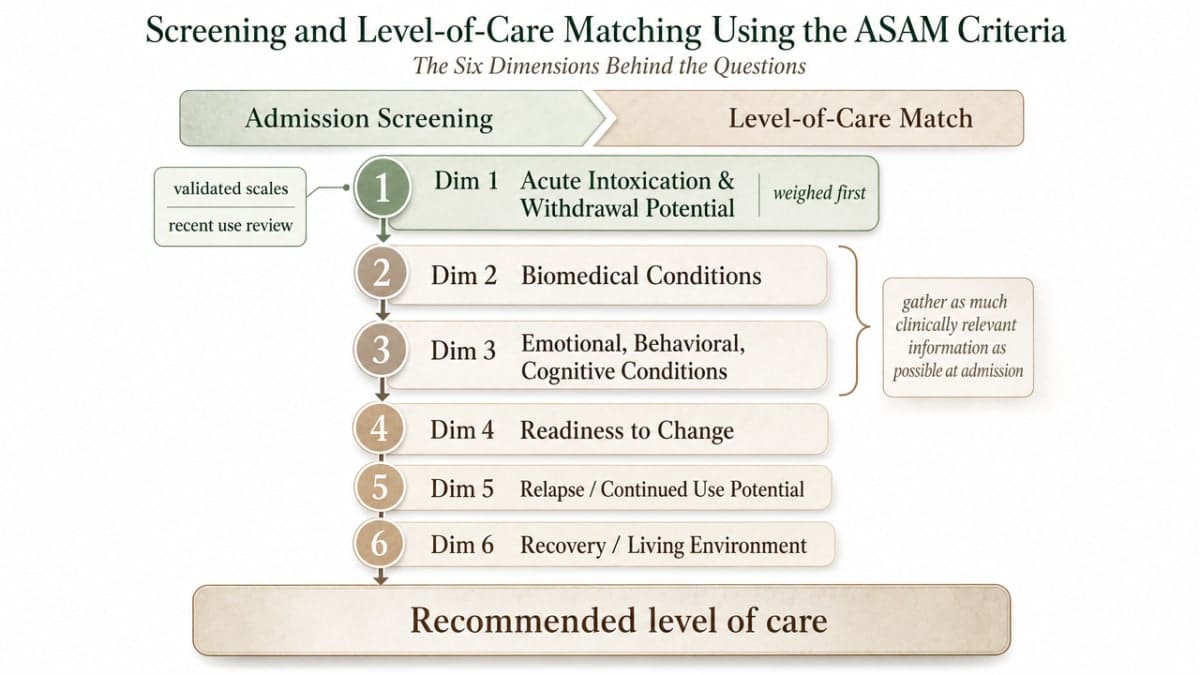
When the intake nurse asks whether you have ever had a seizure during withdrawal, whether you have a place to sleep tonight, or how you feel about coming in today, none of it is small talk. Each question maps to one of six dimensions in the ASAM Criteria, the framework most withdrawal management programs use to decide who needs what level of care.
Dimension 1 covers acute intoxication and withdrawal potential. It is the question the intake team weighs first, using validated scales and a review of your recent use. Minnesota’s implementation guidance for ASAM’s third edition is explicit: at admission, providers assess Dimension 1 and gather as much clinically relevant information as possible for Dimensions 2 and 3, even when the full picture is not yet available 3. Dimension 2 is biomedical—your heart, liver, blood pressure, pregnancy status, chronic pain, whether you have eaten in two days. Dimension 3 is emotional, behavioral, and cognitive—anxiety, depression, thoughts of suicide, trauma history.
The remaining three dimensions shape what happens after the front door. Dimension 4 asks about your readiness to change. Dimension 5 weighs relapse and continued-use potential. Dimension 6 looks at your recovery environment—who is at home, whether it is safe to return there, whether you have transportation to a follow-up appointment.
These six dimensions are how the CMS/Medicaid ASAM resource guide defines the medically monitored inpatient withdrawal management level: care for severe withdrawal requiring 24-hour nursing and physician visits, where a person is unlikely to complete withdrawal safely without medical monitoring 2. When your answers cluster toward severe Dimension 1 risk, unstable Dimension 2 medical issues, or a Dimension 6 environment full of active use, the team is not judging you. They are calibrating the level of care that keeps you alive.
When Non-Hospital Detox Is Not Safe: The Medical Cutoffs
Here is the part most rapid-admission content skips, and it is the part that will save you time and heartbreak if you understand it before the call.
A medical detox center in Oklahoma is not a hospital. Under Oklahoma’s Chapter 18 rules, medically supervised withdrawal management outside a hospital operates under a licensed physician and a licensed registered nurse supervisor, and is limited to people who do not have medical or neurological symptoms that require hospitalization 4. That last clause is the cutoff. If your Dimension 2 findings include something the facility cannot safely manage at its level of care, the honest answer at intake is that you belong in a hospital first, then step down into detox.
If you are the family member calling, this is worth hearing plainly. A referral to the emergency department is not a rejection. It is often the fastest legitimate path into medically supervised care, and many people are transferred into a detox bed within a day or two once they are medically cleared 1.
Insurance Verification, ID, and the Paperwork That Can Stall You
While the intake nurse is running the clinical screening, someone else on the admissions team is usually working the insurance side. This parallel track is what makes rapid admission actually rapid. If it waits until after the clinical call, you can lose an afternoon.
Have these things within arm’s reach before you dial:
- a photo ID or driver’s license,
- your insurance card (front and back),
- a rough list of medications you take and doses if you know them, and
- the name and number of any current prescriber.
If you are calling for a spouse, parent, or adult child, gather what you can and be honest about what you do not know. Admissions teams are used to incomplete information—the CMS/Medicaid ASAM guide notes that admission pathways vary by payer and level of care, which is why verification happens early rather than late 2.
Most facilities offer free benefits verification and will tell you what your plan covers before you commit. If you are uninsured or between plans, say so on the first call. Ask directly about self-pay rates, sliding scale options, and whether the facility can help with a Medicaid application. Do not let a paperwork gap keep you home tonight.
Intake Day: From the Front Door to the First Dose
The First Four Hours—Vitals, Labs, and Withdrawal Scoring
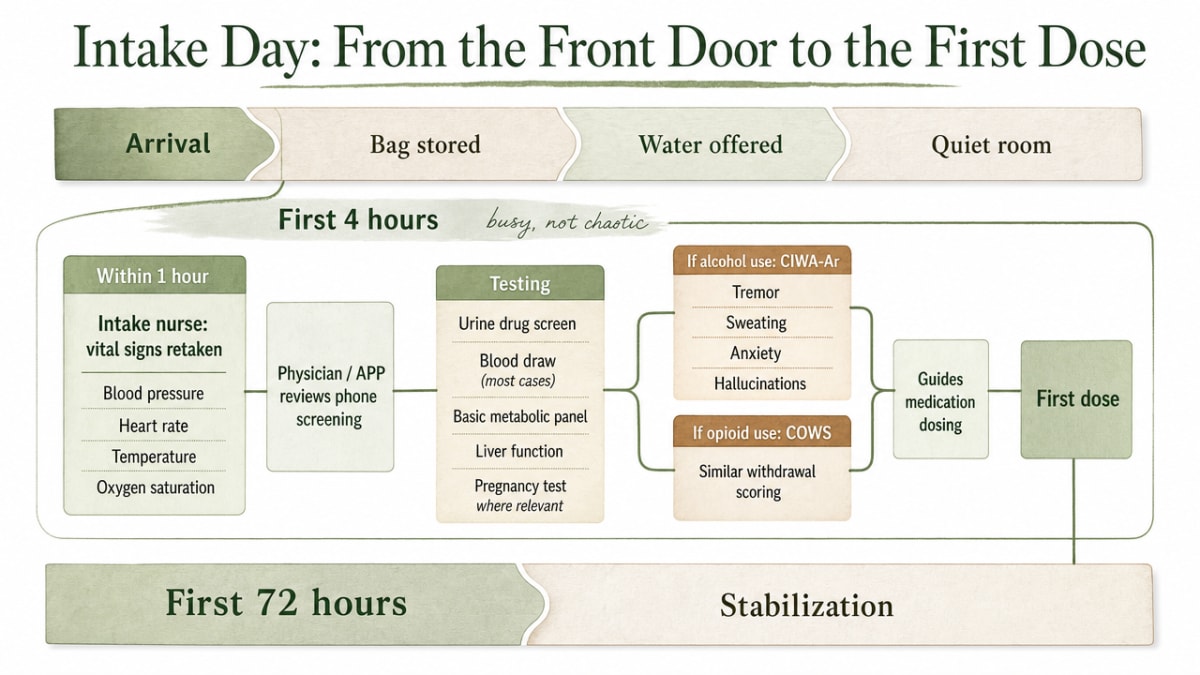
You walk in. Someone takes your bag, offers you water, and shows you to a quiet room. The tone is deliberate. The first four hours are busy, but they should not feel chaotic to you.
Within the first hour, an intake nurse retakes your vital signs—blood pressure, heart rate, temperature, oxygen saturation—and a physician or advanced practice provider reviews the screening the phone team started. You will give a urine drug screen and, in most cases, a blood draw for a basic metabolic panel, liver function, and a pregnancy test where relevant. If you use alcohol, expect a CIWA-Ar score: a bedside checklist that rates tremor, sweating, anxiety, and hallucinations to guide medication dosing. If you use opioids, expect a COWS score doing similar work. Minnesota’s ASAM implementation guidance is explicit that admission includes Dimension 1 assessment plus as much biomedical and behavioral information as can be gathered in the moment, with placement revisited as more data come in 3.
Somewhere in hour two or three, the first medications usually arrive. A benzodiazepine for a rising CIWA score. Buprenorphine once your COWS score confirms you are in enough withdrawal to start safely. An anti-nausea medication. Something for sleep tonight. This is the stabilization function of detox that SAMHSA’s TIP 45 describes, running in parallel with evaluation rather than after it 1. You do not have to remember all of this. Someone is charting every number for you.
The First 24 to 72 Hours in the Bed
The first night is usually the loudest one in your body. Nurses will check on you every few hours, retake vitals, rescore withdrawal, and adjust medications. If you are withdrawing from alcohol or benzodiazepines, that monitoring is not optional—it is the reason you are here instead of on your couch. Symptoms of severe alcohol withdrawal can escalate for 24 to 72 hours before they peak, which is exactly the window a medically supervised bed is designed to cover.
By the second day, most people can eat something. You will meet a counselor or case manager, often briefly. They are not there to dig into your history yet. They are there to start Dimension 4, 5, and 6 work—what does readiness look like for you, what does relapse risk look like when you leave, what does home look like 3. Somewhere in day two or three, the conversation about what comes next begins in earnest, because SAMHSA is direct that detox by itself is not complete treatment 1.
You will feel worse before you feel better, and then you will feel steadier than you expected. That is not a promise about how easy it will be. It is what the clinical rhythm of the first 72 hours is built to make possible.
Substance-Specific Considerations at Admission
Alcohol, Benzodiazepines, and the Seizure Question
If you drink heavily every day, or if you have been on Xanax, Klonopin, Valium, or Ativan for months or years, the withdrawal that scares clinicians the most is not the sweating or the anxiety. It is the seizure risk, and it is the reason you cannot safely quit these two on your own.
At intake, expect specific questions: how many drinks a day, how long since your last one, whether you have ever had a seizure or delirium tremens during a previous stop. For benzodiazepines, expect questions about the exact medication, dose, and how long you have been taking it. The VA’s alcohol withdrawal notice requires facility protocols that use validated severity scales like CIWA-Ar and match patients to ambulatory, inpatient, or ICU care based on that score 7. A high CIWA reading, a seizure history, or unstable vitals push the placement decision toward inpatient monitoring, and sometimes toward the hospital first 4.
Benzodiazepine withdrawal is slower and longer. A tapered dose plan, not an abrupt stop, is the standard. Tell the intake nurse everything you have been taking, even if the prescription is not yours. Honesty here is safety, not confession.
Opioids, Fentanyl, and Precipitated Withdrawal
Opioid withdrawal will not usually kill you, but fentanyl has changed the math on how admission is timed. Because fentanyl lingers in body fat and releases slowly, starting buprenorphine too early can trigger precipitated withdrawal—a sudden, brutal worsening of symptoms within an hour of the first dose. Intake teams now ask when you last used, what you used, and whether it was pressed pills, powder, or a patch, because those answers change the induction plan.
Expect a COWS score before the first buprenorphine dose. The nurse is looking for objective signs—dilated pupils, gooseflesh, yawning, a rising heart rate—that confirm you are in enough withdrawal to start safely. Some centers use low-dose or microdose induction protocols for fentanyl to reduce the precipitated-withdrawal risk. Methadone is another option in some settings.
If You Are a Veteran or Calling for One
If you served, or if you are calling for someone who did, the admission conversation has a few extra pieces worth knowing about before you dial.
Veterans often carry a specific mix at intake: heavy alcohol use, chronic pain treated with opioids, benzodiazepines prescribed for PTSD or sleep, and a higher baseline risk of suicidal thinking. VHA Notice 2024-09 requires VA facilities to use validated severity scales like CIWA-Ar and to match patients to ambulatory, inpatient, or ICU care based on that score, with consultation from addiction specialists built into the protocol 7. Community detox centers that regularly serve veterans tend to follow the same playbook, and it is fair to ask on the first call how they coordinate with the local VA.
The other piece worth naming: the VA/DoD guideline recommends against opioid withdrawal management without planned ongoing pharmacotherapy, because relapse and overdose risk after detox alone is high 6. If you or your veteran uses opioids, ask what happens on day four, not just day one. That question is not pushy. It is exactly the question the guideline wants you to ask.
What Comes After Detox—and Why the Plan Starts at Admission
Here is the truth no one wants to lead with, but everyone needs to hear: finishing detox is not finishing treatment. SAMHSA’s TIP 45 is direct that detoxification is one phase in a continuum, and that stand-alone withdrawal management without a warm handoff to ongoing care is not complete substance use disorder treatment 1. That is why the discharge plan should not be written on day five. It should start being sketched at admission.
By day two or three in the bed, a case manager will begin asking what comes next—residential treatment, an intensive outpatient program, an addiction medicine clinic for continued medications, or some combination. For opioid use disorder, the plan should include ongoing buprenorphine or methadone, not just a taper 6. For alcohol use disorder, VHA guidance points toward initiating pharmacotherapy like naltrexone or acamprosate before discharge, not weeks later 7. Protracted withdrawal—the low-grade sleep problems, anxiety, and cravings that can linger for weeks—is real, and it is the window in which most relapses happen 8.
The most useful thing you can do while still in the bed is agree to a facilitated handoff. A randomized trial of rapid, accompanied access from withdrawal management into an addiction medicine clinic within two days of discharge found higher treatment engagement and fewer emergency department visits at six months than delayed referral 12. Someone walking you to the next appointment beats a phone number on a discharge sheet. Ask for that walk before you leave.
How to Prepare So Nothing Stalls the Admission
You do not need a perfect plan. You need a small stack of information sitting next to the phone, and a willingness to make the call before the willingness fades.
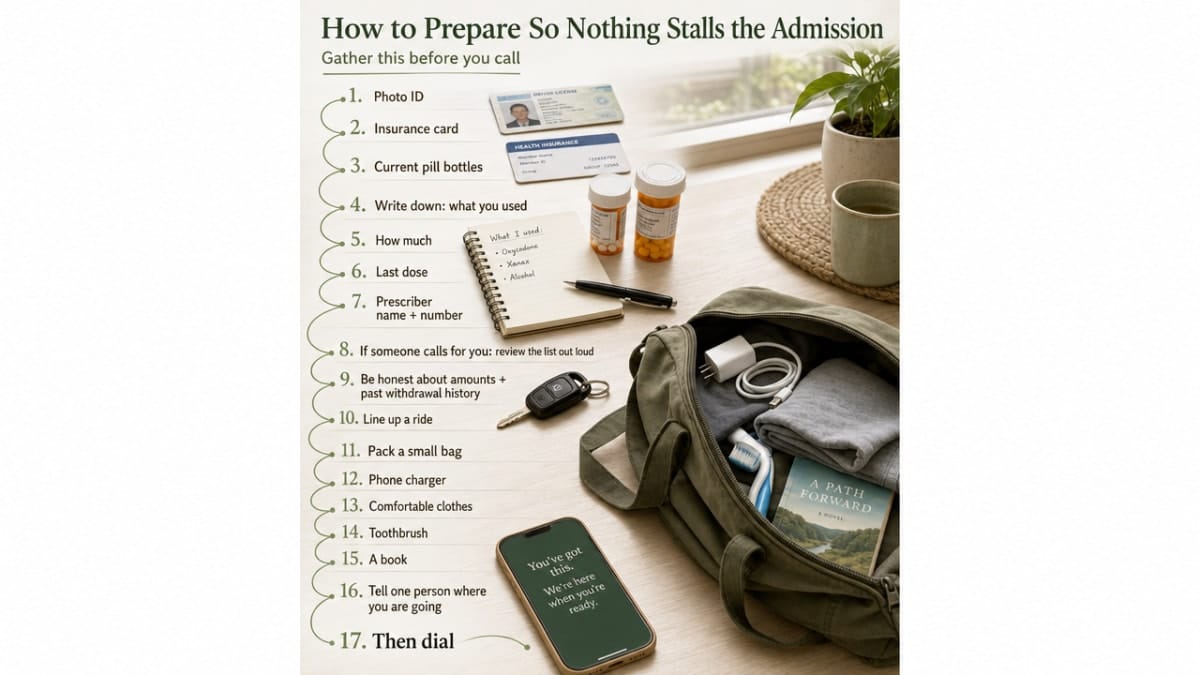
Set a photo ID, your insurance card, and any current pill bottles on the kitchen counter. Write down what you used, how much, and when the last dose was. Add the name and number of your prescriber if you have one. If a family member is making the call for you, walk them through this list out loud so nothing gets guessed at. Honest answers about substance amounts and past withdrawal history let the intake team match you to the right level of care instead of redirecting you later 3.
Line up a ride. Pack a small bag—a phone charger, comfortable clothes, a toothbrush, a book you have been meaning to read. Tell one person where you are going.
Then dial. The clinical assessment and the insurance check will run in parallel from the first minute, which is what makes rapid admission actually rapid 1. Everything else you can figure out after you are in the bed.
Ready for Rapid Admission? Connect Instantly Now
Speak directly with a team member for immediate answers and admission support when every moment counts.
Frequently Asked Questions
How quickly can someone actually be admitted to a rapid detox center?
Timing varies by facility, bed availability, and how quickly clinical screening and insurance verification can run in parallel. Many centers can move a willing person from first call to a monitored bed the same day or next day, especially when you have an ID, insurance card, and honest substance history ready. The screening and stabilization work SAMHSA outlines begins on that first call, not after you arrive 1.
What information should I have ready before making the first call?
Keep a photo ID, your insurance card (front and back), and any current pill bottles within reach. Know what you used, roughly how much, and when your last dose was. Add your prescriber’s name and number if you have one. Honest answers about amounts and past withdrawal history let the intake team match you to the correct level of care under ASAM Dimension 1 assessment 3.
What disqualifies someone from non-hospital detox in Oklahoma?
Under Oklahoma’s Chapter 18 rules, medically supervised withdrawal management outside a hospital is limited to people without medical or neurological symptoms that require hospitalization 4. Active chest pain, uncontrolled blood sugar, a recent seizure or DTs, acute psychosis, a recent overdose, or serious infection typically triggers a hospital referral first. That is not a rejection—it is often the fastest legitimate path into medically supervised care once you are stabilized.
Can I call to arrange admission for a family member, or does the person have to call themselves?
Yes, you can call. Admissions teams routinely work with spouses, parents, and adult children gathering information on behalf of someone in withdrawal. The person entering care will still need to consent and answer clinical questions directly at intake, but you can start screening, insurance verification, and logistics before they pick up the phone. If they are in crisis, 988 is built for that triage 10.
Is medical detox enough on its own, or do I need to plan for more treatment after?
Detox by itself is not complete treatment. SAMHSA’s TIP 45 frames withdrawal management as one phase in a continuum, with a warm handoff to ongoing care built in 1. For opioid use disorder, the VA/DoD guideline recommends against withdrawal management without planned ongoing pharmacotherapy because relapse and overdose risk after detox alone is high 6. Ask about day four before you finish day one.
Are there specific admission considerations for veterans seeking withdrawal management?
Yes. VHA Notice 2024-09 requires validated severity scales like CIWA-Ar, matches patients to ambulatory, inpatient, or ICU care based on that score, and builds in addiction specialist consultation 7. Community centers that regularly serve veterans usually follow the same playbook. Ask on the first call how they coordinate with the local VA and whether they can initiate AUD or opioid pharmacotherapy before discharge 6.
References
- Quick Guide For Clinicians Based on TIP 45—Detoxification and Substance Abuse Treatment. https://nida.nih.gov/sites/default/files/samhsa_detoxification_and_substance_abuse_treatment.pdf
- Overview of Substance Use Disorder (SUD) Care Clinical Guidelines: The ASAM Criteria. https://www.medicaid.gov/state-resource-center/innovation-accelerator-program/iap-downloads/reducing-substance-use-disorders/asam-resource-guide.pdf
- Guidance for Implementing ASAM Criteria, 3rd Edition, for Withdrawal Management Services. https://mn.gov/dhs/assets/WDM%20Guidance_9.8.2025_tcm1053-706303.pdf
- Chapter 18. Standards and Criteria for Substance Use Disorders Treatment Programs (Oklahoma ODMHSAS). https://oklahoma.gov/content/dam/ok/en/odmhsas/documents/policy/provider-certification/administrative-rules/2021/Chapter%2018%20Final%20effective%209-15-21.pdf
- Okla. Admin. Code tit. 450, ch. 18, subch. 3 – Substance Use Disorders Treatment Programs. https://www.law.cornell.edu/regulations/oklahoma/title-450/chapter-18/subchapter-3
- VA/DoD Clinical Practice Guideline for the Management of Substance Use Disorders – Provider Summary. https://www.healthquality.va.gov/guidelines/MH/sud/VADoDSUDCPGProviderSummary.pdf
- VHA Notice 2024-09: Alcohol Withdrawal Management. https://www.va.gov/vhapublications/ViewPublication.asp?pub_ID=11928
- Protracted Withdrawal. https://library.samhsa.gov/sites/default/files/sma10-4554.pdf
- National Helpline for Mental Health, Drug, Alcohol Issues. https://www.samhsa.gov/find-help/helplines/national-helpline
- 988 Suicide & Crisis Lifeline. https://www.samhsa.gov/mental-health/988
- Crisis Services: Meeting Needs, Saving Lives – Compendium. https://988crisissystemshelp.samhsa.gov/sites/default/files/2024-01/crisis-services-meeting-needs-saving-lives-compendium.pdf
- Facilitating Rapid Access to Addiction Treatment: A Randomized Controlled Trial. https://pmc.ncbi.nlm.nih.gov/articles/PMC8152083/
- Patient Perspectives on a Rapid Access, Walk-in, Medication-Assisted Treatment Clinic. https://pmc.ncbi.nlm.nih.gov/articles/PMC12053929/