
Key Takeaways
- Same-day medically supervised detox is available in Oklahoma City for alcohol, benzodiazepine, and opioid withdrawal, meeting readiness in the narrow window when someone decides to seek help.
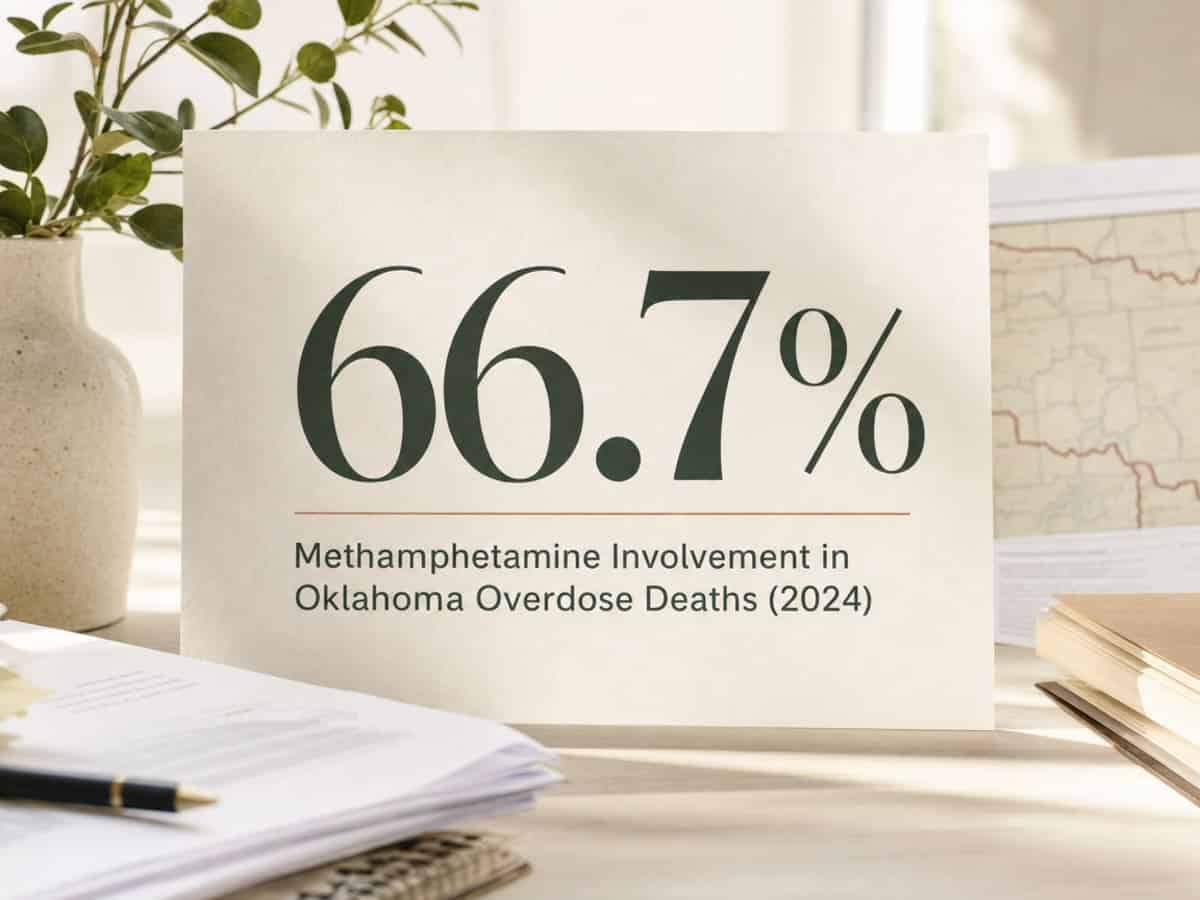
- Oklahoma recorded 1,137 overdose deaths in 2024, with methamphetamine involved in about 66.7% of them, making local access to 24-hour monitoring clinically relevant across substance types 14.
- Before calling, weigh insurance pathways: SoonerCare covers detox, residential SUD care, and MAT with prior authorization handled by intake teams 2, 3, while private plans typically need a benefits verification call.
- Ask each facility about same-day beds, gender-specific or private settings, veteran pathways through the OKC VA 11, and the post-detox handoff to residential, IOP, or MAT before admission.
If today is the day you decided to get help
Something shifted. Maybe it was a scare last night, a look on your kid’s face, a shaky morning that felt different than the ones before it. Whatever brought you here, you searched “rehab okc” — and that took more than most people know.
You do not need to have the whole plan figured out. You just need the next right step, and this guide is built to give you that in plain language.
Here is what you should know before you read another word: medically supervised detox in Oklahoma City is real, it is available, and for many people it can start the same day you make the call. Withdrawal from alcohol, benzodiazepines, and opioids is not something to tough out alone at home — SAMHSA’s clinician guidance describes detoxification as a process that requires medical supervision to stop alcohol or drug use safely 16. That is not fear talk. That is the reason facilities exist.
The pages ahead walk through what same-day admission actually looks like, how SoonerCare and private insurance handle detox and residential care, what withdrawal management involves clinically, and what happens after the medical piece is done. There are separate sections for veterans, for people who want gender-specific care, and for the very first hour if you have no idea where to start.
Read what you need. Skip what you don’t. If you’re reading this for someone you love, that counts too — you’re allowed to be scared and steady at the same time.
Why same-day matters in Oklahoma City right now
You are not overreacting. If your body is telling you something has to change, the numbers behind that feeling are real, and they are local.
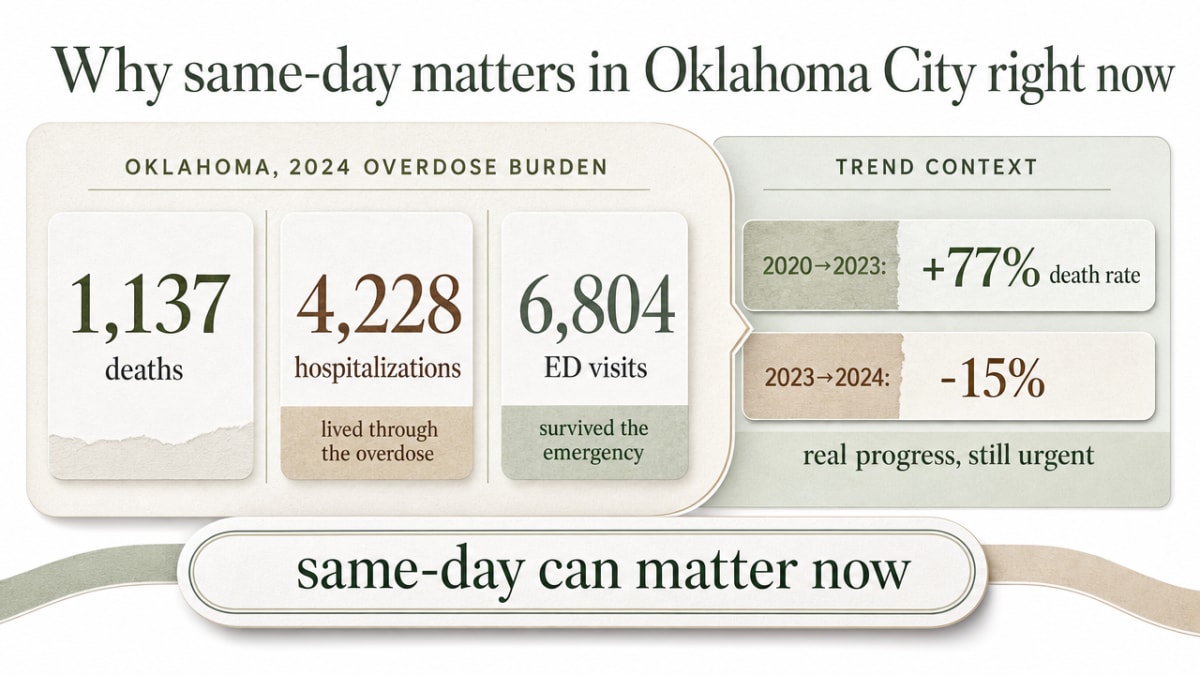
In 2024, Oklahoma recorded 1,137 drug overdose deaths, 4,228 inpatient hospitalizations for overdose, and 6,804 emergency department visits for overdose 14. Thousands of people were sick enough to be admitted to a hospital bed, and they lived. That is the group most people forget about — the ones who made it through a bad night and are somewhere right now, deciding whether to try something different.
You might be one of them. Or you might be trying to help someone before they become one of them.
The trend line has been ugly and uneven. Oklahoma’s unintentional drug overdose death rate climbed 77% from 2020 to 2023, then dropped 15% from 2023 to 2024 13. That drop is real progress, and it is also thin. A single bad batch, a single relapse after a long stretch, and a family is on the wrong side of the statistic. Waiting a week for a bed you could have gotten today is a gamble nobody should have to make on the hardest day of their life.
That does not mean every facility can take you in the next four hours. It means the pathway exists, and knowing how it works is what turns a hard morning into a next step.
What medically supervised detox actually looks like
Alcohol and benzodiazepine withdrawal: where the medical risk is highest
If you or someone you love drinks heavily every day, or has been on Xanax, Klonopin, Valium, or Ativan for a long stretch, this is the section to read twice.
Alcohol and benzodiazepines share a dangerous trait: stopping them suddenly can trigger seizures, and in the worst cases, delirium tremens. That is not a scare tactic. That is why hospitals and detox facilities exist as their own thing instead of telling you to ride it out on the couch. SAMHSA’s clinician guidance describes detoxification as a process requiring medical supervision to stop alcohol or drug use safely 16, and the clinical literature on alcohol withdrawal is direct about what that looks like in practice: benzodiazepines are the first-line therapy for alcohol withdrawal syndrome 15, given on a schedule that tapers as your vitals settle.
Here is what that looks like when you walk in. A nurse takes your vitals. A clinician asks how much you drink, when your last drink was, whether you’ve had seizures or DTs before, and what other medications are in your system. From there, staff monitor you around the clock — blood pressure, pulse, tremor, sleep — and adjust medications so the worst of the withdrawal never lands full-force. You are not white-knuckling this. That is the whole point of being there.
Opioid withdrawal and the role of buprenorphine or methadone
Opioid withdrawal usually will not kill you the way alcohol withdrawal can. It will make you wish it would. Bone-deep aches, sweats, nausea, diarrhea, restless legs at 3 a.m., a level of anxiety that feels physical — this is the part most people try to hide from, and the part most people relapse into.
Medication-assisted treatment changes that math. Oklahoma added Medication Assisted Treatment coverage to its Medicaid program effective October 1, 2020 3, and SoonerCare’s rules require office-based opioid treatment providers to have the capacity to offer FDA-approved medications for opioid use disorder, including for maintenance, detoxification, overdose reversal, and relapse prevention 7. In plain language: buprenorphine (Suboxone) or methadone can start during your detox, not after. That single fact is often the difference between a person completing withdrawal and a person walking out on day two.
If you are dependent on fentanyl specifically, this matters even more. Fentanyl lingers in body tissue longer than heroin or prescription painkillers, and timing the first buprenorphine dose wrong can trigger precipitated withdrawal — a rapid, brutal worsening. That is exactly the kind of thing medical staff are trained to prevent. You do not have to figure it out yourself.
Stimulants, kratom, and polysubstance patterns in OKC
Stimulant withdrawal is the one people underestimate most, and Oklahoma is the wrong place to underestimate it.
Methamphetamine was involved in roughly two out of three Oklahoma drug overdose deaths in 2024 — about 66.7% of them 14. That is not a national average or a projection. That is what happened in your state last year. Meth and cocaine do not usually cause seizures on their own the way alcohol does, so people assume there is no medical piece. There is. The first several days off stimulants often bring crushing depression, sleep that will not come or will not stop, appetite chaos, and — for a meaningful number of people — suicidal thinking that shows up out of nowhere. Being somewhere with 24-hour monitoring during that window is not overkill. It is the point.
Kratom withdrawal looks a lot like opioid withdrawal, because kratom hits some of the same brain receptors. If you have been taking daily doses for months, expect real physical symptoms and consider MAT eligibility as part of the intake conversation.
Most people who walk into an OKC detox are not on one substance. They are on alcohol plus something, or opioids plus meth, or benzos plus a nightly drink. Tell intake everything. The plan changes when they know.
Insurance, SoonerCare, and what changes admission speed
How SoonerCare covers detox and residential SUD care
If you have SoonerCare — Oklahoma’s Medicaid program — the short version is this: medical detox is a covered benefit, and so is residential substance use treatment. You are not starting from zero.
The Oklahoma Health Care Authority lists inpatient acute care, crisis stabilization, and medical detoxification among the mental health treatment benefits available to SoonerCare members 1. Residential SUD services are also covered across children, non-expansion adults, and expansion adults — but prior authorization is required for most of these placements 2. That last part is the piece that matters for admission speed.
Prior authorization is not a wall. It is a phone call and a set of clinical criteria that a detox facility’s intake team handles on your behalf, usually while you’re being medically assessed. Most people never see the paperwork. What it means practically: a facility that admits SoonerCare members every day has a rhythm for this, and you should ask whoever picks up the phone whether they can start the authorization process during your initial call.
Medication-assisted treatment is covered too. Oklahoma added MAT to its Medicaid program effective October 1, 2020 3, and SoonerCare’s rules require office-based opioid treatment providers to offer FDA-approved medications for opioid use disorder, including for detoxification itself 7. If you are on SoonerCare and dependent on opioids, buprenorphine or methadone can be part of your covered care from day one.
Private insurance, self-pay, and verification in the first phone call
If you have private insurance through work — Blue Cross Blue Shield of Oklahoma, Aetna, Cigna, UnitedHealthcare, or one of the smaller carriers — detox and residential treatment are almost always covered under your behavioral health benefits. What varies is your deductible, your out-of-pocket maximum, and whether the facility is in-network.
Here is what you can do in one phone call: ask the facility to run a benefits verification. Most detox intake teams do this for free, usually within the hour. They will pull your plan details, tell you what your financial exposure looks like before you walk in the door, and confirm whether prior authorization is needed on your specific policy. You do not have to call your insurance company yourself while you’re already stressed and unwell.
If you’re uninsured, do not stop reading. Ask about SoonerCare eligibility on the same call — many people who assume they don’t qualify actually do, especially since Medicaid expansion. Self-pay options and sliding-scale arrangements exist too. The cost conversation is not the door being closed. It is one of the questions the intake team is there to answer.
Why most adult detox in Oklahoma happens inpatient, not ambulatory
You may have heard about “outpatient detox” — coming in for a few hours a day, going home at night, tapering under a doctor’s watch. It exists in some states. In Oklahoma, for adults, it is not really how the system is built.
The federal approval document for Oklahoma’s IMD waiver states plainly that ambulatory detox services are not covered as a discrete service model for adults, though ambulatory detox is routinely provided alongside other addiction services 5. The waiver itself was designed to fund the higher-acuity end — residential SUD treatment, facility-based crisis stabilization, and inpatient care through the IMD framework 4.
What this means for you: if you’re an adult in Oklahoma City seeking medically supervised withdrawal management, the pathway that admits fastest and gets billed cleanest is inpatient or residential. That is not a downgrade of your options. It is the level of care the state has actually invested in — 24-hour monitoring, medications on hand, and a bed while your body resets.
The next hour, the next 24 hours, the first week
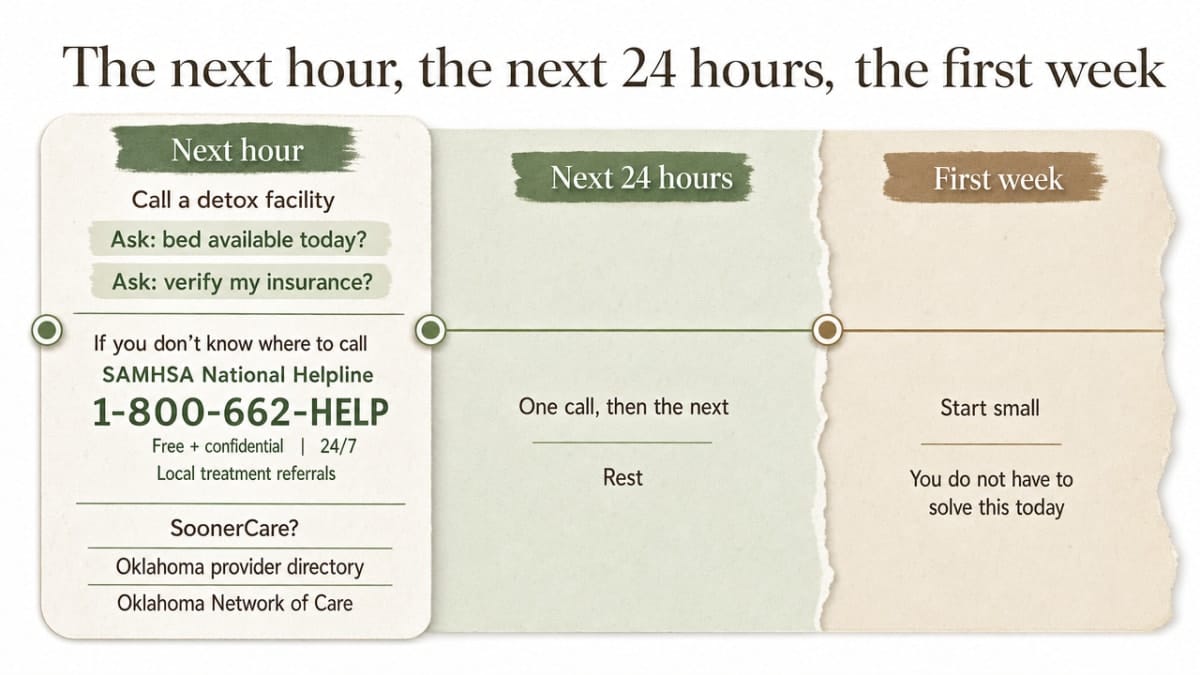
If you have no idea where to start, start small. You do not have to solve this today. You have to make one call, then the next one, then rest.
The next hour
Pick up the phone. If you know an Oklahoma City detox facility you want to try, call them directly and ask two questions: do you have a bed available today, and can you verify my insurance while we’re on the phone. If you do not know where to call, dial SAMHSA’s National Helpline at 1-800-662-HELP — it is free, confidential, and staffed 24 hours a day, seven days a week 8. They will not put you on a waiting list. They will point you toward local treatment referrals.
If you are on SoonerCare or think you might qualify, SAMHSA’s Oklahoma-specific page walks you to the SoonerCare provider directory, the Oklahoma Network of Care, and the same national helpline number 9. Any of those three is a real door.
If someone is actively overdosing right now, call 911. This guide is for the moment after that, not instead of it.
The next 24 hours
Use FindTreatment.gov to search by your ZIP code — it lets you filter by level of care and payment type, so you can see which facilities near you handle detox and take your insurance 10. Write down two or three options, not ten. Call the first one and ask about same-day admission, prior authorization if you’re on SoonerCare, and what to bring.
Eat something if you can. Hydrate. If you drink heavily every day, do not try to stop cold before you get to a medical setting — that is the exact window where alcohol withdrawal turns dangerous. Tell whoever picks up the phone how much you’ve had and when.
The first week
Once you’re admitted, your job shrinks to something manageable: follow the medication schedule, sleep when your body lets you, and be honest at every check-in. The staff builds the rest around that. Before discharge, ask what the handoff looks like — residential, intensive outpatient, MAT continuation — and get the next appointment on the calendar before you walk out the door. That single scheduled follow-up is one of the biggest predictors of whether the work you just did holds.
Pathways for veterans in the Oklahoma City area
If you served, or someone you love did, there is a parallel set of doors built specifically for you. They are not better or worse than civilian pathways — they are different, and worth knowing before you pick one.
The Oklahoma City VA Health Care System operates a Substance Abuse Treatment Program and an Opioid Treatment Program, both listed in the VA’s directory of SUD program locations across the state 11. Residential rehabilitation is also part of the picture: the VA’s residential rehabilitation locator identifies the Oklahoma City VA Medical Center (VISN 19) with a direct phone contact for those services 12. If you are enrolled in VA health care, calling the SUD program is often the fastest route into a bed the VA itself will fund.
Not enrolled, or not sure whether you qualify? The Oklahoma City Vet Center is a separate entry point. It offers confidential, no-cost counseling and can connect you with services for substance use problems specifically, from unhealthy alcohol use to life-threatening addiction 20. Vet Centers use a broader eligibility standard than VA health care, and the staff are largely veterans themselves.
If you are in crisis right now — thinking about ending your life, or watching someone spiral — dial 988 and press 1. That is the Veterans Crisis Line, staffed 24/7 20. It is not just for suicidal ideation. Call it when you need a human who understands the language.
One practical note: VA pathways sometimes take longer to admit than civilian detox facilities, especially outside business hours. If withdrawal is already starting and a VA bed is not available today, a civilian medically supervised detox that accepts TRICARE or your other coverage can bridge you into VA residential care afterward. Ask about the handoff on the first call.
Gender-specific, private, and specialized settings
Not every setting fits every person, and that is not a marketing distinction — it is a clinical and human one.
Some people cannot walk into a mixed-gender detox and be honest about what they’ve been through. Survivors of assault, women managing withdrawal alongside a pregnancy scare or child custody worry, men whose drinking is tangled up with shame they’ve never said out loud — these are real reasons to ask about gender-specific programming during your first phone call. The clinical work of detox depends on you telling the truth about your use, and the setting either makes that easier or harder.
Private or lower-census programs exist for similar reasons. If you are a nurse, a teacher, a first responder, or anyone whose recovery could intersect with your license or your reputation, ask about privacy protections and smaller-group settings. That is not luxury for its own sake — it is one of the factors that determines whether you actually stay for the full course.
Ask directly: Do you offer gender-specific programming? What does your privacy setup look like? Can you accommodate a specific work or family situation? The intake team should answer plainly, not sell.
What happens after detox: the handoff that decides most outcomes
Detox is the door, not the room. SAMHSA’s clinician guidance is direct about this — detoxification is a medically supervised process to stop alcohol or drug use safely, and it works best when it flows straight into ongoing treatment 16. The days between discharge and your next appointment are the fragile part. That gap is where most people lose the ground they just fought for.
Ask about the handoff before you’re admitted, not on your way out. A good intake team will already be thinking two steps ahead — residential treatment, an intensive outpatient program, MAT continuation, or a step-down that mixes counseling with continued medication. Oklahoma structures its post-detox care through the IMD waiver framework for higher-acuity residential SUD services 4, and SoonerCare’s outpatient behavioral health rules include day treatment and MAT continuation as covered pathways once detox ends 6.
If you’re on buprenorphine or methadone, the handoff is not optional. SoonerCare’s MAT rule requires office-based providers to have capacity for maintenance and relapse prevention, not just detox dosing 7. Leaving detox without a scheduled MAT appointment is the single most common way people slide back within a week.
Get Same-Day Medical Detox Help Now
Connect directly for rapid admissions support from a compassionate, experienced team when every moment counts.
Frequently Asked Questions
Can I get admitted to a rehab in OKC the same day I call?
Often, yes. Medically supervised detox facilities in Oklahoma City are built to move fast when withdrawal is active or imminent. On your first call, ask two things: is a bed open today, and can you verify my insurance while we’re on the phone. If a specific facility is full, they will usually help you find another. SAMHSA’s National Helpline at 1-800-662-HELP is a free, confidential 24/7 backup for referrals 8.
Does SoonerCare cover medical detox and residential rehab in Oklahoma?
Yes. SoonerCare’s behavioral health benefits include inpatient acute care, crisis stabilization, and medical detoxification 1. Residential SUD treatment is also covered across eligibility groups, though prior authorization is required for most residential placements 2. The intake team at a detox facility usually handles that paperwork while you’re being assessed. Medication-assisted treatment for opioid use disorder is covered too, effective since October 1, 2020 3.
How dangerous is alcohol or benzodiazepine withdrawal without medical supervision?
Dangerous enough that clinicians treat it as a real medical event, not a rough weekend. Sudden cessation after heavy daily use can trigger seizures and, in severe cases, delirium tremens. SAMHSA clinician guidance frames detox as a medically supervised process for a reason 16, and benzodiazepines are first-line therapy for alcohol withdrawal syndrome in clinical practice 15. If you drink heavily every day, do not stop cold at home.
What options do veterans in Oklahoma City have for same-day substance use care?
The Oklahoma City VA Health Care System runs a Substance Abuse Treatment Program and an Opioid Treatment Program listed in the VA’s SUD directory 11, and the Oklahoma City VA Medical Center is part of the VA’s residential rehabilitation network 12. The Oklahoma City Vet Center offers confidential no-cost counseling and can connect you to addiction services 20. For crisis, dial 988 and press 1 20.
What happens after detox ends?
Detox is the first step, not the finish line. SAMHSA’s clinician guidance frames detoxification as a medically supervised process that works best when it flows into ongoing treatment 16. Typical next steps include residential care under Oklahoma’s IMD waiver framework 4, intensive outpatient, day treatment, or MAT continuation through SoonerCare’s outpatient behavioral health rules 6. Before discharge, ask for a named provider and a scheduled follow-up.
What should I do in the next hour if I don’t know where to start?
Pick one number and call it. SAMHSA’s National Helpline at 1-800-662-HELP is free, confidential, and open 24/7 for treatment referrals 8. If you have SoonerCare, the state-specific SAMHSA page points you to the SoonerCare provider directory and the Oklahoma Network of Care 9. FindTreatment.gov lets you search by ZIP code and filter by level of care and payment type 10. If someone is overdosing, call 911.
References
- Behavioral Health and Substance Abuse Services – Oklahoma.gov. https://oklahoma.gov/ohca/individuals/mysoonercare/soonercare-benefits/behavioral-health-and-substance-abuse-services.html
- Mental Health and Substance Abuse Services – Oklahoma.gov. https://oklahoma.gov/ohca/individuals/programs/mental-health-and-substance-abuse-services.html
- State Plan Amendment (SPA) – Medicaid. https://www.medicaid.gov/CHIP/Downloads/OK-20-0030.pdf
- Institutions for Mental Diseases Waiver for Serious Mental Illness and Substance Use Disorder Section 1115(a) Demonstration Mid-Point Assessment. https://www.medicaid.gov/medicaid/section-1115-demonstrations/downloads/ok-qutrly-cms-accepted-mid-point-assessment-12132024.pdf
- ok-imd-waiver-smi-sud-pa.pdf. https://www.medicaid.gov/medicaid/section-1115-demonstrations/downloads/ok-imd-waiver-smi-sud-pa.pdf
- PART 21. OUTPATIENT BEHAVIORAL HEALTH SERVICES. https://oklahoma.gov/ohca/policies-and-rules/xpolicy/medical-providers-fee-for-service/individual-providers-and-specialties/outpatient-behavioral-health-services.html
- 317:30-5-241.7. Medication-assisted treatment (MAT) services for eligible individuals with opioid use disorder. https://oklahoma.gov/ohca/policies-and-rules/xpolicy/medical-providers-fee-for-service/individual-providers-and-specialties/outpatient-behavioral-health-services/medication-assisted-treatment-services-for-eligible-individuals-with-opioid-use-disorder.html
- National Helpline for Mental Health, Drug, Alcohol Issues. https://www.samhsa.gov/find-help/helplines/national-helpline
- Help for mental health, drugs, alcohol: OK Medicaid, CHIP. https://www.samhsa.gov/find-support/health-care-or-support/professional-or-program/medicaid-or-chip/oklahoma
- FindTreatment.gov (English) – SAMHSA Resource Description. https://www.samhsa.gov/resource/dbhis/findtreatmentgov-english
- Oklahoma – Substance Use Disorder (SUD) Program Locations – VA.gov. https://www.va.gov/directory/guide/state_SUD.cfm?STATE=OK
- VA Residential Rehabilitation Treatment Facilities – Locator. https://www.mentalhealth.va.gov/get-help/va-residential-rehabilitation/locator.asp
- Data – Oklahoma.gov. https://www.oklahoma.gov/health/health-education/injury-prevention-service/drug-overdose/data.html
- Drug Overdose in Oklahoma: Data Update. https://oklahoma.gov/content/dam/ok/en/health/health2/aem-documents/prevention-and-preparedness/injury-prevention/drug-overdose/Drug%20Overdose%20Data%20Graphs%20and%20Maps.pdf
- Alcohol Withdrawal in Hospitalized Patients – NCBI Bookshelf. https://www.ncbi.nlm.nih.gov/books/NBK604324/
- Quick Guide For Clinicians Based on TIP 45—Detoxification and Substance Abuse Treatment. https://nida.nih.gov/sites/default/files/samhsa_detoxification_and_substance_abuse_treatment.pdf
- Drug Overdose Data Dashboard – Oklahoma.gov. https://oklahoma.gov/health/health-education/injury-prevention-service/drug-overdose/data/drug-overdose-data-dashboard.html
- Drug Overdose Deaths, 2019–2023 – Oklahoma. https://oklahoma.gov/content/dam/ok/en/health/health2/aem-documents/prevention-and-preparedness/injury-prevention/drug-overdose/2025%20State%20Drug%20OD%20-%20IPS%20-%20Fact%20Sheet.pdf
- Capitol-Medical Center Improvement and Zoning Commission Rules. https://oklahoma.gov/content/dam/ok/en/omes/documents/CapitolZoningRules.pdf
- Oklahoma City Vet Center | Veterans Affairs. https://www.va.gov/oklahoma-city-vet-center/