Key Takeaways
- Clinicians read addiction through four categories — impaired control, social impairment, risky use, and pharmacologic criteria like tolerance and withdrawal — counted against eleven DSM criteria to gauge severity 1.
- Physical dependence and addiction are not the same; dependence is the body adapting to a substance, while addiction adds the behavioral pattern of compulsive use despite harm 2.
- Substance-specific signs matter: opioid overdose demands immediate 911 response, while alcohol and benzodiazepine withdrawal can produce seizures and require medically supervised detox rather than solo quitting 3.
- Bring specific observations to a doctor and ask for validated screening like the AUDIT or DAST, then get the sequence right — detox before treatment when tolerance and withdrawal are present 8, 9.
What You’re Actually Seeing When Something Feels Off
You have probably talked yourself out of what you are seeing more than once. The missed Thanksgiving that came with a plausible excuse. The twenty dollars borrowed, then forty, then a story about a broken transmission. The bathroom door that stays locked longer than it used to. Your adult child still holds a job, still texts back sometimes, still laughs at the old jokes. So you tell yourself you are being dramatic.
You are not being dramatic. You are noticing a pattern, and patterns are what clinicians actually look for. Addiction rarely announces itself with a single dramatic scene. It shows up as a slow rearrangement of priorities, a growing need for a substance just to feel level, and a quiet loss of the person’s own control over how much and how often 2. That is not a character flaw. It is a documented change in how the brain’s reward and self-control circuits function 2.
What follows is a framework, not a checklist to weaponize. You will learn how clinicians group the signs and symptoms of addictions, how to read them substance by substance, and how to tell when what you are watching has crossed into territory where withdrawal itself becomes the medical problem. Paying attention this closely is hard. It is also one of the most useful things you can do right now.
The Four-Category Framework Clinicians Use
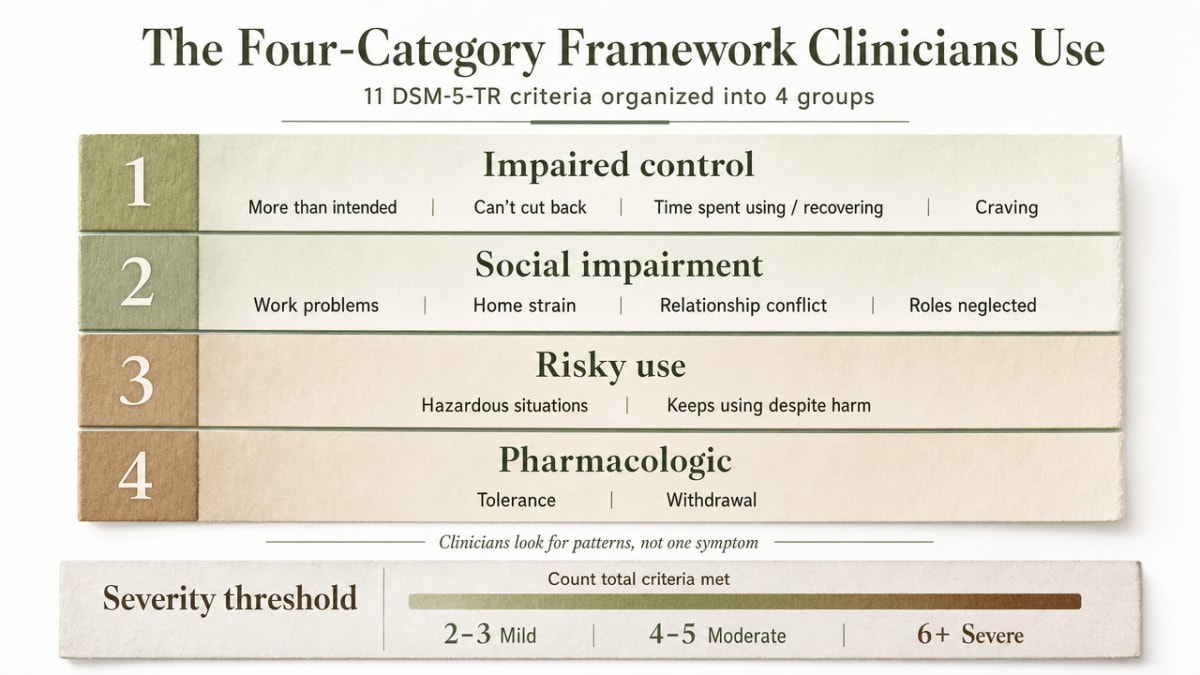
When a doctor evaluates your adult child, they are not scanning for a single damning symptom. They are counting patterns against eleven specific criteria, and those criteria fall into four groups that any parent can learn to read 1. This is the same mental model a clinician uses. Once you have it, the noise starts to sort itself into signal.
Impaired control is the first group. Your daughter meant to have two drinks and had seven. Your son said he was cutting back three months ago and has not. There are unsuccessful attempts to stop, a growing amount of time spent using or recovering, and cravings that push through whatever plan the person made for themselves 1. This is not weak willpower. It is a documented shift in how the brain’s control circuits respond to the substance 2.
Social impairment is the second. Work performance slips. The dog walker gets forgotten. Family events get skipped, then explained away. Arguments start about the using, and the using continues anyway. Old friends drop off; new ones appear who share the habit 1. You may notice this group first because you are watching from the outside.
Risky use is the third. Driving after drinking. Using in situations where injury is likely. Continuing even after a hospital visit, a lost job, or a doctor’s warning that the liver or the lungs cannot take much more 1. What looks like recklessness from the outside is often a sign the substance has become non-negotiable.
Pharmacologic criteria is the fourth: tolerance and withdrawal. It takes more to get the same effect. Stopping produces physical symptoms — shaking, sweating, nausea, anxiety that will not settle — and using again makes those symptoms go away 1. This is the group most relevant to whether medical detox is needed, and we will come back to it.
Severity is a matter of count. Meeting two or three of the eleven criteria is a mild substance use disorder. Four or five is moderate. Six or more is severe 1. You do not need to score your child. You need to know that clinicians think in gradations, not in binaries. Someone can meet three criteria and still hold a job. That does not make the disorder imaginary. It makes it early enough that detox and treatment tend to work better than they will a year from now.
Dependence Is Not the Same as Addiction
Here is a distinction that matters, especially if your adult child takes a prescribed medication. The body can become physically dependent on a drug without meeting the criteria for addiction. Dependence means the nervous system has adjusted to a substance’s presence and will produce withdrawal symptoms when it is removed. That is a pharmacology fact, not a moral one. A cancer patient on long-term opioids for pain can be dependent without ever meeting a single behavioral criterion for a use disorder.
Addiction adds the behavioral pattern on top of the biology. It is the impaired control, the social fallout, the risky use, and the compulsive pull toward the substance even when the person wants to stop 2. Tolerance and withdrawal are only two of the eleven diagnostic criteria, and they do not, on their own, make a diagnosis 1.
Why does this matter to you? Because it changes what you say to a doctor, and it changes what you fear. If your son has been on a benzodiazepine for two years, he probably has some physical dependence. That does not automatically mean he has a use disorder. What tells you the difference is the pattern around the pills — the escalating doses he did not ask for, the early refills, the pharmacy hopping, the mood when supply runs low. Watch the behavior. The biology alone does not tell the whole story.
Substance-Specific Signs Worth Learning to Read
Opioids: Misuse, Use Disorder, and the Overdose Line
Opioids sit on a spectrum, and the three points on that spectrum need different responses from you. Misuse is taking a prescription differently than directed — an extra pill on a bad night, a friend’s leftovers borrowed for a back spasm. Use disorder is the pattern that emerges when misuse settles in: taking opioids in larger amounts or over a longer period than intended, unsuccessful attempts to cut back, and continuing use despite knowing it is causing harm 4. Overdose is a medical emergency happening in front of you right now.
The chronic signs of opioid use disorder tend to accumulate quietly. Your son nods off mid-sentence at the dinner table. His pupils look small even in a dim room. Pills disappear from your medicine cabinet, or new prescriptions appear from doctors you have not heard him mention. He gets irritable, sweaty, and achy when a dose is late — flu-like symptoms that resolve within an hour of him disappearing to the bathroom. Constipation is chronic. Money runs short in ways the paycheck should not explain 4.
Overdose is different. Overdose is a body shutting down. The CDC identifies the emergency signs as small, constricted pinpoint pupils, falling asleep or loss of consciousness you cannot rouse them from, slow or shallow breathing, choking or gurgling sounds, and discolored skin — especially blue or gray lips and nails 3.
The line between the two matters because parents sometimes see nodding off and assume it is the same thing as being unresponsive. It is not. Someone in the drowsy phase of opioid use will typically rouse when you say their name loudly or shake their shoulder. Someone overdosing will not. If you cannot wake them, treat it as an emergency.
Alcohol: Why the Most Familiar Substance Is the Easiest to Miss
Alcohol is the substance most likely to be sitting in your own refrigerator, which is exactly why the signs get past you. A daughter who drinks a bottle of wine every night looks like a lot of adults you know. That does not make it fine.
What tells you something has crossed the line is the pattern, not the volume. She meant to have two and had six. She has tried to take a month off and made it four days. Mornings start rough — a slight tremor in the hands until the first drink, or a lot of coffee and ibuprofen to get moving. She hides bottles, or gets defensive when you notice how many empties are in the recycling. She skips a wedding because there will not be enough to drink, or drinks so much beforehand she embarrasses herself. Work performance quietly slides. A doctor mentions the liver enzymes are elevated and she orders wine that night anyway 1.
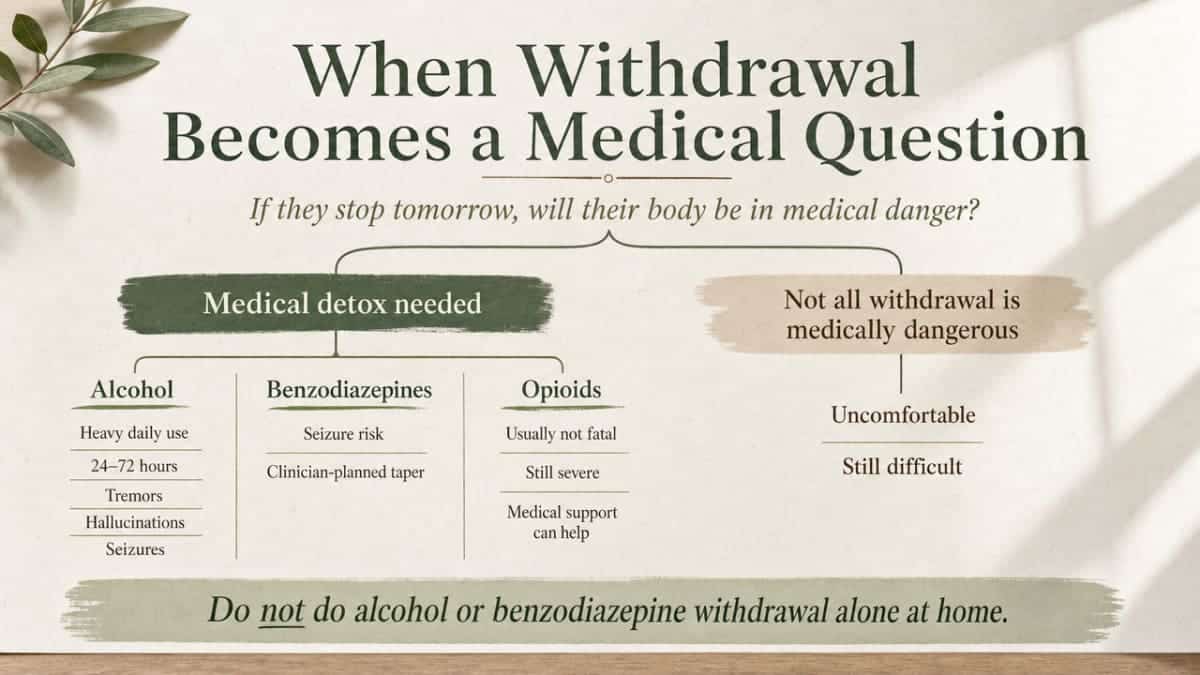
Alcohol withdrawal is one of the few withdrawals that can kill someone. If she has been drinking heavily every day for months and stops cold, she can develop tremors, hallucinations, and seizures within 24 to 72 hours. This is not a lecture point — it is the reason alcohol belongs near the top of any conversation about medically supervised detox. If you are watching a daily heavy drinker and she announces she is quitting on her own tomorrow, the right response is not applause. It is a call to a doctor.
Stimulants: Cocaine, Meth, and Prescription Adderall
Stimulants change the shape of a person in ways you can see across a room. Your son loses weight he did not need to lose. His jaw works constantly. He talks fast, then faster, then repeats himself. He is awake for two days working on a project that did not exist last week, then sleeps through Saturday and Sunday. He is thirty-two and getting acne again, or picking at his skin until it scars.
SAMHSA describes stimulant use disorder using the same DSM framework as other substances: taking more than intended, failing to cut down, giving up recreational or work activities, tolerance building, and withdrawal symptoms when the drug is not available 5. What is specific to stimulants is what escalating doses do to the mind. Peer-reviewed pharmacology research shows that as doses climb, the euphoria comes with a lengthening shadow — insomnia, anxiety, irritability, confusion, paranoia, panic attacks, and hallucinations 6. A daughter who was reliably warm and level starts accusing you of things that did not happen. A son on prescription Adderall who used to take one pill a day is now dry-swallowing three and cannot sit through dinner.
Withdrawal from stimulants is not typically medically dangerous the way alcohol or benzodiazepine withdrawal can be, but it is brutal in its own way. Deep fatigue, heavy sleep, intense cravings, and a crashing depression that can turn suicidal. This is the phase where relapse is most likely and where supervised support matters most, even if the body is not seizing. Do not mistake the absence of dramatic physical withdrawal for the absence of a serious problem.
Benzodiazepines: When a Prescription Becomes a Problem
Benzodiazepines — Xanax, Ativan, Klonopin, Valium — often start with a legitimate reason. Panic attacks after a divorce. Insomnia during a hard year at work. The trouble is that the body adapts fast, and the same dose stops working within weeks to months.
Watch for early refills, pharmacy shopping, and mood that visibly hinges on whether the next dose is nearby. Your daughter gets edgy in a way that only settles after she takes a pill. She combines them with alcohol despite being warned not to. Doses creep up without a doctor authorizing the increase. Memory gaps appear — she does not remember a conversation from yesterday, or she sent texts overnight she cannot account for 1.
Benzodiazepine withdrawal, like alcohol withdrawal, can be genuinely dangerous. Seizures are possible. This is not a taper anyone should attempt alone after long-term daily use. If you suspect your adult child is dependent on a benzodiazepine and considering stopping, the next step is a doctor, not willpower.
Cannabis: What Normalization Hides
Cannabis is where recognition gets hardest, because the culture around it has changed faster than the medicine has. NIDA’s Monitoring the Future data shows past-year cannabis use among adults ages 19 to 30 and 35 to 50 sitting at historic highs in 2023, while past-year use among 12th graders came in around 29% in 2023 and 25.8% in 2024 12. Legal storefronts, medical cards, edibles that look like candy — the signals that once said “something is wrong here” have quietly gone away.
That does not mean cannabis use disorder is not real. It means the signs look domestic instead of dramatic. Your son wakes and takes a hit before coffee. He has tried to take a break and made it a weekend. He gets irritable, sleeps poorly, and loses his appetite when he tries to stop — classic cannabis withdrawal, though nobody around him would call it that. Motivation flattens. He is functional enough to keep a job but not ambitious enough to advance in it. Money that should be going somewhere else is going to the dispensary 1.
Today’s cannabis is not the cannabis of 1985. Concentrates and high-potency products can push THC levels that older comparisons do not capture, and daily heavy use in a developing or vulnerable brain is a different exposure than an occasional joint. If your adult child is using every day and cannot comfortably stop for a week, that is a pattern worth naming — regardless of what the neighbors think about legalization.
Kratom: The Functional Dependence Blind Spot
Kratom is the one many parents have never heard of until they find the packets in a drawer. It is sold in gas stations and vape shops, marketed as a natural supplement, and used by adults who often look completely fine. Recent clinical research notes that most kratom users appear to be functioning in ways uncharacteristic of moderate-to-severe addiction, even while physical dependence and withdrawal are well documented 10.
This is the blind spot. Your daughter holds her job, pays her rent, sees her friends — and takes kratom several times a day. When she runs out, the picture changes fast. A study of daily kratom users found the most common withdrawal symptoms were gastrointestinal upset, restlessness, anxiety, irritability, fatigue, low energy, kratom craving, and the urge to use another substance to relieve the withdrawal 11. That last one matters. Kratom dependence can push people toward opioids to manage the symptoms, which is how a supplement-aisle habit becomes something more dangerous.
If you see daily kratom use, escalating amounts, and physical symptoms when supply runs out, you are looking at dependence. The functional exterior does not disqualify the diagnosis. It just makes it easier to miss.
The Language to Bring to a Doctor
When you finally sit across from a doctor, the goal is not to diagnose your adult child yourself. The goal is to be heard clearly enough that the clinician takes the next step seriously. That means bringing specifics instead of impressions. “He seems off” gets a nod. “He has tried to quit twice this year, he is taking more than prescribed, and he gets sweaty and shaky within a day of stopping” gets a workup.
Two validated tools can help you translate what you have seen into language a doctor already uses. The AUDIT is a short questionnaire for alcohol that has been used in primary care for decades to flag hazardous or harmful drinking 8, and one validation found it detects 97% of alcohol-dependent individuals in the populations studied 13. The DAST does similar work for other drugs, with reliability and validity established across clinical and research use 9. Screening tools are not perfect for every population — one recent study found the standard 10-item AUDIT did not perform reliably among Australian nurses 14— but they give clinicians a shared vocabulary.
You are not administering these tools to your child. You are asking the doctor to. A useful sentence: “I would like you to screen for a substance use disorder. Here is what I have been observing.” Then hand over your specifics.
When Withdrawal Becomes a Medical Question
Here is the question that cuts through everything else: if your adult child stops using tomorrow, is their body going to hurt them? For some substances the answer is uncomfortable but not dangerous. For others it is a genuine medical emergency waiting to happen, and doing it alone at home is not brave — it is risky in ways most families do not realize until they are in the middle of it.
Three categories put withdrawal squarely in medical territory. Alcohol, when someone has been drinking heavily every day for months, can produce tremors, hallucinations, and seizures within the first 24 to 72 hours of the last drink. Benzodiazepines carry the same seizure risk, and the taper needs a clinician planning it, not a person deciding to stop on a Sunday night. Opioids are rarely fatal to withdraw from in an otherwise healthy adult, but the misery is severe enough that most people relapse to make it stop — and a post-withdrawal relapse at the old dose is a leading path to overdose, because tolerance drops fast 3.
Stimulants, cannabis, and kratom generally do not produce medically dangerous withdrawal, but that does not mean unsupervised is the right call. Kratom withdrawal drives many users toward opioids to relieve the symptoms 11, and stimulant withdrawal can crash into a depression deep enough to raise safety questions of its own.
What Noticing Buys You
Paying attention this closely is exhausting, and you have been doing it longer than anyone knows. So here is what it actually earns you.
Noticing buys you language. It turns “something is off” into a doctor’s appointment with specifics attached — the tolerance, the missed obligations, the withdrawal you watched last Sunday. It buys you sequence: knowing that detox comes before treatment when the body has adapted to alcohol, benzodiazepines, or opioids, and that the order matters for safety. It buys you the ability to tell overdose from chronic use in the ten seconds you have to decide whether to call 911.
What noticing does not buy you is the ability to fix this alone, and you were never supposed to. Your job was to see it clearly. The clinicians at a medical detox program — including the team at Renewal Springs — take it from there. You have already done the hardest part, which was refusing to look away.
Talk With a Compassionate Expert Right Now
Get immediate, confidential answers about recognizing and addressing addiction in your loved one.
Frequently Asked Questions
How do I tell the difference between my adult child’s casual use and an actual addiction?
Look for pattern, not volume. Casual use does not usually produce repeated failed attempts to cut back, using more than intended, or physical withdrawal when the substance is unavailable. When two or more of those show up alongside neglected responsibilities or continued use despite harm, you are looking at a clinical pattern worth naming to a doctor 1.
My son takes a prescribed medication and has withdrawal if he stops. Does that mean he’s addicted?
Not by itself. Physical dependence means the body has adapted to the drug and will produce withdrawal symptoms. That is pharmacology, not addiction. A use disorder requires the behavioral pattern on top of the biology — escalating doses he did not ask for, early refills, mood tied to supply, using despite harm 1. Watch what surrounds the pills, not just the pills.
My daughter holds down a good job and pays her bills. Can she still have a substance use disorder?
Yes. Functionality does not disqualify the diagnosis. Kratom research documents that many users appear to be functioning in ways uncharacteristic of moderate-to-severe addiction while still showing physical dependence and withdrawal 10. Meeting two or three DSM criteria puts someone in the mild range and they can still hold a job 1. Early recognition is often when treatment works best.
When is withdrawal actually dangerous enough to need medical detox?
Three substances put withdrawal in medical territory: alcohol and benzodiazepines can produce seizures when heavy daily use stops abruptly, and opioid withdrawal, while rarely fatal in a healthy adult, drives relapse at reduced tolerance — a leading path to overdose 3. If your adult child has real tolerance and real withdrawal from any of those three, the next call is a medical detox program, not a rehab intake line.
What should I say to a doctor to be taken seriously about what I’m seeing?
Bring specifics, not impressions. Instead of “she seems off,” say: “She has tried to quit twice this year, she is drinking daily, and she gets shaky within a day of stopping.” Ask the doctor to screen using a validated tool like the AUDIT for alcohol or the DAST for other substances 8, 9. That gives the clinician a shared vocabulary and puts your observations into the workup.
How do I know if what I’m watching is an overdose emergency versus chronic addiction?
Chronic use signs accumulate quietly over weeks and months. Overdose is happening in front of you now. The CDC identifies overdose by pinpoint pupils, loss of consciousness you cannot rouse them from, slow or shallow breathing, choking or gurgling sounds, and discolored lips or nails 3. If you cannot wake them by shaking or shouting, call 911, give naloxone if you have it, and stay with them.
References
- DSM-5-TR Criteria for Diagnosing and Classifying Substance Use Disorders. https://www.ncbi.nlm.nih.gov/books/NBK565474/table/table-3/
- Drug Misuse and Addiction | National Institute on Drug Abuse. https://nida.nih.gov/publications/drugs-brains-behavior-science-addiction/drug-misuse-addiction
- Signs of Opioid Misuse, Opioid Use Disorder, and Overdose: Know the Signs and Symptoms. https://www.cdc.gov/overdose-resources/files/signs-of-opioid-misuse-opioid-use-disorder-and-overdose-know-the-signs-and-symptoms.html
- Opioid Use Disorder: Diagnosis | Overdose Prevention. https://www.cdc.gov/overdose-prevention/hcp/clinical-care/opioid-use-disorder-diagnosis.html
- Treatment of Stimulant Use Disorders. https://library.samhsa.gov/sites/default/files/pep20-06-01-001.pdf
- Stimulant Abuse: Pharmacology, Cocaine, Methamphetamine and Amphetamine. https://pmc.ncbi.nlm.nih.gov/articles/PMC3056348/
- A Validation Study of the Brief Alcohol Use Disorder Identification Test (AUDIT). https://www.ncbi.nlm.nih.gov/pmc/articles/PMC3560334/
- The Alcohol Use Disorders Identification Test (AUDIT). https://pubmed.ncbi.nlm.nih.gov/7674678/
- A comprehensive review of the psychometric properties of the Drug Abuse Screening Test. https://pubmed.ncbi.nlm.nih.gov/17306727/
- Clinically characterizing adults who use kava or kratom. https://pmc.ncbi.nlm.nih.gov/articles/PMC12663646/
- Assessment of Kratom Use Disorder and Withdrawal Among Daily Users. https://pmc.ncbi.nlm.nih.gov/articles/PMC9402806/
- Cannabis and hallucinogen use among adults remained at historic highs in 2023. https://nida.nih.gov/news-events/news-releases/2024/08/cannabis-and-hallucinogen-use-among-adults-remained-at-historic-highs-in-2023
- The Alcohol Use Disorders Identification Test (AUDIT): A validation study in a Greek population. https://pmc.ncbi.nlm.nih.gov/articles/PMC2696447/
- The validity of the Alcohol Use Disorders Identification Test (AUDIT) in screening for alcohol use among nurses. https://pmc.ncbi.nlm.nih.gov/articles/PMC12505713/