
Key Takeaways
- Heroin use surfaces in a recognizable sequence: physical tells like pinpoint pupils and nodding, behavioral shifts around money and sleep, then paraphernalia in the room, then withdrawal.
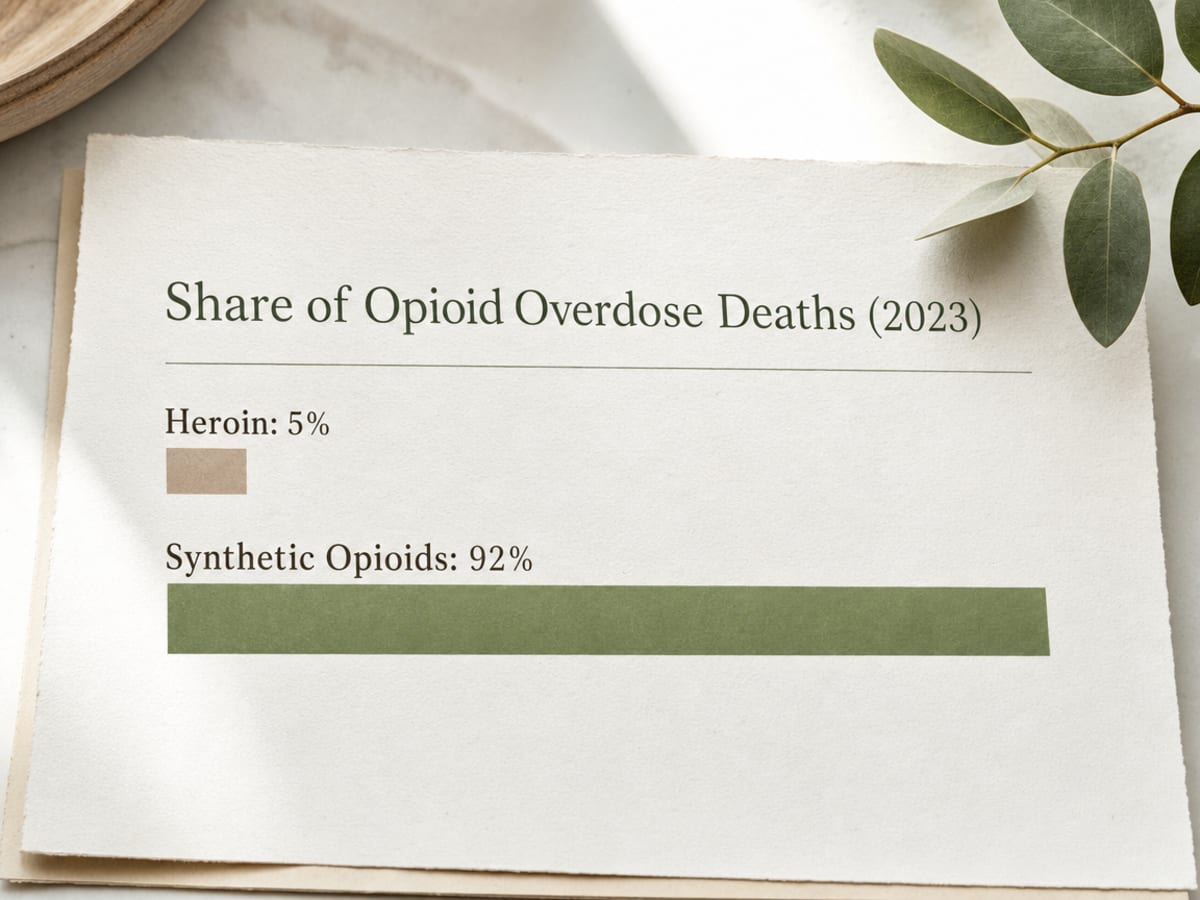
- Most street heroin now contains illicit fentanyl — synthetic opioids were involved in nearly 92% of U.S. opioid overdose deaths in 2023, shrinking the window to act 1.
- Clinicians diagnose opioid use disorder using 11 DSM-5 criteria across impaired control, social impairment, risky use, and physical adaptation — holding a job does not rule it out 4.
- If your adult child cannot be woken and breathing is slow, shallow, or stopped, call 911, give naloxone if available, and place them on their side until paramedics arrive 10.
What You’re Already Noticing Has a Pattern
You didn’t come here casually. Something has been building — the closed door, the borrowed twenty that became a hundred, the way your adult child nods off mid-sentence and then insists nothing is wrong. You’ve been watching. You’ve been second-guessing yourself. And you’re tired.
Here’s what matters right now: what you’re seeing is not random, and you are not overreacting. Heroin use shows up in a recognizable sequence — first on the body, then in behavior, then in the room, then in the withdrawal that hits when the drug wears off, and sometimes in a medical emergency that gives you sixty seconds to act. Clinicians look at the same signals you’ve been noticing, just in a certain order.
This piece walks you through that order, using guidance from the CDC, NIDA, and SAMHSA, so you can tell the difference between a rough patch and opioid use disorder 4. You’ll learn what to watch for, what to say, when to call 911, and when to move toward medically supervised detox.
You’re not being paranoid. You’re paying attention. That’s the first thing any parent gets right.
The Body: Physical Signs You Can See
Short-Term Tells During or Just After Use
The first hour after use is the loudest one, and it’s probably where your gut first told you something was wrong. Heroin acts on the central nervous system quickly, and the effects it produces are surprisingly specific — specific enough that clinicians teach families to look for the same handful of things you may have already caught out of the corner of your eye.
Start with the eyes. Pupils constrict to pinpoints, sometimes as small as the head of a pin, and they stay that way even in a dim room where they should be wide open 11. This one detail is often the tell that turns a suspicion into a certainty.
Then look at the skin. NIDA describes a warm flushing of the skin, often paired with itching — you may catch your adult child scratching at their nose, arms, or neck without noticing they’re doing it 11. Dry mouth is common. So is a heaviness in the arms and legs that makes them move like they’re wading through water 11.
The state that follows is what most parents call “nodding.” NIDA describes it as alternating wakeful and drowsy states, with mental functioning clouded and breathing slowed 11. Your child may start a sentence, drift off, then pick it up again a minute later as if no time passed. They may fall asleep sitting up, holding a phone or a fork. Nausea, vomiting, and slowed, shallow breathing round out the picture 11.
Any one of these in isolation could mean a dozen things. Together, in that sequence, on a repeating pattern — that’s the signal you’ve been reading correctly.
Long-Term Marks on the Body
If use has been going on for months, the body starts keeping a longer record. These signs don’t come and go with each dose. They accumulate, and they’re often what a parent notices when the short-term tells have gotten too familiar to register anymore.
For anyone injecting, the arms tell a story before the mouth does. NIDA notes scarred or collapsed veins, abscesses, and other soft-tissue infections that appear as bruised tracks, raised bumps, or open sores that don’t heal on schedule 12. You may see long sleeves in July, a sudden preference for hoodies, or a bathrobe worn tightly closed at the wrist. Injection sites can migrate — arms, then hands, then legs, then between the toes — as veins scar over.
Beyond the skin, chronic heroin use produces a cluster of medical complications that a parent often reads as “they’re just run down.” NIDA lists insomnia, constipation, lung problems including pneumonia and tuberculosis, depression, sexual dysfunction, and menstrual irregularities in women 12. Recurrent respiratory infections, unexplained weight loss, and a persistent gray or sallow cast to the skin are common.
Injection carries additional risks that show up as fevers, red streaks along a vein, or infections of the heart valves that put someone in the hospital with what looks like a random illness 12. If your adult child has had a strange run of ER visits, dental problems, or infections that keep returning, that pattern is part of the picture too. The body has been telling you what the conversations haven’t.
The Behavior: Shifts in How Your Adult Child Moves Through the Day
Behavior is often where the doubt creeps back in. A skipped dinner isn’t a diagnosis. A locked bedroom door isn’t proof of anything. But when you line up what you’ve been seeing over weeks or months, the shifts stop feeling like personality and start feeling like a pattern — one that state prevention programs describe almost identically for every family that walks into a clinic 14.
Money is usually the loudest signal. Frequent requests for cash, small at first, then larger and more urgent. Cards missing from your wallet. Prescription pills disappearing from the medicine cabinet — yours, your spouse’s, a grandparent’s — sometimes replaced with tablets that don’t quite match 14. Items around the house that hold resale value quietly go missing: a watch, a gaming console, jewelry, tools from the garage. Your adult child has an explanation each time, and each explanation is plausible on its own.
Then there’s the withdrawal from the people who used to matter. Old friends stop coming around. New ones you’ve never met start texting at odd hours. Phone calls get taken in another room. The bathroom door is locked longer than it used to be, and sometimes there’s a long pause before it opens 14. Hobbies your child once cared about — running, guitar, a job they liked — quietly fall away.
The daily rhythm bends too. Sleep patterns invert: awake at 3 a.m., asleep at 3 p.m. Meals get skipped or become sudden sugar binges. Hygiene slips in a way that doesn’t match their age or their history — showers become rare, teeth get neglected, the same hoodie gets worn for a week 14.
Work and obligations start to fray. Clinical guidance describes this exactly: continued use despite worsening problems, difficulty fulfilling professional duties, decreased social activities 5. Late to shifts. Called out sick more often. A missed rent payment they swore was already handled. A court date, a fender bender, a lost phone — the small crises stack up faster than a normal life produces them.
None of these, alone, means heroin. Taken together, over a stretch of time, they describe what clinicians call impaired control and social impairment — two of the categories the DSM-5 uses to diagnose opioid use disorder 4. You’ve been keeping a mental list without realizing it. Trust that list.
The Environment: What You Find in the Room, the Car, the Bathroom
Once you know what a body under heroin looks like, the room starts to make sense too. Objects that seemed random — a bent spoon in a nightstand drawer, a shoelace where a shoelace shouldn’t be — become part of the same picture. You don’t need to be a detective. You just need to know what a few common items mean when they show up together.
The most consistent giveaway is small burnt spoons, bottle caps, or metal candy tins with dark residue on the underside, often kept alongside cotton balls or torn cigarette filters. Short lengths of rubber tubing, shoelaces, or belts stashed somewhere they don’t belong are used as tourniquets. Syringes may be hidden inside pens, sunglasses cases, or the lining of a bag. Small glassine baggies — sometimes stamped with a logo — tiny zip pouches, torn corners of plastic sandwich bags, or squares of aluminum foil with brown or black scorch marks all point to the same thing 14. For smoking, you may find hollowed pens, straws cut short, or foil folded into a chute.
Look for the containers, too: an unfamiliar shaving kit, a locked box in a closet, a shoebox pushed under the bed. Missing prescription pills from your medicine cabinet — yours, a grandparent’s, an old surgery bottle — belong on this list as well 14. One item can be explained away. A cluster, in the same drawer, kept out of sight, is the environment telling you what the conversations haven’t.
Why Today’s Heroin Isn’t Really Heroin
Here’s the part of the picture that changes how urgently you should be reading the earlier signs. What your adult child is buying on the street in 2024 is almost never pure heroin. It’s a powder or pressed pill that may contain heroin, illicitly manufactured fentanyl, a mix of both, or fentanyl with none of the heroin they think they’re using.
The CDC’s most recent numbers make the shift plain: in 2023, heroin was involved in roughly 5% of U.S. opioid overdose deaths, while synthetic opioids — overwhelmingly illicit fentanyl — were involved in nearly 92% 1. The heroin overdose death rate actually dropped about 33% from 2022 to 2023, but that decline isn’t reassurance. It reflects a market that has quietly replaced heroin with something far more potent 1.
Fentanyl is estimated to be many times stronger than heroin by weight, and it’s not mixed evenly. Two baggies from the same source can carry very different doses. That’s why the overdose signs you’ll read about in a moment — pinpoint pupils, blue lips, breathing that slows to a stop — can appear faster than you’d expect, sometimes within minutes of a dose that looked like every other dose your child has taken.
There’s a second layer to this. A 2015 CDC Vital Signs analysis found that more than 9 in 10 people who used heroin also used at least one other drug, most often alcohol, cocaine, or prescription opioids 2. Polysubstance use raises overdose risk further, because respiratory depression from opioids compounds with the sedating effects of alcohol and benzodiazepines.
The Withdrawal Cycle: What You See When the Drug Wears Off
One of the most common mistakes parents make is treating withdrawal like a separate illness. Your adult child wakes up sweating and irritable, complains of a backache, spends an hour in the bathroom with what looks like a stomach bug, snaps at you, and disappears for a few hours. When they come back, they’re calm again. You assume they caught something. What you actually watched was the drug leaving their system — and coming back.
Heroin withdrawal follows a predictable arc, and knowing the shape of it changes what you’re able to see. According to NIDA, withdrawal symptoms can begin within a few hours after the last dose, peak between 24 and 48 hours, and subside after about a week 13. That peak window is the diagnostic anchor. If the pattern you’re watching resolves within a day of your child leaving the house, and returns on a schedule, you’re not looking at the flu.
The early hours are subtle. Restlessness. Yawning. A runny nose. Watery eyes. A mood that turns sharp for no reason you can name 14. Sleep gets thin — they’re up at odd hours, pacing or scrolling. Appetite drops.
As the peak approaches, the physical signs get harder to miss. NIDA lists muscle and bone pain, insomnia, diarrhea, vomiting, cold flashes with goose bumps, and involuntary leg movements 13. State prevention guidance adds abdominal pain, large pupils (the opposite of the pinpoint pupils you see during active use), nausea, chills, mood swings, agitation, and body aches 14. Your adult child may curl up under a pile of blankets and still shiver. They may describe it as a bad flu. To them, in the moment, it feels like one.
Then, often abruptly, they seem better. That reset is not recovery. It’s the next dose. Once you’ve watched the cycle twice, you’ll recognize the third round before it happens — the yawning that starts around hour six, the trip to the bathroom that runs long, the sudden urgency to “run out for a minute.”
This matters for two reasons. First, withdrawal is one of the DSM-5 criteria for opioid use disorder, and by definition it means the body has adapted to the drug 4. Second, unsupervised withdrawal is why so many people relapse within days — the symptoms are miserable enough that using again feels like the only relief. Medically supervised detox exists to break that loop safely, with medications that ease the peak and clinicians watching the vital signs the body can’t regulate on its own.
How Clinicians Gauge Severity: The DSM-5 Framework in Plain Language
By this point in the article, you’ve catalogued a lot of what you’ve been seeing. What you may not have is a way to weigh it. Is what you’re watching a rough patch, a habit, or something a clinician would call a disorder? The people who assess this professionally use a single framework, and it’s more accessible than it sounds.
The CDC and clinical guidance both rely on the DSM-5 to diagnose opioid use disorder, and heroin falls under that category 4. There are 11 criteria in total. If your adult child meets at least 2 of them within a 12-month period, that meets the threshold for a diagnosis. Meeting 2 or 3 is mild. Meeting 4 or 5 is moderate. Meeting 6 or more is severe 4.
The 11 criteria, in plain language, cluster into four groups. Impaired control: using more heroin or using longer than they meant to, wanting to cut back and failing, spending a lot of time getting the drug or recovering from it, and craving. Social impairment: struggling to keep up at work or school, giving up hobbies and friendships, and continued use even when it’s causing fights at home. Risky use: using in situations that are physically dangerous, and continuing despite knowing the drug is causing physical or psychological harm 5. Physical adaptation: needing more to get the same effect (tolerance), and going through withdrawal when they stop 4.
Here’s what this framework does for you. It quietly answers the question that keeps a lot of parents stuck: “But they still have a job.” A person can hold a job, pay rent, and text you back most days, and still meet criteria for severe opioid use disorder. Employment is not one of the 11 items. Neither is a clean apartment or a working car. The criteria are about the pattern of use itself, and the ways it has bent a person’s control, relationships, and health.
You are not diagnosing your child. A clinician does that in an intake conversation, often with a structured interview that scores each criterion and tracks it over time 7. But privately walking through the 11 items with what you’ve observed will tell you roughly where things sit, and whether the word “mild” or “severe” fits better. That distinction matters, because it shapes how much time you have and what level of care makes sense — a conversation and outpatient support at the mild end, medically supervised detox with 24/7 monitoring at the moderate-to-severe end, where withdrawal and relapse risk are highest.
When It’s an Emergency: Overdose Signs and What to Do in the Next 60 Seconds
If you take one thing from this article, take this section. Everything else can wait for a calmer day. Overdose can’t.
An opioid overdose looks like this: your adult child cannot be woken up. You call their name, you shake their shoulder, you rub your knuckles hard against their breastbone, and they don’t respond. Their breathing is very slow, very shallow, or has stopped altogether 10. There may be a gurgling or snoring sound coming from their throat — that’s not sleep, that’s the airway 10. Their face may look pale and clammy. Their body may feel limp 10. Their fingernails, lips, or the skin around their mouth may look blue, purple, or gray 8, 10. Their pupils, if you can see them, are pinpoint — extremely small and unresponsive to light 8.
Here is what to do, in order.
- Call 911 first. Say the words “possible opioid overdose” so the dispatcher sends the right response.
- If you have naloxone (Narcan) in the house, use it now — spray one dose into a nostril and, if there’s no response in two to three minutes, give another.
- Turn your child onto their side in the recovery position so they don’t choke if they vomit.
- Stay with them until paramedics arrive, even if the naloxone works and they wake up. Fentanyl can outlast a single naloxone dose, and breathing can slow again 1.
If you don’t have naloxone, get some this week. Most pharmacies in Oklahoma carry it without a prescription. Keep one in the house and one in the car. This is not a statement about your child. It’s a smoke detector.

From Recognition to Next Step: Talking, Calling, and Handing Off to Detox
You’ve read this far because you needed a framework, and you have one now. The question that follows is quieter and harder: what do you actually do on a Tuesday afternoon, when your adult child is in the next room and you can’t unsee what you’ve been seeing?
Start with the conversation, not the ultimatum. Pick a moment when they’re not high and not deep in withdrawal — usually a few hours after a dose, when they’re lucid but not yet uncomfortable. Say what you’ve noticed, not what you’ve concluded. “I’ve seen the sleep changes, the money, the marks on your arms. I’m scared. I’m not here to fight. I want to help you get to a doctor.” Then stop talking. Silence gives them room to answer without defending.
Expect denial the first time, and sometimes the second. That’s not failure. That’s the conversation starting.
Between conversations, make one confidential call yourself. SAMHSA’s National Helpline is free, available 24/7, and staffed by people who do this all day — they can walk you through options and refer you to local treatment without your child on the phone 15. It’s a low-cost way to get your bearings before you commit to anything.
Because your child is an adult, you can’t force treatment in most situations. What you can do is remove friction from the yes. Have a specific medically supervised detox program identified — one that admits quickly, accepts your insurance, and can start managing withdrawal the same day. When they say yes, sometimes at 2 a.m. after a bad night, the window can be short.
Medically supervised detox is not rehab. It’s the 5-to-10-day medical bridge that gets your adult child through the peak withdrawal window safely, with clinicians monitoring breathing, heart rate, and hydration, and with medications that dull the worst of it so relapse doesn’t happen in the parking lot 13. From there, the team helps hand off to residential or outpatient care.
If you’re in central Oklahoma, Renewal Springs Detox is one local option built around exactly that handoff. Wherever you go, the shape of the next step is the same: a safe room, a licensed team, and a plan that treats your child like a patient — because that’s what they are.
Speak With a Compassionate Detox Specialist Now
Get real answers about heroin withdrawal safety and next steps for your loved one.

References
- Heroin | Overdose Prevention – CDC. https://www.cdc.gov/overdose-prevention/about/heroin.html
- Vital Signs: Today’s Heroin Epidemic. https://archive.cdc.gov/www_cdc_gov/vitalsigns/heroin/index.html
- Heroin overdose: MedlinePlus Medical Encyclopedia. https://medlineplus.gov/ency/article/002861.htm
- Opioid Use Disorder: Diagnosis | Overdose Prevention. https://www.cdc.gov/overdose-prevention/hcp/clinical-care/opioid-use-disorder-diagnosis.html
- Opioid Use Disorder: Evaluation and Management – StatPearls. https://www.ncbi.nlm.nih.gov/books/NBK553166/
- Substance Use Disorders – Impact of the DSM-IV to DSM-5 Changes. https://www.ncbi.nlm.nih.gov/books/NBK519702/
- Measurement‑based care using DSM‑5 for opioid use disorder. https://pmc.ncbi.nlm.nih.gov/articles/PMC6766896/
- SAMHSA Overdose Prevention and Response Toolkit. https://library.samhsa.gov/sites/default/files/overdose-prevention-response-kit-pep23-03-00-001.pdf
- SAMHSA Opioid Overdose Toolkit: Five Essential Steps for First Responders. https://hcpf.colorado.gov/sites/hcpf/files/5%20Essential%20Steps%20for%20First%20Responders.pdf
- Safety Advice for Patients & Family Members. https://library.samhsa.gov/sites/default/files/safety-advice-for-patients-family-members.pdf
- What are the immediate (short-term) effects of heroin use?. https://nida.nih.gov/publications/research-reports/heroin/what-are-immediate-short-term-effects-heroin-use
- What are the medical complications of chronic heroin use?. https://nida.nih.gov/publications/research-reports/heroin/what-are-medical-complications-chronic-heroin-use
- What are the long-term effects of heroin use?. https://nida.nih.gov/publications/research-reports/heroin/what-are-long-term-effects-heroin-use
- Parents (Dose of Reality – Minnesota). https://doseofreality.mn.gov/get-support/parents.asp
- National Helpline for Mental Health, Drug, Alcohol Issues. https://www.samhsa.gov/find-help/helplines/national-helpline