Key Takeaways
- Map the specific nights that worry you by writing dates, times, and the exact reason each event is risky, so vague dread becomes something you can actually plan around.
- Treat a stressful day as the real warning sign, not the craving itself — diary research shows stress raises next-day craving, which then predicts drinking 10.
- Pre-stage two sober contacts before any event: one check-in person expecting a text, and one ride partner who already agreed to leave with you on a signal.
- Rehearse a two-sentence decline out loud and agree on a single exit word with your ride partner, so neither has to be invented under pressure at the party.
- Protect sleep, movement, and meeting attendance during the weeks the calendar tries to dismantle them — stopping exercise and missing meetings are top predictable holiday risks 8.
- Memorize NIAAA’s six craving moves in order — remind, call, distract, challenge, ride it out, leave — so a wave in the room doesn’t become a decision 5.
- Assemble a physical holiday kit with written numbers, a rideshare app, a non-alcoholic drink, and your exit plan; if you’re in opioid recovery, include naloxone 15.
- Write your if-then slip plan before you need it: stop, contact your supporter, leave, remove what’s left, analyze later, and build the next alternative 4.
- Call for professional help when cravings turn constant, slips come faster, or daily drinking returns — alcohol withdrawal can be life-threatening for chronic heavy drinkers 14.
The Decisions You Make This Week Matter More Than Willpower on the Night
Here is the hard truth, said with love: on December 24th, standing in your cousin’s kitchen with a glass of eggnog three feet away, you will not out-willpower a craving you did not plan for. Nobody does. The people who stay sober through the holidays are not stronger than you. They made their decisions earlier, when the stakes felt lower and their heads were clearer.
That is actually good news. It means the work you do this week — the texts you send, the rides you arrange, the events you say no to — matters more than anything you will try to white-knuckle later. SAMHSA’s clinical guidance on holiday recovery is blunt about this: disrupted routines, unstructured time, family contact, parties, and missed meetings are predictable risks, and they call for advance planning rather than in-the-moment courage 7. The season does not catch sober people off guard because it is sneaky. It catches them off guard because they treat it like a normal month.
So this guide is built the way a decent sponsor would build it with you at a coffee shop in early December. You will name the specific nights that scare you. You will stage support before you need it. You will write actual words to say out loud, protect the routines already holding you up, and decide in advance what happens if you slip. And you will know exactly when to pick up the phone instead of riding it out alone.
Map the Specific Nights That Scare You
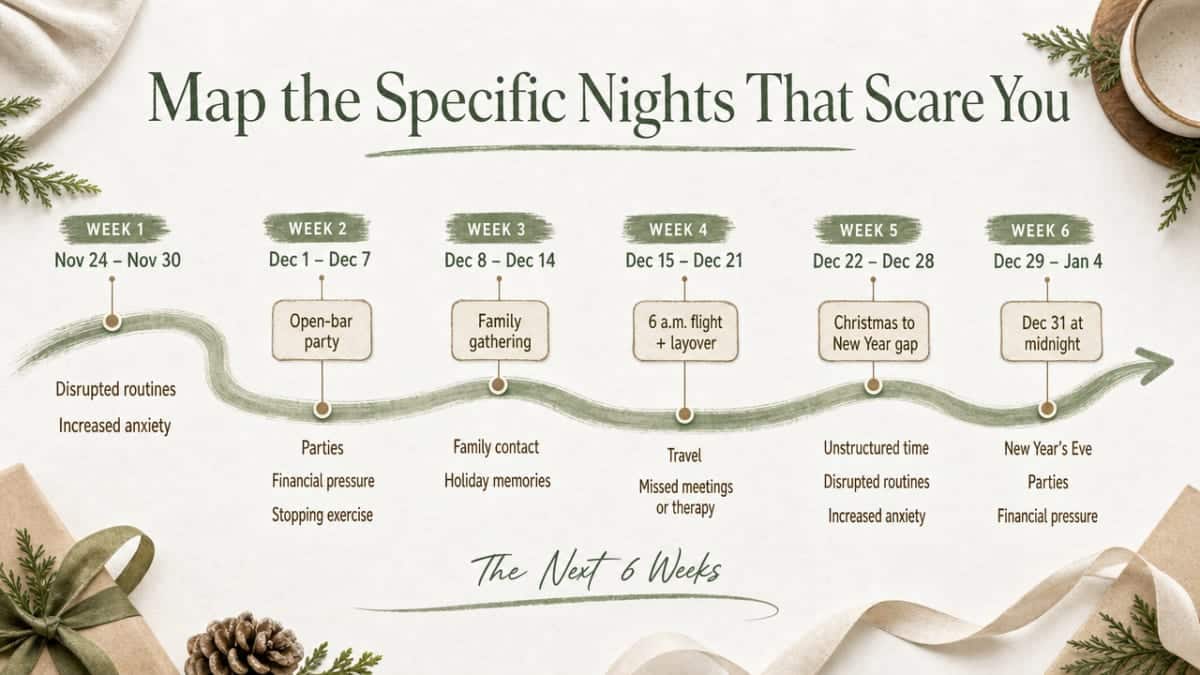
Pull up your calendar right now. Not later. Open the next six weeks and look at the actual dates that are already scaring you a little. The Friday your spouse’s company does the open-bar party. The Sunday your sister is hosting and your dad will be there. The Tuesday you fly out of Will Rogers at 6 a.m. with a two-hour layover. The gap between Christmas and New Year’s where nothing is scheduled and your brain gets loud. December 31st at midnight. Write them down.
SAMHSA’s clinical holiday-recovery session lists the categories that reliably knock people in recovery sideways: disrupted routines, travel, unstructured time, family contact, holiday memories, increased anxiety, parties, and missed meetings or therapy 7. The Matrix outpatient handbook adds financial pressure, stopping exercise, and New Year’s Eve to the same list 8. None of this is surprising when you read it on paper. The problem is that most people in recovery do not read it on paper. They walk into December assuming the hard nights will announce themselves. They do not.
So turn the categories into dates. Next to each risk event, write one sentence about why it is risky for you specifically. “Mom’s house, 4 p.m. Christmas Eve, Uncle Rick will be drunk by five.” “Flight to Dallas, three hours in the terminal bar area.” “December 27th, no plans, kids with their mom.” Specificity is the whole game. A vague worry stays a vague worry. A named Thursday at 7 p.m. is something you can build a plan around.
You do not have to solve every one of these tonight. You just have to see them. The rest of this guide walks through what to put next to each date — the person you text before you go in, the exit you pre-wire, the meeting you add, the event you decide to skip entirely. Right now, the win is honest. You named the nights. That is more than most people do before December hits.
Treat a Stressful Day as the Early Warning, Not the Craving
Most people wait for the craving to show up before they do anything about it. By then, you are already playing defense in a game that is hard to win. The craving is not the alarm. The stress earlier that day was.
A prospective daily-diary study of people in treatment for alcohol use disorder tracked stress, craving, and next-day drinking across weeks of ordinary life. On stressful days, participants reported significantly higher alcohol craving, and that elevated craving — not the stress itself — predicted both the likelihood and the amount of alcohol they drank the next day. The pathway ran through craving. Stress loaded the gun; craving pulled the trigger 10. NIAAA’s clinician guidance says the same thing in plainer language: stress and negative mood are tightly linked with increased craving and heavy-drinking episodes, which is why stress-management is treated as a core recovery skill rather than a self-care luxury 9.
What that means for your December is simple. The fight you have with your mom on the 22nd is the warning. The hour you spend crying in a Target parking lot on the 23rd is the warning. The red-eye flight where you did not sleep, the credit card bill that showed up, the voicemail from your ex — those are all warnings. The craving at the party on the 24th is the thing you have already lost ground against if you did nothing in between.
So change what you do on a stressful day, not just at the stressful event. If today was hard, that is the day you text your sponsor instead of waiting until you feel an urge. That is the day you go to a meeting even though you “don’t need one.” That is the day you go to bed by ten, skip the second scroll through social media, and eat an actual meal. SAMHSA’s coping guidance stacks small protective moves — sleep, movement, breathing, breaks from stressful media — precisely because they lower the baseline before the next trigger lands 17.
Pre-Stage Two Sober People Before You Walk Through the Door
One sober person on your phone is a plan. Two is a safety net. You want both, and you want them locked in before you set foot in your cousin’s living room.
Here is why two. People who sustain recovery describe social support — practical help, encouragement, someone to call, someone to leave with — as one of the things that actually holds the line in hard moments 11. Systematic reviews of peer recovery support services, including a review of 28 studies covering 12,601 participants, found the strongest evidence for keeping people engaged in treatment and showing up to care, with more mixed evidence on preventing any single slip 12. Translation: the person you call is not a magic shield against a craving. They are the thing that keeps you in the game long enough for the craving to pass and for you to make the next right call.
Pick your two now. Person A is your check-in: your sponsor, your recovery coach, a peer from your home group, a therapist who takes texts. Before the event, send a short message. “Headed to Mom’s at four. Will text you by seven. If you don’t hear from me by eight, call.” That is it. You just gave someone else a reason to notice if you go quiet. NIAAA’s craving guidance names a trusted person on standby as a core move for exactly this kind of situation 5.
Person B is your ride and your exit. Someone who drove separately, or who is picking you up at a time you both agreed on in advance. Not someone who might come get you. Someone who already said yes, with a time on the calendar. If your Person B is also sober and attending, even better. If they are not in recovery, tell them plainly: “If I text you the word ‘home,’ we leave in ten minutes, no questions.”
You are not being high-maintenance. You are doing what the clinical guidance tells people to do — line up support before exposure, not after 7. Two names. Two texts. Before you walk in.
Write the Two-Sentence Decline and the ‘I Need to Leave’ Signal
You already know the moment. A tray comes around, or your uncle shoves a beer at your chest, or someone pours wine into the empty glass in front of you “just in case.” If you have to think of what to say right then, you will fumble. So decide now. Out loud. In the car on the way to work tomorrow, say the sentence you are going to use. Say it until it sounds like something you’d actually say.
Keep it to two sentences. The first one declines. The second one closes the door. “No thanks, I’m not drinking tonight. Can you grab me a club soda with lime?” Or: “I’m good, I’m on antibiotics.” Or the plain one: “No thanks, I don’t drink anymore. How’s your mom doing?” You do not owe anyone a recovery story at a Christmas party. You owe them a polite sentence and a subject change. NIAAA’s own craving guidance treats leaving tempting situations “quickly and gracefully” as a core skill, not a social failure 5.
Now the exit signal. Agree on one word with your ride partner before you walk in. “Home.” “Ready.” Whatever you want. When you text that word, they come find you within ten minutes, say something about an early morning, and walk you out. No negotiation at the door. No explaining to your aunt why you’re leaving before dessert. The whole point is that you already made the decision in the parking lot; the signal just activates it.
Practice both of these before you need them. The decline out loud in the mirror. The exit word to your person, in a text, today. You will feel a little silly doing it. Do it anyway. The night you need these, you will be grateful they were already in your mouth and in your phone instead of something you had to invent while a drink was being pushed toward you 3.
Protect the Routines That Are Already Keeping You Sober
Think about what your ordinary Tuesday looks like. You probably wake up around the same time, eat something, move your body in some way, go to a meeting on certain nights, see your therapist on certain weeks, scroll less than you used to, and sleep enough. Those are not boring background details. Those are the scaffolding holding you up. In late December, every single one of them gets quietly dismantled — by travel, by late nights, by houseguests, by the gym being closed, by your Wednesday meeting canceled for Christmas Eve. The Matrix outpatient handbook lists stopping exercise and missing meetings or therapy as two of the top predictable holiday risks, right next to parties and family contact 8. The routine does not collapse because you got careless. It collapses because the calendar changed and nobody warned you to defend it.
So defend it on purpose. SAMHSA’s coping guidance names the specific behaviors worth protecting:
- adequate sleep
- physical activity
- deep breathing
- regular schedules
- hobbies
- time outside when the weather allows
- breaks from stressful media
- celebrating small successes 17
Pick three. Not all eight. Three that you already do and that you know work for you. Put them on the calendar for the hard weeks the same way you’d put a doctor’s appointment. A 7 a.m. walk around your block on December 26th. A 15-minute phone call with your sister on the 28th. Lights out by 10:30 on New Year’s Eve if you’re not at a sober event.
Then handle the meetings. Your home group’s schedule probably shifts for Christmas Eve, Christmas Day, and New Year’s Eve. Check now, not the day of. If your Tuesday meeting is dark, pick a replacement — an online meeting, a different group across town, a daytime slot you don’t normally hit. SAMHSA’s clinical holiday-recovery guidance is direct about adding meetings during this stretch, not subtracting 7. And celebrate the small wins out loud. You walked when it was cold. You went to bed instead of staying up with your phone. You made it to the Thursday meeting even though it felt pointless. Those are not small. Those are what sober looks like in December.
Have Six Moves Ready When a Craving Hits in the Room
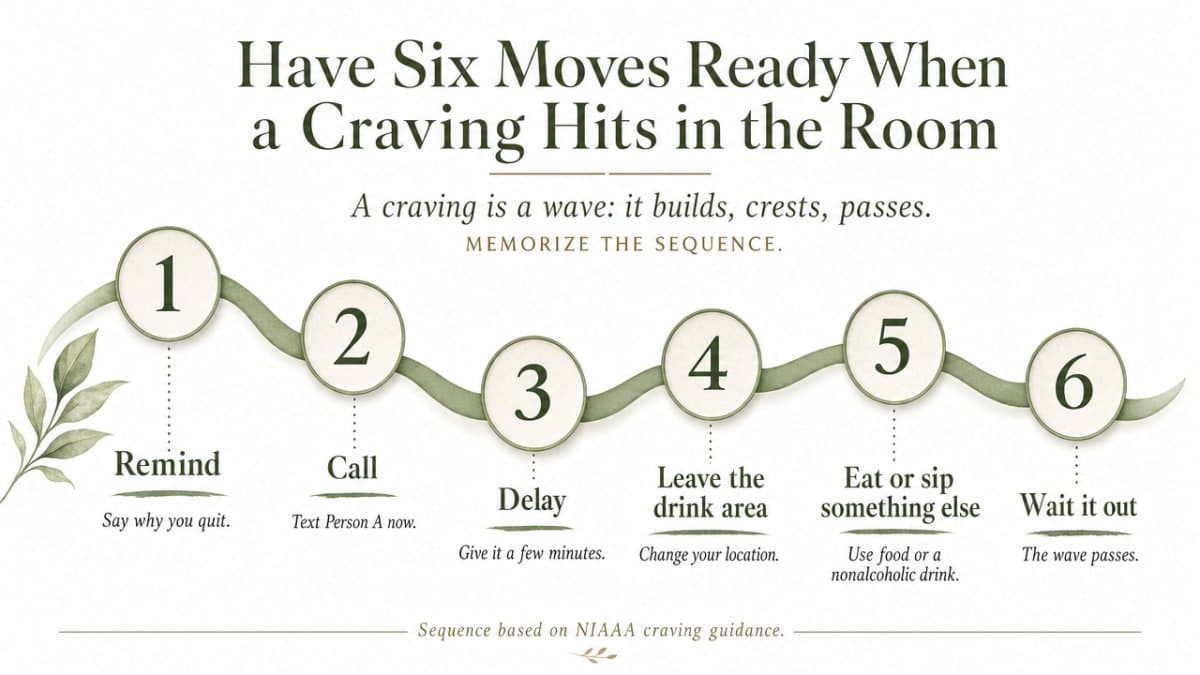
A craving in the middle of a party is not a character test. It is a wave. It builds, it crests, it passes — usually in under thirty minutes if you do not feed it. Your job is not to argue with it. Your job is to have six moves already loaded so you do not have to think when it hits.
NIAAA’s craving guidance names them in plain order, and they are worth memorizing in exactly this sequence 5:
Remind. Say the reason you quit, out loud if you can, in a bathroom if you have to. “I don’t want to wake up on the 25th hating myself.” “My kid saw me sober last Christmas and I’m not undoing that.” One sentence. Yours.
Call. Text Person A right then. Not after you figure out if it’s “really” a craving. The text itself is the move: “I’m white-knuckling at Mom’s. Can you talk for five?” Keeping a trusted person on standby is one of the specific tactics NIAAA recommends for exactly this moment 5.
Distract. Walk outside. Hold a baby. Do dishes. Volunteer to run to the store for more ice. A ten-minute physical task buys the wave time to break.
Challenge. The urge will lie to you. “One won’t matter.” “You’ve earned it.” “Nobody will know.” Answer back: “One always matters. I did not earn this. I will know.”
Ride it out. Cravings are temporary, even when they feel enormous. Set a timer for twenty minutes if you have to. Breathe. It will pass whether you drink or not.
Leave. If the first five did not work, you go. Send the exit word to your ride partner and walk out. NIAAA calls this leaving “quickly and gracefully,” and it is a skill, not a surrender 5. You stayed sober tonight. That counts.
Build a Holiday Kit (and If You’re in Opioid Recovery, Put Naloxone in It)
A holiday kit is a small, physical collection of things that make it easier to stay sober when your brain is tired and the room is loud. You are going to put it together this week, keep it in your car or your coat pocket, and not think about it again until you need it.
Here is what goes in:
- Your sponsor’s number and one backup person’s number, written on paper in case your phone dies.
- A rideshare app installed and set up with a payment method that actually works.
- A non-alcoholic drink you like — sparkling water with lime, a decent N/A beer, a bottle of kombucha — so you are never standing empty-handed at a party where that becomes its own problem.
- A pre-decided exit time written somewhere you’ll see it.
- A short note on your phone with the two-sentence decline and the one-word exit signal, so you don’t have to remember them under pressure.
These are the same practical, pre-staged supports NIAAA recommends for anyone trying to change a drinking pattern: trusted people on call, planned alternatives, and distance from the trigger when you need it 3, 5.
If you are in opioid recovery, add naloxone. Carry it. Make sure one person going with you knows where it is and how to use it. CDC is direct about this: naloxone can restore normal breathing within two to three minutes when an opioid overdose slows or stops it, and with stronger opioids like fentanyl, more than one dose may be needed 15. This matters especially during the holidays because NIDA warns that returning to opioid use after any period of abstinence — even a few weeks — can be fatal, since your tolerance has dropped and the dose that felt normal before can now stop your breathing 6. Naloxone in your kit is not pessimism about your recovery. It is the same logic as a seatbelt. You are not planning to crash. You are planning to survive one.
Write Your If-Then Plan for a Slip Before You Need It
Nobody wants to write this part. Writing it feels like admitting you might fail. You won’t. But if you do drink or use at some point this season, what happens in the next two hours matters more than what happened in the last two minutes. So decide now, while your head is clear, what you will actually do.
Here is the plan, straight from NIAAA’s lapse-recovery guidance, in the order it should happen 4:
Stop as soon as possible. Put the drink down. Walk away from the bump. One is not the same as five, and the next thirty minutes decide which it becomes.
Contact your supporter. Text Person A right then — “I drank. I’m okay. I need to talk.” You are not confessing. You are activating care.
Leave the situation. Get out of the room, the house, the bar. Hand your keys to someone sober or call a ride.
Remove what’s left. Pour it out, flush it, hand it off. Do not take it with you “just in case.”
Analyze what happened, but later. Tomorrow, with your sponsor or therapist, walk back through the day — the stressful morning, the skipped meeting, the moment you said yes. That is data, not shame.
Build the next alternative. Decide what you’ll do differently at the next event this week.
If you are in opioid recovery, the “stop immediately” step is not optional. Your tolerance has dropped, and the dose that felt normal a month ago can stop your breathing now 6. Make sure someone with you has naloxone and knows to use it 15. And re-enter care fast — SAMHSA’s clinical protocol for opioid use disorder is clear that returning promptly to treatment after any return to use is the right move, not a last resort 16. Hours, not days.
When to Call Renewal Springs Instead of Riding It Out
There is a moment some people hit in late December where the plan starts to feel like it is not enough. The cravings are not passing in twenty minutes anymore. You are white-knuckling three days in a row. You already slipped once and told yourself it was a one-time thing, and now it is not. Or you are shaking in the morning, sweating at night, and your heart is doing something that scares you. That is the moment to pick up the phone, not the moment to try harder.
Call us if the cravings are constant instead of situational. Call us if you had a slip and the next one came faster than you expected. Call us if your old prescription is back in the medicine cabinet and you keep walking past it. Call us if you are drinking daily again and the idea of stopping on your own feels medically scary — because for heavy, chronic drinkers, it actually is. NIAAA is direct: alcohol withdrawal can be life-threatening when someone who drinks heavily stops suddenly, and some people need inpatient care to get through it safely 14. If you are in opioid recovery and have returned to use, the window to re-enter treatment is hours, not weeks — SAMHSA’s clinical protocol treats prompt reentry as the standard of care, not a last resort 16.
Renewal Springs is in Oklahoma City, 24/7, judgment-free, and set up for exactly this call. Medically supervised detox, medication-assisted protocols, real-time monitoring. You do not have to be at the bottom. You have to be honest that December got away from you. That is enough.
Need support staying sober right now?
Talk to someone who understands and can help you through tough holiday moments.
Frequently Asked Questions
What should I say when someone offers me a drink at a holiday party?
Keep it to two sentences. One declines, one closes the door: “No thanks, I’m not drinking tonight. Can you grab me a club soda with lime?” You do not owe anyone your recovery story at a party. NIAAA names leaving or deflecting tempting situations quickly and gracefully as a core skill, not a social failure 5.
How do I handle a family gathering where someone is still using?
Decide in advance what you will and will not be in the room for. Arrive late, leave early, and bring a sober ride partner who knows your one-word exit signal. Text your check-in person before you walk in. SAMHSA’s clinical holiday-recovery guidance treats family contact as a predictable trigger that calls for an actual plan, not willpower in the moment 7.
What do I do if I slip and drink or use during the holidays?
Stop as soon as possible. Text your sponsor or supporter right then, leave the situation, pour out or hand off what’s left, and plan a different move for the next event. Analyze what led up to it tomorrow, with your therapist or sponsor — not alone at 2 a.m. NIAAA frames this as getting right back on track, not starting over from zero 4.
Why is relapse especially dangerous for people in opioid recovery?
Your tolerance drops fast during abstinence. The dose that felt normal a month ago can stop your breathing now — NIDA warns that return to opioid use after any period off can be fatal 6. Carry naloxone and make sure someone with you knows where it is and how to use it; CDC notes fentanyl overdoses may need more than one dose to restore breathing 15.
When should I call Renewal Springs instead of trying to ride out a craving?
Call if cravings are constant instead of situational, if a slip has already happened and the next one came faster, or if you are drinking daily again and stopping on your own feels medically scary. NIAAA is direct that alcohol withdrawal can be life-threatening for chronic heavy drinkers 14. Our Oklahoma City team answers 24/7, judgment-free. You do not need to be at the bottom.
What if my regular AA or NA meeting is canceled for the holiday?
Check the schedule now, not the day of. Pick a replacement before you need one — an online meeting, a different group across town, or a daytime slot you don’t usually hit. SAMHSA’s clinical guidance is explicit about adding meetings during the holidays rather than letting them lapse 7. Save two backup meeting links to your phone this week so the decision is already made.
References
- Supporting Your Mental Health During the Holiday Season. https://www.samhsa.gov/blog/supporting-your-mental-health-during-holiday-season
- The Truth About Holiday Spirits. https://www.niaaa.nih.gov/publications/brochures-and-fact-sheets/truth-about-holiday-spirits
- Rethinking Drinking: Alcohol and Your Health. https://www.niaaa.nih.gov/sites/default/files/publications/NIAAA_RethinkingDrinking.pdf
- Patient Handout Rethinking Drinking Tips and Tools to Help …. https://www.niaaa.nih.gov/sites/default/files/patient-education-tips-for-quitting-drinking-and-recovering-from-a-drinking-episode.pdf
- How to Stop Alcohol Cravings | Rethinking Drinking | NIAAA. https://rethinkingdrinking.niaaa.nih.gov/tools/worksheets-more/how-stop-alcohol-cravings
- Treatment and Recovery. https://nida.nih.gov/publications/drugs-brains-behavior-science-addiction/treatment-recovery
- Counselor’s Treatment Manual. https://library.samhsa.gov/sites/default/files/sma13-4152.pdf
- Client’s Handbook: Matrix Intensive Outpatient Treatment for People …. https://library.samhsa.gov/sites/default/files/sma15-4154.pdf
- Support Recovery: It’s a Marathon, Not a Sprint. https://www.niaaa.nih.gov/health-professionals-communities/core-resource-on-alcohol/support-recovery-its-marathon-not-sprint
- A day-by-day prospective analysis of stress, craving and risk of next day alcohol intake in individuals with alcohol use disorder. https://pmc.ncbi.nlm.nih.gov/articles/PMC6916671/
- Social recovery in substance use disorder: A metasynthesis of qualitative research. https://pmc.ncbi.nlm.nih.gov/articles/PMC9306622/
- Peer Recovery Support Services and Recovery Coaching for Substance Use Disorder: A Systematic Review. https://pubmed.ncbi.nlm.nih.gov/41551498/
- Lived Experience in New Models of Care for Substance Use Disorder: A Systematic Review of Peer Recovery Support Services and Recovery Coaching. https://pubmed.ncbi.nlm.nih.gov/31263434/?dopt=Abstract
- Alcohol Use Disorder: From Risk to Diagnosis to Recovery. https://www.niaaa.nih.gov/health-professionals-communities/core-resource-on-alcohol/alcohol-use-disorder-risk-diagnosis-recovery
- Lifesaving Naloxone | Stop Overdose. https://www.cdc.gov/stop-overdose/caring/naloxone.html
- TIP 63: Medications for Opioid Use Disorder. https://library.samhsa.gov/sites/default/files/pep21-02-01-002.pdf
- How to Cope With Mental Health, Drug, and Alcohol Issues. https://www.samhsa.gov/find-support/how-to-cope