
Stimulant Detox in Oklahoma City, OK
Key Takeaways
- Stimulant overdose deaths in Oklahoma have surged from 39 in 2007 to 813 in 2023, so OKC detox facilities and staff are built around this specific crisis.1
- Meth and cocaine withdrawal rarely threatens the body the way alcohol does, but severe depression, suicidal thinking, and lingering paranoia make psychiatric monitoring the real reason for supervised care.8,6
- No medication treats stimulant withdrawal directly, so compare facilities on what supportive care they provide: vitals monitoring, mental-state checks, nutrition, sleep, and targeted symptom relief.5,4
- Ask before admission how the handoff to residential, IOP, or psychiatric follow-up works, since detox alone is not treatment and the anhedonia window is where relapse happens.3,8
Why Stopping Stimulants Feels Impossible Without Help
You already know the loop. You swear this run is the last one. Then the crash hits — the kind of tired that sleep doesn’t fix, the kind of low that feels like your chest has been hollowed out. A few hours or a few days in, using again stops feeling like a choice and starts feeling like the only door out of the room. That is not weakness. That is what stimulants do to the brain’s reward system, and it is why quitting alone almost never works, no matter how badly you want it to.
Methamphetamine, cocaine, and misused prescription stimulants like Adderall and Vyvanse flood your brain with dopamine. When the drug leaves, dopamine drops far below where it started, and your brain — which has stopped making its own supply at normal levels — cannot produce pleasure, motivation, or hope on demand. Depression, sleep collapse, and blunted mood follow, and they are chemical, not moral.6,8
The Oklahoma Meth Reality Behind Your Search
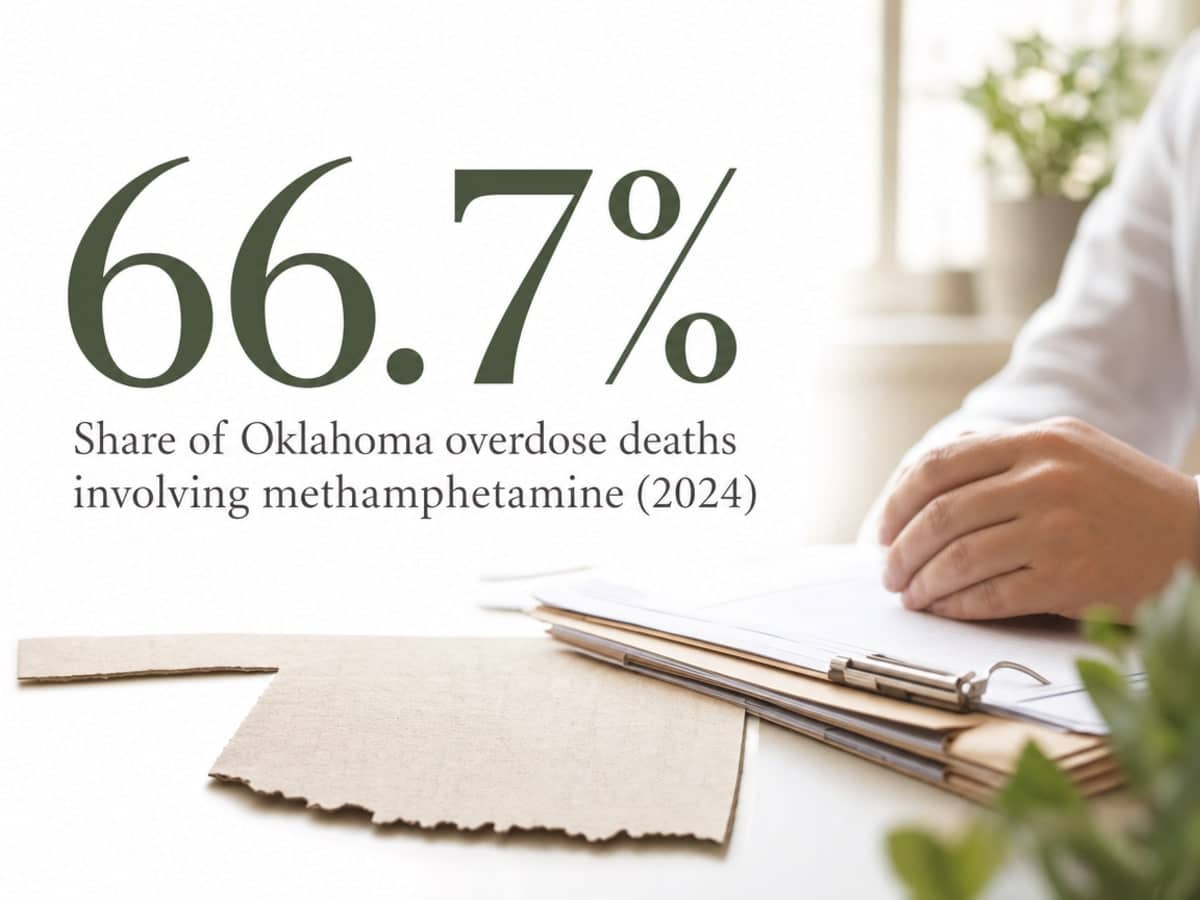
If you are reading this from Oklahoma City, the reason stimulants feel like a statewide undertow is because they are one. Methamphetamine is now involved in roughly two out of three drug overdose deaths in Oklahoma, and meth-related overdose deaths have climbed from 39 in 2007 to 813 in 2023. That is not a rounding error or a bad quarter. That is a sixteen-year arc pointing in one direction, and it is the reason the emergency rooms, county jails, and detox phones here look the way they do.1
You are not imagining that meth in this state hits differently than what national coverage describes. It is cheaper, more available, and more embedded in ordinary Oklahoma life than most public conversations acknowledge. When you search for detox in the OKC metro at two in the morning, you are one of thousands of people in this state doing the same thing, and the systems that respond — hospitals, licensed detox facilities, county crisis lines — have been built around exactly this crisis.1
Here is why the local numbers matter to you specifically. When meth is that woven into a community, the shame of asking for help shrinks. The clinician taking your intake call has heard your story this week already. Probably today. The nurse who checks on you at 3 a.m. during your first night is not going to flinch at anything you say. And the treatment infrastructure in the metro is not built for a rare, exotic problem. It is built for the person you are, in the city you are in, with the drug you have been using.
That is a strange kind of comfort, but it is real. You are not the outlier here. You are the reason the door is open.
What Stimulant Withdrawal Actually Does to You
The Crash: First 24 Hours After the Last Use
The crash is the part your body has been waiting for, and it arrives faster than you expect. Within a few hours of your last use, the wall you have been running on collapses. Deep, heavy exhaustion — the kind where standing up feels like moving furniture. Hunger that comes back suddenly after days of nothing. And underneath both, a mood drop that can go from flat to frightening in one afternoon.
What is happening in your brain right now is not mysterious. Stimulants force massive dopamine release, and when the drug clears, your natural dopamine sits far below baseline. Your reward system essentially goes offline. Food tastes like nothing. Music sounds like static. The people you love feel far away. That is chemistry, not truth.6
The first 24 hours also carry the acute medical risks that matter most for cocaine and high-dose meth use: elevated heart rate, blood pressure spikes, chest pain, and in some cases seizures. This is the window where a clinician taking your vitals every few hours actually catches something. Most people sleep — hard, sometimes for 12 or 16 hours at a stretch. Some cannot sleep at all and spiral into agitation instead. Both are normal. Both are easier to move through when someone is watching.7
Acute Withdrawal: Days 1 Through 5
Acute stimulant withdrawal symptoms begin within 24 hours of your last use and last for roughly 3 to 5 days. That is the clinical window. Inside it, the shape of what you feel changes almost hourly.4
Sleep is often the first thing that gets weird. You may sleep 14 hours and wake up more tired than when you lay down. Or you may not sleep at all, and instead lie in bed with your heart pounding while your mind loops. Appetite comes roaring back — hyperphagia is the clinical word — and eating feels good in a way nothing else does, which can be disorienting after weeks of not eating.
The mood piece is the hardest part. Depression during acute stimulant withdrawal is not sadness. It is closer to a full shutdown of feeling, punctuated by sharp, intrusive thoughts: I have ruined everything. Nothing will ever be okay. I should not be here. If you have had suicidal thoughts before, this is the window they come back the loudest. Paranoia and lingering psychotic symptoms — hearing things, feeling watched, believing family members are against you — can also show up, especially after heavy meth use.6,8
Here is the earned reassurance. Days 3 and 4 are usually the floor. By day 5, most people notice one small thing — a real meal that tasted like food, an hour of sleep that felt like rest, a laugh at something on TV. That is your dopamine system starting to move again. It is not a full return. It is a signal.
The Extended Window: Weeks Two Through Eight
Here is what most articles skip, and it is the part that determines whether the first week was worth it. After acute withdrawal ends, a longer, quieter phase kicks in. You will not feel sick. You will feel gray. Food is okay. Sleep is closer to normal. But joy has not come back yet, and that gap is where relapse lives.
The clinical name for this is anhedonia — the inability to feel pleasure from things that used to move you. Your brain’s dopamine machinery is repairing itself, and repair takes time. Weeks, not days. Somewhere between week two and week eight, most people notice pleasure creeping back in pieces: the smell of coffee, a good text from a friend, five real minutes of interest in something on TV. It comes back. It just does not come back on the schedule you want.8
This is also the window where a specific, ugly thought shows up: I feel this flat, I might as well use again. That thought is not truth. It is your reward system trying to take a shortcut back to dopamine. Knowing it is coming is half the defense. The other half is not being alone with it — outpatient counseling, a sponsor, a therapist, a family member who checks in daily. This is why detox is a first step, not a finish line.6
Why Medical Supervision Matters Even Without a ‘Detox Pill’
The Psychiatric Danger Nobody Warned You About
Here is the thing most people get wrong about stimulant detox. When they hear “medical supervision,” they picture the alcohol or opioid version — IV drips, seizure precautions, a nurse pushing medication into your arm. Stimulant withdrawal usually does not look like that. What it looks like is a person sitting on the edge of a bed at 4 a.m. on day three, convinced that their life is over and that they are the reason.
That is the danger. Not a seizure. A decision.
Depression during stimulant withdrawal can be severe, and it arrives with fatigue and sleep problems that make everything worse. On top of that, heavy meth use can leave behind paranoia, hallucinations, and psychotic-feeling thoughts that do not clear the moment you stop using — anxiety, confusion, insomnia, mood disturbances, and in some cases violent behavior can linger. If you have a history of suicidal thinking, or a family member does, this is the window where those thoughts get loud and start sounding reasonable.6,8
Medical supervision here is not about a pill. It is about a person in the room, or down the hall, every few hours. Someone who knows the difference between “day three low” and “call the psychiatrist now.” That watch is the safety net, and for stimulants, it is the whole point.
What Medical Detox Provides — and What It Doesn’t
Let’s be honest about the pharmacology, because the internet is not. No medication has shown efficacy in reducing the severity of stimulant withdrawal symptoms. There is no Suboxone equivalent for meth. There is no naltrexone for cocaine that works the way it does for alcohol. The clinical literature is direct about this: for stimulants, the mainstay of care is symptomatic medication and supportive care, not a specific detox drug. If a facility promises you a medication that will “treat” your meth or cocaine withdrawal, they are selling you something the evidence does not support.3,5
Here is what medical detox actually does. It monitors you. Blood pressure, heart rate, and cardiac symptoms in the first 24 to 48 hours, because acute stimulant toxicity can still produce dangerous cardiovascular events even after you have stopped using. It watches your mental state — every shift, not just at intake — for suicidal thoughts, psychosis, and severe agitation. When acute toxicity, severe agitation, or a sleep collapse crosses into unsafe territory in those first 48 hours, clinicians may use neuroleptics or short-acting benzodiazepines, targeted at the symptom, not as a “detox protocol”. It restores the basics your body has been running without: fluids, food, vitamins, real sleep.4,5,7
What it does not do is erase the crash. You will still feel the low. You will still feel flat on day four. The people around you cannot skip your brain past the part that hurts. What they can do is keep you alive through it, keep you fed, keep you from making a decision you cannot take back, and hand you off to the next stage of care before you leave. That is not a small thing. That is the whole reason medical supervision exists for a drug class with no detox pill.
A Day-by-Day Look at Medical Detox in Oklahoma City
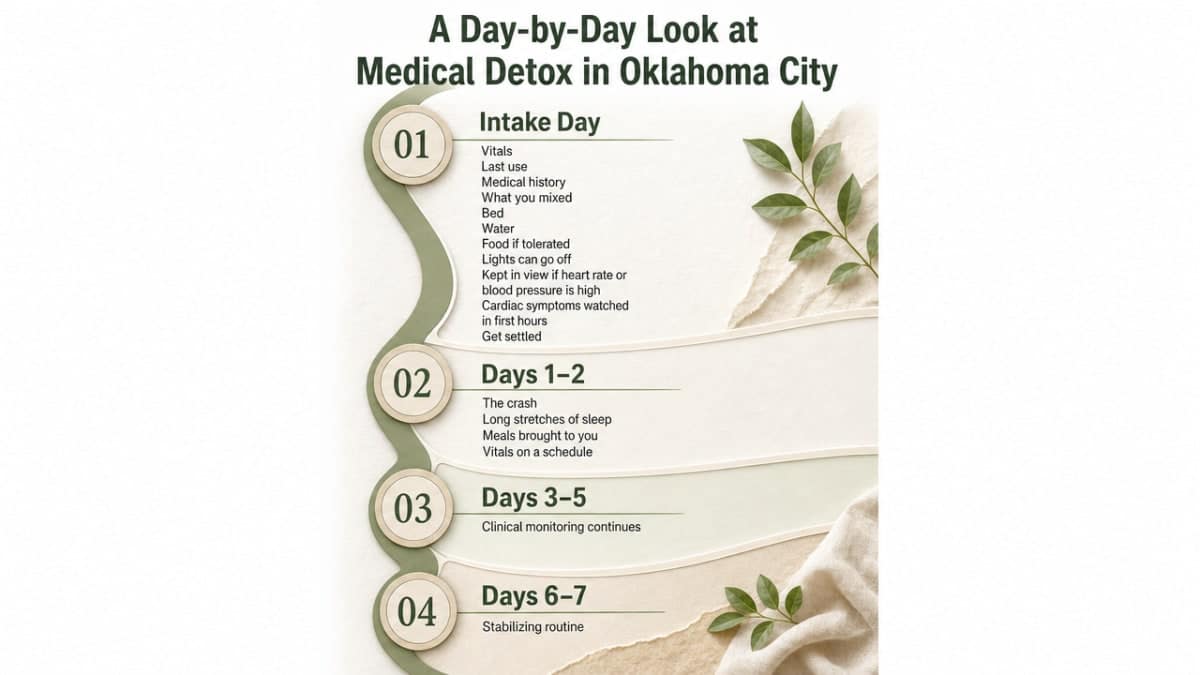
You have probably built a worst-case version of this in your head. It helps to know what the actual days look like when someone is watching.3,4,5,7,8
- Intake day. A nurse takes your vitals, a clinician asks about your last use, your medical history, and what you have been mixing. You get a bed, water, food if you can keep it down, and a room where the lights can go off. If your heart rate or blood pressure is high, or if you are still riding the tail end of a run, staff will keep you in view — cocaine in particular can produce cardiac symptoms in the first hours after your last use. Nobody is going to lecture you tonight. The job is to get you settled.
- Days one and two. This is the crash. Long stretches of sleep. Meals brought to you. Vitals checked on a schedule. If agitation, severe sleep collapse, or acute toxicity crosses a clinical threshold in the first 48 hours, staff may use short-acting medications targeted at the symptom, not as a stimulant “detox drug”. Someone comes by often enough that you are not left alone with your own head.
- Days three through five. The floor of acute withdrawal, then a small lift. Symptoms that began within 24 hours of your last use typically run 3 to 5 days. Depression and intrusive thoughts often peak here, and this is the window where mental-state checks matter more than any medication. Counseling starts in short pieces — 20 minutes, not 90 — because your brain cannot hold more yet.
- Days six and seven. Planning. You are eating. You are sleeping in something closer to a rhythm. Staff walks you through what comes next: residential, intensive outpatient, therapy, a psychiatric follow-up if you need one. Detox alone is not treatment, and the handoff is built into the last days on purpose, not tacked on at discharge.
You Are Not the Only One in Oklahoma Doing This
The middle-of-the-night Google search feels lonely. It is not. In 2015–2017, about 7.3% of people aged 12 and older in Oklahoma — roughly 233,000 people — met criteria for a substance use disorder in the past year, and 2.3% had an illicit drug use disorder specifically. That is more people than fit in most Oklahoma high school football stadiums, and every one of them started somewhere close to where you are right now.2
The number gets sharper if you are younger. Among Oklahomans aged 18 to 25, 13.2% had a substance use disorder in that same window, and 6.9% had an illicit drug use disorder. If you are the parent reading this on behalf of a son or daughter in that age range, the misuse of prescription stimulants like Adderall and Vyvanse alongside meth or cocaine is not rare, and it is not a character flaw. It is a pattern the state’s own data has been tracking for years.2
None of that erases what you are feeling. It does mean the shame you are carrying is heavier than it needs to be. The intake nurse has met people from your neighborhood, your workplace, your church. You are not the story they cannot handle. You are the reason they show up.
After Detox: The Handoff That Determines Whether It Sticks
Seven days sober feels like a summit when you are inside it. It is not. It is a trailhead. Detox stabilizes your body and gets you through the crash, but detoxification alone is not sufficient in the treatment and rehabilitation of substance use disorders. The dopamine repair work — the part where pleasure actually comes back — is happening in the weeks after you walk out, and that is exactly when most people are alone with it.3
The handoff is what closes that gap. A good detox stay ends with a specific next stop already scheduled, not a list of phone numbers on a discharge sheet. That might be residential treatment for a few weeks if home is not safe or sober yet. It might be an intensive outpatient program three or four days a week if you have work or kids to get back to. It might be a psychiatrist appointment within seven days if depression is still heavy, because behavioral therapies — cognitive behavioral therapy and contingency management, particularly — are the treatments with the strongest evidence for stimulant use disorder, and they only work if you show up.6,8
Ask the intake nurse this on day one, not day seven: what does the plan after discharge look like, and who books it? The answer tells you whether you are in a facility that treats detox as a product or as a first step. You want the second one. The relapse window is real, and the people who make it through are almost never the ones who tried to bridge it alone.
Taking the First Step in the OKC Metro
The first step is not a leap. It is a phone call, made from a couch or a car or a bathroom, usually by someone who has been putting it off for weeks. You do not need to be sober to make it. You do not need to have your story straight. You do not need a plan for the next 90 days. You need to say your first name and where you are.
Here is what happens after that. Someone runs your insurance while you stay on the line — most major plans cover medical detox, and a benefits check takes minutes, not days. If you have a ride, you come in today. If you do not, staff will talk you through options. Bring your ID and any prescriptions you are on. Leave everything else.
If you are the parent, partner, or adult child making this call for someone you love, you can call first without them. Ask what the intake looks like, what to say to them, and how to get them through the door without a fight they are too tired to have. Renewal Springs Detox is one option in the OKC metro built for exactly this call. Whoever you choose, choose today. The next run is not the one you survive by accident.
Connect Now for Immediate Stimulant Detox Support
Speak directly with a team member for urgent guidance on safe stimulant detox in Oklahoma City.
Frequently Asked Questions
Is stimulant withdrawal dangerous or life-threatening?
Not usually in the way alcohol or benzo withdrawal is. Stimulant withdrawal does not typically cause seizures or DTs. The danger is psychiatric — severe depression, suicidal thoughts, and lingering paranoia or psychotic symptoms, especially after heavy meth use. Cocaine can also produce cardiovascular events in the first hours after your last use 7. That is why medical monitoring matters, even without a specific detox medication.8,6
How long does stimulant withdrawal last?
Acute symptoms usually begin within 24 hours of your last use and last about 3 to 5 days. The crash hits first, then depression, sleep disruption, and heavy fatigue peak around days 3 and 4. After that, a longer, quieter phase — anhedonia, low motivation, blunted pleasure — can run for several more weeks while your dopamine system repairs itself. It gets better. It just takes longer than the first week.4,8
Is there a medication that treats meth or cocaine withdrawal?
No. No medication has shown efficacy in reducing the severity of stimulant withdrawal, and there are no FDA-approved medications for cocaine or methamphetamine use disorder. The mainstay of care is supportive: fluids, food, sleep, and symptomatic treatment. Short-acting benzodiazepines or neuroleptics may be used for acute toxicity, severe agitation, or dangerous sleep collapse in the first 48 hours. That is targeted symptom care, not a detox drug.4,5,7
Why do I need medical detox if stimulant withdrawal is mostly psychological?
Because the psychological part is the dangerous part. Day 3 depression can bring suicidal thinking that feels reasonable in the moment. Post-meth paranoia and psychotic symptoms can linger past the last dose. Cocaine users still face cardiovascular risk in early hours. Medical detox provides eyes on you every shift — mental-state checks, vitals, sleep and nutrition support, and someone qualified to act if something crosses a line.6,7,8
What happens after detox ends?
Detox alone is not treatment. A good discharge plan already has your next step scheduled — residential care, an intensive outpatient program, or a psychiatric follow-up if depression is still heavy. Behavioral therapies like cognitive behavioral therapy and contingency management have the strongest evidence for stimulant use disorder. The extended anhedonia window is where relapse lives, so the handoff into ongoing care is what determines whether the first week holds.3,6,8
How do I help a family member in Oklahoma City start detox?
Call a licensed detox facility yourself, before you talk to them. Ask what intake looks like, what to bring, and how to handle a person who is exhausted, ashamed, or coming off a run. Most facilities verify insurance in minutes. When you talk to your loved one, keep it short: you are not alone, someone will watch you through this, we can go today. You do not need their whole story to make the call.
References
- Understanding Stimulants. https://oklahoma.gov/health/health-education/injury-prevention-service/drug-overdose/understanding-stimulants.html
- Behavioral Health Barometer: Oklahoma, Volume 5. https://www.samhsa.gov/data/sites/default/files/cbhsq-reports/Oklahoma-BH-BarometerVolume5.pdf
- Quick Guide for Clinicians Based on TIP 45—Detoxification and Substance Abuse Treatment. https://nida.nih.gov/sites/default/files/samhsa_detoxification_and_substance_abuse_treatment.pdf
- Clinical Guidelines for Withdrawal Management and Treatment of Drug Dependence in Closed Settings. https://www.ncbi.nlm.nih.gov/books/NBK310652/
- Management of Drug and Alcohol Withdrawal (review article). https://depts.washington.edu/psychres/wordpress/wp-content/uploads/2017/07/100-Papers-in-Clinical-Psychiatry-Substance-Use-and-Addiction-Psychiatry-Management-of-drug-and-alcohol-withdrawal..pdf
- Research Report Series: Methamphetamine. https://nida.nih.gov/publications/research-reports/methamphetamine
- Research Report Series: Cocaine. https://nida.nih.gov/publications/research-reports/cocaine
- DrugFacts: Stimulant Use Disorders. https://nida.nih.gov/publications/drugfacts/stimulant-use-disorders
- Overdose Death Rates. https://nida.nih.gov/research-topics/trends-statistics/overdose-death-rates
- 2023 NSDUH State Tables – Oklahoma. https://www.samhsa.gov/data/sites/default/files/reports/rpt56188/2023-nsduh-sae-state-tables_0/2023-nsduh-sae-state-tabs-oklahoma.pdf