
Key Takeaways
- Oklahoma City sits inside a worsening overdose picture, with Oklahoma County’s death rate climbing 23% between 2018–2022 and meth and fentanyl driving hospitalizations.7
- Trauma-informed detox rests on safety, choice, and trust—staff who knock, explain medications, and never require you to describe traumatic events in detail to receive care.1
- Oklahoma treats trauma-informed care as a state-recognized standard through the CCBHC model, not a marketing phrase, giving families a real benchmark to hold facilities to.3
- Before choosing a bed, ask specific questions about nighttime room checks, screening practices, medication explanations, and how staff respond when you decline a group or activity.2,17
What You’re Actually Screening For When You Search ‘Trauma-Informed’
If you typed “trauma-informed detox” into a search bar at 2 a.m., you probably weren’t looking for a definition. You were looking for a promise. Something like: this place will not do to me what the last place did.
That’s a fair thing to want. And it’s a reasonable thing to check for before you walk through any door.
Trauma-informed care isn’t a vibe or a slogan a facility can paint on the wall. Federal guidance describes it as an approach built on three moves: realizing how common trauma is, recognizing how it shapes the way people respond to treatment, and responding by actually changing how staff behave. Most people who come in for substance use care are carrying trauma histories, often more than one. So a detox that assumes you’re one of them, and acts accordingly, isn’t doing something extra. It’s doing the baseline right.10,16
What you’re screening for, whether you knew it or not, comes down to a few practical questions. Will the nurse knock before opening your door? Can you say “I’d rather not answer that right now” without being punished for it? Will anyone force you to describe the worst night of your life just to get medication that stops your skin from crawling? Federal practice guidance is explicit that you should never be required to describe overwhelming events in detail to receive care.1
The rest of this page walks through what those answers look like in practice, in an Oklahoma City detox room. Reading this far already counts.
Why Oklahoma City Needs This Kind of Detox Right Now
You’re not imagining that things have gotten worse. The numbers are worse.
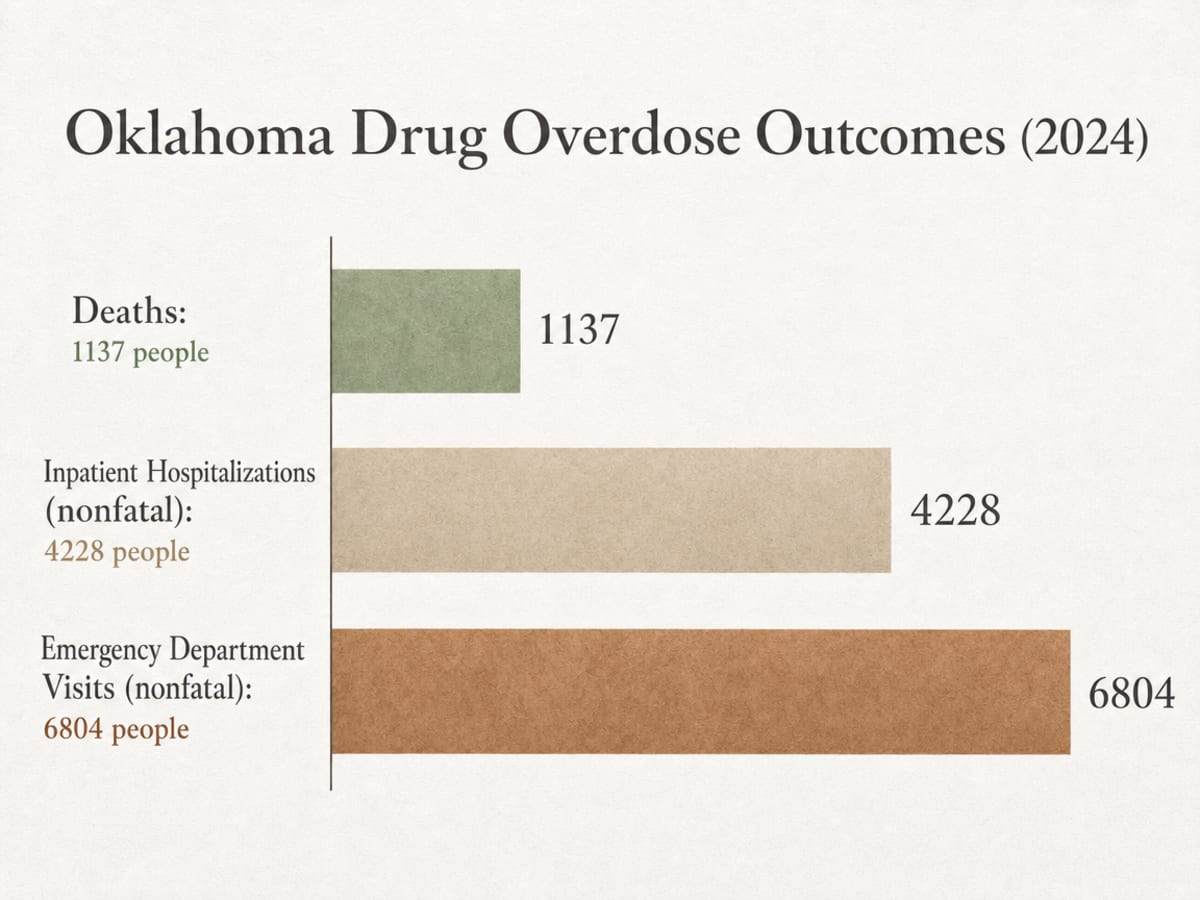
In 2024, Oklahoma recorded 1,137 drug overdose deaths, 4,228 nonfatal inpatient hospitalizations for overdose, and 6,804 nonfatal emergency department visits. Behind each of those ED visits is a person who came close enough to dying that a hospital had to catch them. Some of them made it into treatment afterward. Many did not. And a lot of people who survive an overdose walk out of the ER remembering the fluorescent lights, the questions shouted over them, the restraints, the tone in someone’s voice. That memory does not make them more likely to come back for help. It makes them less likely.5
Zoom in on Oklahoma County, where Oklahoma City sits, and the picture gets sharper. Between 2018 and 2022, the county recorded 655 unintentional drug overdose deaths, and the overdose death rate climbed 23%—from 17.3 per 100,000 in 2013–2017 to 21.2 per 100,000 in 2018–2022. Statewide, methamphetamine became the most common drug involved in overdose deaths, and meth-related deaths more than doubled between 2019 and 2023. Fentanyl is layered into much of the rest.6,7
Here is what that means for you, or for the person you love. The odds that someone in this city needs medically supervised withdrawal are not going down. Neither are the odds that whoever needs it is carrying scars from a previous try—a bad detox, a locked unit, a hospital that treated the overdose but not the person. Research on people entering substance use treatment shows that most have lived through multiple traumatic events, with elevated PTSD symptoms common in the population. That’s not a rare subgroup. That’s the baseline.16
So the question isn’t whether Oklahoma City needs more detox beds. It’s whether the beds we have treat withdrawal as a medical emergency and the person in the bed as someone whose sense of safety matters. A stay that stabilizes your body but leaves you flinching every time a door opens is not a win. It’s a setup for the next relapse.
That’s why the shift toward trauma-informed detox—not as a brochure phrase, but as a set of daily behaviors—matters here, now. The next sections walk through what those behaviors actually are.
The Three Words That Define Trauma-Informed Care: Safety, Choice, Trust
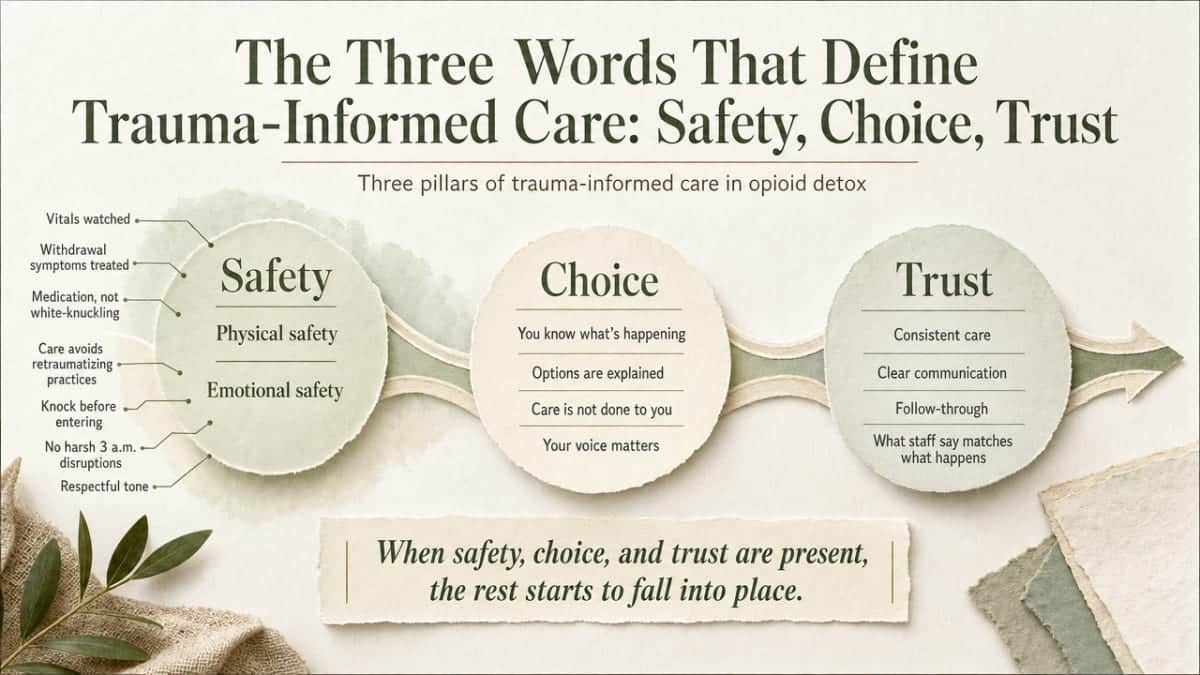
Strip away the acronyms and trauma-informed care rests on three words: safety, choice, and trust. If a detox does those three well, most of the other things you’re worried about start to fall into place.
- Safety
Safety is both physical and emotional. Physical safety in an opioid detox means your vitals are watched, your withdrawal symptoms are treated with actual medication, and no one leaves you white-knuckling through the worst of it. Emotional safety means the room doesn’t feel like a place things happen to you. Federal guidance describes trauma-informed care as care that stays alert to
“institutional processes and individual practices that are likely to retraumatize individuals who already have histories of trauma”.
- So the nurse who bursts in without knocking, the flashlight in your face at 3 a.m., the tone that suggests you brought this on yourself—those are safety failures, not neutral routine.9
- Choice
- Choice is the piece a lot of people don’t expect. When you’ve been in active opioid dependence, choice is usually the first thing that goes—your body chooses for you, your dealer’s schedule chooses for you, an ER team chooses for you while you’re barely conscious. A trauma-informed detox tries to hand pieces of that back. You can decide whether the door stays cracked or closed. You can ask what a medication does before you take it. You can say “not today” to a therapy group without losing your bed. Motivational interviewing, one of the counseling styles used in this kind of setting, is built around exactly that—a “client-centered, directive method” that respects your autonomy while helping you find your own reasons to change.14
- Trust
- Trust is what safety and choice, done consistently, build. It doesn’t arrive on day one. It gets earned in small moments: the tech who said she’d be back in twenty minutes and was, the doctor who explained the taper instead of announcing it. Trauma-informed care assumes trust has been broken before and that rebuilding it is part of the clinical work, not separate from it. That’s the whole model, in three words.10
What It Looks Like at the Bedside
How Staff Enter Your Room
The door is where a lot of trauma-informed care lives or dies. If someone can walk into the room where you’re trying to sleep off the worst of a fentanyl withdrawal without warning, without saying who they are, without giving your body a second to catch up—that’s the moment where a stay stops feeling like care.
State-level practice guidance operationalizes this in almost boring detail, and that boring detail is the point. Safety checks in a trauma-informed inpatient setting include
“Announcing or identifying oneself” before entering and instructions to “Avoid standing and/or hovering directly over patients/residents in their sleeping areas”.2
Read that twice. It is not a philosophy. It is a script.
In practice, the difference at the bedside looks like this:
- Old-style room check: door opens without warning, overhead light flips on, staff member stands over your bed, questions start before you’re upright.
- Trauma-informed room check: a knock, a name spoken through the door (“It’s Maria, your night nurse”), a soft light instead of the overhead, staff staying at the foot of the bed or the chair rather than looming, a quick explanation of why they’re there.
None of that slows down a vitals check. It just changes whether you wake up feeling watched or feeling looked after.
How You’re Asked About Trauma (and What You Don’t Have to Say)
One of the biggest fears people bring into detox is that walking through the door means being cornered into telling a story they’ve spent years trying not to tell. That fear is reasonable. It’s also, in a trauma-informed setting, misplaced.
You are allowed to say “I don’t want to answer that.” You are allowed to say “not yet.” You are allowed to name a piece of it and stop. The point of screening is not to file a story about you. It is to help the nurse know whether to knock a little longer, whether to leave the bathroom door cracked, whether to warn you before touching your arm to check a pulse.
Guidance also warns against delaying that screening until you’re “stable” or abstinent, because the first days are exactly when re-traumatizing missteps are easiest to make. So you may be asked early. And you can still choose what to share.1
Where You Get to Choose
Choice in a detox room shows up in places that sound small until you’re the one in the bed.
You can ask whether a medication is being offered because your vitals need it or because a scheduled dose is due. You can ask what the medication will feel like in the next twenty minutes. You can ask for the blinds up or down, the door open or closed, a female staff member for a body check if that matters to you, a chair pulled to the side of the bed instead of someone standing at the foot of it. You can say “give me ten minutes” before a group meeting. You can decline a group entirely on a day when your skin still hurts.
None of that gets you kicked out. That’s the piece worth underlining. Trauma-informed inpatient care is specifically designed to reduce coercive practices and give people back a sense of control over their environment. If a facility treats a soft “no” as noncompliance, that’s not trauma-informed. That’s the old model with new brochures.17
The choices you make in a detox room won’t fix what happened before you got there. They just start rebuilding the muscle of choosing at all—which, after opioid dependence, is a muscle worth working.
Medical Stabilization for Opioid Withdrawal, Without the Old Harms
Opioid withdrawal is a medical event. Your heart rate climbs, your blood pressure swings, you can’t keep water down, and the anxiety on top of the physical symptoms can feel like your nervous system is trying to escape your body. A trauma-informed detox doesn’t romanticize any of that. It treats it, aggressively, with medication and monitoring—while making sure the treatment itself doesn’t add a new layer of harm.
The stakes for Oklahoma County are not abstract. Between 2013–2017 and 2018–2022, the unintentional drug overdose death rate here climbed 23%, from 17.3 per 100,000 to 21.2 per 100,000, with 655 unintentional overdose deaths recorded in the county over the more recent five-year window. That is the trajectory a medically supervised detox is trying to interrupt. Trying to white-knuckle opioid withdrawal alone, or in a setting without real medical coverage, is how people end up back in the count.7
Medical stabilization in a trauma-informed setting looks like a few specific things happening at once. Your vitals get watched around the clock, not as surveillance but as data that tells the team what your body actually needs. Medications used to ease opioid withdrawal—the ones that quiet the muscle pain, the nausea, the crawling restlessness—are offered with an explanation of what they do and a chance for you to ask questions before you take them. If a dose is on a schedule, you hear why. If something is being offered because your numbers shifted, you hear that too.
The old harms this approach is built to avoid are specific:
- Being restrained without warning.
- Being medicated without being told what was going into your body.
- Having a symptom brushed off because a staff member decided you were drug-seeking.
Inpatient trauma-informed care is designed to reduce exactly those coercive practices and give patients back a sense of control over their environment while medical needs get met. That is the difference between a detox that stabilizes you and a detox that only sedates you.17
You should not have to choose between medical safety and being treated like a person. In a room where both are taken seriously, the medication does its job, and you get to keep your dignity intact while it works.

CBT and Motivational Interviewing: Gentle Tools, Not Interrogation
If you’ve ever avoided treatment because you pictured therapy as sitting in a plastic chair being asked to walk through the worst thing that ever happened to you, you are not alone. That fear keeps a lot of people out of rooms where they could have gotten help. The good news: the two counseling approaches most often used alongside opioid detox are not built that way at all.
Cognitive behavioral therapy, or CBT, sounds heavier than it is. In a detox setting, it’s mostly practical. The work focuses on the development of coping skills and on identifying situations that are high risk for substance use, so you can respond differently the next time one shows up. That might mean naming which times of day your cravings spike, which people or places pull you back, which feelings you’ve been numbing. You are building a toolkit, not opening old wounds. Trauma-informed versions of CBT lean even further in that direction, focusing on collaboration and coping strategies rather than re-exposure to traumatic reminders. You do not have to narrate your history to learn what your triggers are.8,11
Motivational interviewing, or MI, is the counseling style you’re most likely to feel in the tone of the conversation itself. It’s described in the literature as a client-centered, directive method that helps people resolve ambivalence and strengthen their own motivation for change. In plainer terms: the counselor does not lecture you about why you should quit. They ask questions, they listen, they reflect back what you’ve said, and they help you find your own reasons. If part of you wants to stop and part of you isn’t sure, MI treats that as normal, not as denial.14
Neither approach requires you to relive anything. Neither one treats you as a case to be cracked. They are conversations with a shape—one that respects the fact that you already know a lot about your own life, and that you get to decide what you’re ready to work on today.
Trauma-Informed Care Is a State-Recognized Standard, Not a Marketing Line
It’s fair to be skeptical when a facility says it’s trauma-informed. Anyone can print the phrase on a website. What matters is whether it shows up in policy, in payment, in the way the state defines what good care looks like.
In Oklahoma, it does. The state’s Certified Community Behavioral Health Clinic (CCBHC) model, run through the Department of Mental Health and Substance Abuse Services, explicitly frames its services around
“an approach to health care that emphasizes recovery, wellness, trauma-informed care and physical-behavioral health integration”.3
That is not a nonprofit’s mission statement. That is the standard the state uses to define what integrated behavioral health should look like, with covered services spelled out in Oklahoma Health Care Authority rules governing crisis response, outpatient care, and behavioral health interventions.The federal backbone is just as concrete. SAMHSA’s Treatment Improvement Protocol 57 defines trauma-informed care as care that.13
“involves vigilance in anticipating and avoiding institutional processes and individual practices that are likely to retraumatize individuals who already have histories of trauma”.9
That language is what state and clinic policies are built on top of.
None of this guarantees that every door in Oklahoma City opens onto trauma-informed practice. It does mean the standard is real, it is published, and you are allowed to hold any facility to it—including the one you’re considering walking into.
How to Tell If Renewal Springs (or Any Facility) Will Actually Feel Safe
You do not have to take anyone’s word for it. Trauma-informed care shows up in answers to specific questions, not in adjectives on a website. Before you commit to a bed, you can ask, and a facility that means it will not flinch at any of these.1,2,8,14,17
- Do staff knock, announce themselves, and avoid hovering over sleeping patients during checks? Those exact behaviors are named in published trauma-informed safety guidance. A yes should sound specific, not vague.
- Will I be required to describe traumatic events in detail to be admitted or medicated? The correct answer is no. Screening happens, but overwhelming detail is not a condition of care.
- What medications do you use for opioid withdrawal, and will someone explain each one to me before I take it? You are allowed to know what is going into your body and why.
- What happens if I say no to a group, a shower, or a check-in on a hard morning? A trauma-informed unit reduces coercive responses rather than escalating them.
- Do your counselors use CBT and motivational interviewing, and do those sessions require me to relive my history? CBT builds coping skills around triggers, and MI supports your own reasons for change—neither requires re-exposure.
At Renewal Springs, those are the same questions admissions staff expect to hear. Ask them out loud. Ask them twice if you need to. A place that will actually feel safe is one that treats those questions as reasonable, not as pushback.
What Reaching Out Looks Like
Reaching out doesn’t mean committing to anything. It means asking questions and hearing how someone answers them.
A call to Renewal Springs admissions can be as short as you want. You can ask what a typical first night looks like, which medications the medical team uses for opioid withdrawal, whether your insurance is accepted, or how staff handle a hard morning when you’re not ready to talk. You can call on behalf of someone you love and not give a name. You can hang up and call back tomorrow.
If you’re the person in dependence, deciding to make the call is its own step. If you’re the family member, offering to sit next to them while they do it is another. Neither of you has to have the whole plan figured out before you dial.
Trauma-informed care starts before the intake paperwork. It starts in how the first voice on the phone talks to you. Listen for that.
Speak With Someone Who Understands Right Now
Get real answers and support from trauma-informed professionals when you need it most.
Frequently Asked Questions
Will I have to talk about my trauma to get into detox?
No. You’ll likely be asked a few screening questions so staff know how to make you more comfortable, but you are not required to describe overwhelming events in detail to receive care. You can answer briefly, skip a question, or say “not yet.” The purpose is to help the team care for you, not to file a story.1
What medications are used during opioid withdrawal at a trauma-informed detox?
Renewal Springs uses medication-assisted treatment protocols determined by a licensed medical team based on your specific withdrawal picture. What matters as much as the medication itself is how it’s offered: a staff member should explain what each dose does, what it will feel like, and answer your questions before you take it. You are allowed to ask before you swallow anything.
How is a trauma-informed detox different from a regular medical detox?
Both stabilize your body medically. A trauma-informed detox also organizes staff behavior, room routines, and counseling around avoiding re-traumatization—anticipating and side-stepping practices likely to hurt people with trauma histories. That means knocking, announcing, offering choices, reducing coercive responses, and using approaches like CBT and motivational interviewing that don’t require you to relive anything.8,9,14,17
What happens at night—will staff wake me up or hover over my bed?
Vitals still get checked, because your body needs watching during withdrawal. But trauma-informed practice guidance specifically calls for staff to announce or identify themselves and to avoid standing or hovering directly over patients in their sleeping areas. A soft light, a spoken name through the door, and a quick reason for being there—those small choices are the difference between a room check and a startle.2
Can a family member call to ask questions before I decide to come in?
Yes. A parent, partner, sibling, or friend can call Renewal Springs admissions to ask what a first night looks like, which medications are used, whether insurance is accepted, and how staff handle hard mornings. They don’t have to give your name or commit you to anything. Sitting next to someone while they call, or calling on their behalf, is a real form of help.
What if I’ve had a bad experience in treatment or the ER before?
You are not the only one—research shows most people entering substance use treatment carry trauma histories, and prior treatment encounters are often part of that. Tell admissions what happened, or tell them what you don’t want to happen again. A trauma-informed team treats that information as clinically useful, not as a red flag. It helps them plan a stay that doesn’t repeat the harm.16
References
- Trauma-Informed Care in Behavioral Health Services (Practice Guidance Extract). https://library.samhsa.gov/sites/default/files/sma15-4912.pdf
- BSAS Practice Guidance: Trauma Informed Care as a Service Delivery Approach (2023). https://www.mass.gov/doc/trauma-informed-care-practice-guidance-2023/download
- Certified Community Behavioral Health Clinics (CCBHC) – Oklahoma Department of Mental Health and Substance Abuse Services. https://oklahoma.gov/odmhsas/treatment/ccbhc.html
- Drug Overdose Data Dashboard – Oklahoma State Department of Health. https://oklahoma.gov/health/health-education/injury-prevention-service/drug-overdose/data/drug-overdose-data-dashboard.html
- Drug Overdose Data Graphs and Maps (Oklahoma, 2024). https://oklahoma.gov/content/dam/ok/en/health/health2/aem-documents/prevention-and-preparedness/injury-prevention/drug-overdose/Drug%20Overdose%20Data%20Graphs%20and%20Maps.pdf
- Drug Overdose Deaths, 2019–2023 – Oklahoma. https://digitalprairie.ok.gov/digital/api/collection/stgovpub/id/729606/download
- Oklahoma County Drug Overdose Fact Sheet (2018–2022). https://digitalprairie.ok.gov/digital/api/collection/stgovpub/id/641307/download
- Cognitive-Behavioral Therapy for Substance Use Disorders. https://www.ncbi.nlm.nih.gov/pmc/articles/PMC2897895/pdf/nihms205374.pdf
- Trauma-Informed Care in Behavioral Health Services (TIP 57 PDF). https://library.samhsa.gov/sites/default/files/sma15-4420.pdf
- Trauma-Informed Care: A Sociocultural Perspective (TIP chapter). https://www.ncbi.nlm.nih.gov/books/NBK207195/
- EXHIBIT 3.5. Overview of Trauma-Informed Therapies. https://www.ncbi.nlm.nih.gov/books/NBK601490/box/ch3.b21/?report=objectonly
- Drug Overdose Deaths, 2019–2023 – Oklahoma (Fact Sheet). https://oklahoma.gov/content/dam/ok/en/health/health2/aem-documents/prevention-and-preparedness/injury-prevention/drug-overdose/2025%20State%20Drug%20OD%20-%20IPS%20-%20Fact%20Sheet.pdf
- 317:30-5-266. Covered services – Certified Community Behavioral Health Clinics. https://oklahoma.gov/ohca/policies-and-rules/xpolicy/medical-providers-fee-for-service/individual-providers-and-specialties/certified-community-behavioral-health-clinics/covered-services.html
- Motivational Interviewing as a Clinical Strategy to Reduce Alcohol Use. https://www.ncbi.nlm.nih.gov/pmc/articles/PMC3398888/
- Cognitive Behavioral Therapy for Substance Use Disorders. https://www.ncbi.nlm.nih.gov/pmc/articles/PMC2897895/
- Prevalence and Impact of Trauma Among Individuals in Substance Use Treatment. https://www.ncbi.nlm.nih.gov/pmc/articles/PMC4056858/
- Trauma-Informed Care in Inpatient Settings: A Review. https://www.ncbi.nlm.nih.gov/pmc/articles/PMC7552796/