
Key Takeaways
- Oklahoma tribal members often hold layered coverage across IHS or tribal health programs, SoonerCare or SoonerSelect managed care, and sometimes a commercial or marketplace plan.
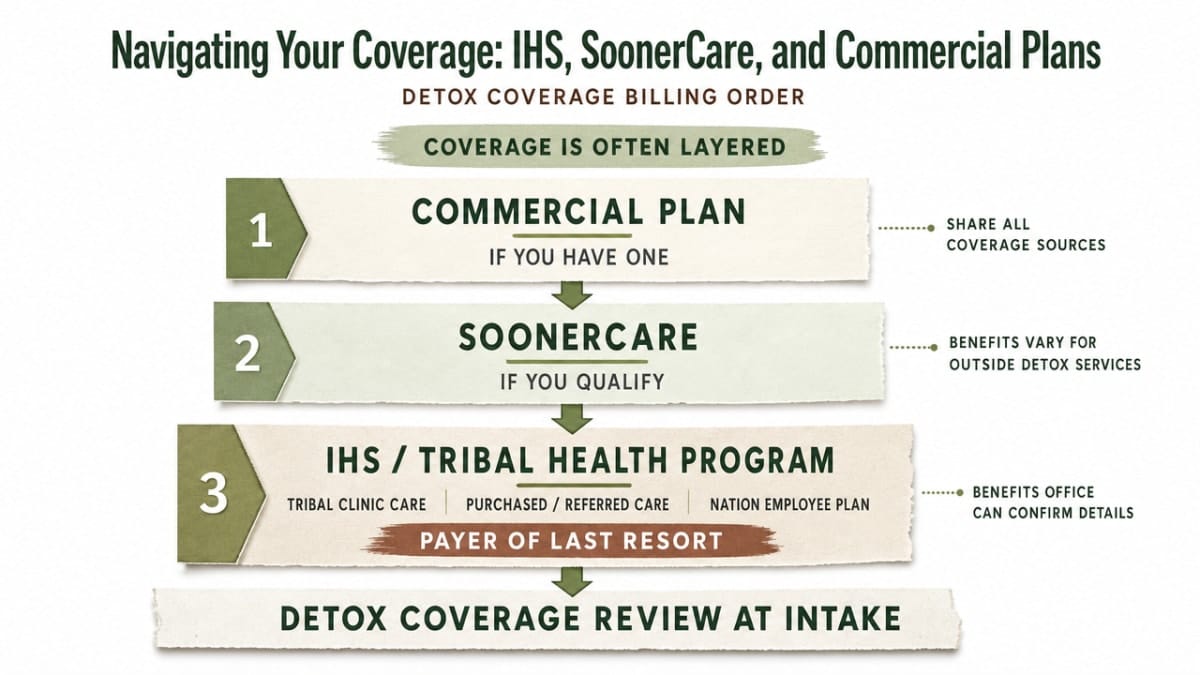
- State policy designates I/T/U benefits as the payer of last resort, so commercial plans bill first, SoonerCare second, and tribal benefits cover what remains 13.
- SoonerCare covers medically supervised detox, residential SUD care, and medication-assisted treatment across eligibility categories, with prior authorization handled by the facility rather than the patient 12.
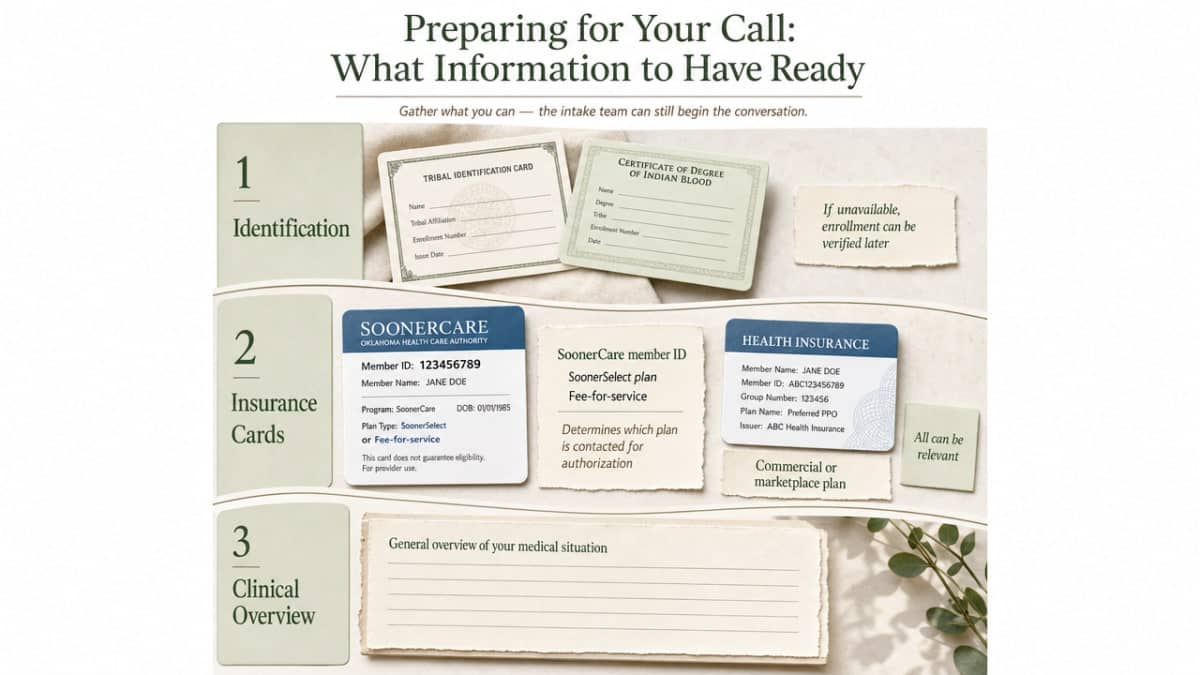
- Before calling a detox provider, gather your SoonerCare card, any commercial insurance card, and tribal ID or CDIB, and be ready to describe recent substance use honestly 8.
Understanding Treatment Coverage for Tribal Members in Oklahoma
If you or a loved one is seeking treatment for substance use, particularly during withdrawal, it’s important to know that you likely have more coverage options than you realize. Oklahoma is home to numerous federally recognized tribal nations, and the healthcare landscape reflects this diversity. Most tribal members in Oklahoma typically have a combination of benefits from the Indian Health Service (IHS) or tribal health programs, SoonerCare (Oklahoma’s Medicaid program, often through SoonerSelect managed care), and sometimes a commercial or marketplace health plan.
Medically supervised detox, which includes 24/7 care and medication to ensure safety during withdrawal, is a covered behavioral health benefit under Medicaid. The Centers for Medicare & Medicaid Services (CMS) specifically identifies inpatient detoxification as a service Medicaid commonly covers for tribal communities 4. Nationally, Medicaid is a primary payer for behavioral health services for American Indian and Alaska Native populations, which highlights its importance in conjunction with tribal benefits 7.
This guide will help you understand how these different coverage options work together, which benefits are typically billed first, and what information to have ready when you seek treatment. You are not alone in this process.
Navigating Your Coverage: IHS, SoonerCare, and Commercial Plans
The Multi-Layered Approach to Tribal Health Coverage
When discussing “tribal insurance,” it often refers to a combination of benefits rather than a single plan. Understanding each layer is crucial because how each contributes to detox coverage can differ. The intake staff at a treatment facility will inquire about all your potential coverage sources.
The foundational layer is your connection to the Indian Health Service or your nation’s tribal health program. This could involve direct care at a tribal clinic, purchased/referred care for services from outside providers, or even a self-funded health plan offered by your nation to its employees. The specific coverage for external detox services will vary, and your nation’s benefits office is the best resource for precise details.
The second layer, if you qualify, is SoonerCare, Oklahoma’s Medicaid program. For many adult members today, this means enrollment in a SoonerSelect managed care plan.
The third layer, if applicable, includes any commercial or marketplace health plan obtained through employment or the health insurance exchange.
You might have one, two, or all three of these layers. Detox coverage is often achieved by strategically combining the benefits each plan offers.
IHS and Tribal Health Programs: Payer of Last Resort
In practice, any commercial or marketplace plan you hold will be billed first. SoonerCare, if you have it, will be billed second. Your IHS or tribal benefits then cover any remaining costs that the initial layers did not. This structure is designed to safeguard your tribal benefits, ensuring that every dollar paid by SoonerCare or a commercial plan for your detox preserves tribal funds for other community health needs.
When a detox facility’s intake team asks about other coverage, they are not questioning your tribal identity; they are following the state-mandated billing order. Identifying all available coverage upfront helps prevent unexpected bills later.
SoonerCare and SoonerSelect: Primary Coverage for Detox
For most tribal members in Oklahoma, SoonerCare plays a significant role in covering detox claims. With the state’s transition to SoonerSelect, adult SoonerCare members are typically enrolled in a managed care plan, such as Aetna, Humana, or Oklahoma Complete Health, rather than traditional fee-for-service Medicaid.
This shift is important because the state’s contracts with these managed care plans explicitly require coverage for a full range of substance use disorder (SUD) services. The SoonerSelect procurement mandates that contractors coordinate the entire continuum of SUD care for enrollees, including assessment, detoxification, residential treatment, outpatient services, partial hospitalization, and medication-assisted treatment 11. This means your managed care plan is contractually obligated to cover detox services.
Tribal members eligible for IHS also have the option to remain in traditional fee-for-service SoonerCare instead of enrolling in a SoonerSelect managed plan, or they can opt into SoonerSelect. Both options cover detox. The specific plan you are on will determine which phone number the detox facility calls for benefit verification and prior authorization, but it does not change whether detox is covered.
If you are unsure of your plan, your SoonerCare member ID card will provide this information. If the card is unavailable, the intake team can usually assist in looking it up.
Commercial and Marketplace Plans: The First Layer of Coverage
If you have health insurance through your employer or a plan purchased on the marketplace, this coverage is typically billed first. This often surprises some tribal members who assume their IHS benefits are primary, but for billing purposes, commercial plans take precedence.
Commercial and marketplace plans are legally required to cover behavioral health services, including inpatient detoxification, at the same level as physical health 4. Deductibles, copayments, and in-network status vary by plan, and a benefits verification call is designed to clarify these details before admission.
A significant benefit of commercial plan coverage is that if it covers a substantial portion of your detox stay, your SoonerCare and tribal benefits can be preserved for subsequent care, such as residential treatment, outpatient counseling, or medication-assisted treatment (MAT) refills. It is always advisable to present any commercial insurance cards you have, even if you are unsure of their active status.
SoonerCare Coverage for Detox and Residential SUD Treatment
SoonerCare consistently covers medically supervised detox for all eligible members. The Oklahoma Health Care Authority’s benefit description explicitly lists detox and residential substance use disorder services as covered for children, non-expansion adults, and expansion adults, with prior authorization required for each category 12. This means that regardless of how you qualified for SoonerCare—whether as a parent, through Medicaid expansion, disability, or as a young adult on family coverage—the detox benefit remains available.
While prior authorization is required, it primarily involves paperwork handled by the detox facility, not by you. The facility submits a clinical assessment detailing your withdrawal symptoms, severity, and medical risks to obtain plan approval before or shortly after admission. You are not expected to manage this process while in withdrawal.
The scope of covered services extends beyond just “detox.” It includes medical detoxification, residential SUD treatment if needed afterward, medication-assisted treatment, and behavioral health services, all within the Medicaid benefit for both tribal and non-tribal members 4. While room and board are generally not covered by SoonerCare, physician services and medications during your stay can be billed separately 3, which is where layering other coverage becomes beneficial.
Your eligibility category for SoonerCare is rarely a barrier to admission. Prior authorization is the main variable, and it is processed quickly when there is a clear clinical need.
Prior Authorization, MAT, and Potential Costs
Prior Authorization During a Crisis
The term “prior authorization” often causes concern, but it should not deter you from seeking help. When you contact a detox facility while in withdrawal, the clinical team will not delay your admission by requiring you to complete forms for plan approval.
Instead, an intake nurse or admissions coordinator will gather essential clinical information, such as substances used, duration, last use, current medications, and any history of seizures or delirium tremens during previous withdrawals. This call typically lasts 15 to 30 minutes. Immediately after, the facility contacts your SoonerCare or commercial plan to initiate the prior authorization request based on the clinical details provided.
While residential SUD services under SoonerCare do require prior authorization across all eligibility categories 12, and the state has specific reimbursement rules for these stays 3, “required” does not mean “slow.” For individuals experiencing acute withdrawal, plans are equipped to respond rapidly. The authorization process occurs concurrently with your admission, not as a prerequisite.
Your primary responsibility is to answer the intake questions honestly.
Medication-Assisted Treatment (MAT) as a Core Benefit
If you have previously used Suboxone, discussed methadone or naltrexone with a doctor, or are concerned about opioid withdrawal symptoms, it’s important to know that medication-assisted treatment (MAT) is an integral part of SoonerCare’s detox coverage, not an optional add-on.
The state’s contract with SoonerSelect managed care plans specifically mandates access to the full continuum of care, including detoxification and MAT, for enrollees with a substance use disorder 11. Furthermore, Oklahoma’s 1115 IMD waiver requires Medicaid-enrolled residential SUD providers to either offer MAT directly or maintain a partnership with a MAT provider 10. This means that buprenorphine for opioid withdrawal, comfort medications for alcohol withdrawal, and other evidence-based protocols are already covered by your plan.
You do not need to request or justify MAT. If the medical team recommends it and you consent, it is included within your benefits and will not result in a separate bill.
Understanding Room and Board, Physician Services, and Billing Surprises
One area where individuals might encounter unexpected information is regarding billing for residential SUD treatment. Oklahoma Medicaid pays for these services on a per diem basis according to the level of care, but room and board are explicitly excluded from this per diem 3. Physician services and medications administered during your stay, however, can be billed separately 3.
For most tribal members with SoonerCare, this distinction typically does not result in a direct charge. The facility handles the per diem billing, and physician services and medications are billed through their respective SoonerCare channels. The room-and-board exclusion is primarily an accounting detail rather than a direct patient charge.
This distinction becomes more relevant if you have a commercial plan with a deductible, or if there is a difference between state coverage and the facility’s charges for accommodations at a specific level of care. In these situations, your tribal benefits, acting as the payer of last resort, often cover what other layers do not.
It is always advisable to ask during benefits verification, “Will I owe anything at discharge?” A reputable intake team will provide a clear answer before your admission.
Tribal-Run vs. Non-Tribal Detox Facilities: Understanding the Differences
If you have noticed differences in how tribal-run treatment programs and facilities like Renewal Springs discuss intake, these distinctions are rooted in state and federal policy. The administrative frameworks for each type of facility are genuinely different.
Tribal-run facilities participating in SoonerCare are reimbursed using a specific federal encounter rate—one outpatient encounter rate per member per day for residential SUD services—unlike the per diem structure used for most other providers 1. To bill SoonerCare, an I/T/U facility must be contracted as a SoonerCare provider and meet the same residential SUD requirements as other programs 2.
An important nuance is that under Oklahoma’s 1115 IMD waiver, all SUD treatment organizations in the state must be certified by the Oklahoma Department of Mental Health and Substance Abuse Services (ODMHSAS), with the exception of tribal entities located on land not subject to state jurisdiction 5, 10. This exemption explains why some tribal-run programs operate under a different regulatory framework than facilities like Renewal Springs. This is not an indicator of quality but a recognition of tribal sovereignty by federal and state law.
For you, the practical implication is that a non-tribal detox facility is ODMHSAS-certified and bills SoonerCare and commercial plans directly, with your tribal benefits covering any remaining costs. Both types of facilities are designed to work together to provide comprehensive care.
Preparing for Your Call: What Information to Have Ready
You do not need to have every detail perfectly organized, but having certain information ready will help the intake team initiate a benefits check and clinical assessment more efficiently.
Gather your tribal ID or Certificate of Degree of Indian Blood (CDIB) card if readily available. If you cannot locate it, the intake team can still begin the conversation, and your tribal health program can verify enrollment later. Also, have your SoonerCare member ID card, as it indicates whether you are enrolled in a SoonerSelect managed care plan or traditional fee-for-service, which determines the plan the facility contacts for authorization 8. If you have a commercial or marketplace plan through work or the exchange, retrieve that card as well, as all three can be relevant.
Be prepared to provide a general overview of your medical situation:
- what substances you have been using, how much, and when you last used
- any current medications and dosages, even over-the-counter ones
- any history of seizures, delirium tremens, or other serious withdrawal complications
- an emergency contact person
You do not need to memorize or neatly write down all this information. Simply communicate it clearly. The intake team is trained to ask appropriate follow-up questions. Free benefits verification means you are not committing to anything by calling; you are simply gathering information, just as they are.
Coordinating Tribal Benefits with Non-Tribal Facilities like Renewal Springs
Renewal Springs is not a tribal facility, but this distinction is less critical than you might assume when utilizing your coverage there. What matters most is whether the facility is a contracted SoonerCare provider that understands the correct billing order and how to coordinate with your nation’s benefits office when claims are processed.
The coordination process typically unfolds as follows:
- If you have a commercial plan, it is billed first.
- Your SoonerCare or SoonerSelect plan is billed next.
- Then, your tribal health program is contacted for any remaining costs, as I/T/U benefits serve as the payer of last resort 13.
During your stay, the medical team provides consistent care—including 24/7 monitoring, MAT if clinically appropriate, and comfort medications—while the billing team manages the coverage stack in the background.
The intake team will ask you to sign a release of information, which allows the facility to communicate directly with your tribal health program or purchased/referred care office. This release facilitates coordination between the different systems, eliminating the need for you to act as an intermediary. If you have previously used purchased/referred care, this step will be familiar.
You are not expected to be an expert in these processes. Your role is to make the call and answer questions honestly. The staff are experienced in these matters, and free benefits verification ensures that financial details are clarified before you incur any obligations.
Your Next Step
The team at Renewal Springs has experience assisting tribal members with navigating complex coverage, and benefits verification is a complimentary service.
Have your SoonerCare card, any commercial insurance card, and your tribal ID or CDIB nearby if possible. If you cannot locate them, please call anyway. Provide an honest account of your substance use and when you last used. The intake team will manage the prior authorization and billing order—commercial first, SoonerCare next, and your tribal benefits covering any remaining costs 13. The IHS treatment locator is also available if you wish to explore tribal-run options in addition to contacting Renewal Springs 14.
Reaching out for help during withdrawal is a significant and courageous step. Make the call.
Speak With Someone About Tribal Insurance Options
Get clear answers about using your tribal insurance for detox and support starting your recovery in Oklahoma.
Frequently Asked Questions
Can I use my IHS or tribal health benefits at a non-tribal detox like Renewal Springs?
Yes. Your tribal or IHS benefits remain applicable at non-tribal facilities. Under Oklahoma policy, I/T/U benefits are designated as the payer of last resort, covering costs not paid by commercial or SoonerCare coverage 13. The intake team will coordinate directly with your nation’s benefits office after you sign a release of information.
If I have SoonerCare and tribal coverage, which one pays for detox first?
SoonerCare is billed before your tribal benefits. Oklahoma Health Care Authority policy designates I/T/U programs as the payer of last resort. Therefore, SoonerCare (or a commercial plan, if applicable) is billed first, and your tribal health program covers any remaining balance 13. This billing order helps preserve tribal funds for community health needs.
Does SoonerCare cover medically supervised detox for adults in Oklahoma?
Yes. The OHCA’s benefit description confirms that detox and residential SUD services are covered for children, non-expansion adults, and expansion adults, with prior authorization required for each category 12. Regardless of your SoonerCare eligibility pathway, the detox benefit is consistent. The prior authorization process is handled by the facility.
Will prior authorization delay my admission if I’m in withdrawal right now?
No, in practice, it will not. While residential SUD services under SoonerCare do require prior authorization 3, plans are designed to respond quickly for individuals in acute withdrawal. The facility initiates the authorization request during or immediately after your intake call, based on the clinical information gathered. The paperwork proceeds concurrently with your admission. Your role is to answer intake questions honestly.
Is medication-assisted treatment (MAT) included during detox, or billed separately?
MAT is included within the benefit. The state’s SoonerSelect contract requires managed care plans to cover the full SUD continuum, including detoxification and MAT 11. Additionally, Oklahoma’s 1115 IMD waiver mandates that Medicaid-enrolled residential SUD providers either offer MAT directly or maintain a MAT partnership 10. Buprenorphine, comfort medications, and other evidence-based protocols are part of the covered services.
What should I have ready when I call to verify tribal insurance for detox?
Have your SoonerCare member ID card, any commercial or marketplace insurance card, and your tribal ID or CDIB card nearby if possible 8. Also, be prepared to describe your substance use history (what, how much, when last used), current medications, and any past withdrawal complications. If you cannot find a card, still call; benefits verification is free and does not obligate you to anything.
References
- OK-21-0013 State Plan Amendment – Indian Health Service/Tribal/Urban Clinics. https://www.medicaid.gov/medicaid/spa/downloads/OK-21-0013.pdf
- 317:30-5-1094. Behavioral health services provided at I/T/Us. https://oklahoma.gov/ohca/policies-and-rules/xpolicy/medical-providers-fee-for-service/individual-providers-and-specialties/indian-health-services-tribal-programs-and-urban-indian-clinics-i-t-us-/behavioral-health-services-provided-at-i-t-us.html
- SECTION 95.50. Residential substance use disorder (SUD). https://oklahoma.gov/ohca/policies-and-rules/xpolicy/medical-providers-fee-for-service/individual-providers-and-specialties/inpatient-psychiatric-services/residential-substance-use-disorder-reimbursement1.html
- Tribal Behavioral Health Coverage. https://www.cms.gov/training-education/partner-outreach-resources/american-indian-alaska-native/behavioral-health/tribal-behavioral-health-coverage
- Oklahoma Section 1115 IMD Waiver for SMI and SUD – Program Approval. https://www.medicaid.gov/medicaid/section-1115-demonstrations/downloads/ok-imd-waiver-smi-sud-pa.pdf
- Behavioral Health and Substance Abuse Services – Individuals. https://oklahoma.gov/ohca/individuals/mysoonercare/soonercare-benefits/behavioral-health-and-substance-abuse-services.html
- Medicaid and American Indians and Alaska Natives. https://www.ssa.gov/policy/docs/ssb/v76n4/v76n4p1.pdf
- SoonerCare in Your Tribal Community: Behavioral Health. https://oklahoma.gov/content/dam/ok/en/okhca/documents/a0301/22761.pdf
- Behavioral Health and Substance Abuse Services – Providers. https://oklahoma.gov/ohca/providers/types/behavioral-health-and-substance-abuse-services.html
- Oklahoma Section 1115 Institutions for Mental Disease (IMD) Waiver. https://oklahoma.gov/content/dam/ok/en/odmhsas/documents/policy/provider-certification/other/OK%201115%20IMD%20Waiver.pdf
- SoonerSelect Medical RFP 8070000052. https://oklahoma.gov/content/dam/ok/en/omes/documents/1SoonerSelectMedicalRFP8070000052.pdf
- Mental Health and Substance Abuse Services – Program Description. https://oklahoma.gov/ohca/individuals/programs/mental-health-and-substance-abuse-services.html
- Indian Health Services, Tribal Programs, and Urban Indian Clinics (I/T/Us) – OHCA Policy. https://oklahoma.gov/content/dam/ok/en/okhca/documents/a0500/18367.pdf
- Find Treatment – Alcohol and Substance Abuse Branch. https://www.ihs.gov/asab/treatment/findtreatment/