
Key Takeaways
- TRICARE East covers medically necessary detox through Humana Military, including inpatient withdrawal management, residential care, PHP, IOP, and medication-assisted treatment for opioid, alcohol, and benzodiazepine dependence 1.
- Coverage, network participation, and medical-necessity authorization are three separate checks, and all must align before admission since directory listings often contain errors 2.
- Active-duty members typically pay nothing for authorized SUD care, while retirees and dependents face deductibles and cost-shares that vary by plan and network status 1.
- A civilian TRICARE-authorized detox often admits patients within 24 to 72 hours, bypassing waitlists at military treatment facilities while preserving federal health-privacy protections 1.
Yes, TRICARE Covers Medical Detox — Here’s What to Confirm Before Admission
TRICARE covers medically necessary detox, and Renewal Springs Detox in Oklahoma City works with TRICARE East through Humana Military. If a loved one is dependent on opioids, alcohol, or benzodiazepines and requires medical supervision for safe withdrawal, TRICARE benefits are designed for this situation 1.
However, coverage alone does not guarantee admission. Three key factors must align: the benefit itself, Humana Military’s authorization for the specific level of care, and confirmation that the facility is currently accepting new TRICARE patients. A directory listing is not sufficient proof for any of these 2.
It is crucial to double-check. Call Humana Military at 800-444-5445, or contact Renewal Springs for a free benefits verification. We can guide you through the verification process, including the typical 24–72 hour timeline and how to navigate potential delays.
What TRICARE East Actually Pays For
Covered Levels of Care for Substance Use
TRICARE’s substance use benefit is comprehensive. When care is medically necessary and provided by a TRICARE-authorized provider, it covers the full spectrum of care needed, not just isolated services 1.
Specifically, TRICARE East can cover:
- Inpatient medical detoxification — 24/7 supervised withdrawal management for substances like alcohol, opioids, and benzodiazepines, where withdrawal poses medical risks.
- Residential SUD treatment — longer-term programming after acute withdrawal has stabilized.
- Partial hospitalization (PHP) — structured day treatment, typically five days a week.
- Intensive outpatient (IOP) — several sessions per week while the patient lives at home.
- Standard outpatient therapy — individual, group, and family counseling.
- Opioid treatment programs and office-based opioid treatment — including medication-assisted treatment (MAT) with methadone, buprenorphine, or naltrexone 1.
It is important to note that coverage for a level of care differs from approval for a specific admission. Each level has its own medical-necessity criteria, and inpatient and residential stays generally require preauthorization from Humana Military before treatment begins 1. If a family member is in acute withdrawal, admission and authorization can proceed concurrently, but someone must initiate the authorization process. Verifying benefits before arriving at a facility is the most effective step you can take.
Active-Duty vs. Retiree Cost-Share
The financial responsibility varies based on the patient’s status. A Government Accountability Office (GAO) review indicates that active-duty service members typically receive covered behavioral-health care, including SUD treatment, without cost sharing. In contrast, retirees and most other beneficiaries generally share costs 1.
To clarify:
- If the patient is active-duty, out-of-pocket costs for authorized, medically necessary detox are usually zero. However, active-duty admissions often require coordination with the service member’s command or military treatment facility.
- If the patient is a retiree, spouse, or adult child on TRICARE, expect a combination of deductibles, copays, or cost-shares. These depend on the specific plan (TRICARE Prime, Select, or other options) and whether the provider is in-network or out-of-network.
Specific dollar amounts cannot be provided here, as they depend on your plan, enrollment status, and whether your catastrophic cap has been met. Humana Military can provide exact figures with one phone call. Request this information in writing or obtain a reference number.
Parity Protections and Their Limitations
The Mental Health Parity and Addiction Equity Act (MHPAEA) generally prevents health plans offering SUD benefits from imposing financial requirements or treatment limitations that are more restrictive than those for comparable medical and surgical benefits 6. This means TRICARE cannot make detox access more difficult than, for example, a cardiac admission.
However, parity laws do not eliminate standard gatekeeping procedures. Preauthorization, medical-necessity reviews, level-of-care criteria, and network rules still apply to SUD care, just as they do for medical services 6. Therefore, if Humana Military requests clinical information before approving a residential stay, this is not a parity violation; it is a standard process similar to what a cardiologist would undergo for an elective hospital admission.
Understanding these protections helps you advocate effectively if a request seems unreasonable, while also accepting necessary steps inherent in any specialized admission process.
Coverage, Network, and Authorization Are Three Distinct Checks
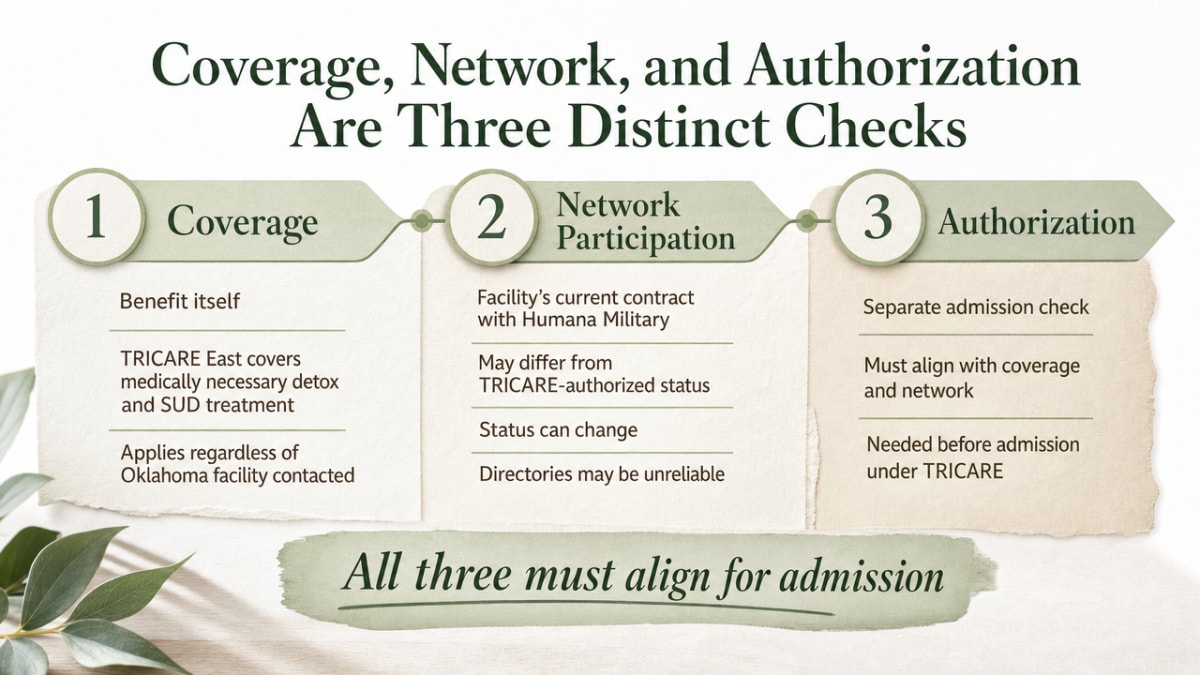
Families often encounter confusion because provider websites and intake calls use these three terms interchangeably. However, all three must align for a loved one to be admitted under TRICARE. Differentiating them can save significant time.
Check one: coverage. This refers to the benefit itself. TRICARE East, as a plan, covers medically necessary detox and SUD treatment 1. This applies regardless of which Oklahoma facility you contact.
Check two: network participation. This is the facility’s current contractual status with Humana Military, the TRICARE East administrator. A facility can be TRICARE-authorized without being in-network for your specific plan, and either status can change. Directory listings are often unreliable; a GAO study found errors in most sampled behavioral-health provider listings, recommending improved oversight of directory accuracy 2. Therefore, always confirm network status by phone on the day of inquiry.
Check three: medical-necessity authorization. This is specific permission for this individual to receive this level of care at this time. Inpatient and residential stays typically require preauthorization from Humana Military before treatment begins 1. Coverage confirms the benefit exists. Network status confirms the facility can bill for it. Authorization confirms Humana Military agrees the admission meets criteria.
Why a Civilian Oklahoma Detox Facility Often Makes Sense
While contacting a military treatment facility might be a first instinct, data indicates limitations in on-base availability. A RAND survey revealed that alcohol-use-disorder treatment was available at 81% of military installations and other SUD treatment at 79% 7. These figures, while seemingly reassuring, mean that roughly one in five installations lacked these services entirely. Even where services existed, reported availability does not equate to immediate bed access, especially during an acute withdrawal crisis.
This gap is precisely why TRICARE East establishes a civilian network through Humana Military. The benefit is designed to provide access to care when on-base programs have waitlists, families live off-post, service members are on leave, or specialized care like 24/7 medically supervised detox with MAT is not offered at the nearest military facility.
For families in and around Oklahoma City, a TRICARE-authorized civilian detox like Renewal Springs can facilitate admission in hours rather than days, eliminating the need to travel to a distant base. Choosing civilian care is not circumventing TRICARE; it is utilizing the system as intended.
Requirements for a Legitimate Oklahoma Detox Facility
Before entrusting a loved one to any detox program, it is important to understand Oklahoma’s regulatory requirements. The state mandates that alcohol and drug treatment providers be certified by the Oklahoma Department of Mental Health and Substance Abuse Services before offering services or billing 5. Medical detoxification is categorized as a residential level of care, requiring residential providers to hold both state certification and national accreditation 8.
Clinical standards are specific. Staff providing medically supervised detoxification must be proficient in recognizing physical withdrawal signs, monitoring vital signs, implementing emergency procedures, and addressing co-occurring mental health needs. Required services include medically supervised screening, observation, evaluation, and physician-directed stabilization 3. State regulations define supervised detoxification as care aimed at preventing withdrawal complications, not merely allowing the body to process substances 4.
A crucial caveat: state certification confirms a facility’s legal authorization to operate and bill in Oklahoma. It does not, however, confirm that the facility is in-network with Humana Military or that your specific admission will be authorized 5. Both conditions must be met. When verifying TRICARE status, also inquire about state certification and national accreditation.
Opioid Dependence: Fentanyl, Withdrawal, and MAT
For individuals using fentanyl, heroin, or prescription painkillers, the landscape of addiction has changed. Fentanyl withdrawal can manifest rapidly, often within 8 to 24 hours, with severe symptoms such as intense aches, sweating, vomiting, and panic. These symptoms frequently drive individuals back to substance use within a day. Medical supervision is not merely for comfort; it is essential for sustaining abstinence during withdrawal.
It is critical to understand that short-term withdrawal management alone carries a high risk of relapse and overdose. Medications for opioid use disorder (MOUD), including methadone, buprenorphine, and extended-release naltrexone, are proven to reduce overdose risk and improve treatment retention 9. Federal guidance considers opioid detox as the initial phase of a treatment plan, not the complete solution. A detox program that discharges an individual after three days without medication or follow-up appointments is not adhering to evidence-based practices.
TRICARE East’s SUD benefit includes opioid treatment programs, office-based opioid treatment, and medication-assisted treatment 1. Recent federal rule revisions in 2024 for opioid treatment programs have expanded telehealth options, relaxed admission criteria, and increased flexibility for take-home medication, making continued MAT more accessible post-discharge than in previous years 10.
When verifying benefits, ask specific questions regarding opioid care: Is MAT covered during inpatient detox? Is buprenorphine or methadone induction authorized at the facility? What is the covered pathway from detox to ongoing MAT, ensuring continuity within the same week? The detox bed is the first step; focus on securing the subsequent steps in the treatment continuum.
Veteran or Dependent? Determining the Correct Pathway
Military families often waste time contacting the wrong entity because the fundamental question—who is the patient—is not explicitly addressed. Clarifying this determines the appropriate course of action.
If the patient is the veteran, the Department of Veterans Affairs (VA) may be the appropriate starting point. VA care for substance use can include medically managed detoxification and medications like methadone and buprenorphine 11. The VA treats SUD as a mental health condition, integrating therapy, withdrawal management, and overdose prevention 12. Some veterans also have TRICARE, for instance, through retirement. In such cases, a TRICARE-authorized civilian detox like Renewal Springs might offer faster admission than waiting for a VA referral.
If the patient is a spouse, child, or other TRICARE-eligible dependent, the VA is not the correct avenue. They are not VA patients, even if the service member in the household is. Their care is managed through TRICARE East and Humana Military. Always identify the patient first before initiating contact.
Active-Duty Confidentiality Concerns
A common, unspoken concern among active-duty families is whether seeking detox will jeopardize a military career. It is important to address this directly.
TRICARE is a health benefit, and clinical records are protected by federal health-privacy rules, similar to any other medical care 1. A civilian detox admission at a TRICARE-authorized facility like Renewal Springs does not automatically trigger notification to a commander. However, command notification can occur due to separate factors such as duty-status issues, safety-sensitive roles, security-clearance self-reporting requirements, or if care is sought through a military treatment facility rather than the civilian network.
This distinction is why many active-duty families specifically explore civilian TRICARE-authorized options. Questions regarding self-referral should be discussed directly with the service member’s chain of command or a Judge Advocate General (JAG) rather than relying on internet searches. Generally, seeking treatment proactively is viewed more favorably than having an issue discovered later.
The Verification Call: A Practical Script
Preparation Before Calling
Gather the following information to streamline your call and reduce stress:
- The sponsor’s full name, date of birth, and DoD ID / benefits number (the service member or retiree whose benefit the patient uses).
- The patient’s name and date of birth, if different from the sponsor.
- Your TRICARE plan (Prime, Select, or other option), if known.
- The facility name, address, and main phone number you wish to verify (for Oklahoma City, this is Renewal Springs Detox).
- A pen and paper or a digital notes application.
Making this call can be challenging, but it is a crucial step.
Communicating with Humana Military
Call Humana Military at 800-444-5445, or use the beneficiary portal. When speaking with a representative, keep your questions concise. You will be performing three checks in sequence 1.
First, confirm the benefit. State: “I need to confirm coverage for medically supervised inpatient detoxification for substance use.” Provide the sponsor’s ID and ask for confirmation that the plan is active and the SUD benefit is currently in place.
Second, confirm the facility. State: “I want to verify that Renewal Springs Detox in Oklahoma City is TRICARE-authorized and currently accepting new TRICARE East patients for inpatient medical detox.” Do not accept “they’re in our directory” as a definitive answer. GAO research indicates that most sampled behavioral-health provider listings contain errors, and a listing does not confirm network status or current capacity 2. Request live confirmation.
Third, confirm authorization and cost-share. State: “What preauthorization is required for this admission, and what will our cost-share be?” If the patient is in acute withdrawal, explicitly state this, as it can expedite the process with Humana Military. Inquire about the documentation the facility needs to submit and the expected timeframe for a decision.
If placed on hold multiple times, remain patient. You are nearing the completion of a critical call.
Information to Document
Before ending the call, record the following details, as they will likely be needed soon:
- The reference or call-tracking number for the conversation.
- The representative’s name and, if provided, their employee ID.
- The date and time of the call.
- Confirmed network status for Renewal Springs Detox specific to your plan.
- Preauthorization requirements and who is responsible for submission (the facility, you, or a primary care manager referral).
- Expected cost-share, deductible status, and whether your catastrophic cap has been met.
- A direct callback number for the SUD authorization team.
You have completed the most challenging part. Document the information, take a moment, and prepare for the next steps.
A Realistic 24–72 Hour Admission Timeline
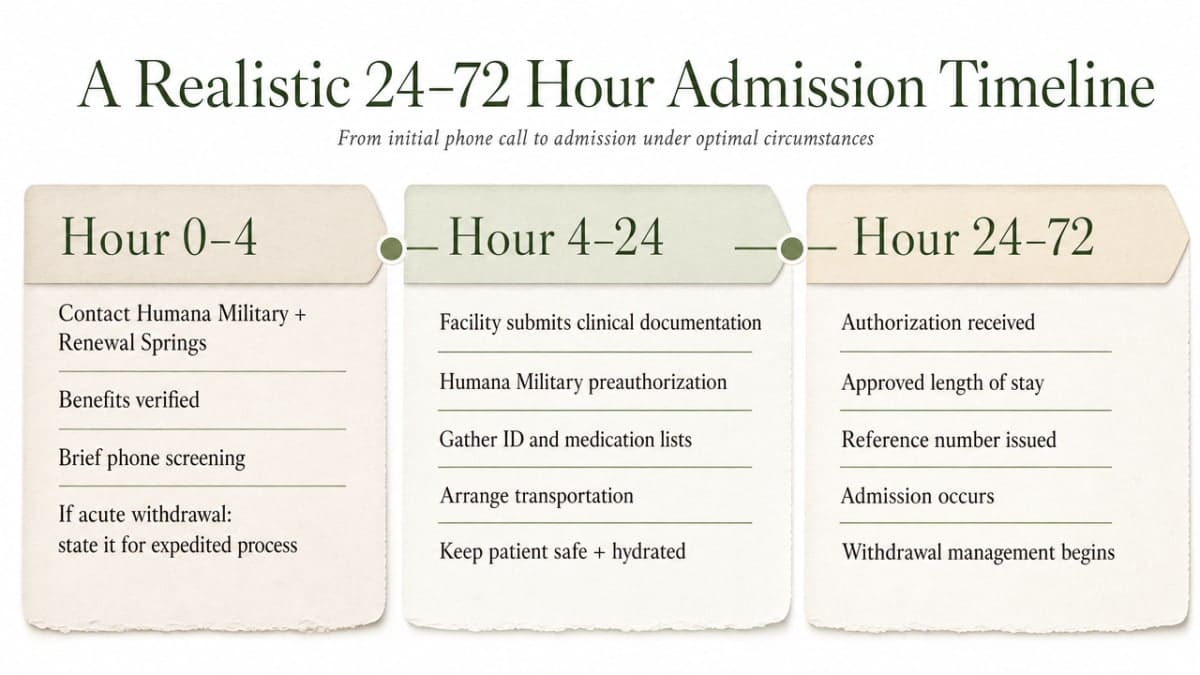
After the verification call, families frequently ask about the speed of admission. Under optimal circumstances, the process from initial phone call to admission typically takes 24 to 72 hours.
Hour 0 to 4. Contact Humana Military and Renewal Springs. Benefits are verified, and the clinical intake team conducts a brief phone screening. If the patient is in acute withdrawal, clearly state this to trigger an expedited process on both ends.
Hour 4 to 24. The facility submits clinical documentation to Humana Military for preauthorization of inpatient medical detox 1. You gather necessary identification, medication lists, and arrange transportation. Ensure the patient remains safe and hydrated.
Hour 24 to 72. Authorization is received, including an approved length of stay and a reference number. Admission occurs. The process of withdrawal management, MAT induction (if appropriate), and discharge planning begins immediately upon the patient’s arrival.
Some admissions may proceed faster, while others might take longer if additional clinical details are required for authorization. Regardless, you are not alone; the facility manages the authorization process while you focus on getting your loved one admitted.
Get Immediate Answers About Tricare Detox Coverage
Speak directly with a specialist about Tricare East/Humana detox options for military families right now.
Frequently Asked Questions
How long does Humana Military authorization for detox usually take?
When clinical documentation is submitted and the patient is in acute withdrawal, authorization decisions often come back the same day or within 24 hours. Explicitly mentioning “acute withdrawal” during the call can trigger an expedited track. Non-urgent requests may take two to three business days. Always ask Humana Military for a reference number and a direct callback line for the SUD authorization team 1.
Will asking for detox hurt an active-duty service member’s career or security clearance?
Clinical records are protected by federal health-privacy rules, similar to any other medical care 1. A civilian TRICARE-authorized detox admission does not automatically notify a commander. Command notification can be triggered by separate factors such as duty status, safety-sensitive roles, or security-clearance self-reporting rules. These are best discussed with the service member’s chain of command or a JAG. Seeking care proactively is generally viewed more favorably than having an issue discovered later.
What should we bring to admission if TRICARE is the payer?
Bring the sponsor’s uniformed services ID, the patient’s photo ID, the Humana Military authorization reference number, a current medication list (including doses and last-taken times), and any recent prescriptions or pharmacy bottles. If the patient has a primary care manager, bring their name and contact information. Comfortable clothes, basic toiletries, and a phone charger are also recommended. Leave valuables at home.
What happens if Humana Military denies the authorization?
A denial is not a final outcome. Request the specific reason in writing and the clinical criteria that were not met. The facility’s utilization-review team can initiate a peer-to-peer review, where their physician directly consults with a Humana Military medical reviewer. You also have appeal rights, and federal parity law limits plans from applying stricter rules to SUD care than to medical/surgical care 6. Many denials are reversed upon review.
My spouse is a veteran — should we use VA or TRICARE for detox?
If your spouse is the patient and is enrolled in VA care, the VA offers medically managed detoxification and MAT options like methadone and buprenorphine 11, 12. If your spouse also has TRICARE through retirement, a TRICARE-authorized civilian detox may offer faster admission than waiting for a VA referral. If you are the patient as a dependent, VA is not applicable; TRICARE East through Humana Military is the correct pathway.
Can TRICARE cover medication-assisted treatment during and after detox?
Yes. TRICARE East’s SUD benefit includes opioid treatment programs, office-based opioid treatment, and medication-assisted treatment with methadone, buprenorphine, or naltrexone 1. The 2024 federal rule on opioid treatment programs expanded telehealth access and relaxed take-home medication rules, making continuity of MAT after discharge more accessible 10. When verifying benefits, specifically inquire about MAT coverage during the inpatient stay and the covered pathway into ongoing MAT within the same week.
References
- Defense Health Care: DOD Assessment Needed to Ensure TRICARE Behavioral Health Coverage Goals Are Being Met. https://www.gao.gov/products/gao-24-106597
- Defense Health Care: DOD Should Improve Accuracy of Behavioral Health Provider Information in TRICARE Directories. https://www.gao.gov/products/gao-24-106588
- TITLE 450 CHAPTER 23. STANDARDS AND CRITERIA FOR …. https://oklahoma.gov/content/dam/ok/en/odmhsas/documents/policy/provider-certification/administrative-rules/2026/Chapter%2023.pdf
- CHAPTER 18. STANDARDS AND CRITERIA FOR …. https://oklahoma.gov/content/dam/ok/en/odmhsas/documents/policy/provider-certification/administrative-rules/2025/PC–Chapter-18_9-1-25.pdf
- New Programs: Overview of ODMHSAS Certification Process. https://oklahoma.gov/odmhsas/policy/provider-certification/new-programs-overview-of-odmhsas-certification-process.html
- The Mental Health Parity and Addiction Equity Act (MHPAEA). https://www.cms.gov/marketplace/private-health-insurance/mental-health-parity-addiction-equity
- Availability of Family Violence Services for Military Service Members and Their Families. https://www.rand.org/content/dam/rand/pubs/research_reports/RR3000/RR3019/RAND_RR3019.pdf
- Provider Certification. https://oklahoma.gov/odmhsas/policy/provider-certification.html
- Federal Guidelines for Opioid Treatment Programs. https://library.samhsa.gov/sites/default/files/federal-guidelines-opioid-treatment-pep24-02-011.pdf
- Medications for the Treatment of Opioid Use Disorder. https://www.federalregister.gov/documents/2024/02/02/2024-01693/medications-for-the-treatment-of-opioid-use-disorder
- Substance Use Treatment For Veterans. https://www.va.gov/health-care/health-needs-conditions/substance-use-problems/
- Alcohol & Drug Addiction Treatment for Veterans – Mental Health. https://www.mentalhealth.va.gov/substance-use/treatment.asp