
Key Takeaways
- TRICARE covers medically necessary detox in Oklahoma through Humana Military under TRICARE East, but coverage hinges on plan type, facility network status, and prior authorization rules.
- Prime, Select, Reserve Select, and TRICARE For Life each carry different referral pathways and cost-shares, so identifying the exact plan on the card shapes every verification call.
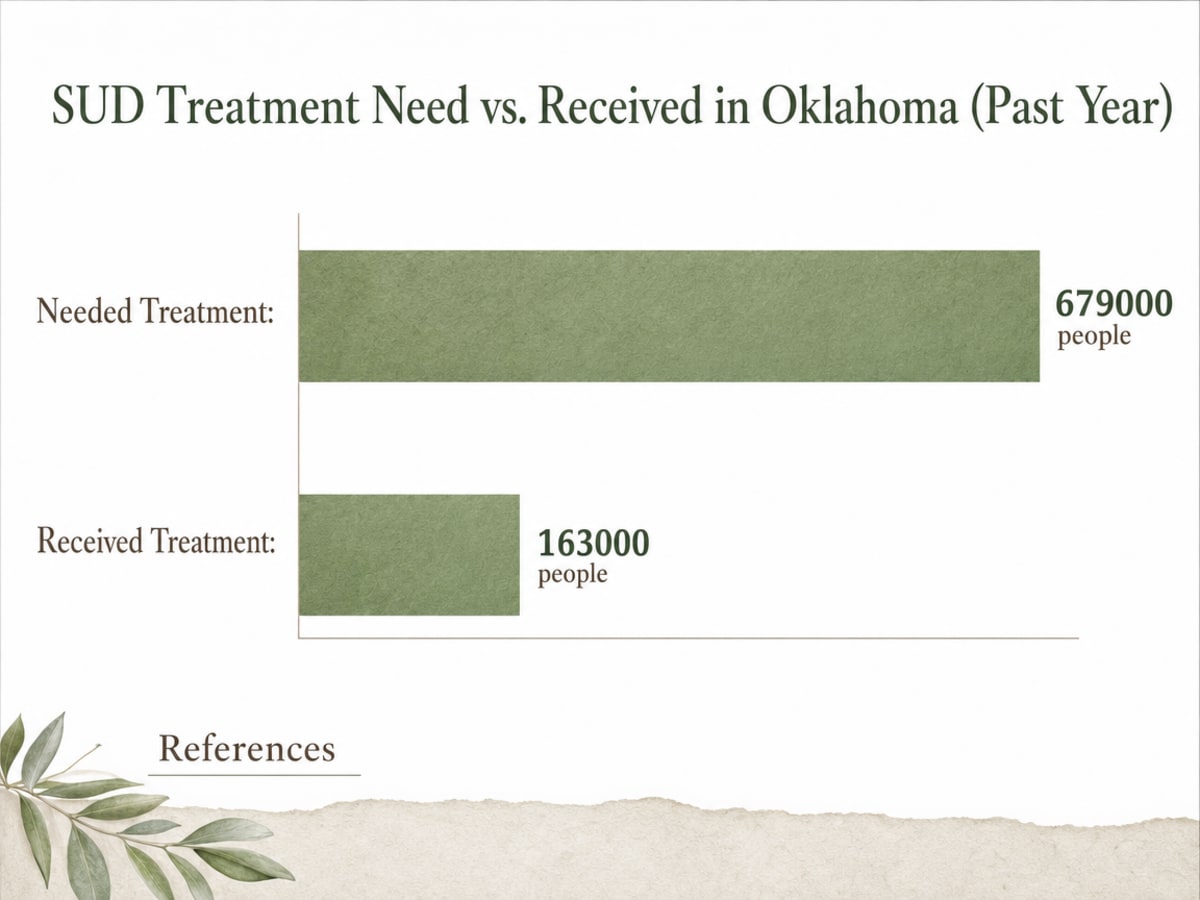
- With roughly 679,000 Oklahomans needing treatment against only 163,000 receiving it 7, in-network beds are limited — confirm Humana Military network status before assuming a facility can admit.
- Gather the sponsor’s DoD ID, plan name, and substance history, then call Humana Military or an in-network Oklahoma facility to verify benefits and initiate authorization tonight.
If You’re Reading This at Midnight
If you’re reading this at midnight, you’re already doing the hard part. Someone you love — a spouse home from deployment, an adult son on your dependent ID, a parent on TRICARE For Life — is in trouble with alcohol, opioids, or something else, and you’re looking for a straight answer about what your card actually pays for in Oklahoma.
Here’s the short version. TRICARE covers medically necessary detox for eligible beneficiaries, including inpatient withdrawal management and medication-assisted treatment, when care is delivered by a TRICARE-authorized provider. The catches worth knowing tonight are which plan you carry, whether the facility is in-network with Humana Military under TRICARE East, and how prior authorization works when the admission can’t wait until Monday.
This guide walks through those three things in order, without a sales pitch. Making the call is a win. Asking the right questions is a win. Every step forward from tonight counts, and there are people on the other end of the line whose job is to help you take the next one.
The Three Questions That Decide Everything
Before you dial anyone, get clear on three things. The answers shape every next step, from who picks up the phone to how quickly your loved one can be admitted.
Which TRICARE plan is on the card? Prime and Select have different referral rules. Reserve Select, Retired Reserve, and TRICARE For Life each work a little differently for behavioral health. If the card belongs to your spouse or your adult dependent, pull it out now and look at the plan name in the corner. That single word changes what you’ll be asked on the verification call.
Is the facility in-network with Humana Military? TRICARE East is administered by Humana Military, and network status is what separates a covered admission from a surprise bill. Oklahoma has hundreds of treatment facilities, but not all of them contract with TRICARE East. Renewal Springs in Oklahoma City is in-network with Tricare East through Humana — worth confirming directly, since network rosters can change.
Is this an emergency, or do you have a few hours? Prior authorization rules bend when the situation is life-threatening. If your loved one is seizing, unresponsive, or actively overdosing, call 911 first. Coverage questions come second, and TRICARE has emergency provisions built for exactly this moment.
Answer those three, and the rest of this guide will make sense.
Which TRICARE Plan Are You Carrying?
Prime, Select, and the Referral Difference
Prime is the managed-care plan. If your service member is active duty, they’re almost certainly on Prime, and so are the dependents enrolled with them. Prime uses a primary care manager who coordinates specialty care, including behavioral health. For most non-emergency detox admissions under Prime, you’ll want a referral routed through Humana Military before admission — otherwise you risk point-of-service charges that can climb fast.
Select is the self-managed plan. Retirees under 65, some family members, and beneficiaries who want more provider flexibility often carry Select. There’s no primary care manager gatekeeping the process, which means you can typically go straight to a TRICARE-authorized detox provider without a separate referral. You’ll still deal with prior authorization for inpatient admissions, and cost-shares run higher than Prime, but the path to admission has fewer stops.
Two practical notes. First, active-duty service members on Prime almost always need command awareness and referral coordination for non-emergency behavioral health admissions — this is a policy layer above the standard referral rule. Second, both plans cover medically necessary detox when the provider is in-network with Humana Military. Confirm plan type and network status on the same call.
Reserve Select, Retired Reserve, and TRICARE For Life
If your loved one is a drilling Guard or Reserve member, they’re likely on TRICARE Reserve Select — a premium-based plan that works a lot like Select for behavioral health. Prior authorization still applies to inpatient detox, and network status with Humana Military still matters. Guard members activated on federal orders shift to Prime for that period, which changes the referral picture, so ask which status they’re currently in.
Retired Reserve covers gray-area retirees not yet eligible for TRICARE For Life. The mechanics look similar to Select: no primary care manager, direct access to authorized providers, prior auth for inpatient stays.
TRICARE For Life is the wraparound for beneficiaries 65 and older with Medicare Parts A and B. Medicare pays first, TRICARE picks up much of what remains. Detox coverage under this arrangement runs through Medicare rules primarily, so the verification call sounds different — you’re confirming what Medicare covers, then what TRICARE For Life picks up after that. If you’re calling on behalf of a parent, mention Medicare and TFL together at the start of the call.
What TRICARE Detox Actually Treats in Oklahoma
Medical detox under TRICARE is not a single service. It’s a bundle: 24/7 monitoring, medications to blunt withdrawal, a physician overseeing the taper, and behavioral health assessments that set up whatever comes next. When your loved one is admitted, the goal isn’t just to get them through the shakes. It’s to keep the heart, brain, and blood pressure stable while the substance leaves the body — and to hand them off to the next level of care with a plan.
The substances that bring Oklahoma families to detox reflect what’s happening on the ground in the state. In 2023, Oklahoma recorded 14,559 substance use treatment admissions, with the leading primary substances being alcohol, marijuana, amphetamines (largely methamphetamine), heroin, and other opiates including prescription painkillers 9. Alcohol and benzodiazepine withdrawal can be medically dangerous on their own — seizures, delirium tremens, dangerous swings in heart rate. Opioid withdrawal is rarely fatal but is punishing enough that people leave against medical advice within hours if they aren’t stabilized properly. Stimulant withdrawal looks quieter from the outside but carries real risk of suicidal depression in the first days.
TRICARE generally covers medically necessary withdrawal management across these categories when the provider is TRICARE-authorized. That includes inpatient detox for alcohol and benzodiazepines, medication-assisted treatment for opioid use disorder using buprenorphine or methadone, and monitored withdrawal for stimulants, kratom, or multiple substances at once. Polysubstance cases — someone who’s been mixing alcohol with Xanax, or fentanyl with meth — often need the inpatient setting simply because the interactions are harder to predict. Ask the verification team specifically whether MAT induction during detox is covered under your plan, because the answer shapes what medications the admitting physician can start on day one.
Why Home Detox Is the Wrong Call
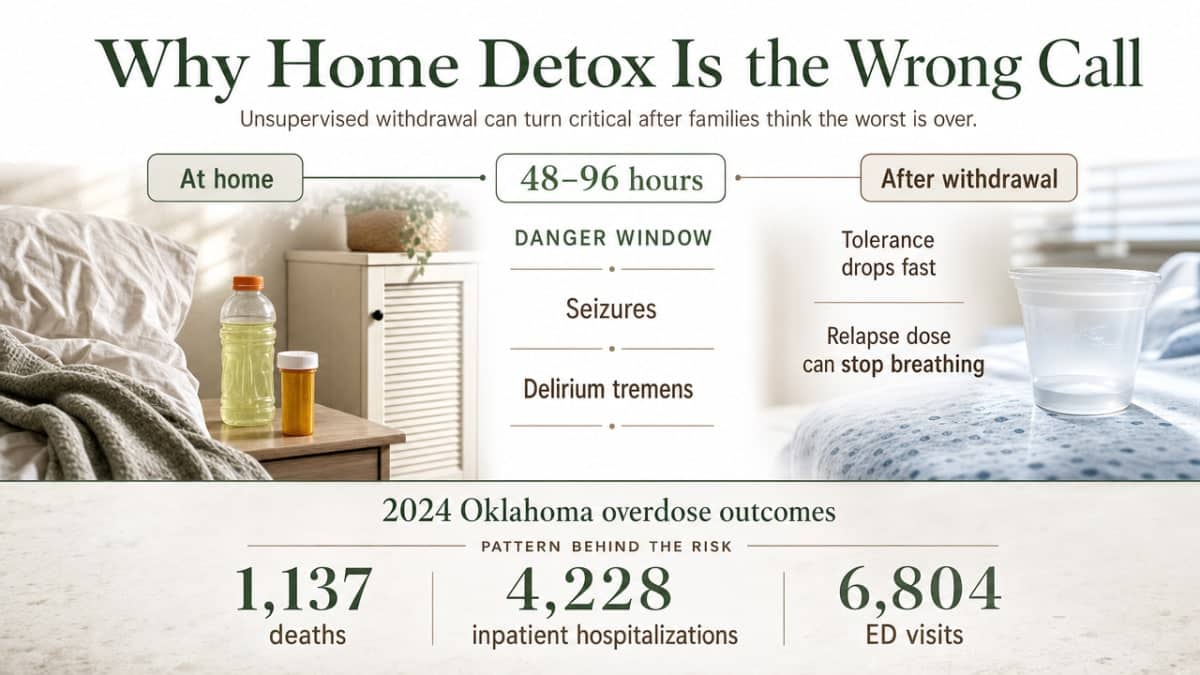
You may be wondering whether you can just get through this at home. A quiet bedroom, a locked liquor cabinet, some Gatorade, a few days of misery. Plenty of families try it. Most of them end up in an emergency room anyway, or worse.
In 2024, Oklahoma recorded 1,137 drug overdose deaths, 4,228 inpatient hospitalizations for overdose, and 6,804 emergency department visits 12. Every one of those hospital admissions was a household that had already tried something else first — waiting it out, cutting back, hoping this time would be different.
A medically supervised detox does what a bedroom can’t. Licensed staff check vitals through the night. A physician orders medications to blunt seizures, ease nausea, steady blood pressure, and start MAT for opioid use disorder on day one when it’s clinically appropriate. If something turns, there are people ten feet away who know what to do.
Choosing supervised care isn’t giving up on your loved one. It’s the version of help that keeps them alive long enough for the next step to matter.
Prior Authorization, Referrals, and Emergency Admissions
The Verification Call: What to Ask Humana Military
Grab a pen. When you call Humana Military — the contractor for TRICARE East — you’re going to hear a lot of terms in a row, and writing things down is how you keep your footing.
Start with the basics: the sponsor’s name, DoD ID number, and which TRICARE plan is on the card. Then ask, in this order:
- Is inpatient medical detoxification a covered benefit under this plan for this beneficiary?
- Is [facility name] in-network with TRICARE East for substance use disorder treatment?
- Does this admission require prior authorization, and if so, can it be initiated today?
- Is medication-assisted treatment covered during detox — specifically buprenorphine or methadone induction if clinically indicated?
- What is the cost-share or copay for an inpatient stay under this plan?
- If a referral is needed from the primary care manager, can it be expedited?
Ask the representative for a reference number for the call before you hang up. Write it on the same page as the answers. If anything changes at admission — a different room type, a longer stay, a MAT medication that wasn’t discussed — that reference number is how you reopen the conversation without starting over.
One more thing. Most detox facilities that work with military families will run this verification for you if you call them first. Renewal Springs in Oklahoma City offers free benefits verification for Tricare East through Humana, which can shave an hour off your night. Making that one call is a real win.
When the Admission Can’t Wait
Prior authorization is a peacetime rule. It’s built for situations where you have a business day and a fax machine. That’s not always the situation you’re in.
If it’s not that acute — your spouse has been drinking around the clock for a week, or your son has been using fentanyl daily and is starting to shake — you still have options after hours. Many detox facilities admit through the night and initiate authorization the next business morning. Humana Military also runs a 24/7 nurse advice line for beneficiaries; the number is on the back of the card.
Don’t wait until Monday because a form feels intimidating. The paperwork follows the patient. It always has.
Access Gaps and Why Network Status Matters
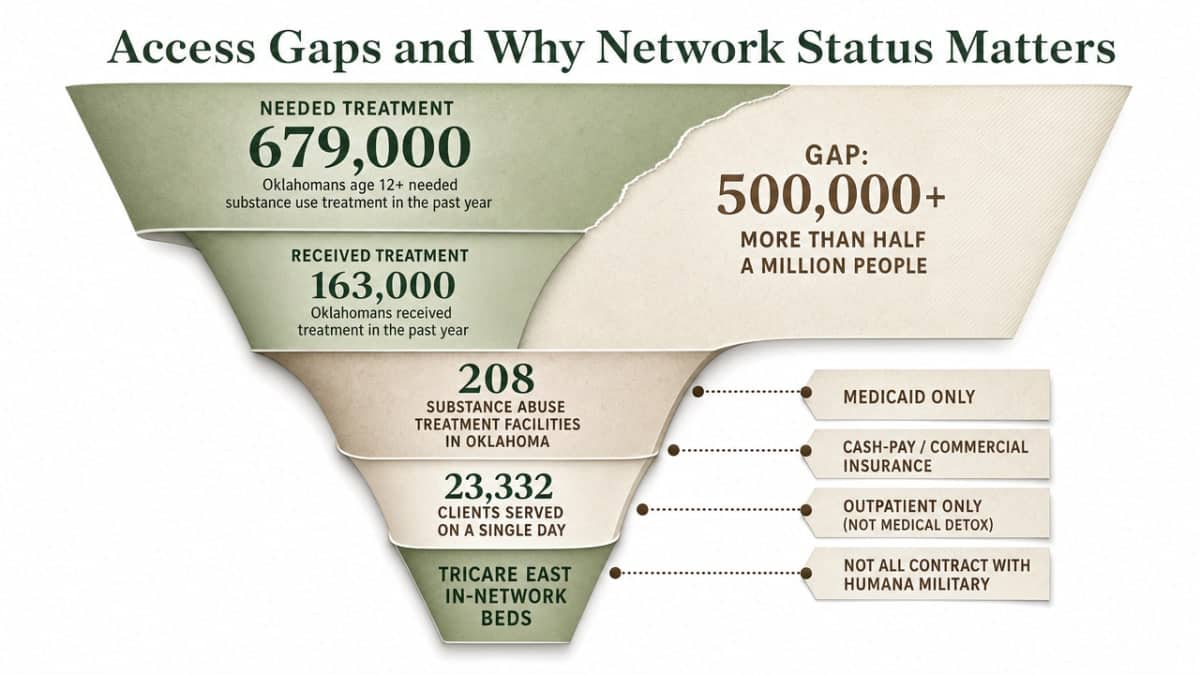
Oklahoma has a treatment infrastructure problem, and it’s the reason network status is more than paperwork. In a recent SAMHSA estimate, roughly 679,000 Oklahomans aged 12 and older needed substance use treatment in the past year, while only about 163,000 received it 7. That’s a gap of more than half a million people, and it presses down on every bed, every intake coordinator, every phone line in the state.
Now layer network status on top of that. The 2019 N-SSATS snapshot counted 208 substance abuse treatment facilities in Oklahoma serving 23,332 clients on a single day 10. On paper, that sounds like plenty of options. In practice, not all of those facilities contract with Humana Military for TRICARE East. Some take Medicaid only. Some are cash-pay or commercial insurance. Some run outpatient counseling but not medical detox. The subset that offers 24/7 medically supervised withdrawal and bills TRICARE East is smaller than the headline number suggests.
What this means for you tonight: the first facility you call may not be able to admit your loved one under your plan, and that’s not a failure — it’s the reality of a strained system. Ask about TRICARE East network status on the opening question, not the closing one. If they’re out of network, ask them for two names of in-network facilities they’d refer to. People in this field usually know each other, and a warm handoff beats starting over at another cold number.
Command, Clearance, and Confidentiality
Here are the two questions military families ask quietly, if at all. Will detox show up in my spouse’s command? Will it cost them their clearance or their career?
The honest answer is that it depends on status and setting, and no one on the internet can promise you a specific outcome. What you can know tonight is how the pieces generally work.
Substance use treatment records held by federally assisted programs are protected under 42 CFR Part 2, a confidentiality rule stricter than HIPAA. A detox facility cannot release records to a commanding officer, a security manager, or anyone else without written consent from the patient, except in narrow situations like a medical emergency or a court order. Adult dependents and retirees are the patient in this scenario, and their records belong to them.
Active-duty service members sit in a different lane. Command notification rules vary by branch and by whether the admission runs through a military treatment facility, a civilian TRICARE-authorized provider, or an emergency room. Self-referral to civilian care, especially for a covered family member, is not the same thing as a command-directed evaluation. Security clearance adjudicators under the SEG Guideline G framework look most closely at untreated substance use and failure to seek help — pursuing treatment voluntarily is generally viewed as mitigating, not disqualifying.
If the service member is the patient and you’re worried about the career piece, ask the admitting facility two specific questions before you sign anything: what their notification policy is for active-duty admissions, and how they handle Part 2 confidentiality. You deserve clear answers before consent, not after.
What Happens During the First 72 Hours
The first three days are the hardest, and also the ones that matter most. Knowing the rhythm ahead of time helps you sit with the wait.
Hours 0 to 12: intake and stabilization. A nurse takes vitals, a physician reviews history and current use, and medications get ordered to blunt what’s coming. For alcohol, that usually means a benzodiazepine taper. For opioids, buprenorphine or methadone induction when clinically appropriate. Your loved one may sleep for the first stretch, or they may be restless and irritable. Both are normal.
Hours 12 to 48: peak withdrawal. This is when alcohol and benzodiazepine risks are highest — seizures, blood pressure spikes, hallucinations. Staff check vitals every few hours, sometimes more often. Opioid withdrawal peaks here too: sweating, cramping, nausea, the bone-deep restlessness. Miserable, but medically manageable.
Hours 48 to 72: the corner turns. Symptoms ease. Appetite returns. A case manager starts the aftercare conversation — residential treatment, intensive outpatient, MAT continuation. This is when the plan for after gets built.
You may only get short phone calls during this window. That’s a good sign, not a bad one. It means the work is happening.
Renewal Springs in Oklahoma City: One In-Network Option
If you’re calling from anywhere in central Oklahoma tonight, Renewal Springs in Oklahoma City is one place worth adding to your short list. The facility is in-network with Tricare East through Humana Military, offers 24/7 medically supervised detox for alcohol, opioids, benzodiazepines, stimulants, kratom, and polysubstance cases, and runs free benefits verification so you don’t have to work through the Humana call tree alone.
A few specifics that matter to military families. There’s a dedicated track for veterans, and gender-specific programs for men and women if that’s a factor for your loved one. Licensed medical staff monitor vitals through the night, and MAT protocols are available on day one when clinically appropriate.
Network rosters change, so verify current status directly before you commit to admission. One phone call answers whether your specific plan, sponsor, and admission date line up cleanly — and that’s the next real step.
After Detox: The Referral You’ll Want Before Discharge
Detox is a doorway, not a destination. The 72 hours that stabilize your loved one physically don’t undo the years that got them here. What happens next — the referral built while they’re still in the bed — decides whether this admission becomes a turning point or a stopover.
Ask the case manager about three things before discharge.
- Level of care: does the treatment team recommend residential, partial hospitalization, or intensive outpatient? TRICARE generally covers all three when medically necessary and delivered by an authorized provider.
- MAT continuation: if buprenorphine or methadone was started during detox, who’s writing the next prescription and when? A gap of even a few days can undo the induction.
- Aftercare timing: the strongest handoffs happen when the next admission is scheduled before your loved one walks out the door, not left as a phone number on a discharge sheet.
Your job through all of this is smaller than it feels tonight. Ask the question. Write down the answer. Keep the plan moving forward one step at a time.
Make the Call
If you’ve read this far, you already know more than you did an hour ago. That counts. The next step is smaller than it feels: one phone call to verify coverage.
Have the sponsor’s DoD ID number, the plan name from the card, and a rough sense of what your loved one has been using and for how long. That’s enough to start. Renewal Springs in Oklahoma City runs free benefits verification for TRICARE East through Humana Military and can tell you within one conversation whether admission tonight is possible under your specific plan.
You’re already doing the hard part. Make the call.
Talk to Someone Who Understands Military Families
Get answers about Tricare detox coverage and next steps for your loved one, right when you need them.
Frequently Asked Questions
Does TRICARE cover medical detox for military families in Oklahoma?
Yes, TRICARE generally covers medically necessary detoxification for eligible beneficiaries, including inpatient withdrawal management and medication-assisted treatment, when care is delivered by a TRICARE-authorized provider. In Oklahoma, that care runs through TRICARE East, administered by Humana Military. Coverage specifics depend on your plan and the facility’s network status, so verify both on the same call before admission.
Do I need prior authorization before my spouse can be admitted for detox?
For non-emergency inpatient detox, yes — prior authorization from Humana Military is typically required, and the facility usually handles the paperwork with you. For a true medical emergency, no. Call 911 or go to the nearest ER first. TRICARE has emergency provisions that let authorization happen after admission, usually within 24 to 72 hours. Don’t let a form delay a life-threatening situation.
Will detox show up in my service member’s command or affect their security clearance?
Substance use treatment records are protected under 42 CFR Part 2, which is stricter than HIPAA and blocks release without written consent in most cases. Active-duty command notification rules vary by branch and setting. Under SEG Guideline G, voluntarily seeking treatment is generally viewed as mitigating rather than disqualifying. Ask the facility about their active-duty notification policy before signing consent forms.
What if it’s an emergency and there’s no time to call Humana Military first?
Call 911 or drive to the nearest emergency room. If your loved one is seizing, unresponsive, actively overdosing, or threatening suicide, coverage questions come second. TRICARE’s emergency provisions cover stabilization without pre-authorization. The receiving hospital or the detox facility handles authorization on the back end after admission. Humana Military also runs a 24/7 nurse advice line — the number is on the card.
Does TRICARE cover detox for adult dependents, retirees, and National Guard members?
Yes, when they’re enrolled in an eligible plan and the care is medically necessary. Adult dependents on a sponsor’s plan, retirees on TRICARE Select or For Life, and Guard or Reserve members on TRICARE Reserve Select all have detox coverage — though the referral rules, cost-shares, and Medicare coordination differ. Confirm the specific plan name during verification, since it shapes what the call sounds like.
How do I find a TRICARE East in-network detox facility in Oklahoma?
Start with Humana Military’s provider directory or call the number on the back of the card and ask for substance use disorder network providers near your ZIP code. You can also call a facility directly and ask if they’re in-network with TRICARE East for SUD treatment. Renewal Springs in Oklahoma City is in-network through Humana and runs free benefits verification if you’d rather start there.
References
- Behavioral Health and Substance Abuse Services – Oklahoma.gov. https://oklahoma.gov/ohca/individuals/mysoonercare/soonercare-benefits/behavioral-health-and-substance-abuse-services.html
- Mental Health and Substance Abuse Services – Oklahoma.gov. https://oklahoma.gov/ohca/individuals/programs/mental-health-and-substance-abuse-services.html
- Provider Certification – Oklahoma.gov. https://oklahoma.gov/odmhsas/policy/provider-certification.html
- Institutions for Mental Diseases Waiver for Serious Mental Illness and Substance Use Disorder Section 1115(a) Demonstration. https://www.medicaid.gov/medicaid/section-1115-demonstrations/downloads/ok-qutrly-cms-accepted-mid-point-assessment-12132024.pdf
- State Plan Amendment (SPA) – Medicaid. https://www.medicaid.gov/CHIP/Downloads/OK-20-0030.pdf
- NSDUH Behavioral Health Barometer: Oklahoma, Volume 8. https://www.samhsa.gov/data/report/nsduh-behavioral-health-barometer-oklahoma-volume-8
- OKLAHOMA – National Survey on Drug Use and Health. https://www.samhsa.gov/data/sites/default/files/reports/rpt56188/2023-nsduh-sae-state-tables_0/2023-nsduh-sae-state-tabs-oklahoma.pdf
- Behavioral Health Barometer: Oklahoma, Volume 4. https://www.samhsa.gov/data/sites/default/files/Oklahoma_BHBarometer_Volume_4.pdf
- 2023 TEDS-A Oklahoma | CBHSQ Data. https://www.samhsa.gov/data/node/51076
- National Survey of Substance Abuse Treatment Services. https://www.samhsa.gov/data/sites/default/files/quick_statistics/state_profiles/NSSATS-OK19.pdf
- Drug Overdose Data Dashboard – Oklahoma.gov. https://oklahoma.gov/health/health-education/injury-prevention-service/drug-overdose/data/drug-overdose-data-dashboard.html
- PowerPoint Presentation. https://oklahoma.gov/content/dam/ok/en/health/health2/aem-documents/prevention-and-preparedness/injury-prevention/drug-overdose/Drug%20Overdose%20Data%20Graphs%20and%20Maps.pdf
- Drug Overdose Mortality | Stats of the States. https://www.cdc.gov/nchs/state-stats/deaths/drug-overdose.html
- Oklahoma. https://www.census.gov/geographies/reference-files/2010/geo/state-local-geo-guides-2010/oklahoma.html