
Key Takeaways
- Medical detox in Oklahoma City is typically covered under UnitedHealthcare because federal parity law and Oklahoma’s SB 1718 bulletin require substance use benefits to match medical benefits 13, 2.
- Local urgency is real: Oklahoma recorded 1,137 overdose deaths in 2024, with fentanyl involved in 86% of opioid deaths, making supervised withdrawal safer than home tapering 8, 6.
- Prior authorization is handled by the facility’s clinicians, not you, and parity rules prevent UHC from applying stricter authorization standards to detox than to medical care 12.
- Before deciding, compare your deductible status, coinsurance, out-of-pocket maximum, and in-network options through a free benefits check that carries no commitment to admission 14.
You’re Reading This Because Something Has to Change Today
Your body already knows. The clock is running on the next dose, the next round of sickness, the next round of shame. And somewhere between one search tab and the next, you typed in the words about UnitedHealthcare and detox in Oklahoma City. That took something. It counts.
Here’s what you actually need to hear right now: medical detox in Oklahoma City is closer than the fear is telling you, and if you carry a UnitedHealthcare card — through your job, through the Marketplace, through a parent or spouse — your plan very likely covers it. Federal parity law says your substance use benefits can’t be treated worse than your medical benefits 13. That’s not a loophole. That’s the rule.
You don’t have to have a plan for the next six months. You don’t have to know what to tell your boss, your kids, or your mother. You just have to get through today, and today has one small next step: let someone check your UHC benefits for you. No decision required. No commitment. A phone call that answers the question you’re already trying to answer alone.
What Your UnitedHealthcare Card Actually Means for Detox
Parity Law: The Rule That Works in Your Favor
Here’s the part nobody explains when you’re scared: there’s a federal law that puts your addiction treatment on the same footing as any other medical care your plan covers. It’s called the Mental Health Parity and Addiction Equity Act, and it applies to most UnitedHealthcare plans — the one from your job, the one you bought on the Marketplace, the one you’re on through a spouse or parent.
What parity means, in plain language, is that UHC can’t charge you a higher copay for detox than it charges for a comparable medical stay. It can’t cap your detox days at a lower number than it caps hospital days for something like pneumonia. It can’t set your deductible for substance use treatment higher than your deductible for the rest of your care 13.
The federal regulation puts it even more directly: a plan can’t apply a financial requirement or treatment limit to substance use benefits that’s more restrictive than what applies to substantially all medical and surgical benefits in the same category 14. Translation — if your plan pays for an inpatient hospital stay, it has to pay for an inpatient detox stay under comparable terms.
You don’t have to memorize any of this. You don’t have to argue the law on the phone. You just need to know that when you call to check your UHC benefits, the rules are quietly working in your favor before the conversation even starts. That’s not a technicality. That’s the ground you’re standing on.
How Oklahoma Backs That Rule Up
Oklahoma didn’t leave parity to the federal government alone. In 2020, the state issued its own bulletin under SB 1718, telling every insurer doing business here — including UnitedHealthcare — that treatment limits on substance use benefits can’t be more restrictive than the limits placed on substantially all medical and surgical benefits 2. Same standard, closer to home, with a state regulator watching.
The Oklahoma Insurance Department also runs a consumer-facing guide that spells out what parity actually protects: cost-sharing, prior authorization, network adequacy, and how claim denials get handled for behavioral health and substance use care 1. If something feels off — a denial that doesn’t match what your plan document promised, a copay that seems out of line — that department is the one you can call.
What this means for you today is simpler than the paperwork sounds. Your UHC plan is being watched by two regulators, not one. Federal rules set the floor. Oklahoma’s bulletin says the same thing in state language and adds an annual reporting requirement for insurers. You’re not alone in a room negotiating with a giant company. There is a system, and it points toward covering the care you actually need.
Prior Authorization Is Not a Wall — It’s a Form Someone Else Can Fill Out
The phrase “prior authorization” scares people off before they even pick up the phone. It sounds like a locked door. It isn’t. It’s a form — a request the detox facility sends to UnitedHealthcare showing that you meet medical necessity for inpatient withdrawal management. The facility fills it out. Not you.
Prior authorization is also regulated. Under federal parity rules, it counts as what’s called a nonquantitative treatment limitation, which means UHC can’t apply it to your substance use care in a way that’s more restrictive than how it applies authorization rules to medical and surgical care 12. Same standards, same evidence, same operational rigor. That’s the law, and it’s the reason authorization for detox usually moves faster than people expect.
Here’s what actually happens: a nurse or clinician at the facility does an intake assessment over the phone with you, documents the withdrawal symptoms and medical risk, and submits the request to UHC’s behavioral health team. For most commercial UHC plans, that submission gets a response quickly — often the same day for inpatient detox, because withdrawal is a time-sensitive medical condition. As a state-level comparison, Oklahoma’s Medicaid program authorizes chemical dependency detox in initial increments of up to five days based on medical necessity 16. Commercial plans work in similar day-based increments, extended as your clinical picture requires.
You do not need to know the codes. You do not need to argue medical necessity. You need to answer honest questions about what you’ve been using, how much, and how long. The rest is someone else’s paperwork.
Why Oklahoma City Needs Faster Detox Access
Here’s the quiet truth about substance use in Oklahoma: most people don’t get help until something breaks. A ride in an ambulance. A stay in a hospital bed. A trip to the emergency department that ends with a social worker, a discharge sheet, and no real plan for what happens tomorrow.
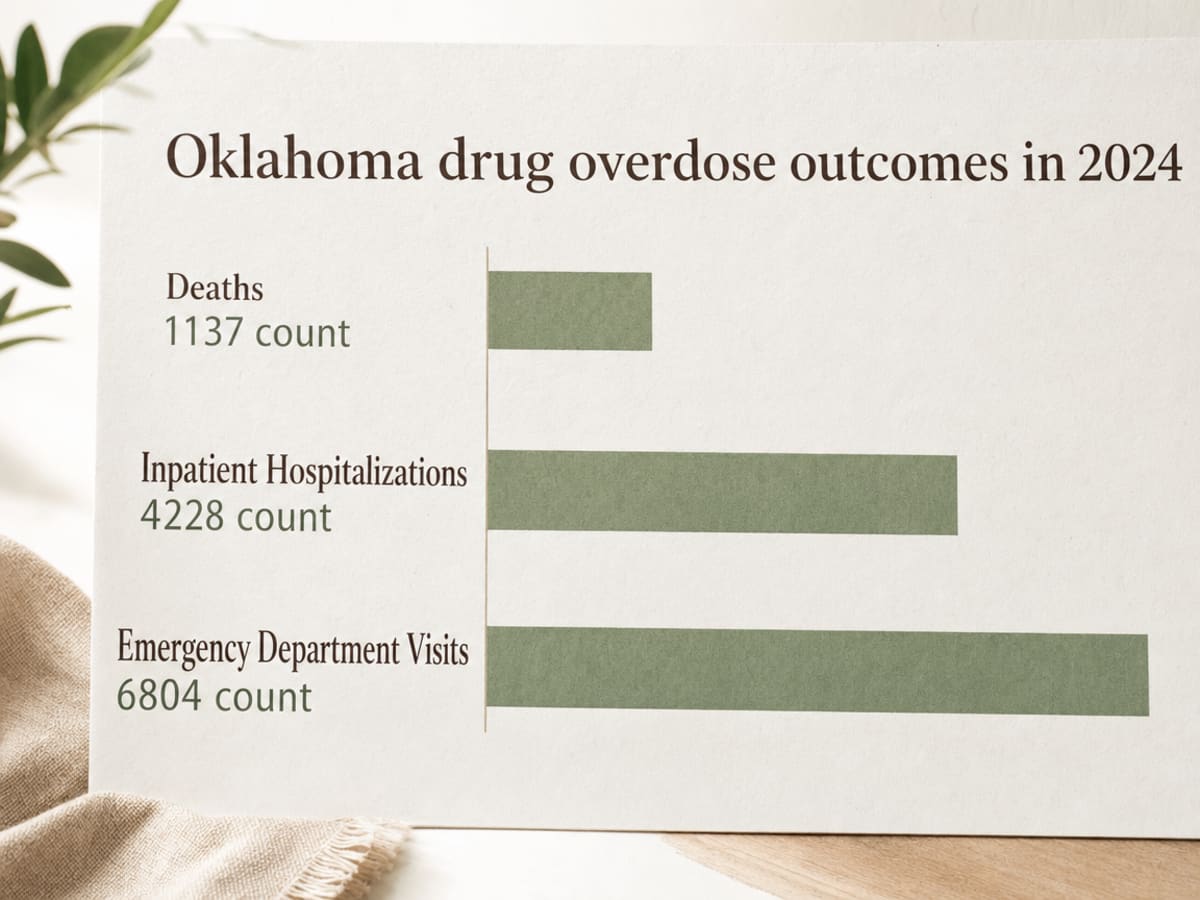
In 2024, Oklahoma recorded 1,137 drug overdose deaths, 4,228 inpatient hospitalizations, and 6,804 emergency department visits tied to drug overdoses 8. Read those numbers together and the pattern shows itself. For every person the state lost, roughly four ended up admitted to a hospital, and six landed in an ED. That’s what waiting looks like in this state. It looks like a crisis someone else has to clean up, in a room full of strangers, on the worst day of your life.
Planned medical detox is the other path. It’s the one where you make the phone call before the ambulance does. Where a nurse asks about your last dose in a normal voice, not a triage voice. Where your UnitedHealthcare benefits get verified before you arrive, so the money question stops circling in your head.
Oklahoma County sits in the middle of this story. From 2018 to 2022, it ranked 27th highest in the state for drug overdose deaths and 16th highest for nonfatal overdose hospitalizations 19. That means Oklahoma City isn’t an outlier at either extreme — it’s a large urban county where the need is steady, the hospital system is busy, and the local demand for medically supervised withdrawal is real every single day.
You are not being dramatic for wanting help now instead of later. You are looking at the same data the state is looking at, and choosing the calmer door. A local admission in Oklahoma City means your family can visit, your clinicians know the region’s drug supply, and your UHC plan is being worked through by people who do this every day. That’s not a small thing when your body is counting hours.
Why Medically Supervised Detox Is the Safer Path for Opioids
You may have already tried to stop on your own. Cut back for a day. White-knuckled it through a weekend. Maybe you found something online about tapering at home with over-the-counter medicine and a strong friend nearby. That’s not weakness. That’s a person trying to solve a medical problem with the only tools they have.
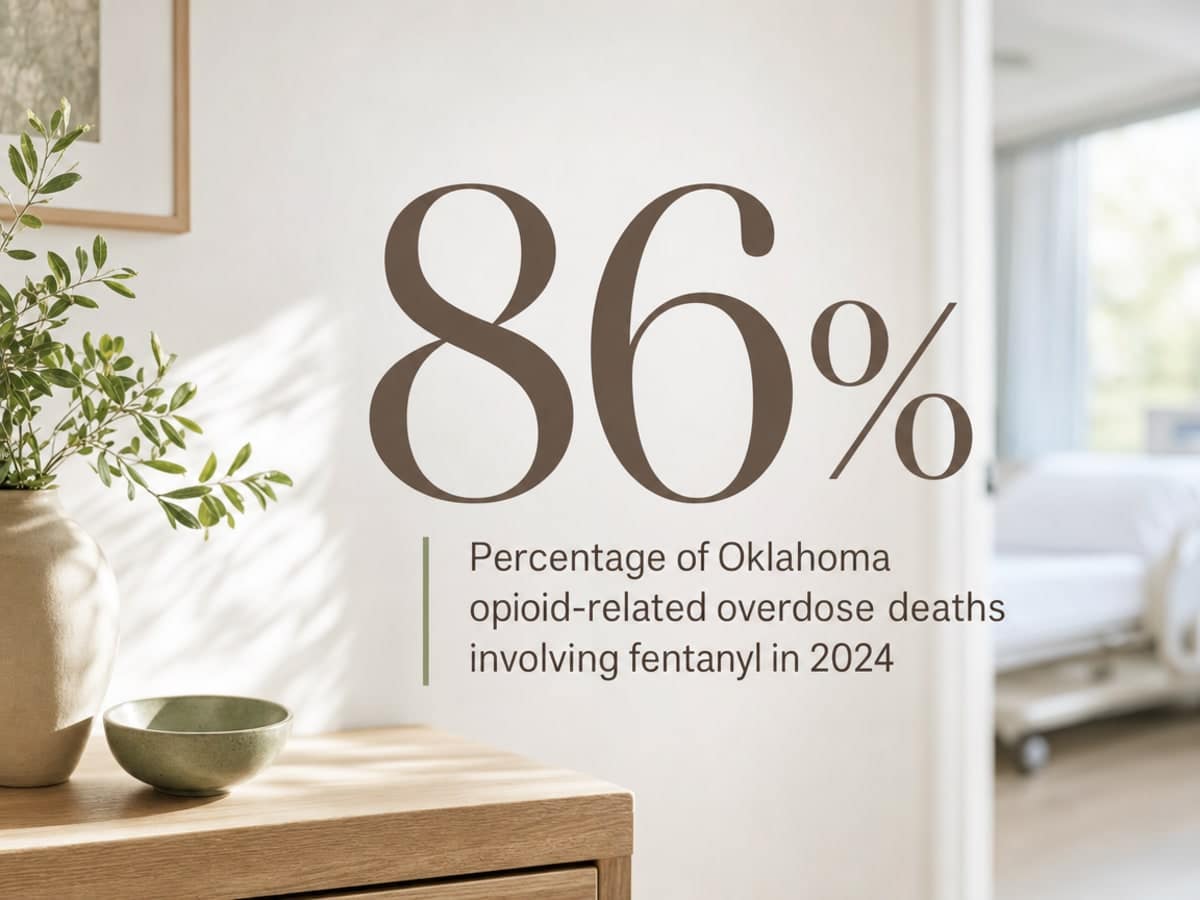
Here’s why those tools aren’t enough right now: the drug supply has changed, and it’s changed in a way that makes going through this alone genuinely dangerous. In 2024, fentanyl was involved in 86% of Oklahoma’s opioid-related overdose deaths 6. Almost nine out of every ten. That’s not a statistic about strangers in some other state. That’s the pill supply, the powder supply, the counterfeit tablets moving through Oklahoma City right now. What you were physically dependent on six months ago may not be the same substance sitting in front of you today, even if it looks identical.
What that means for withdrawal is real. Fentanyl leaves the body on its own timeline, hits harder, and can produce more severe symptoms than the opioids most home-taper advice was ever written for.
- Dehydration from vomiting and diarrhea.
- Blood pressure spikes.
- Cravings so loud that a single “just this one time to take the edge off” turns into an overdose because tolerance drops fast after even a day or two clean.
That last part is what quietly kills people who tried to detox at home and then slipped.
How the UnitedHealthcare Admissions Process Actually Feels
The Call: What You’ll Be Asked and What You Won’t
The first call is shorter than you think. You don’t have to have a speech ready. You don’t have to explain how you got here or apologize for the shake in your voice. The person on the other end has heard it before, and they’re not grading you.
Here’s what you’ll actually be asked: your name, your date of birth, and the member ID on the front of your UnitedHealthcare card. If you can’t find the card, they can usually work with your name and date of birth alone. Then a few clinical questions — what you’ve been using, roughly how much, when the last dose was, and whether you’ve been through withdrawal before. That’s the information the facility needs to check your UHC benefits and start thinking about medical necessity.
Here’s what you will not be asked: to explain yourself, to prove you’re “bad enough” to need help, to commit to admission before you know what your coverage looks like, or to give a credit card. You can hang up at any point. You can call back in an hour. You can put a family member on the line if talking feels like too much right now. The call exists to answer your questions, not to trap you into a decision.
Verification, Authorization, and Arrival
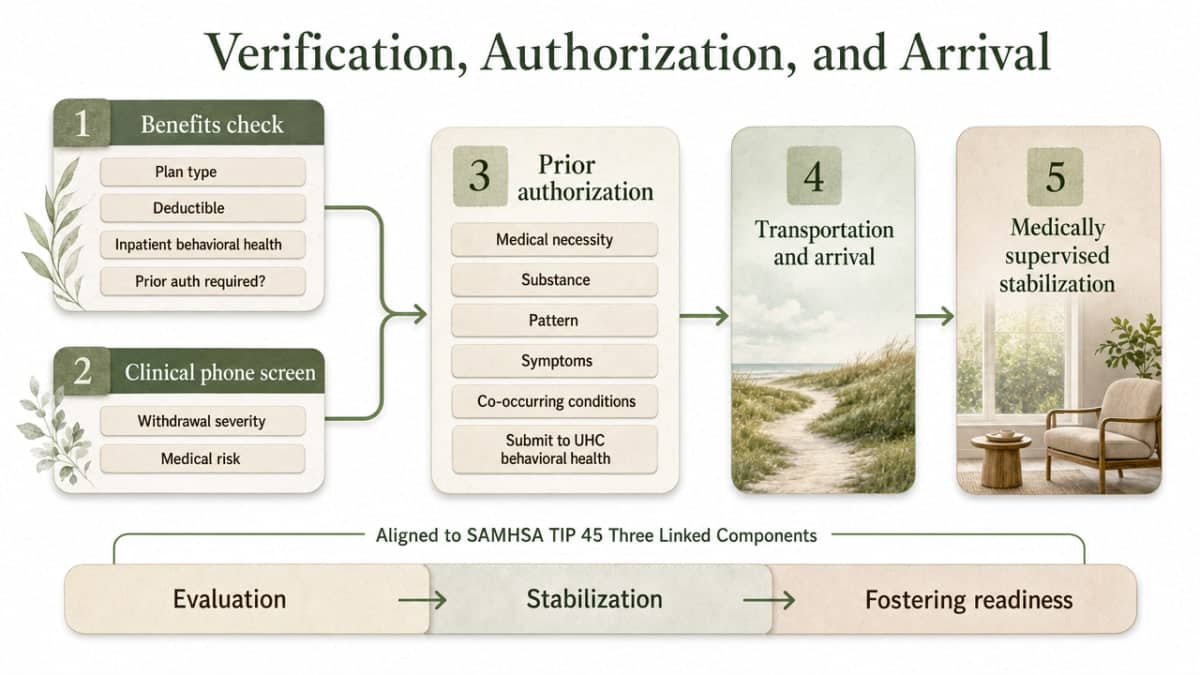
Once the basics are down, two things happen in parallel, and neither of them lands on you. The admissions team runs your UnitedHealthcare benefits — checking your plan type, your deductible status, your inpatient behavioral health coverage, and whether prior authorization is required for medical detox. At the same time, a nurse or licensed clinician does a more complete phone assessment to document withdrawal severity and medical risk.
Those two threads meet at prior authorization. The clinician writes up medical necessity — your substance, your pattern, your symptoms, any co-occurring conditions — and submits the request to UHC’s behavioral health team. You’re not on that call. You don’t have to know the codes. You don’t have to argue anything.
SAMHSA’s TIP 45 clinician guide describes detoxification as three linked components: evaluation, stabilization, and fostering readiness for and entry into ongoing treatment 17. The admissions workflow maps onto that framing in five practical steps you can actually see from the outside:
- A free benefits check.
- The clinical phone screen.
- The prior authorization submission.
- Transportation and arrival.
- Medically supervised stabilization once you’re through the door.
When authorization comes back approved, the team coordinates arrival. For many people in Oklahoma City, that means someone drives them, or the facility arranges transportation directly. You’ll be given a short list of what to bring — an ID, your insurance card, comfortable clothes, prescription medications in their original bottles — and told what to leave behind. If someone is with you, they can stay through intake. If you’re alone, staff will walk you through it. The paperwork you were dreading has mostly already been done by the time you sit down.
Inside Detox: The Three Stages UHC Is Paying For
Once you’re admitted, your UnitedHealthcare plan is paying for real clinical work, not a hotel stay. It helps to know what those days are actually structured around, because the mystery makes everything scarier.
The first stage is evaluation 17. A physician or nurse practitioner does a full medical intake — vital signs, labs, a review of what you’ve been using and any other medications, a check for co-occurring conditions like anxiety, depression, or chronic pain. This is where medication-assisted treatment gets planned specifically for your body, not out of a template. For opioid withdrawal, that often means buprenorphine or comfort medications timed to catch symptoms before they peak.
The second stage is stabilization. This is what most people picture when they think about detox — the round-the-clock nursing care, the fluids, the medications that take the edge off the worst hours, the quiet room when sleep finally comes. Your vital signs are checked frequently. Symptoms are treated as they show up, not on a fixed schedule. This is also the part of the stay UHC is authorizing in day-based increments, extended as your clinical picture requires.
The third stage is where a lot of people get failed by lower-quality programs: fostering readiness for what comes next. Detox alone doesn’t treat opioid use disorder. Before you leave, a case manager works with you on the next level of care — residential treatment, intensive outpatient, medication-assisted maintenance — and coordinates that handoff with your UHC benefits so there’s no gap. You walk out with a plan, not just a discharge paper.
What You’re Likely to Owe (and What Parity Protects You From)
The money question is the one that keeps people from calling. So let’s put it on the table honestly, without pretending anyone can quote you an exact dollar figure over a webpage.
What you’ll likely owe for medical detox depends on the same four things that shape any other hospital-level stay on your UnitedHealthcare plan:
- Your deductible.
- Your coinsurance.
- Your out-of-pocket maximum.
- Whether the facility is in-network.
If you haven’t hit your deductible yet this year, the first days of detox will apply toward it. After the deductible, coinsurance kicks in — often something like 10 to 30 percent of the covered cost, depending on the plan you were given at open enrollment. Once you hit your out-of-pocket maximum, your plan pays the rest of covered care for the year.
Here’s what parity actually protects you from in that math. UHC can’t set a higher deductible for your detox stay than it sets for a comparable medical stay in the same coverage class. It can’t charge a bigger copay for inpatient substance use care than it charges for inpatient medical care. It can’t cap your covered detox days at a lower number than it caps hospital days for other conditions 14. Those aren’t favors. They’re the predominant-requirement rule written into federal regulation.
The Oklahoma Insurance Department consumer guide points out that access problems often show up as separate deductibles for behavioral health, unusual cost-sharing, or network gaps that don’t match the rest of your plan 1. If any of those show up on a benefits check, they’re worth questioning — not accepting.
You do not have to figure this out by reading your plan document at 2 a.m. A benefits check translates the jargon into numbers you can actually see: what your deductible is, what you’ve already met, what an inpatient day is likely to cost you, and whether you’ve hit your out-of-pocket maximum. That call takes about twenty minutes. It doesn’t commit you to anything.
If You’re the Spouse, Parent, or Adult Child Making the Call
You’ve been carrying a lot. The watching. The counting. The nights you stayed up listening for breathing. If you’re the one reading this because they can’t right now, or won’t, that’s its own kind of exhausted, and it deserves acknowledgment before anything else.
Here’s what you can actually do today, even if they haven’t said yes yet. You can call a medical detox facility in Oklahoma City and ask about their UnitedHealthcare admissions process without your loved one on the line. You can share the member ID from their UHC card, describe what you’ve been seeing — the substance, roughly how much, how long, the last use you know about — and get a benefits check started. None of that admits them. None of it locks them in.
What it does do is take one variable off the table. When they’re ready — and readiness for opioid dependence often arrives in a narrow window between withdrawal and using again — you’ll already know what their plan covers, whether prior authorization is likely, and what an inpatient day looks like on their coverage. Parity rules mean their substance use benefits can’t be treated worse than their medical benefits 13. You are not begging for a favor. You are asking a normal question about a covered service.
One more thing worth saying: you don’t have to be the one who convinces them. You just have to be the one who knew where the door was.
Verifying Your Benefits Doesn’t Commit You to Anything
Here’s the smallest possible next step, and it’s smaller than you think: a benefits check. That’s it. A phone call where someone reads your UnitedHealthcare member ID, pulls up your plan, and tells you in plain numbers what your inpatient behavioral health coverage looks like. You don’t pack a bag. You don’t say yes to admission. You don’t hand over a credit card. You get information you don’t currently have.
That call answers the questions circling in your head right now. What’s your deductible, and how much of it have you already met this year? Is prior authorization required for medical detox on your plan? What would a covered inpatient day actually cost you? Parity rules mean your substance use benefits are held to the same standard as your medical benefits 1, so the answers should look a lot like what you’d hear for any other hospital-level stay.
If today isn’t the day, tomorrow can be. If it is the day, you’ll already know what your plan says. Either way, you’ve moved one honest step forward, and that step is yours to keep.
Ready to Verify Your UHC Detox Coverage?
Connect with a team member for fast answers about UnitedHealthcare detox coverage and next steps in Oklahoma City.
Frequently Asked Questions
Does UnitedHealthcare cover medical detox in Oklahoma City?
In most cases, yes. Federal parity rules require UnitedHealthcare to cover substance use treatment on comparable terms to medical and surgical care, which includes inpatient medical detox 13. Oklahoma reinforces that standard through its own parity bulletin under SB 1718 2. The specifics depend on your plan type and network, which is why a free benefits check is the fastest way to see exactly what your card covers.
How long does it take to get approved for detox through UHC?
Often the same day. Withdrawal is a time-sensitive medical condition, and UHC’s behavioral health team typically responds to inpatient detox authorization requests quickly. The facility submits the clinical documentation for you. As a state-level comparator, Oklahoma’s Medicaid program authorizes chemical dependency detox in initial increments of up to five days based on medical necessity 16. Commercial UHC plans generally work in similar day-based increments, extended as your clinical picture requires.
What if my UnitedHealthcare plan requires prior authorization?
Prior authorization is normal for inpatient detox and isn’t a barrier — it’s a form the facility fills out for you. Under federal parity rules, authorization requirements count as nonquantitative treatment limitations, meaning UHC can’t apply them more strictly to substance use care than to medical care 12. A clinician documents your withdrawal symptoms, medical risk, and history, then submits the request. You answer honest questions during intake. The rest is paperwork someone else handles.
Will I have to pay anything out of pocket for detox?
Possibly, depending on where you are with your deductible, coinsurance, and out-of-pocket maximum for the year. Parity rules protect you from having a higher deductible or bigger copay for detox than for a comparable medical stay on the same plan 14. A benefits check translates the jargon into real numbers — what you’ve already met, what an inpatient day is likely to cost you, and when your plan takes over the rest.
Can I verify my benefits without committing to admission?
Yes. A benefits check is exactly that — a check. You share your UnitedHealthcare member ID, the admissions team pulls up your plan, and you get plain answers about coverage. No credit card. No signed paperwork. No promise to walk through the door today. If today isn’t the day, tomorrow can be, and you’ll already have the information. Reading this page is progress. Making that call is progress. Neither commits you to anything.
Can a family member call to check benefits for someone else?
Yes. If you’re the spouse, parent, or adult child carrying this weight, you can call a detox facility in Oklahoma City and start a benefits check without your loved one on the line. Share their UnitedHealthcare member ID and what you’ve been seeing — the substance, roughly how much, how long. That doesn’t admit them or lock them in. It just means when the window opens, you’ll already know what their plan covers 13.
References
- Mental/Behavioral Health and Insurance. https://www.oid.ok.gov/mental-behavioral-health-and-insurance/
- LH BULLETIN NO. 2020-05 – Oklahoma Insurance Department. https://www.oid.ok.gov/lh-bulletin-no-2020-05/
- FAQs about mental health and substance use disorder parity implementation and the 21st Century Cures Act, Part 39. https://www.cms.gov/cciio/resources/fact-sheets-and-faqs/downloads/faqs-part-39.pdf
- The Mental Health Parity and Addiction Equity Act of 2008 (MHPAEA). https://www.cms.gov/newsroom/fact-sheets/mental-health-parity-and-addiction-equity-act-2008-mhpaea
- Fact Sheet: Final Rules under the Mental Health Parity and Addiction Equity Act (MHPAEA). https://www.dol.gov/agencies/ebsa/about-ebsa/our-activities/resource-center/fact-sheets/final-rules-under-the-mental-health-parity-and-addiction-equity-act-mhpaea
- Data – Oklahoma.gov. https://oklahoma.gov/health/health-education/injury-prevention-service/drug-overdose/data.html
- Drug Overdose Data Dashboard – Oklahoma.gov. https://oklahoma.gov/health/health-education/injury-prevention-service/drug-overdose/data/drug-overdose-data-dashboard.html
- PowerPoint Presentation. https://www.oklahoma.gov/content/dam/ok/en/health/health2/aem-documents/prevention-and-preparedness/injury-prevention/drug-overdose/Drug%20Overdose%20Data%20Graphs%20and%20Maps.pdf
- [PDF] Behavioral Health Prior Authorization Procedures – Oklahoma.gov. https://www.oklahoma.gov/content/dam/ok/en/okhca/docs/providers/types/behavioral-health/OHCA%20BH%20Manual.pdf
- PRIOR AUTHORIZATION MANUAL. https://www.oklahoma.gov/content/dam/ok/en/okhca/docs/providers/prior-authorizations/manuals/FY2025%20Outpatient%20Prior%20Authorization%20Manual.pdf
- Mental Health Parity and Addiction Equity Act. https://www.oid.ok.gov/regulated-entities/financial/financial-regulation-forms/mentalhealthparity/
- Requirements Related to the Mental Health Parity and Addiction Equity Act. https://www.cms.gov/files/document/mhpaea-final-rule-omnibus-clean-9424-final-posting508.pdf
- Mental Health Parity and Addiction Equity Act (MHPAEA). https://www.cms.gov/marketplace/about/oversight/other-insurance-protections/mental-health-parity-and-addiction-equity-act-mhpaea
- 29 CFR § 2590.712 – Parity in mental health and substance use disorder benefits. https://www.law.cornell.edu/cfr/text/29/2590.712
- Mental Health and Substance Abuse Services – Oklahoma.gov. https://oklahoma.gov/ohca/individuals/programs/mental-health-and-substance-abuse-services.html
- Behavioral Health Prior Authorization Procedures – Oklahoma.gov. https://oklahoma.gov/content/dam/ok/en/okhca/docs/providers/types/behavioral-health/OHCA%20BH%20Manual.pdf
- Quick Guide For Clinicians Based on TIP 45 Detoxification and Substance Abuse Treatment. https://nida.nih.gov/sites/default/files/samhsa_detoxification_and_substance_abuse_treatment.pdf
- NUMBER OF UNINTENTIONAL OVERDOSE DEATHS BY TYPE OF SUBSTANCE OKLAHOMA COUNTY, 2013-2017. https://oklahoma.gov/content/dam/ok/en/health/health2/documents/opioid-county-fact-sheet-oklahoma-county.pdf
- [PDF] OKLAHOMA COUNTY. https://oklahoma.gov/content/dam/ok/en/health/health2/aem-documents/prevention-and-preparedness/injury-prevention/drug-overdose/county-fact-sheets/Drug%20Overdose%20County%20Fact%20Sheet%20-%20Oklahoma.pdf