Key Takeaways
- Physical dependence on diazepam can develop even at prescribed doses because the nervous system adapts to the drug, while a use disorder is defined by behavioral loss of control layered on top 1, 3.
- Stopping Valium abruptly after sustained use can trigger seizures across short, medium, and long half-life benzodiazepines, making unsupervised discontinuation the single most dangerous choice 1, 15.
- Diazepam’s long half-life delays and softens withdrawal onset compared to Xanax or Ativan, but it does not eliminate seizure risk or the need for a supervised taper 12, 15.
- Safe reduction combines stabilization, gradual dose cuts of roughly 5 to 10 percent every one to two weeks, and shared decision-making about pace between patient and clinician 2, 5.
The question you’re actually asking yourself
You probably didn’t type “valium addiction” into a search bar because you wanted a definition. You typed it because something has shifted. Maybe the dose your doctor prescribed a year ago doesn’t quiet your nerves the way it used to. Maybe you took an extra pill last Tuesday and told yourself it was a one-time thing, and then Thursday happened. Maybe you tried to skip a day and your hands started to shake before lunch.
You’re trying to figure out whether you’re still a patient managing a real condition, or whether you’ve quietly crossed a line nobody drew for you.
Here’s the honest answer, and it matters more than any single warning sign: the line isn’t about willpower, and it isn’t about whether you have a prescription. It’s about physiology and behavior. Your body can become dependent on diazepam even when you take it exactly as directed, and stopping abruptly after that point can trigger seizures 1. That single medical fact should shape everything you do next.
The rest of this article walks you through what dependence actually is, when it tips into a use disorder, and what safe help looks like when you’re ready.
Dependence and addiction are not the same thing
What physical dependence on diazepam actually is
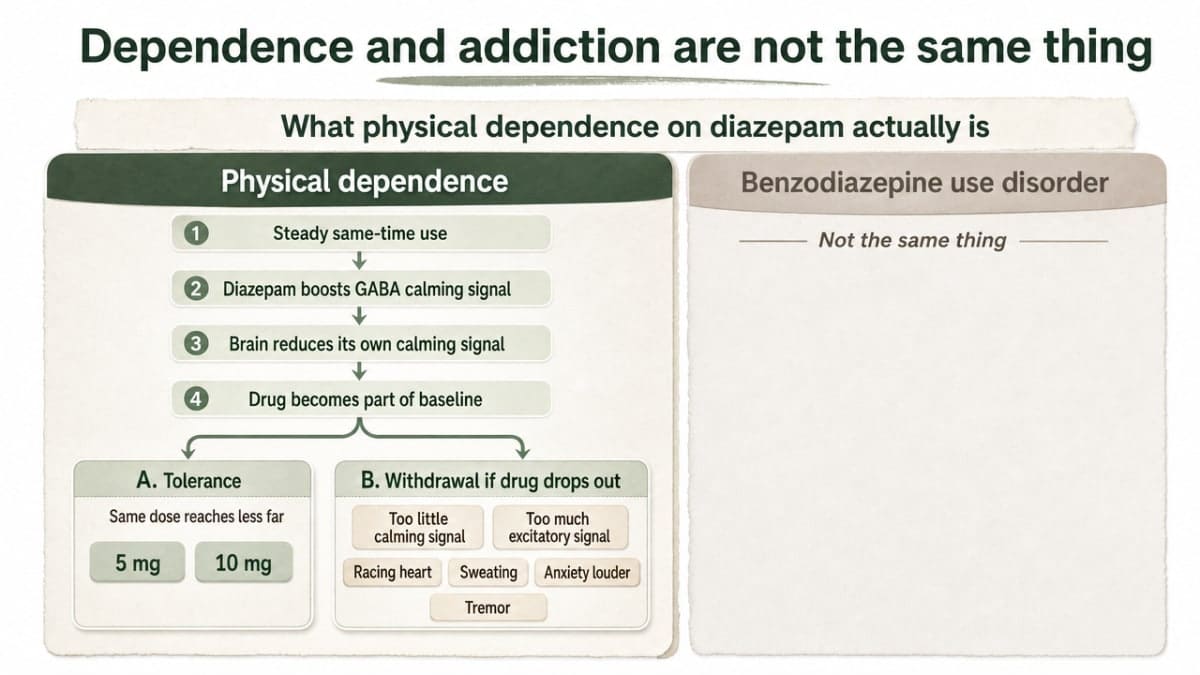
Physical dependence is what happens when your brain adapts to a drug that has been present, day after day, at roughly the same time and dose. Diazepam boosts the calming signal of a neurotransmitter called GABA. Your nervous system, being efficient, dials down its own natural version of that signal to keep everything in balance. After enough weeks of steady use, the drug isn’t just an add-on anymore. It’s part of the baseline.
That’s why two things happen. First, tolerance: the same 5 mg or 10 mg doesn’t reach as far as it used to. Second, if the drug drops out, your nervous system suddenly has too little calming signal and too much excitatory signal. That mismatch is what withdrawal feels like — the racing heart, the sweating, the return of anxiety at a volume you don’t recognize, the tremor in your hands before your next dose.
None of this means you did something wrong. The FDA specifically warns that benzodiazepines can cause physical dependence and dangerous withdrawal even when taken as prescribed, which is why the class carries a boxed warning 1. Dependence is a predictable biological adaptation, not a character flaw.
What crosses the line into a use disorder
Addiction is a different animal. Clinicians call it benzodiazepine use disorder, and it’s defined by behavior and control, not by chemistry alone 3. You can be physically dependent on diazepam and not have a use disorder. You can also have a use disorder without dramatic street-drug behavior. The two overlap, but they aren’t the same.
Think of it as two columns that sometimes touch. On the physiological side, you have tolerance and withdrawal — your body’s adaptation. On the behavioral side, you have things like taking more than intended, unsuccessful attempts to cut down, cravings, spending significant time obtaining or recovering from the drug, and continuing to use even when it’s clearly costing you something — sleep, work, a relationship, your own sense of self 3. Where those columns overlap is where a clinician would start using the phrase “use disorder.”
Here’s the part that trips people up. If you’re taking Valium exactly as prescribed and your only symptoms are tolerance and missed-dose withdrawal, that’s dependence, and it’s manageable 4. If you’ve started taking extra to get through a hard afternoon, hiding pills, calling the pharmacy early, or feeling a pull toward the bottle that has nothing to do with the original prescription — that’s the behavioral column lighting up. Both situations need medical support before you stop. Only one of them means addiction.
The distinction matters because the response is different. Dependence needs a careful taper. A use disorder needs a taper plus treatment for the behavioral piece — therapy, structured support, sometimes a residential setting to interrupt the pattern. Naming what you’re dealing with isn’t about labeling yourself. It’s about pointing your next step in the right direction.
A self-check you can actually use
Read these slowly. You don’t need to answer out loud, and nobody is scoring you. Just notice which ones make you pause.
- Have you taken more Valium than your prescription allows, even once or twice in the last few months?
- Have you tried to cut back and found you couldn’t stick to the plan?
- Do you spend time thinking about your next dose — when you can take it, whether you’ll have enough, what happens if you run out?
- Have you kept using even though it’s hurting your sleep, your focus, your mood, or a relationship that matters?
- Do you feel a craving — not just a symptom, but a want — for the pill itself?
- Have you needed steadily more to get the same relief you used to get from a lower dose?
- Do you feel physically unwell — anxious, shaky, sweaty, unable to sleep — when a dose is late?
If the last two are your only yeses, you’re probably looking at dependence. If several of the first five also ring true, the behavioral column is active, and what you’re describing sounds closer to a use disorder 3. Either way, this isn’t a verdict. It’s information. And it’s information that changes what you should do next — specifically, that you shouldn’t try to stop on your own 4.
You are not alone, and misuse exists on a spectrum
Take a breath. If you’ve been quietly wondering whether you’re the only person whose relationship with a small orange pill has gotten complicated, the numbers say otherwise — by a wide margin.
A national U.S. epidemiologic study estimated that roughly 30.6 million adults used benzodiazepines in a given year, and about 5.3 million (2.2%) reported misuse — meaning use without a prescription, in higher doses than prescribed, more often than prescribed, or for longer than prescribed 6. Millions of people are somewhere on this map. You are not standing on it alone.
What that data also shows, quietly, is that “misuse” isn’t a single thing. It’s a range. On one end, someone takes an extra half-pill on a rough Sunday night and never does it again. Further along, someone stretches a 30-day prescription to 20 days, then calls the pharmacy early. Further still, someone is buying pills from a friend or a stranger because their doctor said no. These are different points on the same road, and one of them being labeled “misuse” doesn’t collapse them into the same story.
Why does the spectrum matter for you? Because shame tends to flatten it. Shame tells you that noticing yourself in any of these descriptions means you’re already at the far end. That isn’t true, and it isn’t useful. Where you actually are on the spectrum determines what kind of help fits — a conversation with your prescriber, a formal taper, or a medically supervised detox with therapy alongside it 3.
The other thing worth saying plainly: recognizing yourself somewhere on this map is a good sign. It means the part of you that pays attention is still online. That part is going to be useful in the next chapter.
Why diazepam behaves differently from Xanax or Ativan
If a friend told you their Xanax withdrawal felt like a wall coming down in twelve hours, and yours has been more like a slow fog rolling in over a week, you’re not imagining things. Diazepam moves through your body on a different clock than the other benzodiazepines you’ve probably heard of, and that clock changes almost everything about what dependence looks like — and what a safer exit looks like.
The word to know is half-life: how long your body takes to clear half of a single dose. Diazepam’s half-life is long, and it produces active byproducts that hang around even longer — often for days. Alprazolam (Xanax) and lorazepam (Ativan) clear out in a small fraction of that time. That difference is why doctors managing benzodiazepine dependence often stabilize people on diazepam before tapering, even if the original prescription was for a shorter-acting drug — the smoother, slower decline in blood levels means fewer sharp withdrawal spikes between doses 12.
For you, the person taking Valium, the long half-life cuts two ways. Between-dose withdrawal tends to be less dramatic, which is part of why diazepam dependence can build quietly, without the daily alarm bells a shorter-acting benzo might set off. But when withdrawal does arrive — after a missed refill, an attempted stop, or a rapid dose cut — it can start later, last longer, and still include seizures. Seizure risk isn’t limited to short-half-life drugs; reviews have documented withdrawal seizures across short-, medium-, and long-half-life benzodiazepines when they’re stopped abruptly 15. Long half-life is not a safety net. It’s just a different timeline.
The seizure risk that changes every next step
What abrupt discontinuation can do to your nervous system
If there is one paragraph in this article that should stop you from doing anything hasty, it is this one. When your nervous system has spent months adjusting itself around diazepam — quieting its own signals because the drug is doing part of the work — pulling that drug away suddenly is not a small event. It’s a rebound. The excitatory side of your brain, which has been held down, comes back loud, and it comes back all at once.
The most dangerous version of that rebound is a seizure. A case-series analysis of withdrawal seizures documented them across different benzodiazepines and across a range of use durations, including in people who had been taking their medication as directed 14. A later review reached the same conclusion from a wider clinical vantage point: withdrawal seizures can occur with short-, medium-, and long-half-life benzodiazepines when the drug is stopped abruptly 15. Diazepam’s long half-life delays that risk window; it does not remove it.
Therapeutic-dose dependence is real
You may be reading all of this while quietly holding onto a thought that sounds reasonable: this doesn’t apply to me, because I never took more than my doctor said. That’s worth taking seriously, because the medical literature took it seriously a long time ago and reached an uncomfortable conclusion.
A landmark review established that prolonged administration of benzodiazepines within the therapeutic range can lead to true dependence in a meaningful share of patients 16. A diazepam-specific review went further and described the withdrawal syndrome that can follow steady Valium use, along with the strategies proposed to manage it 17. Neither paper was written about people misusing pills from a stranger. Both were written about patients following their prescriptions.
What that means for you is simple, and it isn’t a judgment. A prescription is a plan, not a shield. If your body has adapted, it has adapted — the label on the bottle doesn’t change your neurochemistry. The right response is the same either way: don’t stop on your own, and talk to someone qualified to help you taper.
How the risk landscape shifted after 2019
There’s a version of the Valium story that ends at the pharmacy counter — you take what your doctor prescribes, you use it as directed, and the drug behaves the way it did when it was first approved. That version was never complete, and after 2019 it stopped being adequate.
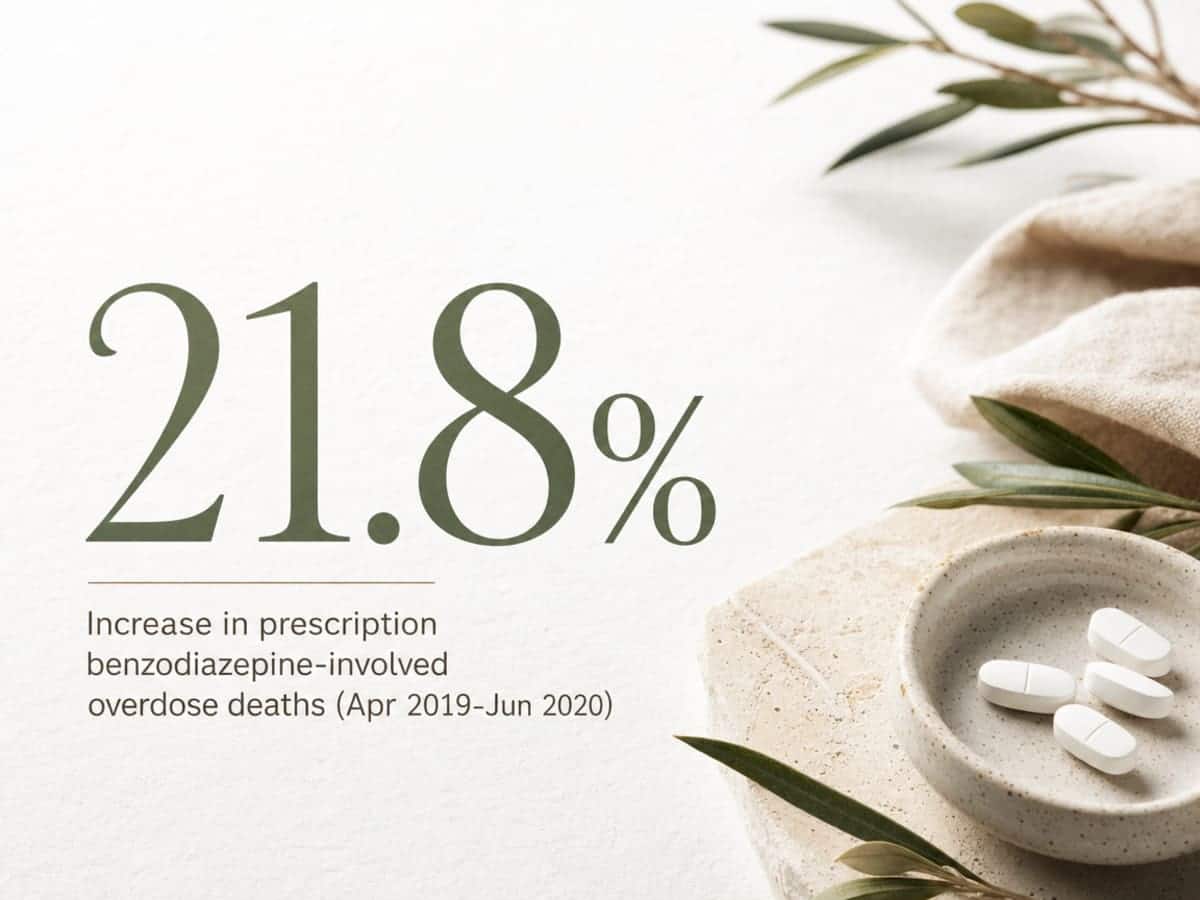
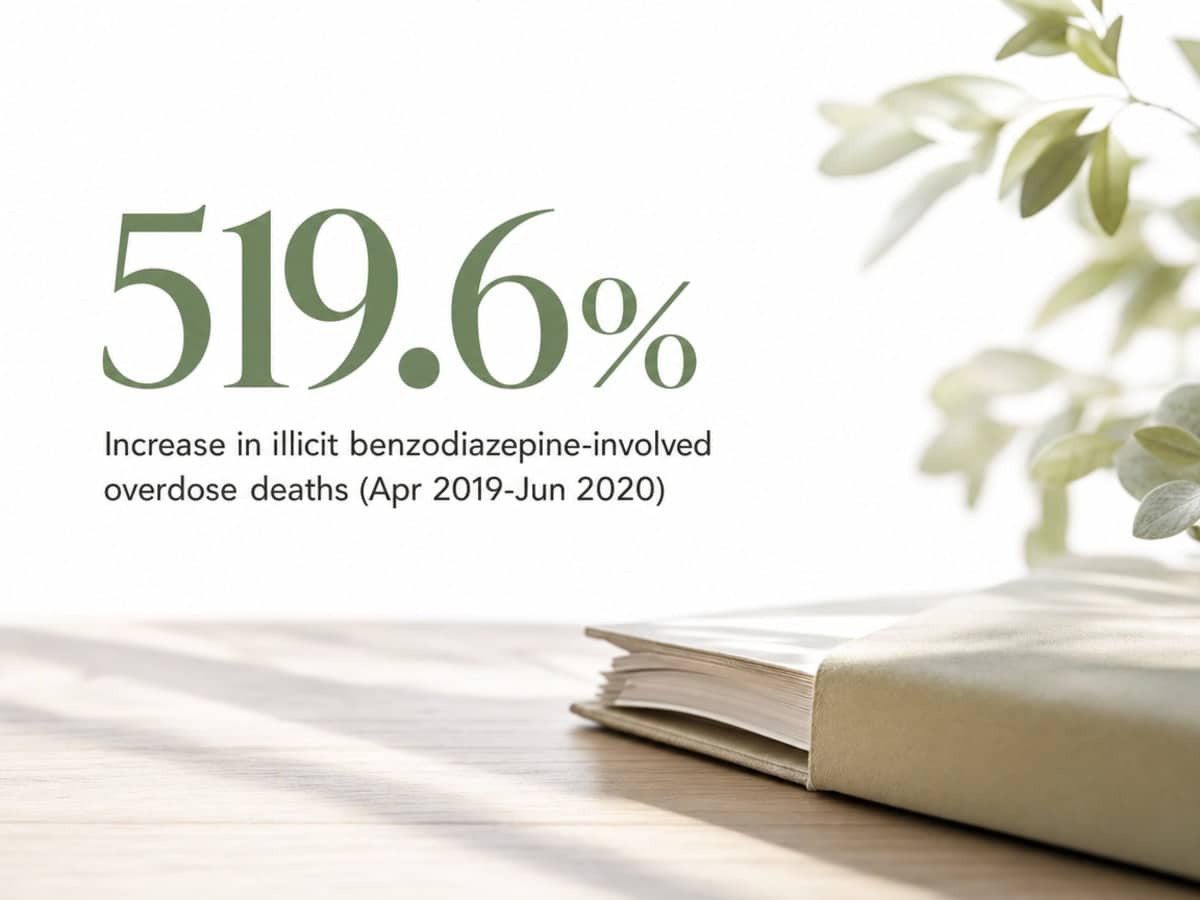
CDC surveillance across 23 states compared April–June 2019 with April–June 2020 and found that overdose deaths involving prescription benzodiazepines rose 21.8%. Deaths involving illicit benzodiazepines rose 519.6% over the same window 7. That second number isn’t a typo. Counterfeit pills started showing up in the drug supply — pressed to look like legitimate diazepam, alprazolam, or clonazepam, but containing unknown doses of other benzodiazepines, opioids like fentanyl, or both. If you or someone you love has ever bought a pill outside a pharmacy because a prescription ran out early, this is the risk you were carrying and probably didn’t know it.
The other number worth sitting with: 91.4% of benzodiazepine-involved overdose deaths in that period also involved opioids 7. Fatal overdose from a benzodiazepine alone is uncommon. Fatal overdose from a benzodiazepine plus an opioid — even a prescribed one, even a low dose — is a different story. Both drugs slow breathing. Stacked together, they can slow it enough to stop it.
What this shifts, practically, is the calculus around running out. Skipping the doctor’s visit, borrowing a pill, filling a gap from a source you don’t fully trust — those choices carry a weight now they didn’t carry a decade ago. That’s not a reason for panic. It’s a reason to make the plan for how you get off Valium, or how you stay safely on it, an actual plan.
What safe help actually looks like
Medical detox, stabilization, and gradual reduction
If the earlier parts of this article have you nodding along more than you’d like, the good news is that the medical playbook for what you’re describing is not a mystery. It has a shape, and that shape is boring on purpose.
The first move in most cases is stabilization. If you’ve been taking a shorter-acting benzodiazepine — or a mix — a clinician may switch you onto an equivalent dose of diazepam itself, precisely because its long half-life produces smoother blood levels and fewer withdrawal spikes between doses 12. If you’re already on Valium, stabilization means finding the dose your body has actually adapted to, not the dose on the label from six months ago, and holding steady there until your nervous system settles.
Then comes the taper. Slow, incremental reductions — often something like 5 to 10 percent of the current dose every one to two weeks, adjusted to how you’re actually doing — let your GABA system rebuild its own signaling instead of getting yanked offline all at once 5. Vitals, sleep, mood, and any breakthrough withdrawal symptoms get watched closely, especially in the first days when seizure risk is highest 12. If you also use opioids, alcohol, or other sedatives, the plan gets built around that reality, not around a fantasy version of your life.
None of this requires you to be at rock bottom, and none of it requires you to have failed at something first. It just requires supervision — someone whose job is to catch what you can’t catch on your own.
Shared decision-making, not surrender
Here’s the part that surprises people who’ve been dreading this conversation: modern benzodiazepine care isn’t something done to you. The 2025 multi-society tapering guideline is explicit about it — decisions about whether, when, and how to reduce a benzodiazepine should come out of ongoing risk-benefit conversations with you, not a rigid schedule imposed from above 2. Your input on pace, timing, and what you’re willing to tolerate is part of the clinical plan, not a nice-to-have.
That matters because a lot of the shame around Valium comes from feeling like asking for help means handing over your autonomy. It doesn’t. A good clinician will tell you what’s medically off the table — abrupt stopping, for one — and then work with you on the rest. If a taper step is too rough, you can pause. If life gets loud in a hard week, the schedule can flex. The goal is a nervous system that can eventually run on its own signal again, not a gold star for finishing fast 2.
Asking for this kind of help isn’t giving up. It’s the first move that actually matches the size of what your body has been carrying.
A next step that fits your actual life
You don’t have to know yet whether you’re dealing with dependence, a use disorder, or something in between. You just have to make the next call to someone who can help you figure it out safely — and who will not ask you to stop on your own before they see you.
A useful first move is a phone call to your prescriber or a medical detox program to describe, out loud, what you’ve actually been doing with the pills. Not the version on the label. The real version. From there, a clinician can tell you whether an outpatient taper fits, or whether the safer route is a stay where your vitals, sleep, and withdrawal symptoms are watched around the clock while the dose comes down 2. If you’re in Oklahoma City, Renewal Springs Detox is one place that conversation can start. Whatever you decide, let the first step be a call, not a cold turkey.
Talk Now About Safe Valium Withdrawal Support
Connect immediately with a specialist for guidance on managing Valium dependence safely and confidently.
Frequently Asked Questions
How long does it take to become dependent on Valium?
There’s no universal timeline, but the medical literature has flagged risk after just a few weeks of steady daily use. A landmark review found that prolonged administration within the therapeutic range can produce true dependence in a meaningful share of patients 16. Some people adapt faster, some slower. If you’ve been taking diazepam daily for more than a month, assume your body has started to change.
Can I be addicted to Valium if I only take it as prescribed?
You can be physically dependent while taking it exactly as prescribed — the FDA’s boxed warning names that risk directly 1. Addiction, or a use disorder, is defined by behaviors like loss of control, cravings, and use despite harm 3. A prescription doesn’t rule either one out, but it also doesn’t automatically mean you have a use disorder. The response to both starts the same way: don’t stop alone.
Is it dangerous to stop taking Valium cold turkey?
Yes. Abrupt discontinuation after weeks or months of steady use can trigger seizures, and case reports have documented them across different benzodiazepines and durations, including at therapeutic doses 14, 15. Other reactions — severe rebound anxiety, insomnia, tremor, dangerous heart rate spikes — are also common. This is the single most decision-changing fact about diazepam. Call a clinician before you reduce your dose, not after something goes wrong.
What are the signs that Valium use has become a use disorder?
Watch the behavioral column, not just the physical one. Taking more than intended, unsuccessful attempts to cut back, cravings, spending significant time thinking about the next dose, and continuing to use even when it’s harming your sleep, work, or relationships are the hallmarks clinicians look for 3. Tolerance and missed-dose withdrawal alone point to dependence. When those behaviors stack on top, you’re closer to a use disorder 4.
How is Valium withdrawal different from Xanax or Ativan withdrawal?
Diazepam has a long half-life with active byproducts that linger for days, so withdrawal often starts later and unfolds more gradually than with alprazolam or lorazepam. That’s why clinicians frequently stabilize patients on diazepam before tapering off a shorter-acting benzodiazepine 12. The long half-life smooths the timeline but doesn’t remove seizure risk — reviews confirm seizures can occur across short-, medium-, and long-half-life benzodiazepines when stopped abruptly 15.
What does medical detox for Valium actually involve?
It usually starts with stabilization on diazepam at a dose your body has actually adapted to, followed by a slow, incremental taper — often 5 to 10 percent reductions every one to two weeks, adjusted to your response 5, 12. Vitals, sleep, and withdrawal symptoms are monitored closely, especially early on when seizure risk is highest. The 2025 multi-society guideline emphasizes shared decision-making, so the pace flexes with you 2.
References
- FDA requiring Boxed Warning updated to improve safe use of benzodiazepine drug class. https://www.fda.gov/drugs/fda-drug-safety-podcasts/fda-requiring-boxed-warning-updated-improve-safe-use-benzodiazepine-drug-class
- Joint Clinical Practice Guideline on Benzodiazepine Tapering. https://pubmed.ncbi.nlm.nih.gov/40526204/
- Benzodiazepine Use Disorder: Common Questions and Answers. https://pubmed.ncbi.nlm.nih.gov/37725458/
- Treatment of Benzodiazepine Dependence. https://pubmed.ncbi.nlm.nih.gov/28328330/
- Management of benzodiazepine misuse and dependence. https://pmc.ncbi.nlm.nih.gov/articles/PMC4657308/
- Benzodiazepine Use and Misuse Among Adults in the United States. https://pmc.ncbi.nlm.nih.gov/articles/PMC6358464/
- Trends in Nonfatal and Fatal Overdoses Involving Benzodiazepines — 23 States, January 2019–June 2020. https://www.cdc.gov/mmwr/volumes/70/wr/mm7034a2.htm
- MMWR, Volume 70, Issue 34 — August 27, 2021. https://stacks.cdc.gov/view/cdc/109262/cdc_109262_DS1.pdf
- Drug Overdose Deaths in the United States, 2023–2024 – CDC. https://www.cdc.gov/nchs/products/databriefs/db549.htm
- DOSE-Dashboard: Nonfatal Overdose Emergency Department and Inpatient Hospitalization Discharge Data. https://www.cdc.gov/overdose-prevention/data-research/facts-stats/dose-dashboard-nonfatal-discharge-data.html
- U.S. Overdose Deaths Decrease Almost 27% in 2024. https://www.cdc.gov/nchs/pressroom/releases/20250514.html
- Withdrawal Management – NCBI – NIH. https://www.ncbi.nlm.nih.gov/books/NBK310652/
- Benzodiazepines: Uses, Dangers, and Clinical Considerations. https://pmc.ncbi.nlm.nih.gov/articles/PMC8629021/
- Benzodiazepine withdrawal seizures: analysis of 48 case reports. https://pubmed.ncbi.nlm.nih.gov/3427560/
- Benzodiazepine withdrawal seizures and management. https://pubmed.ncbi.nlm.nih.gov/21815323/
- Benzodiazepine dependence. A review of the evidence. https://pubmed.ncbi.nlm.nih.gov/6133736/
- Diazepam (Valium): its dependency liability. https://pubmed.ncbi.nlm.nih.gov/2292778/