Key Takeaways
- Oklahoma is home to 300,390 veterans, and community detox centers like Renewal Springs operate alongside the VA rather than as a replacement, filling gaps in timely access to withdrawal care 11, 13.
- Veteran-owned signals cultural fit — shared service background at the leadership level — but it is not the same as a dedicated clinical track, and both should be weighed separately when choosing a facility 18.
- Any Oklahoma detox center should meet ODMHSAS standards: 24/7 physician coverage, licensed nurses monitoring around the clock, national accreditation, and continuation of buprenorphine or methadone during withdrawal 16, 2, 1, 6.
- Call and ask five plain questions about physician coverage, nursing, accreditation, MOUD continuation, and symptom-triggered alcohol withdrawal dosing, then listen for how the handoff to your VA team gets scheduled before discharge 6, 9.
What ‘veteran-owned’ actually changes when you walk in the door
You already know the difference between someone who has been through it and someone who has read about it. That instinct is worth trusting when you’re picking a detox center.
Veteran-owned doesn’t mean the intake nurse is going to check your DD-214 at the door. It doesn’t mean there’s a separate wing with a flag on the wall and a chaplain in ACUs. What it usually means, in a practical sense, is that the people who built the place — the ones setting the tone for how staff talk to you at 3 a.m. when your skin is crawling — have some version of your background in their own history. That shapes small things you’ll actually feel: how directly people speak to you, whether they respect that you’d rather hear the plan than be soothed, how they handle the moment you get short with them.
There’s a real reason culture matters here and not just on the marketing page. Veterans presenting for care carry higher rates of co-occurring PTSD, depression, and chronic pain alongside substance use, and engagement improves when providers understand the service context those conditions grew out of 14, 17. VA’s own Whole Health guidance frames the same idea in plainer language: care for veterans with substance use disorders should be “respectful, nonjudgmental” and treat the whole person, not just the withdrawal in front of them 15.
The Oklahoma veteran community Renewal Springs sits inside
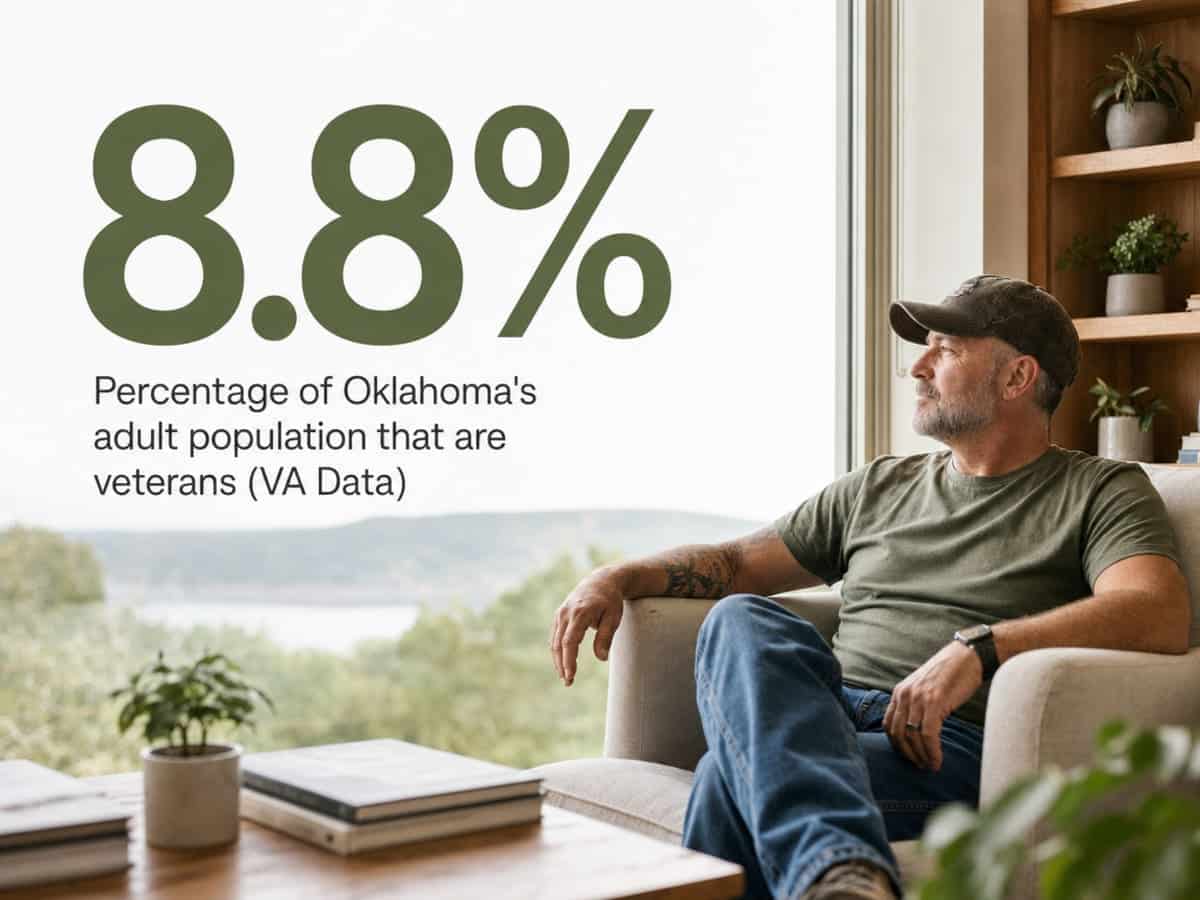
Oklahoma is a state where you cannot go far without running into someone who served. The VA counts 300,390 veterans living here, roughly 8.8% of the adult population 11. That’s not an abstract number — it’s the guy who fixed your transmission, your cousin’s wife, the woman ahead of you at the pharmacy. When a detox facility opens in Oklahoma City and says it’s veteran-owned, it’s opening inside a community large enough that shared background isn’t a marketing gimmick. It’s just accurate to who lives here.
The other half of the picture is how much of that community already leans on the VA. In fiscal year 2024, the VA delivered more than 2,234,000 health care appointments to Oklahoma veterans and enrolled 6,048 new ones 12. That’s a lot of touchpoints — primary care visits, mental health check-ins, pain management follow-ups, prescription refills. If you’re a veteran reading this, some version of that system is probably already in your life, or in the life of the person you’re trying to help.
So why would a community detox center exist alongside that? A few reasons that show up in the research on veteran SUD care. VA capacity for substance use services has been uneven, with documented gaps in timely access 13. Detox is also a specific, short, intense episode of care that community facilities can sometimes start faster than a scheduled VA admission. And veterans with substance use disorders often carry co-occurring PTSD, depression, or chronic pain 17, which means the door they walk through first matters — the tone at intake, whether the staff flinch at your history, whether anyone asks about your service without making it weird.
Renewal Springs sits inside that landscape. Not as an alternative to the VA — as a neighbor to it. A local option run by people who came from the same community it serves.
Culture versus clinical track: an honest distinction
Here’s where a lot of veteran-focused marketing gets sloppy, and where you deserve a straight answer before you make a decision.
Veteran-owned is a cultural credential. It means the people who built and run the facility came from the same world you did. They understand why you might minimize your pain score, why you’d rather be told what’s happening than reassured, why a certain kind of small talk lands and another kind doesn’t. That has real value. Research on improving SUD care for veterans consistently points to the same thing: engagement improves when the people delivering care understand military experience and build trust from that starting point 18. VA’s own Whole Health guidance frames effective veteran SUD care as “respectful, nonjudgmental” and centered on the whole person 15. Culture isn’t fluff. It’s often the reason someone walks in instead of turning the truck around at the parking lot.
A dedicated veterans’ clinical track is a different animal. That would mean a defined, structured program with veteran-specific group therapy, protocols tailored to combat trauma, integrated PTSD care, dedicated staff trained in military sexual trauma response — the kind of thing you’d see spelled out on a program page, staffed by clinicians whose job description names veterans as their population. Some facilities have that. Renewal Springs is veteran-owned and operated, which is the honest description. If a dedicated clinical track matters to you, ask directly on the phone and see what the answer is. Don’t accept a shrug and don’t accept overreach.
Here’s why the distinction protects you. If a facility conflates the two, you don’t know what you’re getting. You might expect specialized trauma programming and receive general detox in a place that happens to feel familiar. Or you might dismiss a genuinely well-run veteran-owned center because you thought “veteran” implied something it didn’t. Both mistakes cost you time you may not have.
The practical move: hold culture and clinical rigor as two separate questions and answer each one on its own. Does the team’s background make you feel like you can be honest at intake? That’s the culture check. Does the facility meet Oklahoma’s medical detox standards, staff it 24/7, continue your medications, and coordinate with the VA when it’s time to hand you off? That’s the clinical check. Both have to pass. The next few sections give you what you need to run the second check with your eyes open.
The medical bar any Oklahoma detox center has to clear
Culture gets you in the door. Medicine keeps you alive once you’re inside. Oklahoma has written down what the second part looks like, and you should know what it says before you sign anything.
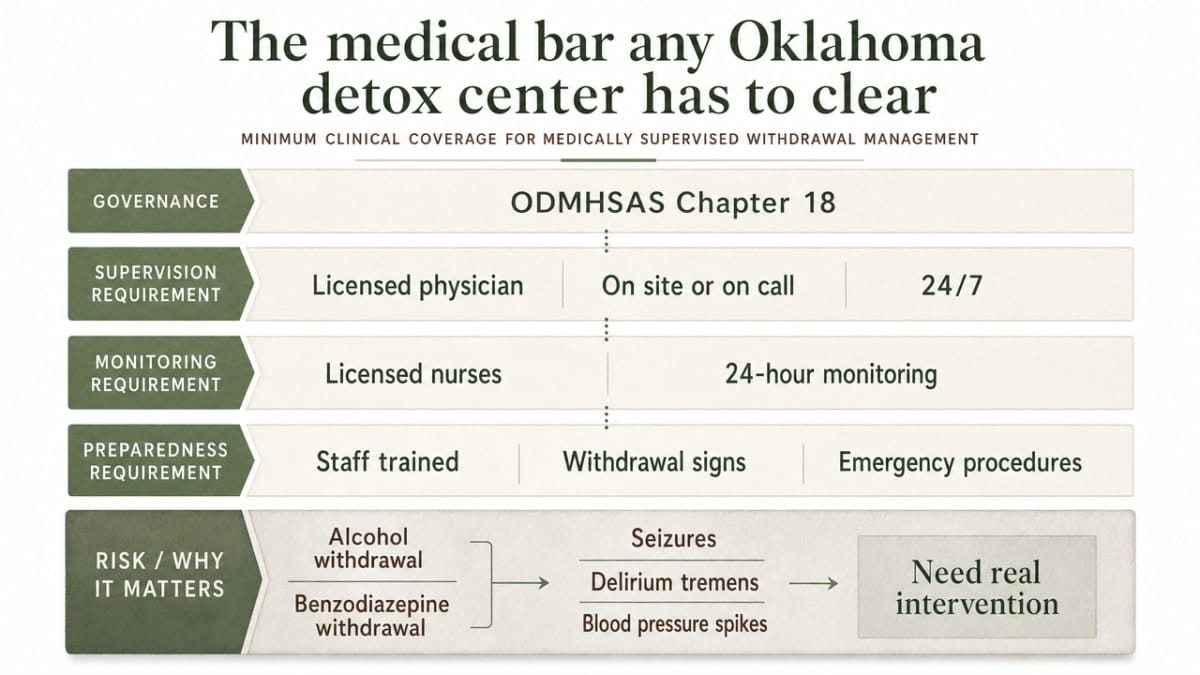
The state’s rules for medically supervised withdrawal management aren’t a mystery or a trade secret. Under ODMHSAS Chapter 18, a licensed physician providing supervision of withdrawal management must be on site or on call twenty-four hours per day, seven days per week 16. Licensed nurses have to provide 24-hour monitoring, and staff have to be trained in the signs of withdrawal and emergency procedures 2. Those aren’t nice-to-haves. Alcohol and benzodiazepine withdrawal can turn dangerous in the space of an afternoon — seizures, delirium tremens, blood pressure spikes that need real intervention. The rules exist because people have died in facilities that didn’t have them.
There’s a second layer worth understanding: accreditation. For residential-level providers — which includes medical detox — national accreditation is required in addition to state certification to be eligible for SoonerCare reimbursement 1. In plain terms, if a facility can bill Oklahoma Medicaid for your detox stay, an outside body has already looked at their operations against a national standard. That’s not a guarantee of perfection, but it’s a meaningful floor. A facility that ducks accreditation is telling you something about itself.
When you call, here’s what you’re actually checking for, in order:
- Physician coverage 24/7. On site or on call, but reachable. Ask who covers nights and weekends.
- Licensed nurses providing round-the-clock monitoring. Not a tech checking on you twice a shift. Nurses.
- State certification through ODMHSAS. Non-negotiable.
- National accreditation. Joint Commission or CARF are the common ones. Ask which they hold.
- Documented assessment and withdrawal protocols. The facility should be able to describe, in a sentence or two, how they assess withdrawal severity and how they adjust care.
You don’t need to know the citation numbers. You just need to hear the person on the phone answer these without hedging. If they get quiet, or redirect to how caring their team is, that’s your answer. The team can be caring and the medicine can still be thin. Both have to be there. When you call Renewal Springs, ask these questions plainly and see what comes back — a facility comfortable with its clinical foundation will walk you through them without flinching.
Medications and withdrawal protocols worth asking about
You don’t need to memorize a pharmacology textbook to make this call. You just need to know what the standard answers sound like, so you can tell when someone is giving you a real one.
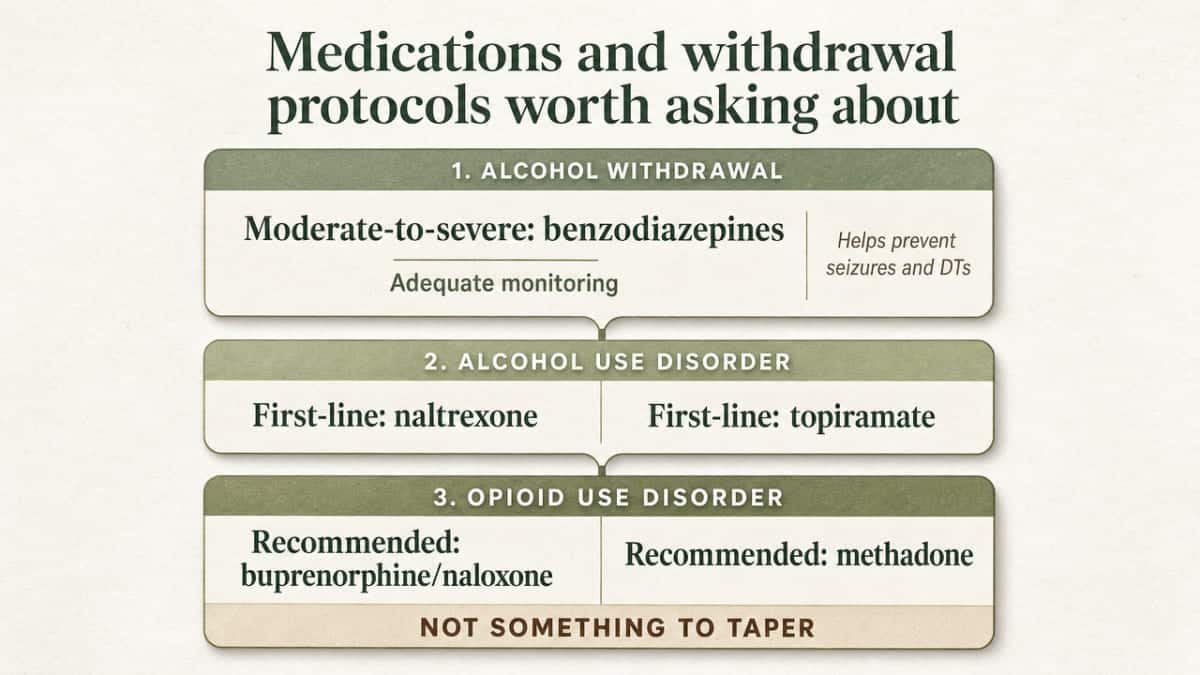
The VA/DoD Clinical Practice Guideline for Substance Use Disorders is the document that shapes how the VA treats detox, and it’s a fair benchmark for what a veteran-aware community center should be able to describe. For moderate-to-severe alcohol withdrawal, benzodiazepines with adequate monitoring are the recommended approach — the medication class that keeps seizures and DTs from turning into something worse 4. For longer-term alcohol use disorder, the guideline names naltrexone and topiramate as first-line medications 5. For opioid use disorder, buprenorphine/naloxone and methadone are the recommended options — not something to taper you off of in a hurry, but medications the guideline treats as ongoing care 5.
Here’s what to do with that. If you’re on buprenorphine or methadone right now — through the VA, a community prescriber, an OTP — the answer you want to hear when you call is that they will continue it through your detox stay, not stop it and “clean you out.” The VHA directive is explicit that MOUD should continue during hospitalization for withdrawal 6. A facility that says they’ll pull you off your buprenorphine to “reset” you isn’t following the evidence, and that’s true whether they’re VA or community.
For alcohol, the question is how they assess severity and adjust dosing. A competent answer sounds like: we use a validated withdrawal scale, we dose benzodiazepines based on symptoms, and a physician reviews the plan. You don’t need the exact scale name. You need to hear that dosing is symptom-triggered, not a flat regimen for everyone regardless of what their body is doing.
Ask about naltrexone and topiramate too, even if you’re only thinking about the withdrawal week. A center that can talk about what happens after the acute phase — what medication options exist to keep you steady once the shakes are gone — is thinking past the discharge date. That’s the mindset you want on your side.
How this coordinates with the VA, not against it
If you’re already enrolled with the VA, you probably don’t want to hear that a community detox center is going to replace what you’ve built there. Good. That’s not the pitch. The honest framing is that community detox works best as a neighbor to your VA care, not a competitor to it.
Start with what the VA itself says. VA medical centers in Oklahoma offer substance use treatment even when they don’t have a dedicated SUD program on the roster, and the VA maintains a program locator specifically to help veterans find local options 7, 8. The Oklahoma City VA Medical Center provides outpatient and residential recovery services and states plainly that it can help with problems ranging from unhealthy alcohol use to life-threatening addiction 9. That’s the system many veterans in this state already know. A community detox center that respects it — that doesn’t pretend the VA doesn’t exist — is a better partner than one that acts like it’s rescuing you from them.
Where community detox often fits in is the acute front end. VA has documented challenges with timely access to some SUD services 13, and medical detox is a short, time-sensitive episode. If you’re in withdrawal on a Tuesday night, waiting for a scheduled VA admission may not be the right answer. A local, accredited facility can start the medical piece now and set up the handoff to your VA team for the longer arc of care.
The handoff is where the coordination actually happens, and it’s worth asking about directly. VHA policy expects patients hospitalized for withdrawal to have follow-up with an outpatient SUD provider within 7 days of discharge, and MOUD should continue during that hospitalization rather than being stopped and restarted 6. When you call a community center, the questions are: Will you talk to my VA provider? Will you share records with my Oklahoma City VAMC team? Will you help schedule that 7-day follow-up before I leave? If yes, you’re looking at a facility that understands its role — a bridge, not a wall.
Veterans who served in combat can also access free counseling and alcohol and drug assessments through community Vet Centers 10, which is a separate lane worth keeping open regardless of where you detox. Nothing about walking through Renewal Springs’ door forecloses any of that. Ask on the phone how the team coordinates with your existing VA relationships, and listen for whether they treat that as routine or as an afterthought.
Paying for detox: SoonerCare, VA benefits, and private insurance
Money is the thing that stops a lot of people from making the call, so let’s clear it out of the way.
If you have SoonerCare, detox and residential substance use disorder services are listed as covered benefits for both adults and children, with prior authorization required 3. That prior auth is not a trap — it’s a step the facility handles on your behalf, usually while you’re still on the phone or shortly after. Ask the intake person to walk you through how they get it done and how quickly. Any facility billing SoonerCare for residential-level detox also has to hold national accreditation on top of state certification, so if they’re taking Medicaid, they’ve already passed an outside review 1.
VA benefits work a little differently. Your VA health care covers substance use treatment inside the VA system, and combat veterans can also access free counseling and alcohol and drug assessments through community Vet Centers regardless of where you detox 10. Community medical detox is often paid through your other coverage — private insurance, SoonerCare, or self-pay — while your VA relationship stays intact for the longer arc of care. In some situations, community care may be authorized through the VA; ask the facility whether they’ve handled that pathway before and what it required.
For private insurance, most major plans cover medically necessary detox. Renewal Springs offers free benefits verification, which means you don’t have to guess what’s covered before you call. When you do, ask what your day rate looks like after coverage, whether there’s any balance you’d owe, and how they handle it if authorization gets delayed. Straight answers here are another culture check.
What discharge should look like before you ever admit
Ask about the last day before you sign up for the first one. That sounds backwards, but it’s the question that separates a facility running a real recovery pathway from one running a hotel with IV poles.
Detox is a short episode. Five to seven days for most people, sometimes longer, and the acute physical piece is only the opening move. What you or the veteran you love actually needs is a plan for what happens when the shakes stop and the front door opens. VHA policy expects patients hospitalized for withdrawal to have follow-up with an outpatient SUD provider within 7 days of discharge, and it treats detox as one link in a chain rather than a standalone event 6. That’s the standard worth borrowing when you evaluate a community center.
On the phone, ask specifically: What does day five look like? Who am I handed off to? If I’m on buprenorphine or methadone, who’s writing the next script and when? If I need residential or intensive outpatient after this, do you have relationships with programs that will take me, or am I on my own with a printed list? If I’m going back to my VA team at the Oklahoma City VAMC, will you send records and coordinate the follow-up appointment before I leave 9?
You want to hear names of partners, timelines, and a warm handoff — not a discharge folder and a handshake. A facility that plans discharge on the day of admission is one that understands what actually keeps people from cycling back through the same door in six weeks.
The phone call: what to ask and what to listen for
The hardest part of this whole thing might be dialing the number. You’ve probably picked up the phone and put it back down more than once. That’s normal. What follows is a short script for when you’re ready — not to make you sound like a case manager, but to give you something to hold onto when your mouth goes dry.
Start with the culture check, because if that fails you don’t need to keep going. Ask directly: Who owns and runs this place? What did they serve in? That’s a fair question and a veteran-owned facility should answer it without a pause. You’re not asking for a resume. You’re listening for whether the person on the other end talks about the team like family or like a marketing bullet point.
Then move to the clinical bar. Keep it plain:
- Is there a physician on site or on call twenty-four hours a day? 16
- Are licensed nurses doing the round-the-clock monitoring? 2
- Are you state-certified through ODMHSAS, and what national accreditation do you hold? 1
- If I’m on buprenorphine or methadone, will you continue it? 6
- How do you assess alcohol withdrawal, and is benzodiazepine dosing symptom-triggered? 4
Five questions. You don’t need to remember them perfectly — write them on the back of an envelope. What you’re listening for is whether the answers come easily. A team that runs a real medical operation talks about physician coverage the way a mechanic talks about a torque wrench: it’s just there, it’s obvious, next question.
End with the handoff. Ask what day five looks like, whether they’ll coordinate with your Oklahoma City VA team, and whether they’ll help set up follow-up before you leave 6, 9. If you’re using SoonerCare or private insurance, ask them to walk you through benefits verification on the same call.
One last thing worth naming out loud. You don’t have to commit on this call. You’re allowed to ask questions, hang up, think about it, call back. A facility worth walking into will treat that as the beginning of a conversation, not a sales close. Call Renewal Springs and ask who’s on the team. Ask what they served in. Ask how they’ll handle your withdrawal. Then decide.
Talk with a fellow veteran about your next step
Connect directly for support and answers from people who understand your service experience.
Frequently Asked Questions
Does veteran-owned mean Renewal Springs has a dedicated veterans’ clinical program?
No, and it’s worth being clear about that. Renewal Springs is veteran-owned and operated, which is a cultural credential — the people running the facility share your service background. That’s different from a dedicated veterans’ clinical track with veteran-specific group therapy or integrated combat trauma protocols. Both can matter, but they’re not the same thing. If a formal clinical program is what you need, ask directly on the phone and listen to the honest answer 18.
Can I use my VA benefits at a community detox center in Oklahoma?
Your VA health care covers substance use treatment inside the VA system, and combat veterans can also access free counseling and assessments through community Vet Centers regardless of where you detox 10. Community detox is usually paid through SoonerCare, private insurance, or self-pay, while your VA relationship stays intact. In some cases, community care may be authorized through the VA — ask the facility whether they’ve handled that pathway and what it required 7.
Will they continue my buprenorphine or methadone during detox?
They should. VHA policy is explicit that medications for opioid use disorder should continue during hospitalization for withdrawal rather than being stopped and restarted 6, and the VA/DoD guideline names buprenorphine/naloxone and methadone as recommended treatments for opioid use disorder 5. Ask directly when you call. If a facility says they’ll pull you off your medication to “reset” you, they’re not following the evidence — and that’s true regardless of whether they’re VA or community.
Does SoonerCare cover medical detox in Oklahoma?
Yes. Detox and residential substance use disorder services are listed as covered SoonerCare benefits for adults and children, with prior authorization required 3. The facility handles that authorization on your behalf. Any residential-level detox provider billing SoonerCare also has to hold national accreditation on top of state certification 1, which means an outside body has already reviewed their operations. Ask the intake person how quickly they turn around benefits verification and prior auth.
What should I ask on the first phone call?
Five things. Is there a physician on site or on call twenty-four hours a day 16? Are licensed nurses doing round-the-clock monitoring 2? What state certification and national accreditation do you hold 1? Will you continue my buprenorphine or methadone 6? How do you assess alcohol withdrawal and dose medications 4? Also ask who owns and runs the place and what they served in. You’re checking culture and clinical rigor as two separate questions.
How does detox coordinate with the Oklahoma City VA Medical Center after discharge?
A good handoff means the facility shares records with your Oklahoma City VAMC team and helps schedule follow-up before you leave 9. VHA policy expects follow-up with an outpatient SUD provider within 7 days of discharge from withdrawal care, and it treats MOUD as continuous rather than something to stop and restart 6. Ask directly whether they’ll call your VA provider, send your records, and set that appointment. Warm handoffs matter more than discharge folders.
References
- Provider Certification – Oklahoma.gov. https://oklahoma.gov/odmhsas/policy/provider-certification.html
- Oklahoma Summary — State Residential Treatment for Behavioral Health Conditions. https://aspe.hhs.gov/sites/default/files/2021-08/StateBHCond-Oklahoma.pdf
- Mental Health and Substance Abuse Services – Oklahoma.gov. https://oklahoma.gov/ohca/individuals/programs/mental-health-and-substance-abuse-services.html
- VA/DoD Clinical Practice Guideline for the Management of Substance Use Disorders (2021). https://www.healthquality.va.gov/guidelines/MH/sud/VA-DoD-SUD-CPG_Final_for-508_v3.pdf
- VA/DoD Clinical Practice Guideline for Substance Use Disorders – Pocket Card. https://www.healthquality.va.gov/guidelines/MH/sud/VADoDSUDCPGPocketCard.pdf
- VHA Directive – Principles of Treatment and Recovery for Veterans with Substance Use Disorders. https://www.va.gov/vhapublications/ViewPublication.asp?pub_ID=10070
- Alcohol & Drug Addiction Treatment for Veterans. https://www.mentalhealth.va.gov/substance-use/treatment.asp
- Substance Use Disorder (SUD) Program – Locations. https://www.va.gov/directory/guide/sud.asp
- Oklahoma City VA Medical Center. https://www.va.gov/oklahoma-city-health-care/locations/oklahoma-city-va-medical-center/
- Substance Use Treatment for Veterans. https://www.va.gov/health-care/health-needs-conditions/substance-use-problems/
- State Summaries – Veteran Cohort Data (Oklahoma). https://www.datahub.va.gov/resource/kerx-pfcg.csv
- VA Delivers Record Care and Benefits to Oklahoma Veterans in Fiscal Year 2024. https://www.va.gov/files/2025-01/Press%20Release%20-%20VA%20Delivers%20Record%20Care%20and%20Benefits%20to%20Oklahoma%20Veterans%20in%20Fiscal%20Year%202024%2010.29.24.pdf
- VA Faces Challenges in Providing Substance Use Disorder Services and Is Taking Steps to Improve These Services for Veterans. https://www.gao.gov/assets/gao-10-294r.pdf
- Evidence-based screening, diagnosis, and treatment of substance use disorders among veterans and military service personnel. https://pubmed.ncbi.nlm.nih.gov/22953439/
- Substance Use Disorders – Whole Health Library. https://www.va.gov/WHOLEHEALTHLIBRARY/docs/substance-use.pdf
- CHAPTER 18. STANDARDS AND CRITERIA FOR SUBSTANCE RELATED AND ADDICTIVE DISORDER TREATMENT SERVICES. https://oklahoma.gov/content/dam/ok/en/odmhsas/documents/policy/provider-certification/administrative-rules/2021/Chapter%2018%20Final%20effective%209-15-21.pdf
- Substance use disorders in military veterans: prevalence and treatment challenges. https://pmc.ncbi.nlm.nih.gov/articles/PMC5587184/
- Improving care for veterans with substance use disorders. https://pubmed.ncbi.nlm.nih.gov/29069382/