
Key Takeaways
- Medical detox is a short supervised stay, usually five to seven days for opioids, where clinicians use medication and monitoring to carry you safely through withdrawal.
- Detox alone does not treat opioid use disorder and raises overdose risk if you leave without medication, naloxone, and a follow-up plan 3.
- Buprenorphine, methadone, and naltrexone are the three FDA-approved medications that shape modern detox, and buprenorphine or methadone can often start the same day you arrive 4, 9.
- Discharge day is the highest-risk window because tolerance drops fast, so leave with naloxone, a medication plan, and a real appointment within 14 days 5, 7.
Reading This at 2 A.M.: What You Actually Need to Know Right Now
If you’re reading this in the middle of the night, phone glowing, body aching, you’re already doing something hard. You’re looking. That counts.
Here’s the short version so you can breathe for a minute.
Medical detox is a short stay — usually about a week for opioids — where licensed clinicians help you stop using safely. You won’t be locked in. You won’t be lectured. You won’t have to white-knuckle withdrawal alone. Medications exist that take the worst edges off, and they’ll be offered to you 4.
You should also know the honest part early: detox by itself is not a cure for opioid use disorder, and leaving without a next step raises your risk of overdose 3. The real goal is a safe stabilization and a warm handoff to what comes next.
Keep reading. By the end, you’ll know what the door, the first three hours, the hardest days, and discharge actually look like. Then you can decide.
What Medical Detox Is (and What It Isn’t)
A Short Medical Bridge, Not a Lockup or a Cure
Medical detox is a short, supervised stay — for opioids, usually around five to seven days — where licensed clinicians help your body get through withdrawal without you having to grit your teeth through it alone.
That’s really what it is. A bridge. Not a jail. Not a 30-day rehab. Not a lecture series.
The federal framework, SAMHSA’s TIP 45, breaks it down into three jobs: evaluate what’s going on in your body and mind, stabilize you safely through withdrawal, and get you ready for whatever comes next 1. Those are the three things happening around the clock. Everything else — the room, the meals, the vitals checks — exists to serve those three jobs.
Oklahoma’s rules go a step further and define supervised detox as care that includes medical monitoring or medical management specifically meant to keep withdrawal from turning dangerous 10. In plain English: someone trained is watching, and they have tools.
You can leave. You’re a patient, not an inmate.
The Honest Part: Detox Alone Doesn’t Treat Opioid Use Disorder
Here’s the part most places won’t say out loud, so we will.
Why? Because detox clears opioids from your system, which also clears your tolerance. If you leave with no medication, no naloxone, and no follow-up, and you use again at the amount you used before, your body can’t handle it.
The good news is the fix is well understood. A multi-state analysis found that starting treatment within 14 days after detox was associated with lower risk of readmission 7. The week after you walk out matters more than the week you were inside.
So detox is the bridge. The road on the other side — medication, a real appointment on the calendar, naloxone in your pocket — is what actually keeps you alive.
The Door, the Chair, the Clipboard: What Intake Really Looks Like
The First Three Hours: Assessment and Your Medical Service Plan
You walk in. Someone greets you. You sit down.
That’s really how it starts. Not with a form thrown at you, not with a lecture. A greeting, a chair, a glass of water if you want one.
In Oklahoma, the clock then starts on something specific. State rules require a medical service plan to be completed within three hours of your admission, with a physician, APRN, or PA on site or on call around the clock, every day of the week 11. That plan is yours. It documents what you’ve been using, how much, how often, when you used last, what else is going on in your body, what medications you take, what you’re allergic to, and what withdrawal is likely to look like for you.
A nurse will check your vitals. Someone will ask about your mental health history, because anxiety and depression often ride along with opioid dependence and the staff is trained to screen for both 12. The questions can feel long. They exist so that nothing gets missed and so your care is built around you, not a template.
What to Bring, What to Leave, What to Expect to Be Asked
Keep it simple. Bring:
- Your ID
- Your insurance card if you have one
- A list of any medications you take (or the actual bottles)
- Comfortable clothes for about a week
- A phone charger
- Basic toiletries
Leave anything you’d be upset to lose. Leave anything sharp, anything alcohol-based (including some mouthwash), and any substances. You don’t have to pretend you don’t have anything on you — just tell the intake nurse. That is a far better conversation than being searched.
Expect to be asked when you last used, how much, and by what route. Expect questions about past withdrawals, past overdoses, and whether you’ve ever had a seizure. Expect questions about pregnancy, if that applies. Expect questions about who at home knows you’re here, and who you want informed.
None of this is a quiz. It’s a map.
Will I Be Judged? Will I Be Forced Into Anything?
Short answers: no, and no.
The staff on intake has heard every version of your story. People arrive high. People arrive in full withdrawal, shaking in the parking lot. People arrive with their last dose still in their pocket. The clinicians asking you questions are trained to assess, not to shame 12. Honesty gets you the right medication at the right dose. That is the whole point of the conversation.
You also can’t be forced into treatment you don’t agree to. You are a patient, not a prisoner. Any medication offered during detox will be explained to you, and you can ask questions until the answer makes sense. Even the plan for what happens after discharge is built with you, not handed down 9.
Walking in is the hard part. The chair is the easy part.
The First Seven Days, Hour by Hour
Day 0 to Day 1: Settling In and Starting Medication
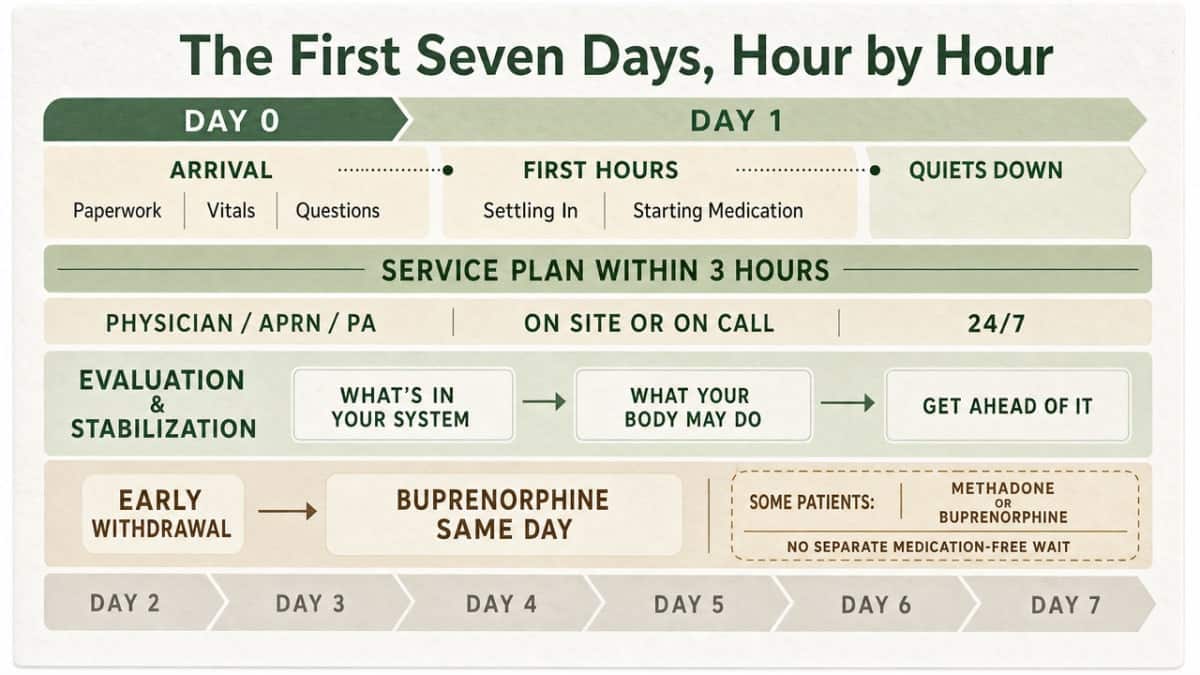
Day 0 is the day you arrive. The first few hours are the loudest — paperwork, vitals, questions — and then it quiets down.
By Oklahoma rule, your medical service plan is written within three hours of admission, and a physician, APRN, or PA is available on site or on call around the clock, every day 11. That matters because the first medication decision usually happens fast. SAMHSA’s framework treats these early hours as the evaluation and stabilization phase: figure out what’s in your system, figure out what your body is about to do, and get ahead of it 1.
If you’re already in early withdrawal, buprenorphine can often be started the same day. SAMHSA’s 2025 guidance confirms that some opioid-dependent patients can begin methadone or buprenorphine without a separate medication-free waiting period 9. Translation: you don’t always have to suffer first to earn relief.
You’ll be shown your room. You’ll be offered water, food if you can keep it down, and a bed. Someone will check on you through the night.
Days 2 and 3: Peak Withdrawal and How It’s Managed
These are the days people are most afraid of. We’re not going to pretend they’re easy.
For short-acting opioids like heroin and most prescription painkillers, withdrawal usually peaks somewhere in the first 48 to 72 hours. Fentanyl can run a different, sometimes longer course. You may feel muscle aches that reach into your bones, waves of sweating and chills, a stomach that won’t settle, restless legs, insomnia, and an anxiety that feels bigger than the room. That’s the floor. The ceiling is what medication and monitoring are for.
Staff will take your vitals on a schedule — blood pressure, heart rate, temperature, sometimes oxygen — because changes in those numbers tell them when to adjust your medications 11. Buprenorphine or methadone eases the physical pull 4. Other medications take on the specific symptoms: something for nausea, something for the cramping, something for sleep, something for the blood pressure spikes.
You’ll be asked, often, how you’re doing on a scale. Say the real number. The dose follows the number.
You will not be alone for the hardest hours. That is the entire point of being here instead of at home.
Days 4 and 5: The Fog Lifts
Something shifts around day four. Not all at once. But you’ll notice.
The sweating slows. You can eat a real meal. You sleep for a stretch longer than two hours. Your mind, which has been running on alarm, starts to quiet enough that you can hear yourself think again. Vital signs settle closer to your baseline 11.
This is also when the real conversations start. A counselor may sit with you — not to grill you, but to ask what you actually want next. Motivational interviewing during this window is a standard part of inpatient addiction care, because readiness lives here, in the quiet after the storm 14.
If you’re on buprenorphine or methadone, your dose gets fine-tuned. If naltrexone is on the table for later, the clock on the required opioid-free window starts to make sense now.
You’ve done the hardest physical part. That is worth naming.
Days 6 and 7: Planning the Handoff Before You Walk Out
The last couple of days are not a holding pattern. They’re the setup for everything that comes after.
SAMHSA defines discharge planning simply: deciding what you need for a smooth move from one level of care to the next 9. In practice, that looks like someone sitting with you and a calendar. Where are you going when you leave? Who’s picking you up? What’s your medication plan for next week? Who’s the first appointment with, and when?
The goal is a real appointment on a real day, not a stack of phone numbers. A multi-state analysis found that getting into treatment within 14 days of detox was linked to lower readmission risk 7. The staff knows this. They’ll push for a date on the calendar before you walk out, not after.
Naloxone goes with you. So does a plan for the first 72 hours. You’ll leave knowing what’s next — not guessing.
The Three Medications That Change the Experience
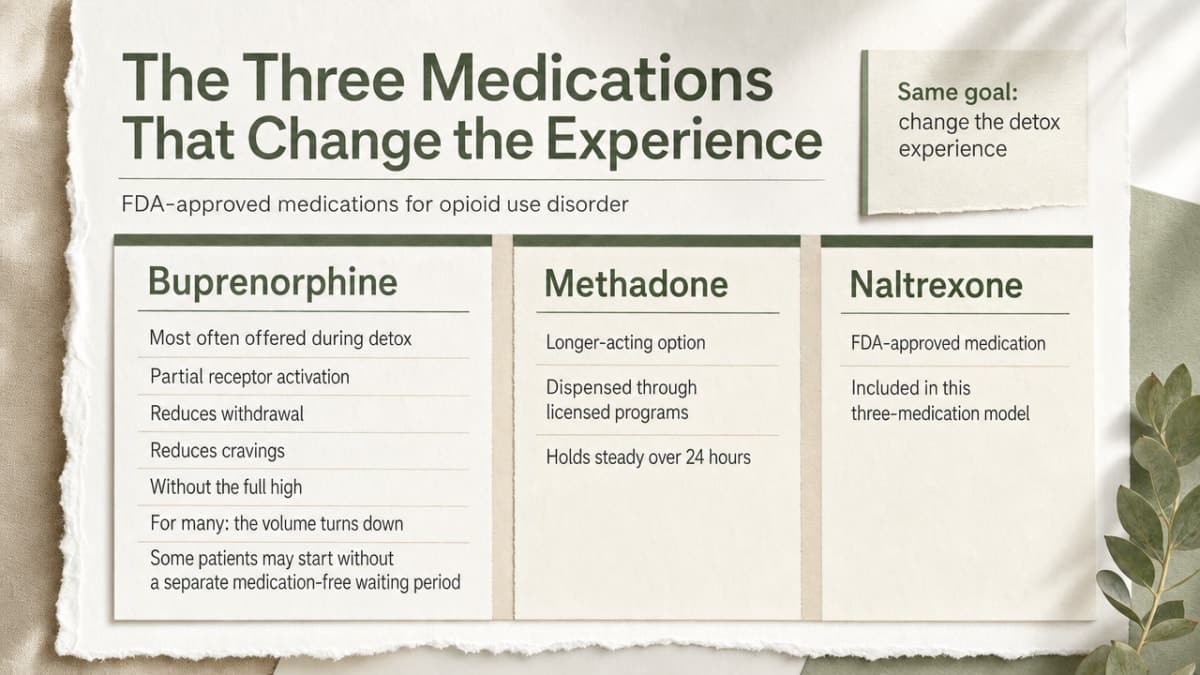
If you remember one thing from this page, make it this: there are three FDA-approved medications for opioid use disorder, and they are the reason modern detox feels different than it did a generation ago 4.
- Buprenorphine.
- This is the one you’re most likely to be offered during detox. It attaches to the same receptors opioids do, but only partially — enough to shut down the worst of withdrawal and the cravings underneath it, without the full high. Most people describe the first dose as the moment the volume turns down. SAMHSA’s 2025 guidance confirms that some opioid-dependent patients can start buprenorphine without a separate medication-free waiting period, so you may not have to suffer through hours of withdrawal to qualify 9.
- Methadone.
- A longer-acting option, dispensed through licensed programs. It holds steady over 24 hours, which makes it a strong fit if you’ve been using heavily or for a long time, or if buprenorphine hasn’t worked for you before. Like buprenorphine, methadone can be started during withdrawal management rather than after a washout 9.
- Naltrexone.
- Different animal. It blocks opioids rather than replacing them, so it requires a fully opioid-free window before the first dose — usually about a week. It’s often the right choice after detox, not during it, and the staff will walk you through the timing.
None of these are a trade of one addiction for another. They are tools 4. You and your clinician pick the one that fits your body, your history, and the life you’re going back to.
Who’s in the Room: The People Watching Over You
You’re never looking at an empty hallway. That’s the point.
Oklahoma rules require a physician, APRN, or PA to be on site or on call every hour of every day 11. A nurse is the person you’ll see most — checking your blood pressure, your pulse, your temperature, asking how your stomach is doing, how your sleep went, where the pain sits on a scale. Those numbers aren’t busywork. They’re how your medication gets adjusted in real time.
Behind the nurse is a tech or aide who may bring your meals, help you to the shower, sit with you when the restlessness won’t let you lie still. A counselor steps in once the worst waves pass, trained in motivational interviewing rather than confrontation 14.
State standards require that every staff member working your detox understands withdrawal signs, vital signs, emergency procedures, and co-occurring mental health needs 12. You are not being watched by volunteers. You are being watched by people trained to catch what matters.
What Oklahoma Rules Mean for Your Safety
You don’t have to take anyone’s word that a detox facility in Oklahoma is doing it right. The state writes the floor in actual rules, and those rules exist to protect you.
Here’s what they translate to in your room:
- A medical service plan has to be written within three hours of the moment you walk in.
- A physician, APRN, or PA has to be on site or on call every hour of every day.
- Nutrition, fluids, and vital signs are not optional — they’re required parts of your care 11.
Staff competency is also spelled out. Anyone working your detox has to understand withdrawal signs, what your vitals actually mean, emergency procedures, and how to recognize co-occurring mental health needs like anxiety or depression showing up alongside opioid dependence 12.
And the facility itself has to carry state certification from ODMHSAS to operate at all 13. That certification is your baseline. It’s the reason you can walk in scared and still land somewhere safe.
Discharge Day: The Part That Actually Protects Your Life
Lost Tolerance and Why the Days After Detox Matter Most
Here’s the thing no one wants to say on your way out the door, so we’ll say it now.
This is why discharge day is not a graduation. It’s the start of the window that matters most.
You will feel physically better than you have in a long time. That feeling is real. It is also the exact moment the overdose risk is highest if you use again at your old amount. Knowing that now, before you leave, is the whole reason this section exists.
Naloxone, MOUD, and a Real Follow-Up Appointment
Three things should leave with you. Not a brochure. Three concrete things.
- Naloxone, first. The nasal spray that reverses an opioid overdose. CDC guidance is explicit that patients with opioid use disorder — and the people living with them — should be offered it 3. You take it home. You show someone else in your house how to use it. That is not a sign that anyone expects you to fail. It’s a seatbelt.
- Second, a medication plan. If you started buprenorphine or methadone during your stay, you leave with a prescription, a dispensing plan, or a transfer to a program that continues it. The FDA recognizes buprenorphine, methadone, and naltrexone as the three approved medications for opioid use disorder, and detox is where that treatment usually begins, not ends 4.
- Third, an actual appointment. A date. A time. A name. Not a stack of numbers to call later.
Continuing Care: Months, Not Days
What comes after detox is not another short stay. It’s a longer, lighter arc.
Researchers who study addiction recovery describe continuing care as something that can last months to a year or longer, with check-ins at planned intervals after discharge 8. That might look like outpatient counseling, a residential program, group meetings, telehealth visits with the prescriber managing your medication, or some mix of all four.
The intensity steps down over time. The connection doesn’t.
You already did the loud, hard part. What’s left is quieter — and it’s where your life actually gets rebuilt.
For the Spouse, Parent, or Adult Child Reading This
A quick note just for you — the person who is not the one using, but who loves someone who is.
You can’t make this decision for them. You already know that. What you can do is know the shape of what’s being offered, so when the moment comes you’re not scrambling.
Here’s what matters most for you to hold onto. Detox is a short stay, not a surrender. Your person won’t be locked in, and they won’t be judged at the door. Medications exist that take the edge off withdrawal, and they’ll be offered the same day in many cases 9. And the days right after discharge are the ones to plan for together — lost tolerance makes a return to old amounts dangerous, which is why naloxone goes home with them and why a follow-up appointment on the calendar matters 5, 3.
You being here, reading this, counts too.
Insurance, Cost, and What to Tell Work
Money and work are the two reasons people most often stall at the door. Let’s take them one at a time.
On insurance: most major plans cover medical detox as a medical service, because withdrawal is a medical condition. You don’t have to figure that out alone or guess what your plan says. Renewal Springs runs a free benefits check for you — you share your insurance information once, and someone reads the policy back to you in plain terms. If you don’t have insurance, say that out loud too. There are still options worth talking through.
On work: you don’t owe anyone the word “detox.” Most employees are entitled to request medical leave for a serious health condition, and “I’m being treated for a medical issue and will be out for about a week” is a complete sentence. Your HR department doesn’t get your diagnosis.
Neither of these should be the reason you wait another night.
If Today Is the Day: What the Call Actually Sounds Like
You’ve read this far. That’s not nothing.
If you’re thinking about calling Renewal Springs, here’s what it actually sounds like. Someone picks up. You don’t need a speech. “I think I need help getting off opioids” is enough. They’ll ask a few questions — what you’ve been using, when you last used, whether you have insurance. If you want them to run a free benefits check, they’ll do it on that call.
No one pressures you to come in that minute. The call is information, not a contract. You can hang up and think about it. You can also say, “Can I come in today?” and the answer is usually yes.
One small step. That’s all this is.
Talk to a real person about detox now
Get your questions answered and know what to expect during medical detox, step by step.
Frequently Asked Questions
How long does medical detox from opioids usually take?
For most people, opioid medical detox runs about five to seven days, though your exact length depends on what you were using, how much, and how your body responds to medication. Fentanyl can sometimes stretch things a bit longer. Your clinical team adjusts to you, not a stopwatch.
Will I be in severe pain during withdrawal?
Not the way you’d be at home white-knuckling it. Buprenorphine or methadone can take the physical pull down significantly, often starting the same day you arrive 9. Other medications handle the nausea, cramping, sleep, and anxiety. You’ll still feel rough for a couple of days — but you won’t be alone, and you won’t be untreated.
Can I leave detox if I change my mind?
Yes. You’re a patient, not an inmate. You can walk out. The staff will ask you to talk it through first, and they’ll be honest about the risks — especially the overdose risk that comes with lost tolerance 5. But the choice is yours. Nobody is going to stop you at the door.
Do I have to stop using opioids before I walk in?
No. Come as you are. Don’t try to tough out withdrawal in your car to “qualify.” Tell the intake nurse what you used and when — that information is what lets them time your first medication safely. SAMHSA’s 2025 guidance confirms some opioid-dependent patients can start buprenorphine or methadone without a separate medication-free waiting period 9.
What happens after I’m discharged from detox?
You leave with three things: naloxone, a medication plan if you started buprenorphine or methadone, and an actual follow-up appointment on the calendar 3, 4. Getting into continuing treatment within 14 days of discharge is linked to lower readmission risk in multi-state research 7. The week after you walk out is the one that matters most.
Will my employer or family find out I went to detox?
Your medical information is protected by federal privacy laws. Your employer doesn’t get your diagnosis — “I’m being treated for a medical issue” is a complete sentence for HR or a medical leave request. Family members only learn what you choose to share with them, and the intake team will ask who, if anyone, you want informed.
References
- TIP 45 Detoxification and Substance Abuse Treatment. https://library.samhsa.gov/sites/default/files/sma15-4131.pdf
- Management of opioid use disorders: a national clinical practice guideline. https://pmc.ncbi.nlm.nih.gov/articles/PMC5837873/
- Opioid Use Disorder: Treating | Overdose Prevention | CDC. https://www.cdc.gov/overdose-prevention/hcp/clinical-care/opioid-use-disorder-treating.html
- Information about Medications for Opioid Use Disorder (MOUD). https://www.fda.gov/drugs/food-and-drug-administration-overdose-prevention-framework/information-about-medications-opioid-use-disorder-moud
- SAMHSA Overdose Prevention and Response Toolkit. https://www.cdc.gov/overdose-prevention/media/pdfs/2024/04/SAMHSA-overdose-prevention-response-toolkit.pdf
- Management of Alcohol Withdrawal in the Emergency Department. https://pmc.ncbi.nlm.nih.gov/articles/PMC7093658/
- A Performance Measure for Continuity of Care After Detoxification. https://pmc.ncbi.nlm.nih.gov/articles/PMC4096006/
- The Continuing Care Model of Substance Use Treatment. https://pmc.ncbi.nlm.nih.gov/articles/PMC4007701/
- National Guidance on Essential Specialty Substance Use Disorder (SUD) Care. https://library.samhsa.gov/sites/default/files/national-guidance-speciality-sud-pep25-04-003.pdf
- CHAPTER 18. STANDARDS AND CRITERIA FOR SUBSTANCE RELATED AND ADDICTIVE DISORDER TREATMENT SERVICES. https://oklahoma.gov/content/dam/ok/en/odmhsas/documents/policy/provider-certification/administrative-rules/2025/PC–Chapter-18_9-1-25.pdf
- Chapter 18_PERM 2025. https://oklahoma.gov/content/dam/ok/en/odmhsas/documents/policy/provider-certification/proposed-rules/2025/PC–Chapter-18_PERM_2025.pdf
- TITLE 450 CHAPTER 23. STANDARDS AND CRITERIA FOR …. https://oklahoma.gov/content/dam/ok/en/odmhsas/documents/policy/provider-certification/administrative-rules/2026/Chapter%2023.pdf
- Provider Certification. https://oklahoma.gov/odmhsas/policy/provider-certification.html
- INPATIENT ADDICTION CONSULT SERVICE. https://pmc.ncbi.nlm.nih.gov/articles/PMC6750950/