
Key Takeaways
- A verifiable state license from ODMHSAS is the foundation of trust, and admissions should name their exact status, including any temporary operations permit or provisional stage.
- Qualified medical staff must be on-site around the clock, with a medical director, 24/7 physician availability, and RN or LPN coverage in the building overnight 3.
- Honest answers about accreditation matter more than a logo, since HHS OIG reviews found survey reports were sometimes inconsistent and incomplete 5, 6.
- Evidence-based withdrawal care means FDA-approved medications like buprenorphine, physician prescribing, and withdrawal scoring tools guiding dosing, not vague promises about getting through it naturally 4.
- Safety protocols should be describable as a clear sequence — nurse assessment, physician call, medication order, and transfer criteria — for unstable vitals or emergencies overnight.
- A real post-detox plan names the next level of care and an appointment within 14 days, since follow-up in that window reduces detox readmission 1.
- Transparency about cost, insurance coverage, and what the program refuses to promise separates trustworthy centers from those selling guaranteed success rates or pressuring same-day admission.
Why a Website Can’t Tell You If a Detox Center Is Safe
You’re reading this because someone you love — or you yourself — needs to stop using opioids, and the wrong choice right now could cost a life. That’s not dramatic. Fentanyl withdrawal is medically serious, and the space between “we can help” on a homepage and what actually happens at 3 a.m. in a detox room is wider than most families realize.
Here’s the honest problem: every detox website looks trustworthy. Soft photos. Words like compassionate and evidence-based. A phone number that promises someone will answer. None of that tells you who is licensed, who is on the floor overnight, what medications the facility can actually administer, or what happens the day your loved one is discharged.
The good news is that trust in a medical detox isn’t a feeling. It’s a short list of things you can verify — usually in one phone call. SAMHSA’s own consumer guide is built around this idea: ask about licensing, staff training, medications, and continuing support, and expect specific answers 4.
The seven signs below are what a safe medical detox looks like from the outside. Each one ends with a question you can ask admissions and what a solid answer sounds like. You’re not being paranoid for asking. You’re being the person in the room who is thinking clearly, and that matters more than you know right now.
Sign 1: A Verifiable State License You Can Confirm in One Call
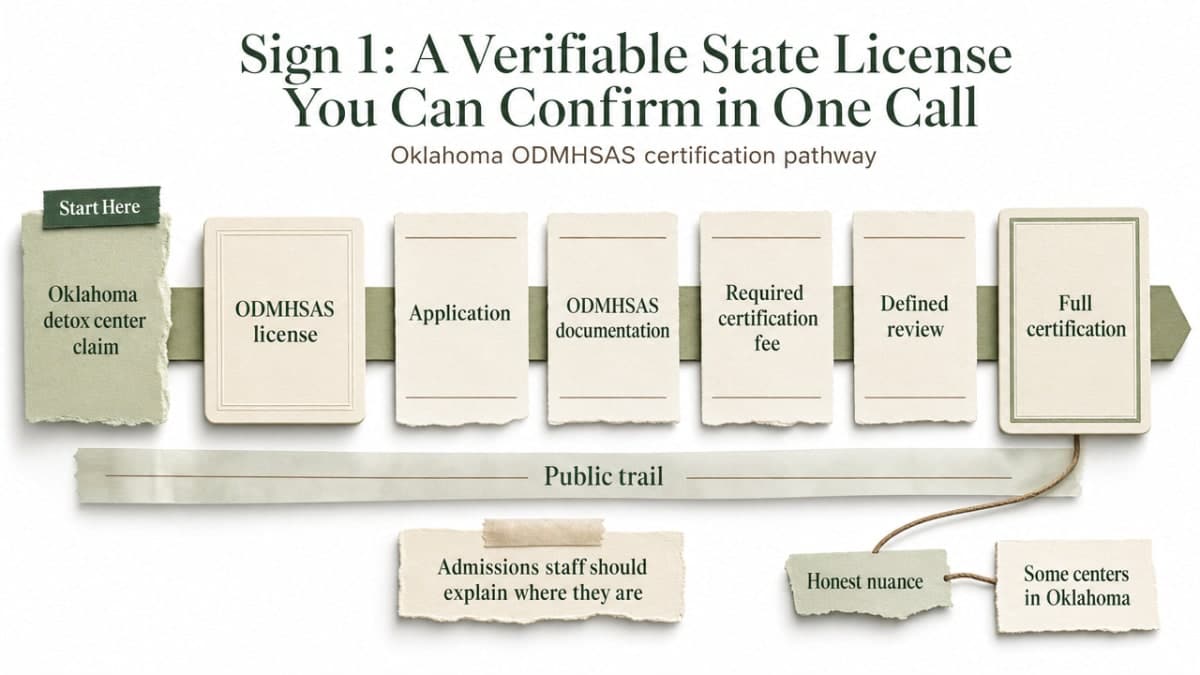
Start here, because everything else rests on it. If a detox center is not licensed by the state to do what it claims to do, no logo, testimonial, or glossy brochure changes that. In Oklahoma, that license comes from the Oklahoma Department of Mental Health and Substance Abuse Services (ODMHSAS), and it is not something a facility can hand-wave.
State certification is a formal process. Applications must include ODMHSAS documentation and the required certification fee, and providers move through a defined review before receiving full certification 9. That paperwork is a good thing for you. It means there is a public trail, and admissions staff at a legitimate facility should be able to explain exactly where they are in that trail without getting defensive.
Here is the honest nuance most articles skip. Some centers in Oklahoma are operating under a Permit for Temporary Operations, which lets a provider begin offering services before full certification is complete 8. That is not automatically a red flag — it is a legal, regulated status for newer programs — but it is something you deserve to know about before your loved one walks through the door. Renewal Springs, for example, currently holds provisional licensure with national accreditation in progress, and that is exactly the kind of answer you should be able to get on the phone in the first two minutes.
Ask admissions: “Are you certified by ODMHSAS, and if you are on a temporary operations permit or provisional status, can you tell me where you are in the process?” A trustworthy answer sounds specific — a status, a stage, a name of the reviewing body. A worrying answer sounds vague, annoyed, or changes the subject to how nice the rooms are.
Sign 2: Qualified Medical Staff On-Site Around the Clock
Opioid withdrawal doesn’t check the clock. Blood pressure spikes at 2 a.m. Vomiting starts before dawn. The question that matters is not who runs the intake meeting on Tuesday morning — it’s who is standing in the hallway when your body is falling apart at 4 a.m. and someone needs to make a medical decision fast.
This is the single strongest trust signal in a detox center, and it is also the one that is hardest to fake. A staffing roster is either there or it isn’t.
Here is what a medically monitored inpatient level of care looks like on paper. Montana’s licensing rule for ASAM 3.7 — a nationally recognized level of care very close to what medical detox provides — requires a designated medical director overseeing treatment and medication management, a physician or physician extender available on-call 24 hours a day, seven days a week, and RN or LPN presence in the building 24 hours a day, seven days a week 3. That’s not one state being unusually strict. That’s what the clinical standard actually says a medically monitored setting should look like.
SAMHSA’s consumer guidance lands in the same place from a different angle: a good program’s staff should be trained in treating substance use and mental health disorders and be licensed or registered in the state 4. Training and licensure are not decoration. They are what let a nurse recognize that a rising pulse plus a certain kind of sweating is not just “a rough night” but a reason to call the physician now.
You’ll hear a few credential names on a good phone call, and it helps to know what they mean in plain English.
- ASAM
- A board certification in addiction medicine, held by physicians who have trained specifically in this work.
- RN
- A registered nurse, the person most likely to be at your loved one’s bedside overnight.
- LPC
- A licensed professional counselor.
- LADC
- A licensed alcohol and drug counselor — the clinicians who do the actual therapy work during and after withdrawal.
Ask admissions: “Who is physically on-site overnight, and what are their credentials? Is there a physician on-call 24/7, and who is the medical director?” A trustworthy answer names roles and shifts without hesitation. A worrying answer is a pause, a redirect to “our caring team,” or an admission that a nurse is only on-site during business hours. In opioid detox, business-hours coverage is not enough. You already knew that. Trust yourself on it.
Sign 3: Honest Answers About Accreditation, Including What’s Still in Progress
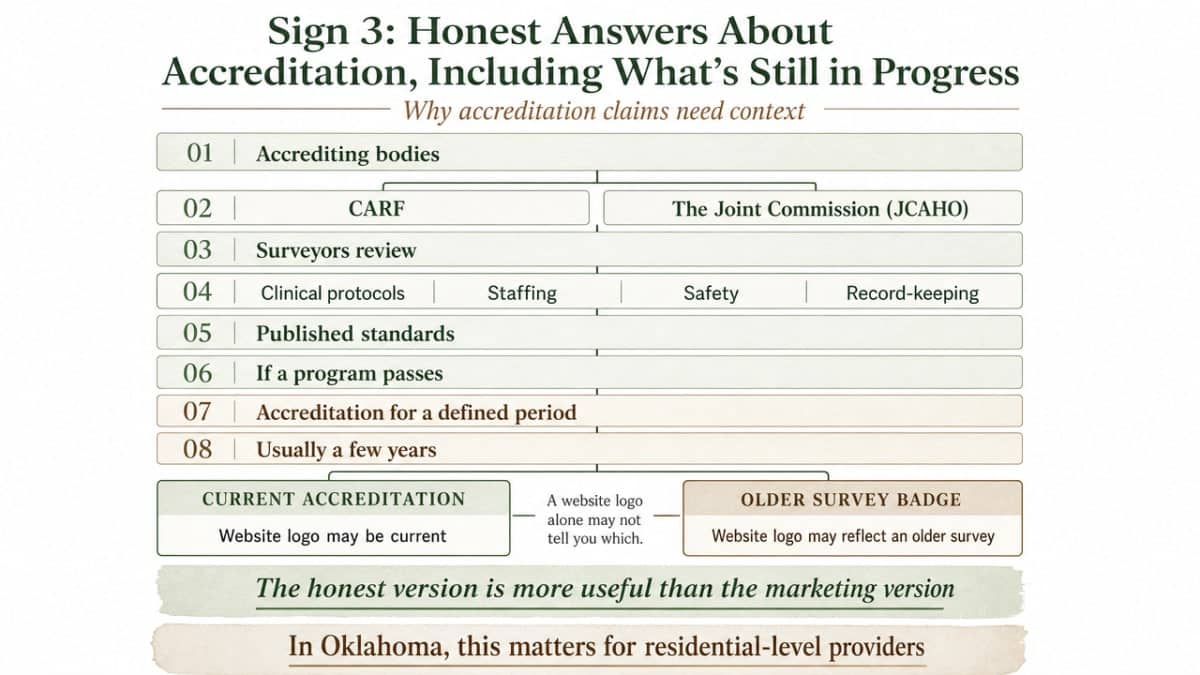
Accreditation is the trust signal most families lean on hardest, and it’s also the one most likely to be oversold on a website. A logo from The Joint Commission or CARF at the bottom of a page feels like a stamp of approval. Sometimes it is. Sometimes it’s a badge from a survey done years ago. The honest version is more useful to you than the marketing version.
Here’s what accreditation actually is. National accrediting bodies — CARF and The Joint Commission (often called JCAHO) are the two most common — send surveyors to review a facility’s clinical protocols, staffing, safety, and record-keeping against a published set of standards. When a program passes, it earns accreditation for a defined period, usually a few years. In Oklahoma, this matters for a specific practical reason: residential-level providers, including medical detox, need national accreditation in addition to state certification for Soonercare reimbursement 7. So if a family is planning to use Soonercare, accreditation is not just a trust signal — it is a payment requirement.
Now the part most articles skip. Accreditation is meaningful, but it is not a guarantee. HHS Office of Inspector General audits of opioid treatment program oversight have found real gaps. At the time of one audit, CARF accredited roughly 60 percent of opioid treatment programs in the United States, and a separate OIG review found that accreditation-body survey reports were sometimes inconsistent and lacked sufficient information to determine whether programs met federal standards 5, 6. That doesn’t mean accreditation is worthless. It means the badge alone isn’t the whole answer, and a trustworthy program will be willing to talk about what surveyors actually looked at.
You should also know that newer programs may be honestly in the middle of the process. A center can be operating legally under state authority while national accreditation is still under review. Renewal Springs is one example of this: the facility currently holds provisional licensure with JCAHO and ODMHSAS accreditation in progress rather than completed. That’s the accurate way to describe it, and if a center you’re calling is in a similar position, you deserve to hear it that way — not dressed up as “fully accredited” when it isn’t yet.
Ask admissions: “Are you nationally accredited, and if so, by whom and when was your last survey? If accreditation is in progress, which body and what stage?” A trustworthy answer names the accreditor, the status, and doesn’t flinch. A worrying answer implies accreditation is completed when it isn’t, or treats the question like an insult. You’re allowed to ask. In fact, you should.
Sign 4: Evidence-Based Withdrawal Care, Not Vague Promises
Opioid withdrawal has an actual treatment protocol. It is not a matter of willpower, a quiet room, and a cup of tea. If a center you’re calling can’t tell you what medications they use, when they use them, and who prescribes them, that’s a signal — and not a good one.
Evidence-based care in a medical detox means a few concrete things. It means FDA-approved medications for opioid withdrawal — buprenorphine is the one most commonly used to ease the physical symptoms and stabilize someone safely — prescribed by a physician who understands addiction medicine. It means vital signs measured on a schedule, not when someone remembers. It means a withdrawal scoring tool (you may hear the initials COWS) used to guide dosing, so the medication response matches what your loved one’s body is actually doing.
SAMHSA’s consumer guide is direct about this: a quality program uses treatments backed by scientific evidence, including approved medications for substance use disorders, and staff should be trained and licensed to deliver them 4. That framing matters because it flips a common myth. Using medication during opioid detox is not “trading one drug for another.” It is the standard of care, and a program that shames patients out of medication is not practicing evidence-based medicine.
You should also hear the word assessment early in the conversation. A trustworthy intake includes a real medical and psychiatric evaluation before a treatment plan is written, because someone withdrawing from fentanyl with an untreated anxiety disorder needs a different plan than someone withdrawing from prescription painkillers after a surgery went wrong. Cookie-cutter plans are a warning sign.
Ask admissions: “What medications do you use for opioid withdrawal, who prescribes them, and how do you decide the dose?” A trustworthy answer names buprenorphine or another approved medication, names a physician role, and describes an assessment. A worrying answer is “we help you get through it naturally” or “every case is different” with no specifics. You deserve specifics. Keep asking until you get them.
Sign 5: Safety Protocols You Can Actually Ask About
Opioid withdrawal can turn dangerous fast. Rising blood pressure, dehydration from vomiting, a heart rate that won’t come down, a person who hasn’t slept in three days and is now confused — these are the moments where a safety protocol either exists or doesn’t. And a real protocol is something you can ask about in plain language.
Start with monitoring. A medically monitored detox should be checking vital signs on a set schedule, not just when someone looks bad. Ask how often blood pressure, pulse, and temperature are taken during the first 72 hours, when opioid withdrawal peaks. Ask what happens if a reading crosses a threshold — who gets called, how fast, and what the on-call physician can order over the phone. Regulatory frameworks for medically monitored inpatient care assume a physician or extender is reachable around the clock precisely so that answer exists 3.
Then ask about the harder scenarios. What happens if someone has a seizure? What happens if they refuse medication mid-detox and try to leave against medical advice? What happens if a patient arrives with a mental health crisis on top of withdrawal? A trustworthy program has walked through these before. SAMHSA’s consumer guidance points families to ask specifically about how programs handle emergencies and co-occurring mental health needs 4.
Sign 6: A Real Plan for What Happens After Detox
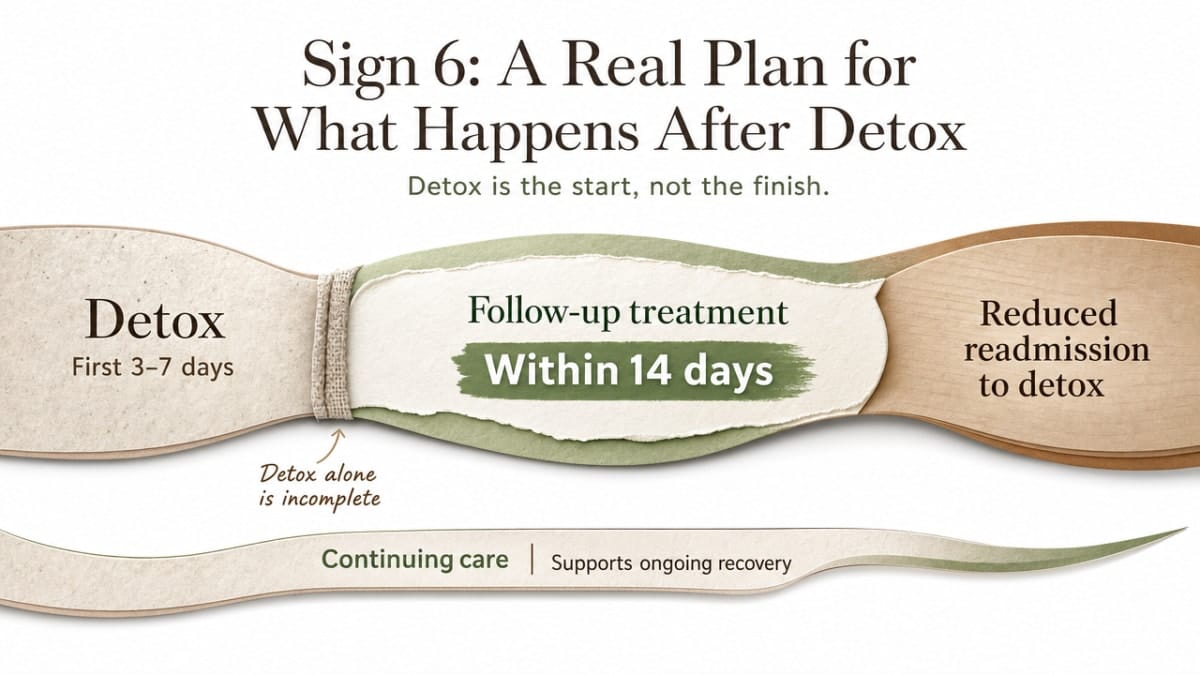
Detox is not the finish line. It’s the first three to seven days of a much longer piece of work, and a trustworthy center knows that — and tells you so before you ever sign paperwork. If admissions talks about detox as if it’s the whole treatment, you’re being sold something incomplete.
Here is why this sign matters more than it might sound. A study across multiple U.S. states found that clients who received treatment for substance use disorders within 14 days after discharge from detoxification were less likely to be readmitted to detoxification 1. That two-week window is not a marketing number. It is a measurable difference in whether someone ends up back in a detox bed or moves forward into recovery. A separate review of the research found that continuing care after initial treatment is generally supported as effective for both adolescents and adults 10.
Translate that into what you should hear on the phone. A trustworthy discharge plan is written down before your loved one leaves — not promised verbally. It names the next level of care (residential, intensive outpatient, or outpatient with medication management), names an actual appointment date within that first two weeks, and names who is responsible for making sure the handoff happens. It usually includes a medication plan for anti-craving or maintenance medications like buprenorphine or naltrexone if those are clinically appropriate, and it names a therapist or counselor for ongoing work.
Ask admissions: “What does discharge planning look like, and how do you get someone into their next appointment within two weeks of leaving?” A trustworthy answer describes a case manager or discharge coordinator, a written plan, and a specific handoff process. A worrying answer is “we give you a list of numbers to call.” A list of numbers is not a plan. You already know what happens to a list of numbers on day three of trying to rebuild a life.
Sign 7: Transparency About Cost, Coverage, and What They Won’t Promise
A trustworthy detox center will tell you two things clearly on the first call: what your insurance actually covers, and what they cannot promise about the outcome. Both matter, and both are places where less-honest centers get slippery.
Start with cost. Ask specifically whether the facility is in-network with your insurance, what your deductible and out-of-pocket exposure looks like for medical detox, and whether they offer free benefits verification before you commit. If Soonercare is in the picture, remember that Oklahoma requires residential-level providers, including medical detox, to hold national accreditation in addition to state certification for Soonercare reimbursement 7. A center that is honest about where it stands on accreditation is also being honest about which payers it can actually bill.
Then listen for what a program will not promise. No legitimate detox center guarantees sobriety, a specific success rate, or a cure. Withdrawal medicine doesn’t work that way, and the research on recovery is clear that outcomes depend heavily on what happens after detox, not just during it. A program that promises a number is selling something. A program that tells you honestly, “We can get you through withdrawal safely and hand you off to the next level of care with a real plan,” is telling you the truth.
Ask admissions: “What will this cost me, what does my insurance cover, and what outcomes will you not promise?” A trustworthy answer includes a benefits check, a written cost estimate, and a clinician who declines to guarantee sobriety. A worrying answer is a flat success-rate number, a pressure pitch to admit today, or a refusal to put costs in writing. You are allowed to slow down and get it in writing. That single act is often what separates families who feel steady about their choice from families who don’t.
The One-Page Checklist to Bring to Your Admissions Call
Print this. Write it on the back of an envelope. Keep it next to you when you call. You don’t have to sound like a lawyer — you just have to keep asking until you get real answers.
- License. “Are you certified by ODMHSAS, and if you’re on a temporary operations permit or provisional status, where are you in the process?” Listen for a specific stage, not a shrug.
- Overnight staff. “Who is physically on-site at 3 a.m., what are their credentials, and is a physician on-call 24/7?” Listen for roles and shifts.
- Accreditation. “Are you nationally accredited, by whom, and when was your last survey — or if it’s in progress, what stage?” Listen for a name and a date.
- Medications. “What medications do you use for opioid withdrawal, who prescribes them, and how do you decide the dose?” Listen for buprenorphine or another FDA-approved medication and a physician role 4.
- Safety. “Walk me through what happens if vitals become unstable overnight.” Listen for a sequence.
- After detox. “How do you get someone into their next appointment within two weeks of discharge, and who owns that handoff?” Listen for a written plan and a named coordinator 1.
- Cost and promises. “What will this cost me, what does my insurance cover, and what outcomes will you not promise?” Listen for a benefits check in writing and a clinician who won’t guarantee sobriety.
You are already doing the hard part by asking. That counts.
Talk With Someone Who Truly Gets It Now
Get real answers about medical supervision, credentials, or next steps—right when you need them most.
Frequently Asked Questions
How do I verify a detox center’s license in Oklahoma?
Call the Oklahoma Department of Mental Health and Substance Abuse Services (ODMHSAS) or check their provider certification page directly. State certification is a formal process that requires ODMHSAS documentation and a certification fee, so there is a public record 9. Ask the center where they are in that process, and expect a specific stage — full certification, a temporary operations permit, or provisional status — not a vague reassurance 8.
What does it mean if a center has provisional licensure or accreditation in progress?
It means the facility is legally operating under state authority while full certification or national accreditation review is still underway. Oklahoma’s Permit for Temporary Operations lets a provider begin services before full certification is complete 8. That’s not automatically a red flag for newer programs, but you deserve a plain answer about which stage they’re in and which body is reviewing them. A center honest about its status is usually honest elsewhere too.
What medical staff should actually be on-site during opioid detox?
At a medically monitored level of care, expect a designated medical director overseeing treatment, a physician or physician extender available on-call 24 hours a day, and RN or LPN coverage physically in the building around the clock 3. Ask who is on-site overnight by role and credential. Look for ASAM-trained physician oversight, registered nurses at the bedside, and licensed counselors (LPC, LADC) handling the therapy side of care.
Is national accreditation alone enough to trust a detox center?
No — it’s meaningful, but not a guarantee. HHS Office of Inspector General audits have found that accreditation-body survey reports were sometimes inconsistent and lacked sufficient information to determine whether programs met federal standards 6. Treat accreditation as one signal alongside licensure, staffing, medications, and discharge planning — not as the whole answer.
What questions should I ask about what happens after detox ends?
Ask for a written discharge plan, a named next level of care, and a specific appointment date within two weeks of leaving. Research across multiple states found that patients who received follow-up treatment within 14 days of detox discharge were less likely to be readmitted 1. Ask who owns the handoff — a case manager or discharge coordinator — and whether the plan includes medications, therapy, and adherence support, since fully adherent patients show better 12-month outcomes 2.
What are the warning signs of a detox center I should avoid?
Vague answers about licensure or accreditation status. No overnight medical staff on-site. No specific medications named for opioid withdrawal. A guaranteed success rate or a hard sell to admit today. A refusal to put costs in writing. A discharge “plan” that is really just a list of phone numbers. SAMHSA’s consumer guidance is clear: quality programs use evidence-based treatments, licensed staff, and continuing support, and are willing to answer specific questions without pressure 4.
References
- A Performance Measure for Continuity of Care After Detoxification. https://pmc.ncbi.nlm.nih.gov/articles/PMC4096006/
- Patient adherence to multi-component continuing care discharge plans. https://pubmed.ncbi.nlm.nih.gov/28755773/
- Mont. Admin. r. 37.106.1475 – ASAM 3.7 Medically Monitored Intensive Inpatient Requirements. https://www.law.cornell.edu/regulations/montana/Mont-Admin-r-37.106.1475
- Finding Quality Treatment for Substance Use Disorders. https://library.samhsa.gov/sites/default/files/pep18-treatment-loc.pdf
- SAMHSA’s Oversight Generally Ensured That the Commission on Accreditation of Rehabilitation Facilities Verified That Opioid Treatment Programs Met Federal Opioid Treatment Standards. https://oig.hhs.gov/reports/all/2021/samhsas-oversight-generally-ensured-that-the-commission-on-accreditation-of-rehabilitation-facilities-verified-that-opioid-treatment-programs-met-federal-opioid-treatment-standards/
- SAMHSA’s Oversight of Accreditation Bodies for Opioid Treatment Programs Did Not Comply With Some Federal Requirements. https://oig.hhs.gov/reports/all/2020/samhsas-oversight-of-accreditation-bodies-for-opioid-treatment-programs-did-not-comply-with-some-federal-requirements/
- Provider Certification. https://oklahoma.gov/odmhsas/policy/provider-certification.html
- New Programs: Overview of ODMHSAS Certification Process. https://oklahoma.gov/odmhsas/policy/provider-certification/new-programs-overview-of-odmhsas-certification-process.html
- Okla. Admin. Code § 450:1-9-6 – Procedures for application for certification. https://www.law.cornell.edu/regulations/oklahoma/OAC-450-1-9-6
- Impact of Continuing Care on Recovery From Substance Use Disorders: A Review of the Literature. https://pmc.ncbi.nlm.nih.gov/articles/PMC7813220/