
Key Takeaways
- Walking into a home-like detox looks less clinical than expected — the first minutes are a conversation, not paperwork, so staff can gauge what your body actually needs.
- Intake hinges on honest answers about what you used and when, because timing sets the clock for comfort medication and shapes a safety plan around you.8
- The first night includes medication timed to your last use, vital checks every few hours, and 24/7 physician coverage required under Oklahoma rules.6
- Opioid withdrawal follows a predictable arc — early symptoms at 6 to 12 hours, peak at 24 to 72 hours — and buprenorphine timing matters to avoid precipitated withdrawal.12
- By day two or three, medications get fine-tuned, appetite returns, and a counselor introduces themselves for low-key check-ins rather than deep clinical work.11
- Family is only contacted with your permission, and staff can send a short update so loved ones know you’re safe without you making the call yourself.15
- Counseling during detox stays short and practical — company, questions, small logistics — because the point is building the relationship you’ll rely on later.11
- Veterans, women, and people with co-occurring diagnoses get a plan that bends to their situation from hour one when they name it at intake.10
The part nobody tells you about walking in the door
You probably pictured a hospital. Fluorescent lights, a clipboard, a stranger asking why you’re here in front of other strangers. That image is why a lot of people sit in the parking lot for twenty minutes before they come inside. If that’s you right now, or if you’re reading this at 2 a.m. on someone else’s behalf, it makes sense that you’re nervous.
Here’s what the door actually opens to at a home-like medical detox: a couch, softer lighting than you expected, and one person who greets you by name. No lecture. No paperwork thrown at you before you sit down. The first few minutes are usually just a conversation, because the people on shift know that whatever you took, and whenever you last took it, matters more than any form.
What follows in the next few days has a structure, even if it doesn’t feel that way from the inside. SAMHSA’s national guidance describes medical detox as three things happening at once: figuring out what your body needs, keeping you safe while it happens, and pointing you toward whatever comes after. You don’t have to memorize that. The staff already knows it. Your only job, walking in, is to tell the truth about what you’ve been using and let the people trained for this handle the rest.1
The rest of this walkthrough follows the clock, hour by hour, so the unknown gets a little smaller before you decide anything.
Your first conversation: intake, honestly answered
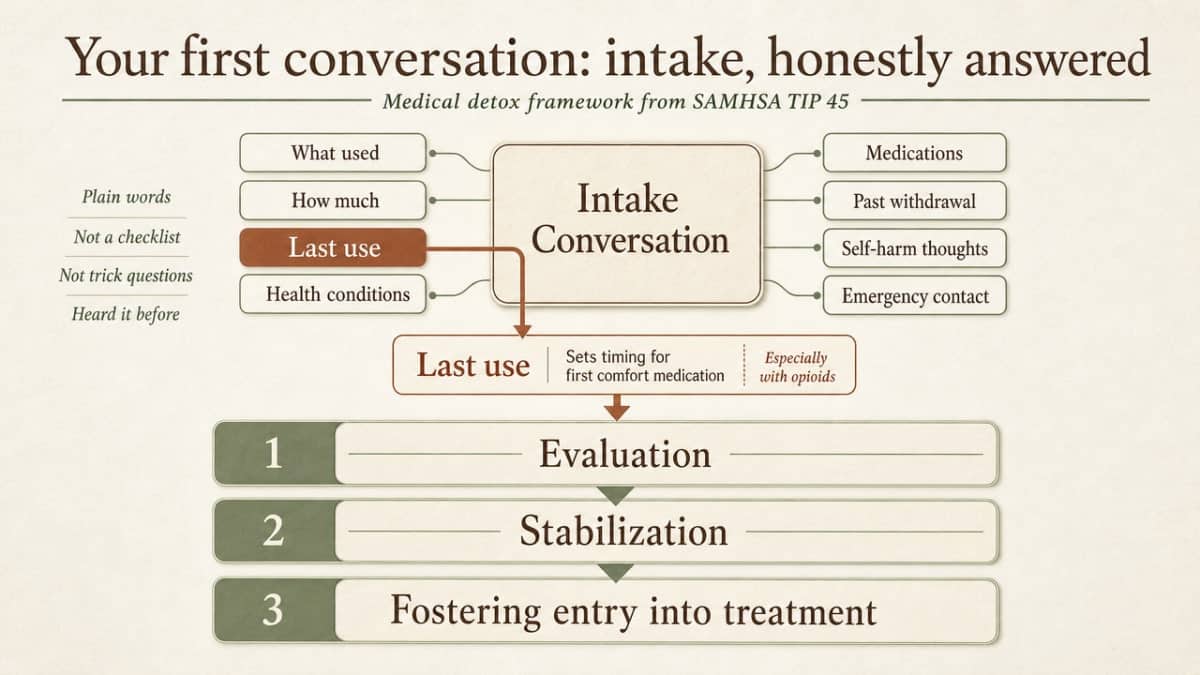
The first real conversation isn’t a checklist. It’s someone sitting across from you asking, in plain words, what you’ve been using, how much, and when you last used. That last question matters more than any other, because it sets the clock for what happens next — especially with opioids, where the timing of the first dose of comfort medication depends on how long it’s been since your last hit or pill.
You’ll be asked about other things too. Any health conditions you know about. Any medications, even the ones you don’t take regularly. Whether you’ve been through withdrawal before, and what happened. Whether you’ve had thoughts of hurting yourself. Whether there’s someone the staff can call if things get complicated. These aren’t trick questions, and the person asking them has heard versions of your answers thousands of times. TIP 45’s clinical assessment guidance treats this intake as the moment where safety gets built — the fuller the picture you give, the more precise the plan they can put around you.8
Here’s the part that surprises most people: you don’t have to remember exact dates or milligrams. “About a gram a day for the last six months, last used maybe four hours ago” is a real, usable answer. “I don’t know, a lot” is also a usable answer. Nobody grades you on how well you kept track.
The whole intake conversation is the first of the three things a medical detox is designed to do — evaluate what you need, stabilize you while withdrawal moves through, and help you figure out what comes after. You’re not signing up for a program yet. You’re giving a small group of people the information they need to keep you safe tonight.1
A quick physical check usually follows. Blood pressure, pulse, temperature, a look at your pupils, a few more questions about how you’re feeling in your body right now. If you’re already starting to sweat, yawn, or feel your legs get restless, tell them. That’s data, not weakness. It tells the doctor on call whether medication should start soon or wait a bit longer. The people doing this work would rather know you’re miserable than have you tough it out in a chair.
By the end of that first hour, someone has usually shown you your room.
The first night: medication, monitoring, and what 3 a.m. actually looks like
The first night is the one people rehearse in their heads before they ever call. You imagine lying in a strange bed, sweating through the sheets, wondering if anyone will come if you press the button. So let’s walk through what that night actually looks like.
After intake, someone helps you get settled. Water on the nightstand. A blanket that’s actually warm. Your phone, in most cases, stays with you. If you’re withdrawing from opioids, the doctor on call is already reviewing your intake notes to decide when comfort medication should start. With short-acting opioids like heroin or most prescription painkillers, that first dose often comes within the first several hours after your last use, once mild withdrawal signs show up. With fentanyl and longer-acting opioids, the timing is trickier and the team may wait a little longer to avoid making things worse before they get better. This is the standard of care, not a delay — TIP 45 identifies medication-supported withdrawal management as the appropriate approach for opioid dependence. You don’t have to understand the pharmacology. You just have to tell them how you feel.12
Someone will check on you every couple of hours through the night. A quick blood pressure cuff, a look at how you’re breathing, a question or two: How are the chills? Any nausea? Sleeping at all? If you’re wearing a continuous monitor on your wrist, some of those numbers are already streaming to the nurses’ station, so a check-in isn’t the only way they know you’re okay. If something changes — your heart rate climbs, your temperature spikes — they see it before you have to name it.
Sleep in fragments is normal that first night. Waking up sweaty, then cold, then hungry, then not — normal. What you’re feeling is your body recalibrating, and the people watching over you have seen this specific night hundreds of times. Morning does come. When it does, someone will bring you something to drink and ask how the night went, and that becomes the first data point of day two.
Opioid withdrawal, hour by hour: what your body will actually do
Most people trying to picture opioid withdrawal are working from a movie scene. Sweat, shaking, someone curled up on a bathroom floor. That image isn’t wrong, exactly, but it’s missing the important part: none of it is happening to you alone, and almost all of it is treatable. Knowing roughly when each wave is likely to hit can make the whole thing feel less like a monster in the dark.
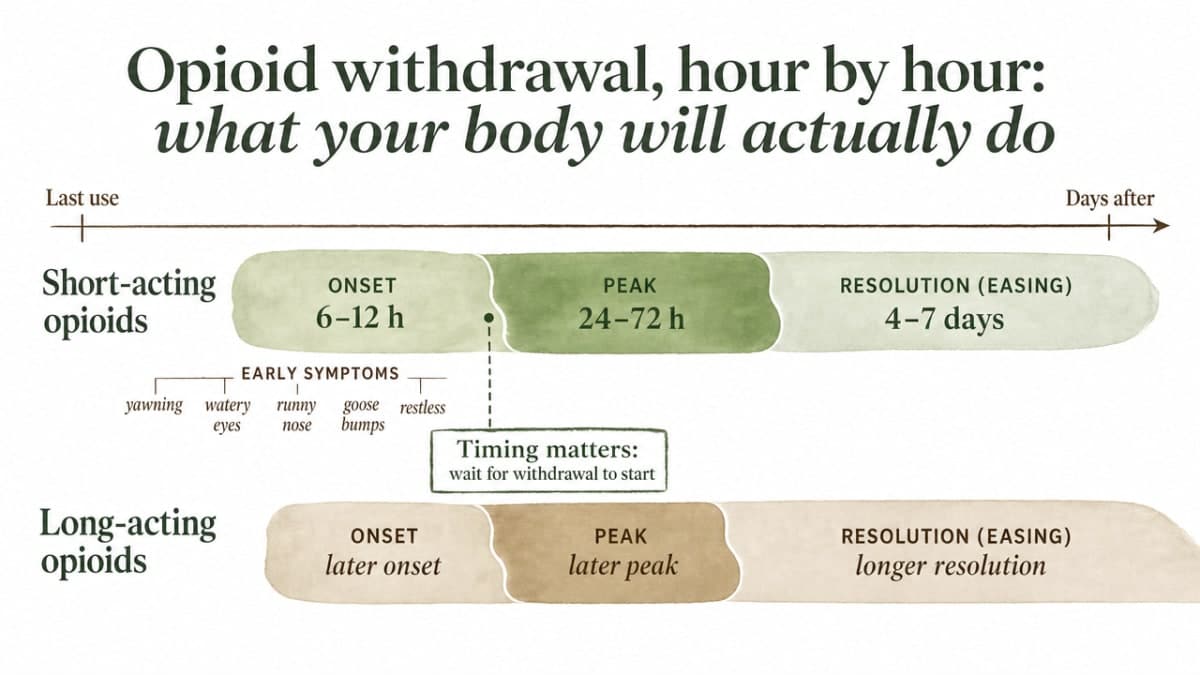
The timeline depends on what you were using. Short-acting opioids — heroin, oxycodone, hydrocodone, most street pills — usually start pulling out of your system within 6 to 12 hours of your last use. That’s when the early stuff shows up: yawning that won’t stop, watery eyes, a runny nose, goosebumps, a low restless feeling under your skin. Symptoms tend to peak somewhere between 24 and 72 hours in, then gradually ease over the next 4 to 7 days. Longer-acting opioids — methadone especially, and to some extent fentanyl, which behaves unpredictably because of how it gets stored in the body — take longer to start and longer to finish. The peak can arrive 3 to 5 days after your last use, and the tail can stretch past a week. Medically supervised withdrawal with medication support is the standard of care for opioid dependence for exactly this reason — the timeline is long enough and uncomfortable enough that gutting it out alone is neither necessary nor safe.12
The peak, whenever it lands for you, is where most people meet the symptoms they’ve been dreading. Muscle aches that feel like the flu turned up a notch. Stomach cramps, nausea, sometimes vomiting or diarrhea. Legs that won’t stay still — the classic “restless legs” that make sleep feel impossible. Anxiety that shows up out of nowhere. A craving so loud it feels like the only thing in the room. This is where the medication side of medical detox does its real work. Buprenorphine, one of the most common comfort medications for opioid withdrawal, doesn’t erase everything, but it turns the volume down significantly on the physical symptoms and cuts into the cravings.
The timing of that first dose matters, and it’s the one thing worth understanding before you walk in. If buprenorphine is given too soon — while there’s still enough of the original opioid in your system — it can push you into what’s called precipitated withdrawal, which is exactly what it sounds like: withdrawal getting suddenly worse instead of better. That’s why the team asks so carefully about your last use, and why they sometimes wait until you’re showing clear early withdrawal signs before starting. It isn’t hesitation. It’s the medication working the way it’s supposed to. With fentanyl, the wait can be longer than people expect because fentanyl lingers in fat tissue, and the team may use different comfort medications in the meantime — something for the nausea, something for the anxiety, something for the muscle aches — so you’re not just waiting in pain.
Day 4 or 5 is usually where the corner turns. The physical stuff starts to fade first — the sweating, the GI symptoms, the muscle aches. What often sticks around a little longer is the sleep disruption, the low mood, and the cravings. That’s normal, and it’s the reason detox isn’t the whole treatment. It’s the part where your body resets so your brain has a chance at the rest of it.
Day two and three: when the room gets quieter
By the middle of day two, something small but important shifts. You’re still uncomfortable — the muscle aches are probably at their loudest, and food still sounds like a bad idea — but the panic of not knowing what’s happening has lifted. You know the nurses by their first names now. You know which recliner in the common area is the good one. The building has stopped being a strange place.
This is also when the comfort medication is doing its steadiest work. If buprenorphine started on day one, the dose has usually been adjusted by now based on how your body actually responded, not on a guess. If the team is treating symptoms individually — something for the nausea, something for the sleep, something for the anxiety — those pieces are also getting fine-tuned. TIP 45’s guidance on medication-supported withdrawal is built around this kind of adjustment; the first dose is a starting point, not a final answer.12
A counselor will probably introduce themselves somewhere in here. Not for a deep session — you’re not ready for that yet, and they know it. More like a check-in. How are you sleeping. What’s on your mind. Whether you want them to help you make a phone call. TIP 45 treats that early rapport as part of the medical care, not a separate service.11
You might notice you’re hungry again. Toast, broth, something bland. That’s a real signal. The nurses will make a note of it, because eating is one of the quiet markers they watch for. The wearable on your wrist is doing the same thing in the background — heart rate settling closer to your baseline, sleep stretches getting a little longer, stress readings coming down from where they started.
By the end of day three, most people can sit up in bed and hold a conversation without their skin crawling. You’re not finished. But the worst hours of the timeline are behind you, and the person on shift can tell you that with a straight face because they’ve watched you get here.
Talking to your family without a script
One of the first questions people ask, once they can string a sentence together, is whether their mom or their partner knows they made it in. The answer is yes, if you want them to. Nobody calls anyone without your permission — that’s the law, not a courtesy. But most people do want the call made, even if they can’t quite handle making it themselves on day one.15
The staff can help with that. Someone will offer to text or call the person you listed at intake with a short update: you’re here, you’re safe, you’re resting. That’s often all a worried parent needs to sleep for the first time in weeks. Later, when you’re up to it, you can talk to them yourself. There isn’t a rehearsed script you’re supposed to follow. “I’m okay. It’s harder than I thought and easier than I thought. I love you.” That’s plenty.
Family involvement isn’t an add-on to detox — TIP 45 treats it as part of the care, because the people who love you are part of what comes after. If your partner wants to know how to help, the counselor can talk to them too, with your okay. You get to decide who hears what.11
What counseling looks like when you feel like garbage
Nobody is going to hand you a workbook on day two. The counselor who stops by while you’re still curled up under a blanket knows you can’t do inventory work when your legs won’t stay still. What they can do is sit in the chair by the window for ten minutes and ask how you’re holding up.
That’s what counseling looks like in detox. Short. Low-key. Sometimes just quiet company. The point isn’t to fix anything yet — it’s to start knowing the person you’ll be working with once you can think straight again. TIP 45 describes this early relationship-building as part of the medical care, because the connection you make now is what makes it easier to keep going after your body settles. Detox staff are also expected to encourage you to ask questions about what’s happening and what comes next, so “I don’t understand why I’m getting this medication” is a fair thing to say out loud.11,13
Some visits are practical. Do you want help calling your job. Is there a bill you’re worried about. Did you eat today. Some are heavier — a five-minute conversation about why you started, if you feel like talking about it, or a longer silence if you don’t. You get to set the pace. Feeling like garbage is not a disqualification from being helped. It’s the whole reason someone is sitting there.
If you’re a veteran, a woman, or living with another diagnosis
Not everyone walks in with the same story, and the plan shouldn’t pretend otherwise. TIP 45’s guidance on special populations makes the point plainly: detox works better when the protocol bends to fit the person in the bed, not the other way around.10
If you’re a veteran, that might mean a room on a track with other veterans, staff who don’t flinch at the language you use, and screening for PTSD or chronic pain running alongside the withdrawal care. If you’re a woman, it might mean a gender-specific space, extra attention to trauma history, and questions asked without a stranger of the opposite sex in the room. If you’re carrying another diagnosis — anxiety, depression, bipolar, an old heart condition, diabetes — the doctor on call folds that into your medication plan from hour one, not as an afterthought on day three.
You don’t have to advocate for any of this by yourself. When you name what’s true about you at intake, the team adjusts. That’s the point of the assessment.8
Your rights, your questions, and the word ‘no’
Here is something that gets left out of most detox brochures: you don’t stop being a person with rights when you check in. Under the ethical standards that govern detox care, you keep informed consent, confidentiality, and the ability to ask questions or refuse an intervention, except in narrow emergencies where safety is on the line. That means the medication being offered is being offered, not administered without explanation. If you want to know what it is, what it does, and what the alternatives are, that’s a fair conversation to have with the nurse or the doctor on call.15
“No” is a real word in that building. You can say it to a specific medication if you have a reason, a religious concern, or a bad past experience with it. You can say it to a phone call the staff was going to make on your behalf. You can say it to a visitor. The team may push back if the choice puts your safety at risk, and they should — that’s their job — but they explain, they don’t override.
Detox staff are also expected to encourage you to ask questions about what’s happening and what comes next, so “why” is never out of bounds. Not knowing is worse than asking.13
Discharge planning starts on day one
Here’s a small thing that changes the whole feel of a detox stay: the plan for what happens after you leave is being built from the first conversation, not scrambled together the morning you go home. When the counselor asks on day two whether you have a place to sleep, whether you have insurance, whether there’s someone at home who’s safe to be around — that’s discharge planning, quietly starting.
TIP 45 is direct about this. Detox is not the whole treatment; it’s the part where your body resets so the real work has a shot. Fostering entry into what comes next is one of the three things a medical detox is designed to do, alongside evaluation and stabilization. If a facility sends you out the door with a handshake and a phone number scribbled on a card, they’ve done part of the job and skipped the rest.1
By mid-week, someone will sit down with you and talk about options in plain terms:
- Residential treatment, where you stay somewhere for a few more weeks.
- Outpatient, where you sleep at home and come in for sessions.
- Medication maintenance, if buprenorphine is helping and it makes sense to keep going.
- Sober living, if home isn’t a safe place to land yet.
The counselor knows what’s available locally and can make the calls with you in the room.11
You get a say in this. What you agreed to on day one when your legs were restless isn’t binding on day five when you can think again. Ask questions. Change your mind. That’s the point.13
How to call without committing to anything
Here’s the part where most articles push you to admit yourself today. This one isn’t going to do that. If you’ve read this far, you already know more about what to expect during medical detox than most people ever will, and the next reasonable step is smaller than a commitment. It’s a phone call.
You can call Renewal Springs and just ask questions. You don’t have to give your full name. You don’t have to say when you last used. You don’t have to decide anything on that call. The person who picks up is used to hearing from people who are still sitting in their car, or still at the kitchen table, or still trying to figure out how to say the words out loud. Ask what you want to ask. What the room looks like. Whether your insurance covers the stay — benefits verification is free and doesn’t obligate you to come in. What happens if you show up and change your mind at the door. Whether your husband can call and check on you. TIP 45’s guidance is clear that staff should encourage questions about the process and what comes next, and that starts before you ever walk in.13
If tonight isn’t the night, that’s okay. Save the number. Call tomorrow. You’re not the first person to sit in a parking lot before walking in, and you won’t be the last.
Talk With Someone Who Truly Understands Detox
Get your questions answered and talk through your detox concerns with someone who cares.
Frequently Asked Questions
How long does opioid medical detox usually take?
Most opioid detox stays run about 5 to 7 days, though the exact length depends on what you were using and how your body responds. Short-acting opioids like heroin or prescription painkillers tend to move through the timeline faster than fentanyl or methadone, which can stretch the stay longer. The medical team adjusts based on how you’re actually doing, not a fixed calendar.12
Will I be given medication to help with withdrawal symptoms?
Yes. Medication-supported withdrawal is the standard of care for opioid dependence, and buprenorphine is one of the most common options because it eases the physical symptoms and quiets cravings. If a specific medication isn’t the right fit for you, the team can treat symptoms individually — something for nausea, something for sleep, something for muscle aches. You’ll be told what’s being offered and why before you take it.12,15
Can I talk to my family while I’m in detox?
Yes, with your permission. Nobody is called or told anything about you without your consent — that’s a legal protection, not a policy. Most people want a short update sent to a parent, partner, or adult child on day one, then talk directly once they’re feeling steadier. Family involvement is treated as part of the care, not a special favor.11,15
What happens if I have a medical emergency in the middle of the night?
You’re not alone in the building. Oklahoma rules require a licensed physician to be on site or on call 24 hours a day, seven days a week, with nursing and support staff present through the night. If your vitals shift, if you can’t stop vomiting, if something feels wrong — press the button, tell the nurse, or say it out loud. Someone comes.6
Can I change my mind or refuse a medication once I’m admitted?
Yes. You keep informed consent throughout the stay, which means any medication being offered is being offered — not administered without explanation. You can ask what it is, what it does, and what the alternatives are, and you can decline it. The team may push back if refusing puts your safety at risk, but the conversation happens with you, not around you.15
What happens after detox is finished?
Detox resets your body so the real work has a chance. Fostering entry into what comes next is built into the stay from day one, not added on at discharge. Options usually include residential treatment, outpatient programs, medication maintenance if buprenorphine is helping, or sober living. A counselor walks you through what’s available locally and can make the calls with you in the room.1,11
References
- Detoxification and Substance Abuse Treatment (SAMHSA TIP 45) – NCBI Bookshelf. https://www.ncbi.nlm.nih.gov/books/NBK64115/
- Quick Guide for Mental Health Professionals – Based on TIP 42 (Co-Occurring Disorders) and referencing TIP 45. https://library.samhsa.gov/sites/default/files/sma10-4531.pdf
- Quick Guide for Clinicians Based on TIP 45—Detoxification and Substance Abuse Treatment. https://nida.nih.gov/sites/default/files/samhsa_detoxification_and_substance_abuse_treatment.pdf
- Quick Guide for Administrators – Based on TIP 24 (Substance Abuse Treatment) with monitoring guidance. https://library.samhsa.gov/sites/default/files/sma12-3581.pdf
- SAMHSA TIPs and Publications Based on TIPs – NCBI Bookshelf. https://www.ncbi.nlm.nih.gov/sites/books/NBK572972/
- Oklahoma Administrative Code 450:18 – Standards and Criteria for Substance-Related and Addictive Disorder Treatment Facilities (2021 Chapter 18). https://oklahoma.gov/content/dam/ok/en/odmhsas/documents/policy/provider-certification/administrative-rules/2021/Chapter%2018%20Final%20effective%209-15-21.pdf
- Title 450 – Department of Mental Health and Substance Abuse Services, Chapter 18 Proposed Rules (2022). https://oklahoma.gov/content/dam/ok/en/odmhsas/documents/policy/provider-certification/proposed-rules/2022/Chapter%2018_2022%20PERM.pdf
- Chapter on Clinical Assessment in Detoxification and Substance Abuse Treatment (TIP 45) – NCBI Bookshelf. https://www.ncbi.nlm.nih.gov/books/NBK64164/
- Chapter on Settings, Levels of Care, and Patient Placement (TIP 45) – NCBI Bookshelf. https://www.ncbi.nlm.nih.gov/books/NBK64160/
- Chapter on Special Populations in Detoxification and Substance Abuse Treatment (TIP 45) – NCBI Bookshelf. https://www.ncbi.nlm.nih.gov/books/NBK64159/
- Chapter on Psychosocial and Biomedical Services in Detoxification (TIP 45) – NCBI Bookshelf. https://www.ncbi.nlm.nih.gov/books/NBK64158/
- Chapter on Pharmacological Approaches to Detoxification (TIP 45) – NCBI Bookshelf. https://www.ncbi.nlm.nih.gov/books/NBK64157/
- Chapter on Patient Education and Fostering Treatment Entry (TIP 45) – NCBI Bookshelf. https://www.ncbi.nlm.nih.gov/books/NBK64156/
- Chapter on Organizational and Administrative Issues in Detoxification (TIP 45) – NCBI Bookshelf. https://www.ncbi.nlm.nih.gov/books/NBK64155/
- Chapter on Legal and Ethical Issues in Detoxification (TIP 45) – NCBI Bookshelf. https://www.ncbi.nlm.nih.gov/books/NBK64154/