Key Takeaways
- Holiday drinking rises because the calendar stacks more occasions, cultural scripts hand out permission, and stress, grief, isolation, and shorter daylight push people toward alcohol as a coping tool.
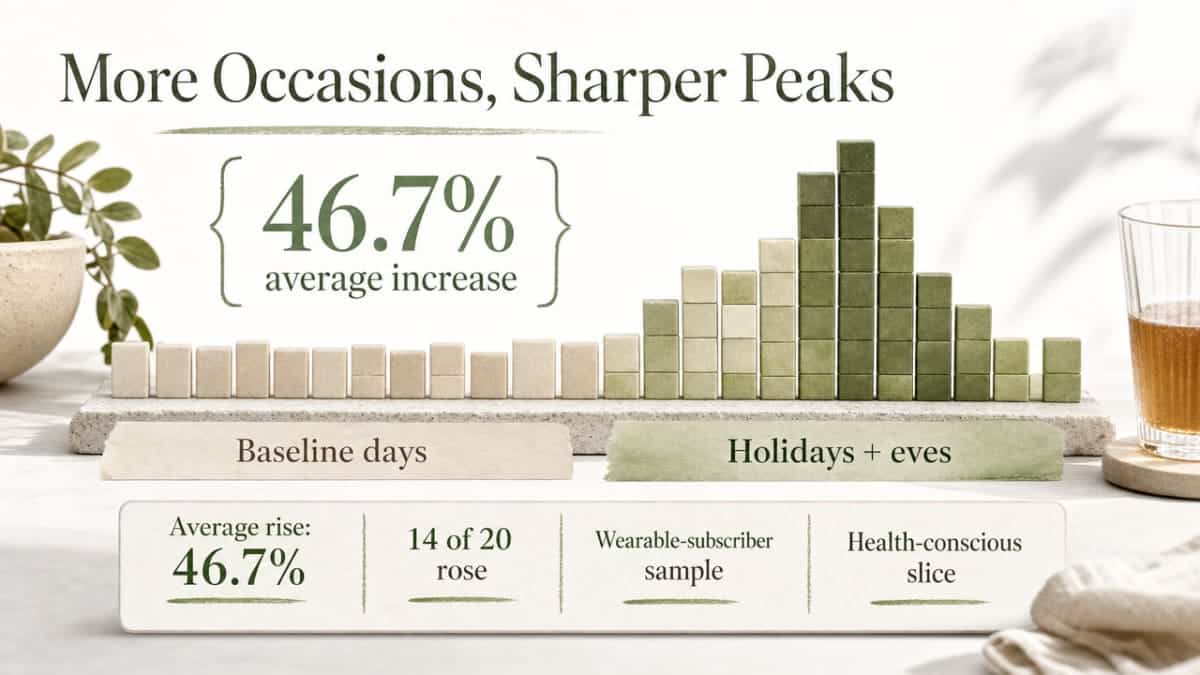
- Research shows measurable spikes during the season, with wearable data finding a 46.7% increase on most holidays 2 and Christmas Eve and New Year’s Eve emerging as the sharpest peaks 1.
- A four-part self-check on frequency, control, consequences, and physical signs separates a heavy season from a pattern that will still be present after the decorations come down.
- Quitting suddenly after heavy daily drinking can be dangerous, with withdrawal symptoms peaking 24 to 72 hours out and sometimes requiring medical supervision rather than willpower 11, 12.
The Season Has More Reasons to Pour
If you’ve noticed yourself drinking more between Thanksgiving and New Year’s Day, you’re not imagining it. The calendar itself changes. The office party on Thursday, the neighborhood open house on Friday, the family dinner on Saturday, the game on Sunday. What used to be a Tuesday is suddenly a reason. And every one of those gatherings tends to come with a glass in your hand.
Some of that is the simple math of more occasions. Some of it is harder. The CDC notes that stress, loneliness, social isolation, and certain mental health conditions can lead some people to drink more 7, and the holidays stack those pressures into a six-week window. Money gets tight. Family dynamics get complicated. The person who used to carve the turkey isn’t at the table anymore. The sun sets before you leave work. None of that is weakness. It’s weather, and alcohol is often the easiest shelter within reach.
This article is for you if the pattern has started to feel bigger than one bad night, or if you’re watching someone you love refill their glass more often than last year. We’ll walk through what the research actually shows, the real reasons the drinking climbs, and how to tell the difference between a season that passes and a signal that needs attention. You don’t have to decide anything today. You just have to keep reading.
What the Data Actually Shows About Holiday Drinking
More Occasions, Sharper Peaks
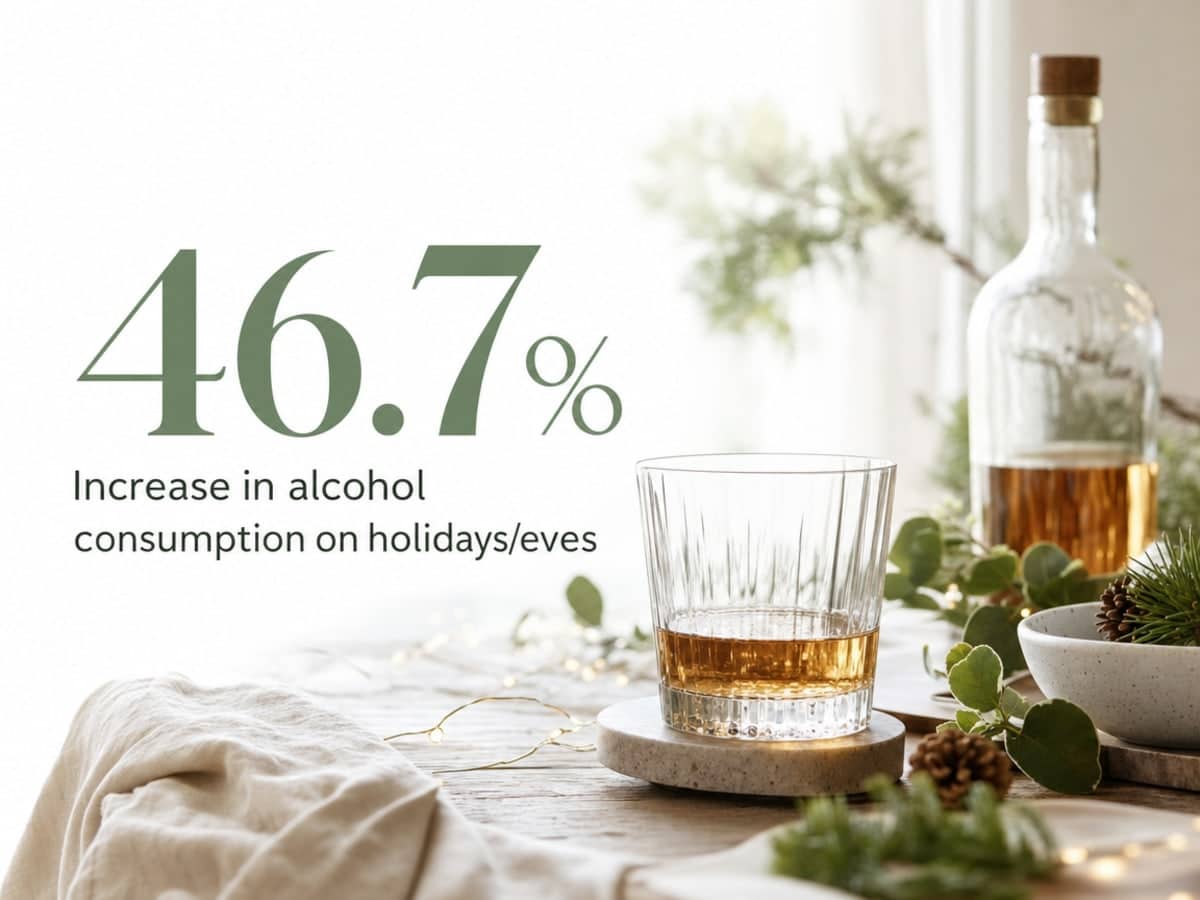
You already know the holidays feel heavier on your liver. The research backs up that feeling in a specific way. One study used wearable-device data to track alcohol use on federal holidays and the days leading up to them. Across 14 of 20 holidays and eves where consumption rose, drinking increased by an average of 46.7% compared with baseline days 2. That is almost half again as much alcohol, concentrated on a handful of calendar squares.
A couple of caveats matter here, because they help you place yourself in the data honestly. The people in that study were subscribers to a biometric wearable platform, which means they were already paying attention to their health in a way the average adult isn’t 2. So the number tells you how a health-conscious slice of the population shifts around holidays, not necessarily how your uncle does. If anything, that makes the spike more striking. These are people with Fitbits and sleep scores, and the calendar still moved them.
Older population-based work points the same direction. One analysis cited earlier research finding that alcohol consumption during the last two weeks of December ran about 70% higher than during typical weeks of the year, though the authors noted that sales figures and self-reports don’t always line up neatly 3. Different methods, different numbers, same shape. December pulls harder than most months. If your own drinking has climbed in that window, you are tracking a well-documented pattern, not inventing one.
Christmas Eve, New Year’s Eve, and the Days That Hit Hardest
Not every holiday weighs the same. When researchers in Toronto followed 578 adults who already drank at least monthly across a five-week winter holiday window, Christmas Eve and New Year’s Eve stood out as the sharpest peaks, with weekends amplifying the effect across the rest of the stretch 1. Those two nights carry a cultural weight the Tuesday after doesn’t.
The medical fallout tracks the same calendar. A 2023 integrative review pulled together 23 studies covering 46 different events and looked at whether alcohol-related emergency-department visits actually changed around holidays and large gatherings. For 27 of those 46 events, ED presentations went up. Christmas Eve, Christmas Day, New Year’s Eve, and New Year’s Day were flagged consistently as higher-risk days 5. The review was careful to note that results were not uniform across every event, every country, or every study design. A holiday on a page is not an automatic spike in the hospital. But those four winter dates kept surfacing.
What does that mean for you, sitting at your kitchen table in mid-December wondering if you’re overthinking this? It means the days you’re probably most worried about are the same days the research is most worried about. If New Year’s Eve has felt like the hardest night to stop at two drinks, that is not a personal failing dressed up as a party. It is a day with a documented pattern of pulling people past their usual limits, and the emergency rooms see the receipts 5.
More Drinkers vs. Heavier Drinkers
Here is a distinction that most holiday-drinking articles blur, and the blur matters. A holiday can raise the total alcohol consumed in a population two very different ways. Either more people pick up a drink who normally wouldn’t, or the same people who already drink pour heavier and faster. NIAAA’s review on high-intensity drinking draws that line clearly: some holidays mostly add new drinkers to the pool, while others crank up the intensity among people who were going to drink anyway 4.
That second pattern is the one worth paying attention to in yourself. The review notes that people often intensify drinking to celebrate and bond with friends, and among young adults, friend-centered holidays like New Year’s Eve were linked with more high-risk drinking than family-centered ones 4. You can be the same person on December 20th and December 31st and still consume dramatically different amounts, because the social script around the glass changed.
So when you’re trying to figure out what your holiday drinking actually looks like, don’t just count parties. Count ounces. Three gatherings where you had one glass of wine is a different pattern than one gathering where you had six. The data cares about which one you are, and so should you.
The Real Reasons the Glass Keeps Getting Refilled
Cultural Scripts and the Permission of the Calendar
There is a reason you don’t feel weird holding a glass of champagne at 11:58 p.m. on December 31st but you might feel weird holding one at 11:58 a.m. on a Wednesday in March. The calendar hands out permission slips. Toasts, cocktails before dinner, wine with the ham, beer with the bowl game, a nightcap because the in-laws finally went to bed. These are not personal choices so much as inherited rituals, and they travel with the season whether you asked for them or not.
That script matters because it quietly rewrites what counts as normal. Three drinks on a Tuesday in July would raise an eyebrow at your own kitchen table. Three drinks at a holiday party barely registers. You pour because everyone else is pouring, and the host keeps topping off your glass before you noticed it was half full. None of that is a character flaw. It’s choreography. The hard part is that choreography doesn’t care whether your body can keep up with it, and once the music stops in early January, some people find the glass is still in their hand.
Stress, Money, and Family Friction
The holidays are often described as warm. For a lot of people, they are also expensive, loud, and exhausting. You’re trying to buy gifts on a budget that already felt tight in October. You’re hosting people who have strong opinions about how the turkey should be cooked and stronger opinions about politics. You’re sleeping on a pullout couch in your sister’s basement, or hosting the sister who critiques your parenting between courses. Somewhere in there, a glass of wine starts looking less like a treat and more like a tool.
The CDC is direct about this: some people drink more when they’re stressed, lonely, isolated, or managing certain mental health conditions 7. The holidays stack several of those conditions on top of each other and then compress them into a few weeks. Add in travel delays, a credit card balance you’re trying not to look at, and the particular ache of a family argument that reopens every December, and you have a chemistry experiment with alcohol as the solvent.
If you’ve noticed that you’re reaching for a drink earlier in the day than you used to this time of year, or that one drink no longer takes the edge off the way it did, you’re not broken. You’re responding to real pressure with the fastest tool culture handed you. That doesn’t make it the right tool. It just makes the pattern understandable.
Grief at the First Holiday Without Someone
The first Christmas after a death is a specific kind of hard. So is the second, which nobody warns you about. The empty chair at the table, the ornament you can’t bring yourself to hang, the recipe in handwriting you’ll never see again. Grief has a way of showing up at holidays because the holidays were built out of the person who is no longer there.
Alcohol dulls that for an hour or two. It is honest to say that, because pretending it doesn’t is how people end up ashamed of coping the only way they knew how. The problem is that alcohol is a short loan at a very high interest rate. The grief is still there in the morning, and now it’s wearing a hangover, and the next evening the glass looks a little more necessary than it did the night before.
If this is your first holiday without someone, or your fifth, and the drinking has climbed with the grief, that connection is worth saying out loud to someone. It’s a reason, not an excuse, and reasons are what therapists, grief groups, and sometimes doctors can actually work with.
Shorter Daylight and Winter-Pattern Depression
By late December in Oklahoma City, the sun is setting before many people leave work. That shift does something to the body and the mood that is not just in your head. For a smaller group of people, it crosses into winter-pattern seasonal affective disorder, a depressive condition that commonly begins in late fall or early winter and can include oversleeping, increased eating, weight gain, and social withdrawal 6.
Most holiday sadness is not SAD. It’s important to be careful with that word. Feeling blue because your family is complicated or because January is going to be financially tight is not a diagnosis. But if you’re sleeping ten hours and still exhausted, pulling away from people you usually like, and finding that a few drinks in the evening feels like the only lever that lifts the fog, those are worth taking seriously as a pattern rather than a mood.
Alcohol and depression also feed each other. A drink can feel like a short reprieve from low mood, but it’s a depressant, and the day after tends to be heavier than the day before. If the shorter days are hitting you hard this year and the drinking has climbed alongside it, those two things are related, and both deserve attention from someone who can tell them apart.
Isolation, Even Inside a Full House
Loneliness at the holidays doesn’t always look like being alone. Sometimes it looks like being surrounded by people you love and still feeling unreachable. The cousin who always understood you moved across the country. The marriage you’re in has gone quiet in a way nobody at the table knows about. You’re the only sober-curious person in a room where the drinks are flowing, or the only one grieving, or the only one who lost a job this year and hasn’t told anyone yet.
Alcohol fills that gap quickly. It softens the room, loosens the tongue, makes it easier to laugh at jokes that aren’t quite landing. The CDC lists social isolation alongside stress and loneliness as a context in which people may drink more 7, and isolation inside a crowd is still isolation. If the glass has been doing the work of connection for you this season, that is worth noticing without judgment, because it tells you something true about what you actually need, which is not more wine. It’s someone to talk to who hears you.
Is This Still Just the Season? A Four-Part Self-Check
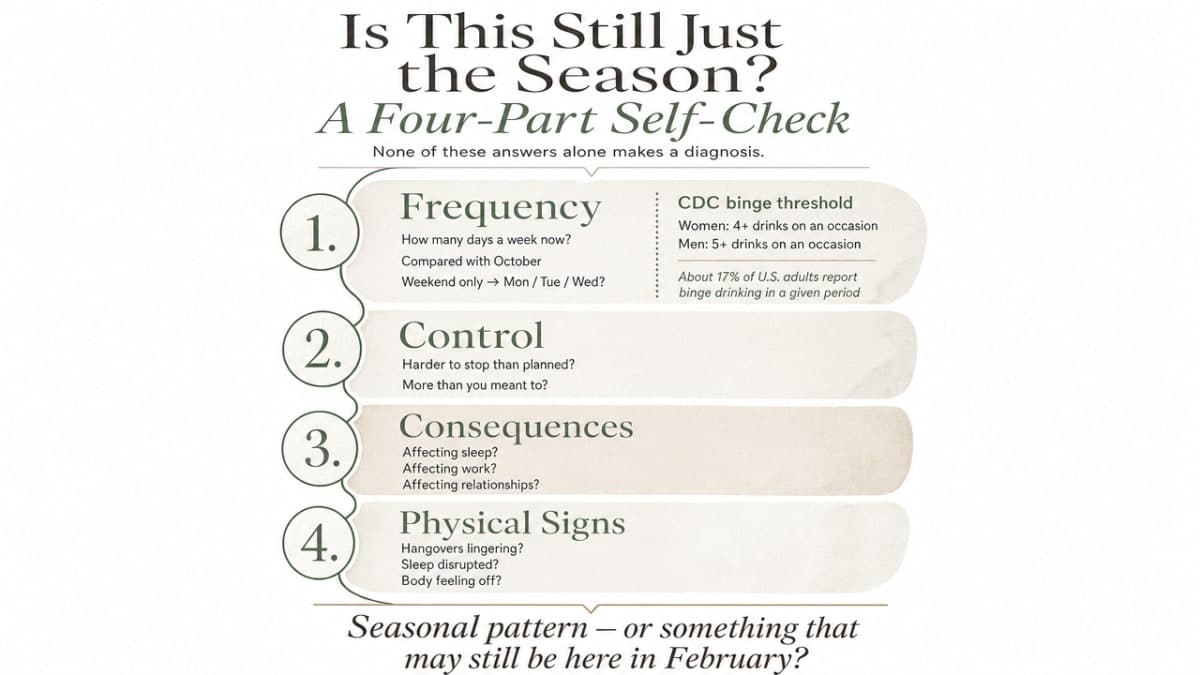
Somewhere between “I had a lot at the party” and “I think something is wrong” is a gap most people cross alone, usually at 1 a.m. with a glass of water they’re pretending will fix things. Here’s a four-part self-check that can give that late-night worry a shape. None of these answers alone makes a diagnosis. Together, they tell you whether you’re riding out a season or looking at something that will still be here in February.
- Frequency.
How many days a week are you drinking right now, compared with how many you were drinking in October? If you were a weekend drinker who’s now pouring Monday, Tuesday, and Wednesday because “it’s the holidays,” notice that. The CDC’s threshold for binge drinking is four or more drinks on an occasion for women and five or more for men, and about 17% of U.S. adults report binge drinking in a given period 9. If most of your holiday nights are clearing that bar, you’re not an outlier of celebration. You’re inside a defined pattern that public-health researchers specifically track.
- Control.
When you decide you’re going to have two, do you have two? Or do two become four without a clear memory of the pour between them? The question isn’t whether you ever go over. Most people do, especially at parties. The question is whether “I’ll stop” and “I stopped” are still landing in the same place.
- Consequences.
Has the drinking cost you something you cared about in the last six weeks? A morning you lost to a hangover. A conversation you regret. A workout you skipped. A credit card charge from a bar you don’t remember agreeing to. A spouse who said something quiet at breakfast. Consequences don’t have to be dramatic to count. They just have to be stacking.
- Physical signs.
When you don’t drink for a day, how does your body respond? Sweating, shakiness in your hands, a racing heart, trouble sleeping, nausea, or anxiety that feels bigger than your week should warrant are not signs of a bad mood. They’re early signals your body has started expecting the alcohol and is reacting to its absence. That one belongs in the next section, because it changes what you should and shouldn’t do on your own.
If you answered honestly and more than one of these landed, that’s information, not a verdict. Keep reading.
When Stopping Isn’t Safe on Your Own
The Withdrawal Timeline You Need to Know
If the last question in the self-check landed, this is the section to slow down on. Shaky hands in the morning, sweating when you haven’t moved, a heart that races before your coffee, a night of sleep that wouldn’t come without a drink. Those aren’t signs you need to white-knuckle through the next day sober. They’re signs your body has adapted to alcohol, and that pulling it away suddenly can get dangerous in a way most people don’t realize until they’re in it.
Here’s the timeline worth memorizing. Withdrawal symptoms can begin within about eight hours of your last drink. They commonly peak between 24 and 72 hours after that last drink, and that peak window is when things can turn 11. Early signs often look like anxiety, tremor, nausea, sweating, and insomnia. Severe signs can include seizures, fever, hallucinations, severe confusion, and irregular heartbeats 11. Those are not symptoms to Google at 3 a.m. and hope pass. Those are emergency-room symptoms.
What the timeline means for you is simple. If your body has gotten used to daily alcohol, the safest way to stop is with medical supervision, not willpower. A clinician can decide whether you need observation, medication, or a hospital bed. You don’t have to make that call alone. You just have to make one phone call to someone who can.
Why Mocktails and Boundaries Are Not Enough Here
Most holiday-drinking articles end with a tidy list. Order a club soda with lime. Eat before the party. Tell your sister you’re taking a break this year. Those are fine suggestions for a social drinker who wants to pull back. They are not clinical advice, and when the pattern has crossed into physical dependence, they can be worse than useless. They can be dangerous, because they leave you alone with a body that needs medical attention.
If you can take or leave a drink and want to drink less in January, mocktails and a plan are reasonable tools. The CDC backs that approach for event-based drinkers, including substituting nonalcoholic beverages and deciding on limits before you arrive 8. That is prevention, and it works for the people it’s designed for.
If you’re waking up shaky, drinking before noon to stop the shaking, or scared of what will happen if you don’t drink tonight, you are not in the mocktail chapter anymore. You’re in the one where somebody with a medical license needs to be in the room. That isn’t a failure. It’s the body telling the truth about where it is, and the right response is a phone call, not a Pinterest board.
If You’re in Oklahoma City and the Pattern Feels Bigger Than the Season
If you’ve read this far, you’re probably not just curious anymore. Something in the self-check landed, or the withdrawal timeline sounded closer to home than you expected. That’s hard to sit with. It’s also the moment most people wait too long on, because reaching out feels like a bigger admission than the drinking itself.
It isn’t. One phone call is smaller than one more bad morning.
Renewal Springs Detox is in Oklahoma City, and the phone is answered around the clock, including the morning after Christmas and the week of New Year’s when most offices are closed. The team is made up of licensed medical professionals who build a detox plan around your drinking history, your health, and what your body is actually doing right now, with 24/7 monitoring so the dangerous parts of withdrawal don’t catch anyone off guard. Benefits verification is free, which means you can find out what insurance covers before you commit to anything.
You don’t have to know what you want to do next. You just have to ask someone who does this every day what your options look like. If the pattern feels bigger than the season, that call is the next step, and it’s smaller than it feels from here.
Talk to Someone Who Understands Holiday Drinking
Get answers and support right now if seasonal drinking is becoming overwhelming.
Frequently Asked Questions
Is it normal to drink more during the holidays?
Yes, and the pattern is well-documented. The season stacks more drinking occasions into a short window, and cultural traditions put a glass in your hand at most of them. The CDC also notes that stress, loneliness, and social isolation can push some people to drink more 7. Common doesn’t mean harmless, though. It just means you’re not alone in noticing it.
How do I know if my holiday drinking has become a problem?
Look at frequency, control, consequences, and physical signs. Are you drinking more days than you used to? When you plan to stop at two, do you? Has the drinking cost you sleep, money, or relationships? Do you feel shaky or anxious when you don’t drink? If more than one of those lands, the pattern is worth a conversation with a doctor, not another month of waiting.
What are the signs of alcohol withdrawal I should watch for?
Early symptoms can start within about eight hours of your last drink and often peak between 24 and 72 hours 11. Watch for anxiety, tremor, sweating, nausea, and insomnia. Severe signs include seizures, fever, hallucinations, severe confusion, and irregular heartbeats 11. Severe symptoms are a medical emergency. If you’ve been drinking heavily for weeks and feel any of these when you stop, call a clinician.
Why do Christmas Eve and New Year’s Eve hit harder than other days?
Those two nights carry heavier cultural scripts than most. A Toronto study of adult drinkers across a five-week winter window found Christmas Eve and New Year’s Eve were the sharpest peaks 1. New Year’s Eve in particular pulls friend-centered high-intensity drinking among younger adults 4. The combination of late hours, toasting rituals, and permission to “go big one night” is what makes those dates land hardest.
Is it safe to quit drinking cold turkey after heavy holiday use?
Not always, and that matters. NIAAA warns that withdrawal can be life-threatening when someone who has been drinking heavily and chronically stops suddenly, and some people need inpatient detoxification 12. If you’ve been drinking daily through the holidays, especially in binge-level amounts, don’t white-knuckle a January 1 reset alone. Talk to a medical provider first. They can decide whether you need supervision, medication, or a hospital setting.
What should I do if a family member’s holiday drinking worries me?
Say something, gently and specifically, when they’re sober. Name what you’ve noticed, not what you’ve concluded. Avoid ultimatums at the dinner table. If they’ve been drinking heavily and you’re worried about them stopping suddenly, don’t push them to quit on their own—withdrawal can be dangerous 11. Offer to help them make one phone call to a medical detox program. That is a small ask that opens a real door.
References
- Event-Specific Drinking in the General Population. https://pmc.ncbi.nlm.nih.gov/articles/PMC4211338/
- Sleep and Alcohol Use Patterns During Federal Holidays and Daylight Saving Time Transitions. https://pmc.ncbi.nlm.nih.gov/articles/PMC9309397/
- Monthly variations in self-report of time-specified and typical alcohol consumption in a population-based survey. https://pmc.ncbi.nlm.nih.gov/articles/PMC4360933/
- High-Intensity Drinking. https://arcr.niaaa.nih.gov/media/606/download
- Alcohol-Related Presentations to Emergency Departments on Days with Holidays, Social, and Sporting Events: An Integrative Literature Review. https://pmc.ncbi.nlm.nih.gov/articles/PMC10694469/
- Seasonal Affective Disorder. https://www.nimh.nih.gov/health/publications/seasonal-affective-disorder
- Facts About U.S. Deaths from Excessive Alcohol Use. https://www.cdc.gov/alcohol/facts-stats/index.html
- Check Your Drinking. https://www.cdc.gov/alcohol/checkyourdrinking/index.html
- Data on Excessive Alcohol Use. https://www.cdc.gov/alcohol/excessive-drinking-data/index.html
- Understanding Alcohol Use Disorder. https://www.niaaa.nih.gov/publications/brochures-and-fact-sheets/understanding-alcohol-use-disorder?bid=bid_bc16e1cb726c9b7936910f2943dcd0c1
- Alcohol withdrawal: MedlinePlus Medical Encyclopedia. https://medlineplus.gov/ency/article/000764.htm
- Alcohol Use Disorder: From Risk to Diagnosis to Recovery. https://www.niaaa.nih.gov/health-professionals-communities/core-resource-on-alcohol/alcohol-use-disorder-risk-diagnosis-recovery