
Key Takeaways
- Relapse patterns that collapse at the same point often signal an untreated mental health condition — anxiety, PTSD, depression, ADHD, or insomnia — that the substance was quieting underneath.
- The highest-risk window is not detox itself but weeks two through eight after discharge, where one cohort saw 76.1% relapse at a median of 54 days.5
- Integrated care means one intake, one plan, and one team handling both diagnoses together, an approach NIH guidance calls consistently superior to treating each condition separately.9
- Before committing to a program, press for specifics on post-detox continuity, assertive outreach, lapse planning, and — for veterans — concurrent PTSD and substance use treatment.3
The quit attempt that keeps collapsing at the same place
You know the shape of it by now. The first three days feel like something you can white-knuckle through. Day five, you sleep badly. Day seven, an old feeling shows up — the panic that comes out of nowhere, the flatness that makes the couch feel like quicksand, the memory that arrives uninvited at 2 a.m. — and by day ten you are back where you started, wondering what is wrong with you.
Probably nothing is wrong with you in the way you think.
If you have tried to quit before and it collapsed at roughly the same place each time, that pattern is telling you something. It is not evidence that you lack willpower. It is evidence that something underneath the substance use kept firing, and the substance was the thing quieting it down. When you took the substance away without treating what it was covering, the covered thing came back louder.
That is the honest starting point for this article. Not a definition. Not a lecture. A recognition of what you have already lived.
What follows is a plain look at why co-occurring conditions — anxiety, depression, PTSD, untreated ADHD, chronic insomnia — pull people back into use, and what a co-occurring-disorder-treatment-programs that handles both problems at the same time actually looks like after medical detox. Reading this is a step. Not the whole road, but a real one. Keep going.
What was actually pulling you back
The mental health condition you were treating as a personality flaw
Here is something worth sitting with for a minute. The traits you have been calling weakness — the racing thoughts at 3 a.m., the dread that shows up before anything has gone wrong, the way a small conflict at work can flatten you for three days — those are usually not who you are. They are symptoms.
Anxiety is a symptom. Depression is a symptom. The hypervigilance after something bad happened is a symptom. So is the ADHD that made every job feel impossible until a drink or a pill quieted the noise. When a symptom goes untreated for long enough, you stop seeing it as a symptom. You start seeing it as your personality. And then when you try to quit the substance, you are not just facing withdrawal — you are facing the raw, unmedicated version of a condition you have never actually treated.
No wonder it feels unbearable.
The clinical world calls this a co-occurring disorder, which is a clinical way of saying two things are happening at once and they feed each other. Integrated treatment exists because both problems have to be addressed, or the one you leave untreated will keep reaching for the other. That is not a moral failure. That is a mechanism. And mechanisms can be interrupted with the right plan.
How untreated symptoms manufacture cravings
Cravings do not appear out of thin air. They are usually the last link in a chain that started hours or days earlier, and if you trace the chain back, you will often find a symptom you were not treating.
Start with sleep. When anxiety or depression or PTSD is active, sleep breaks down. You lie awake, or you wake at 4 a.m., or you sleep but never feel rested. NIDA is direct about this: sleep disruption raises craving and relapse risk, and co-occurring conditions are usually better treated at the same time rather than one after the other. A brain that has not slept properly for a week is a brain that will reach for whatever quiets it down.1
Then add avoidance. If you have PTSD, certain memories are unbearable, so you avoid them — until they show up anyway. If you have social anxiety, you dread the meeting, so you drink before it. If you have depression, you cannot face the pile of unopened mail, so you numb out instead. The substance was never really about the substance. It was doing a job.
Craving is what happens when the job stops getting done and the underlying condition is still firing.
This is why willpower feels like it is running uphill. You are not fighting the drink. You are fighting the panic the drink was covering, and the insomnia the drink was flattening, and the trauma response the drink was muting. Treat those, and the chain gets shorter. Leave them alone, and the chain rebuilds itself every few days.
The post-detox window is where relapse actually happens
Detox is not the finish line. It is the doorway. And the first few weeks after you walk through it are the most fragile part of the whole process — which is not a warning meant to scare you, but a fact worth planning around.
Here is the data that should shape how you think about what comes next. A 2024 retrospective cohort study followed 318 admissions for hospital-based substance use disorder treatment and tracked what happened after discharge. During follow-up, 76.1% of patients relapsed, and the median time to relapse was 54 days. Outpatient follow-up after discharge was independently associated with a reduced risk of relapse.5
Read that again slowly. Not because it is meant to discourage you — but because it changes what you plan for.
This is why what happens after detox matters more than most people realize when they are still white-knuckling through the first 72 hours. The plan for weeks two through eight is where relapse prevention actually lives. That means a real handoff — not a discharge packet and a phone number, but a scheduled next appointment, a therapist who already knows your story, a medication plan that continues without a gap, and someone checking in on the days when it would be easy to disappear.
Outpatient follow-up cut relapse risk in that cohort for a reason. Continuity is the intervention. If your last quit attempt collapsed somewhere in the second month, that was not a personal failure — it was the shape of the risk curve, meeting a plan that ended too early. Building the next attempt around that window, instead of pretending it doesn’t exist, is one of the most concrete things you can do differently this time.5

What integrated care actually looks like in practice
One assessment, one plan, one team
The clearest sign that a program is actually integrated — and not just marketing itself that way — is what happens at intake.
In a non-integrated setup, you tell your story twice. Once to the addiction counselor, who focuses on substances and treats the anxiety as background noise. Once to the mental health provider, who focuses on symptoms and treats the drinking as a separate problem you’ll address later. Two charts. Two treatment plans. Two schedules that may or may not talk to each other. And you, in the middle, translating between them.
Integrated care collapses that into one intake, one assessment that looks at both conditions together, and one treatment plan written by a team that shares information. NIH clinical guidance is direct on this: integrated treatment for co-occurring substance use and mental illness has been found consistently superior to treating each diagnosis separately. Not because any single therapy is magic, but because the plan itself stops splitting you in half.9
What that looks like day to day is small but decisive. The therapist knows what medication the prescriber started. The prescriber knows what trigger came up in group. When your sleep breaks down in week three, someone connects it to the depression instead of writing it off as “just detox.” One assessment. One plan. One team pulling in the same direction. That is the structural piece most failed quit attempts never had.
The components that do the real work
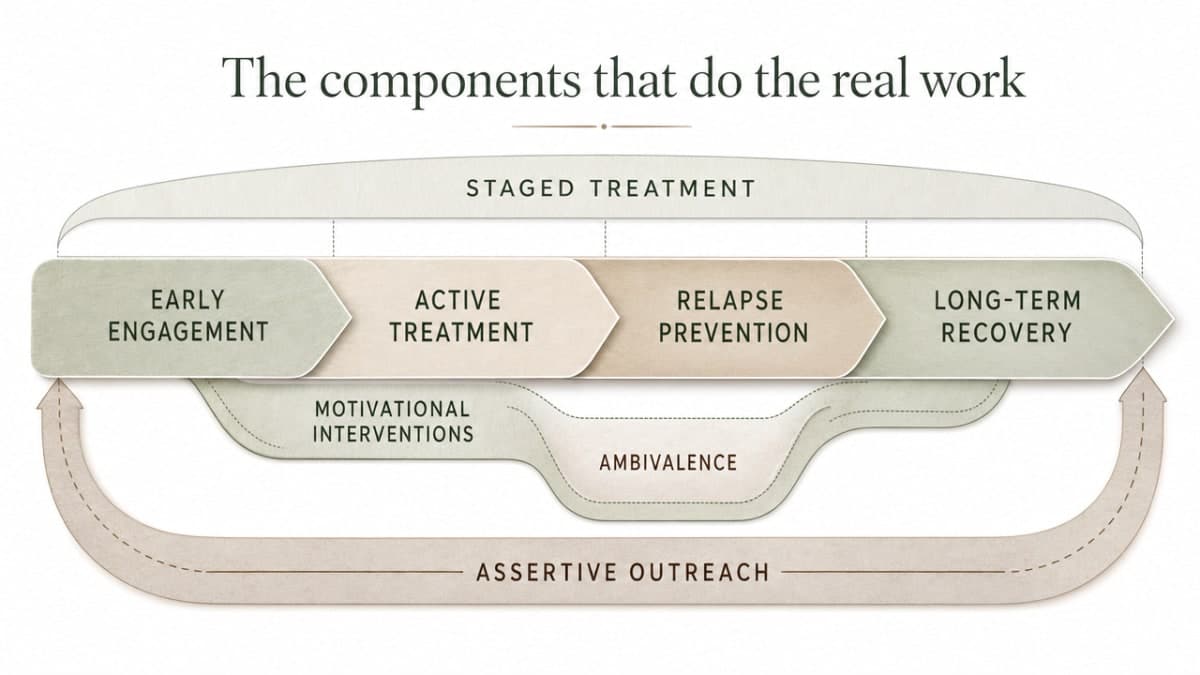
Once the plan exists, the question is what actually goes into it. A real integrated program is not a single therapy repeated in a loop. It is a set of components that each do a specific job, layered over time.
SAMHSA’s evidence synthesis names the core building blocks, and the list is worth knowing by heart if you are evaluating a program 2.
- Staged treatment means the plan meets you where you are — early engagement looks different from active treatment, which looks different from relapse prevention, which looks different from long-term recovery. Nobody expects you to be in the same place in week two as week twenty.
- Assertive outreach means the program comes toward you when you go quiet, instead of waiting for you to reappear after a bad week.
- Motivational interventions meet you honestly about ambivalence — the part of you that wants to quit and the part that isn’t sure yet, both taken seriously.
- CBT-based relapse prevention teaches the actual mechanics of noticing a trigger, sitting with a craving, and choosing a different move.
- Long-term community care extends the plan past discharge into the months where relapse actually happens.
NIH clinical guidance adds the concrete relapse-prevention skills that live inside those components: coping with cravings, lifestyle changes that make recovery easier to sustain, and — this one matters — a plan for managing lapses without turning a slip into a full relapse. You are going to have hard days. A real program teaches you what to do on them, before they arrive.8
What this list is not: a menu where you pick one item. A program that offers CBT but has no continuing care is missing the piece that would have caught you at week eight. A program with strong medication management but no coping-skills work leaves you dependent on the prescription doing all the lifting. The components work because they overlap. Each one covers a moment the others don’t.
If a program cannot describe how these pieces connect for you specifically, that is worth noticing.
Where medication fits without replacing the work
Medication is often the piece people either overweight or dismiss. Both moves cost you.
In integrated care, medication is one lane, not the whole road. If depression has been driving your relapses for years, an antidepressant that actually reaches a therapeutic dose can lower the pressure the substance was releasing. If cravings are the loudest thing in the room, medication-assisted treatment for opioid or alcohol use disorder can quiet that noise enough for the therapy work to land. NIH guidance frames this plainly — medication belongs alongside CBT, motivational work, and recovery supports, not instead of them.9
The honest version is this. A pill will not teach you what to do at 9 p.m. when the old cue shows up. Therapy alone may not be enough when your baseline anxiety is still turned up to a level that makes any coping skill feel useless. The two pieces are doing different jobs. When they run in parallel, inside the same plan, with the prescriber and the therapist actually talking, you get the benefit of both.
The question to ask is not “do I need medication or therapy.” The question is whether the program can adjust either lane as your recovery changes — and whether they will tell you honestly when something is or isn’t working.
An honest look at what the evidence does and doesn’t say
You deserve the real picture here, not a sales version of it. And the real picture is more encouraging than the doom you might be carrying — but it is not a guarantee, and pretending otherwise would insult what you have already been through.
Here is what the evidence is clear about. Treating a substance use disorder and a mental health condition together, inside the same plan, produces better mental health outcomes than treating them separately. NIH clinical guidance describes integrated treatment as consistently superior to diagnosis-by-diagnosis care. A 2024 umbrella review pulling together 30 systematic reviews reached a similar conclusion: integrated treatment usually beats treatment as usual or parallel uncoordinated services for mental health outcomes. If your anxiety, depression, or trauma response has been driving the whole cycle, integrated care is the approach the research most supports.9,10
Here is where the picture gets more honest. A 2023 systematic review comparing integrated and non-integrated treatment found that integrated care clearly improved psychiatric symptoms, but did not show a significant advantage over non-integrated care for substance-use outcomes or retention specifically. The 2024 umbrella review noted, in the same spirit, that sequential care can sometimes match integrated care depending on how it is delivered. Nobody has proven that one specific model erases relapse risk.6,10
What that means for you, plainly: integrated care is your best available bet, especially if untreated mental health symptoms have been the engine of your relapses. But the program’s quality, the continuity after discharge, and your relationship with the team will matter as much as the label on the door. Choose a real one, and give it the time it needs.7
If you’re a veteran, or love one: PTSD and substance use
This one is for a narrower audience — veterans, and the families sitting next to them. If that isn’t you, the shape of what follows still applies to anyone whose substance use grew up alongside trauma.
PTSD and substance use tend to travel together, and the old approach was to treat one and wait on the other. Get sober first, then we’ll deal with the trauma. That order does not work for most people, because the trauma is often the thing driving the use. Sit with untreated PTSD long enough and the substance starts looking like the only tool that reliably quiets it — until it doesn’t, and then the cycle restarts.
VA guidance is clear on this. Patients with co-occurring PTSD and substance use disorder should be offered evidence-based treatment for both conditions, and one diagnosis should not block treatment for the other. That guidance names integrated approaches like COPE, which combines prolonged exposure therapy for PTSD with relapse-prevention work for substance use — inside the same plan, with the same team. Current VA policy goes further, recommending concurrent treatment of SUD and co-occurring disorders and requiring residential mental health programs to provide integrated care rather than sequential handoffs.3,4
What to ask, plainly: does the program treat PTSD and substance use in the same plan, at the same time, with providers who talk to each other. If the answer is “finish detox and we’ll refer you out for the trauma piece later,” that is the older model — and it is the one that has repeatedly left veterans stuck in the same loop.
Questions to ask before you commit to a program
You have already done the hard part — the honest look at what wasn’t working. Turning that honesty into the right next call takes a short list of questions, asked out loud, before you sign anything.
Here is what to ask, and why each one matters.
Do you assess mental health and substance use in the same intake, with one team writing one plan? If the answer involves two separate intakes or a referral out for the mental health piece, that is the older model — the one that leaves gaps.9
What happens in weeks two through eight after I leave? Ask for specifics. A scheduled next appointment before discharge. A therapist who already has your history. A medication plan that continues without a gap. Outpatient follow-up is one of the few things research directly ties to lower relapse risk.5
How do you handle the days I go quiet? A real program has assertive outreach built in — someone reaches toward you when you disappear, instead of waiting.2
What is your plan for a lapse that isn’t a full relapse? If the answer is “start over,” keep looking. A good program teaches you what to do on a hard day before it arrives.8
If I’m a veteran, do you treat PTSD and substance use in the same plan at the same time?3
You are allowed to ask all of these. A program worth your time will answer them plainly.
What a next step can look like from here
You’ve done the honest work of reading this far. That counts, even if it doesn’t feel like it yet.
A real next step is smaller than the whole recovery. It’s one phone call to a program that can assess both the substance use and whatever has been firing underneath it — in the same intake, on the same day, with one team. That is the door. Ask the questions from the last section. Listen for whether the answers are specific.
If you’re in Oklahoma and detox is the piece you need first, Renewal Springs Detox can verify your insurance and walk you through what a medically supervised start looks like, along with the handoff into the weeks that come after.
Whatever program you choose, plan for weeks two through eight before you leave. That is where the last attempt likely ended. It doesn’t have to be where this one does.
Talk Directly With a Specialist About Co-occurring Recovery
Get expert answers and immediate support for your co-occurring disorder recovery path.
Frequently Asked Questions
What is a co-occurring disorder treatment program?
It’s a program that treats a substance use problem and a mental health condition — like anxiety, depression, PTSD, or ADHD — inside the same plan, at the same time, with one team sharing information. Instead of sending you to two separate providers who don’t talk to each other, one intake looks at both problems together and one treatment plan addresses how they feed each other.9
Why do I keep relapsing after detox even when I really want to stop?
Wanting to stop is not the missing piece. Usually something underneath the substance use — untreated anxiety, trauma, depression, insomnia — keeps firing after detox, and the substance was quieting it. When that condition goes untreated, cravings rebuild on their own schedule. Sleep disruption and unresolved symptoms raise relapse risk, which is why treating both problems together tends to work better than treating them one at a time.1
How is integrated treatment different from getting mental health care and addiction care separately?
In separate care, you tell your story twice, get two treatment plans, and translate between two providers who may never speak. Integrated treatment uses one assessment, one plan, and one team, so the therapist knows what the prescriber started and the prescriber knows what came up in group. NIH clinical guidance describes integrated treatment for co-occurring substance use and mental illness as consistently superior to treating each diagnosis separately.9
Do I have to have a formal mental health diagnosis before starting?
No. A real integrated intake includes screening for both substance use and mental health symptoms — that’s part of the assessment, not a prerequisite. If something is firing underneath the substance use, the team’s job is to identify it and build the plan around it. You do not need to arrive with paperwork or a label. You need to be honest about what you’ve been feeling and what has been happening.2
Does medication have to be part of the plan?
Not always, but often it helps. Medication for depression, anxiety, or a substance use disorder can lower the pressure enough for therapy to actually land. It doesn’t replace the work of learning coping skills or building continuing care — it runs alongside it. NIH guidance frames medication as one lane inside integrated care, not the whole road, and the plan should adjust as your recovery changes.9
What should a veteran with PTSD and substance use ask about specifically?
Ask whether the program treats PTSD and substance use in the same plan, at the same time — not detox first, trauma later. Ask if they use evidence-based trauma-focused approaches such as COPE, which combines prolonged exposure with relapse-prevention work. VA guidance is clear that one diagnosis should not block treatment for the other, and current VA policy requires concurrent treatment of substance use and co-occurring disorders.3,4
References
- Co-Occurring Disorders and Health Conditions. https://nida.nih.gov/research-topics/co-occurring-disorders-health-conditions
- Integrated Treatment for Co-Occurring Disorders: The Evidence. https://library.samhsa.gov/sites/default/files/ebp-kit-the-evidence-10242019.pdf
- Treatment of Co-Occurring PTSD and Substance Use Disorder in VA. https://www.ptsd.va.gov/professional/treat/cooccurring/tx_sud_va.asp
- May 15, 2025. https://www.govinfo.gov/content/pkg/CMR-VA1-00199365/pdf/CMR-VA1-00199365.pdf
- Relapse following Hospital-Based Treatment of Substance Use Disorders: A Retrospective Cohort Study. https://pubmed.ncbi.nlm.nih.gov/38367999/
- Integrated vs non-integrated treatment outcomes in dual diagnosis disorders: A systematic review. https://pmc.ncbi.nlm.nih.gov/articles/PMC10157410/
- Dual diagnosis: A systematic review of the organization of community health services. https://pubmed.ncbi.nlm.nih.gov/31957528/
- Chapter 5—Strategies for Working With People Who Have Co-Occurring Disorders. https://www.ncbi.nlm.nih.gov/books/NBK571013/
- Common Comorbidities with Substance Use Disorders. https://www.ncbi.nlm.nih.gov/books/NBK571451/
- Effectiveness of psychosocial interventions for adults with substance use disorder that have a co-occurring mental health disorder: an umbrella review and illustrative cost-effectiveness analysis. https://www.ncbi.nlm.nih.gov/books/NBK623438/