
Key Takeaways
- Confidential detox care in Oklahoma City rests on two overlapping legal layers: federal 42 CFR Part 2 and Oklahoma Administrative Code 450:15-3-20.1, which protects your identity as a patient itself.3
- Oklahomans in licensed professions, small towns, or public-facing roles should know that facilities generally cannot confirm patient status to employers, boards, family, or callers without written consent.1,2
- Before choosing a program, compare how admissions handles the first call, what goes into your file, consent options for family or care coordination, and how discreet arrival logistics work.
- Exceptions to confidentiality are narrow and worth understanding upfront: qualifying medical emergencies, specific court orders, mandated abuse reports, and bounded regulatory audits — not employer inquiries or subpoenas alone.2,5
When Privacy Is the Reason You Haven’t Called Yet
You’ve been carrying this for a while. Maybe the phone has been in your hand more than once, and something stopped you before you could dial. Not the cost. Not even the fear of withdrawal. Something quieter and heavier: what if someone finds out?
If you work a job where your name is on a license, a badge, a marquee, or a church bulletin, that worry has a specific weight. If you live in a town where the same people show up at the grocery store, the gas station, and your kid’s ball games, it has another. You’re not being dramatic. You’re being careful. And you’re not the first Oklahoman to sit with the phone and hesitate.
Here’s what’s worth knowing before you decide anything else: confidentiality in a detox setting is not a favor a facility grants you. It’s the legal starting point. Federal rules built specifically for substance use disorder records exist for exactly this reason — to make it safer for people to ask for help without their identity, diagnosis, or treatment becoming public. Research on why people avoid treatment points at the same thing you’re feeling right now: fear of being labeled, and fear that treatment will be disclosed, keep people out of care they need.1,10
This article walks through what “confidential” actually means once you’re inside a detox program — who can know, who can’t, what gets written down, and what a discretion-first first phone call with a place like Renewal Springs actually sounds like. No absolute promises. Just the honest picture, so you can decide whether to make the call.
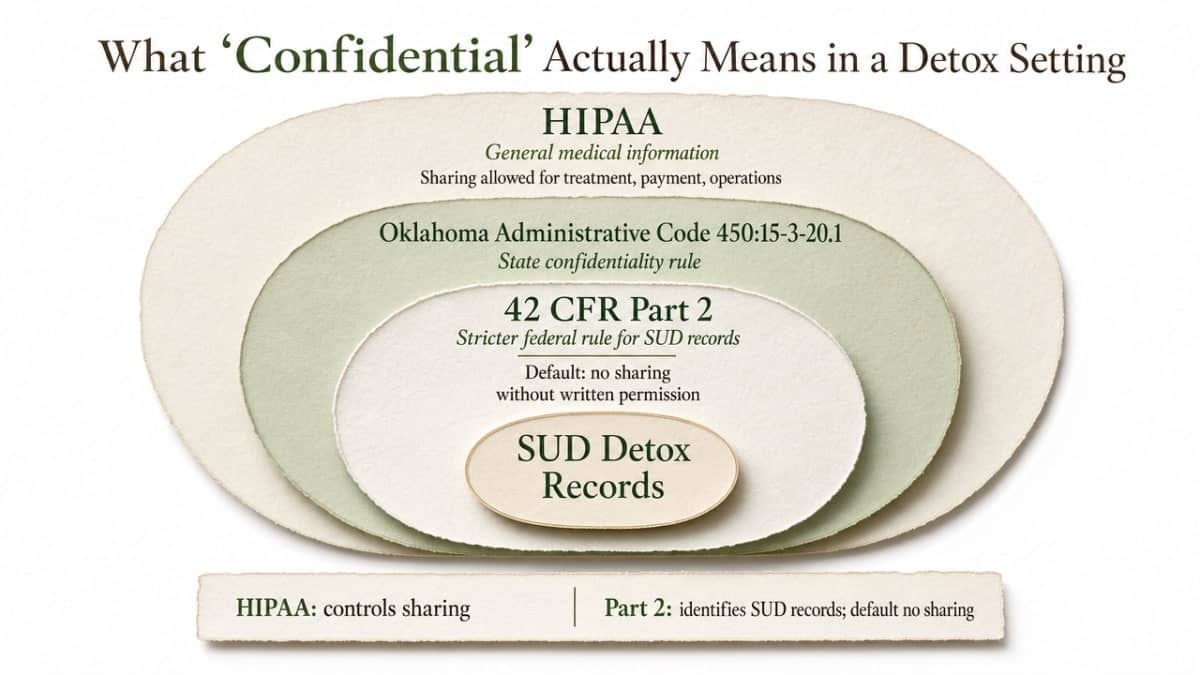
What ‘Confidential’ Actually Means in a Detox Setting
The Federal Rule Most People Have Never Heard Of: 42 CFR Part 2
You’ve probably heard of HIPAA. Most people have. What most people haven’t heard of is a second, stricter federal rule that sits on top of HIPAA specifically for substance use disorder records. It’s called 42 CFR Part 2, and it exists for one reason: to make it safer for people to ask for help.
Here’s the plain-language difference. HIPAA protects your general medical information and controls who your providers can share it with. It allows a fair amount of sharing between doctors, hospitals, and insurers for treatment, payment, and health care operations. Part 2 goes further. It protects records that would identify you as someone who has, or has ever had, a substance use disorder — and by default, those records can’t be shared at all unless you give written permission or a narrow legal exception applies.1,2,9
The most striking piece, and the one worried readers should hear clearly: Part 2 records generally can’t be used against you in civil, criminal, administrative, or legislative proceedings without your specific consent or a court order that meets particular findings. That’s a level of protection standard medical records don’t have. A regular hospital chart might be subpoenaed. A Part 2 SUD record faces a much higher bar.2,5
Part 2 applies to federally assisted programs that provide SUD diagnosis, treatment, or referral, and it covers detox. Federal guidance describes the goal directly: protect the confidentiality of patient records so people will actually seek treatment without fearing that reaching out becomes a permanent, searchable public fact.1,7
That’s the framework quietly working behind the scenes when you make the call. You didn’t have to negotiate for it. It’s already there.
How Oklahoma Law Treats Your Identity as a Patient
Federal rules are the floor. Oklahoma adds its own layer, and the state code says something worth reading twice.
For an Oklahoman who lives in a small town, works a public-facing job, or belongs to a tight faith community, that language matters. It means an Oklahoma detox facility isn’t just protecting what happens inside your file. It’s also protecting the answer to the question, “Is that person a patient here?”
The rule works alongside federal law, so the two systems reinforce each other. Communications between you and your treating clinicians are privileged. Records are confidential. Your name on a patient list is confidential. There are still lawful exceptions — the code cross-references other Oklahoma statutes on access and disclosure — and we’ll walk through those honestly in a later section.3
But the starting point is strong, and it’s written into state code. You don’t have to hope a facility chooses to be discreet. Discretion is the default the law asks for.
The 2024 Update: Single Consent, Redisclosure Limits, and Care Coordination
Part 2 got a significant update. The final rule took effect April 16, 2024, and it changed a few things in ways that matter to you as a patient.4
Before, patients often had to sign a fresh consent form every time their SUD information moved between providers — one for the family doctor, one for the counselor, one for the pharmacy. That created friction and, honestly, more paperwork touching your file than most people wanted. The 2024 rule allows a single, general consent for future uses and disclosures for treatment, payment, and health care operations, so care can move with you without you having to sign the same form again and again.4,8
Two important guardrails stayed firmly in place:2,4,8
- Redisclosure is still restricted — a provider who lawfully receives your Part 2 record can’t just pass it along to anyone.
- The prohibition on using SUD records in civil, criminal, administrative, or legislative proceedings without your consent or a qualifying court order is preserved.
What changed is flexibility for your care. What didn’t change is protection from your record being used against you.
There’s one more piece coming. Starting February 16, 2026, HIPAA-covered entities will be required to include specific SUD confidentiality language in their Notice of Privacy Practices, and Part 2 programs must issue a new patient notice aligned with HIPAA. Translation: the way facilities explain your privacy rights at intake is getting clearer, not looser. The direction of federal expectations around SUD privacy is strengthening.11
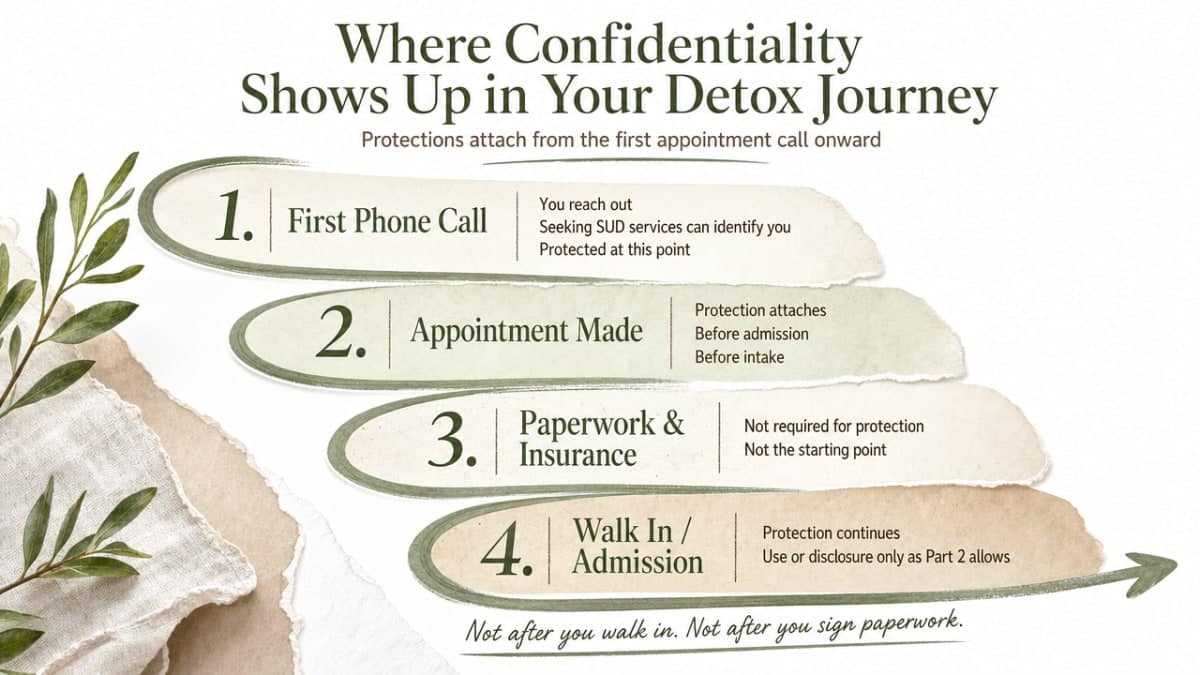
Where Confidentiality Shows Up in Your Detox Journey
The First Phone Call: Protections Begin Before You Walk In
You might think confidentiality kicks in once you’ve signed paperwork. It doesn’t. Federal guidance on SUD treatment records is clear that protections attach “from the moment the client makes an appointment” — not after admission, not after intake, not once your insurance card is on file. The phone call itself is covered.6
That matters because the first call is where most Oklahomans stall. You’re weighing whether to say your real name. Whether to call from your work phone or your personal one. Whether the person on the other end will write something down that could follow you.
Here’s what the law already assumes on your behalf: any information that would identify you as someone seeking SUD services is protected, and it can be used or disclosed only in ways Part 2 specifically permits. That includes what you share on that first call — your name, your situation, the substance you’re worried about, whether you’ve tried to quit before.2
A discretion-first admissions team, like the one at Renewal Springs, treats that call the way the rule intends it to be treated. You can ask questions before giving your full name. You can talk through what confidentiality means at each step — first call, intake, medical care, family contact, discharge — before you commit to anything.
Intake and Medical Records: What Gets Written Down
Once you decide to come in, a file gets started. That part is unavoidable — medical care requires a record. What’s different in a Part 2 program is how that record is protected and what can leave the building.
The federal statute protects records of your identity, diagnosis, prognosis, and treatment when you’re in a program that provides SUD services. So the intake questions you answer, the medications ordered for withdrawal, the notes from your medical team, the vitals monitored during your stay — all of that sits inside a category of records the law treats differently from a regular medical chart.8
Practically, that means your file isn’t a shared document that any outside provider or insurer can pull at will. Disclosures happen through specific pathways: your written consent, care coordination permitted under the 2024 rule updates, or a narrow legal exception.4,2
You can also ask the admissions team, before you sign anything, what specifically goes into the record, who inside the facility sees it, and what your options are for consent. Those questions aren’t paranoid. They’re the questions the rule was written to let you ask.
Family, Employer, and Community Contact: Who Can Be Told What
This is the piece that keeps people up at night. Who gets called. What gets said. Whether a spouse, a parent, a boss, or a small-group leader can find out.
Under HIPAA alone, providers have some latitude to share information with family or others involved in your care in certain situations. Part 2 tightens that considerably. For SUD treatment records, the default is that the program can’t confirm you’re a patient, can’t discuss your treatment, and can’t share your information with anyone — including family — without your written consent or a specific legal exception.1,2,9
Read that carefully. A relative can call the facility asking if you’re there. Without your consent on file, the program generally can’t say yes or no. Your employer can call. Same answer. The protection covers your identity, not just your chart.
You get to decide who’s looped in. Many patients choose to sign a consent for one trusted person — a spouse, a sibling, a sponsor — so that person can coordinate with clinical staff. Others sign nothing and keep the circle at zero. Both are your call.
If you want family involved later, you can add consent. If you want to pull consent, you can do that too. The starting position, though, is silence to the outside world unless you say otherwise.
Discharge and What Happens to Your File Afterward
Leaving the program doesn’t end the protection. Your record keeps its Part 2 status after discharge, and the same restrictions on use and disclosure continue to apply. A file from a detox stay five years ago is still protected today.2
Two points worth knowing:2,4,5
- Redisclosure limits carry forward — a provider who lawfully received your Part 2 record during care can’t just forward it to a new party after the fact.
- The prohibition on using SUD records against you in civil, criminal, administrative, or legislative proceedings without your consent or a qualifying court order doesn’t expire when you check out.
If you want your record shared with a therapist, primary care doctor, or outpatient program for continuing care, you sign a consent and control what moves. If you’d rather your detox stay stay in one place, that’s the default. Nothing walks out the door on its own.
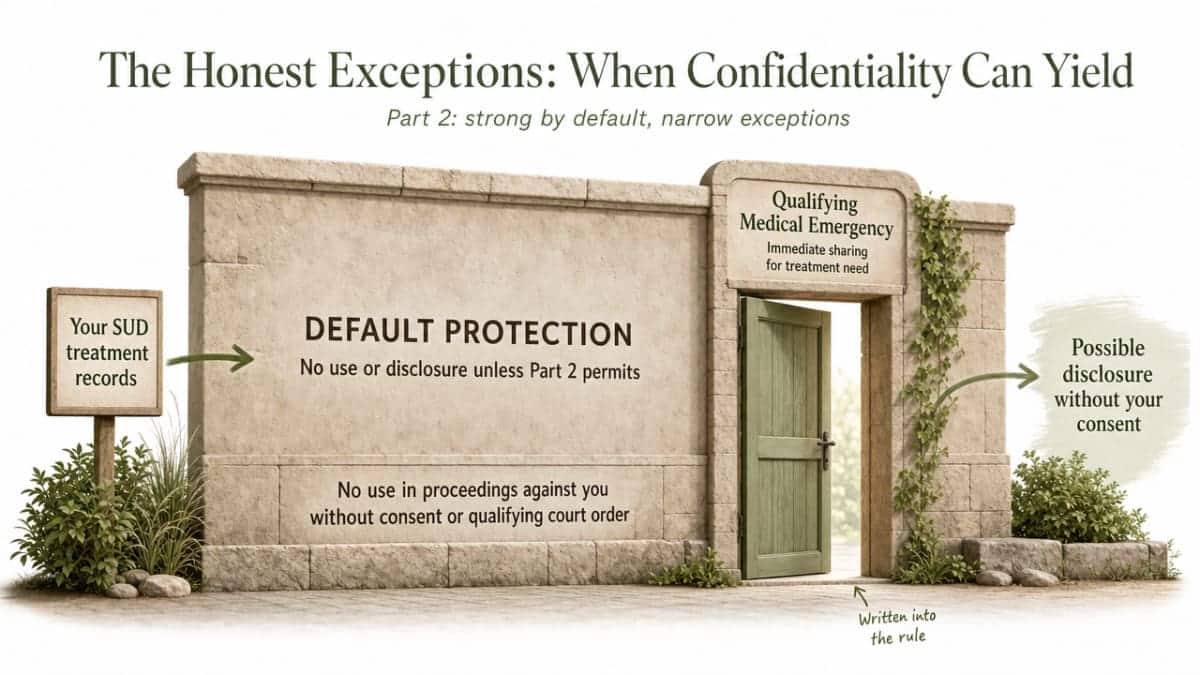
The Honest Exceptions: When Confidentiality Can Yield
You deserve the honest version, not a marketing version. Confidentiality in a detox program is strong by default, but it isn’t absolute — and any facility that tells you otherwise is either overselling or misinformed. The narrow places where disclosure without your consent becomes possible are written into the rule itself, and they’re worth knowing before you make the call, not after.
The default first: SUD treatment records generally can’t be used or disclosed except in ways Part 2 specifically permits, and they can’t be used in civil, criminal, administrative, or legislative proceedings against you without your consent or a qualifying court order. That’s the wall. Now, the doors in it.2,5
- A qualifying medical emergency is one. If you arrive in a state where a treating clinician needs to share information immediately to protect your life or someone else’s, that limited exchange can happen without your prior consent. It’s a genuine emergency standard, not an all-purpose loophole.
- A court order with specific findings is another. Not a subpoena on its own. A court has to make particular findings that meet the Part 2 standard before your record can be released, and even then the disclosure is narrow. That extra step is exactly why Part 2 records sit in a different legal category than a regular medical chart.
- There are a few more, and they’re mostly quiet: communications among staff within the program itself for treatment purposes, certain audits by regulators bound by their own confidentiality rules, and reports of suspected child abuse or neglect as required by state law. None of these turn your file into a public document. They’re bounded, purpose-specific, and named in the regulation.
Read the list plainly: the exceptions exist to keep you alive, to respect a judge’s specifically-authorized order, and to let your care team actually treat you. They don’t exist to feed your record to your employer, your neighbor, or a curious relative. If that distinction holds — and under Part 2 it does — the honesty of naming the exceptions actually makes the rest of the promise more trustworthy, not less.
Fears Specific to Oklahomans: Licensing, Small Towns, and Public-Facing Work
Nurses, Teachers, Pastors, and First Responders
If your paycheck depends on a license, a background check, or the trust of a congregation, the confidentiality question hits differently. You’re not just worried about gossip. You’re worried about whether asking for help creates a paper trail that ends your career.
Here’s what the rule actually says. A detox program covered by Part 2 can’t confirm you’re a patient to a licensing board, a school district, a chief, or a denominational office without your written consent or a specific legal exception. Your employer can’t call and get a yes. A board investigator can’t call and get a yes. The identity protection isn’t a soft policy — it’s the default.1,2
The stronger piece for people in regulated jobs is this: SUD treatment records generally can’t be used against you in civil, criminal, administrative, or legislative proceedings without your consent or a qualifying court order. Administrative proceedings include the kind licensing boards run. That doesn’t erase every reporting obligation you might already carry under your own profession’s rules — those are separate — but the record from a detox stay doesn’t automatically become evidence.2,5
You get to decide whether to loop in an employee assistance program, a peer support program, or a lawyer who handles licensure. You control what leaves the file. That control is the whole point of the framework.
When Everyone Knows Your Name: Small-Community Concerns
Oklahoma has a lot of towns where the barista, the loan officer, and the person sitting two pews behind you all know your last name. In that kind of place, the fear isn’t a leaked file. It’s a car in the wrong parking lot. A neighbor spotting you at intake. A relative calling the front desk on a hunch.
State code answers the front-desk question directly. Under Oklahoma Administrative Code 450:15-3-20.1, the identity of a person receiving mental health or drug or alcohol treatment is itself confidential. A caller asking whether you’re there gets no confirmation without your written consent. Not a hedge. Not a “let me check.” No confirmation.3
Federal Part 2 stacks on top of that. A program generally can’t acknowledge you as a patient to anyone outside the narrow lawful exceptions. Small-town curiosity doesn’t clear that bar.1,2
The stigma research points at exactly the fear you’re carrying — the worry that being seen seeking care will follow you. The rules were written with that fear in mind. You still get to decide who knows.10
What a Discretion-First Admissions Conversation Sounds Like
The call itself is shorter and quieter than most people expect. You don’t have to lead with your full name. You don’t have to explain everything on the first breath. The federal framework already treats what you say as protected from the moment you reach out, so admissions staff at a discretion-first program like Renewal Springs work inside that reality — not around it.6
A good first conversation usually opens with a question, not a form. Something like,
“What would you like me to know, and what would you rather hold back for now?”
You get to answer only what you’re ready to answer. First name. A first name that isn’t yours. A situation, not a name. All of that is fine. The person on the other end is trained to build the conversation around what you offer, not to pull more than you want to give.
You can ask direct questions and get direct answers:
- Who inside the facility would see your file.
- What Renewal Springs would need in writing before speaking with a spouse, a sibling, or an employer.
- How insurance verification is handled and whether that step reveals anything to your employer beyond what a routine benefits check would.
- Whether a discreet arrival — timing, entrance, parking — can be arranged for someone worried about being recognized.
None of those questions are unusual. They’re the questions the confidentiality framework was written to let you ask.
The call is also allowed to end without a decision. You can hang up, think, talk to one trusted person, and call back tomorrow. Making the call is progress. Asking the questions is progress. Verifying your benefits is progress. You’re not signing anything by dialing — you’re testing whether the promise holds. Under Oklahoma code and federal Part 2, the starting position is that your identity as someone considering care is itself confidential. A discretion-first admissions team should sound like they know that, and treat the call accordingly.3,1
Speak With Someone Who Understands Right Now
Connect instantly for private guidance on your confidential detox options and next steps.
Frequently Asked Questions
Will my employer find out if I go to detox in Oklahoma City?
Not from the facility. A Part 2 program generally can’t confirm you’re a patient or share your treatment information with an employer without your written consent or a narrow legal exception. If your employer calls asking about you, the default answer is no confirmation. You decide whether to loop in an employee assistance program or use protected leave, and you control what, if anything, gets shared.1,2
Can my family be told I’m in treatment without my permission?
Generally, no. Even a spouse or parent calling the front desk can’t get confirmation that you’re there without your written consent on file. If you want one trusted person kept in the loop, you sign a consent naming them and setting the limits. If you’d rather no one be told, that’s the starting position. You can add or pull consent at any time.1,2
If I have a professional license, will detox show up on my record?
Not through the facility. A Part 2 program can’t confirm your patient status to a licensing board without your consent or a qualifying court order, and SUD records generally can’t be used against you in administrative proceedings without those same protections. Your profession may have its own reporting duties that apply to you directly — those are separate from what the detox facility discloses.2,5
Can my detox records be used against me in court or a custody case?
The bar is high. Part 2 records generally can’t be used in civil, criminal, administrative, or legislative proceedings without your written consent or a court order that meets specific findings under the rule. A regular subpoena alone isn’t enough. If custody or another legal matter is on your mind, tell admissions before you sign anything — you can also ask an attorney familiar with these rules.2,5
What happens on the first phone call to admissions — do I have to give my real name?
You don’t have to lead with your full name. Federal guidance treats what you share as protected from the moment you make the appointment. You can ask questions first — how the file works, who gets told what, how insurance is handled — before deciding what to say. A discretion-first admissions team at a program like Renewal Springs is trained to build the conversation around what you offer.6
Are there any situations where a detox facility can share my information without my consent?
Yes, and you deserve the honest list. A qualifying medical emergency, a court order meeting Part 2’s specific findings, mandated reports of suspected child abuse or neglect, and certain regulatory audits bound by their own confidentiality rules can allow limited disclosure without your prior consent. Outside those narrow doors, the default is protection — including your identity as a patient under Oklahoma code.2,3,5
References
- Understanding Confidentiality of Substance Use Disorder Patient Records (Part 2). https://www.hhs.gov/hipaa/part-2/index.html
- 42 CFR Part 2 — Confidentiality of Substance Use Disorder Patient Records. https://www.ecfr.gov/current/title-42/chapter-I/subchapter-A/part-2
- Okla. Admin. Code § 450:15-3-20.1 – Consumer rights regarding confidentiality and privileged communication. https://www.law.cornell.edu/regulations/oklahoma/OAC-450-15-3-20.1
- 89 FR 12472 – Confidentiality of Substance Use Disorder Patient Records (Final Rule). https://www.govinfo.gov/app/details/FR-2024-02-16/2024-02544
- New Confidentiality Rules for Substance Use Disorder Records. https://www.sog.unc.edu/sites/default/files/course_materials/6.1%20New%20Confidentiality%20Rules%20for%20Substance%20Use%20Disorder%20Records.pdf
- Appendix B—Federal Confidentiality Regulations (NCBI Bookshelf). https://www.ncbi.nlm.nih.gov/books/NBK64435/
- Substance Use Disorders: Statutes, Regulations, and Guidelines (SAMHSA). https://www.samhsa.gov/substance-use/treatment/statutes-regulations-guidelines
- Fact Sheet: 42 CFR Part 2 Final Rule (HHS). https://www.hhs.gov/hipaa/for-professionals/regulatory-initiatives/fact-sheet-42-cfr-part-2-final-rule/index.html
- Information Related to Mental and Behavioral Health, including Substance Use Disorder (HHS OCR). https://www.hhs.gov/hipaa/for-professionals/special-topics/mental-health/index.html
- Stigma, Discrimination, and Health of People with Substance Use Disorders: A Systematic Review (example article). https://www.ncbi.nlm.nih.gov/pmc/articles/PMC8888946/
- Model Notices of Privacy Practices (HHS). https://www.hhs.gov/hipaa/for-professionals/privacy/guidance/model-notices-privacy-practices/index.html