
Key Takeaways
- Try four numbers in order—988, SAMHSA’s 1-800-662-HELP, FindTreatment.gov, and 211 HeartLine—because one will connect you to same-day intake fast.2,1,10
- Match the substance to the setting: alcohol, benzo, and opioid withdrawal need 24/7 medical care, since seizures, delirium, and overdose relapse are real risks.3,5
- Use Oklahoma’s Urgent Recovery Clinics and Crisis Stabilization Units, which run 24/7 with no appointment or insurance required and route people directly into detox.9
- Let the facility handle insurance verification and SoonerCare prior authorization—detox and residential SUD services are covered, and admissions teams submit paperwork the same day.8
- Expect three phases in your first 24 hours—evaluation, stabilization, and fostering readiness—so honest answers about use and timing shape the medications you receive.4
- If you’re the family member, shorten the distance between willingness and admission by making the call together, packing a small bag, and driving them yourself.
- Plan the handoff before discharge, because detox alone does little to change long-term use, and leaving with a scheduled next appointment is what makes the work stick.6
If You’re Reading This Right Now, Start Here
If you’re reading this at 2 a.m., or on a lunch break, or in a parked car outside a liquor store, you’ve already done something hard. You’re looking. That counts.
The window when someone is ready for detox can be short. Hours, sometimes. So this guide skips the long checklists and gets straight to what actually opens a door today: the right phone numbers, in the right order, matched to what you or your loved one is coming off of.
Here’s what you’ll find below. First, the four numbers to try in the next 60 minutes and what to say when someone answers. Then a plain-language triage of which substances need round-the-clock medical care and which don’t. Then Oklahoma-specific access points most search results skip, a straight answer on insurance and Medicaid, and what actually happens in your first day of admission.
You don’t have to have your life figured out to make the call. You just have to make the call. Keep reading.
Your First 60 Minutes: The Phone Numbers That Actually Open Doors
The Four Numbers to Try in Order
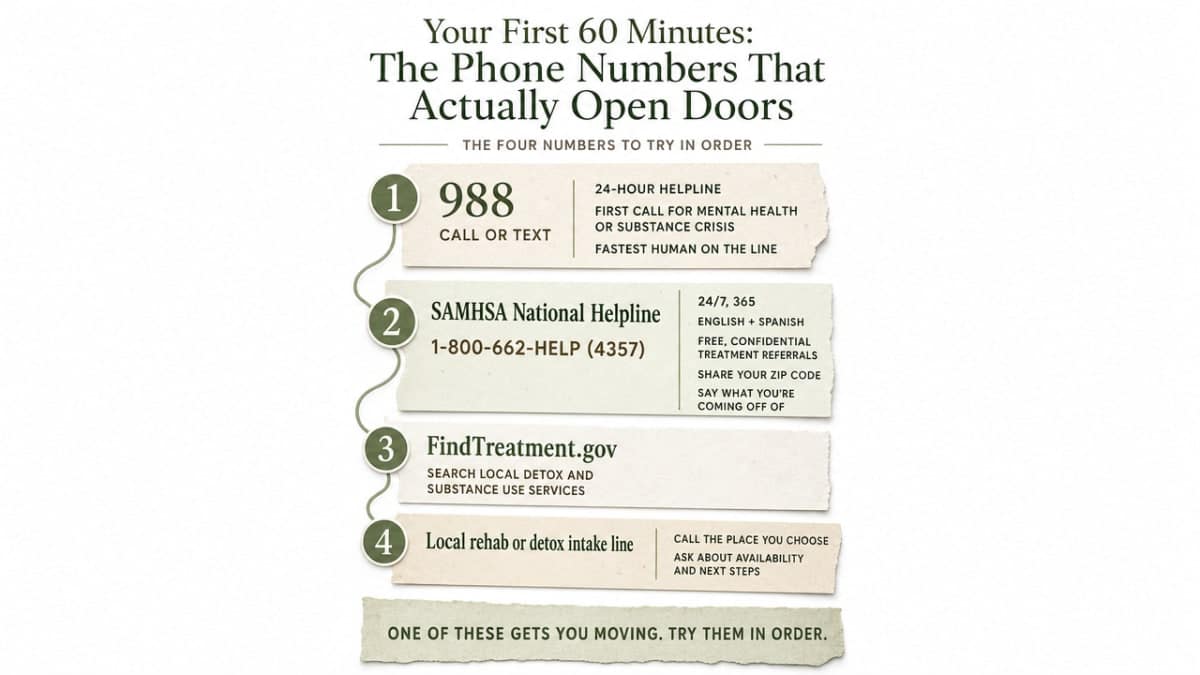
You don’t need to call every rehab in the state. You need four numbers, tried in order, and one of them will get you moving.1,2,10
- Start with 988. It’s a 24-hour helpline, and in Oklahoma City the city itself points residents there first for any mental health or substance crisis. If you’re shaking, scared, or already in withdrawal, this is the fastest human on the other end of a line. You can call or text.
- Call SAMHSA’s National Helpline at 1-800-662-HELP (4357). It runs 24 hours a day, 365 days a year, in English and Spanish, and it exists for exactly this moment: free, confidential treatment referrals to local detox and substance use services. Tell them your zip code and what you’re coming off of. They’ll name places nearby.
- Open FindTreatment.gov on your phone. It’s SAMHSA’s national locator, and you can filter by location and by service type, including hospital-based or residential care, which is what medical detox usually is. Save two or three numbers from the list.
- If you’re in Oklahoma City and want a local human to help sort options, dial 211 and ask for HeartLine. The city recommends it as the connector to local services.
One of these four will put you on the phone with someone who can start an intake. You don’t have to get through all four. You just have to start with the first.
What to Say When Someone Picks Up
Your voice might shake. That’s fine. Intake staff hear it every day, and they’re trained not to flinch.
Here’s a script you can read straight off the screen:
“Hi. I need help finding a medical detox bed near Oklahoma City. I’ve been using [alcohol / opioids / benzos / meth / kratom / more than one]. My last use was [time]. I want to come in as soon as possible.”
That’s it. Four sentences. You don’t owe anyone your life story on the first call.
After that, they’ll ask a few things. Have you had seizures before during withdrawal? Any heart conditions, pregnancy, or other medications? Do you have insurance, Medicaid, or neither? Are you safe right now, or is someone with you? Answer honestly, even the parts you’re embarrassed about. Honesty is what gets you admitted faster, not slower.
If a facility says they don’t have a bed today, ask two questions before you hang up: “Do you know who does have a bed today?” and “Can I be on your waitlist for tomorrow?” Good intake nurses will hand you names. If the person on the phone sounds rushed or dismissive, that’s information too. Call the next number on your list. You are not being difficult. You are being smart.
What to Have Next to You Before You Dial
Grab a pen and the back of any envelope. Then gather these:
- Your ID and insurance card, or your SoonerCare (Oklahoma Medicaid) number if you have it. If you don’t have any of these, call anyway.
- A list of what you’ve been using, roughly how much, and when you last used. Write it down so you don’t blank out mid-call.
- Any medications you take, including doses. A phone photo of the pill bottles works.
- An emergency contact’s name and number, in case intake asks.
- A charger. These calls take longer than you think, and switching between four numbers drains a battery fast.
If you have someone with you, hand them this list and let them help. If you’re alone, take a slow breath. You’ve got what you need. Dial the first number.
Which Substance, Which Setting: A Withdrawal Triage
Alcohol, Benzos, and Opioids Need 24/7 Medical Care
Not every substance carries the same withdrawal risk, and that matters a lot when you’re trying to figure out where to go.
Alcohol withdrawal can cause seizures and delirium tremens, which can kill you. Benzo withdrawal carries the same seizure risk. Opioid withdrawal is rarely fatal on its own, but it is brutal, and it’s the point at which most people relapse and overdose because their tolerance has dropped. ASAM, the national addiction medicine body, is explicit that opioid withdrawal management on its own is not a treatment method and has to connect to medication like buprenorphine, methadone, or naltrexone.5
So if you or your loved one is coming off alcohol, any benzo, or opioids of any kind, the answer to “where should I go?” is a medically supervised detox with staff on the floor 24 hours a day. Not a friend’s couch. Not an outpatient clinic that closes at 5.
Why Benzo Detox Is Slow on Purpose
If you’ve been on a benzodiazepine daily for months or years, here’s something worth knowing before you call: coming off safely takes weeks, sometimes longer. That’s not a facility being cautious. That’s the medicine.
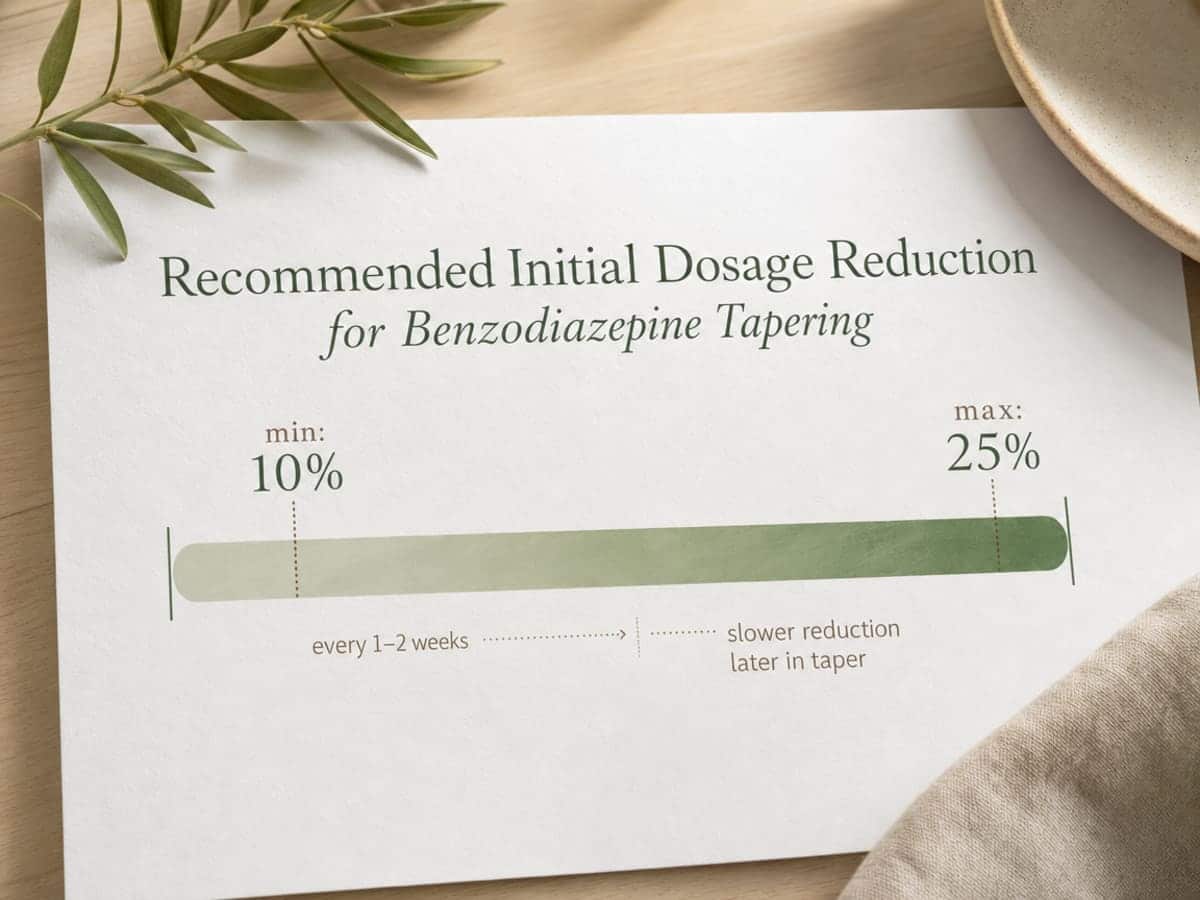
Current tapering guidance for long-term benzodiazepine users recommends reducing the dose by roughly 10 to 25 percent every one to two weeks, with even slower reductions later in the taper. Do the math on that. Someone on a stable daily dose for a year is often looking at a taper of two to three months or more, not a three-day inpatient stay.7
So what does a medical detox actually do for benzos? It gets you started safely. Staff stabilize you, manage the highest-risk early days, treat the anxiety and sleep disruption, and either continue the taper inpatient or hand you off to an outpatient prescriber who continues it under supervision. That’s a win. It’s not a failure that you’re not “done” at discharge.
If someone promises a fast, clean benzo detox in a weekend, be careful. That’s not what the evidence supports, and rushing this withdrawal is how seizures happen.
Stimulants, Kratom, and Polysubstance Use
Withdrawal from stimulants like meth, cocaine, or Adderall doesn’t usually threaten your life the way alcohol or benzo withdrawal can. What it does do is flatten you: heavy fatigue, deep depression, intense cravings, sometimes suicidal thoughts. That last part is why medical detox still matters. You want people watching over you when the crash hits.
Kratom withdrawal looks a lot like a mild-to-moderate opioid withdrawal, because kratom acts on opioid receptors. Sweating, restless legs, GI symptoms, anxiety, insomnia. Manageable with medical support, miserable without it.
Polysubstance use, meaning more than one substance in the mix, is the one to be honest about on your intake call. If you’ve been drinking daily and taking Xanax, that’s a different medical picture than either one alone, and staff need to know so they can dose and monitor correctly. Don’t edit your list to sound less serious. Say all of it. It changes the plan.
Two Shortcuts to Avoid
You’ve probably seen both of these advertised or suggested by well-meaning people. Both are worth naming plainly.5
- Ultra-rapid opioid detox under anesthesia. ASAM’s national practice guideline states directly that ultra-rapid opioid detoxification is not recommended due to high risk of adverse events, including death. If a program pitches you a same-day opioid detox where you sleep through the worst of it, walk away.
- At-home cold turkey from alcohol or benzos. This is the one that sends people to emergency rooms in seizure. If you’ve been drinking heavily every day or taking a benzo regularly for months, do not stop suddenly on your own. Call one of the numbers above and let someone medical make the plan with you.
No shame if you’ve tried either of these before. A lot of people have. What matters is what you do in the next hour, not what happened last time.
Oklahoma-Specific Rapid Access Points
Urgent Recovery Clinics and Crisis Stabilization Units
If you live in Oklahoma, there’s a piece of the system most people don’t know exists until they need it. The Oklahoma Department of Mental Health and Substance Abuse Services runs Urgent Recovery Clinics (URCs) and Crisis Stabilization Units (CSUs) across the state. They operate 24 hours a day, 365 days a year, and they’re built on a “no wrong door” model, which means you can walk in or be brought in without an appointment, insurance card, or referral.9
Here’s why that matters when you’re trying to get into detox today. URCs and CSUs are staffed with multidisciplinary teams who can assess you on the spot, keep you safe while you’re stabilizing, and route you into the right level of ongoing care, including medical detox. If you’re pacing your kitchen at 4 a.m., or your sister just showed up in withdrawal and you don’t know what to do next, this is one of the few places designed for exactly that hour.9
You don’t need to be in a screaming, obvious crisis to use them. Being scared, exhausted, and ready is enough. Call 988 or ask HeartLine 211 to help you find the nearest URC or CSU, and go.
988 and HeartLine 211 in Oklahoma City
The City of Oklahoma City tells its own residents two things when a mental health or substance crisis hits: call or text 988 for 24-hour help, and dial 211 for HeartLine to get connected to local services. Both are free. Neither will send police to your door for asking for help with detox.10
988 is faster if you’re in acute distress, feeling unsafe, or already deep in withdrawal. A trained counselor picks up, listens, and can loop in local resources.
HeartLine 211 is the better call when you’re a step back from crisis and need a human to help you sort real options. They know which local programs have openings, which ones take SoonerCare, and which URC or CSU is closest to your zip code. Use whichever number matches where your head is right now. You can always call the other one after.
When the Emergency Room Is the Right Door
Sometimes the fastest door is the one at your closest hospital. Go straight to the ER, or call 911, if any of these are happening: active seizure or a history of withdrawal seizures, chest pain, confusion or hallucinations, a suspected overdose, thoughts of hurting yourself, or heavy alcohol or benzo use with hours since your last drink or dose and shaking that’s getting worse.
Emergency staff can stabilize you medically, and hospital social workers can start the referral to a medical detox bed while you’re still in the department. That’s a legitimate path in. It’s not a failure or a shortcut. For alcohol, sedative-hypnotic, and opioid withdrawal, 24-hour medical care is the recommended setting anyway, and the ER is one way to reach it.3
If you’re not sure whether it’s an ER situation, call 988 and describe what you’re feeling. Let them help you decide.
Insurance, Medicaid, and Who Handles the Paperwork
Here’s the part that stops a lot of people from calling: they think they can’t afford it, or that the paperwork will take days, or that they’ll be turned away at the door. Take a breath. That worry is understandable, and it’s mostly not how this actually works.
Most medical detox facilities have an intake team whose whole job is to verify your benefits and handle the authorizations. You don’t do that alone at your kitchen table. When you call, they’ll ask for your insurance card or SoonerCare number, run the verification while you’re on the phone or within a few hours, and tell you what’s covered before you show up. If you’re privately insured, detox is typically a covered behavioral health benefit. If you don’t have insurance, ask them what self-pay or scholarship options they offer, and ask 988 or HeartLine 211 which programs in your area take uninsured patients.10
If you have Oklahoma Medicaid (SoonerCare), here’s the straight answer. Detox and residential substance use disorder services are covered, for children, non-expansion adults, and expansion adults alike. They require prior authorization. That word sounds scary. In practice, the facility’s admissions team submits the request, often the same day, and works with the state to clear it while you’re being stabilized. It’s a step, not a wall.8
Ask one question on every intake call: “Who handles the insurance or Medicaid authorization, me or you?” The right answer is them. If the answer is you, keep dialing.
What Admission Actually Involves in the First 24 Hours
The unknown is often worse than the thing itself. So here’s what usually happens after you walk in the door, so your imagination has something real to hold onto.
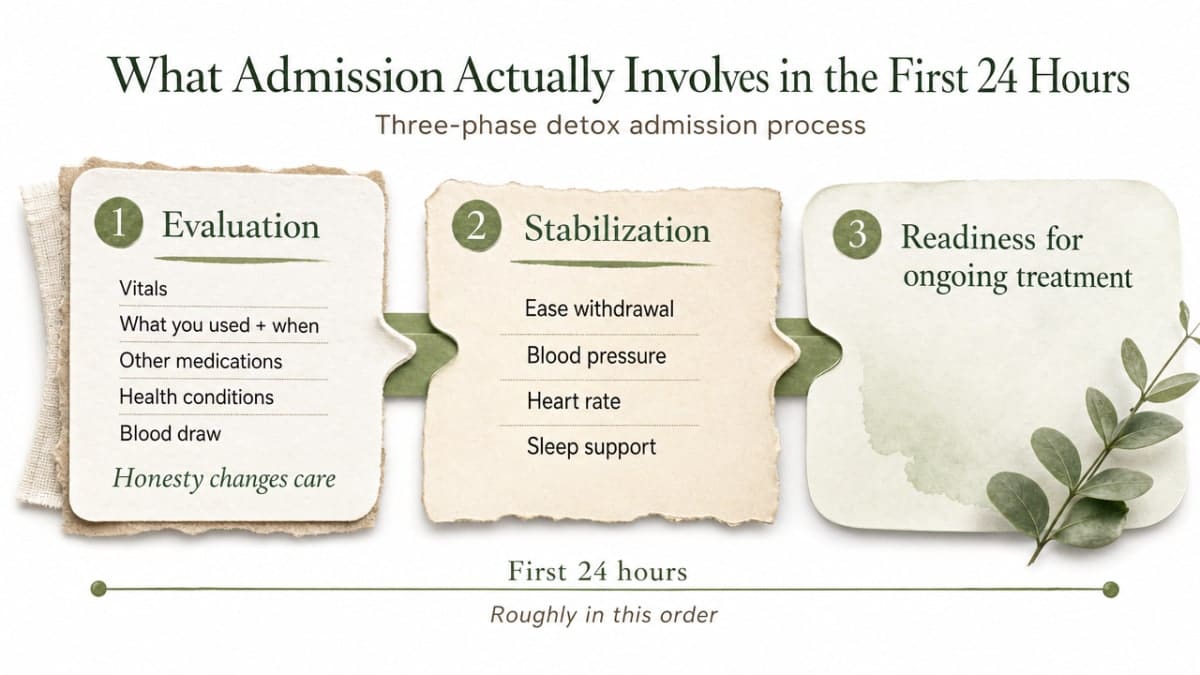
SAMHSA’s clinical guideline breaks medical detox into three components: evaluation, stabilization, and fostering readiness for ongoing treatment. That’s the shape of your first 24 hours, roughly in that order.4
- Evaluation comes first. A nurse takes your vitals, asks what you’ve used and when, checks for other medications and health conditions, and often draws blood. This isn’t a test you can fail. Be honest about the amount and the timing. It changes what they give you.
- Stabilization is next. Depending on the substance, you may get medications to ease withdrawal, keep your blood pressure and heart rate safe, and help you sleep. For alcohol and benzos, staff watch for seizure signs. For opioids, you may start buprenorphine once withdrawal is far enough along. You’ll be checked on regularly, day and night.
- Fostering readiness starts quietly, often on day one. Someone will talk with you about what comes after detox and begin lining it up. You don’t have to decide anything big yet. Just let them plan alongside you.
For the Family Member Making the Call
If you’re the spouse, parent, sibling, or friend reading this while the person you love is in the next room or on the way over, this part is for you.
The window you have is real, and it can close fast. Your job isn’t to convince them of anything big. It’s to shorten the distance between “I think I’m ready” and a nurse taking their vitals.
Here’s what helps. Make the call for them, with their permission, on speakerphone if they’ll allow it. Start with 988 or SAMHSA’s National Helpline at 1-800-662-HELP for a warm, confidential referral. If they’re already in withdrawal or in crisis, an Urgent Recovery Clinic or Crisis Stabilization Unit is built for this exact hour and won’t turn you away for lack of paperwork.2,9
Pack a small bag while they finish the call: ID, insurance card or SoonerCare number, medication bottles, three days of comfortable clothes, a phone charger. Drive them yourself if you can.
Don’t argue. Don’t relitigate last week. Move quietly and quickly. Your steadiness is the intervention.
The Next 72 Hours and What Comes After Detox
By day two or three, the worst of the physical symptoms usually start to ease. You’ll sleep a little better. You’ll eat something. You’ll have longer stretches where your brain feels like yours again. Small wins, and real ones.
This is also when the conversation shifts. Staff will start talking about what comes next, because detox by itself doesn’t hold. NIDA puts it plainly: medical detox is only the first stage of addiction treatment, and on its own it does little to change long-term drug use. That’s not a criticism of what you just did. It’s a reason to keep going.6
What “next” looks like depends on your substance, your history, and your life. For opioids, it usually means starting or continuing buprenorphine, methadone, or naltrexone and connecting to an outpatient prescriber before discharge. For alcohol, benzos, stimulants, or polysubstance use, it might be residential treatment, an intensive outpatient program, or a step-down that lets you go home and keep working. Your case manager will help you pick.5
Say yes to the handoff. Leaving detox with a scheduled appointment on the calendar is the single strongest predictor that the work you just did will stick.
A Short Word Before You Make the Call
Whatever brought you to this page, it took something to get here. Fear, exhaustion, love for someone else, a quiet voice that finally got loud enough. Trust it for the next ten minutes.
You don’t have to feel brave. You don’t have to be sure. You just have to pick up the phone and dial the first number. Someone will answer. If Oklahoma City is home, Renewal Springs Detox is one of the people waiting to help you take the next step. The rest can be figured out after you’re safe.
Talk to a Real Person About Admission Now
Connect instantly for answers, reassurance, and a smooth path to rapid medical detox entry.
Frequently Asked Questions
Can I get into a medical detox center the same day I call?
Often, yes. Many facilities hold beds open for same-day intake, and their admissions team can verify insurance and start authorization within hours. Call SAMHSA’s National Helpline at 1-800-662-HELP for confidential referrals to programs near you, or search FindTreatment.gov and filter for hospital-based or residential care 1. Ask each place directly: “Do you have a bed today?”2
Which withdrawals actually require 24/7 medical supervision?
Alcohol, sedative-hypnotics (including benzodiazepines like Xanax, Klonopin, Ativan, and Valium), and opioids. SAMHSA’s clinical guideline TIP 45 states that for these three, hospitalization or some form of 24-hour medical care is the preferred setting, based on safety. Alcohol and benzo withdrawal can cause seizures. Opioid withdrawal is rarely fatal but carries high relapse and overdose risk.3
Does Oklahoma Medicaid (SoonerCare) cover medical detox?
Yes. Oklahoma Health Care Authority lists detox and residential substance use disorder services as covered for children, non-expansion adults, and expansion adults, with prior authorization required. That authorization is not something you handle at your kitchen table. The facility’s admissions team submits it, usually the same day, while staff begin stabilizing you. Ask them to confirm on the call.8
What should I bring with me to detox admission?
Keep it simple. Bring your ID, insurance card or SoonerCare number, a list or photo of any medications you take with doses, and an emergency contact’s name and number. Pack three days of comfortable clothes, toiletries without alcohol, a phone charger, and any glasses or CPAP equipment. Leave valuables, weapons, and outside medications at home unless staff ask otherwise.
Is it safe to detox from alcohol or benzos at home?
For heavy daily drinking or regular benzo use over months, no. Sudden cessation can trigger seizures and delirium tremens. That’s why TIP 45 recommends 24-hour medical care for alcohol and sedative-hypnotic withdrawal. If you’ve tried cold turkey before, no shame. Call 988, SAMHSA’s helpline at 1-800-662-HELP, or an Oklahoma Urgent Recovery Clinic and let staff plan the taper with you.3,9
What happens after detox ends?
Detox stabilizes your body. It does not, by itself, hold long-term change. NIDA is direct: medical detox is only the first stage of addiction treatment and does little to change long-term drug use on its own. Before discharge, your case manager will line up what comes next: residential care, intensive outpatient, medication like buprenorphine, or a counselor. Say yes to the handoff.6
References
- Treatment Locators: Mental Health, Drug, Alcohol Issues. https://www.samhsa.gov/find-help/locators
- National Helpline for Mental Health, Drug, Alcohol Issues. https://www.samhsa.gov/find-help/helplines/national-helpline
- TIP 45 Detoxification and Substance Abuse Treatment. https://www.govinfo.gov/content/pkg/GOVPUB-HE20_400-PURL-gpo124442/pdf/GOVPUB-HE20_400-PURL-gpo124442.pdf
- Quick Guide For Clinicians Based on TIP 45—Detoxification and Substance Abuse Treatment. https://nida.nih.gov/sites/default/files/samhsa_detoxification_and_substance_abuse_treatment.pdf
- American Society of Addiction Medicine (ASAM) National Practice Guideline for the Use of Medications in the Treatment of Addiction Involving Opioid Use. https://pmc.ncbi.nlm.nih.gov/articles/PMC4605275/
- NIDA Treatment Guidelines (Module: Treatment). https://webcampus.med.drexel.edu/nida/module_1/content/5_0_Treatment.htm
- Prescribing and deprescribing guidance for benzodiazepine receptor agonist drugs. https://pmc.ncbi.nlm.nih.gov/articles/PMC10955669/
- Mental Health and Substance Abuse Services – Oklahoma Health Care Authority. https://oklahoma.gov/ohca/individuals/programs/mental-health-and-substance-abuse-services.html
- Urgent Recovery Clinics and Crisis Stabilization Units. https://oklahoma.gov/odmhsas/treatment/comprehensive-crisis-response/urc-and-csu.html
- Mental Health Services | City of Oklahoma City. https://www.okc.gov/Services/Public-Safety/Mental-Health-Services