
Key Takeaways
- Before dialing, know that verifying insurance is a free, confidential intake call that gathers information about your coverage without committing you to admission or payment.
- Have five things within reach: your insurance card, a summary of substance use, current medications, a preferred admission window, and a private callback number.
- On the facility’s side, staff run an eligibility check, pull a benefits breakdown, handle prior authorization if required, and verify pharmacy coverage separately for any medications.
- Expect eligibility and benefits answers the same day, but prior authorization can take hours or a business day or two depending on the payer.19,16
- Your call is protected health information under HIPAA and 42 CFR Part 2, so tell the coordinator whether voicemail is safe and how to identify themselves.
- Your plan type shapes the path — fully-insured, self-funded, SoonerCare, Medicare Advantage, TRICARE, and VA each route authorization through different rules and regulators.15,20
- Without insurance, you have a federal right to a written Good Faith Estimate before care begins, with specific timing rules once you schedule or ask.5,4
- Parity law requires plans to treat mental health and substance use benefits comparably to medical benefits, giving you leverage if authorization feels arbitrary.9,14
Before You Pick Up the Phone: What This Call Actually Is
You may have picked up the phone twice already and set it back down. That is a normal place to start. Before you dial, it helps to know what how to verify insurance for detox actually is — and, just as important, what it is not.
Verifying insurance for detox is a short intake conversation. You share a few pieces of information about yourself and your coverage. Someone on the other end runs an eligibility check with your insurer, reads back what your plan covers for medical detox, and tells you whether the facility is in-network. The call is free. It is confidential. It does not commit you to admitting, paying anything, or making a decision that day.
Here is what surprises most people: a lot of the work happens on the facility’s side, not yours. Intake staff confirm your coverage is active, pull the benefits breakdown, flag whether the plan requires prior authorization before care can begin, and — if a medication like buprenorphine is part of the plan — check pharmacy coverage separately. Prior authorization simply means the payer wants to review the request and issue a decision before services are rendered. It is common for behavioral health and substance use services, which is why the verification call exists in the first place.19,22
Think of this call as gathering information, not signing up. You are allowed to hang up, think it over, or call back tomorrow.
The Five Pieces of Information to Have Ready
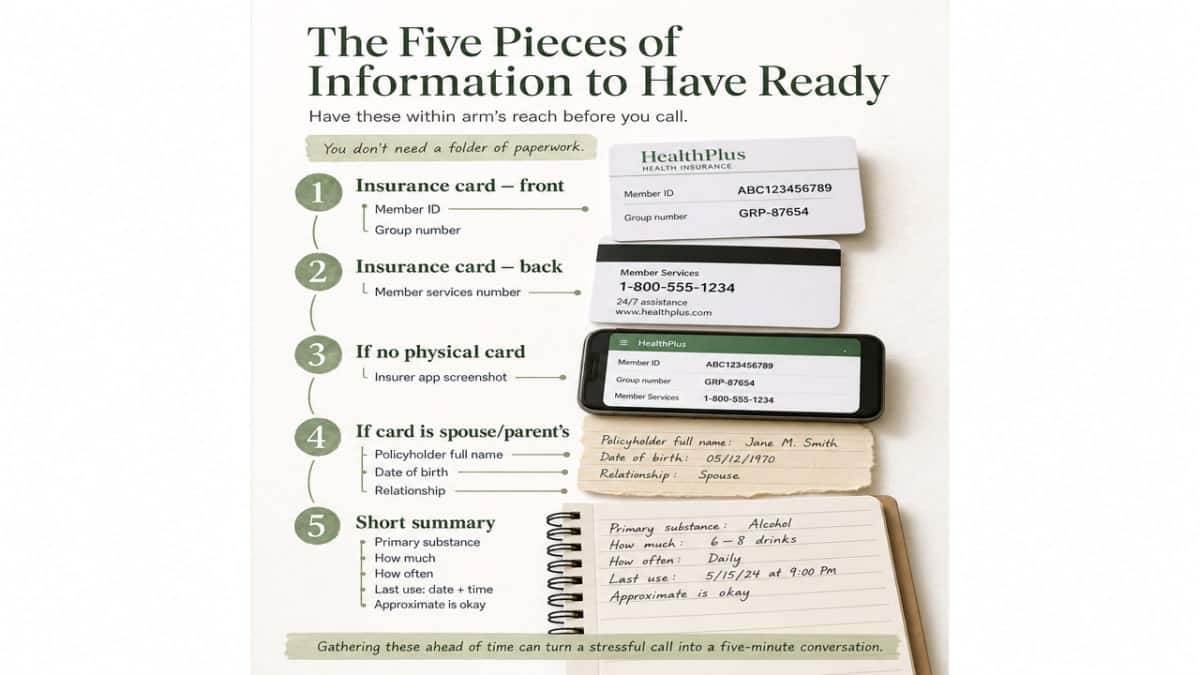
You don’t need a folder of paperwork. You need about five pieces of information within arm’s reach. Gathering them ahead of time turns a stressful phone call into a five-minute conversation.16,18
- Your insurance card. Both sides. The front shows your member ID and group number, which are the two identifiers an intake team enters first. The back usually shows the member-services phone number the facility will call to run your benefits. If you don’t have a physical card, log into your insurer’s app and screenshot both sides. If the card belongs to a spouse or parent, that is fine — you’ll just need the policyholder’s full name, date of birth, and your relationship to them.
- A short summary of what’s going on. The primary substance, roughly how much and how often, and the approximate date and time of your last use. You do not need to have perfect answers. An honest ballpark is what lets a clinician judge medical necessity and, if the payer requires it, supports the prior-authorization request the facility will submit on your behalf.
- Your current prescribed medications. Names and doses if you know them, including anything for anxiety, sleep, pain, blood pressure, or seizures. This matters twice: once for your safety during withdrawal, and again because some medications used in detox are checked against pharmacy coverage separately from the facility stay.
- A preferred admission window. Today, tomorrow, this weekend, or as-soon-as-possible. You are not locked in by naming a date. It simply helps the team route your case — SoonerCare authorization requests, for example, are processed during business hours, which can shape realistic timing.
- A private callback number and the best time to reach you. A cell number is fine. Tell them if voicemail is safe or not, and whether they should identify the facility by name when they leave a message. That single sentence protects your privacy in ways an intake coordinator cannot guess.
If a piece is missing, call anyway. Intake teams work with incomplete information all the time and can often verify eligibility with just a member ID and date of birth.
What Happens on the Facility’s Side of the Phone
While you are giving a coordinator your member ID and answering a few questions, a parallel workflow is already running in the background. Understanding what that workflow looks like helps the whole call feel less like a black box.
The Eligibility Check: Is Your Coverage Active Today
The first thing intake does is confirm your plan is active today. This is a fast lookup, usually through the payer’s online provider portal or a real-time eligibility feed. Your member ID and date of birth are the two fields that unlock it.
What the check tells them: whether your policy is currently in force, when the plan year started, whether the deductible clock has reset, and whether you have any dual coverage (a second plan through a spouse or parent that could pick up what the primary plan does not). It also flags whether the coverage on your card matches the coverage your insurer has on file — cards sometimes lag behind employer changes by weeks.
If your policy shows as terminated or the ID does not match, do not panic. Coordinators run into stale cards constantly and can usually re-verify with a corrected number, a screenshot from your insurer’s app, or a quick call to member services on the back of your card.
The Benefits Breakdown: In-Network Status, Deductible, Coinsurance, Out-of-Pocket Max
Once eligibility is confirmed, the coordinator pulls the actual benefits for substance use disorder inpatient care — the specific benefit category that covers medical detox. This is where the plain-English numbers come from.
- In-network status.
- Whether the facility has a contract with your insurer. In-network almost always means you pay less. Out-of-network coverage exists on many plans but usually at a higher cost share, and some HMO plans do not cover out-of-network care at all except in emergencies.
- Deductible.
- The amount you pay for covered services before your plan starts paying. Intake will tell you how much of your deductible you have already met this plan year and how much remains.
- Coinsurance.
- After the deductible, the percentage of the bill you still owe — often something like 10% or 20% on in-network care.
- Out-of-pocket max.
- The ceiling on what you can pay in a plan year for covered, in-network services. Once you hit it, the plan pays 100% for the rest of the year. For anyone facing an inpatient detox stay, this number matters more than the deductible because it caps your real exposure.
Ask the coordinator to walk you through what your specific numbers translate to for a detox admission. You are not asking for a guaranteed price — you are asking for a realistic range so you can plan. CMS explicitly frames verification as part of the broader effort to prevent surprise charges and clarify network status before care starts.7
Prior Authorization and Medical Necessity: Why Detox Often Needs Pre-Approval
Here is the step that trips up more admissions than any other. Most plans will not simply pay for an inpatient detox stay because a patient shows up. They want to review the request first and issue a decision before services are rendered — that is prior authorization in one sentence.19
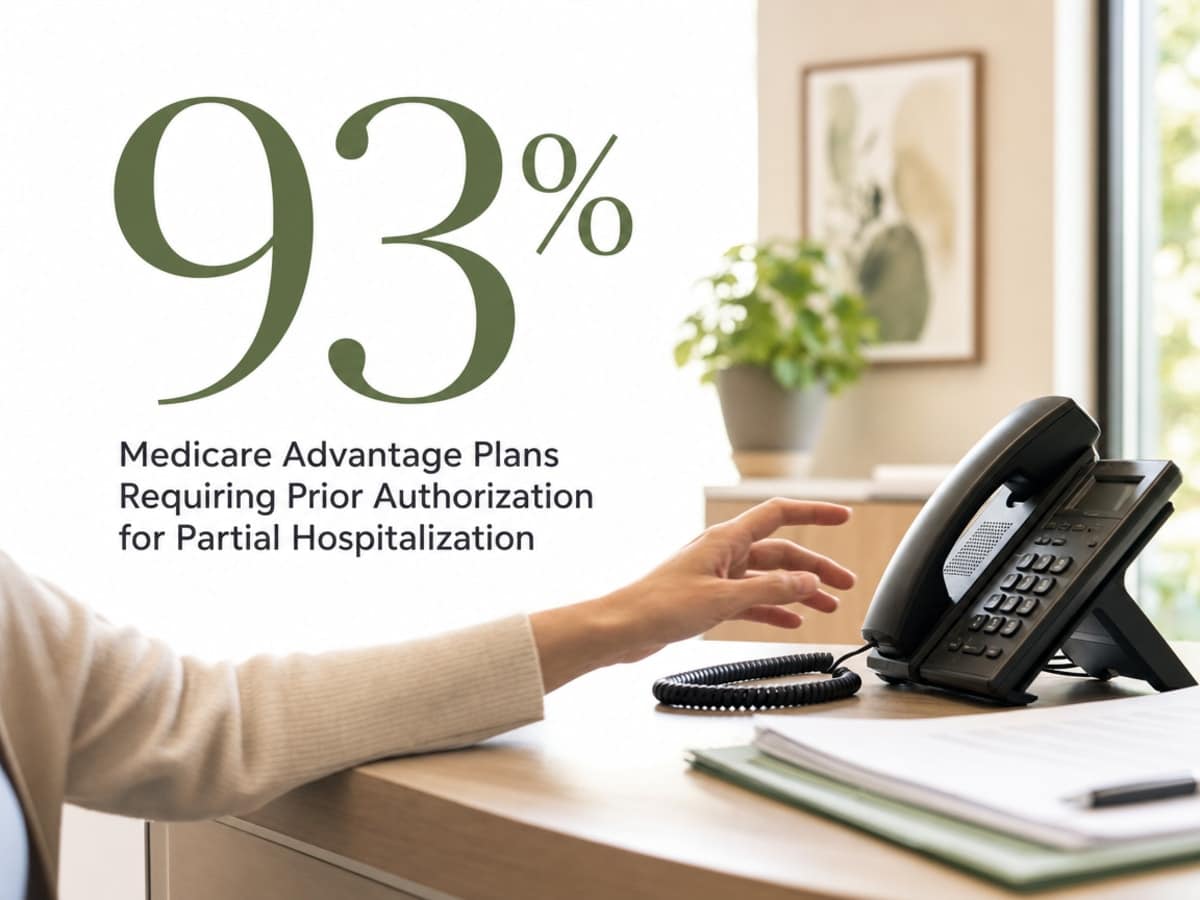
For behavioral health and substance use services, prior authorization is common rather than exceptional. A GAO analysis of sampled Medicare Advantage plans found that 93% required prior authorization for partial hospitalization, with 79% to 80% requiring it for several outpatient behavioral-health categories 21. Scope matters here: that figure comes from a GAO sample of MA plans across selected behavioral-health service categories, not a universal rate across every insurer. Still, it captures the pattern — pre-approval is the default posture, not the exception. A separate GAO review reinforced that behavioral-health prior authorization is widespread across Medicare Advantage organizations, not limited to one plan type. MACPAC has documented the same reality across Medicaid, where behavioral health services, inpatient stays, and rehabilitation services are commonly subject to prior authorization.20,22
What the facility does on your behalf: gather clinical information that documents medical necessity. That usually means your substance and last use, withdrawal risk factors, prior treatment history, co-occurring conditions, and current medications. A clinician on staff frames the request against the payer’s medical-necessity criteria, then submits it — through a portal, a fax, or a payer helpline depending on the plan. For SoonerCare, those requests are processed during business hours through designated provider helplines and fax routes.16
You do not need to run this yourself. You just need to know it is happening, and that the answer may take longer than the eligibility check — sometimes hours, sometimes a business day or two, depending on the payer.
The Medication Question: MAT and Pharmacy Coverage Get Checked Separately
One quiet detail: your facility stay and your medications are often verified through two different sides of your plan. The inpatient benefit covers the room, monitoring, and clinical care. The pharmacy benefit covers the medications themselves — and it has its own formulary, its own prior-authorization rules, and its own tiers.
This shows up most often with medication-assisted treatment. Some behavioral-health medications require pharmacy prior authorization by age or tier — Oklahoma Medicaid, for example, requires prior authorization for stimulants for members older than 20 and for ages 0 to 4. Medicaid access research also treats prior-authorization policy as a real factor in continued OUD medication access after detox.18,23
A good coordinator will check both sides for you and flag anything that could delay a specific medication so your clinical team can plan around it — either by requesting authorization early or selecting an alternative that is already covered.
Realistic Timing: What Same-Day Really Means
Here is where honesty matters more than reassurance. Some parts of verification move fast. Others depend on a payer’s business hours and a clinician’s queue.
The eligibility check — is your plan active, are you who you say you are — is usually a matter of minutes. The benefits breakdown, meaning the read-back of your deductible, coinsurance, and in-network status, often lands within the same phone call or a callback later that day. If you call in the morning with your member ID in hand, it is realistic to know your basic coverage picture before lunch.
Prior authorization is the slower piece. The facility submits clinical documentation, the payer reviews it against medical-necessity criteria, and only then does a decision come back before services are rendered. For SoonerCare, those requests are processed during business hours through provider helplines and fax routes, which means a Friday-evening call may not get a full answer until Monday. Commercial payers vary — some respond in hours, some take a business day or two.16,19
Confidentiality: Who Sees What When You Call
One of the first questions people ask themselves before dialing is quieter than the others: who is going to know I made this call? It is a fair question, and it deserves a straight answer.
The call itself is protected health information. That means the facility cannot share what you say — or even that you called — with your employer, your neighbors, or a family member who did not come with you, unless you give written permission. HIPAA sets that floor, and federal rules for substance use records (often called 42 CFR Part 2) sit on top of it with even tighter protections around addiction treatment.
What your insurer sees is narrower than most people fear. When the facility runs an eligibility check or submits a prior authorization request, the payer sees clinical information tied to medical necessity — your diagnosis, withdrawal risk, and treatment plan. Your insurer does not send a letter to your employer announcing it. If you are on a family plan, the policyholder may see a claim summary or an explanation of benefits at some point, though many insurers now offer confidential communication requests you can file to redirect that mail.19
Tell the coordinator up front what is safe. Whether voicemail is okay. Whether they should say the facility name. Two sentences of instruction protect the rest of the week.
Your Plan Type Changes the Answer
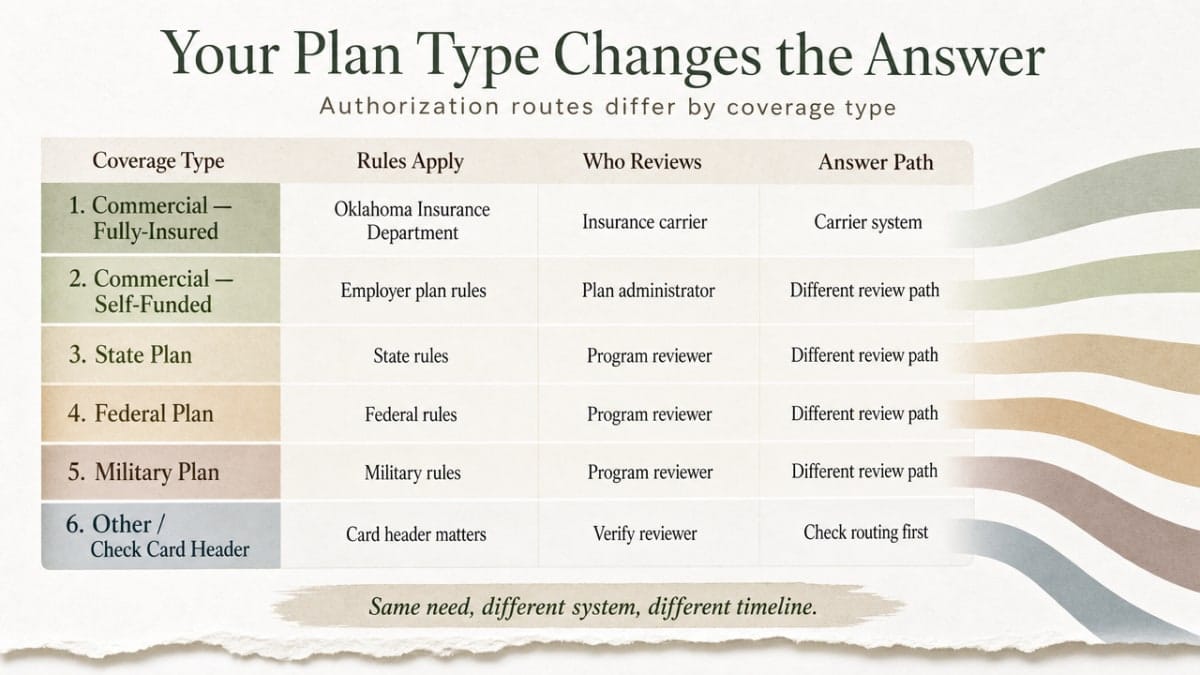
Not every insurance card leads to the same verification path. The header at the top of your card — and whether your coverage is commercial, state, federal, or military — shapes which rules apply, who reviews the authorization request, and how quickly you get an answer. Two people with the same substance and the same story can end up with very different admission timelines simply because their plans route through different systems.
Commercial Insurance in Oklahoma: Fully-Insured vs Self-Funded
Two employer plans can look identical on the card and behave completely differently on the phone. The dividing line is whether the plan is fully-insured or self-funded.
A fully-insured plan is one your employer buys from an insurance carrier. In Oklahoma, those plans are regulated by the Oklahoma Insurance Department and must include mental health and substance use disorder benefits in parity with medical benefits. If your fully-insured plan applies stricter prior-authorization rules to detox than to a comparable medical admission, state regulators have jurisdiction to hear the complaint.14,15
A self-funded plan is one your employer pays claims on directly, often using a carrier only to administer the plan. These plans are governed by federal law, not the state. Oklahoma parity protections do not reach them, though federal parity may still apply. The card usually will not say which type you have. Ask the intake coordinator to check, or look for phrases like “administered by” or “ASO” on your benefits summary.15
The practical difference: the appeal path and the regulator you contact if something feels off are not the same for both plans.
SoonerCare, Medicare Advantage, TRICARE, and VA
If you have SoonerCare, the behavioral-health authorization runs through Oklahoma Health Care Authority channels. Requests move through designated provider helplines and fax routes during business hours, which shapes realistic timing on a Friday-afternoon call. The outpatient PA manual also distinguishes between instant authorization and requests requiring review, so some pieces move faster than others.16,17
Medicare Advantage is its own animal. Behavioral-health prior authorization is widespread — a GAO review found 8 of 9 sampled MA organizations required it for behavioral-health services, with most using internal coverage criteria to make inpatient decisions. That means the coordinator is often working against plan-specific rules rather than a single federal standard, and answers may take longer than a commercial call.20
TRICARE and VA benefits follow military and federal pathways. TRICARE routes through its regional contractor for authorization; VA care for eligible veterans may be delivered directly or through community-care referrals that require VA approval before admission.
Tell the coordinator which card you have on the first call. That single detail changes the script on the other side of the phone.
If You Don’t Have Insurance: The Good Faith Estimate Path
No insurance card in your wallet does not mean no path forward. Federal law gives uninsured and self-pay patients the right to a written cost estimate before care begins — a Good Faith Estimate, or GFE. It is meant to prevent the exact scenario people fear most: agreeing to treatment without any idea of what the bill will look like.5
The GFE is a written document. It has to list the itemized services expected during your stay and the expected charges for each. That means you receive a specific dollar figure on paper, not a vague range someone quotes over the phone.2
The timing rules are the piece worth remembering. If you schedule your detox admission at least 3 business days in advance, the facility has to give you the GFE within 1 business day of scheduling. If you are still shopping and simply ask for an estimate before you schedule anything, the facility generally has 3 business days to get it to you in writing. Either way, you get numbers before you commit.4
When you call, say plainly: “I do not have insurance” or “I want to pay out of pocket.” That single sentence triggers the GFE workflow on the facility’s side. The coordinator will still ask about your substance, last use, and prescribed medications — the same clinical basics an insured patient shares — because those details shape which services end up on the itemized estimate.3
If the final bill later comes in substantially higher than the GFE, you have a federal dispute-resolution path. CMS points uninsured and self-pay patients to the No Surprises Help Desk for exactly this kind of billing question. Keep the written estimate. It is your reference point if anything looks off later.3,5
Being uninsured makes the call feel higher-stakes, not lower. The GFE exists so you can weigh a real number against your real situation before you decide anything.
Parity Is Your Leverage, Not a Favor the Plan Grants You
There is a piece of this you may not know you have: parity. Federal law says a health plan cannot make it harder to get mental health or substance use care than to get comparable medical or surgical care. That includes the utilization-management tools plans use every day — prior authorization, medical-necessity criteria, treatment limits. If your plan waves through a hospital stay for pneumonia but demands three rounds of documentation for medical detox, that gap is exactly what parity exists to close.9
Oklahoma law layers on top of the federal floor. Fully-insured plans sold in Oklahoma must treat mental health and substance use disorder benefits equal to benefits for physical diseases. If your plan is self-funded, state parity does not reach it, though federal parity may still apply.14,15
After You Submit the Form: What to Expect Next
Once you hit submit on Renewal Springs’ verify-insurance form — or hang up from an intake call — the workflow moves to the team’s side of the desk. Here is what happens in the hours that follow.
An admissions coordinator picks up your information and runs the eligibility check against your payer. If your plan is active and detox is a covered benefit, the same coordinator pulls your benefits: in-network status, remaining deductible, coinsurance, and out-of-pocket maximum. If prior authorization is required — which is common for behavioral health and substance use services— a clinician begins gathering the medical-necessity documentation the payer will want to see before issuing a decision.19,22
You will get a callback. Ask when it should come and on what number. That single sentence keeps you from staring at the phone.
The callback covers three things in plain English: what your plan covers for medical detox, what your realistic cost share looks like, and what the next step is — whether that means a same-day admission window, a short wait for authorization, or gathering one more piece of information. If Renewal Springs is not the right fit for your coverage, the team will tell you that too. You are gathering information, not signing anything. Whatever you decide next is yours.
Call now to verify your detox insurance
Get your insurance questions answered in minutes by a knowledgeable, supportive team member.
Frequently Asked Questions
Does verifying insurance for detox cost anything or obligate me to admit?
No. Verification is free, and asking about your benefits does not commit you to admitting or paying anything. The facility runs an eligibility check with your insurer and reads back what your plan covers. You are gathering information, not signing paperwork. You can hear the numbers, take a day to think, or decide not to move forward at all.
How long does insurance verification for detox actually take?
The eligibility check usually takes minutes. A full benefits breakdown often lands the same day, especially if you call in the morning. Prior authorization — where the payer reviews clinical information before services are rendered — is the slower piece and can take hours or a business day or two. SoonerCare requests are processed during business hours.16,19
Will my employer or family find out if I call to verify benefits?
What you share is protected health information. The facility cannot tell your employer, neighbors, or family members you did not authorize. HIPAA sets that floor, and federal substance use records rules add tighter protections on top. If you are a dependent on a family plan, the policyholder may see a claim summary later. Ask about confidential communication requests with your insurer.
What information do I need to have ready before I call?
Five things: your insurance card (both sides), a short summary of your substance use and last use, your current prescribed medications, a preferred admission window, and a private callback number with the best time to reach you. If the card belongs to a spouse or parent, have the policyholder’s name, date of birth, and your relationship ready. Missing a piece? Call anyway.
What if I don’t have insurance or want to pay out of pocket?
You have the right to a written Good Faith Estimate before care begins. If you schedule at least 3 business days out, the facility must provide it within 1 business day; if you ask before scheduling, generally within 3 business days. Say plainly: “I do not have insurance” or “I want to self-pay.” That triggers the GFE workflow.3,4,5
Does SoonerCare or Medicare Advantage cover detox in Oklahoma?
Both often cover medically necessary detox, but each routes authorization differently. SoonerCare behavioral-health authorization moves through Oklahoma Health Care Authority helplines and fax routes during business hours. Medicare Advantage plans commonly require prior authorization for behavioral-health services, with plan-specific criteria. Tell the coordinator which card you have on the first call — that changes the script on their end.16,20
References
- No Surprises Act Overview of Key Consumer Protections. https://www.cms.gov/files/document/nsa-keyprotections.pdf
- The No Surprises Act’s Good Faith Estimates and Patient-Provider Dispute Resolution Requirements. https://www.cms.gov/files/document/gfe-and-ppdr-requirements-slides.pdf
- Good Faith Estimates (GFEs) for Uninsured (or Self-Pay) Individuals. https://www.cms.gov/files/document/faqs-good-faith-estimate-uninsured-self-pay-part-4.pdf
- Sample Notice of Uninsured (or Self-Pay) Individual’s Right to Receive a Good Faith Estimate. https://www.cms.gov/files/document/nsa-gfe-required-notice.pdf
- Understand your rights against surprise medical bills. https://www.cms.gov/newsroom/fact-sheets/no-surprises-understand-your-rights-against-surprise-medical-bills
- CMS Interoperability and Prior Authorization Final Rule CMS-0057-F. https://www.cms.gov/newsroom/fact-sheets/cms-interoperability-prior-authorization-final-rule-cms-0057-f
- Medical Bill Rights. https://www.cms.gov/medical-bill-rights
- Overview of rules & fact sheets. https://www.cms.gov/nosurprises/policies-and-resources/overview-of-rules-fact-sheets
- Parity. https://www.medicaid.gov/medicaid/benefits/behavioral-health-services/parity
- Parity for Mental Health and Substance Use Disorder Benefits. https://www.medicaid.gov/medicaid/managed-care/guidance/parity-for-mental-health-and-substance-use-disorder-benefits
- Mental Health Parity and Addiction Equity Act (MHPAEA). https://www.cms.gov/marketplace/about/oversight/other-insurance-protections/mental-health-parity-and-addiction-equity-act-mhpaea
- New Mental Health and Substance Use Disorder Parity Rules. https://www.dol.gov/agencies/ebsa/laws-and-regulations/laws/mental-health-parity/new-mhpaea-rules-what-they-mean-for-providers
- Mental/Behavioral Health and Insurance. https://www.oid.ok.gov/mental-behavioral-health-and-insurance/
- LH BULLETIN NO. 2020-05. https://www.oid.ok.gov/lh-bulletin-no-2020-05/
- Mental Health Parity and Addiction Equity Act. https://www.oid.ok.gov/regulated-entities/financial/financial-regulation-forms/mentalhealthparity/
- Behavioral Health Prior Authorization Procedures. https://www.oklahoma.gov/content/dam/ok/en/okhca/docs/providers/types/behavioral-health/OHCA%20BH%20Manual.pdf
- PRIOR AUTHORIZATION MANUAL. https://oklahoma.gov/content/dam/ok/en/okhca/docs/providers/prior-authorizations/manuals/FY2025%20Outpatient%20Prior%20Authorization%20Manual.pdf
- Central Nervous System – Behavioral Health. https://www.oklahoma.gov/ohca/providers/types/pharmacy/prior-authorization/2026/central-nervous-system-behavioral-health.html
- Prior Authorization and Pre-Claim Review Initiatives. https://www.cms.gov/data-research/monitoring-programs/medicare-fee-service-compliance-programs/prior-authorization-and-pre-claim-review-initiatives
- CMS Oversight of Prior Authorization Criteria Should …. https://files.gao.gov/reports/GAO-25-107342/index.html
- GAO-24-106794, Accessible Version, BEHAVIORAL HEALTH: Information on Cost-Sharing in Medicare and Medicare Advantage. https://www.gao.gov/assets/880/871430.pdf
- Prior Authorization in Medicaid. https://www.macpac.gov/wp-content/uploads/2024/08/Prior-Authorization-in-Medicaid.pdf
- Access to Medications for Opioid Use Disorder in Medicaid. https://www.macpac.gov/wp-content/uploads/2025/06/MACPAC_June-2025-Chapter-3.pdf
- Insurance barriers to substance use disorder treatment. https://pmc.ncbi.nlm.nih.gov/articles/PMC9948907/